This week in the wacky world of religion…

AtrocitiesBecause my invisible super-being is better than yours, this week I’ve:

murdered you at prayer;

beheaded you as an infidel;

denied you an education;

raped your girls and young women;

committed brutal acts of terrorism;

denigrated LGBT people;

flogged you and imprisoned you.

…And all because of my invisible super-being. Isn’t he wonderful?

As for me, I’m just glad I don’t have an imaginary god if this is the kind of thing he tells his followers to get up to.

Christians’ Favourite Delusions 28: Evolution says we are no more than animals

AngryHere we go again. Christians claiming that evolution reduces human beings to being ‘just’ or ‘no more than’ animals.

Does it? Where? The ‘just’ and ‘no more than’ are unnecessary and invalid value judgements. They’re not there in Darwin, who goes out of his way to avoid making any such statement, while Richard Dawkins explicitly rejects the idea that we are ‘just’ gene carriers.

Evolutionary theory recognises that humans are indeed animals – with no ‘just’ or ‘no more than’ to qualify the fact. How can we not be animals? We do everything they do; like them, we have – indeed are – physical bodies that breath, eat, sleep, excrete, bond, mate, experience pain and pleasure and fight; we are, like most other animals, territorial and also like them, we put a great deal of effort into ensuring our own survival and that of our offspring. Even Christians who deny the body and its demands engage in these kinds of animal behaviour.

Of course, we also do things other animals don’t, or don’t to the same extent; we have remarkably complex social arrangements, which have resulted in our developing systems of morality and sophisticated ways of dealing with each other (though our morality is remarkably flawed); we have achieved much in the fields of culture, technology and in our understanding of the world and the universe beyond our tiny planet. We have also made a mess of our environment.

Our intelligence, our self-awareness, is the evolutionary equivalent of adaptations developed in other species. Our characteristics may seem to us to be somehow superior to those of other animals, but really they’re not. They have enabled our continued survival and allowed us to achieve all that we have, both good and bad. But in evolutionary terms, they are no different from the refinements that have enabled other animals to do the equivalent in their environments. This doesn’t mean, however, we are ‘just’ or ‘no more than’ animals. No creature is ‘just’ an animal and human achievements are all the more remarkable because we’re animals.

What Christians usually mean by their ‘just’ and ‘no more than’ is that as animals we are not extra-special to God, not ‘made in his image’. And of course, we’re not; there’s no God to be extra special to or made in the likeness of. Even if there were, he doesn’t seem to be particularly pre-disposed towards us; we exist as physical bodies that are as susceptible to the same hunger, disease, illness, injury, weakness, infirmity and death as any other animal. We are not immaterial, spiritual beings – though presumably the Christian God could have made us that way if he’d wanted to. To say, as some Christians do, that we are spiritual beings temporarily trapped in material bodies, or that we must deny the body and its demands to become spiritually perfect, is the grand perversion that is the Christian faith. It denies the reality of this physical, material world and our own natures. Any spirituality we might claim for ourselves is a projection of our intelligence and self-awareness; any morality the result of those complex social arrangements.

So, we are not ‘just’ animals, nor are we ‘no more than’ animals in any way that makes sense biologically. We are animals, remarkable perhaps in rising above our biology from time to time, but animals nonetheless, whether Christians want to believe it or not. ‘Just’ and ‘no more than’ don’t come into it.

Good For Nothing

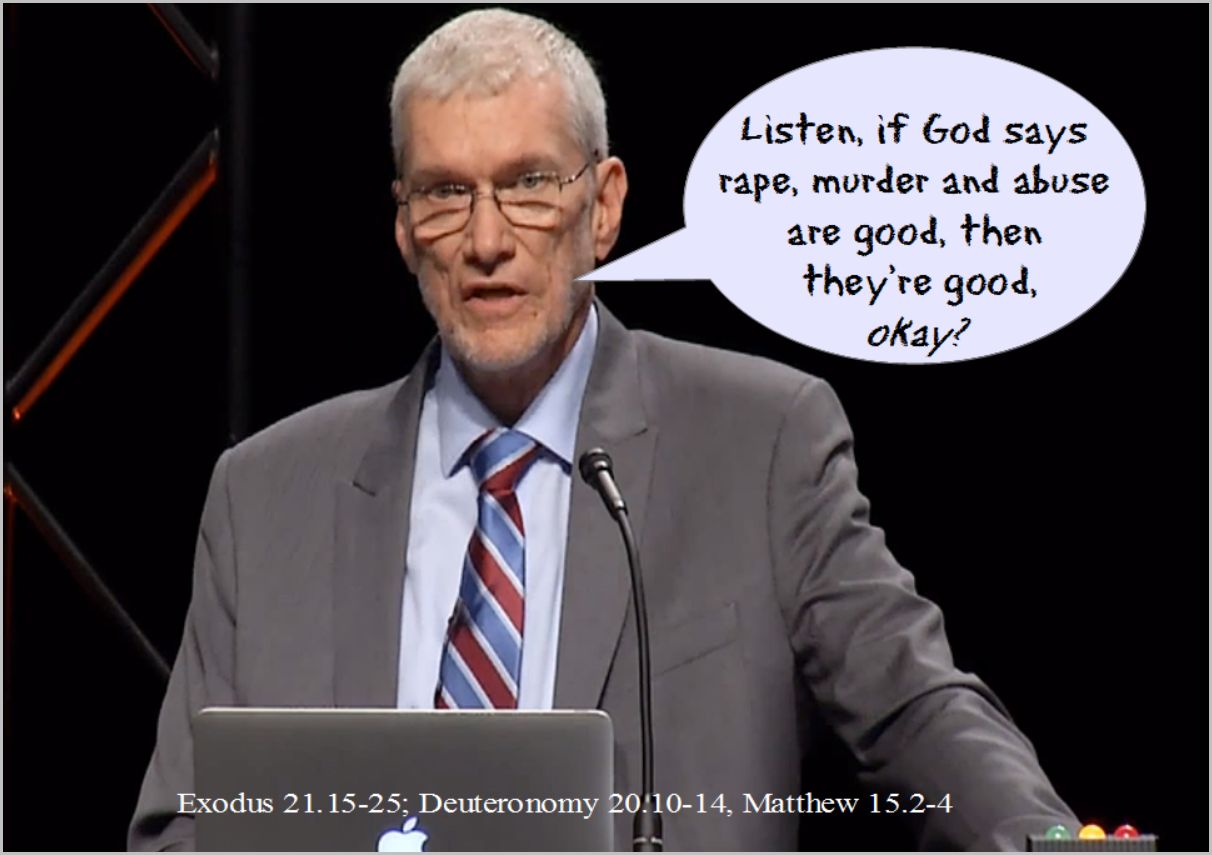
HamWhere does morality come from? Ken Ham of Answers In Genesis says it can only come from (his) God. Atheists have no grounds for morality, he claims, because, without a God to tell them, they’ve no way of knowing the difference between right and wrong .

As usual, Ham is being creative with the truth. Clearly atheists are as capable of being moral as anyone else. Equally and also evidently, Christians and other brands of believers are capable of deplorable immorality. Hardly a week goes by without more reports of Christians abusing, cheating, lying and killing in Jesus’ name.

Why do Christians act so despicably when, supposedly, they have God’s Spirit inside them – that’s the God from whom all morality flows, according to Ken Ham. Why doesn’t his indwelling Spirit guide Christians so that they always behave morally, or even just considerately?

I don’t have the answer. Perhaps Ken Ham or some other knowledgeable Christian can tell us.

No, morality doesn’t derive from any god. It has evolved, inevitably and like much of our behaviour, from our being social animals. Living in close proximity with other humans has meant we have developed ways of behaving that take these others into account, as well as the repercussions of our behaviour on ourselves.* The principle of treating others as we ourselves would like to be treated is very old – much older than Christianity.

Morality, though, is not absolute and is far from infallible. Non-believers, like the religious, make mistakes and don’t always treat others as they should. But the fact they behave well most of the time is evidence that behaving morally has nothing to do with a god, especially not the capricious, murderous psychopath of the Abrahamic religions.

Ken Ham’s position, and that of other religionists who tell us we have no grounds for morality without such a god, is as offensive as it is absurd.


* There are innumerable books that consider our moral evolution; you might like to try Frans De Waal’s Primates and Philosophers; How Morality Evolved or Christopher Boehms’s Moral Origins.


Is This It?

AlphaI was disappointed that my local church, when advertising the Alpha Course this year, didn’t use its usual poster. You know the one – and if you don’t it’s like the one above – that asks ‘Is this it?’, meaning both, ‘Is this all there is to life?’ and ‘Is this life all there is?’ Every year, I so much want to answer the question by scrawling ‘Yes’ on the bottom of the poster. I don’t, of course, because I’m too law-abiding to deface someone else’s property. But ‘yes’ really is the answer to the question ‘Is this it?’ and to the other two questions it suggests. This life is all there is. What you make of it is also ‘all there is’ (so better make the most of it).

Of course, the Alpha Course and Christians in general want to persuade you that this life isn’t all there is, that a better life awaits you after death. They want to tell you too that there’s a life that’s better than the one you’re currently living, however interesting, challenging, fulfilling or unhappy that might be. All you have to do to have this better life – and have it last forever – is to give yourself to Jesus. Oh, yes, and sign up for the Alpha Course too, of course.

Will your life really get better if you decide to believe in a mythical figure who magically sacrificed himself to himself to save you from yourself? It might, but not because you’ll have bought into this particular delusion. If it happens at all, life will be better because you’ll have become a member of a community (a church) and will enjoy the support of others who share the delusion. It might seem better too because your church will tell you what to think about particular issues – morality, abortion, homosexuality, evolution, for example – and you will be freed, should you want to be, from the burden of thinking for yourself.

But your life will not assume any cosmic significance, because nothing human beings do, say or believe ever has cosmic significance. Humans, whatever your church or the Alpha Course tells you, simply do not have cosmic significance. So, your decision to follow Christ won’t mean you’ll live forever (because, however much they might wish it, human beings don’t live forever.) It will not transform you into a ‘spiritual creature’; won’t make you beloved of the Creator of the universe; won’t transform you into the likeness of the mythical Christ. You will not have a hot-line to either the Creator nor to this Christ and so you won’t find them answering your prayers. You will not be part of any cosmic battle between God and the devil. You will not have God’s Son or the Son’s Spirit (which is it, Christians?) coming to make their home in you. You will no more be living in the End Times than you were before your conversion and the world will, though you will fail to recognise it, make even less sense than it does now.

What Christianity offers is pure fantasy, the same sort of fantasy that Mormons, Muslims, Moonies and all manner of other religious believers claim as their Truth. The only difference between your fantasy and theirs will be in the detail. Of course, as a Christian you’ll be told that your set of superstitions is the real and only Truth and that all of the others are false (or the lies of the devil, or whatever.) But in reality, yours will be just as absurd, just as impossible, just as disconnected from reality as theirs. And, what’s more, you’ll go on facing the same problems, the same joys, the same pain, the same short lifespan and the same opportunities that your culture offers you, that you’ve always had.

So give the Alpha Course a miss. Give Christianity a miss. Give all religion a miss. Give anything that tells you this life isn’t all there is a miss too, because this IS all there is. And thank God for that.

What did you do today, God?

Duck

What have you achieved today? I finished some illustrations for a children’s book a friend has written. It’s a minor accomplishment, of course, but one I like to think hasn’t added to the sum total of suffering and misery in the world (though you might want to disagree.) There’s every chance that whatever you’ve done today has been productive and positive too. That is, unless you also happen to be a deity.

What are God’s accomplishments today? What has the Omnipotent, Omniscient and All-loving God achieved in the last twenty-four hours?

Has he, for example, eliminated Ebola, Aids or cancer, or even helped those sinful human beings who strive to develop cures for these terrible diseases (which we would be right in thinking God himself created in the first place)? Erm, no. He hasn’t. Ebola, Aids and cancer are still with us today, their cure and prevention a little closer only because of human endeavour.

Has he prevented any further brutal murders by those who claim to operate in his (alternate) name? Has he rushed to the assistance of Christians being persecuted in Syria and Iraq? Erm… that’s another no. You’d think he might, wouldn’t you, given that his own people are among the persecuted, but no. And given that ‘gentle and compassionate’ relief worker, Alan Henning, has today been beheaded by Islamic extremists, you’d be right to wonder just where God is. What does he spend his days doing?

Did he, then, decide that today was the day he’d let us know which of his many manifestations is the real him – Yahweh? Allah? Shiva? Ra? One of the myriad others? None of the above? No, he didn’t do that either. He left us in our ignorance about which of the many religions, groups and sects has got it right about him. He couldn’t find the time today to tell us who it is that worships the real him, and who it is who’s deceived. Just as he couldn’t for all of the days that have so far made up recorded time.

Maybe, however, he hasn’t had time to do this because he’s been too busy sustaining the universe; you know, winding up gravity and giving the Earth those little pushes it needs to make it spin. But of course, the universe doesn’t work like this. It needs no external power source to keep it going. Even if it was God who set the ‘laws of physics’ in motion at the beginning of everything (it wasn’t), they have been self-sustaining ever since. So, no, he hasn’t the excuse that he spends his days making sure everything is ticking over nicely.

Does he spend them instead empowering believers to move mountains, heal the sick, raise the dead and perform miracles even better than those of his ‘son’, just like he had Jesus promise? Not so’s you’d notice. In fact, not at all.

Oh dear. We really are running out of possible things for God to do. Despite the sometimes desperate state of the world, perhaps all of his time is taken up finding parking spaces for Christians and sorting out their career prospects. Perhaps he’s too busy directing the thoughts and words of his ‘chosen instruments’ (see my previous post) so they can express their hatred for non-Christians and gay people. Or maybe all of his energies go into inspiring those Holy Spirit led church services that ‘bless’ Christians but are no more than human emotion run riot. Alternatively, maybe he just spends his time being offended by everything and everybody. If these are his accomplishments over the last twenty-four hours, then, given all the things he could have been doing, doesn’t it all seem rather pathetic? This is all he can manage?

Of course not. All of the triviality, and all of the brutality, attributed to him is entirely human in origin and manifestation; the beheadings, the euphoria, the offence, the vitriol. All part of the self-delusion that is ‘faith’. There is no God doing all these things, no God who manifests himself in the operation of the universe, in human suffering or the pleasures and happy coincidences of life.

It’s possible, I suppose, that there is a god somewhere, one without any interest in human beings and life here on Earth, but then he’d be even more irrelevant than the impotent gods we’ve invented for ourselves.

As Ariane Sherin famously said, ‘There’s probably no God’, with the ‘probably’ looking ever more redundant.

John Sentamu To End All War

SentamuNever one to shy away from self-promotion, the Archbishop of York, ‘the most reverend and right honourable’ John Sentamu, has begun a week-long fast and prayer vigil for world peace. The Archbishop reckons this will show ‘solidarity with the suffering people of our world, particularly in the Middle East.’

How, I hear you ask, will it do this? How will John’s fasting and praying – ‘on the hour, every hour’ – be any more effective than, say, his cutting up his dog collar in 2007 in protest at Mugabe’s presidency of Zimbabwe (seven years later and Mugabe is still there.) What will all the prayers and the fasting accomplish, other than thrusting the Archbishop briefly into the limelight once again?

Does God need Sentamu’s prayers to alert him to what is going on in the world? Doesn’t God know already? Will his pleading prick God’s conscience so that he intervenes and brings to an end the bloodshed in Syria, Iraq, Afghanistan and Palestine? Why doesn’t God do something anyway?

And isn’t all of this rather arrogant, this assumption that God will only act if problems are pointed out to him by fallible human beings? (Even Jesus thinks this is how it works in Luke 11.5-8.) What sort of God is this, who is unaware of how things are here on Earth and is unable or unwilling to do anything about them until important show-offs men like the Honourable Rev. let him know?

Maybe though, the Archbishop is less ambitious. Perhaps he just wants to demonstrate to those caught up in the world’s conflicts that he stands with them – though only metaphorically. But if that’s it, what exactly is he saying in all those prayers, on the hour, every hour?

Whatever it is, there will be no divine intervention. There is no God to take action, as evidence throughout history has shown us time and time again. Religion is part of the problem not its solution.

The Great Escape

EscapingSometimes I miss my religion. I miss my days of thinking I knew what life was all about, of living in accordance with God’s will, of believing I was in a relationship with Jesus. It was comfortable and secure, and maybe a little bit anxiety inducing too: what was God telling me to sort out in my life now? What sin had I not confessed? How had I let him down this time?

My faith defined my life for me, set its parameters, told me what to believe about other aspects of life – like the role of men and the place of women, parenthood, abortion, homosexuality, evolution, the end of the world (always coming soon! You need to be ready for it!) – and defined my values. God would guide me when making decisions in life, which may be why I made so many bad ones, and even gave me a special set of spiritual words with which to talk about him. I don’t mean speaking in tongues, though there was that, but words like ‘saved’, ‘redeemed’, ‘born again’, ‘witness’ ‘rapture’, ‘seeking the Lord’. (Now there’s a blog post; the surrealism of Christian-speak.)

There was an entire sub-culture to enjoy too; Christian music (some of it – certainly not all of it – as good as anything in the ‘world’), hymns and choruses to sing, devotional books, Bible study notes to tell you what the scriptures really meant, magazines (Buzz, anyone?), conventions like Spring Harvest and Filey where you could go for a spiritual charge (buzz, anyone?) and hear what the Lord had to say to his people – usually that he expected more of them. Church too, of course, which was the means of reinforcing collective beliefs and ensuring conformity, and where there were friends and some really genuine people (some difficult people too, but they probably weren’t ‘real’ Christians.)

Most of all I miss the cosy, fuzzy feeling that came from being a Christian. This was generated by the sure and certain knowledge that I was saved and Jesus loved me. However things might appear, God was in control; everything happened for a reason, which he knew about even if I didn’t. What’s more, and best of all, he would welcome me and everyone else who was genuinely born-again into Heaven when we died. What more could I want?

How about:

  • a healthy dose of reality;
  • shedding a false persona to be the person I was meant to be;
  • using my brain to have views and values of my own;
  • recognising that the Bible is wrong about so much;
  • understanding we have relationships with living people not long dead ‘prophets’;
  • coming to terms with the fact that there’s no-one out there listening to our every thought and answering our prayers;
  • embracing the fact that life is gloriously random and messy;
  • accepting myself and everyone else as they are (also random and messy);
  • knowing this life is all there is, and
  • enjoying everything it makes possible.

Would I change any of this to return to the delusional comfort and stability of Faith? Certainly not. Any belief system that puts mythical beings ahead of real people and espouses principles that its adherents would kill or die for, is, I now see, inherently wicked. As we witness each and every day now, all of the world’s major religions – including Christianity – are inclined towards the heartless extremism that belief in the supernatural engenders. I want nothing to do with them, other than speaking out against them whenever and wherever possible.


Our touchy Loving Father is pissed off (again)

DoctorIn 1665, the great plague overtook London and killed about a sixth of its population. The church and other authorities believed the plague was a punishment from God for the sins of those who lived in the city.

Such a view is understandable among people who lived in a pre-scientific era (just) and had no other way of explaining natural phenomena other than from a religious perspective. Their ignorance is perhaps forgiveable.

Speed forward to 2014 and the outbreak of the Ebola virus in Liberia and other parts of Africa. Ebola causes an incurable disease with a 90% fatality rate. And guess what? Those of arrested development, whose thinking is still stuck in the seventeenth century, attribute it to God. More than that, they predict a plague on a scale next to which the 1665 plague looks like little more than a minor skin irritation. And all because of the sins of other people (naturally). According to Liberian church leaders:

God is angry with Liberia. Ebola is a plague. Liberians have to pray and seek God’s forgiveness over the corruption and immoral acts (such as homosexualism, etc.) that continue to penetrate our society. As Christians, we must repent and seek God’s forgiveness.

The usual suspects – atheists, secularists, those pesky homosexuals, pornography, abortionists and women who have abortions – are bringing the judgement of God to Africa, and far more importantly, according to American evangelical leaders, to America itself. There’s an even a lunatic fringe there who welcome it:

Everybody who stands up and embraces sodomy, BE THOU CURSED WITH EBOLA! Cursed be ye for embracing this!’

rants Harlem Pastor James Manning.

As ever God’s judgement, if that’s what we’re dealing with, will be indiscriminate. It will strike down the weak, the elderly, the vulnerable, and, yes, Christian missionaries (the two American medics who have contracted the disease are just that.) Because God’s like that; when he’s in his Hulk-smash mode, he doesn’t care who gets in his way.

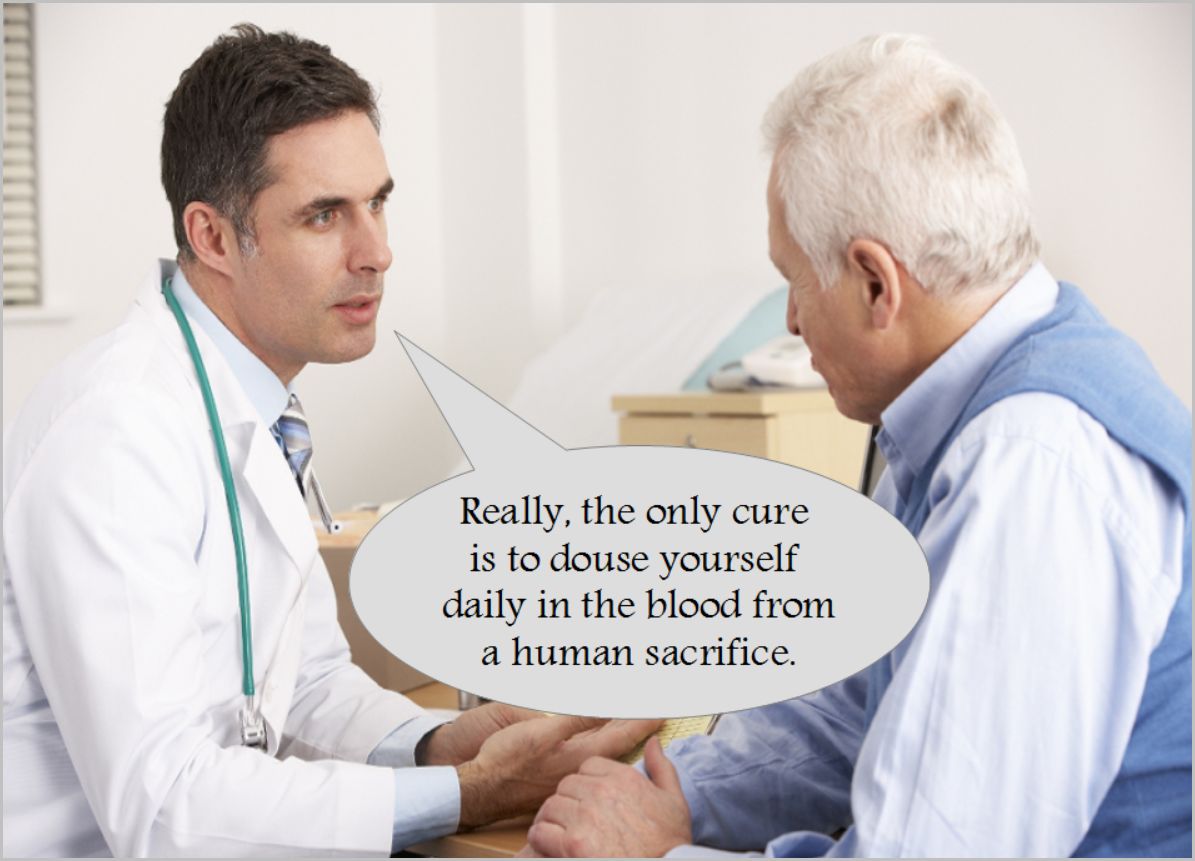
There is a cure though. Just as the scientifically illiterate in 1665 thought prayer would spare them from the plague, the way to survive the coming Ebola pandemic is, according to Pastor Rick Wiles, to be covered in the blood of Jesus:

Now this Ebola epidemic could become a global pandemic and that’s another name for plague. It may be the great attitude adjustment that I believe is coming. Ebola could solve America’s problems with atheism, homosexuality, sexual promiscuity, pornography, and abortion…
If Ebola becomes a global plague, you better make sure the blood of Jesus is upon you. You better make sure you been marked by the angels so that you are protected by God. If not, you may be a candidate to meet the Grim Reaper.

Yes, only true believers who have the blood of a long dead Jewish preacher ‘upon’ them, and angels hovering over their heads, will survive the coming plague (so those Christian missionaries are safe after all – they needn’t bother with the medical care they’re currently receiving back in the States).

This isn’t even seventeenth century thinking; it’s straight from the bronze age.

Will there be a world-wide Ebola plague? It seems unlikely, but who knows; life is more precarious than we sometimes like to admit. If there is, it won’t be because a vengeful, pissed-off God is inflicting it on us… because there’s no such entity. Nor is there a nice, loving, daddy God either – but then he doesn’t figure in this particular scenario anyway.

In spite of what the Bible promises (James 5.14-15), there’s no supernatural protection from Ebola, nor from any other disease. The poor souls who died of the plague in seventeenth century England found that out the hard way. Praying to God and sloshing about in the blood of Jesus, metaphorically or otherwise, protects no-one.

The fool says in his heart…

Celia2If you get into a discussion with Christians about their faith and you tell them, often reluctantly because you just know where it’s going to lead, that you don’t share their belief in a deity on account of there being no evidence for one outside of the human imagination, it isn’t long – if they haven’t done so already – before they start quoting ‘scripture’ at you.

Among their favourite verses, along with ‘For God so loved the world…’ (John 3.16) and ‘for a man to lie with a man… is an abomination’ (Leviticus 20.13) is Psalm 14.1: ‘The fool hath said in his heart there is no God’. And having cited it, they stand back in smug triumph, having put you firmly in your place and clinched the argument.

But the Bible would say this, wouldn’t it? It’s in its interest, and in the interest of those who wrote it and believe in it, to rubbish those who don’t buy into its fallacies. Christians who quote this verse, and others, are wilfully refusing to accept that you don’t recognise the ‘authority’ of their magic book. What they are really saying is, ‘You don’t believe in my God or the Bible, but I’m going to use it anyway to ‘prove’ my point.’

Why do they do this? Can they not see the futility of it? It’s like my quoting from ‘Twas The Night Before Christmas to demonstrate that, whether they like it or not, Santa Claus is watching over them to see if they’re naughty or nice. But referencing one make-believe source does not prove the existence of another. You have to believe in Santa Claus to begin with, as children often do, to believe the poem is an accurate account of his activities. So it is with the Bible. It only has significance if you already believe that God exists. It won’t of itself convince you that he does.

The Koran has its own ‘the fool hath said in his heart’ verses. Loads of them. Christians might like to consider whether a Muslim telling them ‘the vilest of animals in Allah’s sight are those who disbelieve’ (Q8:55) would persuade them that Allah is the one true God, and that they’re idiots for thinking otherwise. It wouldn’t, of course, so perhaps they’d kindly stop wasting their own time, and ours, doing the same to atheists.

The best response to a believer who tells you ‘the fool hath said in his heart there is no God’?

‘If even a fool can see it, why can’t you?’

Christians’ Favourite Delusions 26.2: The Bible is the Word of God

WritingRight on cue, after my post on the Bible as ‘the Word of God’, Mike Ratcliff over at the intense Possessing the Treasure, posted his own item on the forged 2 Timothy 3.16-17, using it to show how the Bible is truly God’s Word.

You should know that Mike will not be contradicted in any way. You’re wasting your time posting a comment about his ‘exegesis’ of biblical texts because his musings – and there are many, many of them – are without any sort of error. Mike doesn’t make mistakes! He explains in his post how the Bible is ‘inspired, infallible and inerrant’. Many evangelical Christians hold this view of the Bible, which is as mistaken as it is idolatrous.

Infallible literally means ‘incapable of failure’ and ‘trustworthy’, but as I’ve attempted to show in many of my previous posts, the Bible fails in all sorts of ways:

It fails as science. It claims light existed before the sun was created; it claims the sun goes round the Earth, which it thinks is the centre of the universe. It has no idea about the order in which life-forms developed; no idea about evolution; no idea about life-forms that cannot be seen with the naked eye. It describes insects as having four legs and gives animals the power of speech.

It fails morally. It endorses slavery, polygamy, rape, incest, genocide and cruelty to both animal and human life. It denigrates women, children, the disabled and gay people. It prescribes brutal and barbaric punishments for those who infringe its petty laws.

It fails in its promises and prophecies. None of its promises ‘work’, none of its prophecies have come true (except those made after the event they’re meant to be predicting.)

Can something that fails so spectacularly and consistently be considered trustworthy? Yes, say Christians like Mike. No, says anyone capable of a little elementary reasoning.

Inerrant means incapable of error. As if the errors in the ‘failure’ category aren’t enough, the Bible is littered with mistakes and contradictions. The gospels, for example, all have different visitors to the tomb of the supposedly risen Jesus. These visitors are all met by different strangers – one man, two men, angels and their dog, Spot. More importantly, the New Testament can’t decide how a person is saved. Paul’s formula is radically different from Jesus’, and different again from the message Luke puts into his mouth in Acts. In total, there are eight different and conflicting ways to find salvation in the New Testament*.

Inspired literally means ‘breathed out’; Mike Ratcliff and others insist that the Bible is ‘breathed out’ by God. Apparently, he ‘breathed out’ his confused, contradictory message into and through fallible tribesmen, and first-century hallucinatory zealots, causing the former to exaggerate their own importance and success and the latter to create those eight different routes to salvation. He didn’t, however, see fit to give them a clear picture of who Jesus actually was, nor a precise formulation of the so-called Trinity (that fanciful nonsense had to be worked out much later), nor of what would happen to believers after death. He did, though, inspire forgeries and fakes like 2 Timothy and left it forty to a hundred years to prompt four individuals who had never met Jesus to write the muddled tales of his adventures on Earth. He didn’t think it important to preserve the originals of any of the manuscripts he’d inspired, nor did he take steps to prevent them from being altered both deliberately and accidentally throughout the ensuing years**. Perhaps he ‘breathed out’ the alterations and errors too.

The real problem with the inspiration argument is though that it is circular; the Bible ‘proves’ God and God proves the Bible.

No, the Bible is not infallible. Nor is it inerrant, nor inspired. It is an all too human creation, fallible and error-ridden. There is greater consistency and style in the works of Shakespeare than there is in the shambolic collection of books cobbled together as the Bible in 397CE. Those who see it as something more, see what they want see and are wilfully blind to its many failings. God’s Word it isn’t.


Notes:

* For the eight (at least) salvation plans in the New Testament see my book, Why Christians Don’t Do What Jesus Tells Them To …And What They Believe Instead, chapter 6.

** For errors, alterations and the non-preservation of any original documents see Bart Ehrman’s Misquoting Jesus: The Story Behind Who Changed The Bible And Why.