Mystic Revelations

What do the three ‘great’ Abrahamic religions have in common?

They all started with visions, hallucinations, dreams and mystic revelations. They’re not only based on these but owe their very existence to encounters with the supernatural that took place entirely within people’s heads. This of course is if they happened at all; many of these encounters with angels and God’s revelations take place in stories that have all the characteristics of myth or legend. Even so, they reveal much about the primitive state of mind (still around today) that believed God frequently revealed himself to, and in the minds of, chosen individuals.

First, the grand-daddy of the Abrahamic religions, Judaism: 

When Abram was 99 years old, YHWH appeared to him. He said to Abram, “I am El Shadday. Live in my presence with integrity. I will give you my promise, and I will give you very many descendants.” Immediately, Abram bowed with his face touching the ground, and again Elohim spoke to him, My promise is still with you. You will become the father of many nations. So your name will no longer be Abram [Exalted Father] but Abraham [Father of Many] because I have made you a father of many nations. I will give you many descendants. Many nations and kings will come from you. I will make my promise to you and your descendants for generations to come as an everlasting promise. I will be your Elohim and the God of your descendants. (Genesis 17)

Then Moses:

The Angel of YHWH appeared to (Moses) in a flame of fire from the midst of a bush. So he looked, and behold, the bush was burning with fire, but the bush was not consumed.

Then Moses said, “I will now turn aside and see this great sight, why the bush does not burn.”

So when YHWH saw that he turned aside to look, Elohim called to him from the midst of the bush and said, “Moses, Moses!” And he said, “Here I am.” (Exodus 3)

Notice how the inner voice goes from being that of ‘the angel of YHWH’ to YHWH himself (or one of his aliases). The entire scenario is preposterous of course, as is the Abraham episode before it. I’ve omitted the other occasions YHWH is said to appear to Abraham, including the infamous Genesis 22, where YHWH instructs Abraham to sacrifice his son. These stories are legends written, created from whole cloth, centuries after Abraham purportedly lived. He, like the later Moses, is almost certainly mythical, a character created to represent the beginnings of the Jewish faith. Even his names are symbolic. In truth, no one knows how Judaism began.

Onto Christianity:

The angel said to (Mary), “Don’t be afraid, Mary; God has shown you his grace. Listen! You will become pregnant and give birth to a son, and you will name him Jesus. He will be great and will be called the Son of the Most High. The Lord God will give him the throne of King David, his ancestor. He will rule over the people of Jacob forever, and his kingdom will never end.” (Luke 1)

Did this happen? If you believe angels exist then possibly, but we know they do not. We also know that this is myth. However, Luke wanted his readers to know that Jesus’ birth was miraculous so invented a story in which Mary encounters a heavenly being. The gospel writer anchors the divinity of Jesus to an implausible event which at best can only be a young woman’s vision (though it most certainly isn’t.)

The same is true of the resurrection appearances. Here’s Matthew 28:1-8:

Now after the Sabbath, as it began to dawn toward the first day of the week, Mary Magdalene and the other Mary came to look at the grave. And behold, a severe earthquake had occurred, for an angel of the Lord descended from heaven and came and rolled away the stone and sat upon it. And his appearance was like lightning, and his clothing as white as snow. The guards shook for fear of him and became like dead men. The angel said to the women, “Do not be afraid; for I know that you are looking for Jesus who has been crucified. He is not here, for He has risen, just as He said.”

More angels (they multiply in later gospels); again at best, though still highly improbable, the angel(s), if seen at all, can only be a vision or an hallucination (or mistaken identity.)

Onto the only first hand account of an encounter with the divine that the bible includes, Paul’s:

God was pleased to reveal His Son in me so that I might preach Him among the Gentiles… I want you to know, brothers and sisters, that the gospel I preached is not of human origin. I did not receive it from any man, nor was I taught it; rather, I received it by revelation from Jesus Christ. (Galatians 1)

I know a man in Christ who fourteen years ago—whether in the body I do not know, or out of the body I do not know, God knows—such a man was caught up to the third heaven. And I know how such a man—whether in the body or apart from the body I do not know, God knows— was caught up into Paradise and heard inexpressible words, which a man is not permitted to speak. (2 Corinthians)

This is all there is. This is the extent Paul talks about his heavenly encounters. In Galatians he admits that God revealing whatever it was he revealed was ‘in’ him, that is, in his own head. The bizarre tale he relates in 2 Corinthians reads like an hallucination (Paul says he doesn’t know whether it was in the body or out of it) which is all it could’ve been; there is no paradise or ‘third heaven’.

And finally, there’s Mohammed:

while I was sleeping last night, the keys of the treasures of the earth were brought to me till they were put in my hand.”… 

The angel came to him and asked him to read. The Prophet replied, “I do not know how to read. The Prophet added, “The angel caught me (forcefully) and pressed me so hard that I could not bear it any more. (Sahih Bukhari 6998)

Encounters with heavenly beings in dreams, ‘revelations’, visions, hallucinations and invented stories: these are central to Judaism, Christianity and Islam. The religions would not exist without them. Written as myth long after they supposedly occurred or referred to obliquely by those who claim to have experienced them, they are the products of fevered pre-scientific minds.

Post-script: I’ve searched in vain for Darwin’s admission that an angel revealed the process of evolution to him. I can only find his collection of evidence, his scientific observations and his careful analysis of his findings. Likewise Mendeleev who calculated the existence of elements that were at the time unknown. Likewise Crick, Watson and Franklin who discovered the structure of DNA. Strangely, none of these people relied on visions, dreams or divine revelations in uncovering truths about reality.

Pest Control

I used to pride myself on how patient I could be. I’m finding recently however that I’m becoming far less so. Not with everyone, I hasten to add, but with religionists, Evangelical Christians in particular.

As I mentioned last time, they have infested my Facebook feed with their inane Jesus-Loves-You Amen BS and now I find they’ve practically taken over a science page I occasionally read called From Quarks and Quasars, a sometimes sensationalist site that collects together science posts from other legitimate sources. It recently published an item called ‘Earth Was Once Entirely A Water World, New Research Shows’, prompting 5.2k comments. Many of these were from cranks trying to show how the finding verifies the biblical flood story, despite the fact the article makes it clear it is talking about something that occurred 3-4 billion years ago. Certified genius Dennis Mears offers this comment (all grammatical, spelling and punctuation errors in the original):

Of coarse it was !! but we don’t need “ new research “ to know what every culture on earth has talked about in their history for thousands of years . We can simply read genesis and learn about it in detail

while Scotty Johnson wades in (pun intended) with:

It’s called the flood, it’s recorded in Genesis in the Bible, Noah and the Ark, kids have been learning about it in Sunday School for years. Scientists should study the Bible first, maybe they wouldn’t be surprised when they discover something.

It’s down to astute reader Gene Steiner, catching the original article’s reference to 3-4 billion years, to correct it:

(In) Genesis 7:24 the great flood covered the whole earth, even the highest mountains; and the waters remained on the earth for 150 days…. Not billions of years ago, but 4500 or so years ago during the NOAHIC GLOBAL FLOOD! We knew that all the time!

This is the line subsequent commenters take up until we get to Tobie Schalkwyk, who offers the insight that the water-covered Earth is the same as mentioned in Genesis 1:

1 In the beginning God created the heavens and the earth. 2 Now the earth was formless and empty, darkness was over the surface of the deep, and the Spirit of God was hovering over the waters.

And on it goes for thousands more comments. The photo at the top of this post was also shoved on somewhere along the line.

It is the purveyors of this sort of crap that I no longer have any patience for. I want to call them out for their tomfoolery. It’s the same with commenters (Arnold and Don on this blog, Marley1312/Aussiestockman on Gary’s, Revival Fires on Bruce’s) who think atheist sites exist only to provide a forum for their brainless theobabble and Bible-bashing. They can’t be argued with, such is the depth of their ignorance and need to inject Jesus into everything. They bring out the worst in me: snark, bad language and name calling (as you can tell from this very post). I don’t want to stoop to this level, nor is it good for my blood pressure, and so feel compelled to leave them to it. I avoid reading comments and sometimes actually abandon sites I like to read because of the infestations of religious gobbledegook.

I know it infuriates some of you too, but what to do? Let the epidemic spread or resist it? What do you advise?

The Bible Is Fantasy

The Bible contains:

113 appearances of angels, usually interacting with human beings;

50+ visions, on which all of Christianity hangs: those of Daniel; Cephas and others who ‘saw’ the risen Christ; Paul and John the Elder in Revelation. 

21 supernatural dreams, including those experienced by Jacob, Technicolor Joseph, NT Joseph, the Magi, Pilate’s wife and Paul

Numerous apparitions and ghostly appearances, including that of the resurrected Jesus as well as Moses and Elijah and, in the Old Testament, the spirit of Samuel, conjured up from the grave by the witch of Endor.

Innumerable resurrections: not only that of Jesus but several Old Testament characters, and, in the New, Lazarus, Jairus’ daughter, the young man of Nain and the hordes who rose from their graves at the time of the crucifixion.

Multiple impossible astronomical events, ranging from the sun stopping in its orbit(!); a star wandering and hovering over a small house; a solar eclipse lasting several hours; stars that one day will fall from the sky; a God who lives just above the clouds and a ‘firmament’ between the Earth and the heavens that holds back water;

Several events in which nature is magically controlled: the parting of the Red Sea; Moses’ magician’s staff becoming a snake; the Nile turning to blood; Jonah being swallowed but not digested by a ‘great fish’ and Jesus calming a storm.

An abundance of fantastic beasts and fairy tale creatures: Giants (Genesis 6:1-4, Numbers 13:33); Leviathan the sea monster (Isaiah 27:1 etc); the Behemoth (Job 40:15-24); the Cherubim monsters (Ezekiel 1:4-21); the dragon and other beasts from Revelation

Many characters who are clearly legendary, from Adam & Eve, Noah, Lot and Abraham to Moses, Job, Daniel and gospel Jesus. Some of the Bible’s fictional characters lived to a literally incredible age: Adam 930 years, Seth 912, Methuselah 969, Noah 950, Abraham 175, Moses a pitiful 120. Jesus holds the record being now either 2,000 years old or eternal, depending on how you count it.

5 mythical places: Eden at the beginning of the book; New Jerusalem at the end; Heaven, the abode of God; Sheol the Old Testament place of the dead; Hades (Sheol mark II?) which Jesus visited while supposedly dead in his tomb (Acts 2:27, 31; Matt 16:18).

2 sentient ‘pillars’: one of cloud, one of fire (Exodus 13).

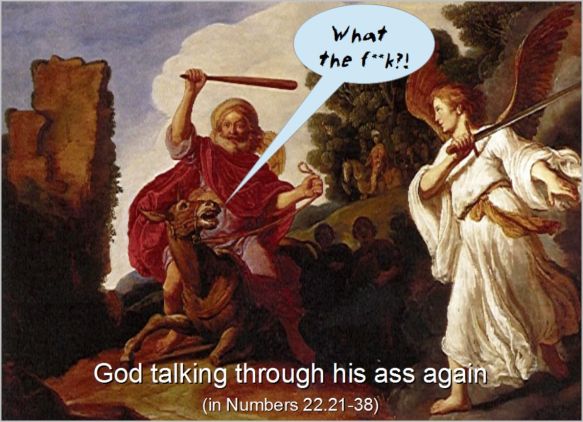
2 talking animals: the serpent in Eden and Balaam’s ass.

1 talking plant (Exodus 3:3).

0 science. No understanding whatsoever of what we now call astronomy, meteorology, germ theory, genetics, evolution, psychology… you name it.

So how do we read all of this? As the ancients themselves would, with an understanding of the world that regarded the supernatural, magic, miracles and monsters as real? We’re told often enough that this is how we should interpret scripture, not from a modern perspective. Perhaps we might credit the creators of the many books of the bible with greater skill, however, and interpret the inclusion of magic and miracle as allegorical or metaphorical; literary pieces, if you will. But then we have to decide which far-fetched stories are myth and which are historical accounts,. There really is no way to do this. A New Testament story awash with impossible events, implausible characters and symbolic tropes is every bit as allegorical or metaphorical as the same kind of story in the Old Testament (or, indeed, in Egyptian, Greek and Roman myth.) The reader who wants to see stories in the Old Testament as carefully crafted allegories has to concede that the Jesus narratives are of the same order.

It looks like we have to read the Bible as 21st century readers, because that is what we are. After all the Bible is supposedly a book for all time. We can, however, recognise the way in which its many creators saw the world – populated with fantasy creatures and subject to impossible events – and accept that they were wrong. Reality is not as they perceived it. What we cannot do is claim that the Jesus story is an oasis of truth in the midst of all this fantasy . 

Evidence of God

As for evidence, you might be aware of Israel. That nation has been in the news much of late. So, without being flippant at all, I present Israel as evidence. Think about it. They are living the script written thousands of years ago. Not by chance.

Israel as evidence for the existence of God. I’m thinking about it as Don suggests.

Where did it all begin, this bizarre notion that one tribe in the Middle East was chosen by God to be his special people? According to the Genesis myth, it was when YHWH promised Abraham he’d be his best buddy forever and ever, so long as he mutilated his body and those of his sons in perpetuity. They would also have to keep every one of this bullying god’s 365 rules and regulations, including the petty and piffling ones. So far so good, apart from the fact it was all very one-sided, and the mutilation of course. You’d think this would’ve been a sign that things weren’t quite kosher, but no; Abraham and his descendants buy into it and almost straight away, YHWH begins to let them down.

God’s Chosen Ones soon find themselves slaves in Egypt. A second mythical character is needed – up pops Moses – to get them out of this scrape. Unfortunately, after Moses has finished chatting with YHWH, who identifies as a burning bush on the top of a mountain, the sulky deity feels slighted by something the Israelites are doing. As is his way, he has many of them slaughtered and the rest he forces to troop around the same small plot of land for 40 years. This is how best buddies treat each other!

Later, the Jews find themselves defeated by the Babylonians and are carted off into exile. This exile, which YHWH does nothing to prevent, lasts 70 years. Still, it leads to a pleasant song made famous by Boney M in 1978 so I suppose it was worth it.

For the next few hundred years, Israel falls under the rule of other nations more powerful than itself. Not to worry though, YHWH is still ‘looking after them’, particularly those who are slaughtered in the rebellions that ensue. As Robert Conner says in a recent comment on Debunking Christianity, ‘If Yahweh ever threatens to bless you and your children, just kill yourself and get it over with.’

Fast forward to the Roman occupation of Israel. YHWH, having undergone a makeover, reneges on his promise to take care of his Chosen Nation forever and ever and comes up with a different plan to save people from his own cussedness. Now, if they want to continue as his friend, they have to believe a supernatural being has returned from the dead.

Abandoned by God, as he now wants to be called, Jews who haven’t defected to the new faith see their sacred, eternal temple destroyed by the Romans in AD70. Thousands of them are massacred and the Jewish nation ceases to exist.

This sets the pattern for the next two millennia in which God’s new friends organise pogroms, massacres and vicious persecution of Jews. This culminates in the Final Solution of the Third Reich which seeks to eliminate the Jewish people entirely. While awaiting extermination in a concentration camp, Andrew Eames scrawls on the wall of his prison: ‘If there is a God, He will have to beg for my forgiveness.’ God allows six million of his Chosen People die at the hands at the Nazis.

Following the second world war, Israel takes possession of the area surrounding Jerusalem, then occupied by Palestinian Muslims who are themselves descended from earlier immigrants. Thousands on both sides are slaughtered in the conflict that follows. In 1948, after almost 2,000 years, Israel becomes a nation once again; not through any miracle of God but as a result of human endeavour and bloodshed.

Tension and further skirmishes followed, leading to the present day when Israel finds itself under attack by Hamas terrorists. Thousands of innocents – women, children and babies – have been slaughtered without mercy. Israel is, as I write, retaliating and intends to enact further vengeance. And where is God in all this? You guessed it: nowhere to be seen.

All of this, according to some – including the naive writer at the top of this post – serves as evidence of God’s existence. That Israel has persevered for so long, despite opposition, persecution and the holocaust is not, however, evidence of God, any more than the great cathedrals of the world are. It is instead testimony to the resilience, resolve and sheer bloody mindedness of the people themselves. Perhaps their belief in YHWH (they don’t of course recognise his Christian counterpart) has fuelled their persistence, as it has their territorial claims.

Jewish beliefs and history are not evidence that YHWH exists. If anything, his apparent abandonment* during their many trials and tribulations is evidence to the contrary.

*Of course a non-existent entity can’t actually abandon anything, any more than it can lend its support or favour one group of people over another.

End Of Term Test

Which of the terms mythological, symbolic, theological is most appropriate when discussing biblical tropes?

Apparently, it’s ‘theological’ because it has an air of respectability, whereas the other terms suggest something with only theoretical underpinning. In fact, this also applies to ‘theological’, which by definition is the study of deities, for which there is no evidential verification. The use of ‘theological’ therefore is as unsubstantive as arguing that a concept is metaphorical or symbolic. None of these terms represents a sound, reliable way to determine the accuracy, historicity or truth of religious claims.

With this in mind see how you do with these questions:

1. Did the original hearers of the Genesis creation story regard it as –

a) true.

b) a theological statement.

c) an entertaining myth.

Of course we’ve no way of knowing what the story’s original hearers thought but there is nothing in the text that suggests they would have regarded the creation story as anything but true. The creators of Jesus’ script certainly seemed to think so, a few centuries later and its original hearers would not have felt the need to preserve it otherwise. In this belief they were wrong.

2. Which of these gospel stories is true, as in ‘really happened more or less as described’ –

a) The virgin birth with its surrounding detail.

b) Jesus meeting with Moses and Elijah (the transfiguration).

c) Resurrected corpses roaming around Jerusalem.

d) The resurrection.

The answer is that either all of them are true or none of them are. If only one of them is mythic, symbolic or ‘theological’ (and more than one of them most certainly is) then it is highly likely the others are too. If we are scrupulous, we cannot assert that one story is symbolic because it’s making a theological point while another equally implausible story is historically accurate because we want it to be.

The criteria for determining the historicity of any story from antiquity are corroborative evidence and, failing that, plausibility. We have already established that there is no independent corroboration for many of the gospel stories. There is no corroboration for some of them even in the Bible itself. We are left then with plausibility: how plausible is it that a virgin gave birth or that resurrected corpses presented themselves to Jewish authorities? Vanishingly small. Jesus’ encounter with Moses and Elijah is equally improbable.

Is his resurrection the exception? No, because dead people do not spring back to life 36 hours after being buried. If the virgin birth, the transfiguration and the resurrection of dead saints are all highly implausible (and they are) then so is the resurrection. It is at best, a story making a theological point but it is not history. The implausibility it shares with many of the other implausible stories in the gospels discounts it as history. There are no grounds for saying it is the exception.

There is also the cumulative effect of implausibility. It is highly unlikely that one of the implausible events above is historical, but it is impossible that all four of them are. Add all the other implausible stories in the gospels – the other miracles; the healings; exorcisms; Jesus sparring with the devil, walking through locked doors and beaming up to heaven: piling implausibility on top of implausibility doesn’t make any of the component implausibilities more plausible. It makes all of them less plausible and collectively impossible.

The things the gospels tell us happened to Gospel Jesus, and those they say he did himself, are equalled only by heroes of myth. Did Osiris or Romulus rise from the dead, as their stories claim? Did Augustus really become a god once he died? Of course not. These are the implausible, improbable events we find in myth. Jesus’ story is no different.

3. While many or all of the gospel stories are highly improbable as history because they are intended to convey a theological point, the words attributed to Jesus in the gospels –

a) are completely accurate.

b) are more or less what he said.

c) passed through an inestimable number of people, being invented, edited and altered in the process, before being written down 40+ years after Jesus supposedly uttered them.

d) are inventions of the gospel writers and/or their particular sect and frequently copied between gospels.

If you’re opting for a or b, you’re now making the logia the exception; the one oasis of historical truth in a desert of implausibility. That’s a big ask. To get this one off the ground, you have to call upon contrivances like –

completely reliable (but different and conflicting) oral traditions;

     hypothetical lists of sayings;

         Peter’s dictation to Mark;

             eyewitness authors;

                  secret teachings;

                     super-translators and

                         the odd spot of collaboration.

So, c and/or d is far more likely to be the answer to this one, representing the explanation that requires the least conjecture and fewest hypothetical components.

How did you do? I expect most of you aced this end of term quiz. If not, better get down to some extra study and repeat the semester next year.

Don’s Dynamic Lie-Detector

But you have an anointing from the Holy One, and all of you know the truth. I do not write to you because you do not know the truth, but because you do know it and because no lie comes from the truth.

1 John 2:20-21 as quoted by Don Camp.

Our resident, regularly banned God-botherer, Don Camp, claims that he has a special way of reading and interpreting spiritual writing. No, he hasn’t got a pair of magic rocks, but an inner ‘anointing’ with what Don calls his ‘lie-detector’. (You might have a similar device yourself, known more commonly as a bull-shit detector. Its alarm may well have been a-ring-a-ding-dinging when you read Don’s comment.)

Anointing, if you’re interested, is the ancient Jewish custom of initiating a king or priest by daubing oil on their head. Don has no evidence that he has been inwardly ‘anointed’ by an unseen spirit that helps him understand scripture better than anyone else. There is no evidence, outside of subjective feelings and one tautological bible verse, that any religious believer has had this done to them. (Read 1 John 2.20-21 again, Don, and you’ll see that a tautology is what it is: ‘the truth is the truth is the truth,’ is really all it says.)

On the contrary, we find that different Christians interpret given scriptures in a variety of different ways (I’ll get to examples in a minute). They differ too on which bits of the Bible are relevant to them and their church or sect. They disregard or explain away verses that don’t suit their purposes.

Don does this himself. His anointing Spirit doesn’t lead him to interpret verses like Matthew 16:27-28; 24:27, 30-31 & 34, Romans 13, 11 & 12, 1 Peter 4:7, 1 John 2:18, Revelation 22.20 etc at face value. He cannot countenance the fact that Jesus, Paul, John and all those other early fanatics were wrong about when the end of the age would happen – they are all very clear they thought it was imminent – so he reinterprets what they say to mean something they clearly and unequivocally do not. Don’s interpretation has them meaning, despite what they say, that the end of the age and all that goes with it would be thousands of years in their future. Should you challenge him on this, Don tells you that how you see it is wrong because you don’t have the special anointing he has. As he puts it in his comment, you’re lacking the right ‘dynamic’ (ring-a-ding-ding!) and as a result, you are incapable of interpreting scripture in the right way (i.e. his way).

In fact, Don does not have a way of understanding scripture that he can call his own. Rather, he interprets it with preconceptions he’s acquired elsewhere; that it is God’s Word, that it is Truth, that the spiritual world it describes is real, that it relates an historical resurrection, and so on. He comes to it with these presuppositions that he has learnt from preachers, teachers, commentaries, devotional books and other Christian propaganda he’s been exposed to. He is completely unable to take a step back to look at what he’s reading objectively. He knows what it says before he reads it – ‘truth’ as far as the Bible is concerned, ‘lies’ when it’s the Book of Mormon – and imposes that meaning onto it. This ‘dynamic’ enables him too to smooth over all of the Bible inconsistencies and allows him to see it as one seamless garment when it evidentially is not. He’s not alone in doing this, of course. Most evangelical (‘anointed’) Christians do it. I know I did.

Now for those examples, and a challenge for Don:

1. A few days ago, Holy Spirit anointed, preacher Dillon Awes used his dynamic lie-detector to interpret the Bible’s declarations about homosexuality like this:

What does God say is the answer, is the solution, for the homosexual in 2022, here in the New Testament, here in the Book of Romans (1:26-27)

That they are worthy of death! These people should be put to death!

Every single homosexual in our country should be charged with the crime, the abomination of homosexuality, that they have. They should be convicted in a lawful trial. They should be sentenced with death. They should be lined up against the wall and shot in the back of the head! That’s what God teaches. That’s what the Bible says.

2. Similarly, over the weekend, Ken Ham interpreted Genesis 1 to mean that dinosaurs and humans lived at the same time. After all, he ‘reasoned’, Genesis says God created ‘everything’ in those first six days, so that must include dinosaurs as well as Adam and Eve.

3. Pastor Douglas Wilson who featured recently on Bruce Gerencser’s blog, interpreted the assertion in Ephesians 5:22-24 that wives should be submit to their husbands, even if it entails rape:

…We have forgotten the biblical concepts of true authority and submission, or more accurately, have rebelled against them… However we try, the sexual act cannot be made into an egalitarian pleasuring party. A man penetrates, conquers, colonizes, plants. A woman receives, surrenders, accepts. This is of course offensive to all egalitarians, and so our culture has rebelled against the concept of authority and submission in marriage.

My question to you, Don, is: do you interpret Romans 1:26-27, Genesis 1 and Ephesians 5:22-24 the same way as these other Holy Spirit directed interpreters of scripture? If not, why not, when it’s the same Holy Spirit that equips you with your dynamic lie-detector, that also leads them into all truth?

These is not a rhetorical question; we all want to know. But be warned, Don, our bullshit detectors are primed and ready.


Can you be a Christian and… accept Evolution?

Hoax

People of faith have a problem with evolution. Some of them can’t seem to see it, but the Theory of Evolution is a significant encumbrance to faith, as it has been since Darwin first proposed it in 1859.

There are essentially four ways Christians (and those from other religions) deal with evolution.

1) There are those who recognise that evolution and faith are incompatible and consequently compartmentalise them both to avoid thinking about the problem: ‘Yes, evolution probably happened but my faith is important to me so I’m going to pretend it didn’t.’

It’s impossible to argue with this head-in-the-sand position, so let’s not bother.

2) Others insist that evolution is ‘just a theory’ and as such is in conflict with what the Bible teaches about the creation of life. But this is a double misunderstanding: of what ‘theory’ means in science, and of what the Theory of Evolution proposes. It has nothing to tell us about how life began, but how it developed. Nonetheless, it contradicts the order of creation found in the two creation accounts in Genesis.

Some believers are content to dismiss evolution on these grounds: a theory, in the popular sense, that is trumped at every turn by the Bible’s accounts of creation. Ken Ham and the laughable Answers in Genesis hold to this position:

The real issue is one of authority—is God’s Word the authority, or is man’s word the authority? So, couldn’t God have used evolution to create? The answer is No. A belief in millions of years of evolution not only contradicts the clear teaching of Genesis and the rest of Scripture but also impugns the character of God. He told us in the book of Genesis that He created the whole universe and everything in it in six days by His word: “Then God said … .” His Word is the evidence of how and when God created, and His Word is incredibly clear.

Hammy and his acolytes do accept what they call micro-evolution, the small incremental stages made within a species over time. Macro-evolution, as they like to call it, when one species gives rise to another over significant amounts of time apparently never happens. Why? Because the Bible says so (but good luck finding where.)

3) Still others extend this dismissal on the basis of ignorance: they are positively hostile to the idea of evolution. Street preachers who set up shop in my home town from time to time are always accompanied by a sign that says ‘Evolution is a Hoax’ (see above.) These kind of believers are not content simply to dismiss evolution as ‘theory’, nor do they accept that it occurs within species. They rail against evolution and disparage the vast amounts of evidence that exist for it. Evolution they declare over their megaphones, is not only a hoax, it is of the devil, who uses it to deceive people and lead them away from God. This is ignorance of a more wilful sort.

Christians in both these last two camps would themselves say that one can’t be a Christian and accept evolution. Actually, they’d say one can’t ‘believe’ in evolution, a word I’ve avoided. Evolution can no more be ‘believed in’ than gravity (itself a theory in the scientific sense.)

4) The fourth way Christians have of dealing with evolution is to attempt to marry the theory with their faith. They acknowledge that evolution has occurred, that life on earth has developed much as Darwin proposed and that the evidence from paleontology, geology, genetics and developmental biology fully substantiates this explanation.

Where then to fit God when he is superfluous to the explanation of life’s development, in much the same way the tooth fairy is superfluous to dentistry? This doesn’t stop these believers finding a place for him. They regard the apparent randomness (their term) of evolution impossible to accept and see a place for God in countering it. As Greg Allison puts it on Desiring God, without a hint of irony, the ‘entire process (of evolution) was undirected and purposeless, without God.’

Consequently, Christians who accept evolution have come up with a couple of ways of injecting God into the process, regardless of the fact he is not needed and there is no place for him. So-called Theistic Evolution, in both its forms, is the belief – and it’s nothing more than a belief – that God set evolution in motion and then let it take its course. One school proposes he occasionally gave it a nudge so that it went in the right direction, the other that he just sat back to see what would happen, though presumably he knew this from the start, being omniscient and all that.

This a hopeless compromise; the prevalence of suffering, death and extinction as drivers of evolution discount any involvement of a benign creator. Such a being’s disinterest in the constant struggle for survival of his created pets, every one of which perishes once past reproductive age (if they reach it in the first place) does not point to a loving God. Paul, who of course had no understanding whatsoever of evolution, believed that death entered creation only when Adam first ‘sinned’. Yet death and suffering existed eons before human beings first appeared. The ‘Evolutionary Creationists’ at BioLogos have a hard time trying to explain this one away. (Spoiler alert: they can’t.)

And let’s not even mention sex; sexual reproduction is a massive problem for the creationist.

As Greg Allison concedes, one cannot be a Christian and subscribe to a theistic model of evolution. Having considered the possibilities, Greg concludes that neither form of theistic evolution is compatible with faith. In this he is right. He comes back to the scriptural accounts of creation as the best explanation of life’s development. In this he is wrong.

No doubt there are commenters out there who think that some form of compromised Christianity and a diluted evolutionary theory are somehow compatible. They have no doubt discovered a way to put God at the heart of evolution or have a misunderstanding of the theory that somehow leaves room for him. Such arguments are unconvincing. Evolution and God are incompatible. One is true (as in observable, supported by evidence and predictive), the other imaginary. There’s no need to pollute the former with the latter.

Metaphor, Hyperbole and Context

Blog387a

A moderate and self-styled ‘intellectual’ Christian told me in a online discussion recently that ‘most of the bible is metaphor’. When I asked what it was a metaphor for, he decided it was time to end the discussion. A metaphor signals a deeper or alternate meaning; the bible cannot be ‘mostly metaphor’ without there being something else – what Christians might regard as a ‘greater truth’ – the metaphor is intended to convey. So, yes, I can see that the Genesis creation stories might be interpreted metaphorically (though symbolically might be a better term) as the inclination of all humans to rebel against God… but then that’s only one of many interpretations, and not actually what the text says. If the bible is mostly metaphor then understanding what God is supposedly communicating through it becomes a matter of personal, subjective interpretation, which is why there are so many factions and sects within the Christian brand.

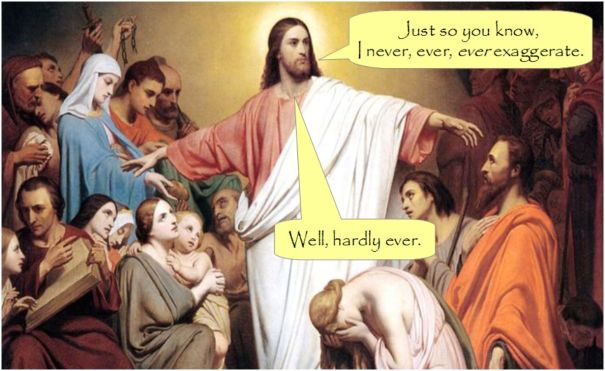
Similarly, when I challenged Dave Armstrong on Biblical Evidence for Catholicism, about why Christians don’t take everything Jesus said literally, he told me it’s because Jesus was fond of hyperbole and it’s the point underlining his hyperbole that matters. I knew, of course, that Jesus liked to exaggerate so I asked Dave how we know which of Jesus’ remarks are hyperbole and which are not. He declared that this was ‘obvious’. Perhaps it is, in sayings like ‘when your eye offends you pluck it out’, but it’s less apparent with pronouncements like ‘sell all you have and give to the poor’ or ‘abandon everything and follow me’. Again, it becomes a matter of subjective opinion, however learned that opinion might consider itself to be, about which of Jesus’ words are hyperbole and which are meant to be followed to the letter.

When I made this point, Dave decided that, rather than it being ‘obvious’, it actually takes years of study to know which is which: ‘It’s by studying Bible commentaries and linguistic aids, and the rules of hermeneutics and exegesis (Bible interpretation).’ Jesus as the incarnation of the God of the Cosmos, and the gospels in reporting him, could surely have made it clear. Instead, it seems, it takes armies of theologians and commentators, and years of study to work it out.

The third way Christians (of all stripes) manoeuvre around the bible’s shortcomings is to say that anything they’re keen to disregard is ‘context-bound’. There are some matters, they say, that are of their time and ancient place and are therefore no longer applicable today.

There are things in God’s timeless Word that pertain only to the time in when they were written? Who knew?

So, instructions like ‘greet each other with a holy kiss’ (which Paul advocates four times in his letters: Romans 16:16, 1 Corinthians 16:20, 2 Corinthians 13:12, and 1 Thessalonians 5:26); ‘women should always have their heads covered in church’ (1 Corinthians 11:2-16) and ‘heal the sick by anointing with oil’ (James 5:14) are now generally considered to be context-bound. This, however, creates the same problem that arose over Jesus’ hyperbole. How do we know which of the bible’s pronouncements are context-bound and which are still of significance today? Answer: we don’t.

It could be argued that, just as ‘greet each other with a holy kiss’ is a custom anchored in the first century, beliefs like

the world is populated by demons,

humans are capable of living forever,

and

incantations (that Jesus is the Saviour) work

are equally context-bound. We know categorically in the 21st century, that demons don’t exist, humans cannot live forever and magic spells don’t work. Only those in a pre-scientific age, dominated by superstition, thought so (together with those today who buy into these same ancient beliefs.)

Once believers start claiming – and it’s Christians themselves who do this – that significant parts of the bible are metaphor, hyperbole or are context-bound, then they’re acknowledging that the bible frequently makes little sense, and that significant portions  lend themselves to whatever interpretation suits the individual reader. Some parts can even be dismissed altogether, which is precisely what Christians do with them (how many Christians do you know who believe they can move mountains or heal the sick by laying on of hands?) What this shows is that they don’t really believe the bible is God’s Word, either in the literal, evangelical sense, nor in a moderate, quasi-intellectual way.

In practice, even to most Christians, the bible is a book of no particular merit.

God’s Very Good Creation

Blog385

I’m recovering from a viral condition that’s affecting people in these parts. It’s set me thinking about how many diseases and conditions humans are susceptible to. An online search suggests the figure is unquantifiable. There are, for example, over 5,000 viruses known to affect human health, including the 200 that cause various versions of the so-called common cold. Of these 5000, we understand only a few hundred. There are also some 6,000 diseases caused by single-gene defects, and even more by other genetic disorders. In case that’s not enough, there are also hundreds of infectious diseases caused by bacteria, fungi and parasites. While some of these cause only minor discomfort, it remains the case that almost every one of us will die, or has already died, from one or other of these diseases, conditions or illnesses.

How does Christianity account for all of these horrors? Here’s the cerebrally challenged Ken Ham to explain:

We need to start with the fact that God created everything perfect, and this perfect creation was then marred by sin. This is the only way the gospel makes sense. You need the foundation of the history in Genesis in order to fully understand the gospel!

Yup, God made everything perfect and a pair of mythical humans messed it up by ‘sinning’. Everything that’s bad about the world is the result of Adam and Eve’s one-off disobedience. That single act opened the floodgates not only to all of the illnesses to which we and the animal kingdom are prone, but also to natural disasters and the brutality we inflict on one another.

But don’t worry, God has a cunning plan! Ken wants us to teach our children about it:

Teach them about God’s original “very good” creation. Instruct them that mankind’s sin broke God’s creation and brought death and suffering into it. Teach them that we needed someone to pay the penalty for our sin, and that’s why Jesus stepped into history… and now offers the free gift of eternal life to all who will put their faith and trust in him.

You see, as Ken likes to say, only this explanation makes sense of our susceptibility to disease and illness. Only this explanation makes sense of the gospel too; the good news that Jesus sacrificial death will put everything right.

                   Eventually.

                            No rush.

                                   Whenever…

It also demonstrates what a complete and utter bastard the biblical God is, that he condemns his ‘very good’ creation to a disease ridden, disaster stricken existence, simply because he himself made the first humans as fallible as he did.

But no. Neither this explanation nor its concomitant ‘gospel’ makes any sense, whichever perspective you look at them from. The development of innumerable diseases, and the viruses, bacteria, parasites and genetic conditions that cause them, are clear evidence of evolution; of an unsupervised arms-race in which the best-adapted invader or host survives to reproduce/replicate. Having then had the chance to transmit their DNA/chemical data, their purpose is served. They die. They stay dead.

The men who created Genesis 1 & 2 did not know about evolution, microbes or viruses. They did, however, see the deficiencies of the world in which they lived, the struggle for existence, illness and death, and found these impossible to square with the benign creator God they imagined existed. And so were formed the Genesis myths of a perfect creation spoilt by the only agent whom these men believed capable of causing such havoc; they themselves. There is no denying their accounts have been remarkably influential, and also completely wrong.

No gospel is needed to put right a fallen creation. It isn’t fallen, it is what we should expect if life evolved; if each species, organism and virus that exists today has spent millions of years constantly adapting in order to survive. Jesus’ supposed sacrifice has no bearing on any of this; it is superfluous, unnecessary and entirely irrelevant. The salvation myth is a virus in its own right, existing, like the meme it is, merely to perpetuate itself.

Jesus can’t save you from the common cold, let alone death.

How the Bible gets almost everything wrong: volume 1

Jesus7

Scripture is under attack! Yes, really. Answers in Genesis says so, so it must be true. The Enemy with a capital letter is out to undermine its authority. That Satan and his school-boy pranks! What will he think of next?

It doesn’t, though, need an all-powerful personification of evil to undermine the bible. It does it all by itself. In any aspect we might care to mention; scientific, medical, historical, moral, psychological – even how the universe operates- the bible is mistaken, confused and just plain wrong. The truth is not in it.

Let’s take look at some examples:

The bible’s scientific blunders

According to the bible:

the Earth was created before the sun (Genesis 1:9-16)

Stars are points of light in the canopy – ‘the firmament’ – that surrounds the Earth (Genesis 1:16-17)

Beyond this canopy is water (water comes for the sky doesn’t it? I guess the canopy leaks. God opens its ‘windows’ during Noah’s flood) (Genesis 1:6-7)

The sun moves, though it can be made to stop in its tracks with the right magic (Joshua 10:12-13)

Genetic characteristics can be changed by whatever animals look at while they’re copulating (Genesis 30:37-39)

Hares and coneys chew the cud (Leviticus 11:5-6) and flying insects sometimes have four legs (Leviticus 11:20-23)

The value of Pi is 3 (1 Kings 7:23-26)

More here if you can bear it: http://skepticsannotatedbible.com/science/long.html

The bible’s historical inaccuracies

The ‘history’ of the Old Testament is largely fabricated. Much of it is myth and legend, created centuries after the events it purports to describe. There is no evidence, for example, that the Israelites were slaves in Egypt, wandered the wilderness for forty years and then invaded the land of Canaan. Historians are now fairly sure that the people who would later fashion themselves as the Israelites were rabble-rousers within Canaan and that they set about eliminating, by one means or another, other populations that lived there. The ‘great kings’ of Judaism – David, Solomon – were no more than tribal leaders; think ‘Taliban commanders’ and you’ll have a pretty accurate picture of what they were really like.

There’s no evidence either for Noah’s ark and a global flood, the events of the tower of Babel, Joshua’s destruction of the walls of Jericho, Daniel’s adventures in the palace of Nebuchadnezzar… you name it. Each and everyone of these stories was created to make theological points, to aggrandise the people who created them.

There are similar problems when it comes to the historicity of Jesus’ life.

The bible’s medical ignorance

According to Jesus – God Incarnate, no less – many disabilities and diseases are caused by demons:

A man in the crowd answered, “Teacher, I brought you my son, who is possessed by a spirit that has robbed him of speech… Jesus rebuked the unclean spirit, saying to it, “You deaf and dumb spirit, I command you, come out of him and do not enter him again.” (Mark 9:17 & 25)

The way to cure illness therefore is to ‘drive out the unclean spirits’ that cause it. Jesus does so many times (Matthew 12.22 etc) and sends his chums out to have a go as well (Matt 10.1). Now, is this because God knows that sickness and disease really are caused by supernatural baddies, or is it because Jesus’ understanding of illness was as limited as that of any other first-century peasant? You got it – Jesus (and his later script-writers) merely reflect first-century ignorance about the causes of illness. However, if, as today’s Christians believe, Jesus was somehow God himself, then why don’t they opt for exorcism every time they’re ill? There are some nut-jobs who do, of course, but why don’t all of them trust their lord and saviour on the matter?

There’s equally ludicrous medical advice elsewhere in the New Testament: James 5.14-15 tells us that the cure for any ailment is prayer:

Is anyone among you sick? Let him call for the elders of the church, and let them pray over him, anointing him with oil in the name of the Lord. And the prayer of faith will save the one who is sick, and the Lord will raise him up.

Sure enough, some believers have taken this ridiculous advice seriously. Instead of medical treatment, they’ve done as the bible commands and prayed for their sick children, frequently with fatal consequences.

More next time…