
Christians’ Favourite Delusions 30: The Resurrection means we’re going to Heaven.

Resurrection2According to the Bible, why did the resurrection happen?

To show us that we’re all going to go to Heaven when we die? No, nowhere does the Bible say that.

To demonstrate that Jesus was really God? No, it doesn’t say that either.

To let people know that God was about to resurrect everyone so that the righteous could live on a renewed Earth, while the rest would be sent off to eternal punishment?

Yup, that’s the one. That’s the way Mark, Matthew and Luke tell it and it’s also what Paul believed. He refers to Jesus as the ‘first fruits’, with lots more ‘saints’ being resurrected after him to populate God’s kingdom on Earth:

…in fact Christ has been raised from the dead, the first fruits of those who have died. For since death came through a human being, the resurrection of the dead has also come through a human being; for as all die in Adam, so all will be made alive in Christ. But each in his own order: Christ the first fruits, then at his coming those who belong to Christ. Then comes the end, when he hands over the kingdom to God the Father, after he has destroyed every ruler and every authority and power. For he must reign until he has put all his enemies under his feet (1 Corinthians 15. 20-25).

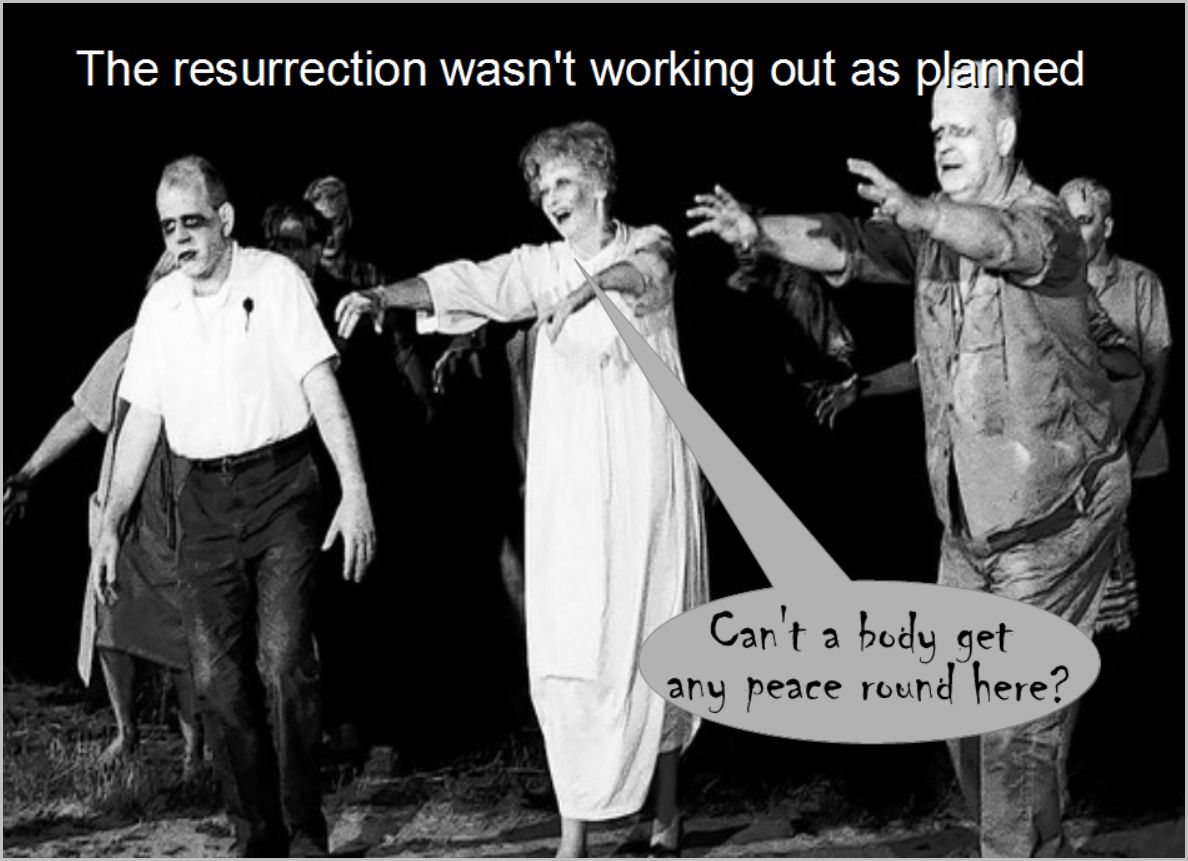
This is why Matthew has hordes of the dead rising from their tombs (Matthew 27.53) – he sees resurrection as the indisputable proof that the Kingdom has arrived. Matthew is so desperate to show that it’s already started, he has bodies emerging from their graves even before he has Jesus himself come back from the dead.

Of course, all of it’s a fairy story, Matthew’s zombies and Jesus’ resurrection included. As we saw last time, there’s no evidence at all that Jesus rose physically from the grave. Paul’s experience of the resurrected Christ was of a beam of light that appeared in his own head, and from this he concocted his entire theology (Galatians 1.12). When the gospel writers created their resurrection stories much later on, they turned such visions into ‘real’ encounters with a reinvigorated Jesus. They offer stories of his eventual return – after a quick visit to Heaven – as a conquering hero who will kick-start God’s Kingdom on Earth (Matthew 25.31).

So there you are. Jesus’ return from the dead, which didn’t happen anyway, was intended to be the first of many such resurrections, right here on Earth. According to Paul and the later synoptic gospels, it signified that God’s Kingdom was about to be established in this world, not the next. In the first century.

As we know, it all happened just as they said it would.
 

Banned from the Kingdom of God

PaulHere’s ‘Saint’ Paul’s list of those who won’t be allowed in God’s Kingdom:

Do you not know that the unrighteous will not inherit the kingdom of God? Do not be deceived; neither the immoral, nor idolaters, nor adulterers, nor sexual perverts, nor thieves, nor the greedy, nor drunkards, nor revilers, nor robbers will inherit the kingdom of God. (1 Corinthians 6. 9-10)

We can do better than that though. Who else could we add? How about the self-righteous? The converted? The born-again? The saved? Fundamentalists? Evangelicals? Evangelists? Ministers, bishops and popes? Christians of all stripes and persuasion? Will they all make it into the Kingdom?

No, they won’t. Not one of them will enter the magic Kingdom.

Why not?

Jesus, Paul and other New Testament writers were sure that the Kingdom of God would be arriving on the Earth soon. That’s ‘soon’ as in their own time, 2000 years ago*, and, as you’ll have noticed, the Kingdom, promised in the past for the past, never arrived. It’s not going to now either; neither Jesus nor Paul thought their fantasy was going to materialise some time in the distant future.

More than this, both were wrong that God was preparing to establish a heavenly kingdom on Earth at all. They were religious fanatics caught up in the religious zeitgeist of their day, religion being all they had to explain life, the universe and everything. Their interpretation was wrong on so many levels – but they were stuck with it. And so, when so much seemed unjust, unfair and unreasonable to them, Jesus in particular felt sure the only solution was for God to intervene to set things right; the meek would inherit the Earth, those last would be first and the first last. It was a dream, a vain hope, a complete invention. Not only did the Kingdom not arrive when Jesus and Paul said it would, it was never going to. There was no God waiting in the wings to make everything better.

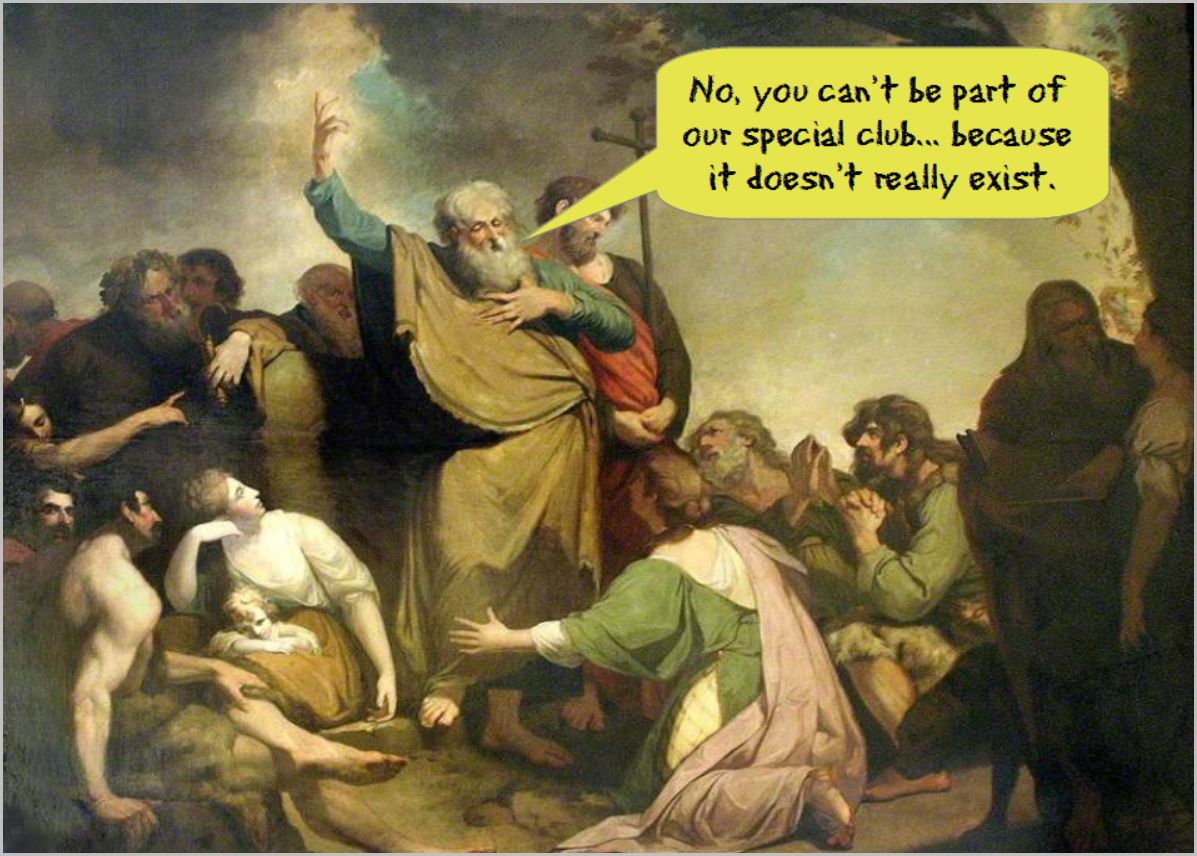
So don’t worry if you’re gay or you like sex with more than one partner or you drink a bit too much or you’ve not been as honest as you might have been. You won’t be part of the Kingdom of God, to be sure, but that won’t be because of your sexuality or your morals or your ‘lifestyle’. You won’t be part of the Kingdom because it isn’t real. You’ll be in good company though – those who love the Lord won’t be getting in either. They’re just as far from Jesus and Paul’s land of make-believe, their special magic club, as you are.


* See Matthew 24:27, 30-31, 34; Luke 21:27-28, 33-34; Matthew 16:27-28; Matthew 19.28; 1 Corinthians 15.51-52; 1 Thessalonians 4.15-17; 1 John 2:17-181 and Peter 4.7 for predictions by Jesus, Paul and other NT writers that the Kingdom was coming real soon.

Christians’ Favourite Delusions 25: Unbelievers are going to Hell!

Spoiler alert: No, they’re not.


HellIt’s always nice when the local fellowship keeps in touch.

There’s good news and bad news. First, the good news: Hell doesn’t exist. You can’t go to a place that doesn’t exist.


Next, the bad news; you’re not going to survive your death. Sorry to break it to you like this, but there it is: no-one survives death. Once the physical, chemical and electrical processes in your brain cease then so do you, because that’s what you’re made of. That self you have a sense of – your soul if you want to call it that – is entirely dependent on those electro-chemical processes. It doesn’t exist independently from them. You cease to be once the brain dies and begins to deteriorate*. Everyone who has ever lived and died, including true believers down the ages – from Jesus, Peter, Paul, Matthew, Mark, Luke and John to Augustine, Bede, Wilberforce and C. S. Lewis – have all ceased to be, dissipated and obliterated forever, along with their physical brains and bodies.


And why, dear Christian, would you want to survive death? What makes you think that the bundle of petty concerns, loves and hates, neuroses, reactions and habits that you call ‘you’, merit long-term survival? Because that odd little collection of impulses is what you’re talking about when you say you are going to live forever. You may regard yourself as changed into some sort of reflection of Christ, but it’s your essential self that you desperately, and arrogantly, hope will enjoy eternal life. It won’t – and why should it?


So, there’s no you to survive and no Hell, or Heaven, for you to go to. The Bible doesn’t offer Heaven – see my previous posts here and here – but it does talk about Hell. It’s the place the Unrighteous go when the Righteous™ take over the earth (albeit it in the first century). According to Jesus in Mark 7.20-23, the Unrighteous are people like murderers, thieves and the proud, while Paul includes other ‘undesirables’ like homosexuals (1 Corinthians 6.9). This isn’t nearly enough for today’s Christians though**. They want everyone except themselves to be sent to Hell. So if you’re not ‘saved’ according to their magic formula, then you’re certain to go there. Never mind if you’re not a murderer or proud or gay. That’s where the God of Love is going to send you, to be tormented forever.


And where is Hell? Jesus seems to think it’s in the heart of the Earth (Matthew 12.40) and invariably those threatened with Hell go ‘down’ to it. The wingnut who wrote Revelation also implies it’s in the Earth (9.2). You’d think, that being the case, we would have found it by now. But we haven’t because, of course, it doesn’t exist. And you’re not going. And there won’t be a ‘you’ to go in any case.


So don’t waste any time worrying about it or letting Christians persuade you Hell is a real place. Live your one and only life in the here and now as best you can. Enjoy it. It’s not a rehearsal for a better place, and certainly not for a far worse one.


Notes:

* In The Lazarus Effect, Dr Sam Parnia relates instances of people being revived up to an hour after death, but only in specific circumstances, when the brain remains undamaged. Any longer than an hour and it’s not possible. Such revivals are extreme forms of the rebooting your brain does every morning after sleep; the brain itself and all its neuro-connections must still be capable of functioning for you to be you again after sleep or even apparent death.


** Yes, I acknowledge some Christians don’t accept Hell. American pastor, Rob Bell, suggests in Love Wins that Hell doesn’t make ‘a very good story’, and that God will save everybody. All Hell was let loose in the resulting backlash from true, Bible-believing Christians; a response that was extreme, brutal and frequently sanctimonious. How dare Bell contradict God’s Word, Holy Scripture? Surely he deserves to go to Hell for that.


Christians’ Favourite Delusions 5: The resurrection is well attested

PsychHere’s a question for you. How many first-hand, eye-witness reports do we have of the resurrection of Jesus?

Thousands? Christians would like you to think so.

Hundreds? St Paul tells us he’s heard this is the case (1 Corinthians 15.6).

Dozens? All those folk mentioned in the gospels, surely…

The answer is one. We have one first-hand, eye-witness report of the resurrected Christ. It’s St Paul’s own which he mentions, in passing, only three times. A total of six verses cover the allegedly most important event in history. Here they are:

Have I not seen Jesus our Lord? (1 Corinthians 9:1)

Last of all, as to one untimely born, he appeared also to me. (1 Corinthians 15:8)

The Gospel preached by me is not of human origin. For I did not receive it from a human being, nor was I taught it, but it came through a revelation of Jesus Christ… When he who had set me apart before I was born, and had called me through his grace, was pleased to reveal his Son in me, in order that I might preach him among the Gentiles. (Galatians 1: 11-12 & 15-16)

And that’s it. That’s Paul’s own account of his seeing the risen Lord. It hardly compares with the high drama of the Acts account, where on the road to Damascus, Paul is blinded by light and has a conversation with Jesus. But that story was written forty years after the supposed event, twenty after Paul’s death, by someone else. What’s more, it is recounted differently each time it’s told (in Acts chapters 9, 22 and 26). It’s not first-hand, it’s not eye-witness and it’s certainly not reliable.

What about the gospel accounts then? Don’t Mary Magdalene, Peter and others see the risen Jesus? Well, no, not in the earliest gospel, Mark, where, in the oldest versions, there are no resurrection appearances at all. The other three gospels have them, but these were written 50 to 90 years after Jesus lived and they contradict each other significantly. You can decide whether his makes them reliable or not, but they certainly weren’t written by the people involved, nor by eye-witnesses.

So, Paul’s account is the only first-hand report we have.

Let’s take a closer look at it.

Even in the heavily reworked versions in Acts, what Paul encounters is not a physical Jesus, a man in a resurrected body, but light from the sky and a disembodied voice, which, depending on which of the Acts account you rely on, no-one else present sees or hears. Paul himself doesn’t even know what he is experiencing – certainly not a recognisable human figure – until the light tells him ‘who’ it is.

There is no difference between Paul’s experience of a light purportedly from heaven and an event that occurred in its entirety – as far as it occurred at all – in Paul’s head. The original Greek of Galatians 1.15-16 makes absolutely clear that this is where it took place: while English translations say that the risen Christ revealed himself to Paul, the original Greek has Paul’s initial experience of the Christ take place in him. Paul, then, admits only to an inner vision of ‘a life-giving spirit’ (1 Corinthians 15.45) and nowhere does he claim that he encountered an extrinsic, embodied Jesus. Nor does the writer of Acts, however much he embroiders Paul’s experience, make the claim for him. The risen Lord, if he’s become anything, is not a resurrected body but a spiritual being made of light.

So, the only witness to the resurrected Jesus who has left us an account – six extremely sketchy verses in his letters – didn’t see the risen Jesus in physical form at all. He experienced an hallucination, or, as he puts it, a ‘revelation’. The resurrected Christ, in our earliest and only eye-witness report, is no more than a vision within a person’s head.

And from this, all else followed.

Jesus’ false promises

I'llBeBackIf Jesus was the Son of God, or maybe God himself, as Christians like to claim, then it wouldn’t be unreasonable to see his promises come true.  After all, if God says he’ll do something, we should expect to see it happen… shouldn’t we?

The fact is, though, that so many of Jesus’ promises have turned out to be false. They haven’t materialised in the time-frame Jesus set for them. Here are just five that turned out to be a complete let down:

1) I’ll be back…

For the Son of Man is going to come in his Father’s glory with his angels… I tell you the truth, some who are standing here will not taste death before they see the Son of Man coming in his Kingdom. (Matthew 16:27-28) 

Just in case we don’t get this the first time, he tells us again in Matthew 24:27, 30-31, 34 and Luke 21:27-28, 33-34, while ‘Saint’ Paul peddles the same nonsense in 1 Thessalonians 4.15-17 and 1 Corinthians 15.51-52. Did JC return with the angelic host for company to establish God’s kingdom on Earth before his disciples died? Nope,’fraid not.

2) Anything I can do…

Very truly, I tell you, the one who believes in me will also do the works that I do and, in fact, will do greater works than these, because I am going to the Father. (John 14.12)

Do we see Christians walking on water? Changing water into wine? Raising the dead? Doing feats even more remarkable than these? We should, if Jesus is telling the truth here. I guess the fact we don’t means this is another fib.

3) Ask and it’s yours…

I will do whatever you ask in my name, so that the Father may be glorified in the Son. (John 14.13)

Very truly, I tell you, if you ask anything of the Father in my name, he will give it to you. (John 16.23)

Does he? When Christians ask of him, does he always provide what they ask, as he says he will here and again in Matthew 18.19? Absolutely not, which is why Christians like to tell us God’s answer to prayer is often ‘no’ or ‘maybe’ or ‘in a while’. But that’s not what Jesus says here; looks like he got it wrong again.

4) Signs and wonders…

These signs will accompany those who believe: …they will lay their hands on the sick, and they will recover’ (Mark 16.17).

Clearly, this why we’ve had no need for medicine or hospitals these last two thousand years. The Christians have been taking care of it all. Or perhaps not.

5) God will provide…

Therefore do not worry, saying, “What will we eat?” or “What will we drink?” or “What will we wear?” But strive first for the Kingdom of God and his righteousness, and all these things will be given to you as well. (Matthew 6.25-7.1)

Which is why true believers don’t need to go out to work to earn money to provide for themselves or their family. Everything they need, the good Lord provides – so long as they ‘strive’ for the kingdom, whatever that entails. Except no amount of chasing the Kingdom of God is going to manifest food and clothing. Jesus must know this because he acknowledges in Matthew 25 that there are people who are hungry, thirsty and without clothes. So why doesn’t God provide for them? It must be that they don’t strive strenuously enough for the Kingdom.

The gospels are full of these empty promises of Jesus’. He fails to deliver on every one, even for those who worship him as God. How would we react if a supposed friend lied to us as often as Jesus does? If we’d any sense, we’d recognise them as a fraud and a failure and send them packing.

Time to do the same to this old con-artist.

Jesus Doesn’t Approve of One Man One Woman Marriage

WeddingWhat does Jesus really have to say about marriage? It’s not what you think.

It is almost impossible to visit a Christian website these days and not find it making pronouncements about gay marriage, same-sex relationships and the ‘evil’ of homosexuality. Some, like Christian Voice, seem to think that the gospel is about nothing else. Elsewhere, Bishop John Quinn of Minnesota, a celibate, single male and thus an expert in matters matrimonial, writes that ‘from the beginning, the church has taught that marriage is a lifetime relationship between one man and one woman… It is a sacrament, instituted by Jesus Christ to provide the special graces that are needed to live according to God’s law and to give birth to the next generation”. Alas, the bishop doesn’t know his Bible, nor his Lord’s teaching. He is not alone in superimposing his own views of marriage on the Bible; it is a common practice among Christians today.

Should you be inclined to do so, you will once again search in vain either for Jesus ‘instituting’ modern marriage or for the early church promoting it. Those who claim he does usually cite Jesus’ apparent endorsement of Genesis 2.24 from Matthew 19.5-6:

a man shall leave his father and mother and be joined to his wife, and the two shall become one flesh”. So they are no longer two, but one flesh. Therefore what God has joined together, let no one separate.

In context, though, Jesus is actually discussing divorce, not marriage, and is making the point that Jewish law permits divorce only because men and women are weak. This prompts the disciples to observe that ‘if such is the case of a man with his wife, it is better not to marry’, with which Jesus agrees, adding,

not everyone can accept this teaching, but only those to whom it is given. For there are eunuchs who have been so from birth, and there are eunuchs who have been made eunuchs by others, and there are eunuchs who have made themselves eunuchs for the sake of the Kingdom of heaven. Let anyone accept this who can. 

In other words, Jesus thinks it is better to be sexless than to marry, the better to pursue the interests of God’s Kingdom. He emphasises the point in Luke 20.34-35:

Jesus said to them, ‘Those who belong to this age marry and are given in marriage; but those who are considered worthy of a place in that age [i.e. that of the Kingdom] and in the resurrection from the dead neither marry nor are given in marriage. 

This is even less ambiguous in its denigration of marriage; it is for this world only, for those who will not be part of the Kingdom, who will not survive death. Those who live in anticipation of the Kingdom, who would be resurrected from the dead, will have nothing to do with marriage in this life, as in the next. Far from ‘instituting’ marriage as Bishop Quinn claims, Jesus heralds the end of the institution.

The Kingdom, however, didn’t come when Jesus said it would. Newly formed groups of believers found themselves having to decide what to do about marriage in a world that was lasting longer than he’d promised. Consequently, ‘from the beginning’, the early church’s position was that marriage would do if believers couldn’t manage to control their sexual urges. But, Paul declares in 1 Corinthians 7.8-9, it is better to remain celibate and not to marry at all:

to the unmarried and the widows I say that it is well for them to remain unmarried as I am. But if they are not practising self-control, they should marry. For it is better to marry than to be aflame with passion.

While it is true Paul assumes any marriage will be between a man and woman, this is hardly the ringing endorsement of marriage we might expect from the assertions of today’s Christians. For Paul, the leaders of the early church and Jesus himself there was no point to marrying when they lived in the end times. As Paul says in 1 Corinthians, 7.28-29:

But if you marry, you do not sin, and if a virgin marries, she does not sin. Yet those who marry will experience distress in this life, and I would spare you that. I mean, brothers and sisters, the appointed time has grown short; from now on, let even those who have wives be as though they had none…

Paul is not sanctioning marriage because he anticipated that any marriage could only be short-lived and traumatic; as he goes on to explain in 1 Corinthians 7.32-34, marriage is little more than a distraction from ‘the affairs of the Lord’. He is not therefore promoting ‘life long’ commitment in the sense Bishop Quinn, Christian Voice’s Stephen Green and Christians who don’t know their Bible claim, because those to whom Paul writes are not, in his view, going to continue in their existing lives for very much longer.

Above all, Jesus and Paul are most definitely not establishing rules for marriage for the rest of time, simply because, for them, there was no ‘rest of time’.