
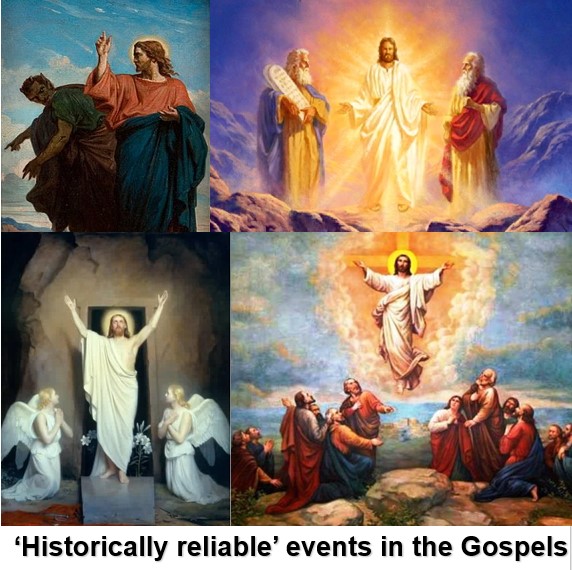
The Gospels and Other Fiction, part 2

The gospels were written as history. Their writers did not make things up.’

History, as koseighty has reminded us, is not littered with angels, devils, demons, spirits, apparitions, miracles, voices from the sky and resurrected corpses. Real history was being written at the same time as the gospels, by Josephus and Suetonius for example, who do not include the supernatural but do reference their sources, something the gospels never manage.

And of course the gospel writers did make things up. They invented numerous stories for Jesus to make it appear he is fulfilling prophecy (even when that ‘prophecy’ wasn’t prophecy to begin with.) This included making up ‘history’; Herod’s Massacre of the Innocents (a rewrite of a fiction about the infant Moses), the crucifixion eclipse, the rending of the temple curtain and more. These are all symbolic events. They didn’t really happen. Jesus’ own resurrection can safely be added to the list. It’s ironic that those who defend the gospel authors against the charge they made stuff up are the same who invent stories themselves: Mark and Luke knew each other? Mark proof-read Luke’s first draft? There were people who would fact check the gospels and point out any errors? But the original Christians wouldn’t do such a thing. Except they did.

There are no Inconsistencies, contradictions and inaccuracies in and between the gospels, but if there are, these are irrelevant. It’s the bigger picture that counts.’

Jesus is different in all four gospels. Despite Matthew and Luke’s plagiarising of Mark, they alter him to reflect the Jesus they believe in. John’s Jesus is so far removed from Mark’s that he’s a different character altogether. The inconsistencies do matter: did Jesus perform signs and wonders or not? Was he crucified on Thursday or Friday? Was it Peter, John or Mary who was first to see him resurrected? Did he hang around for one day or for 40? These conflicting details tell us that the creators of the Jesus story were more than happy to alter it when it suited their purposes. This is not how history is written. It is how propaganda is created. The ‘bigger picture’ is, in any case, made up of these smaller details. They work collectively and cumulatively to create the bigger picture. If we can’t rely on their being accurate how can we be sure the bigger picture is? When the gospel writers are unreliable in the smaller details, how can we be certain they’ve got the bigger picture right, given they’re all copying it from the same source, Mark, and giving it their own spin?

There is corroborating evidence of the gospels’ accounts’.

There is? Where? Just because there is some evidence that Nazareth existed doesn’t mean Jesus performed miracles, any more than Dunsinane castle’s existence proves Macbeth murdered King Duncan (he didn’t). Just because Pilate was a real historical figure doesn’t mean he crucified Jesus, any more than the existence of King’s Cross Station means Harry Potter catches his train there. And these, surely, are merely the small details. There is no corroboration at all for the bigger picture. Mention of the followers of Chrestus in Suetonius confirms at best that there were Christians in Rome at the time of Claudius, but no-one is disputing that. At worst, for the apologist, this curious reference has nothing whatever to do with Jesus. Later references to incidents from his story, by the much vaunted Church Fathers, are derived from the gospels and are therefore dependent on them. As such, they don’t constitute independent corroboration.

Everything Jesus prophesies or predicts in the gospels will come to pass, then sceptics will see that everything in the Jesus story is true.’

This one is from a commenter on Don’s blog. (I only went there by accident, honest.) The problem with this one is that everything Jesus is made to promise should already have come true, two thousand years ago. The Son of Man should have appeared in the sky with the heavenly host to usher in God’s Kingdom on Earth, while sending most of mankind to the fiery pit or outer darkness or some other damn place. Both he and Paul claimed that this would happen within their and their followers’ lifetimes. The trouble with Christianity is it is always winter and never Christmas. Its fulfilment God’s – God’s Kingdom on Earth, life after death, the final judgement – is always going to be at some indeterminate time in the future, a time and fulfilment that never quite arrives. It never will; part of ‘the big picture’ we can be confident we will never see.

More to come (unlike Jesus). 

God: more reasons why not

Blog403

The third reason it’s unlikely God exists (see the previous post for the first two) is that he is a mass of contradictions; omnipotent and yet vulnerable to his creation’s ‘sin’. Loving yet unable to stop himself from meting out savage justice. Interventionist yet conspicuously absent when actually needed. Distant and mysterious and yet intimately involved with a select number of humans. Oblivious to the thousands who starve to death each day yet overly concerned with how others dress, spend their money or have sex.

The God of the Bible is everything a badly conceived character in a third-rate novel might be. Not surprising really, when that’s what he is. The all-too-human authors of that most mixed, muddled and deplorable book creating and recreating him in their own image, modifying and evolving him until he is a transparently human creation. He is a product of their misinterpretation of reality, wishful thinking and vindictiveness, human traits he reflects throughout the so-called ‘holy book’ and in his church throughout history.

Four, God is ineffectual in the real world. He demands the love and devotion of his creation and gives next to nothing in return. Warm fuzzy feelings possibly, and a ludicrously nonsensical ‘salvation’ plan that undercuts his supposed omnipotence. That’s it. That’s all he offers. Oh, and eternal life spent as an automaton, forever worshipping him. Nothing in the here and now. Nothing to alleviate poverty, feed the starving, eliminate disease or rescue us from viral pandemics. He doesn’t even do this for those whom have pledged allegiance to him, however much they claim he has or will do. This leaves us with two options: he is either an absolute failure or he doesn’t exist. I conclude the latter.

Five: Jesus. Jesus is the prime evidence there is no God. Not one of the claims Jesus made for God was realised. God doesn’t answer prayer; he doesn’t give whatever is asked of him (Mark 11.24; Matthew 21.22); he didn’t bring his kingdom to the earth in the first century (Luke 9.27; Matthew 24.29-31 & 34); he didn’t set Jesus and his disciples up as rulers of the world (Matthew 19:28). In short, he didn’t do a damn thing his supposed son said he would. Jesus was sadly mistaken, deluded, about his Father. In terms of delivery, Jesus’ God did nothing for him, nor for those, like Paul, who came after him. The New Testament is nothing but testimony to its own failure, its God mere make-believe.

To be continued, again. I mean how many more reasons can there be that demonstrate God is unlikely to exist?

Hermeneutics = Sameoldtrics?

Paul&JCHermeneutic consistency is the means by which Christian apologists try to harmonise disparate parts of the Bible. Saddled with the premise that the Bible is the Word of God they need to demonstrate a consistency it doesn’t have because God, as its ultimate creator, could not possibly be the author of confusion (1 Corinthians 14.33). Consequently, they set about ironing out the Bible’s many discrepancies and contradictions to arrive at what they claim is a consistent and uniform Salvation Plan.

Unfortunately, this being an essentially dishonest enterprise, they have to pretend that New Testament authors with conflicting ideas about what it means to be a follower of Jesus are really saying the same thing. As I demonstrate in Jesus v Paul Round 2, there are vast differences between Paul’s good news and that ascribed to Jesus in the synoptic gospels. In the latter, Jesus is made to say that ‘righteousness’ can be cultivated in a measure-for-measure arrangement so that the extent to which a person forgives, gives to others and demonstrates compassion and mercy is mirrored exactly in how much God forgives, gives and shows mercy and compassion to that person in return. Paul on the other hand sees ‘salvation’ as being entirely undeserved. It is, rather, the result of God’s ‘grace’, which is given even though unmerited. According to Paul, showing compassion and mercy and offering forgiveness has no bearing on whether one is saved or not. These – Jesus’ path of righteousness and Paul’s unearned salvation – are two entirely different, and mutually exclusive, ‘ways to God’. Christians choose to remain blind to this fact.

They see no difference between the two ways to redemption because they are taught that Christianity is one grand scheme, woven, as it were, from a single piece of cloth. From this perspective, Jesus and Paul are simply drawing attention to different aspects of what is taken to be a consistent pattern. But this isn’t so; the New Testament is more like an untidy patchwork, a series of explanations by at least a dozen hands of what Jesus was about. Its most prominent voice is Paul’s (and those who pretend to be him); Christians prioritise Paul’s teaching over and above that of the synoptic gospels, which is markedly different, and interpret their ‘good news’ in the light of Paul’s mysticism. What doesn’t fit, they discard.

This has been a problem ever since the start of Christianity; the differences and disputes between Paul and the original disciples is well documented in the New Testament itself. Paul did not regard those who had walked and talked with Jesus as having a grasp of the true gospel (his) and was not reticent about saying what he thought of them. In Galatians 5.12, for example, Paul is so pissed off with the apostles he wishes they would accidentally castrate themselves.

Enter Luke, the original hermeneutic harmoniser. His Acts of the Apostles is designed to reconcile the radically different doctrines. By and large he succeeds, with most believers down the ages, perhaps because they haven’t wanted to, unable see the joins. But Acts doesn’t get Paul’s itinerary right, let alone his theology. The speeches Paul makes in Acts are not about the salvation through grace that concern him in his letters. They make concessions to other teaching – that of repentance and forgiveness (for example in Acts 13.38 and 17.30) while the real Paul makes no such compromise. There are no exhortations to repentance nor the promise of forgiveness in Paul’s own writing; there he mentions repentance only once, in a strikingly different context (Romans 2.4), and forgiveness not at all.

Moreover, Paul is adamant that he did not receive his doctrine from Peter or anyone else (Galatians 1.11-12). Instead he insists he got it direct from the Lord – i.e. through the hallucination he alludes to in Galatians 1.11-12 and 1 Corinthians 9.1 & 15.45 – which explains why it is so radically different from the original believers’. In Acts, however, Luke isn’t very happy with this – he’s trying to harmonise, after all – and has Paul meet Peter and James very soon after his conversion (Acts 9.26-30). Following some initial sheepishness, Luke implies, they all get on famously.

According to Paul, however, he and Peter didn’t meet for the first time until three years after Paul’s conversion (Galatians 1.18) and it was fourteen years later before he talked with a larger group of disciples (Galatians 2.1), when ‘the pillars of the church’ summoned him because of his wayward teaching. Paul records how he ‘rebuked’ Peter shortly after this (Galatians 2.11-13) because he objected to Peter’s interpretation of what was involved in following Jesus. In short, Paul and the apostles could not agree on what constituted belief in Jesus and what part Jewish law played.

Two questions result that Christians need to ask themselves, though invariably they don’t:

1. Where there are discrepancies between Paul’s theology and account of events, and Luke’s – written 15-20 years after Paul’s death – which is more likely to be correct?

2. Who is more likely to have the greater understanding of Jesus’ teaching: Paul who never met him but made it all up in his head, or Peter and the other disciples who spent years with him, listening to what he said?

In answer to the second, Christians down the ages have opted for Paul, the one who made it all up. His Salvation Plan is, after all, easier to buy into than Jesus’ mad idea of giving everything away and loving your enemies. Having chosen their man, it follows that the rest of the New Testament must be forced to comply with Paul’s ideas.

This is hermeneutics in the hands of Christians; an intellectually dishonest sleight of hand designed to bring everything into line with their interpretation of Paul’s idiosyncratic take on a man he never met. As for those who are unimpressed by their contortions, well, it must be that they have a faulty hermeneutic. Praise the Lord!