Seek and Ye Shall Find

Thanks to all the Christians who responded to my questions last week. Here’s the answers (in red) they helped me reach.

I asked –

1. What happens to you, as a Christian, when you die:

a) You go immediately to heaven (The Bible says this precisely nowhere)

b) You go into suspended animation until Christ’s coming and the final judgement (Paul implies this is the case in 1 Thessalonians 4:13-18. You have to ask yourself how he knew this)

c) You cease to exist (Yup, this is it. So, as Dolly says, better get to livin’)

2. According to the first three gospels, how long was Jesus in the grave?

a) About 36 hours (Friday tea-time till just before sunrise on Sunday. You do the Math)

b) 3 whole days (see above. Despite saying in Matthew 12:40 that this is how long he’d be dead, he fell way short. The fourth gospel, on the other hand, alters the timeline to make things fit)

c) He wasn’t: he went down to hell (according to 1 Peter 4:6 and the so-called Apostles’ Creed this is exactly what he did. Some people are daft enough to believe it)

3. Which of the following does Paul refer to in his letters?

a) Jesus’ miraculous birth (he mentions this zero times)

b) Jesus’ parables, teaching and miracles (likewise; not a single mention)

c) The Empty Tomb (nor this. Don’t you think that’s strange?)

4. How often did Paul refer to Jesus’ second coming?

a) In all of his letters (Nope)

b) 2 or 3 times (Nope)

c) Never (That’s it: not once. Paul looks forward to Jesus coming soon, as if it’ll be his first visit: 1 Thessalonians 4:13-18 again. Don’t you think that’s significant?)

5. How often did Jesus refer to his second coming?

a) Once or twice (No)

b) Frequently (Again, no)

c) Never (Yes, never. The fictional Jesus of the gospels says someone called ‘the Son of Man’ would be arriving real soon: Mark 14:62. Occasionally Jesus’ creators suggest he and the Son of Man are one and the same, which they are in that both are fictional)

6. When did Paul say the Messiah would be coming to the Earth?

a) Thousands of years in the future (To hear modern Christians talk you’d think this was it, but no: Paul never said this.)

b) While he himself was still alive (He says clearly that he expected he’d still be alive when Jesus came down from heaven: 1 Thessalonians 4:13-18. How many more times?)

c) He didn’t say (course he did: see above)

8. According to the gospels, when did Jesus say the Son of Man would be coming to the Earth?

a) He didn’t (he did)

b) Thousands of years in the future (Nope)

c) While those he was talking to were still alive (Yes: in Mark 9:1; 13:26 and 14:62)

8. What, according to the Bible, is the Word of God?

a) The Bible itself (‘Fraid not)

b) The Church (No)

c) Jesus (Yes, but not as often as you might think: only in John 1:1-3)

9. Which was written first?

a) Mark’s gospel (made up about 70CE)

b) Paul’s letters (the earliest, in the 50s)

c) Acts of Apostles (invented circa 80-90CE)

10. When the New Testament mentions ‘the Scriptures’, what is it referring to?

a) Ancient Jewish writings (exclusively so)

b) The whole of the Bible as we now know it (the Bible as such probably didn’t exist until the 4th century)

c) The New Testament (there was no New Testament when the writers who would later be included in it were writing. So, no)

11. How did the New Testament writers ‘prove’ Jesus was the Messiah?

a) By claiming the scriptures predicted he would be (Exclusively so)

b) By pointing to his miracles (Never)

c) By quoting things he said (Never)

Now isn’t that odd.

12. According to the Bible, how did Jesus want his followers to spend their time?

a) By witnessing to atheists on the internet (You think?)

b) By worshipping him (Never)

c) By feeding the hungry, healing the sick and helping the weak (This. See Matthew 25:31-46. So why you spending your days and nights harassing non-believers on the Net?)

Actually, no Christian helped out with this. The answers are those that scholars (and I, in my own humble little way) have arrived by actually reading the friggin’ Bible. 

Flourishing

The solution to all our problems is to return to God.

How many times have we been told this recently? It seems here in the UK that hardly a week goes by without a new book, report or high-profile article appearing advocating a return to ‘Christian values’ or acknowledging Something Greater Than Ourselves (invariably the Christian God). This, it invariably assures us, is the only way to bring us back to our senses and solve all our problems. Even previously atheist/agnostic writers – Richard Dawkins, Douglas Murray, Tom Holland, Jordan Peterson, Aaran Hirsi Ali and Russell Brand (how’d he get in here?) – suggest that Christianity must be revived to prevent the vacuum created by its decline from being filled by the less humane Islam.

I’ve written about this fallacy before – here and here – so won’t go over the same ground again. Instead, I want to highlight a recent report, The Global Flourishing Study, carried out by Harvard University and funded primarily by the Templeton Foundation. Alarm bells! The Templeton Foundation is a religious organisation, so already the study’s conclusions are thrown into question. What were participants asked? What was their background? What bias did the questions convey?

Not surprisingly then, the study concluded that many people in the world are not flourishing and that those who are, are flourishing – surprise, surprise – largely as a result of religion:

Religious service attendance was one of the factors most consistently associated with present or subsequent wellbeing, across countries and across outcomes.

Religious groups have leapt on the conclusions as evidence that humans need God to live fulfilling lives. The key word here, however, is ‘attendance’. The study itself acknowledges that human community – being with other, like-minded people with a common interest or cause – is a significant aspect of the resulting flourishing. But we knew this already so maybe the $43.4 million spent on the study might have been better spent: feeding the hungry, perhaps? An earlier 2017 study also by Harvard was headlined:

Harvard study, almost 80 years old, has proved that embracing community helps us live longer, and be happier.

Numerous other recent studies have reached this same conclusion (see here, here, and here for more).

The god factor injected into Harvard’s more recent study to satisfy the Templeton Foundation and its affiliates is further complicated by the fact that there isn’t only one god involved in making us all feel jollier. There are currently thousands in use throughout the world (the internet is unable to provide an actual figure, however approximate). Thus, those who congregate in the mosque to praise Allah enjoy the same ‘flourishing’ as those who meet at the synagogue to worship Yahweh. Likewise, those who come together to worship Brahman experience the same benefits as those who gather to praise Jesus. Not because any one of the gods in question is the real one – they can’t all be – but because the participants are worshipping and serving together, collectively as a community. That is where the ‘blessing’ comes from. The innumerable gods involved are incidental. Indeed, each is dismissed, if not held in contempt, by the adherents of the others.

In the end then, what enables us to flourish and live longer healthier lives is company – human company. This doesn’t require a church, mosque, synagogue or temple. There are other, superstition-free ways: time spent with family; volunteering with others; joining a drama/bridge/walking/sports/writing/LGBT (worked for me) /whatever-you’re-interested-in group. The song from Funny Girl gets it right: ‘people who need people are the luckiest people in the world’. Of course other people can be frustrating (present company excepted) but unlike the gods they’re real and provide the companionship, fellowship and company we need to thrive. As ever, no God required.

Conclusions

So what do we see when we arrange the books of the New Testament in chronological order?

  1. In all probability, Jesus was first experienced in visions experienced by a few Jewish zealots looking for the arrival of the Messiah. His name – Yeshua – is symbolic and means ‘The Lord is Salvation’.

  2. These visions led to ‘revelations’ that convinced these zealots that the Messiah would soon arrive on the Earth to set God’s plans in motion.

  3. A small number of Jews were convinced of the veracity of these claims and sought to spread the message that the Messiah/Jesus was soon to arrive on Earth.

  4. A few years later, a Hellenized Jew who called himself Paul, argued that the Messiah – ‘Christ’ in Greek – had died in the heavenly realm and been raised from the dead by God. His sacrifice, Paul insisted, was a propitiation for human sin, both Jew and Gentile.

  5. Also according to Paul, the Christ’s arrival would trigger the resurrection of the dead, prophesied in Daniel 12:1-3 and Isaiah 26:19-20, the final judgement (Daniel 7:22) and the establishment of God’s kingdom on Earth, governed by God’s Chosen (Daniel 7:27). Regrettably, he drew most of these conclusion from a book, Daniel, now known to be fake.

  6. Paul ‘proved’ that the Messiah-figure he’d seen in his visions really was the Messiah prophesied in Jewish scripture by quoting from them extensively.

  7. Soon after Paul died, the original group of visionaries, who had had their differences with Paul, were all but wiped out when the Romans destroyed Jerusalem.

  8. Around the same time, an unknown cultist took it upon himself to write an allegorical history of the Christ’s activities. He based this allegory on Paul’s teaching about the Christ as well as events from Jewish scripture. He set his story in Galilee some forty years earlier and has his fictional Christ, Jesus, prophesy the arrival on Earth of the real Messiah whom he calls the Son of Man, after Daniel 7:13-14.

  9. Two other cultists set about altering and improving this original history. One re-establishes the Christ’s Jewish credentials, and extending references to and allegorising aspects of Jewish scripture.

  10. A completely imaginary history of the early cult was created by one of these writers, smoothing over the differences between the beliefs of the earliest visionaries and Paul.

  11. Other writers, including some pretending to be the late Paul, continue to write of Jesus the Christ as a celestial saviour.

  12. A fourth history of the Christ was created, this time providing Jesus with a bodily resurrection (contrary to Paul) and discarding some of the cult’s earlier beliefs, the imminence of God’s kingdom on Earth included. The authors of this account imply that dead believers will awaken to new life in heaven (John 14:2)

  13. The idea that the Messiah will arrive imminently was, however, kept alive by other writers. One anticipated the Christ would soon purge the world of evil-doers and bring a holy, bejewelled Jerusalem down to Earth.

  14. Others soon abandoned the idea that any of this would happen soon. The arrival of the Christ was postponed indefinitely.

  15. The notion the Son of Man/Messiah/Jesus had yet to appear was also dropped as the church adopted the allegorical gospels as real history. It began to expel those who disputed the gospels’ veracity and denied that Jesus was the Christ incarnate.

  16. While the term is not used in the New Testament the Christ’s delayed arrival was, from the early second century, thought of as a second coming.

  17. The church, once well established went on to embellish doctrine, adding the Triune God; eternal life in Heaven; the elevation of Mary and the saints; the New Testament as the Word of God and the infallibility of the Bible as a whole. Some of these were, and are, in direct contradiction of the beliefs of the earliest Christians.

  18. Believers today, if they read the New Testament at all, take its traditional order at face value, which distorts the evolution of its ideas. They allow their preachers to smooth over what now appear to be random contradictions (hermeneutics).

  19. Today’s Christians believe primarily in the heavenly Christ, who forgives their sins and guides their lives from Heaven. They also hold on to the belief that he was manifested as a human, and vociferously oppose the idea he was and is only an imagined supernatural being.

  20. At the same time they prioritise Paul’s teaching about him over anything he is made to say in the gospels .

That how I see it anyway. The more time I spend looking at the New Testament books in their correct order, as well as what this reveals about the beliefs of early Christians, the more I’m driven to these conclusions. They’re the only ones that make sense of all that we find in their writings. I realise this is contentious. Mythicism is not widely accepted but it is the only position that explains the recorded facts as we have them. The original Jesus was seen (in the mind of the first visionaries and by many later) as a heavenly Messiah. While the gospels were generally accepted as historical many decades after they were written, they are anomalies in the expression of the early faith. They can only be seen as allegories of the living, dying and rising of a cosmic saviour, a sequence not uncommon in the mythologies of the ancient world.

I recognise too that there may well be other problems with this position, which I’ll get to soon.

Encounters with God

I had a couple of encounters with God on a recent trip to the Baltic states of northern Europe. Both were in churches, the first in Helsinki, Finland. The Lutheran Temppeliaukio Kirk (above) is a remarkable structure hewn from solid rock into a stunning enormous cavern. The choir was practising when our tour guide took us there. The singing was sublime, amplified and enhanced by the acoustics of the cave. Listening to the ‘heavenly’ voices was a truly spiritual experience. After the performance, the choir leader dedicated their performance to the glory of God.

The second church was the protestant St Nikolai’s in Kiel, Germany where, local legend has it, a miracle occurred during the second world war. When the town was in danger of being bombed, church officials had all of the church’s historic pews removed and safely stored. The massive suspended crucifix, however, was too big to take down and had to be left in place. Some parishioners quickly became unhappy standing for services and started bringing their own seats, including quite a few sofas. When the town and the church were eventually bombed, the huge crucifix fell from its height and crashed down. While the church itself was all but destroyed, the crucifix survived with only minimal damage, thanks to the sofas on which it landed. A miracle!

The cross suspended again in the restored St Nikolai church

Singing that reflects the glory of God and a miracle in which Christianity’s holy symbol is preserved. Presumably today’s attendees at both churches (St Nikolai’s interior was rebuilt) believe these events to be the work of God. Our tour guide that day expressed his scepticism, as did I, inwardly at least. The singing in the cave church was a tribute not to God but to the human ability to create beauty. It spoke too of the skill of the church’s architects and engineers who provided the building with its stunning acoustics. Human ingenuity, creativity and, I would guess, hours of practice produced the sublime sound.

The crucifix ‘miracle’ was a remarkable convergence of coincidence. A good story to be sure, but not an event that requires any God.

I drew the same conclusion from the two experiences: human beings are prone to give credit to their deities for things they achieve themselves – beautiful singing and stunning architecture included – and to attribute chance events and coincidences to their gods. We should take credit for our achievements (as well as responsibility for our bad behaviour.) The gods have no part to play. There are no gods.

The Missionary Position

Dear Missionary friend,

Why is it you have to tell everyone about what you believe? Whether you’re on the bus, in the middle of town or online, you are compelled, it seems, to tell everyone about your faith. Why is that? You think we’ve never heard of Jesus, Jehovah, Krishna or Muhammed? Let me tell you, we have and most of us are not interested in your mumbo jumbo in whatever form it takes. I guess you think if you can ‘plant a seed’ or draw at least one unsuspecting soul into listening to you, you’re doing the Lord’s work. It’s vital of course that everyone hears your version of the good news. You don’t want even one lost soul to go to hell on your watch.

Well, that’s what you’d say, or something like it. But I think you go around preaching for entirely different reasons. I think you’re compelled to proselytise because you’re indoctrinated by your church to do it. Your minister tells you you must do it, because Jesus or some other prophet commands it. It is a commission. I know this because I was once where you are now. Your standing in your congregation depends on your ‘witnessing’. It also means you can say you’ve done your bit. Those who don’t listen to you, who don’t commit to your religion, have only themselves to blame when they face holy judgement and are thrown in the Lake of Fire/Hell/Jahannam.

But these are not the only reasons. Your church/mosque/meeting house needs more members to keep its coffers full and to maintain its credibility; we can recruit! That and the fact you and those in your church/sect/cult are insecure. Yes, that’s right, you’re insecure in your faith. You need others to validate what you’ve chosen to believe. You need new converts to join you because there’s safety in numbers. They allow you to feel it isn’t just you who’s fallen for whatever malarkey you’re wrapped up in. There are people as gullible as you: what a relief!

So please, next time you feel moved by the Spirit/prophet/saviour to share your beliefs with unsuspecting passengers on the bus, shoppers, passers-by in the street and people minding their own business in their own homes, we’ve got your number. We know what you’re up to.

Yours in Christ alone knows,

The Apostle Neil


The Evil of Christianity

Moral corruption and abuse are the inevitable destinations of religious sects. And they are all sects, regardless of their facade of respectability.

I recently watched Disciples: The Cult of T. B. Joshua, a series of programmes made by the BBC, about the Synagogue Church Of All Nations, led by the late ‘Daddy’ Joshua in Nigeria. You can watch the programmes on the BBC iPlayer where available and on YouTube elsewhere. When not preaching Jesus in the church’s massive auditorium, ‘Man of God’ Joshua was systematically and callously abusing, degrading and raping the vulnerable young women he had lured into serving the church.

Then today, I read of the sexual abuse of children, both historical and recent, by church leaders in a sect operating in Canada and the US known as The Truth. The abuse of some young boys and girls went on for years, leaving victims psychologically scarred and the perpetrators unpunished.

The Church worldwide has a serious, significant problem with sexual abuse that it consistently fails to address. There’s also the widescale abuse perpetrated in and by the Roman Catholic, Southern Baptist and Anglican sects. It is usually left to journalists and secular authorities to take responsibility for rooting out and exposing the abuse. The Church itself covers up, obfuscates and makes excuses, the chief of which is that the sects in question, the leaders in question, are an aberration and not ‘real’ Christians at all. (No kidding. But then who is?)

Individual Believers will say – and there will be some who will say it in response to this post – that it doesn’t happen in their nice little church (you sure?) and dismiss abuse as something that happens only in misguided cults. The truth is that the Church hands power to charismatic, manipulative men who, provided they preach the true gospel (whatever that is), are elevated above secular law and, lacking in empathy, regard themselves as beyond moral constraint. They see themselves as answerable only to God, because the Bible says so, and he has anointed them with both power and authority.

It happens time and again in churches, sects and Christian cults everywhere. It is the surest sign that Christianity does not work and is, despite the honeyed words of its apologists, positively evil.

Jesus Is Cool With It

I was handed a sticker the other day that read ‘Jesus is cool with it’. Just what the hip Jesus of the sticker was cool with was explained by an accompanying leaflet, and the fact I was at a Pride event at the time.

I worked out from the leaflet and his rainbow flag, that what Jesus is cool with is homosexuality and all that goes with it. He might also be cool with transgenderism and other variations in human sexuality, but who knows; the leaflet didn’t say so directly. It did, however, have a list of websites that support those who are religiously afflicted and gay, transgendered or of unorthodox sexuality. It suggested that through these sites it might be possible to find a gay affirming church in the local area.

I was at first pleased to see that Jesus had had a change of heart. That he had in fact made a complete u-turn from his previous position, which evangelicals have long assured me, is that homosexuality is a heinous sin and a ‘violation of God’s design for human sexual behaviour’.

Eagerly, I logged into my favourite – I use the word loosely – Christian sites to see how they were celebrating this new revelation from the Lord. Unfortunately, they had yet to be updated and so weren’t conveying the news that Jesus was now ‘cool’ with gayness and the like.

That was over a week ago. I’ve just checked again only to find that they’re still not proclaiming this particular piece of good news. In fact, some have published even more rants well considered pieces about the evils of homosexuality, drag acts, people who are changing sex and the rest. They are so uncool about it that they’re still quoting the Bible: the Old Testament verses where it says that for a man to lie with another man is an abomination, and Paul, who, channelling Jesus (or so he’d have us believe) insists that homosexuals won’t make it into God’s Magic Kingdom. Some sites also mention Jesus’ pronouncement in Matthew 19:14 (yawn) that God made only male and female and the only time they’re allowed to get jiggy with each other is when they’re married.

I’m left wondering who is right. The ‘Jesus is Cool’ brigade or the great preponderance of evangelical churches that say he isn’t cool, not one jot or tittle, with same-sex doings.

The thing I’ve learnt through this, is that Jesus can be whatever you want him to be: a really cool guy who gives the thumbs up to whatever consensual sex you enjoy or a grouch who didn’t die just so you could continue in your old sinful ways. Take your pick. He’s both, depending on which bits of the Bible you prefer.

I wouldn’t care one way or another if it weren’t for the damage done by those who think they speak for the grouch.

10 Reasons Why

I wonder what are the reasons those of you who were once Christians gave up on faith? Believers who know me far better than I know myself have attributed to me a whole range of motivations. Here’s a top ten of the reasons I rejected Jesus according to these spiritually astute know-it-alls:

In at 10 it’s…

You must have been hurt/had a bad experience of Christians. To which I answer, not particularly, though I did find the people I encountered in churches to be much like those I encountered in any other organisation I’ve been involved with. No different. Certainly no better, and in some ways worse when they squabbled or were petty and judgemental. Not sufficiently worse to make me abandon faith, but perhaps enough to make me ask whether Christianity really ‘worked’. Shouldn’t Christians who are new creatures, reformed in the image of Christ. be so much better than the rest of us?

At 9… You went to the wrong church. If so I must’ve attended several ‘wrong’ churches as I moved around the north of England with work. My wife and I always sought out churches with sound biblical teaching, so it wasn’t the lack of solid food that caused me to backslide (to use the Christian jargon.)

8. You wanted to wallow in your own sin. As I’ve said facetiously before, I like a good wallow as much as the next man and preferably with him. Back in the days of my struggling with faith, however, I didn’t find myself drawn to ‘sin’. I was trying to raise three children, do a demanding job and deal with the fallout from my boss’s affair with a colleague. My own sin was the last thing on my mind.

Related to this is the accusation that an apostate such as I wants, in some unfathomable way, to be God. Certainly I want to be fully human and to take charge of my own life, but aren’t these laudable intentions? It doesn’t mean I aspire to be God; I don’t want to be worshipped, don’t want to laud it over others, blame them for my deficiencies or send them to hell. That’s what God does, right? But it’s not me. 

7. You rejected Christ because you’re gay and didn’t like the constraints faith placed on your sexual behaviour. See above. I didn’t admit I was gay until several years after I ditched faith and it was several more after that before I came out, yet more until I did anything about it. But okay, if you want to reverse the order of events, I gave up on religion because I was latently gay. But not really, though certainly the abandonment of faith was a liberation; I could think for myself and was free, over a long period of time, to finally become myself.

6. You read the wrong books. I certainly did: C. S. Lewis (I still have my collection of his books), John Stott, John Piper, John Bunyan, Bonhoeffer, Joni Erickson, Corrie Ten Boom, Billy Graham, David Wilkerson… and the Bible. So yes, I wasted a lot of time reading this sort of thing, but I’m guessing that’s not what my Christian accusers mean. I read more widely as I moved away from faith which helped me break out of the Christian bubble, but this wasn’t the reason I left the faith. I was well on the way by this time.

5. You were never a true Christian. Your faith was intellectual or habit or emotional but not deeply personal. Of course I was a true Christian. Just ask Jesus. Oh… you can’t. I’ve written about this before as you’ll see here. I was as real a Christian as those who claim they’re the real deal now.

4. You were in thrall to non-Christian writers. Not in thrall, no, but these writers – Ehrman, the so-called New Atheists, science writers (Dawkins’ science books particularly), Pagels, Barker, Loftus, Alter and, yes, Carrier – make a lot more sense than those who write from the perspective of faith. These authors don’t seem to mind, indeed they relish that their readers think critically about the evidence they present. Mumbo-jumbo isn’t passed off as erudition.

3. You have no awareness of the spiritual; you think that only that which can be measured is real. This is true, but it is not why I gave up Christianity. It is a consequence of doing so. I have seen no evidence of a spiritual realm that exists outside the human imagination. If anyone is able to present evidence that it does have independent existence, I’m open to it. Until then I will continue to live with the understanding that angels, devils, demons, heaven, hell, celestial saviours and gods, like unicorns, dragons and Shangri-La, do not exist. It follows that as non-existent beings they cannot communicate with us nor await us as our final destination.

2. Your heart has been hardened by Satan. See above; there is no Satan. Hardening of the heart is a metaphor for those who don’t fall prey to Christianity’s fraudulent claims or at last see through them.

1. You gave up on faith because you realised none of it was true. Yes. Finally. This is why I rejected Christianity. It simply isn’t true, as I’ve attempted to demonstrate on this blog for the last 12+ years. Its third-rate fantasies, fake promises and failed prophecies are all evidence of its falsity.

But wait. None of the telepathic Christians who ‘know’ why I’m no longer a believer ever make this accusation. They would never concede that most (all) of what they believe simply isn’t true. But my life experience and my reading as I began to suspect Christianity was nothing more than a con have borne this out. Christianity is demonstrably untrue, theChristian God a fraud and supernatural-Jesus a fiction. This is why I abandoned Christianity.

How about you?

Can you be a Christian and… gay? (part two)

Blog391b

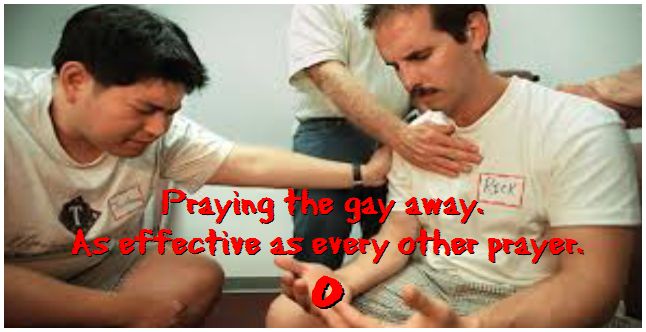
So, you’ve become a Christian. Your sins have been forgiven and you’re a new creature, or so you’ve been told. Christ/the Holy Spirit/your church are about to free you from the shackles of same-sex attraction.

This is a lie. While undoubtedly the pastor/priest/minister and your church/assembly/fellowship will exert subtle, and not so subtle, pressure on you to conform and suppress your sexuality – and for a time you might be able to – you will never change it. Certainly Christ and the Holy Spirit won’t be working any miracles. They don’t exist.

You will do the work of denying, suppressing and repressing who you are. In the process of doing so you’ll cultivate self-hatred, discover just how depressed and lonely you can be, and make yourself ill – I speak from experience. People on Living Out are doing just that right now. I predict that one day everyone of these so-called ‘Side B’ gay people will regret the awful compromise they’re making for the sake of an hallucinatory salvation. What they’re actually doing is trying to please the church, showing everyone how serious they are about dealing with ‘sin’ and ‘living out’ their faith. No good will come of it.

Being gay is no sin. Homosexual sex isn’t either, including when it’s just for fun (like a lot of heterosexual sex.) How do we know? Because there’s no such thing as sin: it’s a fabrication of an ancient, superstitious mindset. Nor are committed same-sex relationships ‘dishonourable’; they’re as wonderful as any other loving relationship. Same-sex marriage – without scare quotes – is too. If your desires are for intimacy with someone of the same sex, then that is how you will find your life’s fulfilment. That is who you are.

So, here’s the dilemma for the wannabe Christian who knows they’re attracted to people of the same sex:

Do you want to compromise who you are for the sake of conformity or do you want to live as yourself?

Do you want to become ill, depressed and lonely for Jesus’ sake, or do you want to find happiness and fulfilment in life?

If the latter, then you really must see Paul’s ranting for what it is and walk away from the discredited belief system that is Christianity. Instead, ‘live out’ your life, true to your nature. It’s not easy, I know, but, as someone or other once said, when you find the pearl of great price, all else is worth abandoning for it.

One thing seems clear: you can’t be gay and a Christian. Not really.

Can you be a Christian and… gay?

Blog391

No. You can’t. The church regards your gayness, your same-sex attraction, as sinful. If you act on your feelings you are, according to the bible, an abomination. You cannot enter the Kingdom of God if you have sex with someone who’s the same sex as yourself, not even if that’s within a committed, loving relationship:

…do you not know that wrongdoers will not inherit the kingdom of God? Do not be deceived: Neither the sexually immoral nor idolaters nor adulterers nor men who have sex with men (1 Corinthians 6:9)

Paul doesn’t mince his words in Romans 1:25-28 either:

…God gave them over to degrading passions; for their women exchanged the natural function for that which is unnatural, and in the same way also the men abandoned the natural function of the woman and burned in their desire toward one another, men with men committing indecent acts and receiving in their own persons the due penalty of their error… God gave them over to a depraved mind, to do those things which are not proper…

There’s no getting away from this: the bible is emphatic and unequivocal about how it views homosexuality and those who ‘practise’ it. There’s no ‘hate the sin, love the sinner’ here. Gay people are unnatural, degraded, indecent, dishonourable, wicked, unrighteous, sinful and more: this, Paul is clear, is how God sees it too.

Some people, however, want to be both; they’re gay and they also consider themselves to be Christians. They’ve answered the altar call/been born again/baptised into the family of God and have made a commitment to Jesus/God/the church in whatever way their particular ‘fellowship’ teaches they should. Now they’re faced with what to do about their sexuality, when the bible, and in all probability their church too, finds it abhorrent. What to do?

Not all Christians are alike, of course, and not all churches the same. Some, a scattered few, are gay affirming. They say it’s okay for you and your partner to be gay, they still welcome you and see your homosexuality as a cause for celebration: you can, they say, be gay and Christian. To do this, however, they have to find ways around what the bible says about homosexuality. So they argue that the condemnation of the Old Testament is no longer applicable and doesn’t, in any case, refer to committed same-sex relationships. They make the case that Paul is really only referring to temple prostitution and promiscuity, not to loving couples.

If they’re honest, they acknowledge that these are pretty weak arguments and resort instead to ignoring everything the bible says about homosexuality (which is actually very little) and find comfort in the fact Jesus himself doesn’t appear to have mentioned it.

There are several problems with this way of thinking:

  • If you’re going to ignore these parts of the bible, what else can safely be ignored? It’s a slippery slope, brethren, a slippery slope;
  • Dismissing the bible’s grave warnings about same-sex sex, doesn’t mean that they’re not still there;
  • you’re engaging in a form of collective cognitive dissonance in pretending they’ve somehow disappeared or are no longer applicable;
  • You’re out of step with most other branches of Christianity, nearly all of which noisily disapprove of homosexual sex, relationships and even “marriage” (note obligatory scare quotes.)

In any case, gay-affirming churches are few and far between. The chances of living close to one are remote. Chances are, you’re stuck with a common-or-garden church. Chances are it disapproves of you. Chances are it will want you to renounce your sexuality. But there’s good news! If you’ve been saved/washed in the blood of the lamb/baptised, it’s easy. Your sins are forgiven and you are a new creature: God/Christ/the Holy Spirit will free you from the shackles of same-sex attraction. Here’s how Paul puts it in 1 Corinthians 6:10-11:

And such were some of you (idolaters, adulterers, homosexuals, that is). But you were washed, you were sanctified, you were justified in the name of the Lord Jesus Christ and by the Spirit of our God.

So that’s it then. You can’t be a Christian and gay. The gay has to go.

That’s the Christian perspective anyway. I hope I’ve represented it fairly enough. I can’t help but feel there’s more to it than that, however. We’ll consider whether there is next time.