
Answers to this year’s all-new Christmas Quiz

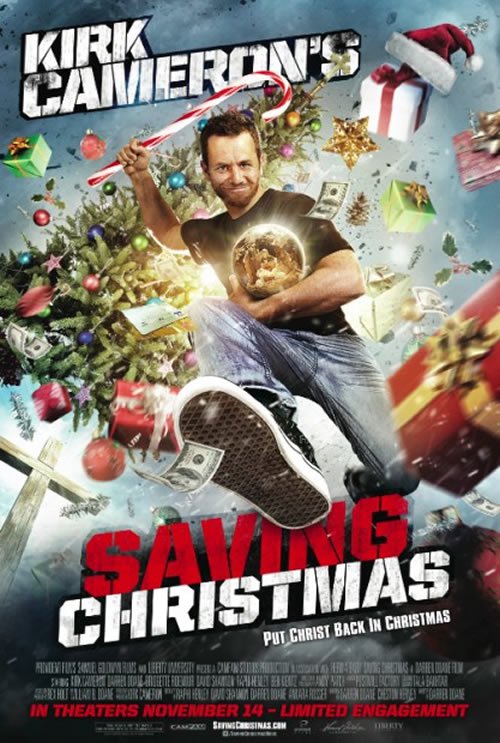
saving-christmas-posterGod save us all from this, this Christmas time.
1. Where does the word ‘Christmas’ come from?
The answer is b, the name comes from the Catholic Mass held on the supposed date of Jesus’ birth. So all you anti-Catholic Christians need to find a new name for it fast.

2. When was Christ born?
a) is the answer here: Christ wasn’t born. Maybe Jesus was, but ‘the Christ’ is an invention of later Christians (Paul, for example, in Romans 8.3 and John’s gospel, written up to a century after Jesus lived.) The Christ is a mythic, supernatural being who’s always existed. He bears little relation to the itinerant Jewish preacher Yeshua who wasn’t born on 25th December or in the year 0.

3. Which gospel writers didn’t think the nativity story worth including in their accounts?
Mark and John (b & c) don’t bother including it. Did they not know it? The two gospels that do have bits of the story – Luke and Matthew – contradict each other.

4. How well attested are the events surrounding the birth in historical documents of the time?
a) Not at all. You’d have thought the Romans, who were pretty good at keeping records (lots of which have survived) would have noted Herod’s massacre of little boys or the appearance of a new, magic star in the sky – they were, after all, a superstitious lot. Not even Josephus, who, in the late first century, acknowledges the existence of Christians, sees fit to mention any of it.

5. Following the miraculous events of Jesus’ birth, what did Mary do?
According to Luke 2.19, she treasured them in her heart. However, the answer is c) because only a few verses further on, she hasn’t a clue about what her son is up to (Luke 2.48). Later still, she is part of the family’s efforts to ‘restrain him’ (Mark 3.21 & 31). Why, on these occasions, doesn’t she recall his miraculous beginning and think, ‘oh yes, I remember now. He behaves like a lunatic because he’s the son of the Most High.’ She certainly didn’t write down the details of his miraculous birth for later use in the gospels. No-one did. On account of them not really happening. Just sayin’.

6. How many times does Jesus refer to his miraculous birth?
a) Never. Strange that.

7. How many times does the rest of the New Testament refer to Jesus’ miraculous birth?
c) Never, even more strangely. Evidently the story hadn’t been invented when the rest of the New Testament was written.

8. When did Christians first start celebrating Christmas?
a) hundreds of years later.

9. Which of these Christmas traditions originate in the Bible?
None of them. Despite what Kirk Cameron might think, Christmas trees, kissing under the mistletoe and giving presents all have pagan origins. The giving of gifts did not come about because the wise men did it first. The tradition pre-dates Christianity.

10. Which of these groups has benefited the most from Jesus’ birth?
Yes, you’re right; none of them. Not women, not black people and not LGBT people. Christianity has a history of oppressing all three groups.

Speaking of which…
11. What does Pastor Steven Anderson want for Christmas?
c) he’d like to see the execution of all homosexuals so that AIDS – which, as far as the reverend understands it (I use the term loosely) only gay people get – might be wiped out. Peace and joy to you too, Stevie.

12. How will Christians celebrate Christmas this year?
The answer is a, b and c: by fighting the War On Christmas, putting the Christ back into Christmas and by telling us that Jesus is the Reason for the Season. Just like they do every year. As you can see, Kirk Cameron’s disaster of a movie, Saving Christmas, has two of these blessed clichés on its promotional poster alone.

So how did you do?
If you scored –
between 10-12: well done. Betcha don’t believe in Santa Claus either.
Between 7-10: your cynicism needs a little work. Order my book for Christmas – it’ll help.
Between 4-6: oh dear. You’re new around here, aren’t you. There’s hope for you though, so stick around. Oh yeah, and order my book for Christmas – it’ll definitely help.
Between 1-3: Like Christmas, you are in need of saving, my friend. May the scales fall from your eyes this holiday period. Amen.

This Year’s All-New Christmas Quiz!

SantaBack by popular demand (well, mine anyway), try this year’s all-new Christmas quiz!

Answers in the Bible or not, as the case may be. Real answers next time.

1. Where does the word ‘Christmas’ come from?
a) the Bible
b) the Catholic Mass held on the supposed date of Jesus’ birth
c) the Greek, meaning to pull the wool over people’s eyes

2. When was Christ born?
a) he wasn’t
b) 25th December
c) in the year 0

3. Which gospel writers didn’t think the nativity story worth including in their accounts?
a) Luke
b) Mark
c) John

4. Following the miraculous events of Jesus’ birth, what did Mary do?
a) she remembered them all in her heart
b) she wrote them down for later use in the gospels
c) she forgot all about them

5. How many times does Jesus refer to his miraculous birth?
a) never
b) twice
c) he doesn’t shut up about it (well, would you?)

6. How many times does the rest of the New Testament refer to Jesus’ miraculous birth?
a) repeatedly, showing how important it was
b) only when making an important theological point
c) never

7. How well attested are the events surrounding Jesus’ birth in historical documents of the time?
a) not at all
b) quite substantially
c) as you’d expect when mass murder and strange astronomical events are involved, they’re mentioned everywhere

8. When did Christians first start celebrating Christmas?
a) hundreds of years after the event
b) not long after Jesus died
c) immediately

9. Which of these Christmas traditions originate in the Bible?
a) Christmas trees
b) kissing under the mistletoe
c) giving presents

10. Which of these groups has benefited most from Jesus’ birth?
a) women
b) black people
c) LGBT people

11. What does Pastor Steven Anderson want for Christmas?
a) his two front teeth
b) peace and joy
c) the execution of all homosexuals

12. How will Christians celebrate Christmas this year?
a) by fighting the War On Christmas
b) by telling everyone that Jesus is the Reason for the Season
c) by putting the Christ back into Christmas


Picture from memegenerator.net


Christmas Quiz Answers

Birth3

1. In what year was Jesus born?   a) 4 BCE (when Herod the Great was king)   b) the year 0     c) 6CE (when Quirinius was governor of Syria)

Matthew’s gospel claims Jesus was born when Herod the Great was king (Matthew 2.1) while Luke says it was when Quirinius was governor of Syria (Luke 2.2). But Herod died in 4BCE and Quirinius didn’t become governor of Syria until ten years later, in 6CE. So JC couldn’t have been born when both men were in their respective positions. Neither was he born in the year 0, because there wasn’t one (the Gregorian calendar goes from 1BCE to 1CE). Most scholars think Jesus was born around 4BCE, just before Herod’s death (as Matthew’s gospel suggests). Award yourself a splash of myrrh if you got this right.

2. When was Jesus born?  a) December 25th?   b) April 1st   c) in the summer

Not December 25th (see my post Jesus Is The Reason For The Season below) which was the date usurped from the pagan festival of Saturnalia; April 1st, maybe, as there’s something about this that takes us all for fools, but if the story is to be believed, it’s most likely he was born in the summer when shepherds would be out on the hillside with their sheep – if the story is to be believed. In short, we don’t actually know. If you said this, reward yourself with three hail Marys.

3. Who was Jesus’ father? a) God himself   b) Joseph, so that Jesus was descended from King David   c) one of Mary’s one night-stands

a) and b) rule each other out: see my post Jesus was born of a virgin… er, no was descended from David, er… below.  There were much later rumours that Mary was raped by a Roman soldier called Pantera, and certainly Jesus’ legitimacy is called into question by early critics of Christianity. This may be reflected in the gospels themselves where Jesus is referred to as his mother’s son, not his father’s as would have been customary (Mark 6.3). Treat yourself to Susan Boyle’s rendering of ‘Silent Night’ if you knew this.

4. How often did the Romans make people return to their ancestral home to be counted?  a) never   b) it was one-off   c) only when the gospel writer needed to get them to Bethlehem

Answer is c). While the Romans did carry out a census in 6CE, i) Jesus was born ten years earlier and ii) there is no record of the Romans forcing people to return to the home of their ancestors.

5. How did Mary get to Bethlehem?  a) on foot   b) on a donkey   c) by being a character in a contrived story

The answer is c). Luke’s nativity story, the only one to have them travel to Bethlehem, doesn’t say how she got there. Leave a carrot out for Santa’s reindeer if you answered correctly.

6. Where was Jesus born?  a) in a stable   b) in a cave   c) at home in Nazareth

Again, Luke’s Bethlehem account doesn’t say. Matthew implies Mary and Joseph lived in Bethlehem all along (Matthew 2.11 & 16) making the whole ‘no-room-at-the-inn’ scenario superfluous. Sprinkle yourself with frankincense for saying so.

7. According to Matthew’s gospel, how many wise-men visited the new-born babe?  a) none   b) three   c) they weren’t wise-men, they were astrologers

The answer is c) and the number isn’t specified.

8. What did the angels say to the wise-men when they told them of Jesus’ birth?  a) you will find him in a manger   b) nothing   c) follow that star

b) is correct. According to the story the angels spoke to the shepherds, not the wise-men. Deck the halls with boughs of holly if you fell for this one.

9. Where did the magic star shine?  a) over the stable where Jesus lay   b) over his house   c) since when do stars shine over specific objects here on Earth?

Looks like c) again, though Matthew, who is the only gospel writer to mention it, claims in Matthew 2.9-11 that it was b), over his house.

10. When did the wise-men visit the infant Jesus?  a) when he was a toddler   b) while he was still in the manger   c) after the Christmas rush

Matthew says Jesus was a child when the so-called wise-men visited him at home (Matthew 2.9-11 again). Given their encounter with Herod (Matthew 2.16), who thinks Jesus could be anything up to two years old, it’s likely JC was a toddler at this point in the fabricated story. Don ye now your gay apparel if you knew this.

11. When did Herod massacre all the little boys, hoping to kill the baby Jesus?  a) later that same week   b) a few years after the birth   c) there is no record of him having done any such thing

Yup, c) again.

12. How many shepherds visited the baby Jesus?  a) all of them  b) two old men and a young boy   c) none

The number isn’t specified, though Luke suggests all of them went (Luke 2.15-16). In fact it was ‘none’ because none of this actually happened.

13. What gifts did the shepherds bring?  a) a lamb   b) a lamb kebab   c) a pair of hand-knitted socks

It doesn’t say. You can have a new pair of hand-knitted socks yourself if you said so. Or a kebab.

14. Which animals were present at the birth?   a) a horse (c’mon, it was supposed to be in a stable)   b) an ox and ass   c) an ox, an ass, the wise-men’s camels and the shepherds’ sheep

No animals are mentioned.

15. After the birth, where did Mary, Joseph and the baby Jesus go?  a) to Egypt   b) home to Nazareth   c) nowhere

According to Matthew (2.13-18) the family went to Egypt following the visit of the wise-men and, after hiding there until Herod died, made their home in Nazareth (Matthew 2.19-23). According to Luke, however, they lived in Nazareth before the birth (Luke 1.26) and simply went back there once they’d had the baby circumcised (Luke 2.38); no mention of the holiday in Egypt nor of Herod, who’d been dead for ten years according to Luke’s chronology. It’s kinda neat the way the Bible tells such a consistent story, don’t you think?

16. Where will you find the Christmas story in the Bible?  a) in Genesis (because the answers are always in Genesis)   b) in all four gospels   c) in only two of the gospels, which have conflicting accounts

The answer is c); only in Matthew and Luke, each having a completely different take on things.

Feel entitled to sacrifice two turtle doves for making it this far.

A short Christmas quiz…

Nativity

How well do you know the Christmas story? See how you fare in this exciting nativity quiz. Answers in the Bible (and posted soon here);

1. In what year was Jesus born?

a) 4 BCE (when Herod the Great was king)   b) the year 0   c) 6CE (when Quirinius was governor of Syria)

2. When was Jesus born?

a) December 25th?   b) April 1st   c) in the summer

 3. Who was Jesus’ father?

a) God himself   b) Joseph, so that Jesus was descended from King David   c) one of Mary’s one night-stands

4. How often did the Romans make people return to their ancestral home to be counted?

a) never   b) it was one-off   c) only when the gospel writer needed to get them to Bethlehem

5. How did Mary get to Bethlehem?

a) on foot   b) on a donkey   c) by being a character in a contrived story

6. Where was Jesus born?

a) in a stable   b) in a cave   c) at home in Nazareth

7. According to Matthew’s gospel, how many wise-men visited the new-born babe?

a) none   b) three   c) they weren’t wise-men, they were astrologers

8. What did the angels say to the wise-men when they told them of Jesus’ birth?

a) you will find him in a manger   b) nothing   c) follow that star

9. Where did the magic star shine?

a) over the stable where Jesus lay   b) over his house   c) since when do stars shine over specific objects here on Earth?

10. When did the wise-men visit the infant Jesus?

a) when he was a toddler   b) while he was still in the manger   c) after the Christmas rush

11. When did Herod massacre all the little boys, hoping to kill the baby Jesus?

a) later that same week   b) a few years after the birth   c) there is no record of him having done any such thing

12. How many shepherds visited the baby Jesus?

a) all of them   b) two old men and a young boy   c) none

13. What gifts did the shepherds bring?

a) a lamb   b) a lamb kebab   c) a pair of hand-knitted socks

14. Which animals were present at the birth?

a) a horse (c’mon, it was supposed to be in a stable)   b) an ox and ass   c) an ox, an ass, the wise-men’s camels and the shepherds’ sheep

15. After the birth, where did Mary, Joseph and the baby Jesus go?

a) to Egypt   b) home to Nazareth   c) nowhere

16. Where will you find the Christmas story in the Bible?

a) in Genesis (because the answers are always in Genesis)   b) in all four gospels   c) in only two of the gospels, which have conflicting accounts

Good luck. Answers here soon.

Christians’ Favourite Delusions 12: Jesus is the reason for the season.

Image

Every year about now, Christians start complaining that Christ has been taken out of Christmas, that we’ve lost the true meaning of the holiday, that the reason we have it at all is because of the arrival on Earth of the Baby Jesus. The tabloid press invariably joins in with this clamour, relating – and often making up – stories of councils that omit the word ‘Christmas’ from town centre displays for fear of offending Muslims. In the States, an influential Christian group has taken to drawing up a ‘Naughty and Nice’ list; stores and organisations that wish customers a ‘happy Christmas’ are to be considered ‘nice’, whether they are or not, while those that opt for ‘happy holidays’ are very, very naughty. Predictably, these Christians advocate boycotting the naughty stores.

The mid-winter celebration now known as Christmas pre-dates Christianity by hundreds of years. It originally had nothing to do with Jesus but instead was a way of celebrating the winter solstice at the time of the shortest day (21st December in the northern hemisphere) and the return, in spring, of the sun. It was entirely pagan and many of the customs today associated with Christmas – giving and receiving presents, decorating the house, singing carols and feasting – originate from it. In Ancient Rome, where it was known as Saturnalia, the festival was held on 25th December and marked the birth, not of Jesus but of the unconquerable sun (Sol Invictus). The early church usurped the festival in the fourth century; too popular to eliminate, they superimposed their saviour and his mythology on to it, in an attempt to make it their own. This had the added bonus of demonstrating – a bit late in the day – that Jesus really was born as a human, when there were those around who claimed otherwise.

So Jesus is not the reason for the season; a pagan celebration of the winter solstice is really what it’s all about.