Idiotic Stuff Jesus Said 7: You Must Be Born Again

Born Again

Jesus answered him, ‘Very truly, I tell you, no one can see the kingdom of God without being born again (or ‘from above’).’ Nicodemus said to him, ‘How can anyone be born after having grown old? Can one enter a second time into the mother’s womb and be born?’ Jesus answered, ‘Very truly, I tell you, no one can enter the kingdom of God without being born of water and Spirit (John 3.3-5).

While John’s gospel isn’t the only source of Christian nuttiness, it’s certainly a mine of golden nuggets. This is mainly because it was made up so long after Jesus lived, by people who had, in all probability, never met him but who belonged to a sect led by someone who claimed he had.

Imagine, in a world without technology, photography and literacy, writing an account from memory (or from other people’s memories) of events that had occurred sixty years earlier. It would be like attempting to create today the history of a charismatic, back-water nobody who lived in the early 1950s – but without any reliable written records, pictures or sound recordings. How much faith would you have in such an account? How far would you trust, at such a distance, the account’s supposedly verbatim dialogue, especially when it conflicts on nearly all crucial points with the few other stories that circulate from the period? Of course you wouldn’t. And yet this is precisely what we have in ‘John’s gospel’, where we find the famous exhortation to be ‘born again’.

Let’s be clear at the outset; Jesus did not say ‘you must be born again.’ The point of the story is that he meant something else (equally ludicrous, but different nonetheless). Despite this, today’s Christians still insist he did say it and that to be truly saved you must indeed be ‘born again’.

But, as Bart Ehrman explains in Jesus, Interrupted (p 155), the misunderstanding central to this exchange, between ‘born again’ and ‘born from above’ occurs only in Greek. As Aramaic speakers, Jesus and Nicodemus would not, if they knew any, have resorted to Greek for this one conversation, just so this very confusion could be created.

The word in question is the Greek word anothen, which can mean both ‘again’ and ‘from above’, and it is this double meaning that prompts Nicodemus to ask if he is expected to crawl back into his mother’s womb so he can be born ‘again’. The contrivance allows Jesus to make a show of correcting him and to make his real point; ‘No, Nic, you dumbkoff. Not ‘born again’, but ‘born from above’. What do they teach you at synagogue school these days?’

So in a conversation he never had, depending as it does on a misunderstanding of the Greek he didn’t speak, ‘born again’ is not what Jesus means: his point, as the writers of John’s gospel make clear (in the Greek Jesus didn’t speak, but they did) is that one has to be ‘born from above’.

And why do people have to be ‘born from above’? Because that’s where the story’s creators believed heaven to be – above them, in the sky. Jesus himself would have believed this too, even though he didn’t utter a single one of the words attributed to him in this fabricated conversation.

Why_Christians_Don't_Cover_for_KindleThis post is adapted from my (five-star rated!) book Why Christians Don’t Do What Jesus Tells Them To …And What They Believe Instead, available from Amazon.co.uk and Amazon.com

 

Idiotic Stuff Jesus Said 5: Give to everyone who asks

Beggar

Give to everyone who asks you, and if anyone takes what belongs to you, do not demand it back. Do to others as you would have them do to you… Love your enemies, do good to them, and lend to them without expecting to get anything back. (Luke 6:30-35)

I’d really like to see this. I’d like to see Christians giving to anyone and everyone who asks them.

Asks them for what? Jesus implies in this ridiculous command that it’s ‘what belongs to you’. He’s talking about physical possessions – give your possessions to whoever asks, he says, and don’t try to get back any item that someone takes from you. There can be no making a metaphor out of this, or symbolising it away. Christians try to of course; see here and here for their lame attempts at explaining why Jesus doesn’t really mean they should give their stuff away. But he does mean it, and just in case Luke might’ve got it wrong, the writers of Mark’s and Matthew’s gospel record him saying much the same thing.

So how about it Christians? How about giving away all you’ve got? Even a little bit of it to everyone who asks of you? Should you own cars, property and businesses when there are charities asking you to give generously to the needy (‘give to all who ask’) and when there are people out there with nothing? Your Lord and saviour proposes you sell all you have and give the proceeds to the poor (Mark 10.21), so how about it? How about conceding (civil) same-sex marriage to gay couples, without making the shameful song and dance about it that you do? How about shouting less about the ‘rights’ you claim are being taken from you when your Lord specifically says not to? Why not try doing instead just what he commands?

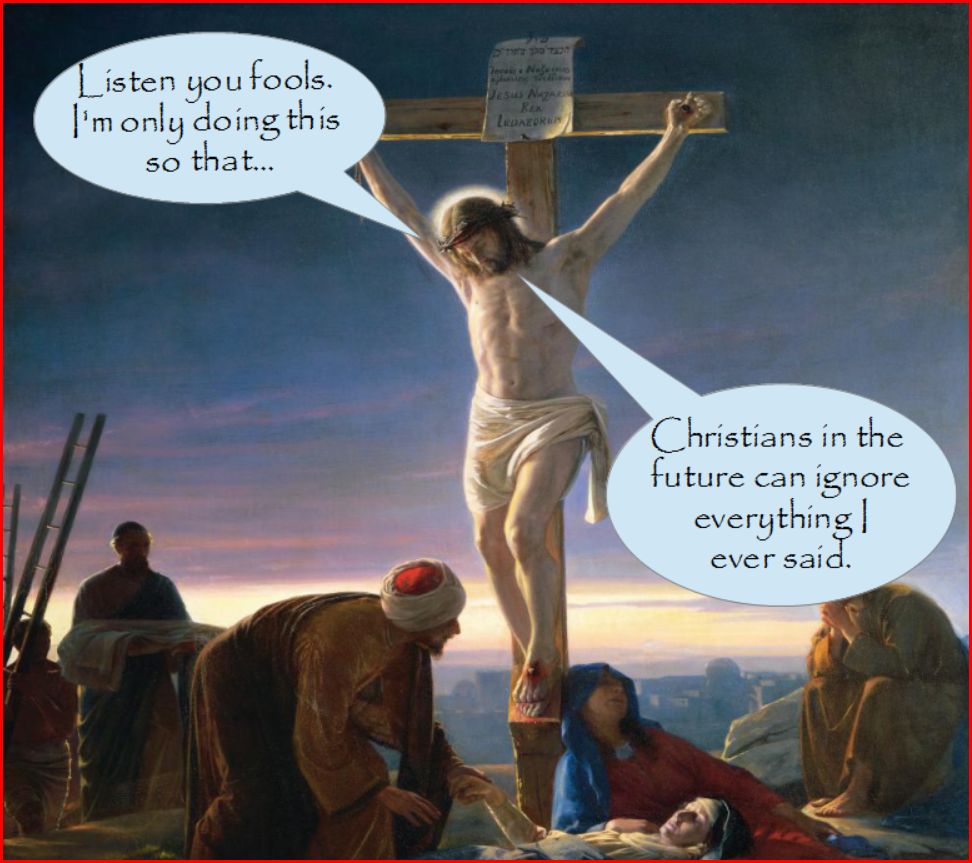
Because you don’t really believe him. You prefer the super-hero Jesus, the ‘Christ’ that St Paul invented, who ‘saves’ you, guides you and doesn’t make demands like Jesus did when he was alive. That Jesus you don’t believe in. And who can blame you? He was a fanatic who believed the world was going to end very soon (Matthew 16.28). His idiotic demands, like this one, were for this soon-to-end system of things. You could give everything away when God was about to intervene and set up his own Kingdom in which you would be rewarded for your generosity. It’s this radical Jesus you reject; you don’t do what he says because he’s just too damned demanding.

Give to all who ask? Let others take things from you? Sell all you have?

Don’t be ridiculous.


Idiotic Stuff Jesus Said 4: Rivers Of Living Water

Or more precisely: Whoever believes in me, as Scripture has said, rivers of living water will flow from within them (John 7.38).

WoundMe: What does this even mean, this ‘rivers of living water’ stuff?

Christian: It’s a metaphor. Jesus means it symbolically.

Me: Symbolically, how? A metaphor for what exactly?

Christian: The wonderful life-giving message that is the gospel.

Me: Which gospel? Jesus’s or Paul’s?

Christian: Oh, you’re splitting hairs. They’re one and the same.

Me: They most certainly aren’t, but we’ll let that pass for now. So by ‘living waters’ you mean that death-obsessed, rag-bag of negativity that fails to deliver in any way? (See all previous posts).

Christian: Well, I wouldn’t put it quite like that, but when one is reborn of the Spirit, then this wonderful feeling takes hold of you. That’s what we mean by ‘living waters’.

Me: I see. So all it comes down to is how good it makes you feel inside. ‘Living waters’ is just a metaphor for feeling good.

Christian: Oh, no, it’s more than that. It’s the Love that compels us to share the good news with others – that’s really what Jesus means by rivers of living waters.

Me: So banging on about hell and how the world is doomed (because, you know, gay people) and how only you know the Truth, is letting your love flow, is it? Is that what we see on sites like this, and this and this? Living waters of love? Or running sores of bile?

Christian: Well, those sites and those people aren’t representative of true Christians.

Me: That’s funny. They say the same about you.

Christian: Now you’re being unfair.

Me: And what’s more, there’s no reference to ‘rivers of living water’ flowing inside people anywhere else in ‘Scripture’. That’s another bit of made-up nonsense.

Christian: Oh, no, you’re mistaken about that. You must be. Jesus wouldn’t get a thing like that wrong.

Me: You know, maybe none of you have rivers of living water sloshing around inside you. Maybe this is just another of those idiotic things Jesus said, or was made to say about a hundred years after he lived, that means absolutely nothing at all.

Christian: Ma! He’s persecuting me.

Let’s Suppose…

This article originally appeared as a guest post on Bruce Gerenscer’s U.S. blog, ‘The Way Forward’ a couple of months back. Bruce has since had to close his blog and as a result the article became inaccessible. I’ve rescued it, my little lost sheep among a hundred, and present it here for your delight and delectation. Or something.

While on ‘The Way Forward, the post generated quite a few comments from Bruce’s readers. Feel free to respond to it here in like manner – and indeed to any other posts. All comments, spam excluded, are published whether agreeing or disagreeing with what I have to say.

BlessedLet’s, for the sake of argument, suppose that Christians could prove that the universe was created by a supernatural agent.

Let’s further suppose that they could demonstrate conclusively that this supernatural agent is none other than their very own God, as opposed to, say, Allah or Atum or Marduk.

And then let’s say they are able to show us, with sundry proofs, that an itinerant Jewish preacher, generally known by the Greek name, Jesus – though he was never called that by those who knew him – was somehow a manifestation of this God on Earth.

Then let’s say we grant them, although it doesn’t seem it from reading Jesus’ story in the synoptic gospels (Mark, Matthew and Luke, all written between forty and sixty years after this man lived) that his death somehow or other bridged the gap between humanity and this very touchy deity.

And then let us suppose that, although he never met Jesus but only had some sort of hallucination about him, the man Paul was right to say that through magically invoking Jesus’ name, people could be reunited with God and completely remade.

Let’s further grant them that, although their book about Jesus and Paul doesn’t actually say so in so many words, they really are going to go and live in Heaven when they die.

Assuming all of this is true – even though Christians are unable to demonstrate even the first of these propositions (the one about the universe being made by a supernatural being) – why is it they disregard and otherwise ignore most of what their god-man, Jesus, tells them about how they should live their lives?

Why are they, for example, so cavalier about forgiving others when he says in order to be forgiven they must first forgive those who have offended them? (Matthew 6.14-15)

Why are they so harsh in their judgements of others when he tells them that how they judge others will be how they themselves will be judged? (Matthew 7.1-2 & Matthew 25.34-46)

Why are they so lacking in compassion, when he says the amount of compassion they’ll receive is directly related to the amount they show others? (Matthew 5.7 & Luke 6.38)

Why are they so vociferous in their condemnation of others when they should be dealing with their own ‘sins’ first? (Luke 6:42)

Why do so many of them fail to serve others sacrificially, without expectation of reward and with no ulterior motive? (Mark 9.35 & 10.43-44)

Why are they not known for selling their possessions, giving to all who ask and going the extra mile? (Luke 12.32, Matthew 19.21, Luke 6.38 & Matthew 5.41)

Why do they not turn the other cheek, bless and pray for those who abuse them, and treat others like they want to be treated themselves? (Luke 6.28-29 & Matthew 7.12)

Why do they not love their neighbour as themselves, and their enemies too? (Matthew 22.39 & Matthew 5.44)

Shouldn’t they be doing these things, and more, as if their eternal lives depended on it? Especially when Jesus says their eternal lives do depend on it (Matthew 25.37-40). Shouldn’t they be just so much more radical than they actually are, changing the world by serving others? (Matthew 25.34-40)

Yes, they should, but they’re not, and they never have. Deep down, they know that Jesus is too extreme, too demanding. They make excuses for themselves; he doesn’t really mean the things he says; he speaks in metaphor and uses hyperbole (specially when he’s saying something they don’t like the sound of) and they invoke the bumper-sticker theology of ‘we’re not perfect, just forgiven’, even when ‘perfect’ is the very thing Jesus tells them they must be (Matthew 5.48).

The only reasonable conclusion we can draw from all of this is that Christians don’t really believe the man they call God and Saviour. Their actions, or lack of them, speak far louder than their words. It’s so much easier to claim Paul’s magical incantation, looking heavenward and damning the rest of us, than it is to do what Jesus demands. Who cares what Jesus said anyway. What did he know?

Idiotic Stuff Jesus Said 3: Whoever Is Not With Me Is Against Me

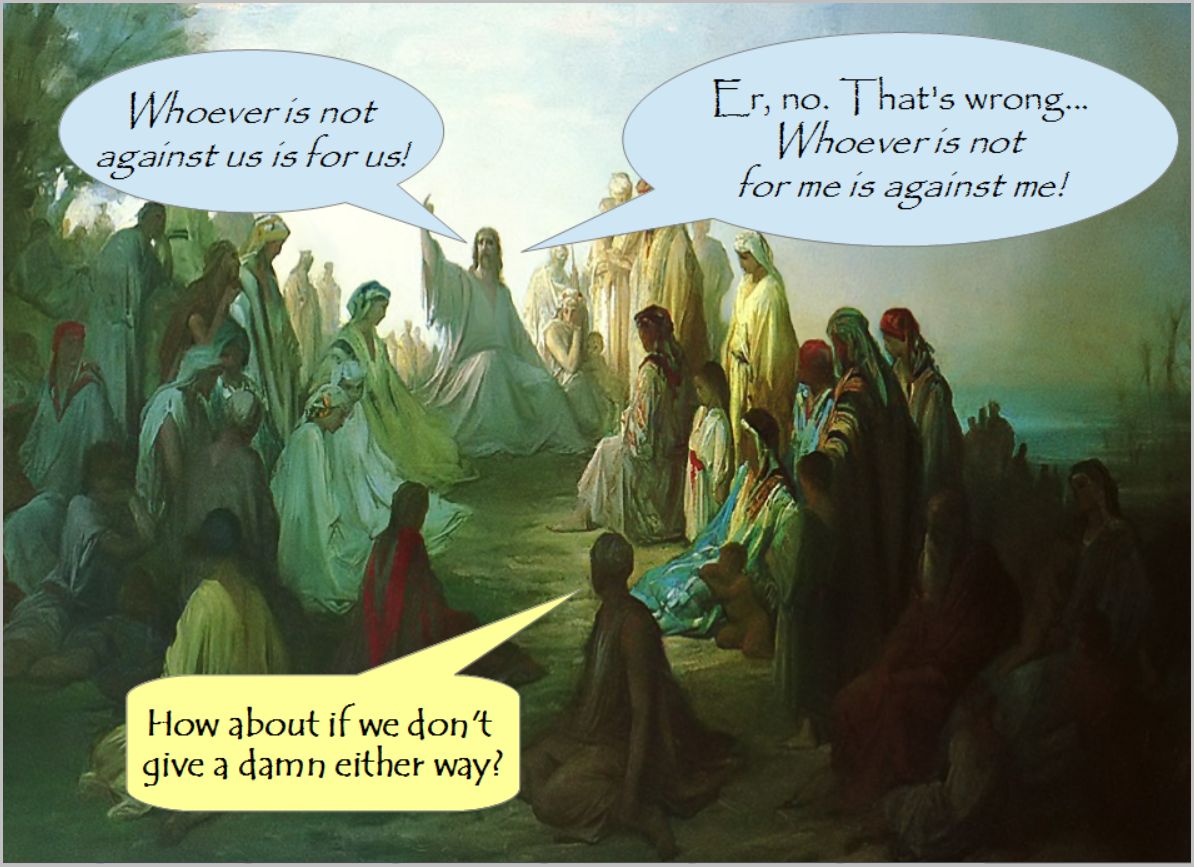
ForUsJesus is reported as saying both that ‘Whoever is not against us is for us’ (Mark 9.40)
and ‘Whoever is not with me is against me’ (Luke 11.23). What he doesn’t seem to realise is that these two statements, each ridiculous in its own right (there is always the third option of not caring either way), mean exactly the opposite of each another. The first is inclusive and relatively friendly. The second is hostile and exclusive; it says, in effect, ‘If you don’t give me your unquestioning devotion you are my enemy.’

This is not the claim of a fully-realised divine being, but of a paranoid megalomaniac. As with much of what he said – or is reported as saying (which is not the same thing) – Jesus reveals himself to be very human; flawed and completely egotistical.

He sets up, as all cult leaders do (and, indeed, as all human groups have a tendency to do) an ‘Us and Them’. Elsewhere, Jesus describes Insiders and Outsiders, with all the rustic charm of a first-century peasant, as the sheep and the goats (Matthew 25.32). It’s still a favourite pastime of Christians to segregate themselves and others into these two categories. They do it with real sophistication these days, of course (I mean, ‘sheep and goats’… c’mon) but it still comes down to Us and Them:

If you’re a mainstream evangelical you’re Saved, while those who don’t subscribe to your brand of Christianity are Lost or Of This World.

If you’re a Bible-believing fundamentalist you’re Regenerate but others are Unregenerate (or Degenerate).

If you’re a Jehovah’s Witness you’re one of the True Church; other believers are part of a False Christianity.

If you belong to the cult formerly known as the Children of God, you’re of The Family and everyone else is part of The System.

If you’re a Roman Catholic you’re the Only True Christians, while all others are Damned.

and so on, throughout all of the 34,000 different Christian sects and denominations.

It is an essential part of the Christian faith to regard yourself as belonging to the only True Church. Everyone else – from those who don’t buy into religion at all to every other faith group – is wrong. They’re an enemy of Jesus because, not being for him or with him in quite the right way (your way) they are, according to the warped logic he expresses here, against him.

The so-called Prince Of Peace proudly declares that he came to bring strife and division into the world (Luke 12.51), which, to this day, remains his greatest achievement. His idiotic words about being either for or against him have proven to be a gift to every sect, cult and church that has ever existed.

Christian Love in Action

CrossI’ve been banned from a ‘Christian’ web-site. From Barbwire, in fact, the extreme mouthpiece of extreme mouthpiece Matt Barber and his chums; Scott Lively, self-confessed ‘father’ of Uganda’s anti-gay movement; Bryan Fischer, bigoted evangelical shock-jock; Laurie Higgins, gay-sex obsessed ‘marriage defender’ and Bradlee Dean, third-rate rockstar-cum-provocatuer, amongst others.

My ban is not because I was abusive. Actually, I’m not sure what prompted it though I’m not alone in having my comments deleted and my name blocked. Others who’ve challenged the bigotry and distortions regularly paraded on Barbwire have been too. Dissent will not be countenanced by ‘Christian’ bullies whose faith is weak and arguments even weaker.

I hope my comments were reasoned and reasonable, even if sometimes flippant; above all, I hope they were challenging. I tried to challenge both those ‘names’ who write for the blog as well as those who comment there, to react and respond as their Saviour commands them to; to treat others as they would want to be treated; to attend to the log in their own eyes before the speck in their neighbours’; not to judge lest they be judged and to show compassion for those with different views.

Have I as a non-believer any right to expect Christians to behave like this? I think so – I think we all have. After all, they’re the ones who’ve bought into Jesus’ demands; the ones who proclaim him as messiah and potential saviour of the world; the ones who feel compelled to tell us about him at every turn. They’re the ones who believe they’re born again as new creatures, filled with the Holy Spirit, who now live transformed lives as Christ-like beings. It’s not unreasonable to expect to see them reflect all of this in how they deal with other people; loving their neighbour, not casting the first stone… and all the rest of it.

So how do they deal with dissenters on Barbwire? They call them ‘morons’, and ‘fools’ and ‘pervs’ and ‘sodomites’ and ‘idiots’. Now, it could well be that I’m all of these things and the good Lord has chosen to reveal it to his gentle people on the site, if not to me. But when you call out these supposed Christians on this less than loving behaviour – pointing out that Jesus says in Matthew 5.22 not to call others fool, let alone all those other things – what happens? You get more abuse, and lots of edging around Jesus’ words (he only meant not to call other Christians fools) and claiming his commands don’t apply to them because he was really only speaking metaphorically – as he always is when they don’t want to do what he says.

And then you, the one on the receiving end of their Christian Love™, are blocked, banned and deleted, while those with the slurs and insults remain, because it’s what Jesus would want, leaving them free to move on to new targets.

ScreenDoes it matter? Not really; as long as for a brief period there are others opposing the bigotry and hatred that spills, in Jesus’ name, from Barbwire and sites like it. Christians such as Matt Barber and, here in the UK, Stephen Green, are relatively powerless individuals, after all. They’re loud bullies who justify their extremism by claiming it is the standard demanded by a mythical being. But all the same, they and their cronies are influential. Witness the sycophantic commenters who commend every scurrilous word these bullies say about non-believers, fellow Christians, gay people, politicians, immigrants and those they imagine ‘persecute’ Christians here and in the States. The articles on Barbwire encourage and reinforce the prejudices, bigotry and small-mindedness of ‘Christians’ like these, helping shape the way they treat people in the real world.

I’d encourage you to take look at Barbwire and to become a commenter yourself, opposing the hatred and bigotry, not to mention the irrationality and stone-throwing, that you’ll find there. If you do, you won’t have to do it for long because, sooner rather than later, you’ll be banned, as the voices of reason and compassion invariably are there.

Then again, there are worse reasons for being thrown out of a sewage plant.


What would the world look like if Jesus had been right?

NewEarth

If everything Jesus promised had come true, then:-

Jesus and his twelve mates – or maybe it’s eleven, what with one of them pissing on the parade – would have been running the world for 2,000 years by now (Matthew 24.34 & Matthew 19.28).

All the undesirables – that’s me and, in all probability, you – would’ve been consigned to Hell and the Righteous would’ve been living on the New Earth, working miracles all day long, not getting married, enjoying eternal life and definitely not having sex (Matthew 13.43, Luke 20.34-35, Matthew 25.46, Matthew 13.41-42).

But seeing how none of that has happened yet, what does the world-according-to-Jesus look like while we wait for the Kingdom to arrive?

Well, duh, look around you; this is how it is:

True Believers go around curing the sick, the blind and the lame, just by touching them or using magic saliva. There’s no need for hospitals, medicine, doctors or heath care. Jesus did this sort of thing and he said his followers would too, to an even greater extent. That’s why Christians can even help amputees grow back missing limbs (Mark 16.18 & John 14.12).

By the same principle, True Believers regularly raise the dead. Okay, so there’s not going to be any death in God’s Kingdom on Earth, but it’s a handy power to have all the same (Matthew 10.8).

Hunger is a thing of the past. When anyone feels a bit peckish – an entire continent, say – Christians feed them using whatever scraps they’ve got lying around, like left-over sardines and burnt toast with Jesus’ face on it (Matthew 14.13-21).

True Believers supply everyone with as much wine as they want, too. They simply pour out some water and change it into alcohol with their water-into-wine superpower. If their beneficiaries turn out to be tee-total, the Righteous change it into something else for them, like coffee or Kool-Aid or cyanide. Of course, cyanide is the beverage of choice for God’s Chosen. He makes sure no harm comes to those who imbibe it (John 2.1-11, Mark 16.18).

Christians are regularly to be seen playing with poisonous snakes, because, like Superman they’re practically invulnerable (Mark 16.18).

Transport is transformed in Jesus’ new world too. No need for ships or ferries; Believers travel overseas by walking over seas. Conditions a bit choppy? The Almighty calms things down for them; all they have to do is ask. (Matthew 14.22-33 & Mark 4.35-41).

Mountains getting in the way? They can just be lifted out of the way using the Power of Faith, and thrown into the sea. Or, if that’s likely to cause problems for those out for a stroll on the oceans, the mountains can be rearranged to make a passage through. Very neat and tidy (Mark 11.23-24).

Best of all, True Believers can ask God for anything at all and whatever they ask for he provides. No questions asked. He does it (Matthew 7.7 & 21.22, Mark 11.24 etc).

Thanks to Jesus’ followers, this is how it is in the world, while they wait for God’s Kingdom to arrive. And when it does, it’ll be even better. Hard to imagine it could be any better than it is, I know, but Jesus guarantees it. What a blessing it is to live, here and now, in such a transformed reality.

Except of course we don’t. None of these things happen. Not the miracles, the healings, the living forever. This is not the world we live in, even though Jesus said it would be. His Kingdom didn’t come; his followers don’t do miracles like his (and certainly don’t do better ones); no-one lives forever. They never have and never will.

Instead his Followers spend their time squabbling between themselves, judging others and living – and dying – pretty much the same way we all do.

Funny that.


Why would someone choose to be like this?

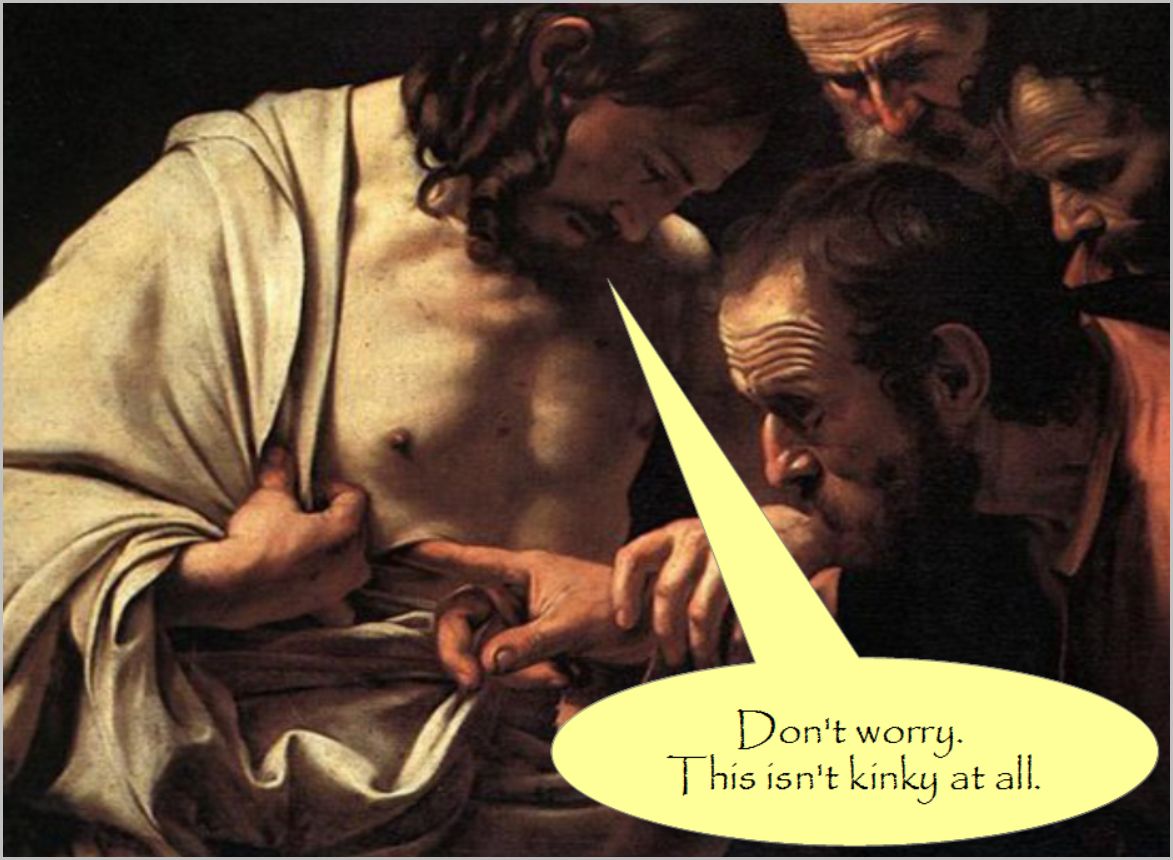
KissJesus and friend enjoy a quiet moment of intimacy.

Over at Barbwire, a particularly prickly Christian web-site about guns and how the world is going to hell in a handcart and how Christians are persecuted – persecuted, I tell you! – just because, out of love, they trash homosexuals, they’ve been discussing gay Christians. In a totally fair and balanced way, they’ve concluded you can’t be both because of something or other the Bible says.

What I don’t understand about gay Christians is how anyone would choose – and it is a choice when there’s no evidence they’re born that way – to be something as destructive, unhealthy, degenerate, unproductive and downright icky, as a Christian.


Christians’ Favourite Delusions 25: Unbelievers are going to Hell!

Spoiler alert: No, they’re not.


HellIt’s always nice when the local fellowship keeps in touch.
There’s good news and bad news. First, the good news: Hell doesn’t exist. You can’t go to a place that doesn’t exist.


Next, the bad news; you’re not going to survive your death. Sorry to break it to you like this, but there it is: no-one survives death. Once the physical, chemical and electrical processes in your brain cease then so do you, because that’s what you’re made of. That self you have a sense of – your soul if you want to call it that – is entirely dependent on those electro-chemical processes. It doesn’t exist independently from them. You cease to be once the brain dies and begins to deteriorate*. Everyone who has ever lived and died, including true believers down the ages – from Jesus, Peter, Paul, Matthew, Mark, Luke and John to Augustine, Bede, Wilberforce and C. S. Lewis – have all ceased to be, dissipated and obliterated forever, along with their physical brains and bodies.


And why, dear Christian, would you want to survive death? What makes you think that the bundle of petty concerns, loves and hates, neuroses, reactions and habits that you call ‘you’, merit long-term survival? Because that odd little collection of impulses is what you’re talking about when you say you are going to live forever. You may regard yourself as changed into some sort of reflection of Christ, but it’s your essential self that you desperately, and arrogantly, hope will enjoy eternal life. It won’t – and why should it?


So, there’s no you to survive and no Hell, or Heaven, for you to go to. The Bible doesn’t offer Heaven – see my previous posts here and here – but it does talk about Hell. It’s the place the Unrighteous go when the Righteous™ take over the earth (albeit it in the first century). According to Jesus in Mark 7.20-23, the Unrighteous are people like murderers, thieves and the proud, while Paul includes other ‘undesirables’ like homosexuals (1 Corinthians 6.9). This isn’t nearly enough for today’s Christians though**. They want everyone except themselves to be sent to Hell. So if you’re not ‘saved’ according to their magic formula, then you’re certain to go there. Never mind if you’re not a murderer or proud or gay. That’s where the God of Love is going to send you, to be tormented forever.


And where is Hell? Jesus seems to think it’s in the heart of the Earth (Matthew 12.40) and invariably those threatened with Hell go ‘down’ to it. The wingnut who wrote Revelation also implies it’s in the Earth (9.2). You’d think, that being the case, we would have found it by now. But we haven’t because, of course, it doesn’t exist. And you’re not going. And there won’t be a ‘you’ to go in any case.


So don’t waste any time worrying about it or letting Christians persuade you Hell is a real place. Live your one and only life in the here and now as best you can. Enjoy it. It’s not a rehearsal for a better place, and certainly not for a far worse one.


Notes:

* In The Lazarus Effect, Dr Sam Parnia relates instances of people being revived up to an hour after death, but only in specific circumstances, when the brain remains undamaged. Any longer than an hour and it’s not possible. Such revivals are extreme forms of the rebooting your brain does every morning after sleep; the brain itself and all its neuro-connections must still be capable of functioning for you to be you again after sleep or even apparent death.


** Yes, I acknowledge some Christians don’t accept Hell. American pastor, Rob Bell, suggests in Love Wins that Hell doesn’t make ‘a very good story’, and that God will save everybody. All Hell was let loose in the resulting backlash from true, Bible-believing Christians; a response that was extreme, brutal and frequently sanctimonious. How dare Bell contradict God’s Word, Holy Scripture? Surely he deserves to go to Hell for that.


Christians’ Favourite Delusions 24: We stand for biblical truth!

Judge

Christian commentator Tony Perkins demands that Christians defend ‘biblical truth without compromise.’ What he really means – because he only ever uses it in this specific context – is that Christians should use the bible to condemn gay people.

He’s not so hot on standing up for the ‘biblical truths’ that say you should turn the other cheek. Or go the extra mile. Or that you should sell all you have and give the proceeds to the poor. No sir. Those are biblical truths that demand something of Christians themselves so of course they feel perfectly at liberty to disregard them.

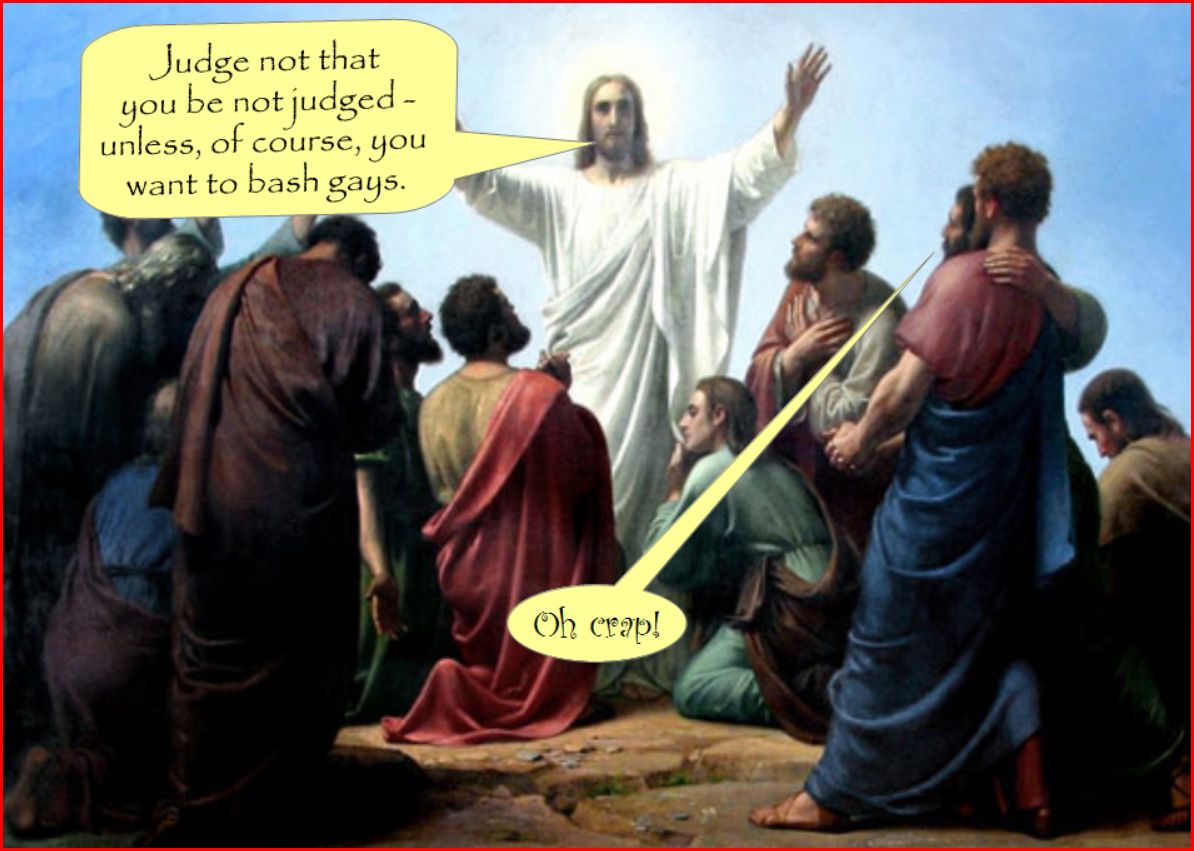
And what about ‘judge not that you be not judged’? Christians will tell you that this doesn’t mean they shouldn’t judge others, just that they should do it according to those same ‘biblical truths’.

This is not what Jesus is saying here though. He clearly means ‘do not judge others unless you’re prepared to be judged yourself’, which, we can only conclude, Christians are happy to have happen to them. They judge others and in so doing open themselves up to judgement; Jesus is very fond of this kind of yin and yang, measure-for-measure arrangement:

Judge not that you be not judged. For with the judgement you pronounce you will be judged, and the measure you give will be the measure you will get (Matthew 7.1-2).

It could also be the case that Jesus is referring here to God’s ultimate judgement as well, in which case those condemnatory Christians who believe that being ‘saved’ allows them to escape the final judgement are in for quite a shock. Still, they can always use the ‘I was only defending biblical truths’ excuse.