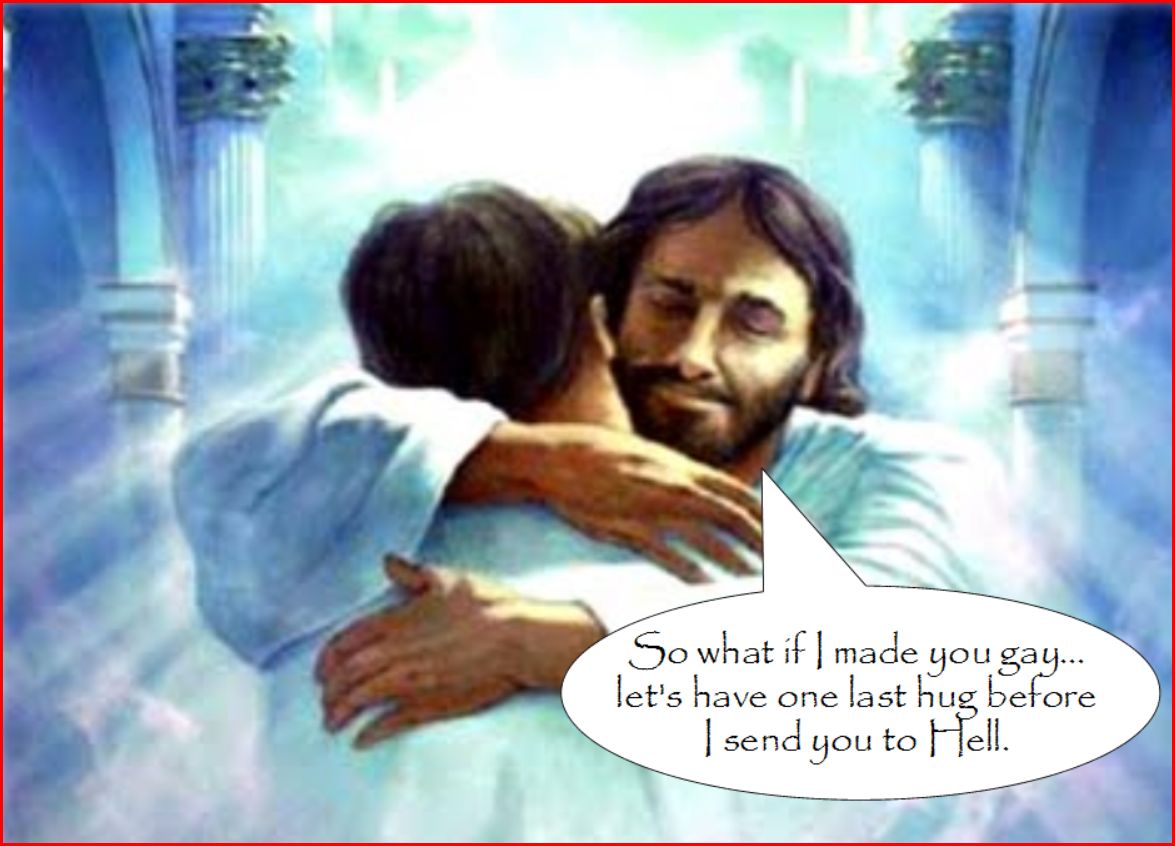
Christians’ Favourite Delusions 23: Jesus shows us how to live

Doctor

Was JC a great moral teacher?

No, the best things he said – do unto others, love your neighbour – had already been said eons before he came along. Some of the other stuff he came out with was ridiculously impractical – give away all you have; live only for today; turn the other cheek – that his followers have been unable to do from day one.

Did what he said about God turn out to be right?

No. He said God would establish his Kingdom on Earth while the disciples were still alive.

Did he commit himself to long-term responsibility for others and their needs?

Another no.

Did he experience the infirmities and difficulties of old age?

Nope.

Did he suffer from any of the serious illnesses we mere mortals are prone to?

Apparently not.

Did he give over his entire life to raising children or taking care of elderly relatives?

Not that we know of.

Did he have to work each day to earn a living?

No. He sponged off gullible female fans (Luke 8.1-3).

Did he have any understanding of science and of how the world works?

Erm, no. He thought people became ill because of sin and demon possession and that Heaven was in the sky.

Was he interested in anything but his own futile ‘mission’?

Yet another no.

Apart from his last few days did he know suffering, the everyday frustrations of life or the daily struggle to make ends meet?

Not so’s you’d notice.

Did he, in short, know anything of the life as it was lived and is lived by ordinary people?

Emphatically not.

There was nothing marvellous about Jesus. He was out of touch with ordinary people and at loggerheads with those cleverer than he was. He was a failed prophet who was turned into a supernatural being by those who came along afterwards – mainly Paul, who’d never met him – and is worshipped today by those who ignore most of what he said.


Today in Christian Love…

HugChristians, what do you do when you’re required to provide a service, say the photos or the food, at a gay wedding? It’s a tricky one, isn’t it, when the Bible tells you that homosexuality is an affront to God and you feel honour-bound to uphold his standards.

Well, Dan Reuter, pastor and attorney-at-law in Bloomington, Indiana has the perfect solution! Here’s what ol’ Danny-boy suggests:

The Christian purveyor of pictures or food should tell the sodomite couple:

Of course, I will provide my stuff for your wedding. I serve, and am required to serve, everyone, whether or not I approve of what he is doing. However, you do understand that if I am at your so-called ‘wedding,’ I will consider it my duty to call attention to God’s view of what you are doing. I will consider it my obligation to warn the guests of the danger they are running and of the harm all of you are doing to your own lives as God observes them. So, I will be distributing literature that explains all this.

And I thank you for the opportunity to reach people who otherwise might never hear this message that I believe they desperately need to hear.

What a neat suggestion! I know it’s neat because most of the comments on the site say so.

Christian love in action – a wonder to behold.

PS. Don’t forget, everyone else, to have some literature handy in your job so you can demonstrate how belief in Old Testament codswallop is an affront to your principles of tolerance and rationality. It’s a message the faithful desperately need to hear.

Hat tip to Steve Wells at http://dwindlinginunbelief.blogspot.co.uk/

The picture caption is not mine this time (they usually are) but I can’t locate the original source.

Christians’ Favourite Delusion 6: God guides our lives

GodGuidesGod, Christians like to tell themselves, has a special plan for the individual believer’s life. This plan involves, amongst other things, directing them towards a specific career, making them successful, guiding them to the person they are to marry and showing them where they should live.

Here, for example, is some ‘guidance’ provided by Bible-Knowledge.com:

Remember – God already has your next new job all set up and planned out for you. All you have to do is simply wait for His timing to bring it to you!

As we might expect, there’s no biblical basis for this fantasy – neither Jesus nor Paul (or any other New Testament writer) mention it, which is why Christian teaching promoting the idea fails, without exception, to reference either of them. Far from being an individually tailored life-plan, God’s agenda, according to Jesus, is the same for everyone: it is to work tirelessly to bring about his Kingdom, loving your neighbour as yourself and God even more (Mark 12.28-34).

And that, once again, is that.

Or not quite, because Jesus goes further. Nothing else, he insists, compares with God’s Kingdom, the pearl of great price next to which everything else is without value or meaning (Matthew 13.45-46). So he demands over and over again that people abandon jobs, homes, spouses and family concerns to seek and work towards the Kingdom (Luke 12.27-37 etc).

Why would he change – reverse even – these priorities, the central core of his ‘earthly ministry’, to direct the careers and prescribe the domestic arrangements of Christians today? Answer: he wouldn’t, demonstrating just how much of a construct of their own imaginations is the Christ that Christians worship, profess to listen to and who, they maintain, guides the minutiae of their lives.

Christians’ Favourite Delusions 5: The resurrection is well attested

PsychHere’s a question for you. How many first-hand, eye-witness reports do we have of the resurrection of Jesus?

Thousands? Christians would like you to think so.

Hundreds? St Paul tells us he’s heard this is the case (1 Corinthians 15.6).

Dozens? All those folk mentioned in the gospels, surely…

The answer is one. We have one first-hand, eye-witness report of the resurrected Christ. It’s St Paul’s own which he mentions, in passing, only three times. A total of six verses cover the allegedly most important event in history. Here they are:

Have I not seen Jesus our Lord? (1 Corinthians 9:1)

Last of all, as to one untimely born, he appeared also to me. (1 Corinthians 15:8)

The Gospel preached by me is not of human origin. For I did not receive it from a human being, nor was I taught it, but it came through a revelation of Jesus Christ… When he who had set me apart before I was born, and had called me through his grace, was pleased to reveal his Son in me, in order that I might preach him among the Gentiles. (Galatians 1: 11-12 & 15-16)

And that’s it. That’s Paul’s own account of his seeing the risen Lord. It hardly compares with the high drama of the Acts account, where on the road to Damascus, Paul is blinded by light and has a conversation with Jesus. But that story was written forty years after the supposed event, twenty after Paul’s death, by someone else. What’s more, it is recounted differently each time it’s told (in Acts chapters 9, 22 and 26). It’s not first-hand, it’s not eye-witness and it’s certainly not reliable.

What about the gospel accounts then? Don’t Mary Magdalene, Peter and others see the risen Jesus? Well, no, not in the earliest gospel, Mark, where, in the oldest versions, there are no resurrection appearances at all. The other three gospels have them, but these were written 50 to 90 years after Jesus lived and they contradict each other significantly. You can decide whether his makes them reliable or not, but they certainly weren’t written by the people involved, nor by eye-witnesses.

So, Paul’s account is the only first-hand report we have.

Let’s take a closer look at it.

Even in the heavily reworked versions in Acts, what Paul encounters is not a physical Jesus, a man in a resurrected body, but light from the sky and a disembodied voice, which, depending on which of the Acts account you rely on, no-one else present sees or hears. Paul himself doesn’t even know what he is experiencing – certainly not a recognisable human figure – until the light tells him ‘who’ it is.

There is no difference between Paul’s experience of a light purportedly from heaven and an event that occurred in its entirety – as far as it occurred at all – in Paul’s head. The original Greek of Galatians 1.15-16 makes absolutely clear that this is where it took place: while English translations say that the risen Christ revealed himself to Paul, the original Greek has Paul’s initial experience of the Christ take place in him. Paul, then, admits only to an inner vision of ‘a life-giving spirit’ (1 Corinthians 15.45) and nowhere does he claim that he encountered an extrinsic, embodied Jesus. Nor does the writer of Acts, however much he embroiders Paul’s experience, make the claim for him. The risen Lord, if he’s become anything, is not a resurrected body but a spiritual being made of light.

So, the only witness to the resurrected Jesus who has left us an account – six extremely sketchy verses in his letters – didn’t see the risen Jesus in physical form at all. He experienced an hallucination, or, as he puts it, a ‘revelation’. The resurrected Christ, in our earliest and only eye-witness report, is no more than a vision within a person’s head.

And from this, all else followed.

Christians’ Favourite Delusions 4: Heaven Awaits

Heaven2Quite a few Christians are now following this blog and I’d like to issue them with a challenge: show me where Jesus or the gospel writers or St Paul or any of the New Testament authors promise you that you’ll go to Heaven when you die.

Because, you see, the Bible doesn’t make any such promise.

Jesus was adamant that ‘the righteous’ (he’s not even talking about Christians!) would soon transfer into God’s new Kingdom on Earth. When you say the Lord’s prayer, Christians, this is exactly what you’re asking for: ‘Thy Kingdom come – on Earth as it is Heaven.’ As the former bishop of Durham, Tom Wright, puts it, ‘at no point do the resurrection narratives in the four Gospels say, “Jesus has been raised, therefore we are all going to heaven.” It says that Christ is coming here, to join together the heavens and the Earth in an act of new creation’… in the first century, we might add.

Paul, with a version of Christianity that bears little resemblance to Jesus’ own, doesn’t teach that the believer will go to heaven either. In attempting to explain why the Kingdom is late in arriving – so late, in fact, that Christians were dying without seeing it – he invents the idea that the deceased will be woken up by Jesus when he returns to Earth (1 Thessalonians 4.14-16. And yes, he really did make up as he went along).

And after Paul? It was becoming increasingly apparent to later Christians that Jesus really wasn’t coming back any time soon. So they invented the idea that they would go to be with him. As Bart Ehrman puts it ‘with the passage of time, the apocalyptic notion of the resurrection of the body becomes transformed into the doctrine of the immortality of the soul’. But this is not what Jesus himself promised – and you’d think as ‘the Son of God’ he’d have known how it all worked – it’s not what St Paul taught and it’s not even what the trippy writer of Revelation claims. He too insists that everything is going to happen here on a recreated Earth (Revelation 21).

So the choice for you today, Christians, is whether you believe ‘God’s Word’ where, for once,  Jesus and Paul say much the same thing, or you go along with those later, post-biblical believers with their altogether different idea of what happens when we die.

Of course, you opt for the latter – even you have doubts that the Kingdom will come at this late stage – instead of facing the fact that when we die, we are just that: dead.

Ehrman D. Bart (2009) Jesus Interrupted: Revealing the Hidden Contradictions of the Bible. Harper Collins: New York, page 266.

What use is religion?

SavedI went to church on Sunday. Not because I wanted to, but to help someone out. It was an interesting experience. There were some really nice people there – good people even. They would say they were good… no, they wouldn’t, they would dispute they were good… they would say any good qualities they had were the result of Christ and the indwelling of the Holy Spirit.

But such a claim doesn’t account for all the other good people we encounter in life who don’t believe in Christ or the Holy Spirit or any of the other aspects of the Christian faith. It doesn’t account either for the mean-spirited, spiteful and obstructive folk that we find in churches. If Christians have been regenerated through faith in Christ – the Bible calls them ‘new creations’ in 2 Corinthians 5.17 – then there shouldn’t be any unpleasant, unloving folk in church, should there?

The minister on Sunday made much of Christians being ‘works in progress’, but this sounds like a nice way of making excuses for difficult people. Some folk manage to be good and loving without faith, without ever being a ‘work in progress’. A Christian commenter on another blog I read, ‘Why There Is No God‘, argued the other day that we shouldn’t judge a religion by the way its adherents behave. But what other way is there to judge it? If a religion doesn’t make individuals more loving – and this is what Jesus claims distinguishes his followers (John 13:35) – then of what use is it?

It seems to me – and I’m aware I’m resorting to personal experience here, mainly because there don’t appear to be any empirical studies of individuals pre- and post-conversion – that good people are good whichever side of the conversion experience they’re on, and hateful types are hateful whether they’re believers or not. Religion doesn’t, in spite of its claims, change people very much. At most it brings out their true natures. Much the same as alcohol, really.

Multiplicity

MultiJesus

Ever see the film Multiplicity starring Michael Keaton as Doug, a man who clones multiple copies of himself? There’s a perfectionist Doug, a slob Doug, a macho Doug, a gay Doug, a romantic Doug… you get the picture. If you haven’t seen the film, you should. Or you could read the Bible for much the same experience.

It’s the original Mulitiplicity, with Jesus as the Michael Keaton character. There’s a Jewish Messiah Jesus, a demanding zealot Jesus, a Greek god-man Jesus, an intangible spirit Jesus and, just like in the movie, having so many clones about leads only to trouble and hilarious consequences. Well, maybe not so much the hilarious consequences, but certainly trouble.

Christians really have time for only one these Biblical Jesuses, the superhero creation of ‘Saint’ Paul’s who goes by the name – the title, no less – of ‘the Christ.’ This Greek god-man makes few demands of his adherents – he does everything for them – and provides them with a free-pass to Heaven (though Paul neglects to mention this particular super-power – you’ll search in vain for promises of Heaven in Paul’s writing.) Supernatural Christ Jesus always proves a better option than the earthy Jesus of the synoptic gospels because ‘gaining a right standing with God’ is a far easier game to play than serving others.

Synoptic Gospel Jesus preaches the coming of the God’s kingdom on Earth in the first century; tells his followers they should sell all they have to give to the poor; commands them to love their enemies and pray for those who persecute them. He insists they should lend without expectation of any return, cut off body parts that offend them and attend to the log in their own eye rather the speck in their neighbours’. No wonder Christians have no time for Gospel Jesus! He’s far too demanding, far too radical, like the super-perfectionist Doug in the film. Oh, they’ll protest they really do believe in Gospel Jesus, but if they did, we would see them doing all the things he tells them they should. And we don’t.

The demanding, Gospel Jesus loses out too to Ephemeral Mystic Jesus, the Jesus found in John’s gospel, the one who just can’t stop talking about himself. Then there’s Avenging King Jesus of the psychedelic nightmare that is Revelation. He’s the one who’s going to come back to Earth at some point (allegedly) to massacre his enemies.

It’s impossible to tell which of the multiple Jesuses is the ‘real’ one. Maybe it’s none of those in the Bible – move over Christ Jesus, Gospel Jesus, Mystic Jesus, Avenging King Jesus; the only Jesus Christians are really interested in is the one of their own making. The one they say lives in their hearts and who once, apparently, lived in mine. This is the best Jesus of all because he can be whatever you want him to be.

Maybe, in the end though, none of the Jesuses, not even the one Christians imagine lives inside them, is real. They’re all just imaginative interpretations of a long-dead, charismatic zealot whose mission went badly awry. And if the Bible hasn’t got a grip on what its central figure is really all about – Jewish Messiah, Greek Christ, intangible spirit – then what else is it confused and wrong about?

Why I could never be a Christian

RidiculousIn Through The Looking Glass, And What Alice Found There, Lewis Carroll has the White Queen boast that in her youth she could believe ‘six impossible things before breakfast’. Pfa! Only six? Today’s Christian can beat that with ease, and not only before breakfast!

To be a Christian you must accept through faith, and contrary to the evidence, that:

  • there is a reality above and beyond nature wherein exist angels, archangels, devils, demons, principalities (whatever they are), spirits (holy and otherwise) and God himself;

  • virgins can conceive and give birth;

  • a man who died 2,000 years ago is still alive;

  • this man could, when he lived, defy gravity; control the weather; sweat blood; reanimate corpses (his own included); pass through solid objects and project himself into space;

  • an intangible part of everyone survives death;

  • believing in a magic formula (‘Christ died for me’ or similar) leads to eternal life;

  • after death, believers will live again in an improved copy of the body they had when alive;

  • God reversed the laws on which the universe operates to make all of this possible, because he wanted to sacrifice a part of himself to himself;

  • he can do this because he is God;

  • he prompted men to explain his plan in a special book;

  • all you have to do to live forever is believe this book is true.

In addition to ‘essential’ beliefs like these, there are still more that Christians choose to accept on faith, add-ons that Christians are invited to see as the underpinning of ‘important’ doctrines. While not absolutely crucial, they are recommended as a means of adhering to (uncorroborated) biblical truth. Consequently, we find Christians who believe that:

  • God created the universe 6,000 years ago (because this is the time-scale that can be calculated from the Bible’s genealogies);

  • dinosaurs and humans co-existed (because this must be the case if the creation stories in Genesis are literally true);

  • evolution didn’t happen; God created the Earth and everything on it in just six days.

  • reality can be changed by the simple expedient of asking God to change it (prayer);

  • God directly controls the weather (omnipotence/divine irritability);

  • Jesus is coming back – with a selection of scenarios available to true believers about what this will be like (the second coming);

  • all unbelievers will be consigned to hell / oblivion / annihilation: again, take your pick (judgement).

There is not one scrap of evidence outside the special book that any of these items of faith are true. None is verifiable, and consequently none has ever been verified (accounts written inter-dependently fifty years after the alleged miracle-man lived don’t count).

There is, on the other hand, overwhelming evidence that virgins don’t conceive; that there is no agency behind the weather and natural disasters; that nothing of an individual’s self survives death and that dead bodies stay dead. This has always been the case and always will be. It was how nature operated two thousand years ago when all of the ‘essential’ items of faith, invented by the kinds of mind that believed earthquakes and floods were deliberate acts of God, were gaining currency.

Though I once did, I can’t subscribe to any of these ridiculously ‘impossible things’ in the vain hope that I might live forever.

Can you?