Respect?

HebdoI could so easily take offence at this. (The caption reads ‘But who wants the English in Europe?’)

How far should we respect religious beliefs? I would suggest, not at all. The multitude of religions that exist in the world, not least the big five – Christianity, Islam, Buddhism, Hinduism and Judaism – are all built on mythologies that require belief in supernatural beings, highly improbable events and meaningless rituals. There is no evidence these beings exist or have ever existed, no evidence the improbable events ever occurred and none that the rituals lead to results of any sort.

Most religions have their revered teacher, prophet or saviour who died centuries or millennia ago, and about whom stories are told that cannot possibly be true. How can any thinking person respect the idea that one of these figures rose from the dead? Or that another flew to heaven on a winged horse? Or another grew a jewel tree from a toothpick? These stories deserve as much respect as other ancient tales – like the one about the man who killed a one-eyed giant or the dude who returned to life after being hacked to death and eaten. The preposterous stories told by today’s religions are of the same order.

For this reason, as well as many others – not least how religion causes some of its adherents to act and relate to others – religion is not above criticism. Indeed, there is a moral imperative to criticise world views based on far-fetched stories, especially when they cause some who subscribe to them to discriminate against others, advocate murder and  take it upon themselves to carry out executions like the ones we’ve seen in Paris this week. I’ve written before about how, while most religious believers are not themselves extremists, it is moderate believers who sustain the culture responsible for those who are. Fanatics, extremists and terrorists do not spontaneously create themselves; they emerge from mosques, churches, synagogues and temples. As Bill Maher said about Islam this week, ‘when there’s this many bad apples, there’s something wrong with the orchard.’

While some have argued that the magazine Charlie Hebdo provoked Muslim extremists to attack it with its satirical drawings of Muhammed (among many other religious ‘leaders’) it is absurd to suggest that publishing provocative pictures automatically leads to murder, as if the perpetrators have no choice in the matter. Of course they do. Caricatures of the pope have also appeared on the magazine’s cover and, as bizarre as the Catholic church is, it has not responded to these depictions with violence.

There is, in any case, a good argument to be made that offence can’t be given, only taken. While no doubt there are Muslims who don’t find rather poorly drawn, largely unfunny cartoons of Muhammed offensive, there are those who choose to. (Just like I could choose to take offence at the cover above.) But provocation, whatever the context, is no defence and no excuse for the slaughter, violence or incarceration of those with whom we’re offended.

The religious need to grow up and put away childish things; to stop taking offence so readily, insisting they’re being persecuted when they’re not and constantly assuming they and they alone have the right to mete out punishment. Is the god each religion claims for itself so weak and feeble he cannot look after himself, his standards and his reputation?

Well of course he can’t, because he doesn’t exist. Every god there has ever been, from Osiris to Christ, from Zeus to Allah has been a human invention. And if no god exists, then neither do his standards and reputation, nor his prophets and teachers, his Sons and emissaries; they’re all largely made up too. No-one should be punished for failing to respect the figments of primitive people’s imagination. It is beholden on all of us who have indeed put away such childish things, to disregard the sensibilities of those who subscribe to and peddle puerile nonsense and point out as often as we can that not only does the Emperor have no clothes but there’s not even an Emperor. Only then can the world work towards being free from the tyranny of religion.

Simplistic maybe, but the alternative is to continue tolerating the intolerable. And look where that’s getting us.

This Year’s All-New Christmas Quiz!

SantaBack by popular demand (well, mine anyway), try this year’s all-new Christmas quiz!

Answers in the Bible or not, as the case may be. Real answers next time.

1. Where does the word ‘Christmas’ come from?
a) the Bible
b) the Catholic Mass held on the supposed date of Jesus’ birth
c) the Greek, meaning to pull the wool over people’s eyes

2. When was Christ born?
a) he wasn’t
b) 25th December
c) in the year 0

3. Which gospel writers didn’t think the nativity story worth including in their accounts?
a) Luke
b) Mark
c) John

4. Following the miraculous events of Jesus’ birth, what did Mary do?
a) she remembered them all in her heart
b) she wrote them down for later use in the gospels
c) she forgot all about them

5. How many times does Jesus refer to his miraculous birth?
a) never
b) twice
c) he doesn’t shut up about it (well, would you?)

6. How many times does the rest of the New Testament refer to Jesus’ miraculous birth?
a) repeatedly, showing how important it was
b) only when making an important theological point
c) never

7. How well attested are the events surrounding Jesus’ birth in historical documents of the time?
a) not at all
b) quite substantially
c) as you’d expect when mass murder and strange astronomical events are involved, they’re mentioned everywhere

8. When did Christians first start celebrating Christmas?
a) hundreds of years after the event
b) not long after Jesus died
c) immediately

9. Which of these Christmas traditions originate in the Bible?
a) Christmas trees
b) kissing under the mistletoe
c) giving presents

10. Which of these groups has benefited most from Jesus’ birth?
a) women
b) black people
c) LGBT people

11. What does Pastor Steven Anderson want for Christmas?
a) his two front teeth
b) peace and joy
c) the execution of all homosexuals

12. How will Christians celebrate Christmas this year?
a) by fighting the War On Christmas
b) by telling everyone that Jesus is the Reason for the Season
c) by putting the Christ back into Christmas


Picture from memegenerator.net


Who Ya Gonna Call?

DemonAnd when they came to the crowd, a man came up to him and, kneeling before him, said, “Lord, have mercy on my son, for he is an epileptic and he suffers terribly. For often he falls into the fire, and often into the water. And I brought him to your disciples, and they could not heal him.” And Jesus answered, “O faithless and twisted generation, how long am I to be with you? How long am I to bear with you? Bring him here to me.” And Jesus rebuked the demon, and it came out of him, and the boy was healed instantly. (Matthew 17.14-20)

Do you believe in spirits and demons? When you’re ill, do you visit the nearest exorcist or do you take yourself off to the doctor or hospital? Of course, most Christians (but by no means all) have more faith in the medical profession than they do in the wingnuts who’d tell them their ailment was the result of demonic activity and command the demon to leave in the name of Jesus.

Why? Because, even Christians know, in spite of what they might tell you, what causes disease and illness. They know what cures them too; and it has nothing to do with Jesus. ‘The Son of God’ is among the wingnuts when it comes to believing unclean spirits are at the root of human ailments and behaviour (Mark 5.1-8; Matthew 8.28-34; Matthew 12.43-45; Luke 4.33-36; Luke 8.29 etc.)

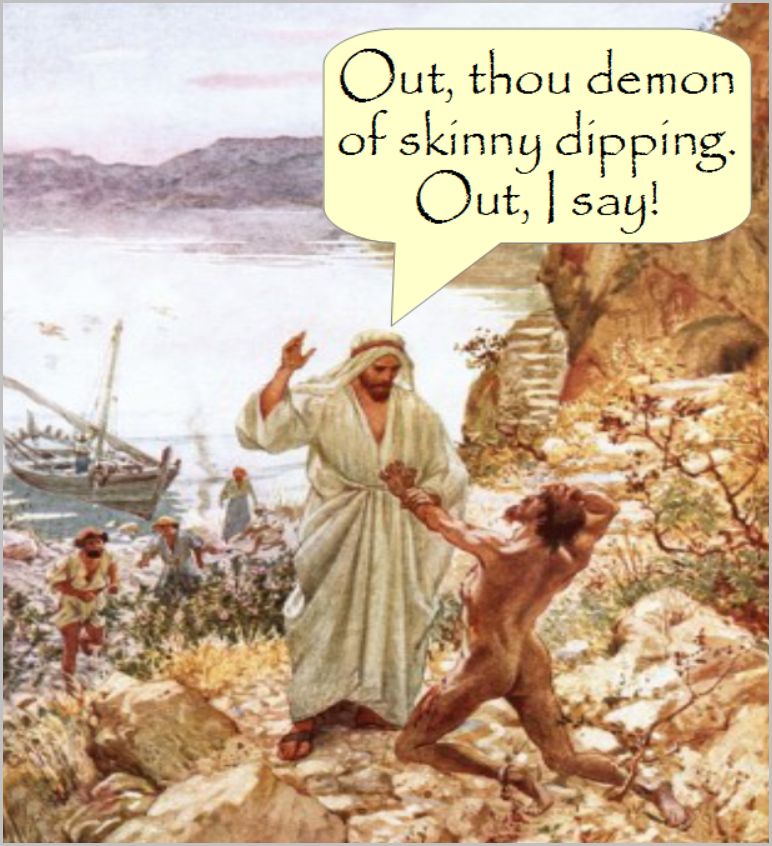
In spite of the fact there’s absolutely no evidence that demons exist, Jesus thought that invisible supernatural creatures were responsible for conditions like epilepsy. Like everyone at the time he thought that if these unclean spirits could be driven out, then the condition would be ‘cured’. Some follow in his misguided footsteps today; the Catholic church has an entire coven of exorcists, and charlatans like the Reverend Bob Larson make a living driving out the demons of pride, lust, homosexuality and greed from stooges and the gullible (except of course they don’t.)

If you’re a Christian, you should believe in demons and unholy spirits; you believe everything Jesus uttered was true, don’t you?

Of course, Jesus was a product of the pre-scientific era in which he lived; his ignorance might be excusable if it wasn’t offered up as God’s Truth. All that Jesus’ belief in devils and unclean spirits demonstrates is that he was very much a man of his time – evidence, if more were needed, that he wasn’t remotely divine. Unless, of course, the God he also believed in was as ignorant of the causes of illness and human behaviour as he was.

But next time you’re unwell, Christian, or you’re feeling a mite greedy or lustful, don’t go to the doctor’s. Don’t even ask the Lord for forgiveness. Have a little faith and, in the name of Jesus, command that hell-spawned demon within you to leave. See how that works out for you.


Update: New this week in ‘It Can All Be Blamed On Demons’:

Right-wing American broadcaster, Bryan Fischer, claims unarmed black teenager killed by cop was in fact possessed by a ‘homicidal demon’.

Tele-evangelist Pat Robertson asserts playing Dungeons and Dragons leads to demon possession.

Thank you, Lord, for your endorsement of fantasist rubbish like this.


No True Christian

WeekendA favourite response of Christians to any criticism is, ‘it doesn’t apply to me. I’m not that sort of Christian. The people who do or believe or think those things are not true Christians.’ This the ‘no true-Scotsman‘ fallacy.

  • You get it when you point out how God’s People™ agitate in Africa and Europe to deprive LGBT people of rights, protection and safety (unless of course you’re talking to a Christian who thinks this is a loving thing to do.)
  • You get it when you challenge Christians about Westboro baptist church’s activities, (the latest of which is claiming that Ebola is God’s punishment for Obama, which must be why he’s smiting poverty-stricken Africans.)
  • You get it when you mention those Christians who believe mumbo-jumbo that’s slightly different from theirs.
  • You get it when you ask them about any of the other deplorable things Christians do in Jesus’ name.

‘These other people are not true Christians,’ they say. ‘Their theology isn’t the same as mine; they’re misinterpreting the Bible; I wouldn’t do those kind of things; you’re picking out extremists.’

And do you know, Christians, those very people you say are not true Christians would say the same about you.

So what defines a Christian? Isn’t it that you accept Jesus Christ as your Lord and Saviour, profess him as such, and avail yourself of the salvation you think he offers?

Indeed it is. And it’s precisely this that you have in common with the Westboro baptist church, with those who peddle the absurd, with those who seek to damage LGBT people, with those who use their positions to abuse others and those with different ideas about what being a Christian is really all about.

You and they have bought into the same fantasy: they, like you, have accepted Jesus; they, like you, have his Holy Spirit in their hearts. That they do things you don’t approve of, or regard as embarrassing or despicable, doesn’t alter that fact. You’re all in it together; they represent Jesus just as much as you do; are as much a part of the ‘bride of Christ’ as you are. The zealots, extremists and wackos are your brothers and sisters in Christ, and if you’re right about Jesus being your Saviour – which of course you’re not; I’m being generous here – you’re going to be spending all of eternity with them.

So time to knock the ‘no true Christian’ excuse on the head – it’s going to be so embarrassing for you when you get to heaven.

Let’s Play Pointless

statue

If anything underlines the pointlessness of religion it’s the Pope’s declaration this weekend that two of his predecessors are now ‘saints’.

It’s pointless because, according to the Bible, Pope John XXIII and John Paul II (not their real names) were already saints. Yes, truly. According to the Bible all believers are ‘saints’ (Romans 1.7, etc).

Pointless because the two of them are dead and bestowing sainthood on them does not affect their fatal condition in any way.

Pointless because the dead are of even less use than the living.

Pointless because the Catholic church’s many adherents already hold these ex-popes in ridiculously exalted esteem – witness the hundreds who turned out yesterday for Pope Frankie’s saint-making ceremony. It hardly matters that he bestows a further, dubious accolade on them.

Pointless because, when alive, both men presided over an obscenely wealthy organisation whose God directed his followers to sell all they had to give to the poor; an organisation that, during these men’s reigns, repeatedly covered up child sex-abuse by its priests, prohibited the use of condoms in Africa (thus aiding the spread of HIV), denied women control of their own bodies and regarded LGBT people as evil. How ‘saintly’ is that?

Pointless because it’s all dressing-up make-believe anyway.

In other news, a giant crucifix in Italy, erected in honour of Pope John Paul II, collapses and kills a twenty-one year old man. Surely this is a sign of… well, something. Sure to be. Maybe someone can tell us… God? Catholic commentators? Saint John Paul?


One rule for the church, another for everyone else

PopeSays

Which of the following is the odd one out?

Bill Roache

Dave Lee Travis

Rolf Harris

400 Catholic priests

Yup, you got it. It’s the 400 Catholic priests. The other three are celebrities currently facing trial for alleged sexual misdemeanours in the 1960s and ’70s because, unlike the USA, there’s no statute of limitations in the UK. The priests, however, all of whom molested children, haven’t had to stand trial and have got away scot free. All that happened to them was that former Pope Benedict XVI defrocked them during 2011 and 2012, while he was still in office. And that, as they say, was that. USA Today explains:

 The maximum penalty for a priest convicted by a church tribunal is essentially losing his job: being defrocked, or removed from the clerical state. There are no jail terms and nothing to prevent an offender from raping again.

So there you have it. You want to escape the penalty of the law? Then hide behind Jesus and the might of the Catholic church and all will be well, whatever you’ve done – and might do again – to the children in your care.

Christians’ Favourite Delusions 9: The supernatural exists

Madeup

If you follow any Christian blogs, you’ll know that what many of them enjoy most is slagging off other brands of Christianity. They take the odd swipe at the heathen and at gay people, of course, but most of their bile is reserved for each other. They dispute the smallest matters of doctrine and principle that they are sure other groups of believers haven’t got quite as right as they have. To the outsider, it’s like arguing about whether the tooth fairy’s dress is pink or green while overlooking the fact that there is no tooth fairy.

It’s curious too because there are more similarities than differences between the varieties of Christianity. They have much more in common with each other than with the rest of us.

Most significantly, they all believe in supernatural beings. This, for me, is the greatest difference between myself and those who profess a faith. I see no evidence for supernatural creatures, places or events. The supernatural has no independent existence outside the human imagination. It is the human mind that, over the millennia, has constructed innumerable gods and their attendant mythologies, just as it has created more recently the inhabitants of Narnia, Middle-Earth and Hogwarts.

Being a Christian requires you believe in not one, but a myriad of supernatural beings, events and locations:-

While believers are adamant that there’s one God, they insist at the same time he is made up of three individuals: a Father, a Son and a Holy Spirit.

They believe in angels who wait upon God the Father in Heaven – a supernatural place they mistakenly believe they’ll be going to when they die – and who, some maintain, aid them here on Earth. How many angels are there? We are told in the Bible there’s a ‘host’ of them, which sounds like quite a lot.

There are also seraphim (Isaiah 6.2) and cherubim (Hebrew 9.5 etc), third-rate special-effects creatures who act as God’s heavies.

In addition to them, there are characters from the early days of Judaism – Moses and Elijah – who have survived death and hang about somewhere or other. They make a surprise return visit to Earth in Matthew 17.3. For some, Jesus’ mother, Mary, is another of this elite group of Eternals.

And what about all of the ordinary believers Christians say have already gone to Heaven? That’s millions of dead people who enjoy supernatural existence. Roman Catholics even believe you can chat with these heavenly ‘saints’ and they’ll argue your case for you with the Big Boss.

There’s the cast of characters from the dark-side too: God’s nemesis the Devil (aka Satan, aka Lucifer – though confusingly this last title is also used of Christ in Revelation 22.16) and his armies of demons and evil spirits who have nothing better to do than take over gullible human minds. This lot live in another supernatural place, Hell, though no-one seems to know where this is either (in Luke 10.15, Jesus implies it’s inside the earth, but it isn’t).

And last but not least are the supernatural events that supposedly took place in the real world: talking animals (Genesis 3.1; Numbers 22.28), sticks that turn into snakes (Exodus 4.3), corpses rising from graves (Matthew 27.52) and a man who magically beams up to Heaven (Luke 24.51), to name but a few.

So, Christians, argue all you like about what makes your version of Christianity better than others, but don’t forget all varieties of the faith depend on believing that these supernatural characters and events are real. In fact, they’re no more real than the pantheon of Greek gods and goddesses who inhabited Olympus, and at least they were interesting.

New series: Christians’ favourite delusions!

Number 1. My version of Christianity is the only true version

GodHates

It’s very easy for the believer to convince himself that his particular set of beliefs is the Absolute Truth and that this Truth needs defending from the ‘man-centred’ philosophies and heresies that threaten his false security. He is compelled to declare to the ever-contracting walls of his make-shift reality, ‘there’s only one Truth: mine!’

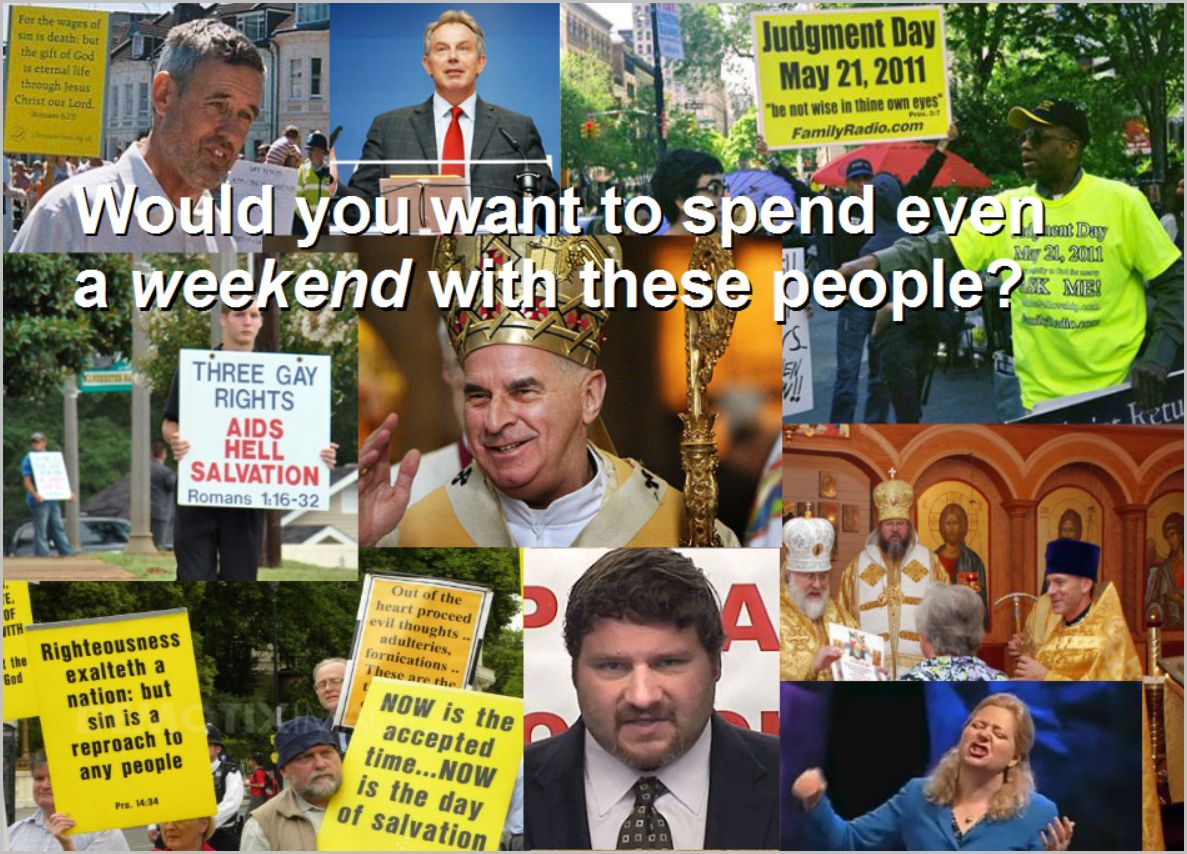
There are 34,000 different, distinct churches, groups and sects within Christianity, all claiming that they alone possess the absolute Truth. Their insistence that only their doctrines are based on ‘inerrant’ scripture demonstrates just how imprecise and wide-open to interpretation ‘God’s Word’ is. Take a look at Possessing The Treasure, Apprising Ministries and Slaughter Of The Sheep for a flavour of the delicious in-fighting. And don’t forget the Westboro Baptist Church, whose repellant views I’ve added to the picture above. These are, according to the church’s website, all Biblically based.

To the outsider, all Christian groups – from evangelicals and Roman Catholics, to Methodists and Baptists – differ very little. They all believe fantastic, unsubstantiated ideas so that their arguments between themselves are no different from disputes about whether the tooth-fairy wears a pink dress or a green one. What they don’t seem to realise is that it’s irrelevant what she wears when she doesn’t exist.

The one thing that all dissenting groups do appear to agree on, however, is that the more demanding and unpalatable aspects of Jesus’ teaching should be ignored. Instead of trashing each other, Christians might set about selling all they have and giving to the poor, just like their leader told them to. That, and not petty doctrinal squabbles loosely based on books of the Bible, many of which we know to be forged, would be real Christian living.

Throwing stones

WomanNew laws in Putin’s Russia have seen a wave of persecution directed at gay people. Christian websites have been quick to condemn the torture, beatings and murders that have taken place in recent weeks, pointing out that this isn’t the way to treat others (Matthew 7.12) or to show love for one’s neighbour (Mark 12.31) or to support a minority group (Matthew 25.45).

Oops. I interrupt this post for a reality check.

Needless to say, no Christian website has done this. Some have come out in support of Russia’s punitive new laws, because – well – God hates all that gay stuff, and, as we know, the odd Bible verse that grumbles about it trumps anything Jesus had to say about being nice to each another. Other Christian sites have ignored the subject entirely.

Our very own Christian Voice, while avoiding any mention of the Russian situation, has posted yet another anti-gay piece. Two thirds of their posts are on the subject, because this is what ‘the gospel’ is really all about. Upset that same-sex marriage is now law – even though they prayed really, really hard to the baby Jesus to stop it – Stephen Green’s sidekick, Robin (had to be really) points out that our bodies matter and, though it will come as some surprise to them, gay people don’t understand this.

You can read the full thing here, where you’ll note C.V. tries to avoid the word ‘gay’ and always puts inverted commas around same-sex ‘marriage’; pathetic doesn’t even begin to describe it .

I’ve attempted to comment on the article on the Christian Voice site, but so insecure are the dynamic duo in their faith, they can’t bring themselves to publish dissenting views. So here, with some slight amendment, are the points I made:

Oh, if only those pesky homosexuals were more like heterosexuals – always monogamous, faithful and never divorcing or remarrying.

If only all gay people were Christians, then the morality you espouse – but which not all Christians live by – might apply to them. As it is, it doesn’t.

If only they could have an encounter with Jesus then they’d be cured of their same-sex attraction.

If only there was some proof of this magical cure or that homosexuals need to be ‘cured’ in the first place.

If only gay people could be celibate, because that worked out so well for the Catholic Church.

If only they’d marry a person of the opposite sex and involve them in living a lie.

These are the options. So what is it you want homosexuals to do, Robin?

What indeed? I suspect he and the other Christians who rant about gay people would be happy only if they disappeared from the face of the Earth or if the great Jehovah were to smite them out of existence. What so many Christians seem unable to do is accept and show the love to their gay brothers and sisters that Jesus demands of them.

Who is the Pope to judge?

CoverSnip2I hope all you gay people out there are feeling mighty grateful to Pope Francis who this week had this to say about you:

“They say they exist. If someone is gay, who searches for the Lord and has goodwill, who am I to judge?” he added. “The Catechism of the Catholic Church explains this very well. It says they should not be marginalized because of this (orientation) but that they must be integrated into society.”

His words were widely reported as reflecting a new found tolerance of gay people by the Catholic church, the world’s largest cult. Nonsense; what his words reflect is the same old intolerance, this time with a smile on its face. The Pope’s words are disingenuous (“they say they exist”), condescending and conditional (‘happy to have you around  – but only so long as you’re interested in the same superstition as me’).

What the media generally failed to report was that Frankie also ‘reaffirmed the Catholic Church’s teaching that homosexual acts are a sin.’ Nor did most of it find it necessary to mention that ‘the official position of the Catholic Church on the issue is that while homosexual desires or attractions are not in themselves sinful, the physical acts are.’

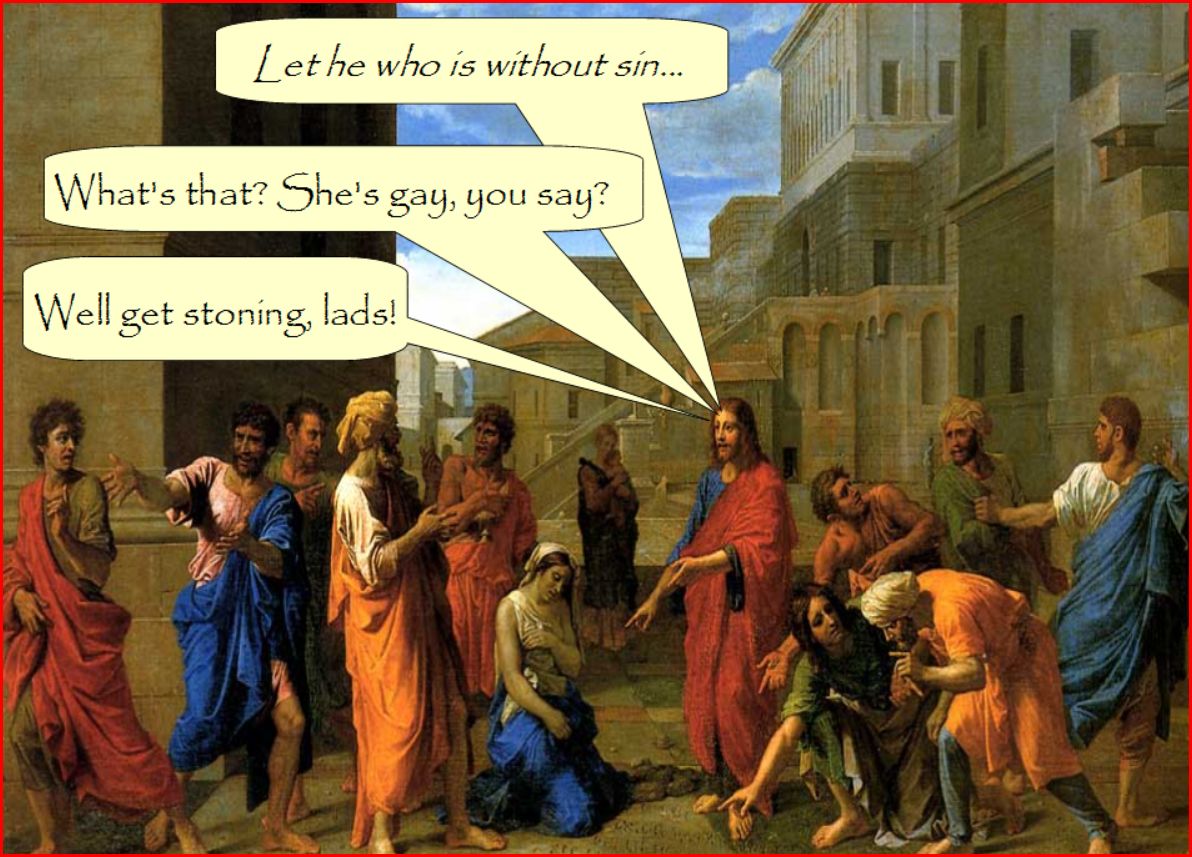
This view, which is held by other Christians too, that gay people should forego all sexual fulfilment in their lives and deny themselves loving relationships, simply because these would, of necessity, be with a person of the same sex is not treating people as Christians themselves would like to be treated (Matthew 7.12). Would Christians be happy with an ‘acceptance’ that allowed them to believe whatever they wanted, provided they didn’t act upon it – church attendance, worship, hymn singing, prayer meetings and overt expressions of faith all disallowed?

I’m guessing not. And it is far more extreme to deny individuals something as integral to their identity as their sexuality, than it is to suppress the expression of a set of spurious beliefs.

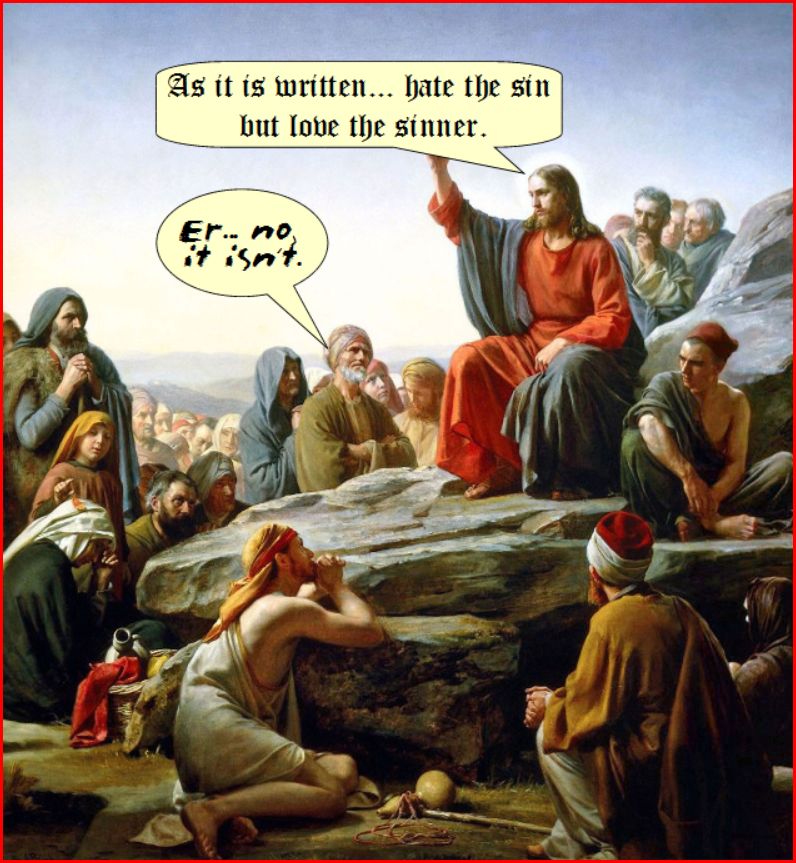
What the Pope was actually trotting out yesterday was the same old ‘hate the sin, love the sinner’ line. And there’s nothing remotely loving – or even biblical – about that. We are our behaviour, all of us, and are entitled to be loved (or not) for what we are, not in spite of it. If you can’t do that for another person, or group of people, then you’re not demonstrating love, whatever else you may be doing.

So, thanks Frankie, but no thanks. Until the Church you lead finds it in its heart to demonstrate real, unconditional love, your ‘tolerance’ is nothing more than an insulting irrelevance.