The Great Resurrection Miscalculation

How long was Jesus in the tomb before he ‘rose again’? Three days you say? Wrong! Read on and discover the secret of the Great Resurrection Miscalculation.

Resurrection

Jesus is wrong about no less an issue than his claim that he would rise from the dead after three days. In Mark 10.33-34 he prophesies:

the Son of Man will be handed over to the chief priests and the scribes, and they will condemn him to death; then they will hand him over to the Gentiles; they will mock him, and spit upon him, and flog him, and kill him; and after three days he will rise again.

On the surface, this seems pretty accurate for a prediction of events made some time before they actually happen (it wouldn’t be a prediction otherwise). Except, of course, this prophecy, like others of Jesus’, was written forty years or more after the event. Even then, Mark or whoever wrote the earliest gospel, can’t get it right. He tells us clearly in Mark 15.34 that Jesus dies at 3pm on Friday; Matthew and Luke agree. Jesus then reappears, fully recharged, ‘very early’ on the Sunday morning (Mark 16.2). But 3pm Friday to the ‘very early’ hours of Sunday is less than 48 hours – not three days, not even two.

What is the cause of this failed prophecy? For some reason, Mark assumes that ‘on the third day’, when he believed Jesus rose from the dead, means the same as ‘after three days’, the words he has Jesus prophesy. The third day after the crucifixion would indeed be the Sunday, but it wouldn’t be, and isn’t, three full days after it, as Mark’s Jesus seems to think.

The problem is not Mark’s alone, however. Matthew’s Jesus is even more emphatic that he will be buried for the three complete days:

For just as Jonah was for three days and three nights in the belly of the sea monster, so for three days and three nights the Son of Man will be in the heart of the earth. (Matthew 12.40)

Thanks to Jesus’ insistence in Mark and Matthew that he would spend three days in the tomb, the belief that he must have done so – contrary to the ‘evidence’ in those same accounts that it was less than two – appears to have become securely established by the time of the fourth gospel. Its writers, however, find their own unique way round the problem. Their thinking seems to have been along the lines that ‘if Jesus said he was going to be buried for three days and three nights, then he must have been. He was the Son of God after all, and he wouldn’t get a thing like this wrong. Therefore, if, as we know, he rose on the Sunday, he cannot have been crucified on the Friday. He must have died on the Thursday’. And so the writers of John’s gospel shift the crucifixion back a day, to around noon on Thursday (John 19.14). It’s an ingenious solution. Thursday to Sunday – near enough three whole days. There’s even some neat symbolism as a bonus: the earlier execution equates with the slaughter of the sacrificial lambs on the Thursday, ready for that evening’s Passover. Problem more than solved!

Except it creates a whole raft of new ones, not least the glaring inconsistency between the synoptic gospels’ accounts of the crucifixion on the Friday – after Jesus’ and the disciples’ celebration of Passover the previous evening – and John’s gospel’s account of the crucifixion during Thursday afternoon, well before the Passover meal would have been eaten. Significantly, no-one in the history of Christendom has ever been persuaded by John’s Thursday crucifixion, otherwise we’d remember it on ‘Good Thursday’ instead of ‘Good Friday’, and have a different day off work.

Does any of this matter? Probably not, but it does demonstrate that:

i) if Jesus’ words in the synoptic gospels are to be taken literally, then either he can’t count or he badly misjudges the timing of his resurrection. If scheduled for three days after the crucifixion it should have occurred on the Monday;

ii) the resurrection probably didn’t happen at all, and more than forty years later Mark and Matthew trip themselves up trying desperately to convince people that it did, and that Jesus knew it would;

iii) the gospel writers are prepared to rearrange already highly improbable events to make equally unlikely prophecies appear true;

iv) because the Bible cannot get its own faked, after-the-supposed-event prophecies right it can’t possibly be trusted about other claims it makes. 

Happy Easter, y’all.

Adapted from my book Why Christians Don’t Do What Jesus Tells Them To …And What They Believe Instead. Buy it on Amazon UK or Amazon US.

Why_Christians_Don't_Cover_for_Kindle


Which Christians won’t be resurrected after they die?

Robertson

All of these well-known Christians are unworthy of the Kingdom of God and won’t live again after they’ve died. See if you can work out why:

Billy Graham, Justin Welby (Archbishop of Canterbury), Desmond Tutu, Pat Boone, Mel Gibson, John Sentamu (Archbishop of York), Stephen Green (Christian Voice), Bono, Her Majesty the Queen, Sarah Palin (politician), Pat Robertson (700 Club), Joyce Meyer (evangelist), Bryan Fischer (outspoken radio broadcaster), Rick Warren (pastor of US mega-church), Rob Bell (ditto), George W. Bush, Tony Blair, Cherie Blair (barrister), Graham Kendrick (songwriter), Tony Perkins (anti-gay preacher), Scott Lively (ditto), Matt Barber (ditto), Peter LaBarbera (ditto), Tom Wright (theologian), Fred Phelps (late of Westboro church), Joni Eareckson Tada (writer), Mike Ratcliff (minister and blogger), Kirk Cameron (actor)… and, in all probability, your local pastor  – and maybe even you yourself, Christian reader.

They’re not worthy of God’s Kingdom nor are they likely to be resurrected because they’re married. And who says this makes them unworthy? Not me… Jesus:

those who belong to this age marry and are given in marriage; but those who are considered worthy of a place in that age (of God’s Kingdom on Earth) and in the resurrection from the dead neither marry nor are given in marriage (Luke 20.34-35).

So next time one of these famous Christians or some other married believer tells you you’re not saved, tell them that they’re not either. Jesus says so.

They won’t care, of course, because they pick and choose the bits of the Bible they believe. They’re more than happy to pretend this tricky bit doesn’t exist or doesn’t apply to them. Obviously, or they wouldn’t be married. Naturally this doesn’t stop them going on about about God’s plan for marriage even though it’s one they’ve made up themselves that flies in the face of what Jesus says.

Which means these same believers also have to ignore Jesus when he says, ‘Why do you call me “Lord, Lord”, and do not do what I tell you?’, which is a very good question.

Proof that God is real?

Thor

Christians – can you prove God exists? J. Lee Grady of Charisma magazine thinks he can and offers ‘7 Things That Prove God Is Real’. Leaving aside the fact that it shouldn’t be necessary to prove God is real – the God of the universe, Creator of Heaven and Earth, Father of Mankind should be more… apparent, shouldn’t he? – what are Mr Grady’s incredible proofs? Glad you asked. You can read the full article here, but to cut a long story short, they are:

Babies, thunderstorms, flowers, the Bible, the global spread of Christianity, Jesus and a personal friendship with God.

I hope you’re convinced. I know I am.

Problem is, all of these things are also evidence that God doesn’t exist.

Babies: Babies are miracles, according to Lee. We’ve evolved to find human babies cute and appealing even when they’re yelling, pooping and spewing – it helps us nurture them. But they’re not miracles; nearly 37,000 are born every day. What’s more, over a million of them die every year on the day they’re born. Which might just suggest God is not real at all.

Thunderstorms: Mr Grady says that because storms are powerful they put him in mind of God. This, however, is not proof of anything. Unless of course it’s Thor, god of thunder in Norse mythology and star of Marvel Comics. Is this who you mean, Lee?

Flowers: Lee says flowers are proof of God because they’re pretty. He seems to be unaware that their appearance is the result of natural selection; it has developed in order to attract insects and birds who then unwittingly assist in the plant’s reproduction. Yes, flowers are pleasing to the human eye as well, but their job is emphatically not ‘to simply make the world beautiful’, as Lee claims. They are evidence of evolution, not of a flower-arranging god.

The Bible: Lee trots out the false assertion that the Bible, in spite of having numerous authors over thousands of years, presents a consistent message. It doesn’t. There are, for example, at least nine different ways of being saved expressed by writers in the New Testament (some of whom, including the one Lee quotes, are forgers) – and they lived within a few decades of each other! A book cobbled together more than 300 years after the supposed main event, by men – not God – with a vested interest in its success, is not proof of the divine.

The global spread of Christianity: Human beings have worked hard throughout the ages to spread their own particular version of Christianity – often converting others on pain of death. There are today over 34,000 Christian groups, sects and cults, which is ‘proof’ that there is no one Mastermind behind it all. Other religions spread too, so perhaps that’s evidence their God is real as well (or instead), and so do diseases. The spread of an idea only illustrates human preoccupation with that idea.

Jesus: Really? His broken promises, failed prophecies, impossible morality and shabby treatment of those who didn’t buy into his mission somehow ‘prove God’? Maybe Lee means that Christ proves God. But ‘the Christ’ is an invention of Paul’s and has little to do with the man Jesus. In any case, one mythical figure does not prove another. Unless it’s Thor, of course, whose existence definitely proves there’s an Odin.

A personal friendship with God: What goes on in Lee’s head doesn’t prove anything, never mind the existence of God. A person’s feelings are subjective, solipsistic and entirely unverifiable. Thinking he’s got a relationship with God doesn’t mean that he has. Unlike my friendship with Thor. That’s really real.

So, seven proofs of God that are no proof at all. Anyone else care to take a turn?

What’s this ‘Biblical morality’ we keep hearing about?

Is it feeding the hungry? Helping the poor? Visiting the sick and the imprisoned? Opposing injustice? Fighting against oppression? Giving away your possessions? Going the extra mile? Turning the other cheek? Respecting others? Loving your neighbour? Loving your enemies?

Or is just about sex? To read Christian web-sites and blogs, you’d think so. Jesus’ followers today are obsessed with it, which is why the God they make in their image is too. Sex that other people might be having, before marriage, during it; sex when it makes babies and when it doesn’t; sex with yourself; sex in the head, on the screen and in different positions; sex with too many partners, with the wrong partners and with partners of the same sex (the worst sin of all, apparently). They write about little else, because you see, what other people do in bed together is of great concern to God. It’s more important to him – or his self-appointed representatives on Earth, anyway – than hunger, oppression, slavery, injustice and genocide combined.

If only we all had sex like the Christian experts say we should (because it’s in the Bible) then we’d all be so much better off; civilisation wouldn’t be slipping into the abyss, God wouldn’t be so upset with us and we wouldn’t all be destined for hell.

End

But morality isn’t just about sex. In fact, it has little to do with who we sleep with and when. Rather, morality is about how we treat others, as Jesus said (Luke 6.31). Of course, how we treat others in a sexual context is important, but it’s no more important than how we treat them in other contexts. That’s because morality is, or should be, all embracing. It’s long past time Christians stopped banging on about it as if it was the only concern of morality. Instead they could start treating those who do sex differently from them as they themselves would like to be treated. That, if there really is such a thing, would be true Biblical morality.

Christians ignore Jesus

Optional

Christians are commanded to ‘take up their crosses’ to follow Jesus (Luke 9.23). That means, amongst other things, doing what he commands. Yet Christians don’t just fail to do as he tells them, they replace his agenda with their own and completely ignore him. Being a Christian, according to Jesus – and you’d think he’d know – is not about pointing out the failings of others, nor about defending God’s honour (as an omnipotent being he’s more than capable of doing that himself) and it isn’t about condemning those you don’t agree with. It’s about treating others as you’d like to be treated, loving your enemies… things like these, in fact –

Do not judge, so that you may not be judged. For with the judgement you make you will be judged, and the measure you give will be the measure you get (Matthew 7.1-2).

Yet Christians judge relentlessly and tell us they’re justified in doing so: ‘you’re a sinner’, ‘you’re going to hell’, ‘gay people are of the devil’, ‘you’ve got the wrong set of beliefs’. We can only suppose they’ve don’t have a problem with the judgement they themselves will face as a result (because they don’t really believe there’ll be any such judgement.)

But I say to you, love your enemies and pray for those who persecute you (Matthew 5.44).

What Jesus really meant to say here, surely, was ‘criticise those you don’t like, claim they’re infringing your rights, sue them if need be’. Yes, that’s it.

Give to everyone who begs from you, and do not refuse anyone who wants to borrow from you (Matthew 5.42).

Really? Let’s give it a go. Beg a Christian to pay off your mortgage or ask to borrow the cash for new car. See how far that gets you. The problem here, as with all of these commands, is that Jesus really has no idea. No wonder Christians ignore this one.

How can you say to your neighbour, ‘let me take out the speck in your eye,’ when you yourself do not see the log in your own eye? You hypocrite, first take the log out of your own eye, and then you will see clearly to take the speck out of your neighbour’s eye’ (Luke 6.42).

Another ‘don’t judge’ command, to which Christians respond, ‘What log? Your speck is more of an eyesore than my log. My log doesn’t impede my vision at all. It’s you who can’t see.’

If anyone strikes you on the cheek, offer the other also; and from anyone who takes away your coat do not withhold even your shirt (Luke 6.28).

Yeah, right.

Do to others as you would have them do to you (Luke 6.31).

From which we can only conclude that Christians really must want to be treated as shabbily as they treat others (see links above)  

So how about it Christians? Maybe if you were doing what Jesus commands instead of judging the rest of us, we might take you a little more seriously. And, assuming he’s up in Heaven watching you – though even you know he isn’t or else you’d be doing as he tells you – so would Jesus himself.

As he says in Luke 6.46: ‘Why do you call me “Lord, Lord,” and don’t do what I tell you?’

Why_Christians_Don't_Cover_for_Kindle

For more on this topic – Christians’ failure to take any notice of Jesus’ commands – see my book Why Christian Don’t Do What Jesus Tells Them To …And What They Believe Instead, available from Amazon.

Is your marriage a Bible-based marriage? Find out in this simple quiz.

Marry

1. If you’re male, have you got more than one wife? If female, has your husband got other wives as well as you?

If you answer ‘yes’, score 20 points: all the heroes of the Old Testament had multiple wives: Abraham, Esau, Jacob, Moses, Gideon, David, Solomon… Clearly, polygamy is acceptable in the sight of the Lord (Exodus 21.10). Even Jesus approves of it (Matthew 5.17-18 & 25.1-13). Well done if this is you! No points for a ‘no’ answer – you’ve a lot of catching up to do.

2. Are you married to your brother/sister?

20 for yes, nothing for no. God approves of this kind of marriage in Genesis 16.1-3 and as we know, the answer’s always in Genesis.

3. Ladies, were you a virgin on your wedding night?

Score 20 if you were. Otherwise, get your husband to have you stoned to death on your dad’s doorstep, like Deuteronomy 22.13-21 says he should.

4. Were you under-age when you married?

No problem. In fact, the minimum age for marriage in the Jesus’ time was 12 for girls, 13 for boys so award yourself 25 bonus points if you were still a child when you married. Nothing though if you were ancient… like say, 20.

 5. Have you taken a slave as a partner?

Another 30 points if you have. God’s quite happy with this arrangement. The slave might not be, but who cares? Not God, that’s for sure (Numbers 31.17-18).

6. Men, did you buy your bride off her father? Ladies were you bought?

To really qualify as a bible-based marriage, this how it should be. You gonna argue with Genesis 34.12 and Exodus 22.16-17? Score 50 if money changed hands. Nothing if it you did it all for love: that’s not biblical at all.

7. Have you married your brother’s newly widowed wife?

70 points if you did – it’s what God expects (Genesis 38.9 & Deuteronomy 25.5-10). Just don’t spill your semen on the ground on the wedding night because, as Onan discovered, sex-obsessed Yahweh will smite thee if thou doest.

 8. Do you frolic naked round a garden with your partner without bothering with a formal marriage service?

Score 50 if this Adam-and-Eve arrangement is for you – they didn’t bother with marriage either. You get nothing if you keep your clothes on while gardening.

9. Do you hate your spouse (and children and your father and mother)?

Jesus says you should, in Luke 14.26, so that you can follow him more zealously. If you really can’t stand the person you’ve married to, score 100 points. You get nothing if you’re soppy and still love your wife or husband.

10. Christians, have you shunned marriage altogether?

Your Saviour says you should (Luke 20.34-35) otherwise you’re not worthy of a place in his Kingdom (offer good only in the first century, admittedly). Award yourself 200 points if you’ve been obedient, nothing if you decided this instruction wasn’t for you and you went ahead and got married anyway!

11. Have you castrated yourself for Jesus’ sake?

He thinks you should, you know; see Matthew 19.12. Score 500 (though not much else) for taking this final step. You get nothing for deciding – again! – that this isn’t for you. What are you? A man or a wimp?

12. Have you divorced your partner and married another?

True, Jesus doesn’t approve of divorce, but more ‘bible-believing’ Christians divorce in the USA than non-believers (32% compared with 30%) and they can’t all be wrong. What does Jesus know anyway? Add an extra 100 points to your score for every additional wife or husband you’ve had.

So how did you do?

0. Forget it. You marriage is worthless in the eyes of the Lord.

5-100: What must God think? You’ve really let him down. He offers you all these attractive, biblical options – multiple wives, slaves, siblings  – and you’ve not gone for any of them. For shame.

100-199: Get serious! You think biblical marriage is negotiable?

200 and 499. Pretty good. You’ve avoided marriage, just like JC says you should.

Over 500: You’ve definitely got a bible-based marriage. Or rather, you haven’t, and no balls either.

Christians’ Favourite Delusions 11: God is ours

preacher3

Apparently, you surrender any right to talk about or comment on God when you’re an atheist. Or so Christians would have it. ‘If you don’t believe in God, why don’t you just shut up about him? Why does it bother you that others believe?’ is the sort of line they take. You’ll find it in the comments on this blog and other sites that are critical of faith.

Like so much else, Christians are wrong about who can have an opinion about God. Unbelievers have as much right as believers, of whatever persuasion, to express views on the God-concept. It’s fair game for everyone.

So why do I bother? Six reasons.

1) I gave Jesus the best years of my life. Well, not really ‘Jesus’ because you can’t give anything to someone who’s been dead these past two millennia – but I was a Christian for twenty plus years and I complied with what the church and the Bible told me. It was a mistake; I denied myself, as I was told to do (in Matthew 16.24) and wasn’t able to be who I really am. I’m so much happier without being told what that should be.

2) I find the persistent proselytising by Christians to be thoroughly objectionable. It’s almost impossible to walk through the town centre where I live without being told by some street-preacher or other that without Jesus we’re all bound for Hell and that ‘evolution is lie’. (One of these claims is, that’s for sure.) If you get too near, a confederate will thrust a tract into your hand, replete with Bible quotations, spelling mistakes and dodgy grammar. And should you manage to avoid these particular desperadoes, you’ll then have to watch you don’t fall over the stands of Jehovah’s Witness literature, ‘manned’ by smiling ladies who think their brand of superstition is the truth.

3) Christians’ treatment of gay people is generally deplorable. ‘Hate the sin but love the sinner’ is the line frequently trotted out, even though it’s entirely unbiblical.  They may claim to love gay people but it’s a hollow claim when ‘in love’ Christians condemn gay people as sinners of the worst sort; ‘abominations’ is the word used in their holy book (and some Christians use worse language than this). Because of what the Bible says, many believers seek to deny same-sex couples the right to marry and resist attempts to grant them the same rights as everyone else. Christians insult us all by calling this love.

4) Christians’ uncritical adherence to superstition is incomprehensible. There are innumerable Christian web-sites, some of which I read (purely for research purposes, you understand) that are, variously, sources of hilarity and despair in equal measure. There has to be some counter-balance to the irrationality and evangelistic fervour of these sites and thankfully there is. Hopefully this blog makes some small contribution.

5) However much they preach at the rest of us, Christians fail to do as their saviour commands them. They think they’re ‘saved’ through St Paul’s magic formula but ignore everything Jesus says is required of them (see previous posts and my book Why Christians Don’t Do What Jesus Tells Them To …And What They Believe Instead.) It’s all specks and logs, to paraphrase JC himself; Christians enjoy pointing out everyone else’s sinfulness – and arguing about doctrine, of course – while blatantly ignoring Jesus’ commands. I feel obliged to point this out.

6) If, through this blog, I can lead people to question their beliefs, help them reflect critically on what they are told by church leaders and very selective reading of ‘God’s Word’, encourage them to think rationally about their belief in supernatural beings and, most of all, if I can be instrumental in rescuing one person from the Jesus cult, then I’ll be more than happy.

That’s why I bother.

Christians’ Favourite Delusions 10: God cares

dead-sparrow

@deadsparrow had just made his final Tweet.

The Bible says God controls the weather and 53% of Americans believe it. A further 17% say they don’t know or don’t want to say whether he does; evidently, they aren’t prepared to rule out the possibility, otherwise they would be among the 29% who know that he doesn’t.

I wonder what those who were hit yesterday by the typhoon in the Philippines think of God’s control of the elements? Was the destruction he brought about by sending Haiyan a mark of his love for mankind? Presumably not – destroying lives, homes, possessions and livelihoods hardly speaks of love.

Was it a punishment then? Right-wing Christians like to tell us that natural disasters are God’s judgement on human sin and our ‘shaking a fist at God‘ by redefining marriage to include gay people.  Why then does he consistently punish those in parts of the world which are already prone to extreme weather conditions? Why does he punish those who are already poor? Why does he send devastating weather to the fifth largest Christian country in the world, which doesn’t recognise gay marriage? It’s all a bit indiscriminate, wouldn’t you say? What sort of Almighty are we dealing with here, who can’t even direct his punishments at the right target? It doesn’t speak much of ‘control’.

Jesus might claim, in Matthew 10:28-31, that God cares even for the sparrows but this is another of his bare-faced lies. The evidence tells us otherwise: ‘God’ doesn’t care how many humans perish in storms, typhoons, tornadoes, tsunamis, earthquakes and all manner of natural disasters. He doesn’t care how many lose their homes, loved ones and all they’ve worked for.

The weather, in fact, is random, largely unpredictable and indifferent to human and animal needs. If God exists, then he is as indiscriminate and uncaring as the weather he supposedly creates. But of course God is not needed to explain the weather; science tells us how it occurs in terms that don’t involve him. His very superfluousness – the same superfluousness we find in evolution and all the other ‘laws’ of the universe – is all the evidence we need that he doesn’t exist.

An experiment in Christian morality

Forget

Time for a little experiment: some data gathering for ourselves that will demonstrate the extent to which Christians are willing to comply, without cynicism or irony, with their Saviour’s peculiar requirements. While the Bible assures us it is wrong to put the Lord God to the test (Deuteronomy 6.16, etc), rest assured the same does not apply to believers themselves.

Our experiment is a cruel one to be sure, but given Jesus’ command in Matthew 5.42, that believers should ‘give to everyone who begs from you, and do not refuse anyone who wants to borrow from you’, we would be within our rights to test their adherence to the principle. After all, Jesus specifies that his followers must oblige ‘everyone’ and ‘anyone’ who asks, which is accommodating enough to include any sceptics conducting an experiment. He doesn’t stipulate either that those doing the asking have to have genuine need; indeed the entire thrust of his teaching in this section of Matthew is about responding sacrificially to unreasonable demands. We won’t be unreasonable – so no slapping of cheeks – and we will do our best to ensure our request is designed to meet as genuine a need as we can create.

For any experiment we need a hypothesis, so I propose that for this particular one we go with something like ‘Christians will not give to those who beg from them nor lend to those who ask to borrow’. If you want to amend this to suit your own circumstances, by all means do. You can choose too whether you’re going to beg, which means you get to keep anything you are given, or to borrow, in which case you won’t and you’ll need to pay it back at a later date.

Next, you’ll need to select your subject: you can choose an individual – they must of course be a card-carding, Spirit-filled Christian – or an institution: a church, say, or Christian organisation like Christian Voice or Focus on the Family. Whichever you opt for, you’ll need to ensure they are capable of meeting your request – we’re not going to pick on Christians of more modest means – and decide what you will ask for. I suggest that if your subject is a renowned evangelist or the pastor of a so-called mega-church you could reasonably ask him or her to lend you the money to pay off your mortgage, for example, or to meet medical expenses. I’m sure he or she will agree that these qualify as truly genuine needs, though you don’t necessarily have to tell them why you want the money, given there’s no mention of the beggars in Jesus’ instructions explaining themselves. On the other hand, if you think it will go some way to help disprove the hypothesis, you can and perhaps should be clear about why you want the cash.

Right. You should be all set. Be sure to let me know how you get on and whether your Christian subject demonstrates the hypothesis or refutes it. I’ll collate the data.

What’s that you say? You’re not going to bother because it’s a foregone conclusion that most Christians, whether prominent individuals, churches, organisations or ordinary believers won’t give to anyone and everyone who asks?

You could well be right, because, although Christians do give generously to causes close to their hearts, they baulk at the idea of giving to just anybody, in spite of what Jesus says. Maybe Christian readers of this blog can explain why; why don’t you do what Jesus tells you in this and many other respects? You cannot be his disciple, he says in Mark 10.25, unless you give away all that you have and he won’t recognise you as a follower unless you obey him entirely (Luke 6.46). So how about it?

Today in Christian Love…

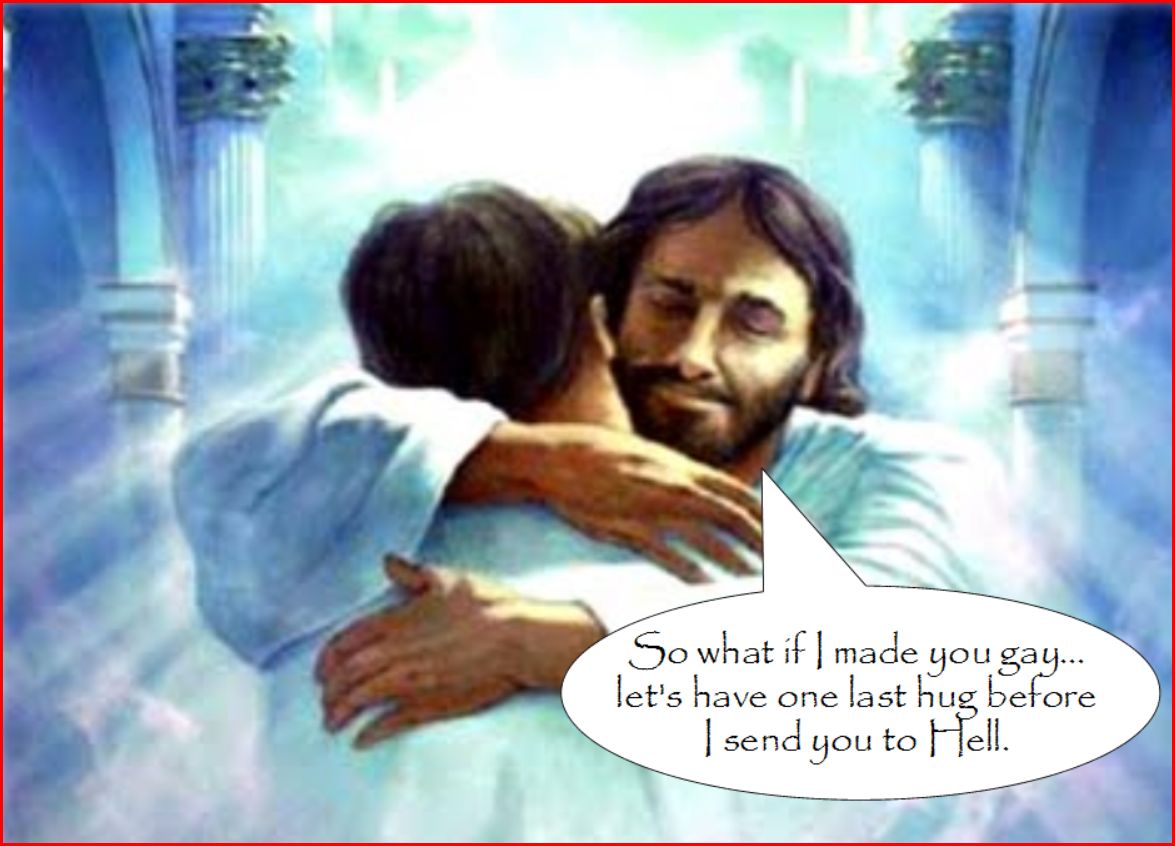
HugChristians, what do you do when you’re required to provide a service, say the photos or the food, at a gay wedding? It’s a tricky one, isn’t it, when the Bible tells you that homosexuality is an affront to God and you feel honour-bound to uphold his standards.

Well, Dan Reuter, pastor and attorney-at-law in Bloomington, Indiana has the perfect solution! Here’s what ol’ Danny-boy suggests:

The Christian purveyor of pictures or food should tell the sodomite couple:

Of course, I will provide my stuff for your wedding. I serve, and am required to serve, everyone, whether or not I approve of what he is doing. However, you do understand that if I am at your so-called ‘wedding,’ I will consider it my duty to call attention to God’s view of what you are doing. I will consider it my obligation to warn the guests of the danger they are running and of the harm all of you are doing to your own lives as God observes them. So, I will be distributing literature that explains all this.

And I thank you for the opportunity to reach people who otherwise might never hear this message that I believe they desperately need to hear.

What a neat suggestion! I know it’s neat because most of the comments on the site say so.

Christian love in action – a wonder to behold.

PS. Don’t forget, everyone else, to have some literature handy in your job so you can demonstrate how belief in Old Testament codswallop is an affront to your principles of tolerance and rationality. It’s a message the faithful desperately need to hear.

Hat tip to Steve Wells at http://dwindlinginunbelief.blogspot.co.uk/

The picture caption is not mine this time (they usually are) but I can’t locate the original source.