
Either All True Or None True

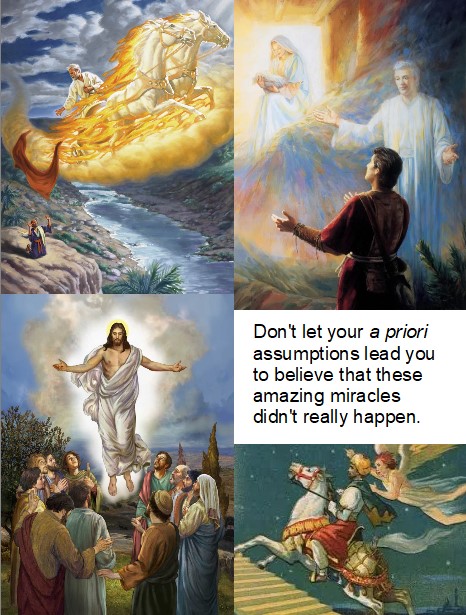
About 2,500 years ago, a man called Elijah went up to heaven while still alive. He was taken through a whirlwind in a chariot of fire, pulled by horses of fire. This amazing event was witnessed by several other people who were profoundly affected by it. The story of this ascension was possibly relayed orally for many years until finally being written down in what is now 2 Kings 2.

Did any of this really happen?

Of course not. It’s a myth.

Some time in the 4th century BCE, the first king of Rome, Romulus, was taken, while still alive, to the dwelling place of the gods. From that time on he was worshipped as a god – some said he was eternal to begin with – with a temple being built in the very place from where he had ascended. Later he appeared to one of his followers, Julius Proculus who said the resurrected Romulus was larger and more beautiful than ever, armed with weapons shining like fire. Julius Proculus attested to this appearance of the resurrected Romulus, swore an oath to its veracity and relayed it faithfully to others.

Did any of this really happen?

Of course not. It’s a myth.

https://mythologymatters.wordpress.com/2019/04/18/easter-mythology-the-resurrection-as-modeled-on-greco-roman-myths/

It is not known when Mithras was born, if indeed he was. He emerged from a rock in the spiritual realm as a child or youth, ritually slaughtering a bull and sharing a banquet with the god Sol. He guided souls to the after-life, propelled as they were by the bull’s blood and flames. He was worshipped primarily by soldiers who saw him as their salvation from the bitterness of earthly life. There were rituals to be followed to become a true initiate and for Mithraic mysteries to be revealed. How Mithras made himself known to his acolytes is unknown, but in the first three centuries CE, his cult rivalled that of the Christians in popularity.

Did all of this really happen?

Of course not. It’s a fabrication, a myth.

In the 8th century CE, the prophet Muhammad flew from Mecca to Jerusalem on a winged equine. Once in Jerusalem he climbed a ladder to heaven. Once there he travelled through the various levels, having conversations with other lesser prophets, before entering Allah’s domain. His journey was later revealed to two early prophets who had known Muhammed when they were boys. They conveyed the details accurately until they were recorded, briefly at first in the Qur’an and later in more detail in its supplement, the hadith.

Did any of this really happen?

Of course not. It’s a fabrication, a myth.

In the early 19th century, Joseph Smith was visited by Jesus and his Father in a vision. They told him that he should not join any existing church because they were all in error. Later, a hitherto unknown angel named Moroni appeared to Smith and indicated to him where some gold plates were buried. He instructed Smith to dig up and translate the plates. Obediently, Smith did so, using a pair of seer stones for the translation. The resulting Book of Mormon was a revelation of Christ’s activities in North America following his resurrection. Smith wisely had a number of his associates witness, in writing, the existence of the gold plates as well as their supernatural provenance.

Did any of this really happen?

Of course not. It’s a fabrication.

In 1916 the Virgin Mary appeared numerous times to three poor Portuguese children, giving them instruction and prophesying to them. She also promised that she would perform a miracle at Fatima. Accordingly, between 30,000 and 100,000 people, including reporters and photographers, gathered at Fatima where many saw multi-coloured lights before the sun itself ‘danced’. It came closer to the Earth before zig-zagging back to its usual place in the sky. While not all of the attendees testified to the phenomenon of the dancing sun (some saw only the lights, others nothing at all) many did and testified to the effect the miracle had had upon them.

Did all of this really happen?

Of course not. It’s a fabrication based on hallucinations.

Around 30CE, a rabbi known as Jesus, who had been born of a virgin, gathered together 12 followers and went around Galilee preaching absolution from sin and the imminence of the Kingdom of God. He announced he was the Messiah who would rule the Earth when the kingdom arrived. The Jewish authorities took exception to his claims and petitioned the Romans to have him executed. This they did, only for Jesus to come back to life three days later, appearing in visions to his followers. He ascended to heaven, promising that those who believed in him would enjoy eternal life. Some of his disciples spread his message faithfully until it was eventually written down, first by a former Pharisee called Paul and then by four authors who accurately recorded what Jesus had said and done.

Did all of this really happen?

What do you think?
Real or Metaphor?

Don has been asked repeatedly by Ark to ‘explain how to tell the difference between real and metaphor in a biblical context’.

Don has so far evaded the answer, gifting us instead his lectures about how we don’t really understand figurative language (I didn’t publish the latest), or telling us it all depends on whether the event described somehow feels real.

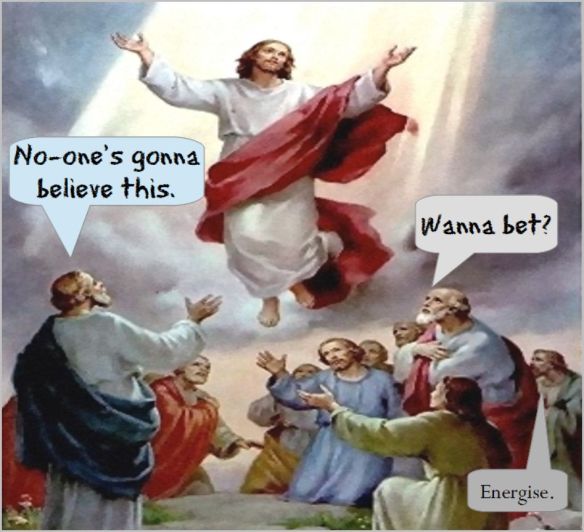
Let’s see if we can’t pin him down to a direct, unequivocal answer. Please tell us clearly, Don, whether the following account, from Acts 1:9-11, is real or metaphorical and how you know.

Now when (Jesus) had spoken these things, while they watched, he was taken up, and a cloud received him out of their sight. And while they looked steadfastly toward heaven as he went up, behold, two men stood by them in white apparel, who also said, “Men of Galilee, why do you stand gazing up into heaven? This same Jesus, who was taken up from you into heaven, will so come in like manner as you saw him go into heaven.”

No prevarication now, Don. None of your ‘it could be both’ bluff, nor your ‘it’s stylized history that isn’t really history’ evasiveness. No answering by turning the question back on us or suggesting we’re all too dumb to understand.

Is it real or is it metaphor, and how do you know?

End Of Term Test

Which of the terms mythological, symbolic, theological is most appropriate when discussing biblical tropes?

Apparently, it’s ‘theological’ because it has an air of respectability, whereas the other terms suggest something with only theoretical underpinning. In fact, this also applies to ‘theological’, which by definition is the study of deities, for which there is no evidential verification. The use of ‘theological’ therefore is as unsubstantive as arguing that a concept is metaphorical or symbolic. None of these terms represents a sound, reliable way to determine the accuracy, historicity or truth of religious claims.

With this in mind see how you do with these questions:

1. Did the original hearers of the Genesis creation story regard it as –

a) true.

b) a theological statement.

c) an entertaining myth.

Of course we’ve no way of knowing what the story’s original hearers thought but there is nothing in the text that suggests they would have regarded the creation story as anything but true. The creators of Jesus’ script certainly seemed to think so, a few centuries later and its original hearers would not have felt the need to preserve it otherwise. In this belief they were wrong.

2. Which of these gospel stories is true, as in ‘really happened more or less as described’ –

a) The virgin birth with its surrounding detail.

b) Jesus meeting with Moses and Elijah (the transfiguration).

c) Resurrected corpses roaming around Jerusalem.

d) The resurrection.

The answer is that either all of them are true or none of them are. If only one of them is mythic, symbolic or ‘theological’ (and more than one of them most certainly is) then it is highly likely the others are too. If we are scrupulous, we cannot assert that one story is symbolic because it’s making a theological point while another equally implausible story is historically accurate because we want it to be.

The criteria for determining the historicity of any story from antiquity are corroborative evidence and, failing that, plausibility. We have already established that there is no independent corroboration for many of the gospel stories. There is no corroboration for some of them even in the Bible itself. We are left then with plausibility: how plausible is it that a virgin gave birth or that resurrected corpses presented themselves to Jewish authorities? Vanishingly small. Jesus’ encounter with Moses and Elijah is equally improbable.

Is his resurrection the exception? No, because dead people do not spring back to life 36 hours after being buried. If the virgin birth, the transfiguration and the resurrection of dead saints are all highly implausible (and they are) then so is the resurrection. It is at best, a story making a theological point but it is not history. The implausibility it shares with many of the other implausible stories in the gospels discounts it as history. There are no grounds for saying it is the exception.

There is also the cumulative effect of implausibility. It is highly unlikely that one of the implausible events above is historical, but it is impossible that all four of them are. Add all the other implausible stories in the gospels – the other miracles; the healings; exorcisms; Jesus sparring with the devil, walking through locked doors and beaming up to heaven: piling implausibility on top of implausibility doesn’t make any of the component implausibilities more plausible. It makes all of them less plausible and collectively impossible.

The things the gospels tell us happened to Gospel Jesus, and those they say he did himself, are equalled only by heroes of myth. Did Osiris or Romulus rise from the dead, as their stories claim? Did Augustus really become a god once he died? Of course not. These are the implausible, improbable events we find in myth. Jesus’ story is no different.

3. While many or all of the gospel stories are highly improbable as history because they are intended to convey a theological point, the words attributed to Jesus in the gospels –

a) are completely accurate.

b) are more or less what he said.

c) passed through an inestimable number of people, being invented, edited and altered in the process, before being written down 40+ years after Jesus supposedly uttered them.

d) are inventions of the gospel writers and/or their particular sect and frequently copied between gospels.

If you’re opting for a or b, you’re now making the logia the exception; the one oasis of historical truth in a desert of implausibility. That’s a big ask. To get this one off the ground, you have to call upon contrivances like –

completely reliable (but different and conflicting) oral traditions;

     hypothetical lists of sayings;

         Peter’s dictation to Mark;

             eyewitness authors;

                  secret teachings;

                     super-translators and

                         the odd spot of collaboration.

So, c and/or d is far more likely to be the answer to this one, representing the explanation that requires the least conjecture and fewest hypothetical components.

How did you do? I expect most of you aced this end of term quiz. If not, better get down to some extra study and repeat the semester next year.

Stories


  • Many Christians believe that God himself impregnated Mary and that her son, Jesus, was God Incarnate. Yet they don’t accept that numerous others, including Perseus, Buddha and Vishnu, who were all fathered by gods, are in any way divine. Why not?
  • Evangelicals and other Christians believe that Jesus performed many miracles. However, they dismiss other miracle workers as frauds or mythical beings. As John Oakes puts it on the Evidence for Christianity website, ‘religious figures (such) as Osiris, Empedocles or Krishna almost certainly were not real people, making stories of supposed miracles they worked irrelevant’. Why?
  • Christians believe Jesus fed 5,000 people with 5 fish and 2 loaves. They don’t believe the Qur’an’s story that Muhammed did much the same thing. Why not?
  • Christians believe Jesus was visited by the long dead Moses and Elijah. They believe Paul saw Jesus after he died. Yet they dismiss the Mormon claim that Joseph Smith saw Jesus and God himself. Why?
  • Christians believe Jesus came back to life a day and a half after he was killed. However, they regard the resurrection stories of Dionysus, Osiris and Attis as counterfeit. Why?
  • Christians believe Jesus rose into the sky to take up his place in heaven. Yet they think it preposterous that Muhammed went there on a flying horse. Why?

When it comes to their own stories Christians are adamant that they are reliable accounts of events that really happened. Jesus really was God’s son. He really did do magic; really did feed 5,000 people with a few scraps; really did rise from the dead and really did beam up to heaven. Paul really met him on the road to Damascus.

Even liberal Christians like Joel Anderson, while acknowledging there is much that is suspect in the Jesus story, argue with all the cognitive dissonance they can muster, that the gospels are nevertheless ‘historically reliable’. This really won’t do. Evidentially, the gospels are as ‘historically reliable’ as the tall tales involving Osiris, Buddha, Vishnu, Muhammed and Joseph Smith. Gods only make visits to the Earth in stories, individuals only rise from the dead in stories, magic and miracles only occur in stories. The Christian examples of these tropes are as imaginary as all the others. The heroes of such stories – be it Empedocles, Perseus, Mithras, Buddha, Krishna or Jesus – are fabrications too.

If it’s constructed like a story, has all the components of a story and reads like a story then that’s exactly what it is. 

Making it all up

While the Old Testament is made up of myth and legend and the New created from the visions and dreams of a few disturbed individuals, we are expected to believe that the gospel accounts nevertheless shine out as beacons of truth.

We know, however, that much of what is contained in the four canonical gospels is fiction. I’m not referring here merely to how contradictory they are (though there is that), I’m talking about the parts that are clearly made up, invented for theological and literary purposes. These include:

The nativity stories: These are myth, created so that the Godman has an origin similar to those of other Godmen: There is no historical evidence for a wand’rin’ star, a census that involved the mass movement of populations or the Massacre of the Innocents.

The virgin birth: relies on a misreading of ‘young woman’ in Isaiah 7.14

The flight to Egypt: a misapplication of Hosea 11.1.

Genealogies: invented. Matthew’s and Luke’s are completely different and don’t, in any case, include sufficient generations to reach back to ‘the first man’.

The Magnificat: Written as a Greek poem. It is not an outpouring of a young peasant woman.

The temptation in the wilderness: Jesus did not have a conversation with the devil. He was not attended to by squadrons of angels; we know such beings do not exist. In any case, which eye-witness was present to record these fanciful encounters?

Angels: 12 appearances across the gospels. Demons and other evil spirits: at least 20 mentions. Myth, pure and simple.

The miracles: all of them make a theological point. This is their purpose. They are literary.

Jesus’s teaching: designed to encourage members of the cult, a cult that could only exist after the events the gospels purport to relay. Everything he’s made to say comes from different sects, Paul’s teaching, Old Testament wisdom literature and even pagan sources.

The sermon on the mount: created and written in sophisticated Greek, not delivered by a semi-literate itinerant preacher.

John’s self-obsessed Jesus: nothing like the character in the synoptic gospels. Either he’s made up or they are. Or both.

The Transfiguration: Elijah and Moses do not return from the dead to have a chat with Jesus. This is completely made up.

The Eucharist: first appears in Paul’s teaching in I Corinthians 11.23-27. It is distinctly pagan but is accommodated in the gospels because Paul insisted he got it directly from his (imagined) Christ.

Judas’ betrayal: suggested by Zechariah 11.12-13 (which in context is not a prophecy).

The custom of freeing a prisoner (Barabbas): no such custom existed. The event is symbolic.

Resurrected corpses emerge from their graves: Matthew made this up. No-one else seems to know of it and Luke makes a point of cutting the episode out of his version of events.

The Crucifixion: based on Isaiah 53 and various Psalms.

The Resurrection: based on the visions of Cephas, Paul and others with added, invented detail, incompatible across the four accounts.

The Ascension: Jesus levitates into the stratosphere, in front of witnesses no less. Or perhaps not; Luke invented this impossibility.

There is much more in the gospels that is evidently and demonstrably made up. We can, as Christians do, believe it all really happened. We can insist that the stories are not based on other sources but that these sources are prophecies of real events that took place in history. From this perspective, Paul’s and others’ visions are then the result of these same events.

But which is more likely? –
The Old Testament is packed with prophecies about Jesus’ life and death, and that what Paul and others saw in their heads was because Jesus really existed and spoke to them once he’d returned to Heaven…

Or: The Jesus story is fictional, a patchwork of Old Testament snippets, mystical visions, invented symbolic events and pagan ideas of resurrecting Godmen.

And If the gospels are fiction – and they evidently are – then why not Jesus himself? If there was no real history to be written about him, just this mish-mash of other sources, that can only be because there was no Jesus who walked the Earth 2000 years ago.

Jesus is the same as his near contemporaries Osiris, Dionysus and Mithras. Like them, he is entirely mythological.

Will the real Jesus please stand up? (part 2)

What evidence is there in the Bible that Jesus really existed? Let’s take a look*:

Paul’s Christ – imaginary (only in his head)

The crucifixion – invented (structured around and based on selected parts of the Old Testament. These aren’t prophecies of his death, they’re used as the template for people writing centuries later)

The Resurrection stories – made up (following various visions and ‘revelations’. The stories themselves are not in Paul or Mark; they’re made up later)

The empty tomb – imaginary (added to bolster resurrection stories. Unknown to Paul)

Miracles – made up (not in Mark where Jesus flatly refuses to perform them. Later miracles all have symbolic meaning. They are symbolic)

Nativity stories – make-believe (the two accounts in Matthew and Luke conflict and have all the properties of myth)

Jesus’ ‘I Am’ statements – invented (only in John: missing entirely from the other gospels. How did they miss them?)

Sermon on the Mount – made up by Matthew (not in Mark but suddenly in Matthew where it is clearly a literary construct)

Jesus’ teaching – invented (next to none of it is original, based as it is on Paul’s teaching, Old Testament ‘wisdom’ and what the gospel writers needed him to say to fit their agendas)

Cult rules – made up (by members of the early cult church)

The Beloved Disciple/Lazarus and Nicodemus – imaginary (not in the other three gospels. How could they not know about Jesus’ most impressive miracle, the raising of Lazarus?)

The woman caught in adultery – invented (a very late addition to the fourth gospel; possibly as late as 350CE)

The Ascension – make-believe (I mean, really?)

Paul’s adventures in Acts – made up (largely incompatible with what Paul himself relates)

Revelation – total lunacy (made up in its entirety: Jesus didn’t say any of the things attributed to him there: he didn’t dictate letters to churches, isn’t a cosmic warlord, hasn’t brought a celestial city to the Earth, etc, etc)

Satan, demons, angels, spirits, powers and principalities – imagined (all non-existent)

Old Testament tales – made up (Creation, Adam & Eve, Tower of Babel, Noah, the Exodus, Job, Jonah, Daniel. Too many to list)

Ephesians, Colossians, 2 Thessalonians, 2 Peter, James, Jude, 1 & 2 Timothy, Titus – forgeries

Jesus – imaginary? It makes you wonder. So much is demonstrably made up about him. If he did exist, he has been buried under layers of make-believe, myth and other fiction; a grave from which he will never rise.

To be continued…

* Examples derived from my own considerations, Richard Carrier’s On The Historicity of Jesus, Bart D. Ehrman’s Forged and Did Jesus Exist?, Michael J. Alter’s The Resurrection, Barrie Wilson’s How Jesus Became Christian &  Freke and Gandy’s The Jesus Mysteries, amongst others.