
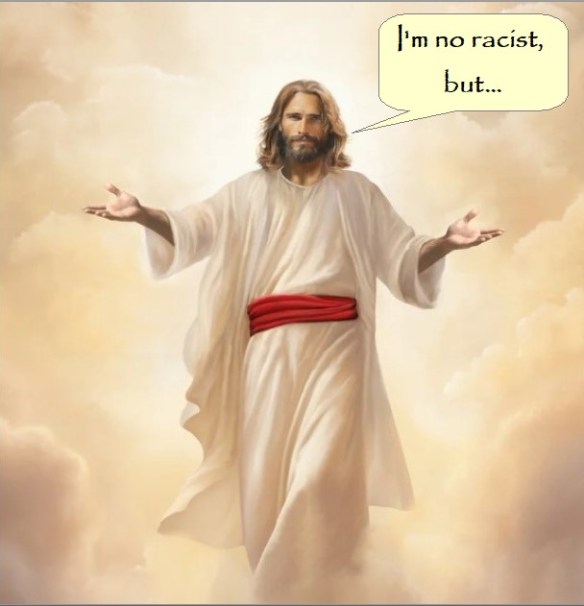
Racism? What Would Jesus Do?

The Church Of England recently issued guidelines to its London clergy advising them to preach anti-racist sermons and suggesting how they might go about it. Asked about it on UK TV, the reverend Sam Norton said he was worried that expressing concerns about the number of migrants entering this small island, many of them illegally, might unreasonably be construed as racist. He argued that it is not; I agree. The reverend was at pains to emphasise that racism was abhorrent (again, I agree) and was not something Jesus would condone.

So, again, Jesus gets a free pass. As he’s portrayed in the four gospels, Jesus is racist. Or, rather, the men who made up his script, the early cult members now known as Mark, Matthew, Luke and John, were. They were racist about those who were not part of the new movement, particularly towards those who were hostile towards it. Granted the gospel creators had Jesus say some pretty good things too: love your neighbour as yourself, love and pray for your enemies, the parable of the good Samaritan; all wildly impractical and widely ignored by Christians everywhere.

Many of Jesus’ admonishments were written by cultists anticipating the end of the age for members of their own group; they were all too happy to lash out at those who weren’t part of it. Hence, the Syrophoenician woman of Mark 7:24–37 whom Jesus calls a ‘dog’, dogs being unclean in Judaism. This woman would have had a paler complexion than Jesus, who would not be the fair Caucasian he’s often portrayed as being. His name-calling is racist; it is only the woman’s pluckiness that persuades him to respond to her pleas.

The story is repeated in Matthew 15:21-28 where the woman is said specifically to be from Canaan, Jesus says explicitly that he ‘was sent only to the lost sheep of Israel’. Earlier, in Matthew 10:5, he instructs his disciples not to take his supposed life-saving message to anyone other than his fellow Jews: ‘Do not go into the way of the Gentiles, and do not enter a city of the Samaritans’. Matthew would, of course, have his version of Jesus exclude those who were not Jewish. Jesus’ racism here reflects Matthew’s community intent on preserving their Jewish heritage. Which makes the anti-Semitism Jesus is made to express in the fourth gospel all the more startling;

You (Jews) belong to your father, the devil, and you want to carry out your father’s desires. He was a murderer from the beginning, not holding to the truth, for there is no truth in him. When he lies, he speaks his native language, for he is a liar and the father of lies… Whoever belongs to God hears what God says. The reason you do not hear is that you do not belong to God [‘the right cult’?]

This is the racism of John 8:44, the rift between the new cult and Judaism having widened by the time the fourth gospel was written.

There are those online who argue that even though Jesus was God incarnate, his ‘human side’ and his upbringing in a prejudiced environment account for his narrow views of ethnicity.  This excuses his racism, they say, and shows how like us he really was. It doesn’t. It reflects the prejudices and racism of those who created the various versions of him. (Alternatively, online Christians argue, as here, that the pericope is invariably read ‘out of context’.) And, please, don’t get me started on the overt racism of Jesus ‘Holy Father’, the genocidal tyrant of the Old Testament.

The Bible as a whole is rife with blatant, divinely-inspired racism. Apart from this, I agree with the reverend Norton: having concerns about the scale of immigration is not racism. Just as criticism of Jesus is not blasphemy and censure of Muslim beliefs and practices is not Islamophobic.

Free Speech

The British government is considering making what it describes as Islamophobic remarks, on social media and elsewhere, a crime. It has so far been unable to define what Islamophobia is, but evidently it goes beyond the libel laws that already exist and which were used to jail the idiots who called for violence against immigrants (not exclusively Muslims) in the summer.

Critics say the government’s proposals are the means of introducing a blasphemy law through the back door. They fear it could lead to criminalising legitimate criticism of Islamic beliefs and practices. Should these be immune from criticism when some Muslim beliefs are as absurd as their Christian counterparts, others positively harmful and some antithetical to British democratic and social values? Should these aspects of Islam be immune from criticism or mockery? It would be a mistake if they were. Islam troubles me, and many others here in the UK, by virtue of the fact it is a religion. The imposition of a protected religion – any religion – is not something that would be beneficial for a largely secular society (or any other in my opinion).

And what of other religions? There has been mention that the new law would also protect Jews from anti-Semitism though there are, again, existing laws that do that. It’s difficult too to know what would be considered ‘anti-semitic’. Is criticism of the Israeli government’s actions? Hasidic Jews treatment of women? It’s hard to say, and it seems unlikely the British government will enlighten us any time soon.

You can be sure that if comment deemed Islamophobic or anti-Semitic becomes punishable by law, other religions will soon look to have their beliefs and practices granted the same ‘protections’. It would be perfectly reasonable for them to do so. After all, the criticism and mockery of Christianity and Christians themselves found here and elsewhere on the internet could be seen as being Christophobic, or whatever the Christian equivalent of Islamophobia is called. Of course Mormons and Jehovah’s Witnesses would be entitled to special protection too, as well as Buddhists, Hindus and all fringe religions. It might not be too long before criticism of politicians and politics is similarly curtailed.

Free speech would still exist for the practitioners of religions themselves of course. Our beloved local street preacher would still, presumably, be able shout about the evils of Pride and the sinfulness of homosexuality; his right to do so is, after all, enshrined in law. Muslim groups in Britain would still be able to deny women the same rights as men, while calling out the decadence and immorality of kafir Western cultures that have given them refuge. Terrorist acts carried out by Islamists would be protected from comment and censure. All religions would be able to assert the rightness of their ideologies over the mistaken beliefs of all the others.

Or will they? Will the proposed new law defining criticism of Islam as ‘Islamophobia’ escalate in the way I’m suggesting so that no-one can criticise or mock the beliefs of others? What of free speech then? How long before any such comment would be deemed hate speech, as negative remarks about transgenderism are now. How long before commenting on government policy is deemed to be ‘misinformation’? Questioning its ruinous pursuit of net zero, its immigration policy (or lack of one) and speaking out against whatever the current narrative happens to be might soon be anathema, in the same way questioning approaches to Covid were a few short years ago. How long before such ‘hate speech’ and ‘misinformation’ is punishable by law?

Of course I’m not saying calls to violence against any group of people whether religious, gay or transgender is something that should be tolerated. There are already laws to punish advocates of real hatred, as those who used social media to provoke riots in the UK discovered. Severely restricting free speech on the pretext of controlling hate speech and ‘misinformation’ still further will serve only to extinguish the legitimate criticism of religion, politics and other belief systems. It’s something totalitarian states do.