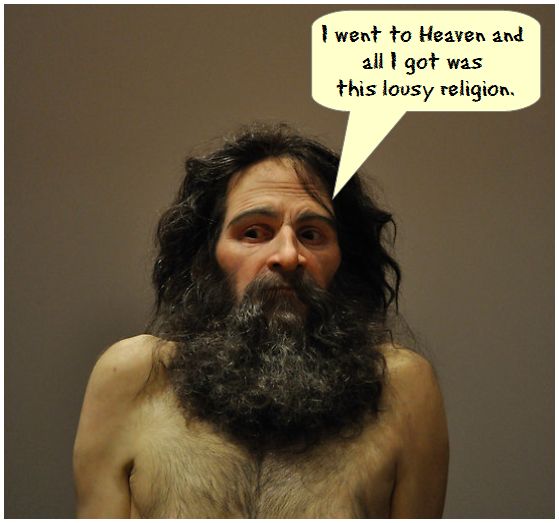
Spiritual Forces of Evil in the Heavenly Realms

Original AI image from Night Cafe 

For our struggle is not against flesh and blood, but against the rulers, against the authorities, against the powers of this dark world and against the spiritual forces of evil in the heavenly realms. (Ephesians 6:12)

…you followed the ways of this world and of the ruler of the kingdom of the air, the spirit who is now at work in those who are disobedient. (Ephesians 2:2)

the prince of this world now stands condemned. (John 16:11)

The first-century worldview of early Christian cultists was that somewhere above the Earth a battle raged between God and Satan. The powers of darkness – the devil and his demons – had in ages past launched an attack on the Lord and his angels. This war in the spiritual realm continued unabated up to the time when a cultist wrote Ephesians, pretending to be Paul. Paul himself had already alluded to Satan as the god of this age (2 Corinthians 4:4), while the authors of the fourth gospel would later refer to him as the archon – ruler and prince – of this world (John 12:31; 14:30).

Which just goes to show how the Almighty God they believed in was nothing of the sort. He had tussled with his arch-enemy for eons without quashing his rebellion and putting an end to his persistent attacks. The stand-off had gone on for millennia, and, according to today’s Christians, is still happening. A puny god it is who cannot get the better of one of his far less powerful creations.

And what are God and Satan fighting over? Us, apparently. The devil wants control of human beings.

Why? Who knows. In fact, according to Paul, Satan already has control over us. He enslaves us to sin, which in turn leads to death (Romans 5:12, 6:23). 

Not to worry though, Paul, fake Paul and the fourth gospel writers assure us that their enfeebled God has a cunning plan! He’ll allow a being who is precious to him – like a son, in fact – to be sacrificed so that anyone who believes in him will no longer be enslaved to Satan and sin and will be granted eternal life. How’s that for special magic!

Who shouted out from the back that that sounds like a cop-out? It’s a fantasy bordering on the insane. Like it or not, we are somehow embroiled in heavenly warfare, specially if we’re of the number who’ve bought into this malarkey.

While we’re at it, have you noticed how so many of the wars and skirmishes currently afflicting the world have religion at their heart? YHWH is scrapping with Allah, Allah is up against the Great Satan while Jesus – no stranger to war-mongering himself – presides over it all, leading the world to Armageddon and his own ultimate ‘return’.

Here’s my suggestion. All the gods and demons need to get their act together. They should agree to an ultimate slug-fest, a final battle in the spiritual realm to decide who’s really the Supreme God – the last deity standing – and leave us humans out of it entirely. Surely, being gods, they’re up for finding out who can piss furthest up the wall.

A preposterous idea? Of course it is. None of these fantasy beings exist. There’s no YHWH, Allah, Heavenly Father, Jesus, Krishna, angels, archons, Satan or ‘spiritual forces of evil’ to duke it out. There’s no ‘heavenly plane’ where they can get to it. Everyone of these despotic characters is a human creation, as are the wars, disputes and skirmishes they underpin. It follows that none of them can be the supreme god and certainly none of them are worth fighting over. It’s time we grew up and put away all of our childish imaginary tyrants.


The latest, most accurate translation of 2 Corinthians 12:1-5

I met this bloke down the pub, oh, I dunno, 14 years ago maybe, and he was telling me how he’d taken a wild trip to another dimension. Yes, really. I believed him and so should you. I mean, why would he lie? He said it was absolutely fab and totally mind-blowing. The incredible beings he met in this other dimension told him that once he sobered up got back to reality he’d have to keep schtum about what he’d seen and heard. So really he couldn’t say much about it. Now, I mean, why would he make up stuff like this? He wouldn’t, right? Specially when people would say he was a nutter if he did. So it really happened, right?

Anyway, I promised I’d write it up for him if ever I started a blog, so I did, way back here. Honest to God, even after all that time I could remember what he told me word for word.

I might though have claimed it was me who’d tripped out in the other dimension (a spliff or two can do that to ya) so I’m here to set the record straight.

You do believe me, don’t you?

Your best mate,

Paul

Where’s Jesus?

Not a rhetorical question. Christians keep telling us that he’s alive, so where is he exactly? If he’s alive he has to be some place. The old hymn, ‘I Serve A Risen Saviour’, which I sang many times in my younger days, thinks it knows:

He lives, He lives, Christ Jesus lives today!
He walks with me and talks with me along life’s narrow way.
He lives, He lives, salvation to impart!
You ask me how I know He lives?
He lives within my heart.

This isn’t much use though, is it. All it’s saying is ‘I’ve convinced myself Jesus is alive because I feel him inside me.’ That’s the extent of it, and this being so, it’s really no evidence at all that Jesus is alive in any sense the word is usually understood, let alone that he has an independent on-going existence.

Perhaps the bible will be of more use. Acts 7.55-56 has Stephen see Jesus alive in heaven, standing at the right hand of God. Well, that’s great. Now we’ve got two problems. Not only do we still not know where Jesus abides, we don’t know where God lives either. They’re both together somewhere, ‘heaven’ according to Acts says, but we’re no closer to knowing where this is either.

According to the preceding verse, Acts 7.54, Stephen is ‘looking up’ when he has his vision of heaven. This is significant because for early Christians, God’s abode – heaven – was in the sky. The New Testament speaks of different levels or realms of heaven, all of them up in the sky.

In 2 Corinthians 12, Paul claims to have visited the third (and highest?) level, while the Paul-imposter who wrote Ephesians helpfully explains that the lower level, the one nearest the earth, is occupied by demons and Satan’s minions whom he refers to as ‘the powers of the air’, ‘cosmic powers’ and ‘powers and principalities’. These are the very beings whom Paul claims in 1 Corinthians 2:8 killed Jesus (betcha thought it was the Romans) and 1 Peter 5:8 says seek to devour men’s souls.

Next is the heavenly realm inhabited by angels and the original perfect copies of everything here on Earth (Hebrews 9:22-24).

Then, finally, there’s the highest heaven (alluded to in Luke 2:14)) where dwells the CEO, God himself. If Jesus stands or sits at his right hand, then presumably that’s where he is too. But where is this highest heaven, or indeed any of the levels the early cultists believed existed? There’s no evidence for any of them.

In fact, the Bible’s heavenly hierarchy (which you can read about in detail here) is absolute drivel. Above us, as John Lennon was known to say, is mere sky – the stratosphere, mesosphere, thermosphere and the like – followed by the endless vastness of largely empty space. If Jesus is alive in an imaginary highest heaven somewhere out there, then he, like it, is similarly non-existent.

But let’s not write a living Jesus off just yet. It’s possible that he, his Father and all those lesser supernatural beings – the demons and devils, powers and principalities as well as the angels and snoozing saints – are hidden away in some other invisible and undetectable alternate dimension.

Other dimensions are, according to some scientists, theoretically possible. There may, they say, be as many as 11, but unfortunately for Jesus, none of the Bible authors knew of them. Those who wrote about heaven in the early days of the Jesus cult, were convinced it was overhead and, as ‘intellectual’ Christians are fond of pointing out, we need to read and interpret scripture as the ancients themselves did, not with a modern sensibility. Certainly not with an understanding of ‘dimensions’ derived from Star Trek.

Despite this, theologians have to work mighty hard to transplant such theoretical dimensions into the Bible in order to claim that heaven, and therefore Jesus, exists in one of them. And work hard they do, at what is little more than a god-of-the-gaps argument: ‘we know Jesus is not a few (or even many) miles up above us, therefore we must find a location for him somewhere that science appears to allow.’

(Interestingly, when it comes to the fine-tuning argument, apologists are quick to dismiss the idea of other dimensions, multiverses and parallel worlds; these make the earth less special, less ‘just right’ for life, less designed by God specially for us.)

Locating the living Jesus is like finding Wally/Waldo in one of those cluttered pictures, except this time he hasn’t been included. So tell us, Christians, where is Jesus? And where is the evidence he’s where you say he is?

Suffer, Little Children

I recently wrote the post below for The Life and Times of Bruce Gerencser and thought that if you missed it, you might like to read it here. 

I was reading Gary Marston’s latest post on Escaping Christian Fundamentalism God Is So Good! He Allowed Ten Thousand Children to Starve to Death Today.

Gary has his very own Christian troll (All atheist/agnostic bloggers have them) called Swordmanjr, who leapt to God’s defence, the mighty Creator Of All Things needing fallible, flawed human beings to do this for him. Swordmanjr accused Gary of scapegoating God who, apparently, is not really responsible for suffering, nor indeed anything horrible.

I guess God could be being scapegoated if it wasn’t for the fact, his Son, God Incarnate according to some, tells us he cares for human beings much more than he cares for sparrows (which is, admittedly, not much at all), that he is concerned to the extent that he numbers each and every hair on individuals’ heads (Matthew 10:29-30). This must be before he allows so many of them to die of starvation and in natural disasters.

The evidence is that God does not care. He doesn’t care if you’re a child born into poverty who then dies a slow, miserable, painful death through malnutrition. He doesn’t care if you’re caught up in a natural disaster like the recent earthquake in Turkey (which, according to some Christian nutjob, was God’s response to Sam Smith’s performance at the Grammies) in which your entire community and you yourself are wiped out. He doesn’t care if you die of a nasty virus, which ultimately he’s responsible for, as millions including Christians did during the pandemic. He doesn’t care that you die, when, or how horribly. He – just – doesn’t – care, period.

Jesus, as he was about so much, was plain wrong about his Father’s caring. The real world does not and will not match up with this early Christian fantasy.

Believers who leap to God’s defence invariably do it by launching vitriolic ad hominem attacks on non-theists who dare to criticise his shoddy performance. In doing so, they demonstrate yet another of Christianity’s disconnects; it’s promise that it makes new creatures of people, filled with love and compassion (2 Corinthians 5:17).

By their fruits shall ye know them,’ proclaims Jesus in Matthew 7:15-20. If the Christians who lurk around atheist blogs are anything to go by, those fruits are often pretty rotten: vitriol, spite, hatred… ‘evil’ Jesus calls it. These Christians frequently end their comments with a threat: one day the atheist will stand before God’s judgement throne and then they’ll be sorry: hell awaits!

God is not there in this kind of behaviour. He’s not there when humans suffer and die, frequently horribly. He’s not there in the Bible verses that promise he is there in such circumstances. God is not there.


New Bodies For Old

Paul taught that believers in the Lord Jesus would, once the Christ returned, be resurrected in a ‘spiritual body’. Those who remained alive at this time, as Paul anticipated he himself would be, were also to be ‘re-clothed’ in a new body (2 Corinthians 5.3) in preparation for life in the Kingdom.

He also seems to have believed that Jesus himself was resurrected in a ‘spiritual body’. This is presumably what Paul thinks he saw when Christ revealed himself to him in his head. Christians since have argued that when Jesus rose from the dead, it was in the same body in which he was crucified. Indeed, John’s gospel goes so far as to show his resurrected body still carried the wounds he suffered during his execution (John 20.26-29).

So what does this spiritual body, the one Paul promises all believers will receive, which is somehow physical yet not – the risen Jesus can pass ghost-like through locked doors (John 20.19) and levitate into the sky (Acts 1.8-11) – look like? What is its nature? Is it ephemeral so that it can vanish at will (Luke 24.31) and change its appearance (Luke 24.16), or is it like the bodies we have now, only better? Is it made of meat and gristle? Does it breath, eat, sweat, need to sleep, poop and pee? If not, then in what way is it a body? Will the new body retain its lungs, sweat glands, digestive system and genitals? Can it be considered a proper body if it doesn’t? If it’s to be an upgraded version of our existing bodies, minus all those pesky instincts, demands and messy bits, then how does it work? Does it only vaguely resemble the body we have now, like an Avatar in the famous film? Is it intangible, like the risen Christ’s (as implied in John 20.17)? Can it morph into unrecognisable forms (John 20.14)? Will it be able to pass through physical objects like Jesus’ ghostly form could ?

Alas, we shall never know. When Paul was making pronouncements about ‘spiritual bodies’ he hadn’t a clue what he was talking about. Writing to the cultists in Corinth, he anticipates that someone might want to know what ‘spiritual bodies’ are like. Here’s his profound answer:

But someone will ask, “How are the dead raised? With what kind of body do they come?” You foolish person! (1 Corinthians 15.35)

Yup, he had no idea what he was talking about so he resorts to ad hominem abuse instead. He then twitters on about how the physical body has to die, like a seed, before the new super-duper spiritual body can manifest itself. Except a seed doesn’t die in order to produce a plant. It may be buried but it doesn’t die. His analogy, which, you’ll note, doesn’t actually answer the question, fails miserably:

What you sow does not come to life unless it dies. And what you sow is not the body that is to be, but a bare kernel, perhaps of wheat or of some other grain…. So is it with the resurrection of the dead. What is sown is perishable; what is raised is imperishable. It is sown in dishonour; it is raised in glory. It is sown in weakness; it is raised in power. It is sown a natural body; it is raised a spiritual body. If there is a natural body, there is also a spiritual body. (1 Corinthians 15.36-37, 42-44)

His final flourish – if there is physical body then there has to be spiritual one – is, to use a technical term, absolute crap. He is making this stuff up and passing it off as a message from the Lord. Then as now, there were those who were taken in by him.

No-one has ever received a new body after their death; when this, our only body dies, we die. Our consciousness does not survive; it is a manifestation of our bodies, specifically of the brain, part of the meat and gristle that make up our bodies. It doesn’t hang around waiting for Jesus or God or some other non-existent being to transplant it in an imaginary super body.

No-one has ever received a new ‘spiritual body’, and no-one ever will. Of the 100.8 billion people who have died in the history of mankind, not one has gone on to live again in a new ‘spiritual body’. Not one has gone on to live again, period. If you think they have, you are free to present your evidence here. (Jesus, I should point out, doesn’t count: he wasn’t, according to Christian myth-making, entirely mortal. Plus his resurrection appearances are fiction.)

Paul is lying. There is no such thing as a ‘spiritual body’, no such thing as resurrection. You won’t be experiencing either. You are allowing yourself to be duped if you think you will.

In which Paul takes a trip to the third heaven

Blog408

In the New Testament, there are:

8 or more supernatural ‘visions’;

18 or so ‘appearances’ of angels;

about 6 significant dreams, through which God talks to people;

a dozen apparitions of dead people and

at least 3 significant ‘revelations’, in which individuals sense God in their heads (Paul, Jesus and John of Patmos).

The man who is largely responsible for Christianity as we know it, Paul, alludes only briefly to his magical conversion to the faith, describing it as ‘in’ his head in Galatians 1.16. It’s up to the writer of Acts to elaborate and embroider this non-event. Paul does, however, give rather more detail about another hallucination he has, in 2 Corinthians 12.1-4. To avoid boasting, he says boastfully, he refers to himself in the third person:

I must go on boasting. Although there is nothing to gain, I will go on to visions and revelations from the Lord. I know a man in Christ who fourteen years ago was caught up to the third heaven. Whether it was in the body or out of it I do not know, but God knows. And I know that this man—whether in the body or out of it I do not know, but God knows— was caught up to Paradise. The things he heard were too sacred for words, things that man is not permitted to tell.

This is evidently a psychotic episode; seeing things that are not there, experiencing events that are not happening. Paul himself admits he doesn’t know whether it was a real experience, nor does he know if he was in his body or not (definitely in it, just out of his mind.) He heard, he says, things he can’t possibly repeat, which makes you wonder why he bothers mentioning the whole bizarre episode in the first place: ‘I had this fantastic experience, unlike anything I’ve experienced before – but I can’t tell you a thing about it.’ It sounds like a dream he’s having trouble remembering or, like, man, a really freaky hallucinogenic trip.

From psychotic episodes like this – his conversion is another one – Paul spins his entire theology. Yes, the faith of Christians everywhere is founded on the hallucinations of a first century nutcase visionary.

I don’t know about you, but I’ve better things to do with my life than base it on the dreams and visions of a psychotic who lived 2000 years ago.