I Wish We’d All Been Ready

Holy cow!

This is a special, urgent post!!! I just learnt to today, courtesy of Joe.My.God that tomorrow is the date set for the Rapture. In case you didn’t know, I need to warn you to give you time to repent and turn to Jesus. We know the rapture’s going to happen this time for sure because a pastor in South Africa was visited by Jesus a couple of nights ago who told him he was definitely returning tomorrow, 23rd September, at the time of the Jewish Feast of Trumpets (me neither). Charlie Kirk’s martyrdom has something to do with it too:

I’m sure these three signs together can’t be wrong, which means the Rapture is going to happen tomorrow as an absolute certainty.

Here’s how the UK’s always reliable Daily Mail reports it:

An ancient Biblical event in which Christians disappear from Earth and those who remain are left to face Doomsday is believed to be just days away.

Claims by social media users, as well as respected pastors and rabbis, have pushed the idea that the Rapture will begin on September 23, marking the Second Coming of Jesus and Judgment Day for non-believers.

This year, September 23 falls during the Jewish Feast of Trumpets, also known as Rosh Hashanah, but some Christians have tied the holiday to the prophecy that Jesus will return to Earth ‘with the voice of the archangel and with the trumpet call of God.’

The prophecy is mentioned in the Bible, 1 Thessalonians 4:16, which states that even the faithful who have died will rise from their graves and be taken to heaven by Jesus; however, a date for this event is not given.

In a YouTubevideo viewed nearly 500,000 times, Pastor Joshua Mhlakela, a South African preacher, claimed Jesus appeared to him in a divine vision and said he would return during the Feast of Trumpets.

‘The rapture is upon us, whether you are ready or not. I saw Jesus sitting on his throne, and I could hear him very loud and clear saying, I am coming soon,’Mhlakela said during the interview with CettwinzTV.

‘He said to me on the 23rd and 24th of September 2025, I will come back to the Earth,’ the pastor declared.

Even more clips predicting the imminent return of Jesus this month have been viewed hundreds of thousands of times in the last week alone.

If you can’t find it in yourselves to welcome Jesus into your hearts as Lord and Saviour then you’ll have to gird your loins for what happens next. Something dire I feel sure. Judgement and a millennium of despair or some such. It might not be too bad though, once the Righteous Ones are out of the picture.

Whichever, I’ll see those of you who are still around come Wednesday when we can discuss what we’re gonna do!!! This blog isn’t going to be of much use any more, that’s for sure. Those of you who’ve decided to head heaven-bound meanwhile, enjoy the trip and don’t forget to write.
Dear Christian…

I’m seriously considering converting but need some help figuring what I should believe. Can any Christians out there help me out?

1. As a Christian, what will happen when I die? Will I –

a) Go immediately to heaven like my pastor says;

b) Go into suspended animation until Christ’s coming and the final judgement, as it says in 1 Thessalonians 4:13-16;

c) Just cease to exist like my atheist friends tell me?

2. Can you clear up for me how long was Jesus in the grave?

a) Was it about 36 hours (Friday evening till early Sunday morning);

b) Three whole days like he predicts in Matthew 12:40;

c) Was he not really in the grave but down in hell like it says in the Apostles’ Creed?

3. Where can I find information in Paul’s letters about

a) Jesus’ miraculous birth;

b) Jesus’ parables, teaching and miracles;

c) The Empty Tomb?

4. How often did Paul refer to Jesus’ second coming?

a) In all of his letters

b) 2 or 3 times

c) Never

5. Can you tell me how often Jesus referred to his second coming? Was it –

a) Once or twice;

b) Frequently;

c) Never because it was someone called the Son of Man who was going to come?

6. Can you clear up my confusion about when Paul says the Messiah will be coming to the Earth? Is it –

a) While Paul was still alive;

b) Thousands of years later;

c) Any day now?

7. When did Jesus say this Son of Man would be coming to the Earth?

a) He didn’t

b) Thousands of years in the future

c) While those he was talking to were still alive

8. What is the Word of God? I’ve heard the term used for –

a) The Bible

b) The Church

c) Jesus

9. Help me out: which was written first?

a) Mark’s gospel

b) Acts of the Apostles

c) Paul’s letters

10. Can you clarify what it’s referring to when the Bible talks about ‘the Scriptures’?

a) Ancient Jewish writings;

b) The whole of the Bible as we now know it;

c) The New Testament.

11. How does the New Testament writers prove Jesus was the Messiah?

a) By claiming the scriptures predicted he would be;

b) By pointing to his miracles;

c) By quoting things he said

12. How would Jesus want me to spend my time?

a) By witnessing to atheists on the internet;

b) By worshipping him;

c) By feeding the hungry, healing the sick and helping the weak

(I know which I’d prefer.)

The Lyin’, Cheatin’ Book

The Bible is a lyin’, cheatin’ book. And no, that isn’t the title of a long lost country song. The Bible was compiled by men who allowed themselves to be deceived and who were more than willing, perhaps unwittingly (to give them the benefit of the doubt), to dupe others. They included letters claiming to be by Paul and Peter that we know were not. They took the imaginary history of the early church, Acts, at face value, and the invented stories about Jesus – the gospels – as historical. They put them together in a way that made it look as if the gospels were written first, followed by Acts, Paul’s letters and the bulk of the forgeries. Paul’s letters they arranged, not in any sequential or thematic way, but from longest to shortest.

In fact, as far as Paul and the gospels are concerned, this is pretty much the reverse of the order in which they came into being. Of the documentation that made it into the New Testament, Paul’s genuine letters were first, starting with 1 Thessalonians in the late 50s and ending with Philippians in the early 60s. Only after Paul was dead did the first gospel appear (circa 70 CE), the anonymous account later attributed to ‘Mark’. After yet two more attempts to get the Jesus story right, came Acts, the notoriously inaccurate account of the early days of the cult and Paul’s adventures lifted from other sources. The fourth gospel followed much later, between 90 – 100 CE. Written by a sect of the late first century it offered a complete reimagining of the Jesus story. Along the way, numerous forgeries appeared as well as the lunacy that is Revelation, written circa 96 CE.

What would happen if we rearranged the books of the New Testament so they followed the order in which they were written? It would make them less duplicitous for a start and would also give us a more realistic picture of how Christianity arose. We would still be lacking a picture of what the earliest cultists believed prior to Paul but we can make a rough guess of what that might have been from what he says about those who preceded him.

We’ll do this next time and see what the newly ordered New Testament tells us about early Christian beliefs.

The Great Resurrection Scam

Brothers and sisters, we do not want you to be uninformed about those who sleep in death, so that you do not grieve like the rest of mankind, who have no hope.  For we believe that Jesus died and rose again, and so we believe that God will bring with Jesus those who have fallen asleep in him. According to the Lord’s word, we tell you that we who are still alive, who are left until the coming of the Lord, will certainly not precede those who have fallen asleep. For the Lord himself will come down from heaven, with a loud command, with the voice of the archangel and with the trumpet call of God, and the dead in Christ will rise first. After that, we who are still alive and are left will be caught up together with them in the clouds to meet the Lord in the air. And so we will be with the Lord forever.

1 Thessalonians 4:13-17 (circa AD 49-51)

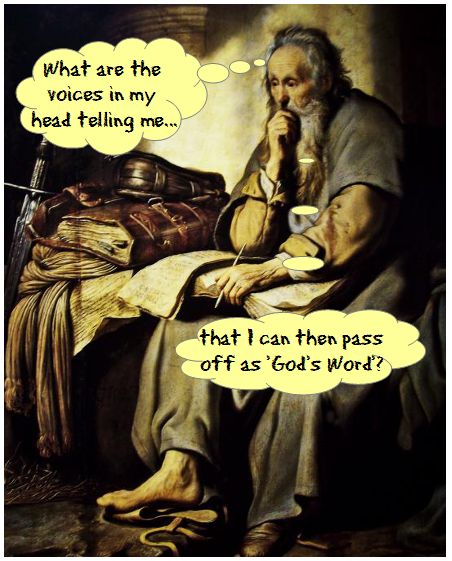
Paul said that because Jesus died and rose from the dead others would too. How does this follow?

He also claimed that all a person had to do to be sure of a spiritual resurrection was to believe that Jesus had already risen (1 Corinthians 15:20, AD 53-54), How did he know this? Almost certainly it came to him in one of his visions and his subsequent ‘revelations’ (‘the Lord’s word’ as he puts it in the letter to the Thessalonian sect).

Possibly, though less likely, he learnt it from the Christians he persecuted prior to his conversion. If so, where did they get the idea from? That the cult members in Thessalonica had to ask Paul what would happen to those who had passed away suggests this wasn’t a significant concern prior to this point. Paul and other early believers thought the Messiah/Son of Man was going to appear within their lifetimes (‘we who are still alive’ etc). It was only when cultists started dying off in noticeable numbers, and the Lord remained a no-show, that it started to become an issue. Paul had to make something up. And make it up he did.

Paul and the Oral Tradition

Much is made of the oral tradition that it is said informs the material in the synoptic gospels, and possibly John too. The tradition of conveying the events of Jesus’ life and the things he said goes back to Jesus’ original followers – the disciples and the apostles (the terms are not necessarily interchangeable) – and continues with a high degree of accuracy, at least until AD70 when the first gospel was written. 

Which must be why we find so much detail about Jesus’ life in the letters of Paul, from his first letter, 1 Thessalonians, written circa AD55 to his last, Philippians (now an amalgam of several letters), written about 62. Paul was aware of the stories about Jesus – as all converts were – and affirms so many of the details of his life in his letters, passing on the vital stories and the traditions associated with him, in written form.

But not in our reality. Our Paul knows nothing of the details of Jesus’ life. Not once does he quote him or refer to the events of his life before the resurrection. There is nothing of the oral tradition. Nowhere in his letters does he draw from it; never does he say he knows for a fact that Jesus said or did a specific thing while on Earth.

Even after his meeting with Cephas and James, a full three years after his conversion, Paul relays not a single thing he learnt from them. After the encounter, he continues to promote only his own revelations and says nothing of what he learnt about Jesus from the man who supposedly spent three eventful years with him.

Fourteen years later, Paul meets again with Cephas and encounters other apostles for the first time. On this occasion, he and Cephas argue about justification and Paul comes away grumbling that ‘those leaders added nothing to me’ (Galatians 2:6) What? Not even stories about their time with the Master? Apparently these weren’t as important as disputes about soteriology.

Later still, Acts tells us that immediately after his conversion, Paul stayed with ‘disciple’ Ananias and other ‘disciples’ for several days. Did Ananias not know any of the oral tradition that he could pass on to Paul? Details about Jesus’ life, a saying or two or an account of a miracle? Apparently not. (This might be because the story is pure fabrication. Paul tells us himself, in Galatians 1: 16, that immediately after his conversion he ‘did not rush to consult with flesh and blood’).

Surely, though, he must have heard some of the Jesus story from those he persecuted prior to his dramatic conversion. If he did, he didn’t see fit to include any of it in his letters. Likewise, Paul had contact with cult communities he didn’t himself establish, such as that in Rome. Surely they conveyed some of the stories about Jesus that they had had passed on to them. He appears too to have known at least one other evangelist:  Apollos. If these other believers did pass on stories of Jesus from an ultra-reliable oral tradition, why didn’t Paul see fit to include any of them in his letters?

So what were Paul’s sources? Certainly not the oral tradition, nor Q, the hypothetical sayings gospel, which he likewise ignores. If the gospel was being spread orally from the time Jesus lived, by the apostles and other preachers, and was being passed around the fledgling cult communities, why did Paul know nothing of it? If in fact he did, why did he choose to ignore it in favour of his own inner-visions? Did he consider it of such little value?

These questions matter, as we’ll see next time when Mark decides he’ll set the Jesus story down on paper.

What Happens When We Die (According to the Bible)

Street preacher Dale McAlpine was busy regaling the shoppers of my home town yesterday with the good news that they’re all sinners destined for hell. The God who created them will, Dale assured them, face an eternity of torture unless they turn to Jesus.

Dale didn’t have many (any) takers for this wonderful good news. One brave person, a young woman, asked him why, if people are resurrected, the cemeteries remain resolutely full. Good point! Dale, armed with his megaphone and hectoring ignorance, responded that it is the soul that survives death and is taken up to Heaven to live eternally with God. For those without Jesus, their souls will be consigned to hell where they will burn for eternity.

How unbiblical is that? The Bible does not teach that believers will go to live forever with God in heaven. Eternity in Heaven is not on offer. The New Testament writers anticipated the arrival of Heaven – God’s new Kingdom – on Earth. When it did, they believed, the dead would be resurrected: the saints to everlasting life in new spiritual bodies on a regenerated Earth (Revelation 21:1-4), the rest to eternal damnation.

Paul has some vague ideas about what will happen to those who die before the general resurrection – he thinks their souls will be kept safe ‘in Christ’ (whatever that mean but doesn’t suggest they will be living it up in Heaven. Rather, he describes them in 1 Thessalonians 4:14-15 and 1 Corinthians 15:20 as being ‘asleep’. Many Christian ‘thinkers’ really take exception to this idea, though Paul says this intermediate state won’t last for long; the Kingdom on Earth was imminent. He believed it would arrive while most of those he was writing to were still alive (1 Thessalonians 4:17; 1 Corinthians 15: 51-52).

It’s all tosh, of course. Paul had absolutely no idea what happens to people after death. He invented everything he said about it, from the independent existence of sleeping souls to Jesus arriving on the clouds to resurrect the dead in new spiritual bodies. These bizarre ideas come from a fevered brain convinced it had seen a dead person alive again and thought it had once taken a trip to the third heaven (whatever that is).

How do we know Paul invented it all? Because of the aspects of his teaching that should by now be history: the arrival of God’s Kingdom on Earth, the resurrection of the dead and Christians being supplied with new spiritual bodies ( while the rest of us roast in hell.) None of these things happened when he said they would, or indeed at all. We know it too because we are aware both instinctively and empirically that there is no continuation after death. When the body ceases to function so too does the ‘self’, which can be generated only by a living brain. We have no ‘soul’ that goes on alone after death and which will one day be clothed in a new sparkly body.

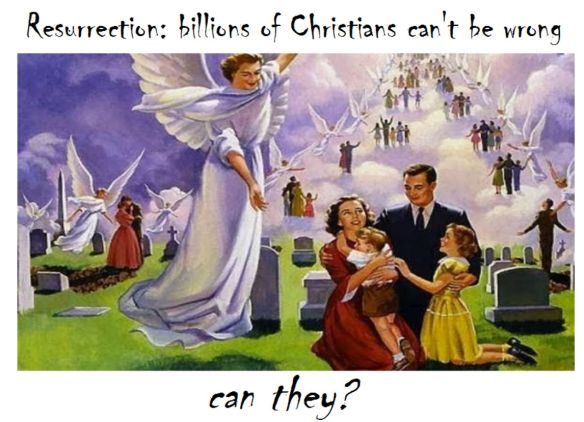
Here’s my challenge then to those who believe and propagate such nonsense; the Dales, the evangelicals, the fundies and the oxymoronic intellectual Christians of this world: provide evidence of one individual who has survived death in the way Paul said they would. Show us one believer who has been resurrected or whose soul is currently sleeps in Christ or who now lives in Heaven. The only proviso is that this must be a real person who is 100% human; not a mythical demi-God, not a character in a story, not someone for whom the evidence of a resurrection is extremely poor. Not, in short, Jesus. Where is the evidence anyone else has experienced a resurrection or embarked on their eternal life in heaven? Billions of believers have died since Paul created his fantasy. Surely there must be someone

What Second Coming?

Richard Carrier notes in On the Historicity of Jesus (p560) how Paul never speaks of a ‘second coming’, prompting me to look at all the predictions of Christ’s future arrival in the New Testament. Here’s a selection of verses, some of them supposedly the words of Jesus himself, where this coming is ‘prophesied’:

And then they will see the Son of Man coming in clouds with great power and glory (Mark 13.26).

You will see the Son of Man seated at the right hand of Power, and coming with the clouds of heaven (Mark 14.62).

For as the lightning comes from the east and shines as far as the west, so will be the coming of the Son of Man (Matthew 24.27).

For as the days of Noah were, so will be the coming of the Son of Man… they knew nothing until the flood came and swept them all away, so too will be the coming of the Son of Man (Matthew 24. 37, 39)

When the Son of Man comes in his glory, and all his angels with him, then he will sit on the throne of glory. (Matthew 25.31).

You also must be ready, for the Son of Man is coming at an hour you do not expect (Luke 12.40).

For the Lord himself will descend from heaven with a cry of command, with the voice of an archangel, and with the sound of the trumpet of God (1 Thessalonians 4.16).

Now may the God of peace himself sanctify you completely, and may your whole spirit and soul and body be kept blameless at the coming of our Lord Jesus Christ. (1 Thessalonians 5.23).

For as often as you eat this bread and drink the cup, you proclaim the Lord’s death until he comes (1 Corinthians 11.26).

Be patient, therefore, brothers, until the coming of the Lord… Establish your hearts, for the coming of the Lord is at hand (James 5.7-8).

Waiting for our blessed hope, the appearing of the glory of our great God and Saviour Jesus Christ (Titus 2.13).

Behold, he is coming with the clouds, and every eye will see him, even those who pierced him, and all tribes of the earth will wail on account of him (Revelation 1.7).

Behold, I am coming soon, bringing my recompense with me, to repay everyone for what he has done (Revelation 22.12).

Isn’t this strange? None of them refer to Christ’s arrival as a ‘return’ or ‘second coming’. You’d be hard pushed to find any such ‘prophecy’ in the New Testament*. His appearance here on Earth is described as the coming of a celestial being. Even Jesus is made to talk about the manifestation of such a figure, taken by Christians to mean his own future self, as if he’s talking about someone else: the Son of Man, who hasn’t yet appeared but will do so in the near future. It’s as if the gospels’ fictional Jesus is being made to predict the arrival of the ‘real’, celestial Jesus.

More importantly, the Son of Man and Paul’s version of the same figure, the Christ, are spoken of as ‘coming’ or ‘descending’, not ‘returning’ or coming again. It’s as if Paul, the writers of the synoptic gospels, John of Patmos and other first-century Christians* didn’t believe that the Christ had already visited the Earth. They talk instead as if he’s about to arrive for the very first time. When he does, they believed, he would be coming as an avenging angel, rescuing those who believe in him – as a celestial being who carried out his salvific work in the heavenly realms (1 Corinthians 15, Galatians 1.11-12 etc) – and slaughtering those who don’t. This is the apocalypse – the revealing or uncovering of the heavenly Christ for the very first time.

That Jesus will ‘return’ or make a second coming is an assumption made by later believers on the basis of verses like those above. In fact, they say no such thing. The earliest Christians wrote as if they didn’t believe their envisaged hero had ever been on Earth. For them, his one and only arrival was still to come.

————————————

* An exception appears to be Hebrews 9.28 which says, ‘so Christ, having been offered once to bear the sins of many, will appear a second time, not to deal with sin but to save those who are eagerly waiting for him’. Hebrews, however, regards the Christ only as a supernatural high priest, operating in the heavenly realms. This second appearance then can only refer to this character, who is not conceived as having had any existence here on Earth.

What Jesus didn’t know

Blog416

Creating the picture for the previous post reminded me of how little Jesus, assuming he actually existed, knew of the consequences of his ‘ministry’. Here’s a few of the things he either didn’t do or had no knowledge of while he lived.

  • Jesus never read a single word of the New Testament. The earliest of its books, I Thessalonians, was written about twenty years after he died. The New Testament did not appear in its entirety until the end of the 4th century.
  • He never read any of the accounts of his life, the first of which didn’t appear until about forty years after his death.
  • He had no control at all over what went in any of the gospels.
  • He did not endorse them in any way, nor verify their accuracy.
  • He never met Paul nor was he aware of the fantastical claims Paul would make about him.
  • He had no idea he would come to be regarded as God.
  • He did not know that soon after his death, people would worship him as God.
  • He would not have anticipated that his teaching would be adapted for a Gentile audience. It is unlikely he would have approved if he had.
  • He had no idea a new religion would be created in his name.
  • He did not know anything about, nor did he anticipate, the Church. His apparent acknowledgement of it is a fabrication.
  • He did not know the damage those who followed him would do in his name.
  • He did not know that the Kingdom of God would never arrive on Earth, nor that the Romans would continue to dominate it for a further 400 years.
  • He did not know the world would continue pretty much as it was for another 2000 years.
  • He did not know of the scientific discoveries that would be made in those years that would invalidate his beliefs and worldview.
  • He did not know that, forty years after his ‘ministry’, the Jerusalem temple would be destroyed by the Romans. His ‘prophecy’ of it is a fabrication written after the event.
  • He did not know of the world beyond the Roman Empire, if he was aware even of that. He certainly did not know of the American continent.
  • He had no knowledge of the United States, founded more than 1,700 years after he died.
  • He had no concept of most, if not all, of the concerns of today’s evangelicals: religious liberty, right-wing politics, guns, abortion, ‘the homosexual agenda’.
  • He had no idea what his legacy would be: the arrested development of millions and of western society itself; pogroms, persecutions and inquisitions; a corrupt and abusive church; the psychological damage caused to innumerable people; his name hi-jacked for political causes he had never heard of and almost certainly would not have approved of.

None of this is what he saw for himself. He thought he would be ruling the world with his besties on behalf of Yahweh. Like every other mortal, he had no idea of anything that would happen after his lifetime. What does this tell us about him?