
Prophets At A Loss

prophets

God’s prophets; holy men who are God’s confidantes, his mouthpiece on Earth. They know how he thinks, what his plans are, what pleases him, what annoys him, what he intends doing in the future. They’re the first to know all of these things because they’re so much in touch with him, he speaks to them personally.

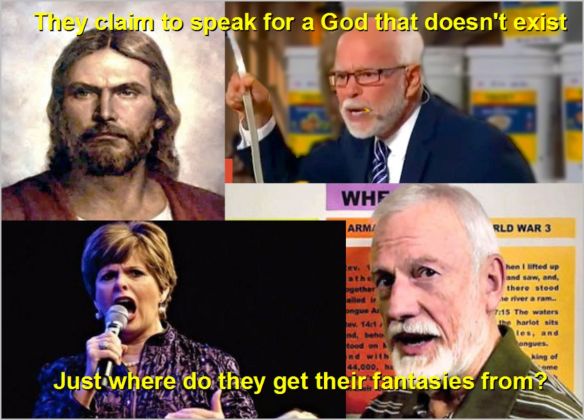
That’s how Jim Bakker knows God plans to punish those counties in the States that voted for Hillary Clinton. God simply can’t stand her, you see, and is going to vent his anger at those who thought she’d make a better president than his anointed one, the Donald.

It’s how Cindy Jacobs knew in 2015 that Civil War and Christian persecution were coming to America, how Michelle Bachmann knew Obama would start World War III, how William Tapley (‘the Third Eagle of the Apocalypse’, don’t you know) sees the signs of the End Times™ everywhere, and how John McTernan can tell us that natural disasters are the result of America’s lack of support for Israel.

These men and women (who evidently don’t know they’re supposed to keep quiet [1 Timothy 2:12] ), are also proficient, or so they’d have us believe, at interpreting the signs of the times. They know when events are actually God meting out punishment (usually) or trampling over someone’s much vaunted free-will to ensure his purposes are met. Hence, their conviction that natural disasters are divine tantrums, caused by a growing acceptance of LGBT people, or abortion, or some other damn thing they don’t care for much. And they know for sure that Trump’s election was because God wanted him to be the next president, because the Almighty told them so himself.

There are others, however, who think these fellow-Christians have got it all wrong. God has no need of prophets today (Luke 16.16). He used them only in more primitive times when people were more credulous and superstitious – Bible times, in fact. The only way of knowing what God is up to these days, these prophecy-denying Christians say, is to read and interpret his Holy Word.™

If only it wasn’t filled with the same sort ramblings as those of the current crop of fantasists, the only difference between today’s and yesterday’s prophets being that the earlier nutjobs were lucky enough to have their words preserved – by those with a need to believe and the self-interested – in the supposedly ‘ineffable’ Bible. Their prophecies are no more accurate and have no more bearing on reality than the messages of Bakker, Jacobs, Tapley, McTernan and the like claim to receive from God today. They’re of the same lunatic level, offering the same sort of vacuous bullshit.

How do we know? Because of the Bible’s prophecies written before the events they purport to predict, none has come to pass. This includes Jesus’ prophecy that the Son of Man would soon appear in the sky with the heavenly host to usher in God’s Kingdom on Earth (Matt 16.27-28; Matt 24:27-31. Including his and Paul’s predictions of an imminent judgement (Matthew 7.22 & 25:36-40; 1 Corinthians 4.5); Paul’s promise of a rapture (1 Corinthians 15.51-52; 1 Thessalonians 4.15-17); John’s prophecy of the armies of heaven defeating the Whore of Babylon (the Romans) and Jesus being put in charge instead (Revelation 17.8-14 & 20.11-15). These prophets were certain these events were going to happen soon, within, as the text spells out, the lifetimes of their listeners and readers. They didn’t and they’re not going to happen now either, two thousand years after their sell-by date. They’re not going to happen at all.

They are fantasies, every one of them. As are the messages supplied by the self-appointed prophets of our day. Fraudulent twaddle from charlatans with a pathological need to have their delusions taken seriously; these men and women of God can no more divine the future than you or I. True, once in a while events in the real world might bear some coincidental resemblance to one of their predictions, but that is all it is – coincidence. As the Brexit vote and the election of Donald Trump have reminded us, we can’t ever see the future with any degree of certainty. Soothsayers, fortune-tellers and Prophets of God who tell us we can – tell us they can – are liars and deceivers. And we know, don’t we, what the Bible says should be done about them (Deuteronomy 13.5).

Picture: Artist’s impression of JC, archetypal false prophet (as if there’s any other sort); Jim Bakker, crook and adulterer; Cindy Jacobs (loose screw not shown) and William Tapley, Looney Tune of the Apocalypse.

God’s Chosen Ones

chosen The God of the Bible is not the God of Reason that Answers in Genesis, William Lane Craig, Tim Keller, Silence of Mind and others tell us he is. None of the evidence, some of which we’ve reviewed, supports the supposition. That’s because the God of Reason, like all gods, is a construct of the human mind. In much the same way as Yahweh was a reflection of irrationality, this God is a reflection of our rationality. He could not – and did not – exist before the Enlightenment, before Rationalism itself and the new understanding of mathematics, science and philosophy.

As appealing as his apologists try to make him, the God of Reason is demonstrably not the God of the Bible, who is defined by impulsive, destructive passions. No, he’s not the tempestuous Yahweh, nor is he the daddy-god Jesus imagined (who is just Yahweh with a few rough edges knocked off), nor the God of blood-sacrifice and atonement beloved of Paul. He is, like all those inventions, a fabrication of our own making. For Christians who are drawn to him, he is a false god. But then, aren’t they all?

Whichever version of the Christian God Christians choose to worship, however, they’ve got it wrong. They don’t choose to believe in him or to follow Jesus or whatever. Not at all; he chooses them (or not as the case may be.) Now known as Calvinism, the idea that God earmarked a select few to be his best mates right back at the dawn of time – while disregarding others who might want to be but aren’t on the guest list – is right there in the Bible. Paul first:

For those God foreknew he also predestined to be conformed to the image of his Son, that he might be the firstborn among many brothers and sisters. And those he predestined, he also called; those he called, he also justified; those he justified, he also glorified (Romans 8:29-30; see also 1 Thessalonians 1.4)

The idea is picked up by one of Paul’s imitators in the forged letter to the Ephesians:

For he chose us in him before the creation of the world to be holy and blameless in his sight. In love he predestined us to be adopted as his sons through Jesus Christ, in accordance with his pleasure and will—to the praise of his glorious grace, which he has freely given us in the One he loves. (Ephesians 1.4-6)

The same sort of time-loop paradox also finds its way into the gospels. In Matthew 22.1-14, Jesus tells a parable involving a man who has been asked to a Royal Banquet (i.e. the Kingdom of God) only for the King (Jesus) to take offence at the way he’s dressed. For this heinous crime he is bound hand and foot and unceremoniously thrown out. Jesus concludes his cheery tale with the aphorism, ‘Many are called but few are chosen.’

So much for ‘free will’, a notion that’s alien to the Bible in any case. If I were a Christian, which thank God I’m not, I’d really want some answers to the questions this bizarre idea throws up. We’ll take a look at what these are next time.

Picture shows Tim Keller, John Sentamu (Archbishop of York), ‘Pastor’ Rick Warren and ‘Pastor’ Steve Furtick. Chosen by God, every one. And some kids he couldn’t care less about.


Smash! Kill! Destroy!

handsofgod

So how has the great God of Reason done so far?

We’re still not out of Genesis and he’s –

Trashed his entire creation just because a couple who didn’t know how touchy he is managed to upset him;

Destroyed two towns and almost everyone in them because he found the locals offensive;

Drowned everyone in existence (except for an old piss-head and his family) because – you guessed it – they offended him;

Engineered a spot of child-abuse;

Decided the best way for people to show him they’re his bestest buddies is to have them disfigure their genitals.

Now, honestly, Christians, how can you say any of this is rational or logical, reasonable or considered? Your God’s response to everything is Smash! Kill! Mutilate! Destroy! – never as a last resort, always as his first reaction. He’s the Hulk, Godzilla and ISIS all rolled into one. Not once does he apply reason or logic. Smash! Kill! Mutilate! Destroy! And not only in Genesis but throughout the Old Testament:

His chums want the land occupied by other tribes? Smash! Kill! Destroy!

They don’t show him enough love? Smash! Kill! Destroy!

They break one or other of his mostly petty rules? Smash! Kill! Destroy!

They offend him in some remarkably trivial way (collecting sticks, teasing a bald bloke, doing sex wrong)? Smash! Kill! Destroy!

Over and over again.

Until, at last, he has another big idea! Another Master Plan! The Master Plan to end all Master Plans! (His fourth at least.) And guess what? It’s all Smash! Kill! Destroy! Especially Kill! This is a dude who really can’t think outside the box.

Here’s how it goes: the Lord gives up on his previous Master Plan, which he’d told some selected desert marauders was forever and ever, and decides its time to have another go at sorting out mankind that he helped screw-up in the first place. His idea this time is to come to Earth himself as a sort of clone, which he creates by raping a young woman, just like all the other gods of old. When he grows up this clone/avatar tells everyone how God wants them to behave so they don’t upset the version still in Heaven quite so much. The clone then gets himself murdered at the hands of the very people he’s come to visit – the same ones the Lord promised to take care of forever and ever in his previous Master Plan – which magically allows anyone who repeats a special incantation to join an exclusive club. Everyone else he plans to torture and murder for all eternity, because that’s what he likes doing best. Of course, the version of himself he sends to Earth won’t actually make any of this clear – that’ll be left to someone else to make up afterwards – but, in the best illusion yet, he’ll come back to life before beaming up to Heaven to cosy up to his other self, the one preoccupied with death, destruction and mutilation.

This time it’s foolproof: a well-thought through, logical, rational and reasonable plan.

Except… not really. It’s bullshit. There’s no reasoning here, just a lot of stuff made up as people went along. None of it makes sense. The copy seems to have no idea what’s going on and certainly no inkling that his death has cosmic significance. On top of that, no-one really knows how the magic works – everyone who mentions it has a different idea – and the record of it all is scrappily cobbled together donkeys’ years after it all was supposed to have happened. Still, the main thing is it all involves a lot of killing – the clone first; then the poor sap manipulated into ‘betraying’ him; a couple who don’t want to give away all their belongings; some of the dudes who believe the magic is for real then, after they’ve really pissed off the Romans, lots more of them and finally, once the nutjobs get the upper hand, loads and loads of other people – which must really have pleased the God of Death Reason.

If this is the best he can do, then we’re in trouble deep. If our ability to reason comes from him, as Christians claim, it’s no wonder we can be irrational, illogical, unreasonable and unreasoning. Which of course is why he is, because he’s a reflection of the beings  that created him – us. Human emotions and cognitive capabilities came first and were projected onto the gods we created, including, eventually, the monotheistic monster, Yahweh. It was he primitive tribesmen decided must be responsible for natural disasters and the brevity and brutality of life. Such things had to be punishments, hadn’t they? And if punishments, then there had to be One doing the punishing. One who must be appeased if he was ever to stop. Hence sacrifices, behaving in ways that might please him, killing those who don’t, worship. All futile, like pleading with one’s own reflection in a mirror.

The God created by this kind of thinking only reflected back at his makers the worst of themselves; jealousy, anger, intolerance, belligerence, petulance, vengefulness and violence. Hardly ever Reason. 

And so does he still.


Idiotic Stuff Jesus Said

JC&ManJust what did Jesus say? The Jesus Seminar and other scholars* conclude that only about 18% of the words attributed to him in the gospels are authentically his. They reach this conclusion because so much of what Jesus ‘said’ – 82% of his utterances – is demonstrably derived from elsewhere.

There were four major sources for his words, which I’ll discuss briefly here, providing an example of each. Bear in mind also that whatever the derivation of Jesus’ words, those we have today have been subject to, in their earliest days, an unreliable oral tradition, repeated copying and deliberate and accidental alteration. The earliest surviving ‘words of Jesus’ (a few fragments of the fourth gospel) date to a century after he lived.

1. The early church created a good deal of the Jesus narrative, making him say what was important to them. For example, ‘take, eat, this is my body,’ and ‘take, drink, this is my blood that is shed for you,’ is clearly a post-crucifixion perspective. While it appears in arguably the most Jewish of the gospels (Matthew’s) the idea of drinking blood, even symbolically, would have been, and remains, anathema to Jews, whose scriptures forbid it (Leviticus 17.10 -16). Jesus was an orthodox Jew; it was the Hellenised Paul who transplanted the pagan ritual into nascent Christianity. He relates in 1 Corinthians 11.23-26, written about 15 years before the first gospel, how his wholly imaginary ‘Christ’ told him of this bizarre activity. Once established in the early church, Jesus then had to be made to endorse it and it was written back into the gospels.

2. The gospel writers (or others) invented dialogue for him. His entire conversation with Pilate, for example, is invented not once but four times, the encounter being rendered differently in all four gospels. It is probable that the entire scenario is fiction, given the likelihood the excessively cruel Roman governor would even entertain the idea of questioning a seditious nobody himself. And then there’s the ‘I am’ statements of John’s Jesus that I considered here.

3. The gospel writers altered difficult sayings into something more palatable. For example, in Matthew 15.24 Jesus says he was ‘sent only to the lost sheep of Israel’ (my italics). By the end of the same gospel, as well as in Luke and John, this has become a commandment to ‘make disciples of all nations, baptising them in the name of the Father, the Son and the Holy Spirit’ (Matthew 28.19). So which was it? Was the message exclusively for Jews or was it for all? It suited early churches, filled with non-Jews, that the gospel was for everyone, just as Paul had argued. Jesus’ words to the contrary – even if they were sufficiently widely known to have had to be included in Matthew’s original account – needed to be amended. Who amended them and when we shall never know, but it was certainly after the idea of the Trinity had taken hold.

4. Statements Jesus actually made. The Jesus Seminar regards as authentic sayings such as:

If anyone strikes you on the right cheek, turn the other also (Matthew 5.39)

If anyone wants to sue you and take your coat, give your cloak as well (Matthew 5.40)

Love your enemies (Luke 6.27)

Blessed are you who are poor for yours is the Kingdom of God (Luke 6.20) [changed in Matthew’s gospel to the less radical ‘poor in spirit’!]

If anyone forces you to go one mile, go also the second mile (Matthew 5.41)

As inspiring as these might initially appear, they actually mean very little; they’re either prophecies that didn’t come to pass, impractical moral expectations or pseudo-spiritual homilies. And how much of this advice, these admonitions, do today’s Christians follow? You’d be hard pushed to find many that do. After all, following Jesus doesn’t entail doing what he says.

* I have used Robert W. Funk et al‘s The Five Gospels (HarperOne, 1997), Simon Loveday’s The Bible For Grown-Ups (Iconbooks, 2016) and Mark Allan Powell’s rather less impartial The Jesus Debate (Lion, 1998) for this post

Recent Encounters of the Religious Kind

3. Prophecy Fulfilled

DB&JC

Back in January I predicted that David Bowie’s demise would lead to his apotheosis. And so it comes to pass.

First there’s this, from the Guardian‘s Suzanne Moore:

The theory that it was in fact, David Bowie’s presence in the universe that was holding everything together is one I find hard to resist, given how awful everything has been of late…

Second is Paul Morley’s new Bowie biography, the cleverly titled The Age of Bowie: How David Bowie Made a World of Difference, with its abundance of publicity including Radio 4’s broadcast ‘book of the week’. It is probably worth a look if you’re at all interested in the Thin White Duke and his various incarnations.

Two aspects of the biography stand out: first, Morley’s admission that he’s had to invent some details of Bowie’s life because either there is a lack of information – about his pre-fame period, for example – or, there are too many contradictory reports of certain events (often from Bowie himself) – or, a biography is so much more interesting when ‘facts’ are reorganised, again as Mr Bowie himself was wont to do when it suited him.

Second, the tone is uncritical to the point of sycophancy. Morley’s evident respect and admiration for Bowie translate into an adulation that elevates the late star to a priestly, semi-divine status. Within the first few pages Bowie is described as someone who manipulates time (xii); has a voice that pierces straight to the heart (p2); possesses the wisdom of the ages (p8); is capable of rearranging others’ minds (p8); can recreate the cosmic order (p8); symbolises the future (p8); dramatically splits reality wide open and penetrates time itself (p9); hunts for kindred spirits ready to surrender to his ways (p11); is obsessed with the deeper truths of existence (p14) and is a kind of teacher (p15) who proclaimed, ‘look how amazing this is. I am never, ever going to die’ (p20). Bowie would surely have been amused by most of these claims.

Written only a matter of months, perhaps weeks, after the singer’s death, in a time when, after his initial success in the 1970s, his every word, note, movement, metamorphosis, transformation, declaration and pronouncement was seized upon, broadcast and preserved for posterity, it is remarkable how much of the biography has to be constructed. Remarkable too how much it reflects Morley’s own experience of Bowie, how he writes about his Bowie, or series of Bowies.

Imagine if he were writing this same biography 40 or more years from now, with no personal or direct experience of the Bowie phenomenon, when no-one who had first-hand experience of it was alive, or if they were, had to rely on shaky memories of events that had happened – or maybe not – in their youth. How much more would the author have had to invent, even if he had access to archive material, about the impact the subject had, the effect of his music, his presence, his vision(s), his theatricality, his changes, his highs, his lows, his philosophy, his influence, the contribution he made to popular music and to art, the difference he made to ordinary individuals’ lives…

Now: imagine there are no reliable archives; no recordings, no film, no contemporaneous newspaper reports. Imagine too the author is not a twenty-first century journalist and musician, but has, like all those around him, including his audience, little or no scientific understanding of the world. Rather, he has a mind-set dominated by God, angels and devils, and is prone to superstition and the possibility people can and do rise from the dead. How much more readily would the half-forgotten charismatic of this ‘biography’ be elevated to god-like status. How much more miraculous the behaviour attributed to him. How much more a priest and saviour than any modern day icon.

And so the gospels came to be.