This time it’s personal

Desperately searching for another reason to dismiss recent critiques of Christianity, Don has suggested that my views and those of commenters here are somehow invalid because they’re ‘personal’. (I declined to publish Don’s latest comment in which he elaborated on this theme; not only was he already on enforced rest but he also decided to have a rant about ‘sexual depravity’. This would appear to have been directed  at my own happy same-sex relationship, as well as all other forms of consensual sex that God Don disapproves of.)

So what’s wrong with ‘personal’? My faith, when I had it was personal. I’d prayed the sinner’s prayer in which I confessed I was a sinner and I received Jesus into my heart (or so I thought) and began to live my life in accordance with what he required of me. This personal relationship with Jesus, as it was usually described in evangelical circles, was reinforced by the preaching I heard in church, by prayer meetings and Bible studies, by the devotional books I read, C. S. Lewis’s writing and the notes I used alongside my personal Bible reading.

I’ve written before how I abandoned all of this when, in a time of crisis, God wasn’t there, and I eventually came to realise, in what I can only describe as a moment of personal revelation, that this was because he didn’t exist.

I then set about discovering what it was I had believed for the previous 30 years; what were these beliefs that had shaped my life, determining what I did, who I married, my morality, my sense of guilt and failure… essentially all that I was. That quest, which began with my broadening my reading well beyond the bounds of devotional Christian books (how treacherous I felt when I first picked them up!) was personal. It was fuelled by the reaction of some Christian friends who attacked me personally when, still later, I came out not only as an atheist but as gay too. My dealings with one particular zealous and homophobic friend led to my first book and ultimately, over 12 years ago, to this blog.

RejectingJesus is a personal working out of my love-hate relationship with Christianity. It is, I hope, informed by my reading but it is first and foremost personal. The posts are my analysis of Christianity as it is practised and my own dissection of the Bible. I’m not a historian nor a theologian (thank god); my Masters is in English Literary Research and it is these skills, together with my knowledge of the Bible from my Christian days, that I apply in my sometimes irreverent analyses. Nothing is sacred, though I’m aware of the importance of providing evidence for my claims and, where relevant, in citing appropriate sources, which is why I provide links and reference relevant verses from the Bible. Perversely, Don also accuses me of being in thrall to the scholars I cite; the opposite of his complaint that posts are ‘personal’.

Do I then, as Don implies, try to discredit the Bible because I’m gay? Am I, as Don suggests, motivated by the ‘constraints’ the Bible places on my sexuality? I don’t believe so. Once I recognised that God didn’t exist, it followed that he could not have any opinion about homosexuality or indeed anything else. Like any other fictional character, his views were created by those who presumed to speak for him: ‘I am so mysterious and my ways unknowable. Oh, but by the way, I really don’t like those depraved gays. Feel at liberty to stone them.’ God’s self-appointed homophobes have to be challenged because of the damage they do.

Am I as an atheist predisposed to being critical of both faith and the Bible, as Christian readers sometimes say? Undoubtedly, but I’m no more predisposed than as a Christian I was predisposed to see God everywhere. As Nan put it in a recent comment:

Any individual who allows him/herself to put aside the centuries-long teachings of Christianity … and read the scriptures without bias and/or preconception … cannot fail to see the multitude of inconsistencies.

Nor can they fail to see the Bible’s flights of fancy, its reliance on dreams and visions, its make-believe and pretend fulfilment of prophecy, its forgeries and false promises, its disconnect from reality and magical thinking, its supernaturalism and sheer cultishness. Critically evaluating scriptures at face value, without making excuses for them or trying to guessing what the original writers might have ‘intended’ or deciding that unpalatable parts are ‘really’ symbolic/metaphorical is, however ‘personal’, by far the more honest approach.

To insinuate with a personal slur that having ‘personal’ reasons for criticising Christianity is a weak ad hominem. It does not address the arguments in question nor the issues at hand. Anyone who wants to demonstrate that what I say about the Bible, Christian belief and practice is wrong needs to provide evidence of their own. Insult, screeds of Bible quotation and ‘a legion of “work arounds”’ (Nan again) is not how to go about it.


The Return of the Annual Christmas Quiz!

Back, due to popular demand! The annual Christmas quiz, last seen in 2014. Ten questions on Biblical trivia. Answers at the bottom of the page.

Good luck. You’ll need it.

1. Where did Mary and Joseph live prior to Jesus’ birth?

a) Bethlehem

b) Nazareth

c) Galilee

2. How did Mary conceive?

a) By the power of the Holy Spirit

b) She didn’t. It’s a story.

c) How’d you think?

3. What was the relationship between John the Baptist and Jesus?

a) They were second cousins

b) They didn’t know each other and didn’t meet until they were adults

c) Jesus originally belonged to John’s baptism cult

4, When was Jesus born?

a) When Herod I was alive

b) After Herod had died and Quirinius was governor of Syria

c) Perhaps he wasn’t

5. How did Mary end up giving birth in Bethlehem?

a) There’s no evidence she gave birth in Bethlehem

b) She and Joseph had to go there because of the Roman census

c) She lived there anyway

6. The Lord tells Mary to call her child

a) Jesus

b) Immanuel

c) Yeshua

7. Where did the family go following the birth?

a) They went home to their house in Bethlehem

b) Egypt

c) Nazareth

8. Who preserved the songs of Zechariah, Mary and Simeon (Luke 1 & 2)?

a) They were preserved orally word-for-word for 50 years

b) They were recorded in Q

c) They were created in their entirety by Luke, based loosely on Jewish scriptures

9. Where is the prophecy, quoted by Matthew (2:23), that Jesus would be called a Nazarene?

a) Micah

b) Isaiah

c) Nowhere: there is no such prophecy in Jewish scriptures or anywhere else

10. Which is the most unbelievable part of the nativity stories of Matthew and Luke?

a) a host of singing angels hovering in the sky

b) the wand’rin’ star

c) a virgin giving birth

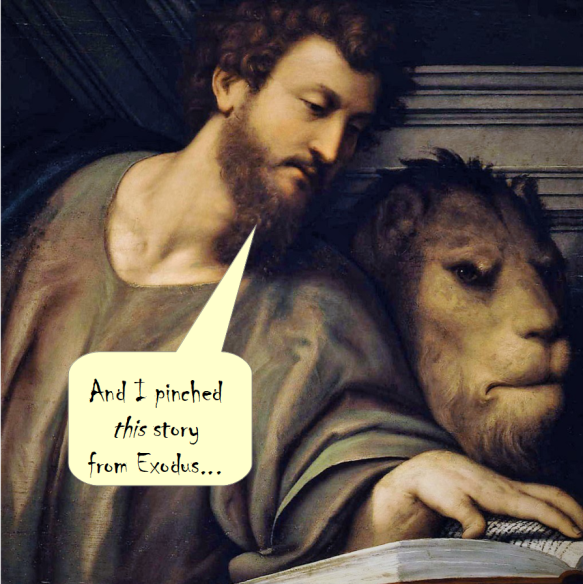
d) Herod’s re-enactment of a story from Exodus

e) All the angelic visitations, dreams and visions that are needed to make the stories function

Answers:

1. Where did Mary and Joseph live prior to Jesus’ birth? All of the answers here are correct, so the Holy Bible say. According to Matthew, Mary & Joseph lived in Bethlehem. According to Luke they lived in Nazareth. According to Mark, it was known that Jesus hailed from Nazareth though he doesn’t say Jesus was born there. John refers to Jesus being from Galilee and acknowledges he comes from Nazareth (1:46).

Matthew and Luke insist Jesus was from Bethlehem to make him ‘fulfil’ the prophecy that the Messiah would come from there. Mark and John apparently don’t care.

2. How did Mary conceive? Matthew and Luke have the Holy Spirit do the deed. Matthew says merely that Mary ‘conceived by the Holy Spirit’, while Luke really goes to town with a ridiculous story involving an angel and Mary being orgasmic about the coming of the Lord. Mark hasn’t heard of either account, because neither had been invented, and fails to invent his own. John is only interested in Jesus as The Logos prior to his time on Earth. Actually, Jesus could only have been conceived by the only method we know that works: boy and girl hoochie-coochie.

3. What was the relationship between John the Baptist and Jesus? All are correct. Luke says Jesus and John were second cousins (1:36) and their mothers were close (1:56). The Gospel of John (1:31) says that John the Baptist didn’t know Jesus personally. Some scholars think Jesus was originally a member of John’s baptism cult.

4, When was Jesus born? a) and b) are both correct according to the gospels. Matthew places Jesus’ birth in Herod I’s reign, which ended when he died in 4BCE. Luke meanwhile dates it to Quirinius’ governorship of Syria, which was in 6 and 7CE. No wonder there are those who think Jesus may never have existed, so encrusted with myth and make-believe is he.

5. How did Mary end up giving birth in Bethlehem? The census is a contrivance to shift the birth to Bethlehem. There wasn’t a census of the kind described when Quirinius was governor of Syria, nor in 4BCE. Quirinius’ census was of property and would not have entailed the (mass) movement of people. Matthew seems to think M&J lived in Bethlehem all along. No-one else thinks so.

As the Bethlehem connection derives only from prophecy (Micah 5:2), it is likely Matthew and Luke located the birth there to show the ‘fulfilment’ of that prophecy. In other words, they invented it, as they do other ‘fulfilments’. It looks like a) is the only viable answer.

6. The Lord tells Mary to call her child… According to Matthew. Mary is meant to call the baby Immanuel, which, as the text helpfully informs us, means ‘God with us’. This is to make the story comply with Isaiah 7:14 which claims the Messiah will be called Immanuel. But Mary doesn’t call her baby Immanuel. She calls him Yeshua, meaning ‘God Saves’, which is not the same thing. How Matthew thinks this is a fulfilment of the Immanuel prophecy is anyone’s guess. When the gospels came to be written, Yeshua was rendered in Greek as Iesus and eventually in English as Jesus. Neither he nor his mother would have recognised this rendering.

7. Where did the family go following the birth? Again, all are correct according to the gospels. The family went on living in Bethlehem according to Matthew (2:7-11) but fled to Egypt according to Luke. Mark doesn’t appear to know either the Bethlehem or Egypt stories and refers only to Jesus coming from Nazareth.

8. Who preserved the songs of Zechariah, Mary and Simeon (Luke 1 & 2)? c) is correct. No oral tradition could possibly preserve the three carefully structured poems verbatim for 50 years. The hypothetical Q is conjectured to be a collection of Jesus’ sayings so the songs don’t come from there either. Luke or his community made them up.

9. Where is the prophecy, quoted by Matthew (2:23) that Jesus would be called a Nazarene? There is no such ‘prophecy’ anywhere in Jewish scripture nor in any extant writing: c) is correct once again.

10. Which is the most unbelievable part of the nativity stories of Matthew and Luke? That’s right. All of them are completely unbelievable.

How did you do? If you’re confused, don’t be. It’s the gospel writers who were. They made up stories about Jesus so that he complied with parts of Jewish scripture that seemed to them to be speaking of the Messiah. (John’s stories are a little different; they and Jesus’ tedious monologues were created to make him seem more like a Greek demi-god.)

Perhaps though I’m taking it all too literally, ‘like a fundamentalist’ as my self-appointed chief critic likes to say. I should perhaps accept it’s all just a metaphor, as he advises. Of course, when I do, he objects to that too; ‘A metaphor for what?’ he asks, forgetting he’s the one who believes the stories are ‘intended’ to be deeply meaningfully symbolic.

The muddled accounts arose as each gospel writers attempted to make an origin story for their hero based on scraps from Jewish scripture, Paul’s teaching and the emerging beliefs of their particular brand of the cult. They’d have got away with it too if some clever-dicks hadn’t decided, many decades later, to put their efforts side by side so their differences were laid bare for all to see: all the contradictions, inconsistencies, fallacies, anomalies and incompatible flights of fancy. Thank god the church kept their writings hidden away from most folks by preserving them in a language they couldn’t read.

That same critic will no doubt tell me I’m wrong again. ‘Everything happened as Matthew and Luke relate. There are no contradictions between them and the other two, Mark and John, had different priorities anyway.’ (See comments to this post here). He’ll tie himself in knots rather than admit the nativity stories are myth, as is everything that follows.

Have a happy Christmas, ya’ll. See you on the other side.

 

Miracles made to order

Mark makes his Jesus perform all the deeds the scriptures say will be performed by the Messiah. He doesn’t spell out that this is what he’s doing. He wants those who hear his gospel being read aloud (as it would have been to the cult’s members) to work it out for themselves: ‘he who has ears let him hear’ and all that.

This isn’t good enough for Matthew, however. He wants to make it obvious what’s going on, so he invents a story to draw attention to it. To do so, he has to have John the Baptist, who has previously acknowledged Jesus as the Messiah and heard God say as much from Heaven, doubt all of it. Matthew considers it worth it to make the more important point that Jesus is truly God’s Chosen One:

John (the Baptist) heard in prison about the works of Christ, and he sent his disciples to ask Him, “Are You the One who was to come, or should we look for someone else?”

Jesus replied, “Go back and report to John what you hear and see: The blind receive sight, the lame walk, the lepers are cleansed, the deaf hear, the dead are raised, and the good news is preached to the poor. Blessed is the one who does not fall away on account of Me.” (Matthew 11:2-6)

Matthew makes Jesus refer to several scattered verses from the scriptures that appear to say that once God’s Kingdom arrives on Earth the deaf shall hear, the blind see and the lame walk. Now you can believe, if you like, that Jesus really did make the blind see and the lame walk because the Kingdom had arrived (though -oops – it hadn’t!) or you can recognise that Matthew (and Mark before him) was aware of these references and made up a hero to embody them. Which is more likely, when every one of the miracles Jesus alludes to in Matthew 11 illustrates specific verses from scripture?

The blind see, the deaf hear, the lame walk (Isaiah 35:4-6) is brought to life in Matthew 9:27-31; 15:31-37 and 9.1-8.

Lepers cleansed: Leviticus 14 materialises as Matthew 8:1-4. The ability to heal a ‘defiling skin disease’ had long been thought to be a sign of the Messiah, so naturally Jesus has to be able to do it.

The dead rise: Daniel 12:2 is resurrected as Matthew 9.18-26.

The good news preached: Isaiah 52:7 becomes Jesus’ message.

A man called Jesus didn’t do these looked-for amazing things. These looked-for amazing things gave rise to a character constructed by myth makers: gospel Jesus. 


Cruci-fiction

Given the birth, baptism and wilderness narratives are fiction, why not then the other parts of Mark and Matthew? We’ve already seen how the trial and crucifixion in Mark are literary creations, which Matthew lifts and embellishes. The resurrection stories are also invented, which is why the different accounts are confused and contradictory. The likelihood that everything between the beginning and the end – Jesus’ ‘ministry’, miracles and preaching – is invented too, either by the authors of the gospels themselves or by those who preceded them. My money would be on the former; the stories are so carefully arranged, forming an integral part of a clever literary construct.

I have a growing, sneaking admiration for what Mark and Matthew, and later Luke and John, achieved. They consciously set about creating myth. When Paul and others preached that their Christ had died and risen again ‘according to the scriptures’ that’s literally what they meant; the Christ was discernible in Jewish scripture, his story laid out there for those with eyes to see it. Mark tells us as much in Mark 4:9: ‘He who has ears to hear, let him hear.’

What he and, to an even greater extent, Matthew did, was construct a Saviour story from these elements. They saw him, or thought they did, all over the place. Whether or not there was an actual Jesus is beside the point. as is the extent to which the gospel writers may have used existing stories about him. Gospel Jesus is their imaginative creation from start to finish. His life, deeds and many of his sayings are put together by cutting and pasting scripture.

Cite any episode in Mark and Matthew’s gospels and it will have a precedent in scripture, either a prophecy (that invariably isn’t a prophecy) or episode (that was never about a future suffering Messiah) or character (usually legendary in their own right.) You can believe, as many True Believers do, that these ‘Old Testament’ episodes foreshadow the events of Jesus’ life. That he miraculously fulfilled prophecy through everything he did and said while here on Earth. Or you can take the view that doesn’t rely on faith in the miraculous, and recognise that he’s merely written that way. He’s the literary embodiment of scattered scraps of scripture.

On this much more realistic view, everything Jesus is made to do, particularly his miracles and crucifixion, is symbolic; a fictional enactment of scripture. Other aspects are drawn from Paul (the Last Supper/Eucharist, for example), claims of inner-visions (the resurrection) and early cult rules (behavioural expectations.) The events of Jesus’ earthly existence, as created by the gospel writers, have no historical basis; they didn’t really happen. I maintain that all of the gospel writers were fully cognisant of this as they created their respective symbolic lives for him.

According to Scripture

A simple comparison of Mark’s and Matthew’s gospels is enough to demonstrate that the gospel writers invented their stories of Jesus. I’m going to take only a few examples over the next few posts, but the same analysis could be made of any of the episodes in the two gospels and yield the same results.

Mark starts his story with Jesus’ baptism and subsequent 40 days in the wilderness. The dominant motifs of both episodes are intended to alert the reader to the fact that Mark sees Jesus as the new Moses, preparing to lead his people out of bondage and into the Kingdom that God is preparing for them. The parting seas of Exodus 14 become the parting clouds through which God proclaims Jesus his Son, the 40 year trek through the wilderness (Exodus 16 etc) is replaced with Jesus’ 40 days in the wilderness. 

Mark gives the wilderness episode a mere two sentences (Mark 1.12-13) which isn’t enough for Matthew. He embellishes it in his gospel, making it a full-blown fantasy, complete with a lengthy conversation between Jesus and Satan. Matthew invented this story. We know he did because:

it cannot possibly have come from an eye-witness (because there wasn’t one);

It is patently fantasy material, with Satan, ministering angels and teleportation;

it cannot have derived from any oral tradition (as it is an embellishment of Mark’s tale, invented only a decade earlier, designed to echo the Moses story);

It is designed specifically to extend the analogy with the Moses. In Matthew, Jesus encounters the same temptations as the ancient Israelites in their wilderness trip, but, unlike his forebears, Jesus triumphantly resists them. He then recruits 12 disciples to go on ahead of him (Mark 3:13-15) just as Moses’ appointed 12 spies for the same purpose (Numbers 13). 

Matthew has even more up his sleeve. He is fully aware of the parallels Mark has made between Jesus and Moses and adds a third to the beginning of his Jesus narrative. In his contrived nativity story, he rewrites the story from Exodus 1 and 2, itself a complete fabrication, in which Pharaoh orders the elimination of all Israelite baby boys. He lifts it directly into the so-called Massacre of the Innocents episode in his gospel.

Again, we know Matthew made this up:

Herod did not order any such massacre. It is not an historical event.

Matthew was determined to find incidents in Jewish scripture he could claim were really about Jesus. Here he is at it.

He is determinedly extending Mark’s metaphor; this is not material from any other source or tradition.

He constructs the narrative using additional ‘prophecies’ he finds in the scriptures. For example, the trip to Bethlehem and the flight to Egypt, neither of which happened (no other gospel writers knows of them.) The Egypt episode is an imaginative (and dishonest) expansion of Hosea 11:1: ‘Out of Egypt I called my son’. In context, the verse refers to the Jewish nation not a future Messiah. And who led the Israelites out of Egypt? Moses.

The nativity story and the Moses/Israelite parallels in the Egypt/baptism/wilderness episodes in Matthew are not drawn from tales of Jesus that were doing the rounds. They are clever, contrived literary creations. They tell us too that Matthew did not regard Mark’s more basic stories as history or biography. He evidently did not view them as immutable. He changes and adds to them to make his own points, ‘correct’ Mark, extend his analogies and emphasise that which he thinks Mark hasn’t emphasised enough. Throughout his gospel he’s prepared to create new incidents, even when they conflict with points Mark makes. He knows that Mark’s work, like his own, constitutes carefully devised stories and he feels free – compelled – to improve them. You can’t treat history this way but you can rewrite fiction.

A Star Is Born

Did you know that the original, 1937 version of A Star Is Born may well have been based on a true story, first aired in an earlier, 1932 movie called What Price Hollywood? Yet every word of dialogue in the original Star Is Born was invented, all of its characters fictional, all of its scenes made up.

By the time of the 1954 remake, the female lead had gone from being an aspiring actress to an aspiring singer, played by Judy Garland, looking for her big break. Her mentor is still the addictive personality of the original film but this time he’s a has-been singer, not an actor, and crucially he doesn’t commit suicide before the film’s end (apologies for the spoiler.) Practically everything about this remake – its dialogue, characters, songs (songs? Where’d they come from?) settings and scenes – is different and, once again, is completely made up.

In the Barbra Streisand 1976 version, the female lead is once again a singer, her mentor a rock star whose career is on the slide. This film is about the perils of a rock’n’roll lifestyle and the passionate relationship between the two protagonists. It bears only the scantest relationship to its predecessors, never mind the original true-story that inspired the first film. Again, everything in it is pure invention.

Which brings us to the fourth version, starring Lady Gaga, that borrows a little something from all of the previous films. All the same, it alters the story, creating completely new scenarios, dialogue, songs and settings. It would be unrecognisable to the original audience of the first A Star Is Born, as different from that film as… well, as John’s gospel from Mark’s.

As the various versions of the film demonstrate, stories evolve. They are fluid and in their telling and retelling they change. Their creators adapt them and ‘improve’ them to meet the evolving tastes of their intended audience. They happily invent new episodes, new scenarios and new dialogue.

And so it is with the gospels: Mark’s original based on the visions of a few people from 40 or so years earlier; Matthew and Luke’s based on Mark’s – with their own largely invented additions – and John’s (the Lady Gaga of the set) a wild reimagining of all three. Apart from the outline of the story (which they get from Mark), every one freely adapts everything else: dialogue, scenarios, pericopes and, yes, songs.

We’ll look in detail next time at the evidence, still apparent in today’s versions of the gospels, at how we know this to be the case. 

Tailor Made

So where did the stories of Jesus life on Earth come from? The traditional answers to this question are wholly inadequate. As we’ve seen, they didn’t seem to be around when Paul was writing; the hypothetical Q is an unconvincing way of explaining them while unreliable memory, coupled with the so-called oral tradition, don’t offer any means of conveying accurate verifiable information about Jesus.

The writers of the gospels, particularly Mark the creator of the first, would have known this. The gospels are not collections of the speculative tales that were doing the rounds. They might have made some incidental use of them, but all of the gospels are carefully constructed, designed to make theological points about their hero. Particular kinds of stories were required for this and the gospel writers thought nothing of making them up. It’s possible they made use of existing tales, but if they did, they almost certainly retooled them to suit their purposes. The stories we find in the gospels are tailor made to illustrate these purposes. None of the gospels is history: they are all carefully crafted literary creations.

What were the purposes and the agendas of the gospel writers? Propaganda, designed not so much to convert non-believers, but to explain to those who were already part of the cult, and their own sects in particular, what belief in Jesus entailed. To this end, they created allegories, symbolic stories about his life on Earth.

Mark began the process. He constructed his narrative by adapting Paul’s teaching ;and inventing stories based on ‘prophecies’ from the scriptures to create a symbolic narrative every part of which makes a theological point. He may also have retooled existing stories while borrowing features of existing myth that fellow cultists would expect to find in an account of a demi-god’s adventures.

Matthew and Luke then followed his lead, lifting what they thought was of relevance to their own agendas, dropping or amending the rest and inventing their own symbolic stories.

You think they didn’t? I’ll show you that they did, and how, using Mark, Matthew and Luke’s gospels, in a couple of posts time. But before that: a slight and relevant diversion.

The Oral Tradition

Where did stories about Jesus originate?

Memory and the Oral Tradition, part 2

The passing on of stories from memory is the ‘oral tradition’ that some argue preserved the words of Jesus more or less accurately for forty years. We’re expected to believe that eye-witnesses recalled in precise detail what Jesus said and did; that they all largely agreed on what this was; that none of them embellished or altered their recollections in any way in the telling and that they were passed on to convert after convert after convert in precise and unaltered form. And then, that no-one in forty years amended or refined the stories in any substantial way, because if they did the originators of the tales would be quick to point out any inaccuracies.

We know this isn’t what happened. The stories evolved and were refined and embellished as they were passed along for forty years between numerous converts. The defence that ancient largely illiterate cultures were better at faithfully preserving stories orally than we are today is a myth. (See EhrmanHow Jesus Became God: The Exaltation Of A Jewish Preacher from Galilee)

Even when some of the oral stories about Jesus were eventually written down, as in the gospels, they continued to evolve; Matthew and Luke both altered stories they took from Mark while John’s Jesus, in the latest of the canonical gospels, is a different creation altogether; either the source stories John knew had evolved quite differently from those Mark, Matthew and Luke had access to, or John created his Jesus out of whole cloth himself.

These stories once written down were changed again, both deliberately and accidentally, whenever the gospels were copied. We know this from the myriad of differences in the extant manuscripts. As Bart Ehrman puts it in Misquoting Jesus, there are more variations among our manuscripts than there are words in the New Testament’. The evolution continued. This is why the Jesus seminar concluded, controversially, that only 20% of the words attributed to Jesus in the gospels can be regarded as originating with him. I consider this to be over-generous. 

Even if the writers of Jesus stories took some of their material from the so-called oral tradition (aka, ‘stories that were being passed around’), we have no way of knowing which of it, if any, is an accurate representation of the things Jesus did and said. It’s unlikely much of it is, given how stories are misremembered, reshaped and altered over time. Their evolution makes them less reliable, not more.

By the way, you’ve not read the post I wrote on Cape Cod. Most of it was completed in Boston and I’ve edited and posted it from my home in the UK. In other words, it evolved in various locations. Kind of like the gospels.


Memory


Where did stories about Jesus originate?

3. Memory and the Oral Tradition, part 1

I’m writing this on Cape Cod in Massachusetts. I lived and worked here for a year almost 40 years ago and have returned to visit a few old haunts and stay with a friend, Carol, from back in those days. So much is how I remember it, some has changed and some I can’t remember at all.

Carol and I have met only once in the intervening years, 20 years ago, but we have kept in touch through letters and emails. We’ve been reminiscing a lot this week, telling stories from the time we worked together in the ‘80s, stories we’ve each told many times before. It’s been interesting to discover how much our memories of the same events differ.

We don’t always remember who else was present on a given occasion (were there 4 there or 6? Was K with us or was it V?); who said what; what they actually said and what order events occurred in (was that before this, or vice versa?)

This is before we add in the refinements we’ve each made to the stories over the years; the gaps in our memories we’ve filled in to allow the story to flow; the (different) parts we’ve omitted because they interrupt that flow or now seem irrelevant; the tidying up and restructuring of the tale to make it pithier; the refining of half-remembered dialogue to make it punchier and funnier; the changes in vocabulary (cheeky for fresh, pushchair for stroller)… and so on.

And all of this from eye-witnesses, Carol and me, who were both present and involved when the events in question took place almost 40 years later (which coincidentally is the time between the supposed events of Jesus life and Mark’s gospel.)

On occasion, I’ve heard someone else repeat one of my stories, and infuriatingly they never get it right. They change it to tell it their way; I want to say, and sometimes do, ‘that’s not how it happened. That’s not what she said.’ But that’s the trouble when stories are passed on. They’re out of the control of those who originated them. They take on a life of their own. They become unverifiable, even by their originators. They are changed further when still others take them over. And others and still others, like a giant, out-of-control game of Chinese whispers. In this way, stories evolve and are far beyond anyone’s control – beyond my control in terms of my Massachusetts memories. I couldn’t fact-check them even if I wanted to.

I’ll get to the point – though you can see it coming, can’t you – next time.

In Search of the Lost Q

Where did the stories about Jesus that we find in the gospels come from?

2. Q

Q is a hypothetical document said to be a collection of Jesus’ sayings. It was first hypothesised in the late 19th century and developed by minister B. H. Streeter in 1924. it was intended to explain why Matthew and Luke’s gospels shared material that wasn’t plagiarised from Mark. Streeter speculated they must both have had access to an alternative source that he christened Q (after the German for source, Quelle.)

While the idea caught on and is still assumed by many scholars (including Bart Ehrman) there are numerous problems with it:

Q doesn’t exist and has never existed. There is absolutely no evidence for it, aside from the duplication of material in Matthew and Luke, the very context it was designed to explain. There are no surviving copies, nor even fragments of any written collection of Jesus’ sayings (unsurprisingly for a non-existent document.) Nor is a book of Jesus’ sayings referred to in any form by any New Testament writer (again, unsurprisingly.)

Q is unnecessary. As other scholars, including M. A. Farrer, Mark Goodacre and Richard Carrier, have pointed out, there is a far simpler explanation for Matthew and Luke’s sharing of material they didn’t get from Mark. Either Matthew or Luke had access to the other. It is generally accepted that Matthew’s gospel predated Luke’s by a few years. It is likely therefore that Luke took certain stories from Matthew, as he had others from Mark, and made them his own. Doesn’t he say at the start of his gospel that he intends to collate material about Jesus that was already in circulation? Occam’s Razor also leads to the conclusion that this is a far better explanation of the duplication than a hypothetical third document.

Q doesn’t answer the question of where the stories came from in the first place. Arguably, it moves the solution back a stage but that’s all. If for the sake of argument we assume Q did exist, we still don’t necessarily know where it got its material from. Q really gets us no further forward.

Q is conjectured to be a collection of sayings. They are not set in any context; Q lacks a narrative structure so cannot be where Matthew derived his accounts, for example, of the Temptation in the wilderness (4:1-11), the Sermon on the Mount (5:1-12) or the healing of the centurion’s servant (8:5-13) that Luke would later copy and adapt. These are stories, not mere sayings. Even if Matthew got the sayings they include from some now lost written source from where did he get their context? Eyewitnesses? Unlikely, given he was writing 50 years after the purported events when most eyewitnesses would be dead. He was certainly not an eyewitness himself; he would not have needed to copy large swathes of Mark if he was. Nor does Matthew claim to be using eyewitness testimony. Like all the gospel writers he comes nowhere close to citing his sources.

Matthew is, however, notorious at making up stories he thinks make Jesus fit prophecy. He invents still others to make theological points. It’s quite possible he invented these particular accounts too.

Or perhaps, as apologists like to claim, Matthew and the other gospel writers got at least some of their stories from the so-called oral tradition, a grand name for the tales about Jesus that circulated for the 40-70 years before the gospels were written.

We’ll take a look next time.