Encounters with God

I had a couple of encounters with God on a recent trip to the Baltic states of northern Europe. Both were in churches, the first in Helsinki, Finland. The Lutheran Temppeliaukio Kirk (above) is a remarkable structure hewn from solid rock into a stunning enormous cavern. The choir was practising when our tour guide took us there. The singing was sublime, amplified and enhanced by the acoustics of the cave. Listening to the ‘heavenly’ voices was a truly spiritual experience. After the performance, the choir leader dedicated their performance to the glory of God.

The second church was the protestant St Nikolai’s in Kiel, Germany where, local legend has it, a miracle occurred during the second world war. When the town was in danger of being bombed, church officials had all of the church’s historic pews removed and safely stored. The massive suspended crucifix, however, was too big to take down and had to be left in place. Some parishioners quickly became unhappy standing for services and started bringing their own seats, including quite a few sofas. When the town and the church were eventually bombed, the huge crucifix fell from its height and crashed down. While the church itself was all but destroyed, the crucifix survived with only minimal damage, thanks to the sofas on which it landed. A miracle!

The cross suspended again in the restored St Nikolai church

Singing that reflects the glory of God and a miracle in which Christianity’s holy symbol is preserved. Presumably today’s attendees at both churches (St Nikolai’s interior was rebuilt) believe these events to be the work of God. Our tour guide that day expressed his scepticism, as did I, inwardly at least. The singing in the cave church was a tribute not to God but to the human ability to create beauty. It spoke too of the skill of the church’s architects and engineers who provided the building with its stunning acoustics. Human ingenuity, creativity and, I would guess, hours of practice produced the sublime sound.

The crucifix ‘miracle’ was a remarkable convergence of coincidence. A good story to be sure, but not an event that requires any God.

I drew the same conclusion from the two experiences: human beings are prone to give credit to their deities for things they achieve themselves – beautiful singing and stunning architecture included – and to attribute chance events and coincidences to their gods. We should take credit for our achievements (as well as responsibility for our bad behaviour.) The gods have no part to play. There are no gods.

Speaking in Tongues


I used to be so uncomfortable in prayer meetings that I attended back when I was a true believer when someone would start praying in tongues. It usually went something like alaluboolubamuba repeated over and over again, like a babbling brook. Babbling is what it was. In the churches I experienced it in, there was rarely any interpretation of the tongues as Paul instructed there should be. Even when someone was led by the Spirit to pipe up, what the speaker in tongues had said in gobbledegook was standard praise stuff: ‘Thank you Jesus for your wonderful mercies. Praise you for all you have done for us. Alleluia! Praise you’ etc, etc. And who were we, the others present, to say it wasn’t? Some would add their own Amens to the interpretation, adding credence to the meaningless phenomenon. The Spirit at work indeed.

Speaking in tongues, glossolalia, seems to have afflicted the cult in Corinth in particular. Paul addresses it in his first letter to the church there, and nowhere else. He doesn’t seem to know what to make of it. He feels unable to say that it’s merely a few people getting carried away (because that’s pretty much what all early Christian worship was) and can’t say it’s not the Spirit moving them to babble when that’s what the church was claiming. So he fudges it, claims he speaks in tongues more than anyone else (why do I hear Donald Trump in this boast?) and makes a few stipulations:

Only speak in tongues if there’s an interpreter present. (What happens if you get the urge the Spirit moves you when there’s no interpreter around?)

Glossolalia is ‘uttering mysteries’ in the Spirit that no-one can understand (so how can they be translated/interpreted by someone else?)

You shouldn’t speak in tongues all at the same time. It’s unseemly.

Use tongues only in private (according to the great know-it-all apostle, tongues are of the spirit and are merely a way of praising God. Tongues then are God praising God: what a narcissist he is! Other than this, Paul concludes they’re not much good.)

Interestingly, at no time does Paul suggest or acknowledge that some of the tongues manifesting themselves are other languages – real languages as opposed to unintelligible babbling. In fact he makes much of the fact that no-one understands what is said. It’s left to Luke to elevate linguistic nonsense to miracle status. In Acts 2:4-12, he has the disciples speak in real foreign languages after the Holy Spirit takes hold of them. Those around are ‘amazed’ (aren’t they always?) that they can suddenly hear the gospel message in their own tongue. Luke labours the point that, conveniently, there were men from ‘every nation under heaven’ present to verify the use of multiple languages by otherwise uneducated fishermen. Far more likely is that Luke, aware of the outbreak of babbling in at least one early church, shaped what he’d heard into what he thought was a more credible account. In other words he made up the story of the disciples spontaneously becoming fluently multi-lingual.

Later still, the unknown writer who invented the longer ending of Mark decided to mention the tongues phenomenon in the prophecies he invented for Jesus. In Mark 16:17 he has Jesus promise that those who believe in him would miraculously speak in ‘other languages’. How many times has this happened in the ensuing two millennia? I’d put money on there only ever having been sporadic outbreaks of meaningless babbling, such as that which I experienced. 

The church today continues to be confused about tongues. Some claim that ‘the gifts of the Spirit’, of which tongues are a part, no longer manifest themselves among believers. It’s a neat way to consign bizarre behaviour to the dumpster of history, but alas, it’s unscriptural. Nowhere does Paul suggest tongues and the other gifts of the Spirit would have a sell-by date before the Lord’s coming. Admittedly, he thought the Lord would be coming real soon. Only then, not before, would tongues and the other gifts of the Spirit ‘pass away’.

Other churches today are open to the possibility of tongues. Some even claim that the Spirit does indeed enable believers to launch fluently into languages, complete with correct syntax and vocabulary, that they don’t actually know. We can be sure there would be evidence of this online if it really occurred. There isn’t. 

Others are happy to go along with the unintelligible babbling, preferably with an interpreter who makes stuff up is also led by the Spirit to make sense of the mumbo jumbo.

Some abandon all restraint, with entire congregations babbling at the same time. Paul’s rules be damned!

And they wonder why we don’t take them seriously. As Paul himself warned:

If the whole church comes together and everyone speaks in tongues, and inquirers or unbelievers come in, will they not say that you are out of your mind? (1 Corinthians 14:23)

They surely will.

Have any of you encountered speaking in tongues? What did your church make of it?

The Boy On The Bus


The pleasant looking young man, his face scrubbed and shining, was already on the bus when we got on. He smiled as we took a seat in front of him. He struck up a conversation with the older woman on the seat across the aisle from him. Did she live nearby, he asked, his accent American. Had she been out shopping, what had she bought, which supermarket had she been to? He appeared interested in her answers, commenting and asking follow up questions. It was all harmless if a little intrusive. What possible interest could a young man in his early twenties have in the shopping habits of an elderly woman?

He told her he was from Ohio and his companion from Utah. The companion, whom we hadn’t noticed, was sitting further back in the bus He hadn’t spoken, perhaps having no interest in old ladies’ shopping trips.

The woman asked, probably out of politeness, what the two of them were doing in a town in the far north of England.

We’re on our way to a church meeting,’ the talkative one replied, ‘to prepare for missionary work.’

Oh,’ said the woman uncertainly, wishing perhaps she hadn’t asked.

Have you ever been to our church?’ asked the young man, the building in question being something of a local landmark, never looking, in our experience, as if it was ever open or attended.

Oh no,’ said the woman.

Why’s that?’

Because I… er, have my own religion.’

Which one is that?’ pounced her interlocutor.

Luckily, the bus happened to be passing a Roman Catholic church at this point. ‘Er, Catholic?’ stammered the unfortunate woman.

Catholic?’ he said. ‘Is that the same as Roman Catholic?’

No,’ she replied. ‘They’re quite different.’

The young man assured her, that Catholic or Roman Catholic, neither was a good church to be part of. They were, he told her, full of false teaching and idolatry. She should instead avail herself of the truth offered by his church.

The bus pulled up outside the local meeting house of the Church Of Latter Day Saints. ‘Here’s my stop,’ the missionary announced. ‘I hope you’ll think about my offer,’ he added as he stood up.

The two young men jumped down from the bus, the vociferous young man waving frantically to his mark as it set off again. His confederate had still not uttered a word.

Frankie Goes to Hollywood

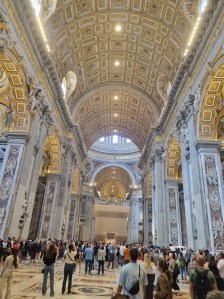
Dennis and I found ourselves in Rome last week, doing what I’m sure native Romans don’t do: the tourist trail. It’s a magnificent city.

As we were passing, we thought we’d call round at Frankie’s little place. We knew he wasn’t in, seeing as he was still on his world tour, just behind The Boss himself. He’s certainly got a great pad – Frankie that is, not Bruce – and after being frisked by hunky security guards we were admitted to St Peter’s Square. We felt moved, in the Pope’s absence, to grant an audience to the fairly thin crowd (it would get bigger later in the morning) and issue the benediction they so evidently craved. ‘Go, get a life,’ we offered from the steps of the Basilica. The faithful remained unmoved by this sage advice.

The Vatican is, I have to say, stunningly beautiful, a monument to human ingenuity and skill. But the cynic in me couldn’t help wonder what the majesty of it all had to do with the (supposed) teaching of Jesus in the Bible. I found myself playing a little game in my head along the lines of ‘how many ways does all of this contravene, contradict or downright ignore the beliefs of the earliest Christians, as expressed in what is now the New Testament?’ (Before any evangelicals tell me this is only to be expected of the Roman Catholic church, let’s not pretend that every other denomination doesn’t do the same thing.)

So, here are my suggestions for the Biblical admonitions that had to be ignored to create a religious monument on the scale of the Vatican. Feel free to make your own suggestions in the comments.

You shall not make for yourself an image in the form of anything in heaven above or on the earth beneath or in the waters below. (Exodus 20:40)

The statues of Paul and the apostles atop the buildings, the numerous images and carvings of saints, pious Marys and gruesome blood-spattered Jesuses certainly qualify as exalted images. The prohibition might not be New Testament but it is one of the Big Ten. The Vatican ditches it wholesale.

Jesus answered, “If you want to be perfect, go, sell your possessions and give to the poor, and you will have treasure in heaven. Then come, follow me.” (Matthew 19:21)

Like this ever happens!

Jesus said, ‘I am the way and the truth and the life. No one comes to the Father except through me (John 14:6)

And the Pope. And Mary. And the Saints. And the Church. And the Priests.

…the Most High does not live in houses made by human hands. (Acts 7:48)

So why build them for him? They may be meant to reflect his power and glory but they really only reflect that of the popes who had them built, plus the gullibility of their followers.

Do not store up for yourselves treasures on earth… But store up for yourselves treasures in heaven… For where your treasure is, there your heart will be also. (Matthew 6:19-21)

The Vatican’s tax free wealth, only some of which is on display around St Peter’s Square, is estimated to be between ten and fifteen billion dollars.

As I say, the Vatican is stunningly impressive; my photos don’t do it justice. If Christianity had never existed it would not have been created. But something equally impressive would have been, inspired by different ideals, deities or practicalities. Rome has stunning examples of these kinds of structures too. Nor am I getting at Catholicism per se. But you won’t find in it any expression of the beliefs, apocalyptic expectations and social reversals of the original Christian cult, nor in religion in general. Like all movements the cult had to evolve to survive, to the point it would be unrecognisable to its original quarrelsome adherents. Even if their images do look down on you from the roofs of beautiful buildings.

Oh, the Irony!

The Pope visited Papua New Guinea earlier this week, where he spoke of the need to –

drive out fear, superstition and magic from people’s hearts, to put an end to destructive behaviors such as violence, infidelity, exploitation, alcohol and drug abuse, evils which imprison and take away the happiness of so many of our brothers and sisters.

You couldn’t make it up. You really couldn’t.


Gullibility

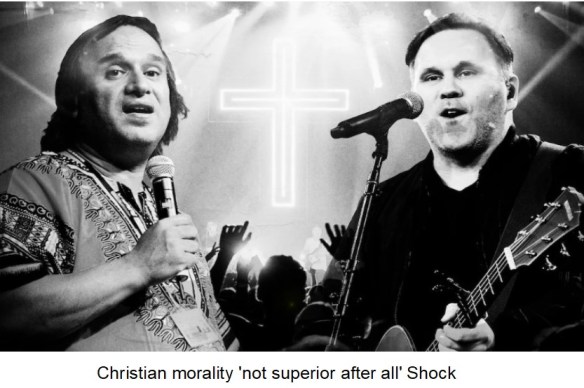
On the left, oily evangelical preacher the reverend canon Mike Pilavachi (yes, really. No irony at all in those self-aggrandizing titles.) Pilavachi used his spiritual authority to abuse young men, compelling them to take part in homoerotic wrestling matches and providing them, for his own kinky gratification, with full body massages. Because, you know, it’s what Jesus would’ve wanted. He also bullied and manipulated others in his church and ‘across the world’ in his ‘ministry.’ So far so much par for the course.

What I find incredible is the reaction of one of Pilavachi’s victims, Matt Redman (right), musical partner in Pilavachi’s Soul Survivor church festivals.

Redman had this to say recently:

I think Jesus is an expert at bringing things into the light, and I think that’s what’s happening in this whole process. I think Jesus is doing this. I think Jesus is cleaning up his church and bringing something into the light that needed to be in the light.

What lunacy! Jesus will bring the sordid goings ‘into the light’, which raises more questions than it answers :

Was it Jesus who brought these doings into the open or was it victims who found the courage to speak out? If it really was Jesus, why didn’t he reveal matters much sooner to prevent more young men from falling foul of the deplorable Pilavachi’s abuse? Why, indeed, did Jesus not prevent the abuse in the first place, saving everyone the pain and psychological damage Pilavachi’s actions caused? Why did Jesus not make Pilavachi into a brand new creation, as promised in 2 Corinthians 5:17, when first he imbued him with his Spirit, a creation that lacked the desire to manipulate and abuse others?

I think we know the answer to all these questions.

Believing in Jesus is to believe in a fiction that has no more concern for your well-being than Casper the Friendly Ghost (to whom he is closely related). As much as I empathise with the vulnerable Matt Redman, he needs to be less forgiving of Pilavachi, reassess his reliance on a shadow and face reality. If anything, his belief in Jesus led him into the clutches of a psychopath who used him for his own gratification.

Mike Pilavachi has yet to be questioned by police. I guess Jesus really does look after his friends.

Respect

Even before the events in Israel and Gaza, there were numerous recent examples of the term Islamophobia being used to suppress freedom of expression or shield wrongdoing.

A recent report by an all party group of UK MPs.

I’ve been told before that I should respect people’s religious beliefs. We all should apparently.

I can’t, I confess, summon respect for patent nonsense, nor for those who subscribe to it. I’m not even going to try.

There have, I admit, been a few believers I’ve met in life for whom I have had respect and even admiration, but this has been for the kind of person they were, not because of their religious beliefs per se. And no; their religion is not what made them admirable people. They were admirable irrespective of, or even despite, their irrational beliefs. I still hold to the theory of my own making, that religious conviction is like alcohol: both accentuate the existing characteristics of the individual, making them more of the person they already were, for better or for worse.

Equally, I’ve met many non-believers (I hate it that we have to describe ourselves as what we are not), LGBT people (for many religionists, the antithesis of admirable) and individuals whose views and outlook on life I haven’t necessarily agreed with, for whom I have also had respect and admiration.

It comes down to the old cliche, a truism nonetheless, that respect has to be earned. Just because someone believes in the supernatural or that Jesus died for our sins or that their deity or prophet trumps all others doesn’t mean I have to respect such views, or indeed those who hold them.

But this is where we’re headed, it seems. We’re expected to respect any old make-believe so long as it comes under the banner of religion and still more that doesn’t. It’s becoming ‘hateful’ to criticise religious belief and those who practise it. Because their views are sincerely held, the thinking goes, they merit protected status.

I commented some time ago on a Christian site (something I rarely do except when incensed) that was insisting ‘sodomites’ would burn in hell, because… the Bible. I countered that gay people were not going to hell because, in fact, no-one was. As well as the subsequent ‘loving’ comments from Christians, I was taken to task by a gay person telling me I was disrespecting the original poster’s Christian convictions.

Likewise when I suggest that we should be more wary of Muslim beliefs I’m told I’m being profoundly unfair, racist and Islamophobic, towards a minority – as a minority of one myself – and I should show more respect for an ancient and sacred tradition as well as those who subscribe to it.

I can’t do it. I can’t respect religious belief. It is no more worthy of respect than astrology, palm reading and spiritualism. It flies in the face of rationality. Not only is it insupportable, it is dangerous, a threat to hard-earned freedoms and rights.

No God and the Domino Effect

This a response to Don Camp’s comment on my post The Evil of Christianity, in which he tries to isolate ‘the crux’ of our disagreement about the Faith.

You start, Don, from the assumption that there is a God. I, on the other hand, have considered the evidence and concluded that in all probability there isn’t one. Certainly not the Christian God. There may be a god out there somewhere that has no interest in human beings and their affairs, though I doubt it. As far as we humans are concerned such a deity is as good as non-existent, being entirely hypothetical. If it is out there, it certainly won’t be offended at my saying so.

Once I realised some years ago that a personal God did not exist a number of other things followed (or rather, collapsed):

No God means no Son of God or God Incarnate, no Saviour or Christ.

No God means no resurrection (which Paul makes clear was a work of God).

No God means no Holy Spirit.

No Holy Spirit means no regeneration of individuals to become new creations in God (you only have to look at Christians today to see this is the case.)

No God means no grand Salvation plan.

No God means no Heaven, no Final Judgement, no Kingdom of Heaven of Earth, no Eternal Life.

No God means the universe can’t have been created by him.

No God means no manipulation of evolution, no intervention in human history and no prophecy of things to come.

No God means that the world would be just as we find it: messy, beautiful, dangerous, turbulent, indifferent.

No God means prophecy is man-made and comes to pass at no greater rate than chance allows (i.e. practically zero.)

No God means conversations with ‘him’, revelations from him and visions of him are all imagined, generated by and within the human brain, which works in mysterious ways.

No God means no God-given morality. Morality is, as you say, culturally determined and so may and does change over time. (You can see this in the Bible itself where morality supposedly handed down by God for all time evolves throughout the Old Testament and into the new.)

No God means there is neither Sin nor Righteousness. These are religious concepts. The whole spectrum of human behaviour, from destructive to altruistic, is demonstrated by believers and non-believers alike.

No God means assertions like ‘the issue turns on what I perceive as good for me versus what God declares is good for me’ are illusory. What is good for you is what you have worked out, even if you think God had a hand in it. A supernatural being who doesn’t exist cannot be responsible for your well-being, though your church and the bible undoubtedly contributed to your conditioning.

No God means individuals must work out their own meaning and purpose. Some do, some don’t, as you observe, Don. This is as true of believers as it is for non-believers. Many atheists have managed it, or not, without having it imposed by religion. And despite what you say, Christianity is a religion. It is the epitome of religion.

No God means none of the Abrahamic religions are true and therefore Christianity and its ‘holy’ book, being based on an invalid premise, must be false. Most of the posts on this here blog are about demonstrating this fact.

No God means all gods are man-made, not all gods except one.

The crux of the matter is you believe in God while I see how unlikely it is that there is one. I’d agree with you if I could, Don, but then we’d both be wrong.

The Evil of Christianity

Moral corruption and abuse are the inevitable destinations of religious sects. And they are all sects, regardless of their facade of respectability.

I recently watched Disciples: The Cult of T. B. Joshua, a series of programmes made by the BBC, about the Synagogue Church Of All Nations, led by the late ‘Daddy’ Joshua in Nigeria. You can watch the programmes on the BBC iPlayer where available and on YouTube elsewhere. When not preaching Jesus in the church’s massive auditorium, ‘Man of God’ Joshua was systematically and callously abusing, degrading and raping the vulnerable young women he had lured into serving the church.

Then today, I read of the sexual abuse of children, both historical and recent, by church leaders in a sect operating in Canada and the US known as The Truth. The abuse of some young boys and girls went on for years, leaving victims psychologically scarred and the perpetrators unpunished.

The Church worldwide has a serious, significant problem with sexual abuse that it consistently fails to address. There’s also the widescale abuse perpetrated in and by the Roman Catholic, Southern Baptist and Anglican sects. It is usually left to journalists and secular authorities to take responsibility for rooting out and exposing the abuse. The Church itself covers up, obfuscates and makes excuses, the chief of which is that the sects in question, the leaders in question, are an aberration and not ‘real’ Christians at all. (No kidding. But then who is?)

Individual Believers will say – and there will be some who will say it in response to this post – that it doesn’t happen in their nice little church (you sure?) and dismiss abuse as something that happens only in misguided cults. The truth is that the Church hands power to charismatic, manipulative men who, provided they preach the true gospel (whatever that is), are elevated above secular law and, lacking in empathy, regard themselves as beyond moral constraint. They see themselves as answerable only to God, because the Bible says so, and he has anointed them with both power and authority.

It happens time and again in churches, sects and Christian cults everywhere. It is the surest sign that Christianity does not work and is, despite the honeyed words of its apologists, positively evil.

Evidence of God

As for evidence, you might be aware of Israel. That nation has been in the news much of late. So, without being flippant at all, I present Israel as evidence. Think about it. They are living the script written thousands of years ago. Not by chance.

Israel as evidence for the existence of God. I’m thinking about it as Don suggests.

Where did it all begin, this bizarre notion that one tribe in the Middle East was chosen by God to be his special people? According to the Genesis myth, it was when YHWH promised Abraham he’d be his best buddy forever and ever, so long as he mutilated his body and those of his sons in perpetuity. They would also have to keep every one of this bullying god’s 365 rules and regulations, including the petty and piffling ones. So far so good, apart from the fact it was all very one-sided, and the mutilation of course. You’d think this would’ve been a sign that things weren’t quite kosher, but no; Abraham and his descendants buy into it and almost straight away, YHWH begins to let them down.

God’s Chosen Ones soon find themselves slaves in Egypt. A second mythical character is needed – up pops Moses – to get them out of this scrape. Unfortunately, after Moses has finished chatting with YHWH, who identifies as a burning bush on the top of a mountain, the sulky deity feels slighted by something the Israelites are doing. As is his way, he has many of them slaughtered and the rest he forces to troop around the same small plot of land for 40 years. This is how best buddies treat each other!

Later, the Jews find themselves defeated by the Babylonians and are carted off into exile. This exile, which YHWH does nothing to prevent, lasts 70 years. Still, it leads to a pleasant song made famous by Boney M in 1978 so I suppose it was worth it.

For the next few hundred years, Israel falls under the rule of other nations more powerful than itself. Not to worry though, YHWH is still ‘looking after them’, particularly those who are slaughtered in the rebellions that ensue. As Robert Conner says in a recent comment on Debunking Christianity, ‘If Yahweh ever threatens to bless you and your children, just kill yourself and get it over with.’

Fast forward to the Roman occupation of Israel. YHWH, having undergone a makeover, reneges on his promise to take care of his Chosen Nation forever and ever and comes up with a different plan to save people from his own cussedness. Now, if they want to continue as his friend, they have to believe a supernatural being has returned from the dead.

Abandoned by God, as he now wants to be called, Jews who haven’t defected to the new faith see their sacred, eternal temple destroyed by the Romans in AD70. Thousands of them are massacred and the Jewish nation ceases to exist.

This sets the pattern for the next two millennia in which God’s new friends organise pogroms, massacres and vicious persecution of Jews. This culminates in the Final Solution of the Third Reich which seeks to eliminate the Jewish people entirely. While awaiting extermination in a concentration camp, Andrew Eames scrawls on the wall of his prison: ‘If there is a God, He will have to beg for my forgiveness.’ God allows six million of his Chosen People die at the hands at the Nazis.

Following the second world war, Israel takes possession of the area surrounding Jerusalem, then occupied by Palestinian Muslims who are themselves descended from earlier immigrants. Thousands on both sides are slaughtered in the conflict that follows. In 1948, after almost 2,000 years, Israel becomes a nation once again; not through any miracle of God but as a result of human endeavour and bloodshed.

Tension and further skirmishes followed, leading to the present day when Israel finds itself under attack by Hamas terrorists. Thousands of innocents – women, children and babies – have been slaughtered without mercy. Israel is, as I write, retaliating and intends to enact further vengeance. And where is God in all this? You guessed it: nowhere to be seen.

All of this, according to some – including the naive writer at the top of this post – serves as evidence of God’s existence. That Israel has persevered for so long, despite opposition, persecution and the holocaust is not, however, evidence of God, any more than the great cathedrals of the world are. It is instead testimony to the resilience, resolve and sheer bloody mindedness of the people themselves. Perhaps their belief in YHWH (they don’t of course recognise his Christian counterpart) has fuelled their persistence, as it has their territorial claims.

Jewish beliefs and history are not evidence that YHWH exists. If anything, his apparent abandonment* during their many trials and tribulations is evidence to the contrary.

*Of course a non-existent entity can’t actually abandon anything, any more than it can lend its support or favour one group of people over another.