
You may have been informed yesterday that a new post was available. For some reason, WordPress may have briefly put next week’s post online while I was working on it. If so, please ignore it as it really needs to be read after this week’s post. As we’ve recently been reminded, context is all! Here’s the correct post for today:
Apparently, I’m anti-intellectual and a fascist. This was revealed to me when I became involved in a discussion on Facebook about a highly suspect report claiming less well educated people were more likely to vote for right-wing parties. This, the Facebook ‘experts’ scoffed, was because less well educated people were brainwashed and indoctrinated. My mistake was in suggesting that better educated people were just as likely to be indoctrinated as their less well educated counterparts. Perhaps higher education institutions, inclined to the left, might influence the views those attending them to the extent that they too are conditioned. Hence, the accusation I’m anti-intellectual and a fascist*.
This happy experience got me to thinking about the extent to which we’re all indoctrinated/ conditioned/brainwashed.
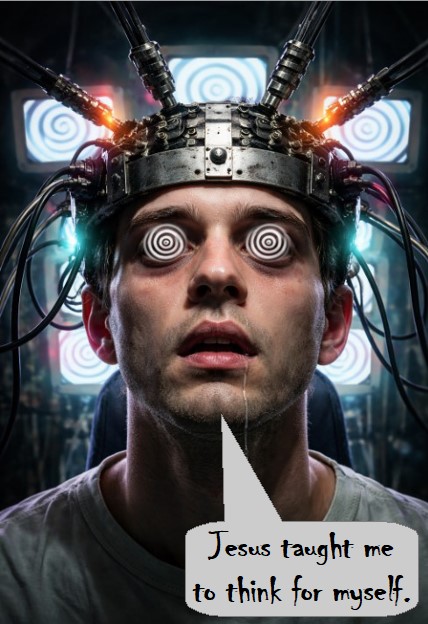
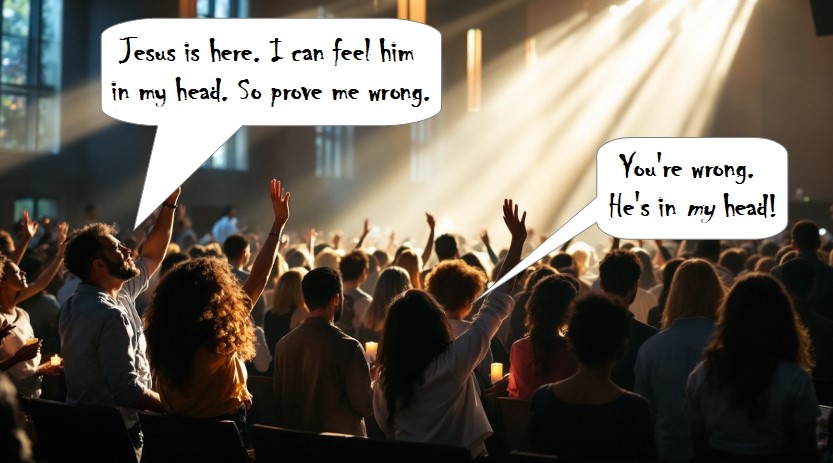
Like many of you reading this, I was brainwashed as a Christian. I swallowed whole the story I was told: that I was a sinner in need of salvation because my sin alienated me from God. Jesus had to give his life so that I might be reconciled to God. I had to accept Jesus into my life. I would then live forever, going to heaven after I died to be with God, Jesus and the angels. You know this story. And a story it is. As Yuval Noah Harari shows in his book Nexus we – all of us not just the less well educated – are more susceptible to investing in a story than in cold hard facts or evidence (not that there is any evidence for this Christian narrative, as with so many of the others we’re subject to.)
Then there were too all those optional additions to the Jesus story that weren’t optional at all: God would meet my needs if I prayed in earnest, read His Word (always with the capitals), met with fellow-believers and listened to the prompting of God’s Holy Spirit inside me. (Deep breath.) Also If I shared my faith with others (‘witnessed’), grew in my walk with him (a mixed metaphor, surely?) and regularly gave money to the work of the church, then I’d be a True Christian™. You and I could not be reasoned out of any of this, because we weren’t reasoned into it in the first place.
The indoctrination was reinforced on an ongoing basis, which is why we were constantly told that we must ‘fellowship’ with those who had been similarly brainwashed. We were told we must also reject and separate ourselves from the thinking and values of non-believers (‘the world’) because they might be a threat to what we were being taught, causing us to backslide and out of the Truth (a feature of every cult.)
There came a point for some of us, however, when a small chink appeared in our armour of God conditioning: an unanswered question about something we’d been told that seemed, well… a little off; an unconvincing attempt to reconcile faith with an aspect of science; the realisation in a crisis that God wasn’t there at all.
It was this latter for me, and as I’ve said before, I began to read books I hoped would throw some light on what I’d believed for so many years. Did these books condition me in ways contrary to those I had escaped from? Yes, probably. But I didn’t subscribe to their stories unquestioningly. I weighed arguments and evidence, taking some on board, putting some aside and creating a synthesis of views as diverse as Carrier’s (Jesus was probably mythical) and Ehrman’s (Jesus existed but was mythologised by early converts.)
I’m quite prepared to accept that this too was a form of conditioning, my selection and rejection of arguments and evidence being determined by my being predisposed to find some persuasive and others not. This predisposition was of course part of earlier conditioning to which I had already been subject, the result of my liberal education that taught me to be impressed by sound argument and evidence. We can’t invest in a position, idea or even propaganda without previous conditioning predisposing us to. Our politics, religious beliefs, rejection of religious beliefs, perspective on life and morality are not genetic. We do not arrive equipped with them, rather we learn them from our environment, our parents, our education, influential people in our early lives, the media, our reading, our culture, the zeitgeist, the groupthink we’re subjected to and the bubble in which we find ourselves. In short, the views we’re exposed to, which is why most of us in the West are not communist or Muslim. Even rebelling against familial or societal values is a form of conditioning, replacing the views and values of our parents or school with others from, for example, a subculture or political cause.
We are never in a position to exercise ‘free will’. We can only make decisions about that which confronts us in the present, with whatever we have internalised in the past. I don’t think there’s ever been a truly original thought in the history of humankind because each thought depends on that which has gone before, both in our own heads and in the heads of others. Your position on any issue, your opinions, views, religious/anti-religious beliefs politics are all the result of conditioning, as selective as that might have been as a result of your conditioned predispositions.
Where does that leave us? Not as ‘free thinkers’ (your free thinking will conform fairly closely with that of other ‘free thinkers’) nor as entirely open-minded (your previous conditioning and the predispositions it led to have taken care of that.) It will, in all likelihood leave you exposed – even though you may regard yourself to be immune – to whatever political and social propaganda is circulating in your particular culture. We’ll take a look at this next time – if you’re predisposed to.
*For the record, I have not so far voted for a right wing party in all of my 70 years. I get my news from a variety of outlets, some left wing, some right. I spent all of my working life in Education, the latter part as an academic; anti-intellectual I am not, though I have little time for those who flaunt their credentials and use them to cudgel others.








 rejectingjesus,