The Golden Age of Christian Values

If only we could get back to the golden age of Christian Values. The one that existed when I was young, before things changed so much and when life was so much better. People believed in God, went to church every Sunday and had good old fashioned, biblical values. The troubles of today could so easily have been averted if only we’d stayed true to those beliefs.

Yes, If only we could go back…

‘Let me take you there,’ says a disembodied voice.

‘That you Jesus?’ I ask.

‘If you like,’ it replies, ‘but I’d rather think of myself as the Spirit of Times Gone By. Let’s you and I return to some of them together and see if we can’t find the Golden Age of Christian Values.’

I feel him take my hand and suddenly we’re travelling through a vortex in time, away from the 2020s and into the past. As we do so, my smartphone disappears from my pocket, as if it had never existed. Disconcertingly, my Fitbit does the same. I’m sure going to miss them.

‘Take a look here,’ says the voice as a vista opens up on front of us. ‘Behold, 2003.’

‘Yes,’ I say. ‘Things were so much better even just 20 years ago. No wokeness, no talk of irreversible climate change… and no one had heard of gender identity or drag queen story hours!’

‘Really?’ my guide says. ‘That’s how you remember it? America was still reeling from 9/11, a Christian president was about to invade a country that had nothing to do with the attack and there were a record number of tornadoes across the US. Things weren’t that great for a whole load of people, especially the ordinary folk of Iraq.’

‘I guess not,’ I concede. ‘Maybe we need to go further back. Find that special time when we hadn’t abandoned God and he hadn’t left us to our own devices.’

‘Let’s do that,’ my host says, as once again we take to the swirling vortex, emerging seconds later in what he says are the early 1990s.

‘Much better,’ I say. ‘No destructive social media, no same-sex marriage anywhere. The Berlin wall has come down and the Second Gulf War is set to be a great success.’

I can feel my guide staring down at me, though oddly I can’t quite make out the details of his face. ‘Really?’ he says again. ‘I’m surprised you mention that. There’s also the Siege of Sarajevo on the horizon, racial unrest following the beating of Rodney King and in Bangladesh 138,000 people have just been killed by an earthquake. Plus, as you say no social media to speak of. You do remember, don’t you, how much you like arguing with atheists on it. I’m not sure this is the time we’ve been looking for either.’

I have to agree it isn’t, as once again he takes my hand and we return to the vortex, emerging mere seconds later… when?

‘The ’80s,’ he announces. ‘AIDs, the Iran-Contra scandal, acid rain, Chernobyl. I don’t see any Christian Golden Age here.’

‘Oh, I don’t know,’ I reply. ‘At least there was the Moral Majority, a genuinely Christian president and in England, a Prime minister with Christian principles. She even quoted the Bible sometimes. We had politicians of real integrity in this time period.’

I feel him raise an eyebrow even though I can’t see him. ‘A Christian president who left thousands to die,’ he remarks.

‘They brought it on themselves. God’s judgement on a sinful generation,’ I tell him, pleased to score a point.

We move on. ‘The 1960s,’ he declares. ‘Could this be your Golden Age?’

‘If there’s one thing I know for sure, it’s that the 1960s were not the Golden Age. Definitely not. That’s when everything started to go wrong. Moral relativism, Women’s Lib, Civil Rights riots, Stonewall, psychedelic drugs…’ I stop to catch my breath. ‘Long hair, promiscuity, nudity, abortion, decadent music. Oh Lord, it was awful and it paved the way for the depravity and dissolution that was to come. If ever there was a decade in need of God it was this one.’

‘Let’s not forget Assassinations and Vietnam,’ he adds.

‘For sure. That’s what comes of abandoning God.’

‘It looks like the 1960s were nearly as bad as you say 2023 is. Maybe things don’t really change as much as you think.’

‘Maybe,’ I concede. I haven’t really thought about it before.

‘You know, says my companion, I’m beginning to think we’re further than ever from the Golden Age you seek. But I’m prepared to give it one more shot if you are.’

I agree and we’re off again, emerging this time in the 1950s. ‘This is it!’ I exclaim, ‘This is Christianity’s Golden Age! People going to church, looking after their neighbors; there’s prayer in school and real Christian standards. This is where it all happened and it’s here where we should all return.’

‘I see what you’re saying,’ the figure beside me replies, ‘but it wasn’t good for everyone, was it.’

‘What do you mean?’ I ask incredulously.

‘Well,’ he says, ‘it wasn’t a great time if you were black. There was segregation and I assume you know there were still lynchings in this era.’

‘I didn’t say it was perfect,’ I object.

‘No?’ he says. ‘In this Golden Age, women were expected to keep house, raise children and serve their husbands, just like it says in the Bible. Too bad if they wanted a life beyond that.’

I can’t see a problem with this but something stops me from saying so.

‘And of course it was illegal to be gay back here. Fines, imprisonment and ruin were the price to be paid. Staying hidden was the only option for many.’

‘Not a bad thing,’ I murmur.

‘Then there was the Korean War in which 2.5 million people died, including 36,000 American servicemen; the Cold War with its ever present threat of nuclear annihilation; McCarthyism, the paranoia of The Red Scare and the persecution of those presumed to have left wing views… Need I go on?’

‘No, no. I take your point. Perhaps this isn’t the Christian Golden Age I’m looking for after all.’

‘You still don’t get it, do you?’ my companion says. There is no Christian Golden Age. If we were to go back another ten years we’d find the Second World War and the Holocaust when 6 million of God’s Chosen People and 5 million others were brutally, senselessly murdered.’

‘I guess,’

‘You guess? And even if we were to go back to the start of your Faith you would find the infighting, corruption and immorality prevent even that from being a Golden Age.’

‘Oh, I think you’re wrong there. It says in Acts…’

But he cuts me off: ‘My friend, your Golden Age has never existed.’

‘I’m sure we could find it somewhere,’ I mumble.

‘No,’ he says. ‘This is it. This, here in the ‘50s is as good as it gets. But only for some. This is where we stop. This is where you stay.’

‘Stay? I don’t want to stay here. I need to get back to my own time, to my family and my technology. I’ve atheists to argue with online.’

I see his eyes glow high above me. ‘The only way you’ll get back is to live your life from this point on, through the decades you’ve dismissed, and see how far you get. But it’s unlikely you’ll get back to 2023. Life expectancy in the 1950s is much shorter than where you’ve come from. And you’re no spring chicken to begin with.’

‘No, please,’ I stammer. ‘You can’t. I don’t belong here. This isn’t a Christian Golden Age after all.’

But I was on my own. My companion, like my shaky beliefs, had simply vanished.


God’s Obsession

The first of a series of posts by guest contributor YHWH who posts on AllMadeUpandImaginary.com.

______________________________________________

Hi guys! And gals too though I have to confess I’m not really as interested in gals. I like cocks. I’m obsessed by them. I like them cut, and the sooner the better. I’m a bit of a perfectionist, you see. I made the first cock for the original human male, a beefcake called Adam. His name was a little joke on my part. You see, I knew the Hebrews would become my best buddies in few millennia’s time and that they’d use the word ‘Adam’ to mean ‘man’. Good pun, don’t you think?

Admittedly, it only works in the long term.

Anyway, Adam had the first. Cock that is. I’d made it so he was hung like a horse, and I thought he’d get some fun out of it with the female I’d thoughtfully supplied him with, though not for reproductive purposes. I hadn’t predicted at that stage how much trouble Adam and the woman were going to be, so when they were, I had to rethink my plan and invent procreation. I didn’t want to start again from scratch so I just repurposed the penis, shrunk it down a little and got the Adam prototype to cover it up. I didn’t want to get rid of it entirely because of course I was so pleased with it. Also it had some other function at the time, though I can’t recall now what that was.

After watching humans copulate for what seemed like an eternity (in what they imagined was privacy, which still makes me laugh), I felt that I hadn’t got the design of the dick quite right. It looked, well, comical with all that superfluous skin at the end that folded away anyway when the damn thing raised itself up in praise. I thought I could do better, but you know, by then I’d already restarted the whole damn project for a second time and to be honest, I couldn’t be bothered going back to the drawing board a third time.

So first chance I got, I came up with a contingency plan. I would find some way of getting them to cut it off. Not the whole cock, don’t get me wrong, ’cause as I say, I like that. No. The extra skin on the end. I figured they just didn’t need it and the whole thing would look more streamlined without it. Sure, they might lose some sensitivity when fucking, but so what. 

So I wait for the right dickhead (see what I did there?) to come along. Someone who’d be daft enough to sacrifice his offspring to me if I told him to. Sure enough, one soon comes along and I actually have to stop him from murdering his own son because, despite my reputation, I’m not really into that kind of thing. Well, not much. No, the cock’s the thing. So I tell him he can be my extra special buddy if only he’ll cut the skin off the end of his penis. I tell him that this’ll show me and the world that we have a special pact. In return, I promise that I’ll look after him and his descendants forever and ever. Not that he was gonna get to show his cock to the world, you understand, but you get my drift. And whaddya know, the idiot agrees to it and there and then takes an old rock to his old man, and his kids’, his slaves’ and anyone else he could lay his hands on, and hacks off the ends. I tell you, there’s one born every minute.

It wasn’t a pretty sight, I admit, what with all the blood and ragged skin, but it had more or less healed after a few months, infections notwithstanding, into something presentable. I took a look, ’cause I like looking at cocks and anything humans do with them, and I decided I approved. It looked more like I should’ve made the thing in the first place.

So for the next few hundreds years I’m happy with all the mutilated penises. I give their owners instructions about what they can and can’t do with them:

Slice off the top: That’s a must.

Rape female captives and slaves: Of course.

Fuck as many women as you can afford to keep: Naturally.

Have sex with your daughters: Well, okay but only if you’re pissed and they make the first move.

Don’t play around with other men’s cocks: Oh now, come on! Only I’m supposed to have an interest in other males’ members. So that’s a no. There are limits!

Then along comes some twerp who starts saying that anyone wants to be my buddy doesn’t have to crop their foreskin. I mean, who the hell does he think he is? I nudge a couple of my old mates and get them to tell this killjoy that I’m dead against the idea. But he ignores them and pretty soon there’s a whole bunch of fanatics who won’t get their dicks out for me. I ask you.

Thank God Me, there are still those who will though, including that other lot of God-botherers I’ve been keeping my eye on. They’re more than happy to slice and dice their young son’s willies. That’s what I like to see: commitment. And a nice bit of genital mutilation.

______________________________________________

Thanks YHWH for a really enlightening blog. Next time, His Almightiness will be talking about what he calls ‘The Spare Rib Problem: the Dickless Chicks.

Suffer, Little Children

I recently wrote the post below for The Life and Times of Bruce Gerencser and thought that if you missed it, you might like to read it here. 

I was reading Gary Marston’s latest post on Escaping Christian Fundamentalism God Is So Good! He Allowed Ten Thousand Children to Starve to Death Today.

Gary has his very own Christian troll (All atheist/agnostic bloggers have them) called Swordmanjr, who leapt to God’s defence, the mighty Creator Of All Things needing fallible, flawed human beings to do this for him. Swordmanjr accused Gary of scapegoating God who, apparently, is not really responsible for suffering, nor indeed anything horrible.

I guess God could be being scapegoated if it wasn’t for the fact, his Son, God Incarnate according to some, tells us he cares for human beings much more than he cares for sparrows (which is, admittedly, not much at all), that he is concerned to the extent that he numbers each and every hair on individuals’ heads (Matthew 10:29-30). This must be before he allows so many of them to die of starvation and in natural disasters.

The evidence is that God does not care. He doesn’t care if you’re a child born into poverty who then dies a slow, miserable, painful death through malnutrition. He doesn’t care if you’re caught up in a natural disaster like the recent earthquake in Turkey (which, according to some Christian nutjob, was God’s response to Sam Smith’s performance at the Grammies) in which your entire community and you yourself are wiped out. He doesn’t care if you die of a nasty virus, which ultimately he’s responsible for, as millions including Christians did during the pandemic. He doesn’t care that you die, when, or how horribly. He – just – doesn’t – care, period.

Jesus, as he was about so much, was plain wrong about his Father’s caring. The real world does not and will not match up with this early Christian fantasy.

Believers who leap to God’s defence invariably do it by launching vitriolic ad hominem attacks on non-theists who dare to criticise his shoddy performance. In doing so, they demonstrate yet another of Christianity’s disconnects; it’s promise that it makes new creatures of people, filled with love and compassion (2 Corinthians 5:17).

By their fruits shall ye know them,’ proclaims Jesus in Matthew 7:15-20. If the Christians who lurk around atheist blogs are anything to go by, those fruits are often pretty rotten: vitriol, spite, hatred… ‘evil’ Jesus calls it. These Christians frequently end their comments with a threat: one day the atheist will stand before God’s judgement throne and then they’ll be sorry: hell awaits!

God is not there in this kind of behaviour. He’s not there when humans suffer and die, frequently horribly. He’s not there in the Bible verses that promise he is there in such circumstances. God is not there.


Fakin’ It

Here’s my dilemma. I got this letter from a group of students at the university of Selcuck in Turkey. Well, when I say I received the letter, it was addressed to Professor Paulson who was head of the Philosophy department here in the 90s. He’s been dead now over 20 years of course, so when I picked up the letter, I thought I’d just write back and tell them that and that they’d have to work out their problems for themselves. Then I thought, ‘well, hang on a minute, the Professor was your tutor back in the day. You know how he thought and how he’d address these particular problems. Hell, you’ve even got some of his old papers locked away in your filing cabinet. You could take one or other of those and with a bit of tweaking, concoct a reply yourself. That’d be perfectly legitimate wouldn’t it?’ I mean I occupy the chair he once did so I am in effect his replacement.

So that’s what I do. I take one of Professor Paulson’s papers and I use it as the basis of a letter. Of course, matters in philosophy have moved on a bit since the Professor’s time so I add quite a bit of my own stuff, which is all pretty good and in line with what he might have thought, had he lived this long. After all, I studied under him in the ’80s so I have a pretty good idea of what he might think today, if he were still with us. If I do say so myself, it’s pretty good stuff. Nobody could tell Paulson didn’t write it.

Now, I do consider admitting at the start of the letter, or maybe the end of it, that I wrote the letter and not the Prof. But then I think, well, these folk don’t know he’s no longer with us so what’s the harm? I’ll just send it and they can reach their own conclusions. I mean, it wouldn’t be my fault, would it, if they jumped to the wrong conclusion. And then I think, well, if they’re going to do that I might as well sign it as if it is from the Professor. I mean, who’s to know? And maybe I could add that bit at the beginning suggesting it was from him. Suggesting? Saying it is from him. That’s what I do, and off it goes.

I hear later, on the grapevine, it’s gone down pretty well. They like what it says and are convinced it’s from Paulson. Everybody’s happy.

And then I find out, a couple of months down the line, that it’s been published. The Selcuck students have had it published, in an influential journal no less, and the academic world is celebrating the final lost paper of Professor Paulson’s. And here’s my dilemma: it’s not, is it. It’s me. I’ve taken his old paper, embellished it and sent it out into the world as if it’s his. What do I do? What would you do? Confess it’s not what it seems? Or bask in the knowledge that what I’ve written is as good as anything he wrote in life? A fake, yes, for sure, but a damn good one that, with a bit of luck, no-one’s ever going to spot. Do you know, I think I’ll leave it, say nothing. The joke’s on them.

Of course such a thing could never happen. Or could it? The letter to the Ephesians in the New Testament claims to have been written by Paul. It starts with this greeting:

Paul, an apostle of Christ Jesus by the will of God, To God’s holy people in Ephesus, the faithful in Christ Jesus: Grace and peace to you from God our Father and the Lord Jesus Christ.

and ends with some vaguely autobiographical details.

But it wasn’t written by Paul. Scholars think it was created in the 80s, about twenty years after Paul died. Much of the letter is a reworking of Colossians, the authorship of which is similarly disputed. Here’s the opening of Colossians:

Paul, an apostle of Christ Jesus by the will of God, and Timothy our brother, To God’s holy people in Colossae, the faithful brothers and sisters in Christ: Grace and peace to you from God our Father.

The Ephesians opening is a direct lift. None of Paul’s genuine letters follow this format. The letter itself has a style and vocabulary unlike that in the genuine Pauline letters and there are significant differences in theology too. Here’s how Bart Ehrman summarises the problem (though note he is not the only scholar who disputes Paul’s authorship of Ephesians; it is the consensus view): 

Ephesians does not resemble Paul’s writing style and the letter contains an inordinate number of words that Paul does not use in any of his undisputed letters. As in Colossians, Ephesians suggests that the believer has already been raised with Christ-a view that contradicts Paul’s undisputed writings. The author of Ephesians, moreover, uses the term “works” differently than Paul. For Paul, “works” refers to adherence to the Jewish law, actions that cannot save. The author of Ephesians, however, understands “works” to mean those actions that demonstrate one’s faith.

Some generously describe Ephesians and other letters attributed to Paul that aren’t by him, as Deutero-Pauline: ‘in the tradition of Paul’. Some speculate that they were written by one of Paul’s disciples but there’s no way of knowing this for sure. Others prefer the term Pseudepigrapha, literally ‘false inscription or writing’, which is nearer the mark.

The author of Ephesians, like those of other pseudepigraphical letters, such as the pastorals (1 and 2 Timothy and Titus) claims explicitly to be Paul knowing full well he is not. This is not some disciple trying to express the views of the master, this is someone passing themselves off as someone else, pretending they are the more well-known, revered and authoritative figure. Even if they were someone familiar with Paul’s teaching (the differences in theology suggest otherwise) would it be legitimate for him to claim he is Paul?

Like my fictional individual above, the author of Ephesians is a deceitful impostor, his work a forgery, designed possibly to ‘correct’ Paul’s position on certain issues. And yet here is his letter in the New Testament; God’s Holy Word no less. While there is a very human history of how works were selected for inclusion in the New Testament, how on Earth did God, in the guise of the Holy Spirit, allow this and other forgeries to become part of the canon?

Of course, God had nothing to do with it. The author of Ephesians duped not only the letter’s original audience, but also the later believers who included it in the Bible. He continues to deceive the faithful down to this day.  I know: I was one. 

What Christian Music Tells Us About God

ThankYouBasedGod.tumblr.com

Have your ever noticed how the unchanging God’s musical tastes… well, change?

In the time of David, or so we’re told in Psalm 150, he liked nothing better than the sound of lutes and harps. When monasteries were all the rage, he was pacified by the monotonous chanting (‘plainsong’) of those very same psalms. He went all highbrow a few centuries later with the likes of Bach and Handel, but found out later still that he preferred bad poetry set to rousing tunes, such as How Great Thou Art and Amazing Grace (the latter by slave trader John Newton.) Not to show partiality, he’s also been known to be turned on by some good ol’ gospel music. Last night on TBN, a TV network of spectacular mindlessness, he was brought to orgasm by a third-rate hip-hop track that, like a primitive enchantment spell, repeated Jesus’s name ad infinitum. Which reminded me of a Christian rock group of that name that performed back in my youth, when God was into sub-standard glam rock. It is amazing, isn’t it, that God’s musical tastes keep pace with our own.

On the other hand, maybe it’s that we delude ourselves into thinking our changing musical preferences, be it for lutes and harps, glam rock or hip-hop (ten years past its sell-by-date), are what please the Lord. He is not a God of changing tastes but one who is a reflection of whichever culture projects its idiosyncrasies, musical or otherwise, onto their conception of him. He truly is made in our image.

God writes…

Blog398a

I see the insects are in trouble again. Seems they’ve infected themselves with some sort of virus. The joke is they think I’m going to do something about it. Imagine! Course, it could be said that I created this virus in the first place. But then I gifted it to bats, not them. How they managed to catch it, I don’t know (and care even less) but it’s certainly running rampant through them.

Some of them think they’re channeling their thoughts up to me and that with sufficient grovelling I’ll intervene. Fat chance! I know they think I have some interest in them – one of their number even reckoned I had nothing better to do but count the hairs on their heads. Well, I have nothing better to do, but I’m certainly not going to count hairs on their heads, or anywhere else. In fact, I’m not interested in them in any way. Why should I be? Incredibly, some of them think I want to have a relationship with them. A relationship! There’s as much chance of my having a relationship with them as they have with a colony of microbes.

And while we’re on the subject, I’ve have never ever written a book. I make galaxies and nebulae, I don’t write books. They do that and tell themselves it’s me. I ask you! Nor have I ever sent any messengers to their god-forsaken planet to tell them what I want from them. I don’t want anything from them. I don’t need anything from them. I. Am. Not. Interested. There are no special ways of attracting my attention whatever any of them say. And as for the idea I have an allergy to their behaviour – preposterous! I AM God Almighty. Their stupidity has no effect on me. They offer me nothing nor do they affect me in any way.

So, they’ll have to get on with their virus on their own, as they have with every other drawback of their miserable existence. I’ll be doing nothing, no matter how much they beg. Why should I?

Note:

No gods were harmed in the making of this blog. Any resemblance to any deity imagined or dead is purely coincidental. The existence of a god or gods is not presumed by this post. In point of fact, none does.

Can you be a Christian and … a Realist?

Blog391c

If you’ve been reading this series of posts, you’ll pretty much know how this one’s going to go. You can’t really be Christian if you have, as the old song goes, half a brain. Still, it won’t hurt to see how compatible faith is with reality as we know it. You never know, we might be surprised.

Speaking of songs, I always liked Billy Joel’s ‘An Innocent Man’ from the album of the same name. Of course, by Christian reckoning there’s no such thing as an innocent man, nor woman or child – no, not one – because all have fallen short and are worthy only of death (Romans 3:23 & 6:23). All the same, we’ll give Billy the benefit of the doubt. In a song of insightful lyrics, the lines I particularly like are

Some people hope for a miracle cure
Some people just accept the world as it is
But I’m not willing to lay down and die
Because I am an innocent man

Christians seem to have such difficulty accepting the world as it is. They’re constantly upset that the world, which I’m taking to be synonymous with reality, does not and will not conform to what they expect of it. And when it doesn’t, it’s the world that’s at fault, that has it all wrong.

When the evidence is presented for climate change and our contribution to it, some believers announce, with no hint of irony, that God will never let it happen. He’ll step in, just like he always does, to prevent it. So take that Australia with your bush fires, Java with your floods and all you polar bears with your melting icebergs: God’s got it all in hand.

When a Hollywood movie depicts a same sex couple in the background of a scene for a nano-second, the born-again are apoplectic about the world’s immorality. When two female performers wiggle their bits, Franklin Graham – arch-supporter of the Pussy-Grabber-in-Chief – has the hypocrisy to claim, ‘I don’t expect the world to act like the church, but our country has had a sense of moral decency on prime time television in order to protect children.’ Clearly he does expect the world to act like the church (which as we know is both spotless and sinless.) All these modern-day Jeremiah’s do.

Reality doesn’t, and won’t, conform to what Christians want it to be. So what to do? Either join with Graham and those other evangelicals railing pointlessly against reality, like Don Quixote and his damn windmills, or (and this a much more comfortable position to adopt) be like those climate change deniers and tell yourself that whatever sort of state the world is in, God will be step in any time soon to sort it all out. After all, this is what Jesus believed. He didn’t rant and rave about the state of things, brutal Romans and all, he just had a simple, smug faith that his Father was going to set everything right real soon and put him in charge.

Christianity demands that Jesus’ disciples deny the world; reject it, despise it. The faith has denial at its core, even of oneself. It demands reality be replaced with a fantasy version of the world.

As I’ve written before:

Christians, even moderate ones

Those older links could easily be replaced with up-to-date, reality-denying ones. This is what it’s like in the Christian bubble; with all this denial taking up space, there’s no room for accepting the world as it is, and trying to change what needs changing and improve what needs improving.

Again as I’ve said before, truth, reality and other people are the casualties of religion’s life-denying efforts at self-preservation. Fantasy and reality are just not compatible.

Can you be a Christian and… a Woman?

Blog391Bi

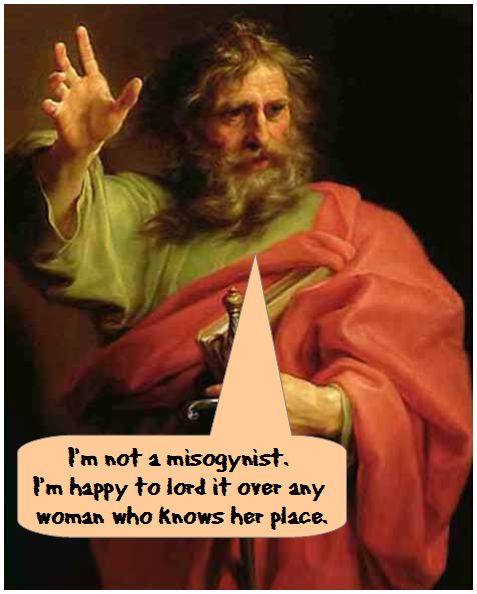
…women should adorn themselves in respectable apparel, with modesty and self-control, not with braided hair and gold or pearls or costly attire, but with what is proper for women who profess godliness—with good works… Let a woman learn quietly with all submissiveness. I do not permit a woman to teach or to exercise authority over a man; rather, she is to remain quiet… she will be saved through childbearing—if they continue in faith and love and holiness, with self-control (1 Timothy 2:9-10; 13-15).

The women should keep silent in the churches. For they are not permitted to speak, but should be in submission, as the Law also says. If there is anything they desire to learn, let them ask their husbands at home. For it is shameful for a woman to speak in church (1 Corinthians 14:34-35).

But I want you to understand that the head of every man is Christ, the head of a wife is her husband, and the head of Christ is God (1 Corinthians 11:3).

Wives, submit to your own husbands, as to the Lord. For the husband is the head of the wife even as Christ is the head of the church, his body, and is himself its Saviour. Now as the church submits to Christ, so also wives should submit in everything to their husbands (Ephesians 5:22-24).

Wives, submit to your husbands, as is fitting in the Lord (Colossians 3.18).

(Women should) be self-controlled, pure, working at home, kind, and submissive to their own husbands, that the word of God may not be reviled (Titus 2:3-5).

So according to the cult handbook, women must be –

submissive, quiet, silent, submissive, under a man’s authority, modest and… submissive. They should work at home, do nothing that might embarrass their husbands and have no authority over any men.

If a woman wants to be a Christian this is the behaviour she must assume. Above all, she must be submissive to the men God has placed above her, from her husband to… well, every other male.

What self-respecting woman is going to submit herself to this?

But wait, I can already hear liberal, enlightened Christian women approaching, all set to tell me that these New Testament admonitions are no longer relevant because they’re ‘culture bound’. They were devised, by men, in a first century milieu and therefore they don’t apply today! Which is odd, given they were applicable for almost all of the previous two thousand years, well beyond the time and context in which they were written. Not until the twentieth century, when the church’s power began to wane and women began to demand equal treatment with men, was the Bible’s misogyny questioned. Less than a hundred years have passed since women’s rights were reluctantly acknowledged by western society, even less since parts of the church caught up.

Many evangelical churches today still subscribe to the ‘commands’ of Paul and the imposters that followed in his wake. They expect their women to be silent, modest, under men’s authority and submissive. Witness the number of Christian blogs that traduce women, many written by women who regard themselves as ‘godly’ wives. Look at the frequent attacks by fellow evangelicals on female preachers like Beth Moore and Joyce Meyer, who ‘presume’ to teach men. (I can’t stand either of them personally, but not because they’re women.)

Liberal churches, however, know better. They safely consign the New Testament views of women to history; curios that provide an insight into how first century cultists thought, none of which are binding on today’s women. The world has moved on. Indeed it has; western culture has changed its views on women and their rights and roles, with little help from the church. While this is a very good thing, aren’t Christians told not to conform to ‘the world’? They are (Romans 12.2). Clearly this is yet more biblical teaching that can be ignored when it suits.

So, can you be a woman and a Christian? Evidently so, though it involves either compromising yourself as a woman to comply with the Bible’s warped ideas of what you should be and how you should behave – or compromising the Bible’s directives in order to respect and be yourself. But is compromise really what Christianity is about? Paul and his fellow fanatics didn’t seem to think so.

Can you be a Christian and… gay?

Blog391

No. You can’t. The church regards your gayness, your same-sex attraction, as sinful. If you act on your feelings you are, according to the bible, an abomination. You cannot enter the Kingdom of God if you have sex with someone who’s the same sex as yourself, not even if that’s within a committed, loving relationship:

…do you not know that wrongdoers will not inherit the kingdom of God? Do not be deceived: Neither the sexually immoral nor idolaters nor adulterers nor men who have sex with men (1 Corinthians 6:9)

Paul doesn’t mince his words in Romans 1:25-28 either:

…God gave them over to degrading passions; for their women exchanged the natural function for that which is unnatural, and in the same way also the men abandoned the natural function of the woman and burned in their desire toward one another, men with men committing indecent acts and receiving in their own persons the due penalty of their error… God gave them over to a depraved mind, to do those things which are not proper…

There’s no getting away from this: the bible is emphatic and unequivocal about how it views homosexuality and those who ‘practise’ it. There’s no ‘hate the sin, love the sinner’ here. Gay people are unnatural, degraded, indecent, dishonourable, wicked, unrighteous, sinful and more: this, Paul is clear, is how God sees it too.

Some people, however, want to be both; they’re gay and they also consider themselves to be Christians. They’ve answered the altar call/been born again/baptised into the family of God and have made a commitment to Jesus/God/the church in whatever way their particular ‘fellowship’ teaches they should. Now they’re faced with what to do about their sexuality, when the bible, and in all probability their church too, finds it abhorrent. What to do?

Not all Christians are alike, of course, and not all churches the same. Some, a scattered few, are gay affirming. They say it’s okay for you and your partner to be gay, they still welcome you and see your homosexuality as a cause for celebration: you can, they say, be gay and Christian. To do this, however, they have to find ways around what the bible says about homosexuality. So they argue that the condemnation of the Old Testament is no longer applicable and doesn’t, in any case, refer to committed same-sex relationships. They make the case that Paul is really only referring to temple prostitution and promiscuity, not to loving couples.

If they’re honest, they acknowledge that these are pretty weak arguments and resort instead to ignoring everything the bible says about homosexuality (which is actually very little) and find comfort in the fact Jesus himself doesn’t appear to have mentioned it.

There are several problems with this way of thinking:

  • If you’re going to ignore these parts of the bible, what else can safely be ignored? It’s a slippery slope, brethren, a slippery slope;
  • Dismissing the bible’s grave warnings about same-sex sex, doesn’t mean that they’re not still there;
  • you’re engaging in a form of collective cognitive dissonance in pretending they’ve somehow disappeared or are no longer applicable;
  • You’re out of step with most other branches of Christianity, nearly all of which noisily disapprove of homosexual sex, relationships and even “marriage” (note obligatory scare quotes.)

In any case, gay-affirming churches are few and far between. The chances of living close to one are remote. Chances are, you’re stuck with a common-or-garden church. Chances are it disapproves of you. Chances are it will want you to renounce your sexuality. But there’s good news! If you’ve been saved/washed in the blood of the lamb/baptised, it’s easy. Your sins are forgiven and you are a new creature: God/Christ/the Holy Spirit will free you from the shackles of same-sex attraction. Here’s how Paul puts it in 1 Corinthians 6:10-11:

And such were some of you (idolaters, adulterers, homosexuals, that is). But you were washed, you were sanctified, you were justified in the name of the Lord Jesus Christ and by the Spirit of our God.

So that’s it then. You can’t be a Christian and gay. The gay has to go.

That’s the Christian perspective anyway. I hope I’ve represented it fairly enough. I can’t help but feel there’s more to it than that, however. We’ll consider whether there is next time.

Metaphor, Hyperbole and Context

Blog387a

A moderate and self-styled ‘intellectual’ Christian told me in a online discussion recently that ‘most of the bible is metaphor’. When I asked what it was a metaphor for, he decided it was time to end the discussion. A metaphor signals a deeper or alternate meaning; the bible cannot be ‘mostly metaphor’ without there being something else – what Christians might regard as a ‘greater truth’ – the metaphor is intended to convey. So, yes, I can see that the Genesis creation stories might be interpreted metaphorically (though symbolically might be a better term) as the inclination of all humans to rebel against God… but then that’s only one of many interpretations, and not actually what the text says. If the bible is mostly metaphor then understanding what God is supposedly communicating through it becomes a matter of personal, subjective interpretation, which is why there are so many factions and sects within the Christian brand.

Similarly, when I challenged Dave Armstrong on Biblical Evidence for Catholicism, about why Christians don’t take everything Jesus said literally, he told me it’s because Jesus was fond of hyperbole and it’s the point underlining his hyperbole that matters. I knew, of course, that Jesus liked to exaggerate so I asked Dave how we know which of Jesus’ remarks are hyperbole and which are not. He declared that this was ‘obvious’. Perhaps it is, in sayings like ‘when your eye offends you pluck it out’, but it’s less apparent with pronouncements like ‘sell all you have and give to the poor’ or ‘abandon everything and follow me’. Again, it becomes a matter of subjective opinion, however learned that opinion might consider itself to be, about which of Jesus’ words are hyperbole and which are meant to be followed to the letter.

When I made this point, Dave decided that, rather than it being ‘obvious’, it actually takes years of study to know which is which: ‘It’s by studying Bible commentaries and linguistic aids, and the rules of hermeneutics and exegesis (Bible interpretation).’ Jesus as the incarnation of the God of the Cosmos, and the gospels in reporting him, could surely have made it clear. Instead, it seems, it takes armies of theologians and commentators, and years of study to work it out.

The third way Christians (of all stripes) manoeuvre around the bible’s shortcomings is to say that anything they’re keen to disregard is ‘context-bound’. There are some matters, they say, that are of their time and ancient place and are therefore no longer applicable today.

There are things in God’s timeless Word that pertain only to the time in when they were written? Who knew?

So, instructions like ‘greet each other with a holy kiss’ (which Paul advocates four times in his letters: Romans 16:16, 1 Corinthians 16:20, 2 Corinthians 13:12, and 1 Thessalonians 5:26); ‘women should always have their heads covered in church’ (1 Corinthians 11:2-16) and ‘heal the sick by anointing with oil’ (James 5:14) are now generally considered to be context-bound. This, however, creates the same problem that arose over Jesus’ hyperbole. How do we know which of the bible’s pronouncements are context-bound and which are still of significance today? Answer: we don’t.

It could be argued that, just as ‘greet each other with a holy kiss’ is a custom anchored in the first century, beliefs like

the world is populated by demons,

humans are capable of living forever,

and

incantations (that Jesus is the Saviour) work

are equally context-bound. We know categorically in the 21st century, that demons don’t exist, humans cannot live forever and magic spells don’t work. Only those in a pre-scientific age, dominated by superstition, thought so (together with those today who buy into these same ancient beliefs.)

Once believers start claiming – and it’s Christians themselves who do this – that significant parts of the bible are metaphor, hyperbole or are context-bound, then they’re acknowledging that the bible frequently makes little sense, and that significant portions  lend themselves to whatever interpretation suits the individual reader. Some parts can even be dismissed altogether, which is precisely what Christians do with them (how many Christians do you know who believe they can move mountains or heal the sick by laying on of hands?) What this shows is that they don’t really believe the bible is God’s Word, either in the literal, evangelical sense, nor in a moderate, quasi-intellectual way.

In practice, even to most Christians, the bible is a book of no particular merit.