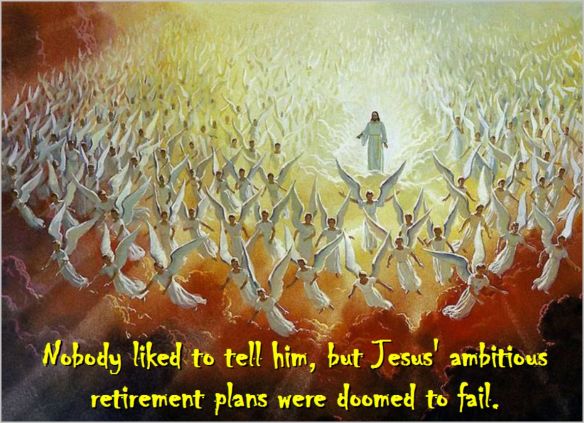
The original ‘good news’ had nothing to with any mystical salvation plan (part two)

Disciples2

Last time, I provided evidence that Jesus’ original ‘good news’ had nothing to do with any mystical salvation plan constructed around his supposed resurrection. My six references demonstrated that, even after his death, the disciples adhered to Jesus’ original message: God’s Kingdom was coming soon and they were going to rule over it. Here are six more reasons we can be sure this was the case:

7. Our earliest sources, Q and the gospel of Mark, do not give much credence to the resurrection as an actual event: Q records no sayings of the risen Jesus and Mark has no resurrection appearances; it ends with the women who discover the empty tomb deciding not to tell the disciples about it. In Mark’s gospel, then, the disciples are not even aware the tomb is empty, let alone that Jesus has returned from the dead. We can conclude from this that the community that produced Mark’s gospel, the supposed resurrection was not significant in and of itself.

8. Paul tells us that the disciples’ gospel was not the same as his, despite the fact he too believed the Kingdom wasn’t far off (1 Thessalonians 4:17). The disciples, he says in 2 Corinthians 11.4-5 and Galatians 1.6; 2.11-21, were preaching ‘a different gospel’. Different from his, certainly, but the same as the ‘good news’ Jesus proclaimed: Jewish people should prepare for the imminent arrival of God’s Kingdom on Earth (Mathew 9.35; 15.24), when, as Jesus himself had promised them, the disciples would judge the restored tribes of Israel and rule over them. It is, as we have seen, out of the question that they would jettison this aspect of the ‘good news’, given to them by Jesus himself.

9. Because the disciples – and Jesus’ brother James – saw the new Kingdom as intended for Jews only, as Jesus had before them (Matthew 10.23), they insisted that any Gentile converts must be circumcised; must become Jewish (Galatians 2.7). Paul, of course, objected to this requirement and throws tantrums about it in his letters (Galatians 5.1-12; Philippians 3.3). But like Jesus, the disciples saw no place for Gentiles, the unrighteous, in the new age; those who didn’t convert would, of necessity, be dispatched to eternal punishment (Matthew 25.31-46).

10. As far as the disciples were concerned, therefore, it was entirely for their own good that converted Gentiles be circumcised (Galatians 6.12-13) as this was their only guarantee of a place in the new Kingdom. What this tells us is that a salvation formula, such as that dreamt up by Paul, had no part in the disciples’ ‘good news’.

11. Wherever they appear – in Paul’s writing, the gospels, Acts – the disciples are portrayed as being at odds with an incantational, faith-based Christianity. The Bible attests, even with Paul’s new religion superimposed, that they held to a different gospel, a different sense of what Jesus’ life meant and a different notion of their place in the coming Kingdom. And wouldn’t they be the ones to know? They knew Jesus, spent time with him, listened to his teaching, bought into his misguided mission and had sufficient understanding of it to spread his ‘good news’ to fellow Jews, both while he was still alive and afterwards (Matthew 10.23; Luke 9.1-2).

12. The New Testament is testimony to the failure of everything Jesus and the disciples stood for; their ‘news’ that God was soon to turn the Earth over to the meek and that they would then rule the only people who mattered, the twelve tribes of Israel, with everyone else thrown into outer darkness (Luke 13:28). Jesus himself, of course, would return at some point to be top dog, God’s representative on Earth – his anointed one. None of this happened.

If only it had been allowed to rest there, we might not know today of Jesus and his mad ideas. Instead, Paul stepped in, reinterpreted the whole ridiculous enterprise and bequeathed the world a set of different but equally absurd beliefs. And the rest is history: religious wars, pogroms, inquisitions, suppression, superstition, clerical child abuse, Pat Roberston. Is this the Kingdom that Jesus and his closest associates foresaw? Decidedly not. But it is their legacy.

The original ‘good news’ had nothing to do with any mystical Salvation Plan™


Pentecost

As I discussed last time, there are indications throughout the New Testament that Jesus’ original ‘good news’ had nothing to do with a mystical salvation plan. There are clues too that the disciples clung to this original message – they’d heard it from Jesus himself, after all – even as other interpretations began to supersede it.

Let’s take a look at the evidence:

  1. Jesus tells his chosen twelve, which includes Judas, that they will rule with him in the age to come (Matt 19.28). As Bart Ehrman points out1, the fact that Jesus evidently had no foreknowledge of Judas’ later betrayal means this promise undoubtedly goes back to Jesus – it is unlikely later believers would have made it up. Though their names vary between gospels, Jesus hand-picked twelve men to rule with him.

  2. He appoints twelve disciples quite specifically and later tells them privately that this is so they can judge and each rule one of the twelve tribes of Israel once God’s Kingdom arrives (Luke 22.30).

  3. When Judas kills himself, the remaining eleven disciples think it vital to appoint a replacement twelfth (Matthias, in Acts 1.21-26). The number remains significant to them. How would they be able to rule the twelve tribes of Israel if there were only eleven of them? There had to be twelve for this very purpose. Even after Jesus’ death and supposed resurrection, the disciples are still preparing for the end of the age he prophesied and for their positions of power in God’s Kingdom.

  4. By the time the synoptic gospels were written, Jesus secret teaching that the Twelve would rule alongside him in the new kingdom had become common knowledge (hence its inclusion in the gospels). Given that he told them in private they’d be judges and rulers, it can only have been the disciples who later broadcast this information. And why would they do this? Because it was an integral part of their good news. Furthermore, all three synoptic gospels include a range of episodes in which the twelve are castigated for their presumption (eg: Mark 10.37-41; Matthew 20.22-24; Luke 22.24-30). These have all the hallmarks of stories created later, when a different ‘good news’ was emerging, specifically to mock the disciples’ belief.

  5. In much the same way, the disciples are consistently depicted as having no real understanding of Jesus’ mission (Mark 9.30-32; 10.35-45). And they don’t, in that they have no understanding of the later reinterpretation of Jesus’ significance. How could they? By the time the gospels came to be written, the mystical-Christ version of Christianity had started to take hold. Paul’s salvation plan and the supposed resurrection were beginning to assume greater importance than Jesus’ original message. How could the disciples, 40 years earlier, have known that this was going to happen? How could Jesus? They have to be portrayed as being largely ignorant of later developments – developments which, in any case, they opposed when they did encounter them (Acts 9.26; Galatians 1.6; 2.11-14; 3.1-3).

  6. In fact, Jesus teaching – all of it – was predicated on his belief that the Kingdom of God was ‘at hand’, imminent, about to happen real soon (Mark 1.15; 9.1; 13.30; Matthew 10.23; 16.28; 24.34), and that when it did, he and his chums would be there ruling it. It is unthinkable his inner circle would abandon this teaching, even after he died, in favour of something else. Any visions they had of him returned from the dead would only have reinforced their commitment to his ‘good news’; resurrection, after all, was a sure sign of the Kingdom’s arrival (Daniel 12.2-3).

To be continued…

1 Ehrman, Bart D., The Lost Gospel of Judas, p146

Suffer the Little Children

Jesus said to them, “Let the little children come to me, and do not hinder them, for the kingdom of God belongs to such as these.” Mark 10.14

…the very hairs of your head are numbered. Fear not: you are of more value than many sparrows. Luke 12.7

Jesus+kid

Recently, I attended the funeral of a little boy who died of the cancer he’d suffered from the time he was nine months old. His young parents are friends of mine. They showed their son such incredible love during his illness, ensuring he received the best medical care possible.

But where was God through it all? The God that Christians say has a special affinity for children, who loves them and cares for them? The God who looks after ‘the little people‘?

That God was nowhere. He showed no interest in this particular ‘little person.’ No concern and no compassion for him or his parents. Of course, that’s because he doesn’t exist, though this didn’t stop Christians telling the family how marvellous and caring and loving he is.

Really? If I had any vestige of faith left, what has happened to this innocent during his short life would have cured me of it entirely. And make no mistake, he was innocent, not a sinner (as if that would let God off the hook.) A deity who allows a baby to have cancer and to die after fourteen months of prolonged, invasive treatment would be a callous, worthless bastard. But we knew that already.

Had there been a God who cared, this little boy would’ve been two today, Easter Sunday.

The disciples would not have died for a lie (part one)

SonOfMan

The disciples would not have died for a lie, or so Christians like to argue.

Would they not?

Fanatics today do and it is more than likely the disciples believed their lie was true, if indeed they died for it at all. There’s not much evidence that they did. But if they did, maybe the lie they believed to be true was not the one today’s Christians think it was.

There is no evidence anywhere that Jesus’ original followers were martyred because of their faith in a physically resurrected Jesus – for their beliefs, maybe, but not necessarily because they believed Jesus had returned in bodily form from the dead. On the contrary, the evidence suggests that they holed up in Jerusalem to await his return through the clouds as the Son of Man, with a phalanx of hostile angels by his side (Heaven was, after all, just on the other side of those clouds). This was the crux of their beliefs.

How do we know?

There was significant tension between the disciples and Paul, which Paul himself relates, not only because he was convinced his message should be taken to the Gentiles but because of the very nature of that message. Paul and the disciples meant different things by ‘the gospel’. Paul’s irritation that others were preaching a different gospel is apparent in 2 Corinthians 11 & 12 where he calls the original disciples, ‘false apostles, deceitful workers, disguising themselves as apostles of Christ’ and bitterly refers to them as ‘the most eminent apostles’. He is arrogant enough to suppose, and to proclaim, that he has it right and they are wrong.

Paul’s good news was about the resurrected Christ of his visions, who magically made those who put their faith in him righteous in God’s eyes. As he puts it in 2 Corinthians 5:21, ‘God made him who had no sin to be sin for us, so that in him we might become the righteousness of God.’ Paul also believed this supernatural being would soon descend from the skies when he would give believers new bodies (Philippians 3.20) but this is a very different figure, and agenda, from the Jesus known to the disciples.

What then of Paul’s insistence, in 1 Corinthians 15.5 (written circa 55CE), that ‘the Twelve’ experienced the Risen Christ in much the same way he did? Firstly, of course, we have only Paul’s word for this. We have no first-hand corroboration (just the opposite in fact) and Paul had a vested interest in showing how significant his own experiences were. What better way to do so than by claiming Jesus’ original followers had had the same sort of hallucinations? Secondly, we don’t know what these ‘visions’, if they had them, meant to the disciples. Their belief would undoubtedly have been in a physical, bodily resurrection (cf: Daniel 2.12; Matthew 27.52), not in the beam-of-light manifestation of hallucination; this was much more Paul’s thing. Perhaps this is why any words uttered by vision-Jesus (for surely he would have spoken to his old chums) were not considered significant enough to be included in the earliest written record, ‘Q’.

The fully-realised resurrection appearances found in the gospels, then, in which Jesus declaims ‘blessed are they that have not seen, and yet have believed’ and ‘go and make disciples of all nations,’ are very clearly later developments, based, not on Q but on the visions suffered by Paul and others of influence and ‘written back’ into the gospel accounts.

Despite claiming that the Twelve experienced the Risen Christ in much the same way he did, Paul is critical of the disciples for preaching a different gospel, a different Jesus even, from the magical salvation-formula gospel he expounds. So what did the disciples believe – what was this other gospel that Paul disparaged so much?

We’ll see next time.


How not to love your neighbour

preachersImagine: a group of health-fascists set themselves up on a soap box in the city centre from where they lambaste everyone going past, with language that is abusive and demeaning, about the poor state of their health, their out-of-condition bodies and that many of them are  significantly over-weight. But, the speakers insist, a bottle of a magic potion they just happen to be selling will solve all their health problems overnight! All anyone has to do is commit to swallowing some every day for the rest of their lives.

Unsurprisingly, people are upset about this; they’ve come to town for all sorts of reasons, but not to be lectured about their health and size, which, for most of them are both perfectly fine. Some of these folk challenge the snake-oil salesmen, shouting back at them (not having the benefit of a tannoy system) and demanding to know what gives them the right to harass passers-by. In response, one of the salesmen pulls out a copy of last Tuesday’s Daily Mail; ‘it’s all in here,’ he declares, ‘all in black and white, and we believe it. The Daily Mail wouldn’t lie to us. Its Word is Truth. So get your magic potion now before it’s too late, ya depraved, ignorant slobs!’

Acceptable or not?

While you think about – if you even need to – the picture above was intended to accompany the previous post. It shows street preachers Michael Overd, Michael Stockwell and Adrian Clark before their trial for ‘public order offences’, which started last week and concluded on Tuesday this week. I felt it couldn’t be used while the trial was ongoing (contempt of court and all that) and so had it replaced with one of rabid American nutcase Franklin Graham.

Two of the three preachers, Overd and Stockwell, were found guilty and fined. Naturally, there’s an outcry from Christians and assorted fruitcakes everywhere about how the two have been denied their freedom of speech (though there is no protection of free speech under UK law) and how – oh calamity! – it’s no longer possible to ‘preach the gospel’ in the Britain. Absolute nonsense, of course, and while some more liberal commentators feel the case should never have reached the courts (let the nutjobs condemn themselves by spouting in the streets, suggests one) an example has been made of people who think the way to show love for your neighbour is setting out, in the judge’s words, to ‘insult, humiliate, demean (and) belittle’ them in public using a loud speaker in a shopping centre.

As Andrew Calibre pointed out in the previous post, haranguing and provoking people like this has nothing to do with love, nor is it ‘the gospel’. Shouting, as Overd did, about how your neighbour is ‘depraved and ignorant’ and how those who have sex outside marriage and gay people (of course) are ‘filthy, depraved and perverted’ is not, by any stretch of the imagination, ‘the good news’.

Perhaps the confusion is understandable when the Bible and God’s people™ are so muddled themselves about what ‘the good news’ actually is; God’s Kingdom arriving on Earth, as Jesus seems to have thought? Paul’s magical salvation formula? Or maybe it’s that there’s a free pass to heaven? One thing’s for sure, verbally abusing your neighbours and other strangers it isn’t. Even if street preachers justify their arrogance and rudeness by claiming they’re only conveying what (they think) the Bible says – so what? Their tawdry little book has no more authority than any other collection of ancient (or modern) fantasy, prejudice and supposition.

So, no, it’s not acceptable that hypothetical, self-appointed health experts verbally abuse strangers in the street. And as the court ruled this week, nor is it when religious zealots do the same. Passers-by and by-standers have every right to feel irritated, annoyed and offended, just as Christians would be if a group of Muslims propounded their beliefs with the same aggression, informing all and sundry how wicked they are and how they are destined to spend eternity in whatever hell Islam envisages. Nor would ‘we’re only preaching what the Qu’ran teaches’ be any justification.

But the issue isn’t only the irritation that people feel when religious extremists abuse them. It’s the one in a hundred, or whatever the percentage is, who takes them seriously, accepts the confederate’s tract, shows interest and is ultimately sucked into one of the many versions of the mind-numbing Jesus cult. Far worse than selling people magic potions, or insurance they don’t need, there is something obscene about cranks taking to the streets to recruit the gullible and unsuspecting to their (lost) cause. We wouldn’t tolerate it if it were anything other than religion, why should we accept it when it is? The prosecution of presumptuous con-artists does us all a service.


What’s Love Got To Do With It?

franklinA guest post by Andrew Calibre.

So there’s this smart-arse who thinks he’ll catch Jesus out by asking him a tricky question like, is it true microbes cause illnesses? Or, is Ken Ham right that the universe is only six thousand year old? But he bottles it, maybe ’cause he knows JC won’t have a clue what he’s talking about, and asks him an easy one instead – simple stuff about Jewish rules or something. “What is the greatest commandment?” is the best he can come up with (Matthew 26.32-40).

Jesus takes his chance and says, “Love the Lord your God with all your heart and with all your soul and with all your mind.” Predictable or what, even if he does make a big mistake: whoever heard of ‘the mind’ having anything to do with religion! Still, JC can’t resist elaborating on it. “This is the first and greatest commandment,” he says, as if everybody round him doesn’t know that already when it’s in their old magic book (Deuteronomy 6.5). He’s on a roll now and on he goes: “And the second is like it: ‘Love your neighbour as yourself.’ Clearly a cock-up, but there’s no stopping him: “The whole bloody religion” – he’s talking about the Jewish stuff, not the Christian fantasy that he knows nothing about on account of it not being invented yet – “is about these two things, nothing more,” he says.

Christ! How could he have got it so wrong? Love your neighbour as yourself! Whoever heard such crap? I know, a nice idea, but I ask you. Everybody knows that being religious, being a Christian, is about believing the right stuff (having the right doctrine, I think it’s called), trashing other Christians who believe the wrong stuff, and dumping on everybody else, specially if they’re sinners (and they’re all sinners), foreigners, LGBTI or transgender. Now that’s real Christianity. I know it is, because that’s how Christians do it, and they’re the ones who should know.

Apart from Jesus, nobody thinks loving others like you love yourself is a good idea. Even he wasn’t very good at it (Matthew 15.22-28 etc). What ‘your neighbour’ is for, is pointing out how sinful/lost/degenerate they are, how they’ve f**ked up their lives, how God’s going to punish them for all eternity for not being the same as you and how they’re just about single-handedly bringing about the end of the world on account of being so perverted/evil/foreign.

That’s how you love your neighbour! You can’t even claim to be loving them properly unless you’re telling them about Jesus, over and over again, and, in the process, denigrating, dismissing and damning them to hell over and over again. This is what truly loving your neighbour is about! I know because Christians say so endlessly: ‘you’re only really loving others if you’re telling them what shite they are and how they need Jeeesus to wipe it all away.’ So, okay, this isn’t exactly how you love yourself, but what’s that got to do with it?

If only Jesus had listened to his mouthpieces today. They know far more than he did about what’s important.

And love it isn’t.


Faith by any other name (is still a waste of time)

celia3Faith; the brand name for ‘wishful thinking’. In what other area of life, other than the religious, do we have faith in faith? Christians like to say we do – we have faith, they say, in the pilot who’s controlling the aircraft we’re flying in, or we have it in the surgeon who’s operating on us. But this is not faith in the sense religious people usually use the term. ‘Faith’ in pilots, surgeons and even our own abilities is more like trust or confidence; trust that the pilot is qualified to fly the plane, confidence that the surgeon is trained and skilled or that we have the ability to complete the task we’ve set ourselves. This is not faith in the sense of ‘belief in things that can’t be seen and for which there’s no evidence’. It’s not faith in the sense of wishing and hoping there really is a God and that he cares enough about us to grant us eternal life, much in the manner of the magic fountains and wish-granting genies of folk tale.

Religious faith – Christian faith particularly – is of this latter kind. It’s not trust in a real person’s capabilities, be it our own or a specialist’s. It’s a blind belief in a God who evolved from being one tribal deity among many into the everlasting, omniscient creator of all things. A God who, if he did create everything, set us on the Earth together with viruses, microbes, infections, disease, sickness, cancer, AIDs and Alzheimer’s. A God who thought putting us in an environment so frequently hostile to our well-being on an insignificant planet in the corner of a vast and indifferent universe was just the right place for us.

This is a God who doesn’t seem to understand us but who is swift to punish us while he himself stands by as half of his favoured creation endures poverty, starvation and the cruelty of much of the other half. His ways are not our ways, believers say, making what they surely know is a flimsy excuse – the flimsiest – for his failure to interact with us in any meaningful way.

Faith is the wishful thinking that despite the evidence, this neglectful, capricious God really does care for us. He cares so much he has devised an illogical, incomprehensible plan (or two) that, with its blood sacrifice and magical overtones, we must believe if we want his forgiveness for the way he made us in the first place.

We need to have faith that this cosmic madman will bring us back to life us after we’ve died and take us to Heaven to live with him, but we must first have the right sort of belief, even if it’s difficult to work out what that is. Faith is necessary for all of this because there isn’t a scrap of evidence anyone has ever been returned to life after they’ve died, or that Heaven exists, or that anyone has ever gone there. That’s why it takes, not trust, but a great wallop of wishful thinking that this fantasy is not only real but more real than the reality in front of us.

As for me, I can’t believe any of it.

  – I can’t believe the claims of those who even today say they’ve seen or heard from God or Jesus or Mary, who reckon they’ve had visions the same way Paul or Peter, Joseph Smith or Mary Baker Eddy did.

  – I don’t believe those who say they almost died and went to Heaven, because what these visions of fantasy figures and make-believe places have in common is that they take place, so far as they occur at all, entirely within people’s heads.

  – I won’t believe that those who say all of this magic, hallucination and mumbo-jumbo is true because it’s in the Bible, when the creators of that book were men far more ignorant and superstitious than any reasonably educated person today.

  – I am unable to believe muddled nonsense that is designed to appeal to our vanity and fear of obliteration.

  – And I really don’t care that some say they get comfort, joy and morality from their belief; their morality no more derives from God as mine does from Superman and emotions don’t make any of it true.

So, faith – what good is it? If your answer is it enables you to believe the impossible, then isn’t it just another word for delusion?


Have Faith

reason

So there we were in court. First time I’d been on a jury. Pretty serious case too. If it went against the defendant, he’d be facing the death penalty. So I suppose it was pretty serious for him too.

First up was the arresting officer. ‘Oh, yes,’ he said. ‘I have every faith this guy’s the culprit.’

‘How much faith?’ said the judge. ‘Is it real, deep-down, sincere faith?’

‘Oh, yes,’ said the cop. ‘Really unshakeable, supernatural faith. That’s him okay. We’re not looking for anyone else. Genuine conviction, you see.’

‘Yes, I do see,’ the judge said. ‘And very commendable it is too.’

‘But…’ spluttered the guy in the dock.

‘Wait your turn,’ the judge snapped. ‘We gotta hear the expert testimony before we get to you.’

The expert took the stand. ‘I believe it was this guy,’ he said, pointing to the man in the dock. ‘Yes sir, I’m sure it was. I have a really good feeling about it. This is him, definitely.’

‘You really, really truly believe?’ the judge asked and the expert nodded. ‘Well, that’s good enough for me,’ the judge said. ‘So… anybody got anything to add before I pass sentence?’

‘Er, yeah,’ said he guy in the dock. ‘What about the evidence?’

‘The evidence?’ said the judge. ‘Who needs evidence when we’ve got all this belief, faith and deeply held conviction?’

‘Well,’ the guy said, ‘far be it from me to say so, but isn’t the evidence important?’

‘Important?’ snorted the judge, resulting in guffaws all around the courtroom, including from my fellow jurors.

‘Yes,’ said the accused. ‘Important evidence like my watertight alibi. Like the DNA and finger prints that weren’t mine. Like the CCTV footage. Like… that other guy’s confession.’

‘Oh, come on,’ said his defence lawyer jumping up. ‘We’ve been over this. It means nothing. What’s really important is what people believe. Faith, like the officer here said.’

‘Well,’ said the guy in the dock, ‘I have my doubts about that.’

‘Oh, but doubt is of the devil,’ said his lawyer, ‘It’s faith that matters – faith and right belief.’

‘That hardly seems reasonable to me,’ said the man. ‘After all, it’s my life that’s on the line here.’

‘Now you’re just being absurd,’ said the judge. ‘What has reason got to do with anything?’

‘But I thought…’ began the accused, looking more perplexed than ever.

‘We’re none of us here to think,’ said the judge, ‘least of all you. How many more times must we tell you? Faith is all that matters.’

‘Well,’ said the defendant doubtfully, ‘if you say so…’

‘Great!’ said the judge, jumping in quickly. ‘I’m glad you’ve finally seen the light.’ Then he turned to us, the jury, and said: ‘I’m going to direct you to find the defendant guilty. The belief and faith of those here today is all we need to convict him.’

So we did, and the judge passed the death sentence. The condemned guy didn’t seem too pleased and as they led him away, started yammering all over again about evidence. I guess some people never learn. But I mean, faith, belief, conviction – call ’em what you will – they trump evidence any day.