Answers to this year’s all-new Christmas Quiz

saving-christmas-posterGod save us all from this, this Christmas time.
1. Where does the word ‘Christmas’ come from?
The answer is b, the name comes from the Catholic Mass held on the supposed date of Jesus’ birth. So all you anti-Catholic Christians need to find a new name for it fast.

2. When was Christ born?
a) is the answer here: Christ wasn’t born. Maybe Jesus was, but ‘the Christ’ is an invention of later Christians (Paul, for example, in Romans 8.3 and John’s gospel, written up to a century after Jesus lived.) The Christ is a mythic, supernatural being who’s always existed. He bears little relation to the itinerant Jewish preacher Yeshua who wasn’t born on 25th December or in the year 0.

3. Which gospel writers didn’t think the nativity story worth including in their accounts?
Mark and John (b & c) don’t bother including it. Did they not know it? The two gospels that do have bits of the story – Luke and Matthew – contradict each other.

4. How well attested are the events surrounding the birth in historical documents of the time?
a) Not at all. You’d have thought the Romans, who were pretty good at keeping records (lots of which have survived) would have noted Herod’s massacre of little boys or the appearance of a new, magic star in the sky – they were, after all, a superstitious lot. Not even Josephus, who, in the late first century, acknowledges the existence of Christians, sees fit to mention any of it.

5. Following the miraculous events of Jesus’ birth, what did Mary do?
According to Luke 2.19, she treasured them in her heart. However, the answer is c) because only a few verses further on, she hasn’t a clue about what her son is up to (Luke 2.48). Later still, she is part of the family’s efforts to ‘restrain him’ (Mark 3.21 & 31). Why, on these occasions, doesn’t she recall his miraculous beginning and think, ‘oh yes, I remember now. He behaves like a lunatic because he’s the son of the Most High.’ She certainly didn’t write down the details of his miraculous birth for later use in the gospels. No-one did. On account of them not really happening. Just sayin’.

6. How many times does Jesus refer to his miraculous birth?
a) Never. Strange that.

7. How many times does the rest of the New Testament refer to Jesus’ miraculous birth?
c) Never, even more strangely. Evidently the story hadn’t been invented when the rest of the New Testament was written.

8. When did Christians first start celebrating Christmas?
a) hundreds of years later.

9. Which of these Christmas traditions originate in the Bible?
None of them. Despite what Kirk Cameron might think, Christmas trees, kissing under the mistletoe and giving presents all have pagan origins. The giving of gifts did not come about because the wise men did it first. The tradition pre-dates Christianity.

10. Which of these groups has benefited the most from Jesus’ birth?
Yes, you’re right; none of them. Not women, not black people and not LGBT people. Christianity has a history of oppressing all three groups.

Speaking of which…
11. What does Pastor Steven Anderson want for Christmas?
c) he’d like to see the execution of all homosexuals so that AIDS – which, as far as the reverend understands it (I use the term loosely) only gay people get – might be wiped out. Peace and joy to you too, Stevie.

12. How will Christians celebrate Christmas this year?
The answer is a, b and c: by fighting the War On Christmas, putting the Christ back into Christmas and by telling us that Jesus is the Reason for the Season. Just like they do every year. As you can see, Kirk Cameron’s disaster of a movie, Saving Christmas, has two of these blessed clichés on its promotional poster alone.

So how did you do?
If you scored –
between 10-12: well done. Betcha don’t believe in Santa Claus either.
Between 7-10: your cynicism needs a little work. Order my book for Christmas – it’ll help.
Between 4-6: oh dear. You’re new around here, aren’t you. There’s hope for you though, so stick around. Oh yeah, and order my book for Christmas – it’ll definitely help.
Between 1-3: Like Christmas, you are in need of saving, my friend. May the scales fall from your eyes this holiday period. Amen.


This Year’s All-New Christmas Quiz!

SantaBack by popular demand (well, mine anyway), try this year’s all-new Christmas quiz!

Answers in the Bible or not, as the case may be. Real answers next time.

1. Where does the word ‘Christmas’ come from?
a) the Bible
b) the Catholic Mass held on the supposed date of Jesus’ birth
c) the Greek, meaning to pull the wool over people’s eyes

2. When was Christ born?
a) he wasn’t
b) 25th December
c) in the year 0

3. Which gospel writers didn’t think the nativity story worth including in their accounts?
a) Luke
b) Mark
c) John

4. Following the miraculous events of Jesus’ birth, what did Mary do?
a) she remembered them all in her heart
b) she wrote them down for later use in the gospels
c) she forgot all about them

5. How many times does Jesus refer to his miraculous birth?
a) never
b) twice
c) he doesn’t shut up about it (well, would you?)

6. How many times does the rest of the New Testament refer to Jesus’ miraculous birth?
a) repeatedly, showing how important it was
b) only when making an important theological point
c) never

7. How well attested are the events surrounding Jesus’ birth in historical documents of the time?
a) not at all
b) quite substantially
c) as you’d expect when mass murder and strange astronomical events are involved, they’re mentioned everywhere

8. When did Christians first start celebrating Christmas?
a) hundreds of years after the event
b) not long after Jesus died
c) immediately

9. Which of these Christmas traditions originate in the Bible?
a) Christmas trees
b) kissing under the mistletoe
c) giving presents

10. Which of these groups has benefited most from Jesus’ birth?
a) women
b) black people
c) LGBT people

11. What does Pastor Steven Anderson want for Christmas?
a) his two front teeth
b) peace and joy
c) the execution of all homosexuals

12. How will Christians celebrate Christmas this year?
a) by fighting the War On Christmas
b) by telling everyone that Jesus is the Reason for the Season
c) by putting the Christ back into Christmas


Picture from memegenerator.net


It’s a Miracle!

MaryDo you believe in miracles? Do they happen? Author Eric Metaxas thinks so. He says so in his new e-book, Miracles: What they are, why they happen and how they can change your life.

He also says that anyone who doesn’t believe in miracles is closed-minded and intolerant, which is his Christian persecution complex speaking. Metaxas and other believers who accept unusual events as miracles are, apparently, ‘open-minded’, while the sceptic who looks for a rational or scientific explanation isn’t.

But isn’t the reality the opposite of this? Isn’t the seeking of rational explanation and analysing the evidence, the open-minded, imaginative act? And isn’t blindly accepting on faith that a particular event is the Christian God (naturally) messing about with ‘the laws of physics’, the closed-minded, unimaginative response? By definition, closing down all other possible explanations is the closed-minded response. It takes no imagination, no being open to possibilities, to refuse to look for an explanation beyond ‘God did it.’

As I’ve said before, most miracles are, in any case, very mundane, trivial affairs. They’re never the regrowing of severed limbs, the eradication of Ebola or the holding back of a tsunami. Why not? Why are ‘miracles’ always so unimpressive, like the ‘inner healings’, visions and coincidences Metaxas writes about? Why do they have far better scientific or rational explanations than supernatural ones? And when it comes to it, why do we more often hear about miracles than see them for ourselves? Why are most miracles nothing more than hearsay, rather like ghost sightings? It’s uncanny how miracles always happen to someone else, who swears they really happened just as they describe them (this is where the exercise of imagination comes into play.) The miracles in Metaxas’s book seem to be just this; second hand accounts of largely unspectacular coincidences and hallucinations, none of which happened to the author himself nor were witnessed directly by him. Why should any thinking person accept such spurious testimony? Why indeed should we be ‘tolerant’ of such woolly wishful-thinking?

If, for you, second-hand reports of unremarkable events qualify as miracles, then so be it. Like Eric Metaxas, you should just close your mind and accept. But don’t tell those of us who are considerably more sceptical that we’re the ones who aren’t open-minded or tolerant.


The picture above was originally used as a billboard by St. Matthews-in-the-City Church in Auckland, New Zealand. The captions were added later, though I don’t know by whom.


Who Ya Gonna Call?

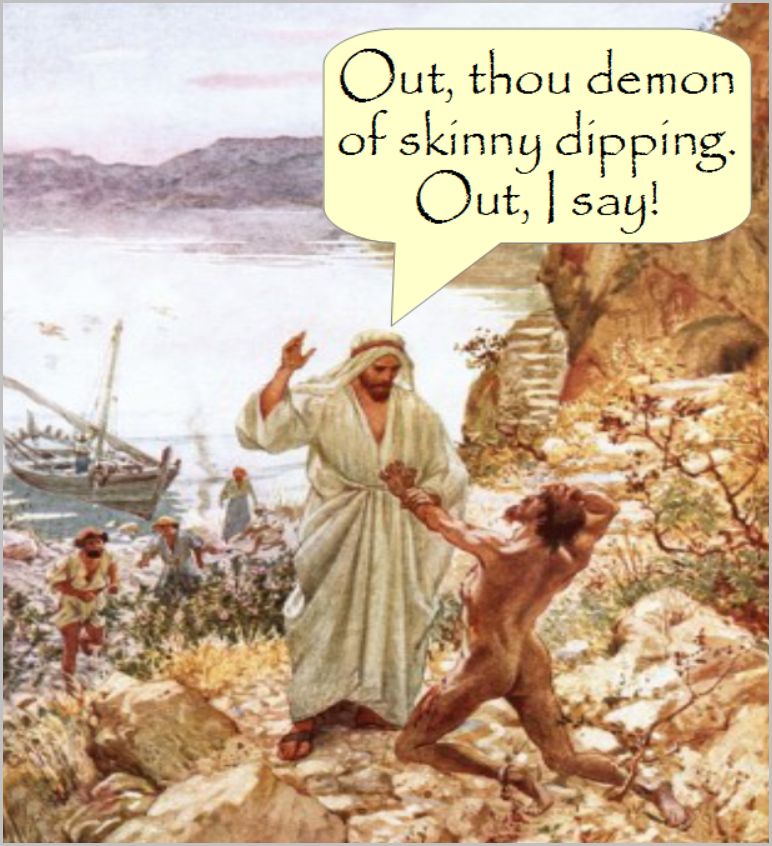
DemonAnd when they came to the crowd, a man came up to him and, kneeling before him, said, “Lord, have mercy on my son, for he is an epileptic and he suffers terribly. For often he falls into the fire, and often into the water. And I brought him to your disciples, and they could not heal him.” And Jesus answered, “O faithless and twisted generation, how long am I to be with you? How long am I to bear with you? Bring him here to me.” And Jesus rebuked the demon, and it came out of him, and the boy was healed instantly. (Matthew 17.14-20)

Do you believe in spirits and demons? When you’re ill, do you visit the nearest exorcist or do you take yourself off to the doctor or hospital? Of course, most Christians (but by no means all) have more faith in the medical profession than they do in the wingnuts who’d tell them their ailment was the result of demonic activity and command the demon to leave in the name of Jesus.

Why? Because, even Christians know, in spite of what they might tell you, what causes disease and illness. They know what cures them too; and it has nothing to do with Jesus. ‘The Son of God’ is among the wingnuts when it comes to believing unclean spirits are at the root of human ailments and behaviour (Mark 5.1-8; Matthew 8.28-34; Matthew 12.43-45; Luke 4.33-36; Luke 8.29 etc.)

In spite of the fact there’s absolutely no evidence that demons exist, Jesus thought that invisible supernatural creatures were responsible for conditions like epilepsy. Like everyone at the time he thought that if these unclean spirits could be driven out, then the condition would be ‘cured’. Some follow in his misguided footsteps today; the Catholic church has an entire coven of exorcists, and charlatans like the Reverend Bob Larson make a living driving out the demons of pride, lust, homosexuality and greed from stooges and the gullible (except of course they don’t.)

If you’re a Christian, you should believe in demons and unholy spirits; you believe everything Jesus uttered was true, don’t you?

Of course, Jesus was a product of the pre-scientific era in which he lived; his ignorance might be excusable if it wasn’t offered up as God’s Truth. All that Jesus’ belief in devils and unclean spirits demonstrates is that he was very much a man of his time – evidence, if more were needed, that he wasn’t remotely divine. Unless, of course, the God he also believed in was as ignorant of the causes of illness and human behaviour as he was.

But next time you’re unwell, Christian, or you’re feeling a mite greedy or lustful, don’t go to the doctor’s. Don’t even ask the Lord for forgiveness. Have a little faith and, in the name of Jesus, command that hell-spawned demon within you to leave. See how that works out for you.


Update: New this week in ‘It Can All Be Blamed On Demons’:

Right-wing American broadcaster, Bryan Fischer, claims unarmed black teenager killed by cop was in fact possessed by a ‘homicidal demon’.

Tele-evangelist Pat Robertson asserts playing Dungeons and Dragons leads to demon possession.

Thank you, Lord, for your endorsement of fantasist rubbish like this.


Banned from the Kingdom of God

PaulHere’s ‘Saint’ Paul’s list of those who won’t be allowed in God’s Kingdom:

Do you not know that the unrighteous will not inherit the kingdom of God? Do not be deceived; neither the immoral, nor idolaters, nor adulterers, nor sexual perverts, nor thieves, nor the greedy, nor drunkards, nor revilers, nor robbers will inherit the kingdom of God. (1 Corinthians 6. 9-10)

We can do better than that though. Who else could we add? How about the self-righteous? The converted? The born-again? The saved? Fundamentalists? Evangelicals? Evangelists? Ministers, bishops and popes? Christians of all stripes and persuasion? Will they all make it into the Kingdom?

No, they won’t. Not one of them will enter the magic Kingdom.

Why not?

Jesus, Paul and other New Testament writers were sure that the Kingdom of God would be arriving on the Earth soon. That’s ‘soon’ as in their own time, 2000 years ago*, and, as you’ll have noticed, the Kingdom, promised in the past for the past, never arrived. It’s not going to now either; neither Jesus nor Paul thought their fantasy was going to materialise some time in the distant future.

More than this, both were wrong that God was preparing to establish a heavenly kingdom on Earth at all. They were religious fanatics caught up in the religious zeitgeist of their day, religion being all they had to explain life, the universe and everything. Their interpretation was wrong on so many levels – but they were stuck with it. And so, when so much seemed unjust, unfair and unreasonable to them, Jesus in particular felt sure the only solution was for God to intervene to set things right; the meek would inherit the Earth, those last would be first and the first last. It was a dream, a vain hope, a complete invention. Not only did the Kingdom not arrive when Jesus and Paul said it would, it was never going to. There was no God waiting in the wings to make everything better.

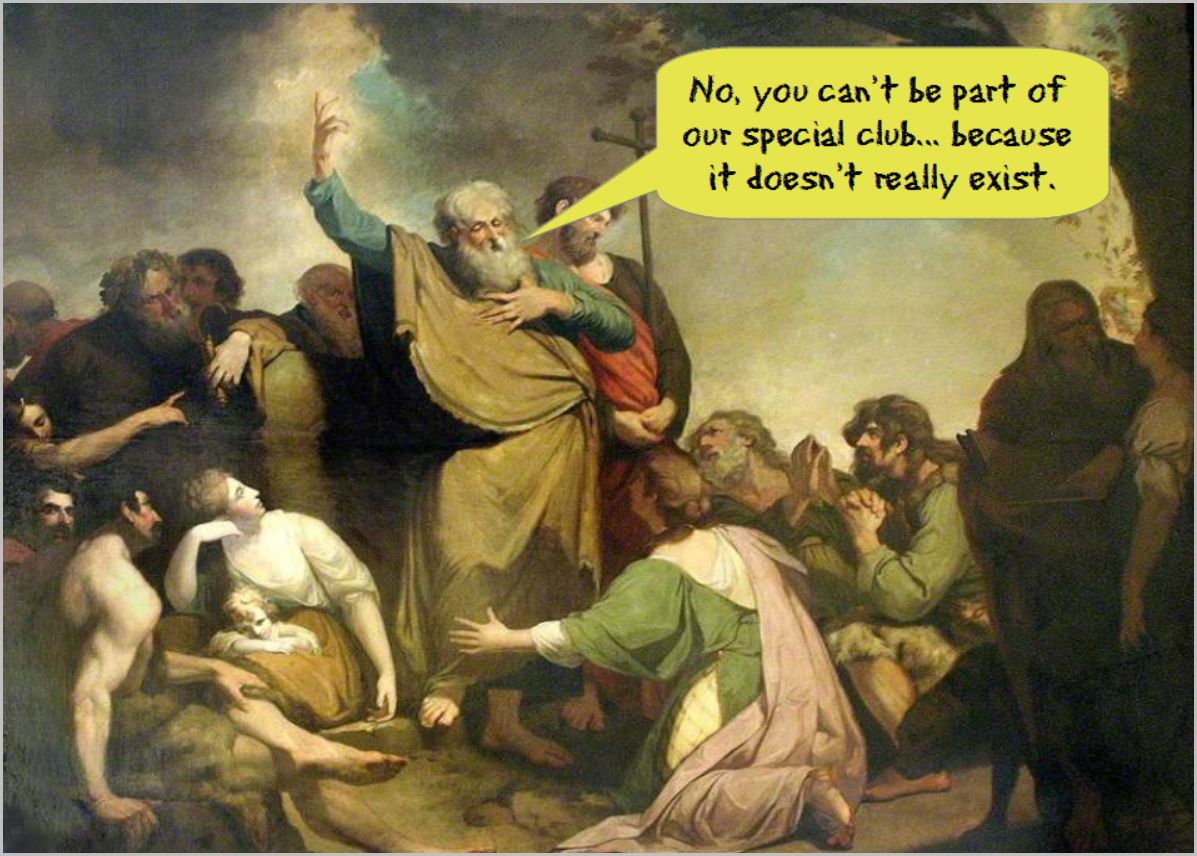
So don’t worry if you’re gay or you like sex with more than one partner or you drink a bit too much or you’ve not been as honest as you might have been. You won’t be part of the Kingdom of God, to be sure, but that won’t be because of your sexuality or your morals or your ‘lifestyle’. You won’t be part of the Kingdom because it isn’t real. You’ll be in good company though – those who love the Lord won’t be getting in either. They’re just as far from Jesus and Paul’s land of make-believe, their special magic club, as you are.


* See Matthew 24:27, 30-31, 34; Luke 21:27-28, 33-34; Matthew 16:27-28; Matthew 19.28; 1 Corinthians 15.51-52; 1 Thessalonians 4.15-17; 1 John 2:17-181 and Peter 4.7 for predictions by Jesus, Paul and other NT writers that the Kingdom was coming real soon.

Idiotic Stuff Jesus Said 8: Hate, hate and hate again

Preacher2If anyone comes to me and does not hate his father and mother, his wife and children, his brothers and sisters – yes, even his own life – he cannot be my disciple… In the same way, any of you who does not give up everything he has cannot be my disciple. (Luke 14. 26 & 33)

The words, not of an extremist Islamic preacher, but of Jesus.

The man was a megalomaniac. Almost everyone, with the exception of a few gullible fishermen, thought so (Mark 3.20-21). Even his own family was convinced he was mad. He claimed that all the spiritual leaders who’d come before him were thieves and robbers (John 10.8) and believed – demanded – that everyone should give their lives over to him. And, boy, did he turn unpleasant when they didn’t! (Matthew 11.20-22 etc) Imagine what we’d make today of a fanatic who went around making the same sort of claims. It puts Jesus’ delusions of grandeur in perspective, doesn’t it.

Christians will tell you, though, that Jesus had such a high opinion of himself because, of course, he was divine; he was, and is, God’s only son – God himself, in fact – so he was fully entitled to say the nutty things he said about himself.

But there are a couple of problems with this conclusion:

1. Little of what he promised came to be, from his predictions of his own return heralding the end of the world (Matthew 16.28) to his guarantees his followers would be able to do all manner of wondrous things (Mark 11.24 etc). In other words, there’s just no evidence to support Jesus’ ludicrous assertions about himself. The end of the world, marked by his return in power and glory, didn’t happen when he promised it would (or, indeed, at all); his followers didn’t and still don’t do the incredible things he said they would. In fact, the early church, despite the rosy story made up for it in Acts, spent its time judging and squabbling (Romans14, etc), much like the church today. Little wonder that Jesus’ friends and biographers had to invent the resurrection story, to replace all the stuff he said would happen that didn’t.

2. Christians aren’t prepared to be as radical as Jesus demands; by and large they don’t disown their parents and offspring; they don’t hate their own lives (only other people’s ‘lifestyles’) and they don’t give up their possessions when they become disciples. They’re right not to, of course, otherwise they’d be giving into the whims of a madman, but all the same they want their cake and eat it: to adopt this particular extremist as their saviour while ignoring everything he demands that they do. So they compromise; not prepared to despise their families, and certainly not wanting to give up everything, they claim him as their God while hanging on to all they hold dear. I don’t blame them, but Jesus certainly wouldn’t approve of the compromise. He says so in the passages quoted at the top of this post and in numerous other places in the Bible.

So, Christians, why do you call him ‘Lord, lord’, when you won’t do what he tells you? (Luke 6.46)

Good For Nothing

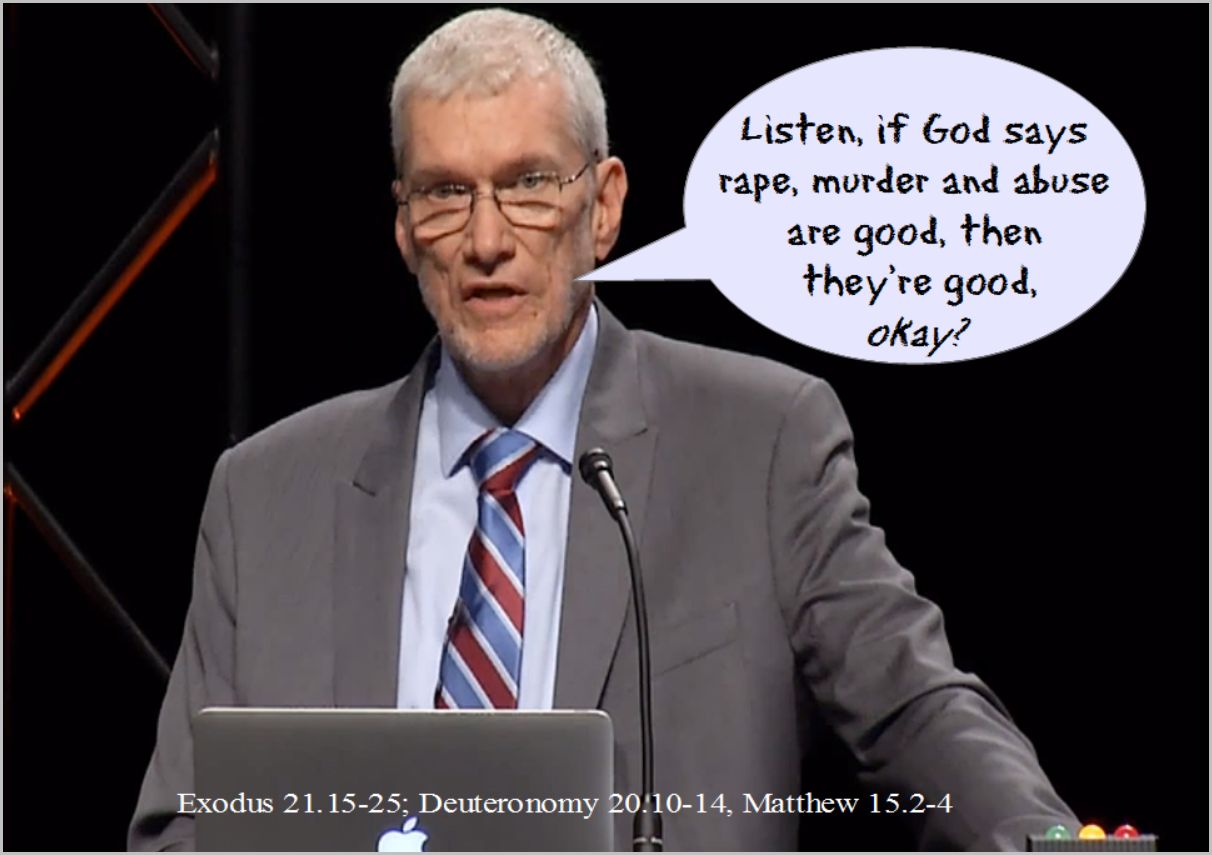
HamWhere does morality come from? Ken Ham of Answers In Genesis says it can only come from (his) God. Atheists have no grounds for morality, he claims, because, without a God to tell them, they’ve no way of knowing the difference between right and wrong .

As usual, Ham is being creative with the truth. Clearly atheists are as capable of being moral as anyone else. Equally and also evidently, Christians and other brands of believers are capable of deplorable immorality. Hardly a week goes by without more reports of Christians abusing, cheating, lying and killing in Jesus’ name.

Why do Christians act so despicably when, supposedly, they have God’s Spirit inside them – that’s the God from whom all morality flows, according to Ken Ham. Why doesn’t his indwelling Spirit guide Christians so that they always behave morally, or even just considerately?

I don’t have the answer. Perhaps Ken Ham or some other knowledgeable Christian can tell us.

No, morality doesn’t derive from any god. It has evolved, inevitably and like much of our behaviour, from our being social animals. Living in close proximity with other humans has meant we have developed ways of behaving that take these others into account, as well as the repercussions of our behaviour on ourselves.* The principle of treating others as we ourselves would like to be treated is very old – much older than Christianity.

Morality, though, is not absolute and is far from infallible. Non-believers, like the religious, make mistakes and don’t always treat others as they should. But the fact they behave well most of the time is evidence that behaving morally has nothing to do with a god, especially not the capricious, murderous psychopath of the Abrahamic religions.

Ken Ham’s position, and that of other religionists who tell us we have no grounds for morality without such a god, is as offensive as it is absurd.


* There are innumerable books that consider our moral evolution; you might like to try Frans De Waal’s Primates and Philosophers; How Morality Evolved or Christopher Boehms’s Moral Origins.


Is This It?

AlphaI was disappointed that my local church, when advertising the Alpha Course this year, didn’t use its usual poster. You know the one – and if you don’t it’s like the one above – that asks ‘Is this it?’, meaning both, ‘Is this all there is to life?’ and ‘Is this life all there is?’ Every year, I so much want to answer the question by scrawling ‘Yes’ on the bottom of the poster. I don’t, of course, because I’m too law-abiding to deface someone else’s property. But ‘yes’ really is the answer to the question ‘Is this it?’ and to the other two questions it suggests. This life is all there is. What you make of it is also ‘all there is’ (so better make the most of it).

Of course, the Alpha Course and Christians in general want to persuade you that this life isn’t all there is, that a better life awaits you after death. They want to tell you too that there’s a life that’s better than the one you’re currently living, however interesting, challenging, fulfilling or unhappy that might be. All you have to do to have this better life – and have it last forever – is to give yourself to Jesus. Oh, yes, and sign up for the Alpha Course too, of course.

Will your life really get better if you decide to believe in a mythical figure who magically sacrificed himself to himself to save you from yourself? It might, but not because you’ll have bought into this particular delusion. If it happens at all, life will be better because you’ll have become a member of a community (a church) and will enjoy the support of others who share the delusion. It might seem better too because your church will tell you what to think about particular issues – morality, abortion, homosexuality, evolution, for example – and you will be freed, should you want to be, from the burden of thinking for yourself.

But your life will not assume any cosmic significance, because nothing human beings do, say or believe ever has cosmic significance. Humans, whatever your church or the Alpha Course tells you, simply do not have cosmic significance. So, your decision to follow Christ won’t mean you’ll live forever (because, however much they might wish it, human beings don’t live forever.) It will not transform you into a ‘spiritual creature’; won’t make you beloved of the Creator of the universe; won’t transform you into the likeness of the mythical Christ. You will not have a hot-line to either the Creator nor to this Christ and so you won’t find them answering your prayers. You will not be part of any cosmic battle between God and the devil. You will not have God’s Son or the Son’s Spirit (which is it, Christians?) coming to make their home in you. You will no more be living in the End Times than you were before your conversion and the world will, though you will fail to recognise it, make even less sense than it does now.

What Christianity offers is pure fantasy, the same sort of fantasy that Mormons, Muslims, Moonies and all manner of other religious believers claim as their Truth. The only difference between your fantasy and theirs will be in the detail. Of course, as a Christian you’ll be told that your set of superstitions is the real and only Truth and that all of the others are false (or the lies of the devil, or whatever.) But in reality, yours will be just as absurd, just as impossible, just as disconnected from reality as theirs. And, what’s more, you’ll go on facing the same problems, the same joys, the same pain, the same short lifespan and the same opportunities that your culture offers you, that you’ve always had.

So give the Alpha Course a miss. Give Christianity a miss. Give all religion a miss. Give anything that tells you this life isn’t all there is a miss too, because this IS all there is. And thank God for that.

What did you do today, God?

Duck

What have you achieved today? I finished some illustrations for a children’s book a friend has written. It’s a minor accomplishment, of course, but one I like to think hasn’t added to the sum total of suffering and misery in the world (though you might want to disagree.) There’s every chance that whatever you’ve done today has been productive and positive too. That is, unless you also happen to be a deity.

What are God’s accomplishments today? What has the Omnipotent, Omniscient and All-loving God achieved in the last twenty-four hours?

Has he, for example, eliminated Ebola, Aids or cancer, or even helped those sinful human beings who strive to develop cures for these terrible diseases (which we would be right in thinking God himself created in the first place)? Erm, no. He hasn’t. Ebola, Aids and cancer are still with us today, their cure and prevention a little closer only because of human endeavour.

Has he prevented any further brutal murders by those who claim to operate in his (alternate) name? Has he rushed to the assistance of Christians being persecuted in Syria and Iraq? Erm… that’s another no. You’d think he might, wouldn’t you, given that his own people are among the persecuted, but no. And given that ‘gentle and compassionate’ relief worker, Alan Henning, has today been beheaded by Islamic extremists, you’d be right to wonder just where God is. What does he spend his days doing?

Did he, then, decide that today was the day he’d let us know which of his many manifestations is the real him – Yahweh? Allah? Shiva? Ra? One of the myriad others? None of the above? No, he didn’t do that either. He left us in our ignorance about which of the many religions, groups and sects has got it right about him. He couldn’t find the time today to tell us who it is that worships the real him, and who it is who’s deceived. Just as he couldn’t for all of the days that have so far made up recorded time.

Maybe, however, he hasn’t had time to do this because he’s been too busy sustaining the universe; you know, winding up gravity and giving the Earth those little pushes it needs to make it spin. But of course, the universe doesn’t work like this. It needs no external power source to keep it going. Even if it was God who set the ‘laws of physics’ in motion at the beginning of everything (it wasn’t), they have been self-sustaining ever since. So, no, he hasn’t the excuse that he spends his days making sure everything is ticking over nicely.

Does he spend them instead empowering believers to move mountains, heal the sick, raise the dead and perform miracles even better than those of his ‘son’, just like he had Jesus promise? Not so’s you’d notice. In fact, not at all.

Oh dear. We really are running out of possible things for God to do. Despite the sometimes desperate state of the world, perhaps all of his time is taken up finding parking spaces for Christians and sorting out their career prospects. Perhaps he’s too busy directing the thoughts and words of his ‘chosen instruments’ (see my previous post) so they can express their hatred for non-Christians and gay people. Or maybe all of his energies go into inspiring those Holy Spirit led church services that ‘bless’ Christians but are no more than human emotion run riot. Alternatively, maybe he just spends his time being offended by everything and everybody. If these are his accomplishments over the last twenty-four hours, then, given all the things he could have been doing, doesn’t it all seem rather pathetic? This is all he can manage?

Of course not. All of the triviality, and all of the brutality, attributed to him is entirely human in origin and manifestation; the beheadings, the euphoria, the offence, the vitriol. All part of the self-delusion that is ‘faith’. There is no God doing all these things, no God who manifests himself in the operation of the universe, in human suffering or the pleasures and happy coincidences of life.

It’s possible, I suppose, that there is a god somewhere, one without any interest in human beings and life here on Earth, but then he’d be even more irrelevant than the impotent gods we’ve invented for ourselves.

As Ariane Sherin famously said, ‘There’s probably no God’, with the ‘probably’ looking ever more redundant.

Idiotic Stuff Jesus Said 7: You Must Be Born Again

Born Again

Jesus answered him, ‘Very truly, I tell you, no one can see the kingdom of God without being born again (or ‘from above’).’ Nicodemus said to him, ‘How can anyone be born after having grown old? Can one enter a second time into the mother’s womb and be born?’ Jesus answered, ‘Very truly, I tell you, no one can enter the kingdom of God without being born of water and Spirit (John 3.3-5).

While John’s gospel isn’t the only source of Christian nuttiness, it’s certainly a mine of golden nuggets. This is mainly because it was made up so long after Jesus lived, by people who had, in all probability, never met him but who belonged to a sect led by someone who claimed he had.

Imagine, in a world without technology, photography and literacy, writing an account from memory (or from other people’s memories) of events that had occurred sixty years earlier. It would be like attempting to create today the history of a charismatic, back-water nobody who lived in the early 1950s – but without any reliable written records, pictures or sound recordings. How much faith would you have in such an account? How far would you trust, at such a distance, the account’s supposedly verbatim dialogue, especially when it conflicts on nearly all crucial points with the few other stories that circulate from the period? Of course you wouldn’t. And yet this is precisely what we have in ‘John’s gospel’, where we find the famous exhortation to be ‘born again’.

Let’s be clear at the outset; Jesus did not say ‘you must be born again.’ The point of the story is that he meant something else (equally ludicrous, but different nonetheless). Despite this, today’s Christians still insist he did say it and that to be truly saved you must indeed be ‘born again’.

But, as Bart Ehrman explains in Jesus, Interrupted (p 155), the misunderstanding central to this exchange, between ‘born again’ and ‘born from above’ occurs only in Greek. As Aramaic speakers, Jesus and Nicodemus would not, if they knew any, have resorted to Greek for this one conversation, just so this very confusion could be created.

The word in question is the Greek word anothen, which can mean both ‘again’ and ‘from above’, and it is this double meaning that prompts Nicodemus to ask if he is expected to crawl back into his mother’s womb so he can be born ‘again’. The contrivance allows Jesus to make a show of correcting him and to make his real point; ‘No, Nic, you dumbkoff. Not ‘born again’, but ‘born from above’. What do they teach you at synagogue school these days?’

So in a conversation he never had, depending as it does on a misunderstanding of the Greek he didn’t speak, ‘born again’ is not what Jesus means: his point, as the writers of John’s gospel make clear (in the Greek Jesus didn’t speak, but they did) is that one has to be ‘born from above’.

And why do people have to be ‘born from above’? Because that’s where the story’s creators believed heaven to be – above them, in the sky. Jesus himself would have believed this too, even though he didn’t utter a single one of the words attributed to him in this fabricated conversation.

Why_Christians_Don't_Cover_for_KindleThis post is adapted from my (five-star rated!) book Why Christians Don’t Do What Jesus Tells Them To …And What They Believe Instead, available from Amazon.co.uk and Amazon.com