Whatever Happened to Judas Iscariot?

Even more significant in the gospels than Mary Magdalene is Judas. Like her, he is strangely absent from the rest of the New Testament. Apart from Luke’s ridiculous story of his death in Acts 1:18 – a story that contradicts the one in Matthew 27:5 – he isn’t mentioned anywhere else. You might think that’s to be expected, given he’s the disciple who betrays Jesus in the gospels. His name must have been anathema to early Christians.

We might expect, however, that when Paul is describing the Lord’s Supper for the very first time in 1 Corinthians 11:23-26, he might, when he gets to the part where he says ‘on the night he was betrayed’, have mentioned the name of the betrayer. It would seem the natural thing to do. Unfortunately, the word ‘betrayed’ (prodidomi) doesn’t appear in 1 Corinthians 11:23-26 or anywhere else in the epistles. The word Paul uses is paradidomi, meaning ‘handed over’, a handing over by spiritual agents (God himself?) not a traitorous human. Judas is in fact absent from Paul’s description of the Lord’s Supper, a revelation he claims to have received directly from the heavenly Jesus, who neglects to include Judas and all the other disciples too. Nor does Paul call the event ‘The Last Supper’; that name would come later. Read 1 Corinthians 11:23-26 for yourself and see. Bart Ehrman also addresses the problem here.

Bizarrely though Judas does turn up, sort of, in 1 Corinthians 15:3-8, when Paul is quoting a creed thought to originate in the earliest days of the new faith. Because it is considered so early, this creed is greatly valued and frequently cited by apologists. Never mind that it contradicts the later gospel sightings of the Risen Jesus (see the previous post). Here’s what Paul says in 1 Corinthians 15:5: ‘(Jesus) appeared to Cephas, and then to the Twelve.’ Then to the Twelve? What Twelve? As Simon Peter, wasn’t Cephas one of the Twelve to begin with? Maybe they weren’t the same person after all.

More significantly, the Twelve, at least according to the later gospels, originally included Judas. He was one of Jesus’ inner circle. And according to Matthew 27 and Acts 1 he killed himself almost immediately after betraying Jesus. He wasn’t around to see the Resurrected Christ. Yet according to Paul and the early creed all of the Twelve saw Jesus alive again. Either Judas wasn’t one of the Twelve and the gospels are wrong, or he was and he didn’t betray his Master after all, remaining alive for his reappearance. (Just to be clear, the Twelve at the time of the resurrection appearances did not include Judas’s replacement, Matthias (Acts 1:23-26). Matthias doesn’t become one of the Twelve till after Jesus has returned to Heaven (Acts 1: 9).

So, Judas isn’t mentioned as a Jesus’ betrayer by anyone other than the gospel writers, decades after the supposed resurrection. He isn’t mentioned by name at all. The only possible reference to him is in 1 Corinthians 15:5 where he’s still one of the Twelve and sees the resurrected Jesus. It couldn’t be could it, that Mark, reading Paul’s description of the Lord’s supper mistook, or deliberately misinterpreted, the phrase ‘was handed over’ to mean ‘was betrayed’ and constructed his story about the duplicitous Judas accordingly? Why, yes it could.

Conveniently, ‘Judas’ is the Greek form of ‘Judah’, the kingdom of the Jews who, so far as early Christians were concerned, rejected Jesus as the Messiah. Judas is a symbolic character in a literary work, representing those foolish Jews who turned their backs on salvation and so ‘betrayed’ the true Messiah.

After the Gospels

None of the New Testament documents written prior to AD70 – those by Paul – contain any of the sayings, miracles or activities attributed to the Earthly Jesus in the later gospels. They don’t reflect anything of the oral tradition, first proposed in the 18th century. Those same gospels don’t reflect much of it either; the only ‘good news’ passed on by word of mouth was of a transcendent celestial Godman seen in visions. There is no evidence of any other. The later gospels incorporate the visions experienced by Cephas and others in their resurrection stories.

What then of the letters and books written after the appearance of the gospels? Do they reference, quote or base their teaching on the pre-crucifixion aspects of the Earthly Jesus of the gospels? Or do they, like Paul, concentrate solely on demonstrating the heavenly Jesus is the Messiah on the basis of what can be found in Jewish scriptures? You’d think that, with the gospels in circulation by then, that It’d be the former. But you’d be wrong.

Let’s make a quick survey of New Testament books post AD70. I’m taking their composition to be those listed here.

Hebrews (composed anywhere between 60 and 115 by unknown author[s])

Hebrews describes the Messiah as a heavenly high priest. Everything the writers ascribe to him is taken not from the gospels, nor an oral tradition on which the gospels are supposedly based, but from ancient Jewish writing; what we know as the Old Testament. Every single reference is from this source. Read the book for yourself and take note of the footnotes. Like gospel Jesus, Jesus the High Priest is constructed from snippets lifted from the Old Testament.

Revelation (composed anywhere between 70-110)

In Revelation, warrior Jesus has a lot to say, most of it quotations from the Old Testament. None of it is derived from the gospels nor the oral tradition on which the gospels are supposedly based. John’s ‘revelation’ is a fantasy constructed around ancient ‘prophecy’. Again, read the book for yourself and take note of the footnotes. Like gospel-Jesus, Jesus the Great Warrior is constructed from snippets lifted from the Old Testament.

1 Peter (70-100) and 2 Peter (125-150)

You’d think the letters purportedly written by the disciple Peter (or Cephas), the man who, according to the gospels spent three years with Jesus, would be full of his teaching, the mysteries he explained only to his closest followers, reports of his miracles or any of his other activities. But no. The best he can do across the two letters (written by two different people, decades apart, neither of them Peter the disciple) is this:

For we did not follow cleverly devised stories when we told you about the coming of our Lord Jesus Christ in power, but we were eyewitnesses of his majesty. He received honour and glory from God the Father when the voice came to him from the Majestic Glory, saying, “This is my Son, whom I love; with him I am well pleased.” We ourselves heard this voice that came from heaven when we were with him on the sacred mountain (2 Peter 1: 16).

Remarkably, this fake Peter recalls an event which never happened: when Jesus glowed like a lightbulb as two long-dead prophets beamed down from Heaven. It is, however, finally a reference to a gospel story. But then, doesn’t the author disparage ‘cleverly devised stories’ in this same passage? What else could he be referring to if not the gospels? We find a similar warning in 1 Timothy (and again in Titus 3: 9):

…command certain people not to teach false doctrines any longer or to devote themselves to myths and endless genealogies. Such things promote controversial speculations rather than advancing God’s work – which is by faith (1 Timothy 1: 4, written by a fraud pretending to be Paul).

These New Testament writers, even when they seem aware of gospel myths and their endless genealogies don’t approve of them. Perhaps that is why they prefer to ignore them, deriving proof of the Messiah from ancient Jewish scriptures instead. Every other reference to Jesus in the Peter epistles is from the Old Testament. How strange for someone pretending to know the man in the flesh.

We could go on to look at other books of the New Testament – for example, that written by ‘James’, supposedly Jesus’ brother – but this post is already too long. Rest assured if we did, we would see the same thing: none of the information about Jesus is derived from the gospels or the oral tradition on which the gospels are said by apologists to be based. There was no oral tradition, apart from stories of visions. The gospels are literary recreations – allegories – of those visions. They were not well received by the other writers of the New Testament who either ignore or disparage them. All that mattered to these early cultists were ‘revelations’ directly from the Lord and the Old Testament ‘prophecies’ that validated them.

Christmas Quiz!

See how you do in this year’s Christmas Quiz. Most of the questions are related to subjects we’ve discussed during the year.

  1. Which of the events listed are literary realisations of so-called prophecies from Jewish scripture?

a) The virgin conception and birth

b) Bethlehem as Jesus’ birth place

c) Herod’s massacre of the Innocents

d) The ‘Holy Family’s’ flight into Egypt 

  1. Which of the events listed are metaphorical?

a) God’s insemination of Mary with Holy Semen

b) Pregnant Mary visiting Elizabeth, herself pregnant with the child she’d christen ‘John The Baptist’ (sarcasm, for those who can’t tell)

c) The visit of the shepherds with their symbolic gifts

d) The visit of the magi with their symbolic gifts

  1. Which of the events listed are sentimental and/or dramatic invention on the part of the gospel writers?

a) The archangel Gabriel visiting Mary

b) Joseph’s dream convincing him Mary hadn’t been sleeping around behind his back

c) The no room at the inn scenario

d) Jesus being laid in a manger

  1. Which of the events listed are historical fact?

a) The Roman census that entailed pregnant women trailing off to their husband’s ancestral home

b) The angelic host appearing unto shepherds

c) The Star of Bethlehem hovering over Jesus’ place of birth / home

d) Jesus’ birth occur during the reign of Herod the Great (died 4 BCE) and while Quirinius was governor of Syria (appointed 6 CE)

         5. What do the answers to questions 1-4 tell us about the rest of the      gospel stories?

a) They’re equally fanciful

b) They’re all metaphorical

c) They’re invented, largely based on ancient Jewish scripture

d) There’s nothing historical about them either

        6. What do the answers to questions 1-5 tell us about those who believe these stories to be factual and true?

a) They’re gullible

b) They’ve switched off their critical faculties

c) They believe whatever they’re told

d) They feel compelled to argue that all of the fanciful stories about Jesus are true


Answers:

  1. Which of the events listed are literary realisations of so-called prophecies from Jewish scripture?

All of them are based on what Matthew found in Jewish scripture and shoe-horned into his Jesus fantasy.

  1. Which of the events listed are metaphorical?

All of them. You don’t think such blatantly symbolic events really happened, do you?

  1. Which of the events listed are sentimental and/or dramatic invention on the part of the gospel writers?

Oh come on, what else could they be?

  1. Which of the events listed are historical fact?

None of them.

  1. What do the answers to questions 1-4 tell us about the rest of the gospel stories?

They tell us the gospel writers – Matthew and Luke as far as the Christmas stories are concerned – were more than happy to invent stuff for metaphorical purposes and to make it look like prophecy was being fulfilled when it wasn’t. If they were prepared to do this for the Nativity them why not for all of their other stories, the resurrection included?

  1. What do the answers to questions 1-5 tell us about those who believe these stories to be factual and true?

Yup, they’re all of those things. And they won’t be happy till they’ve inflicted their damn fool views on you too.

So how’d you do? Well done to everyone who got full marks. Try to do better next time the rest of you. It really wasn’t hard.

A very merry Christmas to both my readers. See you on the other side.

If the Gospels were History…

If the gospels were written by eye-witnesses, we should see the use of the first person singular or plural: ‘I saw this happen’, ‘we heard him say that’ and so on. This would not necessarily mean that the author was present, just as he isn’t in the ‘we’ passages in Acts, but it is what we should reasonably expect if the authors were involved in at least some of the events. There are no such instances in any of the gospels.

We would see gospel authors identifying themselves, at the start of their accounts, for example. We don’t.

We would not see an eye-witness lifting significant amounts of material from someone who wasn’t an eye-witness. Yet Matthew plagiarises Mark, ‘improves’ it and passes it off as his own. This isn’t eye-witness behaviour and it is not how eye-witness testimony works.

We would see the gospel writers cite their sources: Mark would tell us he’s recording Peter’s recollections and that he witnessed Jesus’ trial personally (there’s no evidence he did either, speculation from centuries later notwithstanding.) Luke would tell us which accounts he’s referring to in Luke 1:1-2. While we now know he too plagiarises Mark and quite probably Matthew, he doesn’t admit it. We would know the source of events that took place behind closed doors such as Jesus’ interview with Pilate.

We could expect contemporaneous accounts independent of the gospels, recording the miraculous events they claim occurred; the wandering star, the earthquakes, the hours long eclipse, the healings and controlling of nature, the resurrected zombies, the ripping of the 35 foot temple curtain, the resurrection of an executed criminal. Instead there’s nothing, not even in later works such as those of Josephus (because all of these events are metaphorical).

We should expect Cephas (known as Simon Peter in the later gospels) to have recorded his experiences with Jesus. Yet, when he gets his chance, in the letters he supposedly wrote (1 and 2 Peter), he makes no mention of them at all.

We should expect the Christians prior to Paul to have recorded some of these episodes. Some argue that they did, in a document now called Q, but this precious document was, unbelievably, soon lost or abandoned. Alternatively, they may not have seen the need to write anything down because they believed the world was about to end very soon. Either way – no accounts from them about ‘the history of Jesus’.

We should expect Paul to mention aspects of the Jesus story in his letters. After all, he claims to have persecuted Christians for some time before his conversion and to have met and conversed with Cephas for 15 days. Yet he conveys no details at all. Instead, he claims all he knows of Jesus derives from visions and ‘revelations’ in his head. His account of the bread and wine ritual informs Mark’s story of the Last Supper, not the other way round; it is – Paul says clearly – another ‘revelation’ in his head.

We should expect there to be details about Jesus’ earthly life in other books of the NT. Instead we find only a celestial high priest in Hebrews and a warrior Christ in the supposed visions of Revelation. Nothing historical here.

We should, if the gospels are history, expect them to read like history. History, including that written at a similar time does not include angels, devils and apparitions, magic stars, virgin births, miracles and supernatural healings. Where it does, as in Constantine’s vision of the cross, such elements are seen for what they are: myth, not history.

We would not expect the central figure of the gospels to be constructed almost entirely from parts of older religious writing. This is not a technique used in genuine historical records.

We would not expect to find the level of metaphor and mythic tropes – magic, supernatural characters, returns from the dead – in what is ostensibly an informational text. History does not rely heavily on metaphor and symbolic tropes the way the gospels do. There is no ‘logic of history’ in the Jesus story.

We would expect to see geographical and political details relayed reasonably accurately. Instead, Jesus’ trial arrangements are highly improbable; they do not conform with what is known about Roman trials – and we know a lot, because of the records they kept. Jesus would not have had a personal interview with an indecisive Pilate, who would not have consulted the mob, would not have sent Jesus to the Jewish authorities or Herod and would not have offered to exchange Jesus for Barabbas (there was no ‘tradition’ of exchanging one criminal for another) and so on. From what we know of him, Pilate would have authorised the execution without a qualm, as he did for many other would-be messiahs. The rest – the gospel details – are drama, Jewish scripture brought to life with added metaphor. Fiction, in other words.

How To Read The Bible

A step by step guide to reading God’s Word, courtesy of Don Camp.

Always read passages in context. This is the only way you can understand what they mean.

Synthesise different passages from a range of contexts so that collectively they say something else.

Read the Bible with all the discernment of a fifth grader.

Always take what is being expressed at face value.

Work out what the original author intended. (Note: ignore the Intentional Fallacy for this purpose.)

Scrutinise what the author intended until he says what you think he should say.

Because the Bible is made up of stories, poems and other literary forms, make sure you recognise the genre you’re dealing with and process it accordingly. (Note: different genres may be synthesised if it suits your purposes.)

Always assume that the improbable, implausible or ludicrous parts of the bible are metaphor, allegory or hyperbole.

Interpret metaphor and allegory in a way that eliminates their obvious ludicrousness.

Do not apply the metaphor/allegory principle to the gospels. The gospels are 100% historical documents, untainted by metaphor and allegory.

Ignore any of Jesus’ commands that are expressed as metaphors.

Dismiss any of Jesus’ more extreme commands – give away all you have, love your enemies, turn the other cheek etc – with the assurance that they’re hyperbole and/or metaphor.

Read the Bible like a first-century believer, even though the Bible didn’t exist in the first century.

On no account concede that Carrier, Ehrman or any other scholar with a book to sell has reached a far more valid conclusion than you have yourself.

To appreciate fully the nuances of New Testament theology, learn Ancient Greek.

Above all, remember that cognitive dissonance is one of the most powerful tools at your disposal.

(Continues in similar vein for 86 pages.)

Thank you, Don. I appreciate how you’ve collected together the many and varied points you’ve made in your recent voluminous comments, synthesised them and presented them here to equip us to read the Bible the Don Camp way. I can’t help but think that, as a result, we’re all that much closer to a personal encounter with Jesus.

End Of Term Test

Which of the terms mythological, symbolic, theological is most appropriate when discussing biblical tropes?

Apparently, it’s ‘theological’ because it has an air of respectability, whereas the other terms suggest something with only theoretical underpinning. In fact, this also applies to ‘theological’, which by definition is the study of deities, for which there is no evidential verification. The use of ‘theological’ therefore is as unsubstantive as arguing that a concept is metaphorical or symbolic. None of these terms represents a sound, reliable way to determine the accuracy, historicity or truth of religious claims.

With this in mind see how you do with these questions:

1. Did the original hearers of the Genesis creation story regard it as –

a) true.

b) a theological statement.

c) an entertaining myth.

Of course we’ve no way of knowing what the story’s original hearers thought but there is nothing in the text that suggests they would have regarded the creation story as anything but true. The creators of Jesus’ script certainly seemed to think so, a few centuries later and its original hearers would not have felt the need to preserve it otherwise. In this belief they were wrong.

2. Which of these gospel stories is true, as in ‘really happened more or less as described’ –

a) The virgin birth with its surrounding detail.

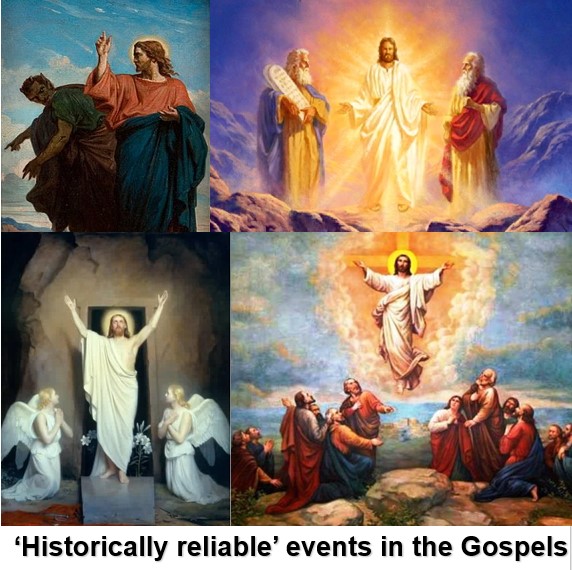
b) Jesus meeting with Moses and Elijah (the transfiguration).

c) Resurrected corpses roaming around Jerusalem.

d) The resurrection.

The answer is that either all of them are true or none of them are. If only one of them is mythic, symbolic or ‘theological’ (and more than one of them most certainly is) then it is highly likely the others are too. If we are scrupulous, we cannot assert that one story is symbolic because it’s making a theological point while another equally implausible story is historically accurate because we want it to be.

The criteria for determining the historicity of any story from antiquity are corroborative evidence and, failing that, plausibility. We have already established that there is no independent corroboration for many of the gospel stories. There is no corroboration for some of them even in the Bible itself. We are left then with plausibility: how plausible is it that a virgin gave birth or that resurrected corpses presented themselves to Jewish authorities? Vanishingly small. Jesus’ encounter with Moses and Elijah is equally improbable.

Is his resurrection the exception? No, because dead people do not spring back to life 36 hours after being buried. If the virgin birth, the transfiguration and the resurrection of dead saints are all highly implausible (and they are) then so is the resurrection. It is at best, a story making a theological point but it is not history. The implausibility it shares with many of the other implausible stories in the gospels discounts it as history. There are no grounds for saying it is the exception.

There is also the cumulative effect of implausibility. It is highly unlikely that one of the implausible events above is historical, but it is impossible that all four of them are. Add all the other implausible stories in the gospels – the other miracles; the healings; exorcisms; Jesus sparring with the devil, walking through locked doors and beaming up to heaven: piling implausibility on top of implausibility doesn’t make any of the component implausibilities more plausible. It makes all of them less plausible and collectively impossible.

The things the gospels tell us happened to Gospel Jesus, and those they say he did himself, are equalled only by heroes of myth. Did Osiris or Romulus rise from the dead, as their stories claim? Did Augustus really become a god once he died? Of course not. These are the implausible, improbable events we find in myth. Jesus’ story is no different.

3. While many or all of the gospel stories are highly improbable as history because they are intended to convey a theological point, the words attributed to Jesus in the gospels –

a) are completely accurate.

b) are more or less what he said.

c) passed through an inestimable number of people, being invented, edited and altered in the process, before being written down 40+ years after Jesus supposedly uttered them.

d) are inventions of the gospel writers and/or their particular sect and frequently copied between gospels.

If you’re opting for a or b, you’re now making the logia the exception; the one oasis of historical truth in a desert of implausibility. That’s a big ask. To get this one off the ground, you have to call upon contrivances like –

completely reliable (but different and conflicting) oral traditions;

     hypothetical lists of sayings;

         Peter’s dictation to Mark;

             eyewitness authors;

                  secret teachings;

                     super-translators and

                         the odd spot of collaboration.

So, c and/or d is far more likely to be the answer to this one, representing the explanation that requires the least conjecture and fewest hypothetical components.

How did you do? I expect most of you aced this end of term quiz. If not, better get down to some extra study and repeat the semester next year.

The Gospels and Other Fiction, part 3

The final part of my critical look at Christians’ defence of scripture as truth.

‘The logia of the Lord in all three of the synoptics stand out from the narration of the author by style and grammar.’

The same way Elizabeth Bennet’s/Jay Gatsby’s/Hermione Granger’s dialogue stands out from the narration and the speech of other characters in Pride and Prejudice/The Great Gatsby/Harry Potter. A skilled author can make all of their characters speak in different and distinctive styles, with their own particular grammar and syntax. This doesn’t mean those characters are real. Nor does the fact that some of the ‘logia of the Lord’ was carried over from Mark into Matthew and Luke mean the two later authors were at pains to preserve the real words of Jesus. They were, as scholars, including the evangelicals Dr Strauss and Dr Wallace suggest, copying, plagiarising, editing, amending and inventing his script.

There are also the omissions to take into account: words recorded by Mark that Matthew and Luke didn’t see fit to copy into their gospels. Were they not convinced these were genuine sayings of Jesus? Did they just not like them? On what basis did they jettison these ‘logia of the Lord’?

If only there were a fourth gospel that didn’t lift its logia from Mark, one whose Jesus speaks in a very different style, with different content, vocabulary, syntax and grammar from the synoptics, but which is itself internally consistent. We would know then his script could be made up.

Miracles of miracles, we do have such a gospel, one in which Jesus is completely different from the version in the synoptics. Where does this character’s logia come from? A different oral tradition, one totally separate from and uninfluenced by that used by Mark but which existed in parallel to it? Highly unlikely. An eyewitness? One who heard Jesus speak an entirely different set of words from whoever supposedly heard those eventually used by Mark? Of course not. The fourth gospel’s logia was invented by a much later author and his collaborators, with no direct experience of Jesus (if he existed). He and they do a pretty good job of writing his fake lines.

And if they can do it, why not Mark forty years earlier?

‘There are, in the synoptic gospels, fewer variations in the logia than in the surrounding shared narrative.’

This doesn’t mean there aren’t any. There are. For example:

Whoever is not against us is for us’ (Mark 9.40) v. ‘Whoever is not with me is against me.’ (Luke 11.23). 

‘And these are the ones sown on the good soil: they hear the word and accept it and bear fruit, thirty and sixty and a hundredfold.’ (Mark 4:20) v. ‘But as for that in the good soil, these are the ones who, when they hear the word, hold it fast in an honest and good heart, and bear fruit with patient endurance.’ (Luke 8:15) [Luke makes a terrible job transferring this parable from Mark to his own gospel. His is full of errors and discrepancies, generally attributed to ‘author fatigue’. He was just so tired of cribbing from Mark and Matthew.]

The time has come,’ he said. ‘The kingdom of God has come near. Repent and believe the good news!’ (Mark 1:15) v. ‘The kingdom of God is not coming in ways that can be observed, nor will they say, ‘Look, here it is!’ or ‘There!’ for behold, the kingdom of God is in the midst of you of you.’ (Luke 17.21)

It looks like isolating the logia and claiming because they are similar across the gospels they must be the actual words of Jesus. Matthew and Luke copying from Mark (and each other?) while John invents his own unique dialogue, makes for a far better explanation of both the similarities and the differences.

The Gospels and Other Fiction, part 2

The gospels were written as history. Their writers did not make things up.’

History, as koseighty has reminded us, is not littered with angels, devils, demons, spirits, apparitions, miracles, voices from the sky and resurrected corpses. Real history was being written at the same time as the gospels, by Josephus and Suetonius for example, who do not include the supernatural but do reference their sources, something the gospels never manage.

And of course the gospel writers did make things up. They invented numerous stories for Jesus to make it appear he is fulfilling prophecy (even when that ‘prophecy’ wasn’t prophecy to begin with.) This included making up ‘history’; Herod’s Massacre of the Innocents (a rewrite of a fiction about the infant Moses), the crucifixion eclipse, the rending of the temple curtain and more. These are all symbolic events. They didn’t really happen. Jesus’ own resurrection can safely be added to the list. It’s ironic that those who defend the gospel authors against the charge they made stuff up are the same who invent stories themselves: Mark and Luke knew each other? Mark proof-read Luke’s first draft? There were people who would fact check the gospels and point out any errors? But the original Christians wouldn’t do such a thing. Except they did.

There are no Inconsistencies, contradictions and inaccuracies in and between the gospels, but if there are, these are irrelevant. It’s the bigger picture that counts.’

Jesus is different in all four gospels. Despite Matthew and Luke’s plagiarising of Mark, they alter him to reflect the Jesus they believe in. John’s Jesus is so far removed from Mark’s that he’s a different character altogether. The inconsistencies do matter: did Jesus perform signs and wonders or not? Was he crucified on Thursday or Friday? Was it Peter, John or Mary who was first to see him resurrected? Did he hang around for one day or for 40? These conflicting details tell us that the creators of the Jesus story were more than happy to alter it when it suited their purposes. This is not how history is written. It is how propaganda is created. The ‘bigger picture’ is, in any case, made up of these smaller details. They work collectively and cumulatively to create the bigger picture. If we can’t rely on their being accurate how can we be sure the bigger picture is? When the gospel writers are unreliable in the smaller details, how can we be certain they’ve got the bigger picture right, given they’re all copying it from the same source, Mark, and giving it their own spin?

There is corroborating evidence of the gospels’ accounts’.

There is? Where? Just because there is some evidence that Nazareth existed doesn’t mean Jesus performed miracles, any more than Dunsinane castle’s existence proves Macbeth murdered King Duncan (he didn’t). Just because Pilate was a real historical figure doesn’t mean he crucified Jesus, any more than the existence of King’s Cross Station means Harry Potter catches his train there. And these, surely, are merely the small details. There is no corroboration at all for the bigger picture. Mention of the followers of Chrestus in Suetonius confirms at best that there were Christians in Rome at the time of Claudius, but no-one is disputing that. At worst, for the apologist, this curious reference has nothing whatever to do with Jesus. Later references to incidents from his story, by the much vaunted Church Fathers, are derived from the gospels and are therefore dependent on them. As such, they don’t constitute independent corroboration.

Everything Jesus prophesies or predicts in the gospels will come to pass, then sceptics will see that everything in the Jesus story is true.’

This one is from a commenter on Don’s blog. (I only went there by accident, honest.) The problem with this one is that everything Jesus is made to promise should already have come true, two thousand years ago. The Son of Man should have appeared in the sky with the heavenly host to usher in God’s Kingdom on Earth, while sending most of mankind to the fiery pit or outer darkness or some other damn place. Both he and Paul claimed that this would happen within their and their followers’ lifetimes. The trouble with Christianity is it is always winter and never Christmas. Its fulfilment God’s – God’s Kingdom on Earth, life after death, the final judgement – is always going to be at some indeterminate time in the future, a time and fulfilment that never quite arrives. It never will; part of ‘the big picture’ we can be confident we will never see.

More to come (unlike Jesus). 

The Gospels and Other Fiction, part 1

Christian apologists vigorously deny the idea that the Jesus story is fiction even though all of the evidence, both internal and external, points to the fact that it is. I’m not going to rehearse that evidence in this post (I address it in several earlier posts, including here and here, and there are always primary sources that, God forbid, defenders of the faith could read for themselves.) I’m interested here in looking at Christians’ defence of scripture as truth. What arguments do they have and better still, what evidence, that the gospels are historically accurate depiction of events in 1st century Palestine? Most of these arguments have been offered by our resident apologist, Don Camp, and although I’m fairly sure Don makes things up as he goes along, I’ll not reference other sources except where I’m introducing an argument he hasn’t offered.

Church Fathers believed the gospels were accurate, therefore, because they lived closer to the time of the gospels’ composition, they’re more likely to be right.’

Church Fathers, such as the unreliable Eusebius,, Papias, Clement, Ignatius and Polycarp were predisposed to believe the gospels were accurate; they had already converted to the faith and had a vested interest in seeing it promulgated and preserved. They were also steeped in the thinking of the age, typified by Paul and other NT writers, that the Earth was at the centre of a cosmic war between God and the forces of Satan. Above all, the Jesus story was theirs, a new revelation from God that didn’t, as far as they were concerned, belong to Jewish tradition or any other. It was new and it belonged to them: they wanted and needed it to be true. Later scholars, from the 19th, 20th and 21st centuries, did not come with these particular encumbrances and while of course not entirely free of prejudices of their own, considered the texts more dispassionately as history and found them to be wanting.

‘‘Mark’ is an accurate record of the disciple Peter’s time with Jesus.’

There is no evidence at all for this claim. Analysis of Mark (and also Matthew and Luke) demonstrates how the story is constructed around supposed prophecies from Jewish scriptures. Mark also incorporates much of Paul’s gospel to the Gentiles, a feature Matthew is at pains to ‘correct’. His Jesus is distinctly Jewish.

There was an oral tradition that accurately preserved the stories about Jesus until such time as they could be written down.’

There is no evidence that this tradition, if it existed, was accurate. It is, as Bart Ehrman shows in Jesus Before The Gospels, highly unlikely that it was. We know that stories conveyed orally are altered, embellished and modified with successive retellings.

There was an earlier document that preserved sayings of Jesus’ until such times they could be incorporated into the gospels.’

Then it simply vanished so that no fragment of it survived. The Church Fathers don’t appear to know anything about it. Wouldn’t such a priceless document have been preserved somehow, somewhere by someone? Q, as it’s called, is entirely hypothetical. It’s unlikely it existed. Even if it did, it is considered to have been a sayings gospel. It did not preserve details of Jesus’ life, death or resurrection. We’ll get to the so called ‘logia’ in part 3.

The gospels were written by eye-witnesses or associates of eye-witnesses.’

We know with certainty that this is not the case. All of them were written in Koine Greek and are carefully constructed literary creations. None was written in Palestine but much further afield and all reflect the concerns of the later cult. Over a hundred years after they were written, Irenaeus ascribed the names by which they are now known without any evidence that the authors were called Matthew, Mark, Luke or John. Later compilers of the New Testament didn’t even know of ‘Mark’s’ primacy, which is why ‘Matthew’s’ gospel appears first in the New Testament. ‘Matthew’ and ‘Luke’ are heavily dependent on ‘Mark’ (as is ‘John’ for its overall structure), an incongruous and inexplicable approach for Matthew to take, and John too, if they were eye-witnesses themselves. Eye-witnesses do not need to rely on the testimony of people who weren’t.

More next time…

No Sign of Life

For what I received I passed on to you as of first importance, that Christ died for our sins according to the Scriptures, that he was buried, that he was raised on the third day according to the Scriptures. (1 Corinthians 1:4)

This, apparently, is what early Christians believed; Paul is thought to be quoting an early creed here. What an incredible statement it is. Incredible because of its demonstrable falsity.

Christ died for our sins according to the Scriptures’: just where, in which scriptures, does it say this? Presumably Paul, or those he’s quoting, thinks it’s Isaiah 53, where it says:

…the Lord was willing to crush (his servant), and he made him suffer. Although you make his soul an offering for sin, he will see his offspring, and he will prolong his days, and the will of the Lord will triumph in his hand. ‘the Lord makes his life an offering for sin’ (Isaiah 53:10)

Unfortunately for Paul, most scholars agree that Isaiah 53 is not about the Messiah at all, but about the Jewish nation. It looks as if it neatly fits the much later ‘Christ’ because the Christ is a construct built on a handful of believers’ visions and this very chapter, which seemed, but only superficially, to validate their inner experiences.

Paul goes on to say, ‘he (Christ) was buried (and) was raised on the third day according to the Scriptures. Here he is on even shakier ground. The Messiah was not going to die for his people – he would be a triumphant warrior king – and he certainly wasn’t predicted to rise from the dead. There are no references at all, anywhere in the Scriptures, to the Messiah being raised from the dead and certainly not ‘on the third day’. Paul is wrong. At best, he’s mistaken, at worst he’s deliberately perpetuating a falsehood.

When Paul wrote this, the gospels were still many years away from being written. All that new believers, in as faraway a place as Corinth, could rely on was the testimony of preachers who came to tell them about the Christ. Some of these preachers may have known Jesus personally (though I doubt it) but most, like Paul, had limited means of persuading those they aimed to convert that Jesus had died for their sins and had risen again. Not unlike today’s evangelists, all they offered was their own and others’ inner spiritual experiences and visions, together with ‘evidence’ from scripture. Paul admits this is all he’s offering here: ‘what I received’ and ‘according to scripture’. But there is no evidence from the scripture available at that time.

What’s a gospel writer to do? When Mark created his gospel, he undoubtedly knew of Paul’s teaching about the resurrection and he may have known of this early creed. Yet he knew also that there was no prophecy about Jesus rising ‘on the third day’, on which to build his story. Consequently, he has Jesus declare in Mark 8:12 that ‘no sign will be given’ (= ‘there’s nothing in the scriptures about this’) and he omits the resurrection from his story.

Not so Matthew. As is his way, Matthew scoured Jewish scripture till he alighted, in the absence of anything resembling a prophecy, on the story of Jonah. Jonah 1.17 claims preposterously that this ancient prophet spent ‘three days and three nights’ in the belly of a great fish – and Matthew decided, ‘that’ll do!’. He has his Jesus refer to the tall tale as a ‘sign’ that he too will spend three days and nights in the belly of the earth:

Then some of the scribes and Pharisees told Jesus, “Teacher, we want to see a sign from you.” But he replied to them, “An evil and adulterous generation craves a sign. Yet no sign will be given to it except the sign of the prophet Jonah, because just as Jonah was in the stomach of the sea creature for three days and three nights, so the Son of Man will be in the heart of the earth for three days and three nights…” (Matthew 12:38-40)

Contradicting Mark’s Jesus (‘no sign will be given’), Matthew also modifies the original belief that Jesus rose on the third day. Now it’s after ‘three days and three nights’, which does not mean the same as ‘on the third day’. According to Matthew’s own gospel, Jesus was in the tomb – the belly of the earth? Really? – from Friday ‘as the evening approached’ (Matthew 27:57) till before dawn on Sunday morning (Matthew 28:1). This only just qualifies as being ‘on the third day’, given that days are counted from evening to evening in the Jewish calendar; it certainly isn’t ‘three days and nights’. Jesus lay dead in the tomb for no more than 36 hours. The damn ‘sign’ Matthew is so eager to use doesn’t even fit his own story.

What a mess. It’s what you get when you lift any old tall tale from ancient scripture and use it as a symbol for your own made-up story.