I Know What It’s Like To Be Dead

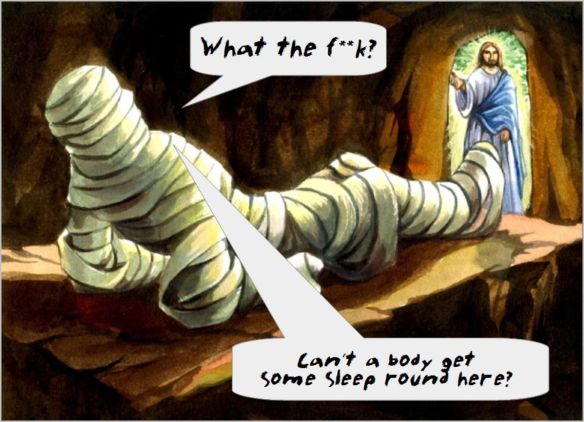
lazarus

And you do too.

We experienced what it was like last night and, you know, it really wasn’t too bad.

We entered, at some point, a deep, dreamless sleep (we dream for only a quarter of the time we’re asleep and even then often can’t remember what we’ve dreamt about) and the rest of the time we were, as far as subjective experience was concerned, dead to the world. During that deep sleep, our conscious mind was completely switched off; we did not experience anything while we were in this state and as far as awareness is concerned, we did not exist. And when we woke this morning we were none the worse for our period of non-existence. We booted up reasonably satisfactorily and the memories we had yesterday, before our deep sleep, were restored and the entity we call our self began to interact with the day.

This period of deep sleep, this unconscious oblivion, is precisely what it is like to be dead. Of course, in death we switch off permanently; there’s with no reboot afterwards, either in our beds, our graves or in heaven. The oblivion that is death is permanent. But, and this is my point, being dead is no more painful or unendurable, and no more to be feared, than the deep sleep you had last night and that you will enjoy tonight. We might not much like the idea that once we fall into the ultimate sleep there will be no waking up, but that is only a concern, if it’s a concern at all, of the living. I guarantee that it does not cross the minds of those who are already dead. They have no minds, the same as you didn’t last night, for it to cross.

Being dead, to paraphrase Mark Twain, does not trouble us at all. Its prospect, while we remain on this side of it, should encourage us to enjoy life and live it to the full. It shouldn’t cause us to worry about being dead, because there’s nothing we can do about it and, in any case, it’s no worse than being in deep sleep. Nor should we be concerned about whether we’ve subscribed to the right incantation, appeased the right God in the right way or lived a good enough life, in order to avoid death. There’s no avoiding death and the promises of religions that we can if only we believe the right magic, are utterly false. Understandable perhaps, but false.

Oh death, where is thy sting, says Paul in 1 Corinthians 15.55. Well, death still has its sting. It has it in its inevitability – every organic creature, of which we are one, must die – and it has it, depending on your perspective, in our individual obliteration. (Though, frankly, why anyone should think their own personal bundle of thoughts, impulses and prejudices merits everlasting existence is a mystery). Most significantly, however, it has it in the dying process, which for many of us can be debilitating and painful. This is the way of it for all of us, including those who believe religions’ false promises. They are not spared the suffering, even though modern medicine can help alleviate much of it. Christians, Muslims and Hindus, despite their belief that a deity smiles benevolently upon them, are not guaranteed a comfortable passage from this life to non-existence.

Death is the great leveller; we all experience dying in much the same way and we none of us experience anything after it. One of these – maybe both if we’re lucky – isn’t too bad. Just like deep sleep in fact.

Until then, we should make the most of life while we still have it.

Sleep well.


Rejecting Jesus the Christian way

jesus2

I’m sometimes taken to task for pointing out that Christians don’t make much effort to live as their saviour says they should. The title of my first book, Why Christians Don’t Do What Jesus Tells Them To …And What They Believe Instead sums it up. Since the very beginning, believers have replaced the radical commands attributed to Jesus with mythology, mysticism and magic formulae, none of which he’d recognise and all of which are far less demanding than going the extra mile, turning the other cheek and loving enemies. So today, when confronted with what Jesus says is expected of his followers, believers are inclined to say, ‘what right have you to tell us how we should be living?’ to which the answer is, ‘it’s not I, nor any other commentator, who tells you how to live; it is your Lord and Saviour. All we do – all I do – is remind you of what that is.’

Christians don’t like this, primarily because they don’t like what Jesus commands – it’s too exacting, too radical, too impractical – and they want to go on disregarding it. It’s damned annoying being reminded of it and being challenged on how far they are from complying with it.

Have those of us who point out Christians’ failings any right to do so? Well, of course. Christians spend their time judging, castigating and condemning others and as Jesus himself points out, judging others leads to being judged in return (Matthew 7.1-5). He sees this as something of a natural consequence, a yin for a yang. But ‘judge not that ye be not judged’ is another of his commands his followers like to ignore. Even so, if Christians are going to insist on pointing out the speck in others’ eyes, they must expect others will have something to say about the plank in theirs. That’s the way it works – Jesus says so.

So, Christians, if you don’t like me and others challenging you on how far you fall short of your Lord’s expectations maybe you need to lay off atheists, LGBT people, those you consider to be sinners, those of other faiths and even fellow Christians you think haven’t got the right theology. Put your own house in order first and then maybe we’ll listen to you (or maybe not). But don’t say we’ve no right to look at how far you measure up to Jesus’ standards. We’ve every right to ask whether the so-called Salt of the Earth (Matthew 5.13) has any of its flavour left.


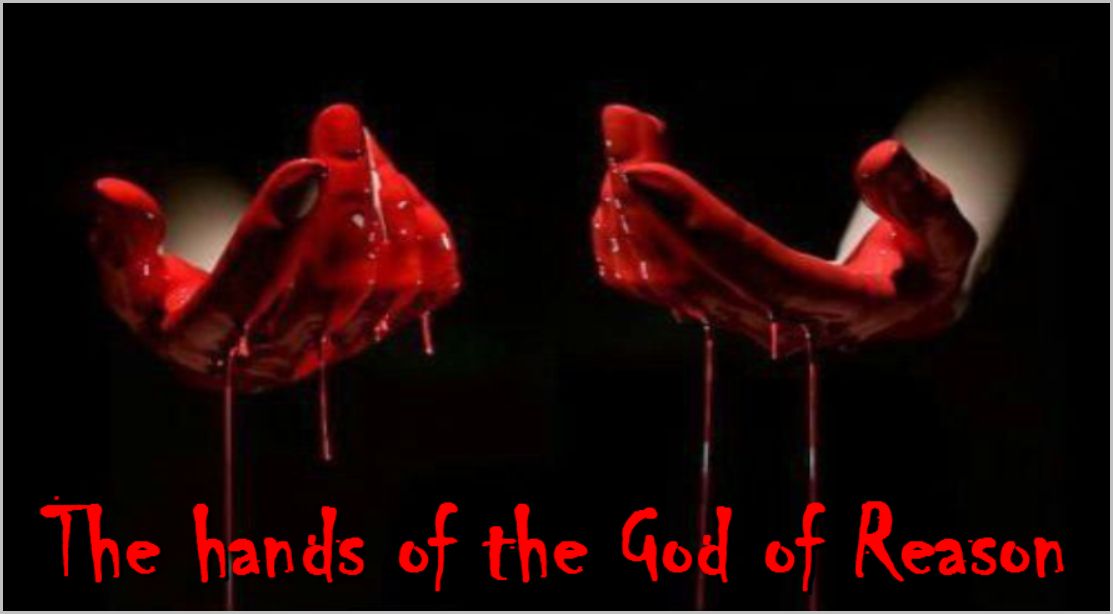
Smash! Kill! Destroy!

handsofgod

So how has the great God of Reason done so far?

We’re still not out of Genesis and he’s –

Trashed his entire creation just because a couple who didn’t know how touchy he is managed to upset him;

Destroyed two towns and almost everyone in them because he found the locals offensive;

Drowned everyone in existence (except for an old piss-head and his family) because – you guessed it – they offended him;

Engineered a spot of child-abuse;

Decided the best way for people to show him they’re his bestest buddies is to have them disfigure their genitals.

Now, honestly, Christians, how can you say any of this is rational or logical, reasonable or considered? Your God’s response to everything is Smash! Kill! Mutilate! Destroy! – never as a last resort, always as his first reaction. He’s the Hulk, Godzilla and ISIS all rolled into one. Not once does he apply reason or logic. Smash! Kill! Mutilate! Destroy! And not only in Genesis but throughout the Old Testament:

His chums want the land occupied by other tribes? Smash! Kill! Destroy!

They don’t show him enough love? Smash! Kill! Destroy!

They break one or other of his mostly petty rules? Smash! Kill! Destroy!

They offend him in some remarkably trivial way (collecting sticks, teasing a bald bloke, doing sex wrong)? Smash! Kill! Destroy!

Over and over again.

Until, at last, he has another big idea! Another Master Plan! The Master Plan to end all Master Plans! (His fourth at least.) And guess what? It’s all Smash! Kill! Destroy! Especially Kill! This is a dude who really can’t think outside the box.

Here’s how it goes: the Lord gives up on his previous Master Plan, which he’d told some selected desert marauders was forever and ever, and decides its time to have another go at sorting out mankind that he helped screw-up in the first place. His idea this time is to come to Earth himself as a sort of clone, which he creates by raping a young woman, just like all the other gods of old. When he grows up this clone/avatar tells everyone how God wants them to behave so they don’t upset the version still in Heaven quite so much. The clone then gets himself murdered at the hands of the very people he’s come to visit – the same ones the Lord promised to take care of forever and ever in his previous Master Plan – which magically allows anyone who repeats a special incantation to join an exclusive club. Everyone else he plans to torture and murder for all eternity, because that’s what he likes doing best. Of course, the version of himself he sends to Earth won’t actually make any of this clear – that’ll be left to someone else to make up afterwards – but, in the best illusion yet, he’ll come back to life before beaming up to Heaven to cosy up to his other self, the one preoccupied with death, destruction and mutilation.

This time it’s foolproof: a well-thought through, logical, rational and reasonable plan.

Except… not really. It’s bullshit. There’s no reasoning here, just a lot of stuff made up as people went along. None of it makes sense. The copy seems to have no idea what’s going on and certainly no inkling that his death has cosmic significance. On top of that, no-one really knows how the magic works – everyone who mentions it has a different idea – and the record of it all is scrappily cobbled together donkeys’ years after it all was supposed to have happened. Still, the main thing is it all involves a lot of killing – the clone first; then the poor sap manipulated into ‘betraying’ him; a couple who don’t want to give away all their belongings; some of the dudes who believe the magic is for real then, after they’ve really pissed off the Romans, lots more of them and finally, once the nutjobs get the upper hand, loads and loads of other people – which must really have pleased the God of Death Reason.

If this is the best he can do, then we’re in trouble deep. If our ability to reason comes from him, as Christians claim, it’s no wonder we can be irrational, illogical, unreasonable and unreasoning. Which of course is why he is, because he’s a reflection of the beings  that created him – us. Human emotions and cognitive capabilities came first and were projected onto the gods we created, including, eventually, the monotheistic monster, Yahweh. It was he primitive tribesmen decided must be responsible for natural disasters and the brevity and brutality of life. Such things had to be punishments, hadn’t they? And if punishments, then there had to be One doing the punishing. One who must be appeased if he was ever to stop. Hence sacrifices, behaving in ways that might please him, killing those who don’t, worship. All futile, like pleading with one’s own reflection in a mirror.

The God created by this kind of thinking only reflected back at his makers the worst of themselves; jealousy, anger, intolerance, belligerence, petulance, vengefulness and violence. Hardly ever Reason. 

And so does he still.


The God of Reason

god4

The next three posts will look at the claim Christians make for their God being the God of Reason. The fact that he is, they say, demonstrates how inconsistent those who see no evidence for a deity are when we use his very attributes – reason, logic and rationality – to make a case against him. Here’s Dr Jason Lisle on Answers In Genesis:

…there is an absolute standard for reasoning; we are to pattern our thoughts after God’s. The laws of logic are a reflection of the way God thinks… Laws of logic are God’s standard for thinking. Since God is an unchanging, sovereign, immaterial Being, the laws of logic are abstract, universal, invariant entities. In other words, they are not made of matter—they apply everywhere and at all times. Laws of logic are contingent upon God’s unchanging nature. And they are necessary for logical reasoning. Thus, rational reasoning would be impossible without the biblical God.

The materialistic atheist can’t have laws of logic. He believes that everything that exists is material—part of the physical world. But laws of logic are not physical… The atheist’s view cannot be rational because he uses things (laws of logic) that cannot exist according to his (Godless viewpoint).

Similarly, Tim Keller in his book The Reason for God argues that the fact humans can reason is evidence both of God’s existence (because reason has to come from somewhere) and of our being made in his image.

According to Christians then, God is the only reason we can think rationally at all.

But then where did God’s rationality come from? Is he pure reason or is reason an attribute he acquired or evolved over time as we did? As Richard Dawkins has pointed out, the only reasoning intelligence we know of is our own, and it is the product of evolution. If God’s ability to reason also evolved – and we know of no other way it could have developed – then he must intially have been incomplete. He could not have been the supreme intelligence Christians claim he is now. If, on the other hand, God is and always has been pure reason, there should be plenty of evidence for it. Let’s take look:

We first encounter God in the opening chapters of Genesis, where he puts two naked humans in a garden and tells them not to eat the fruit of a tree labelled ‘The Tree of the Knowledge of Good and Evil’.* He sets this tree right where they can see it and then he leaves. The two people, who have no concept of right and wrong (that’s the point of the tree) each take a bite of its fruit. While taking his evening stroll in the garden, God discovers what they’ve done and is not best pleased. (I hope you’re getting just how logical all of this is.**)

This deity, who, according to Dr Lisle and Tim Keller is the epitome of logical reasoning, doesn’t then take the trouble to explain to his creations, ‘Look, I’m sorry I made you without a sense of right and wrong; I’ll put that right. But you’ve got to promise me you’ll do as I say from now on because you won’t like me when I’m angry.’ No, he doesn’t do this; instead he throws a hissy fit. He punishes the couple, who until they’d tried the fruit had no idea disobeying him was wrong, and, just for good measure, he trashes the rest of Creation too – forever. Because of a single act committed by two naive individuals who didn’t know any better, he ruins everything and then, irrationally, blames the humans for the mess he’s made. That’s his reasoned, reasonable and rational response to their upsetting him – which, if he was the omniscient being Christians tell us he is, he’d have known was going to happen anyway.

Of course the whole set up and God’s reactions are not rational, reasonable or logical at all. They’re not considered, proportionate or insightful either. The God of Reason, the God who is Reason according to Answers in Genesis and Tim Keller, scores on this, his first outing, zero points on the scale of reasoned, reasoning reasonableness.

Maybe though God was just having an off day and he improves later on, once his intelligence has evolved a bit more. We’ll find out next time.


* All my examples of God’s great thinking skills and ‘reasonableness’ are drawn from the Bible; there are, however, simply too many to reference throughout this series of posts. I would be happy to supply them to any who feel the need to see them.

** Yes, I’m aware it’s a myth but a) many Christians don’t and b) even as a myth the story seeks to address how humans became alienated from God, ironically by developing the capacity to think for themselves. 


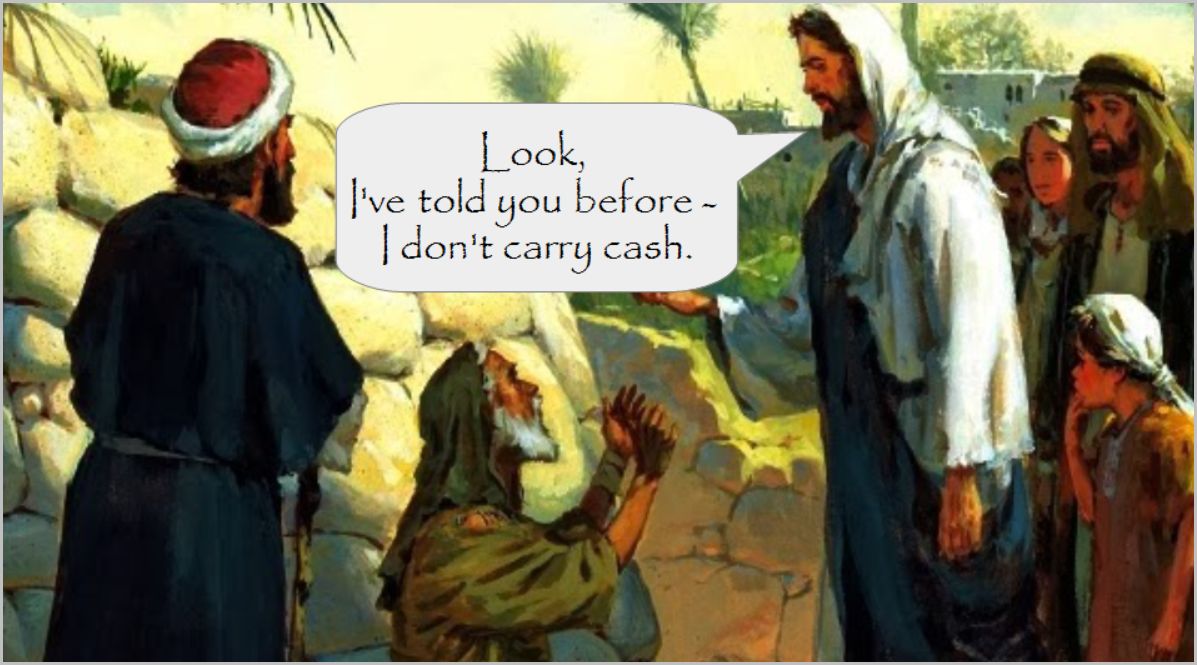
God wants you to beg

beggar2 What do God and the Queen have in common?

Neither of them do money. Famously, Queen Elizabeth II never carries cash. It’s not like she’s ever going to find herself out of milk so that she has to dash to shop for some. Even if she did, she wouldn’t be expected to pay for it. So she doesn’t need to bother with money.

Same with God. He’s less likely to run out of milk, it’s true, but he does lots of important work in the world and a bit like the Queen, who is funded in large part by the British tax payer, he expects everyone else to cough up what’s needed.

Though he’s a God of abundance who supplies whatever is asked of him, he just can’t bring himself to do money. We know this because those humans who work for him here on earth constantly have to beg other people for it. When they’re busy getting his Word™ out to those who don’t have a Bible of their own, the Lord refuses to pay a penny. Likewise, he declines to assist the brave souls who work tirelessly protecting one-man-one-woman marriage, which, as they tell us, was all his idea in the first place. Nor does he support building Noah’s Arks theme parks ($18 million in tax perks helped with that one), church maintenance (tithes anyone?), helping the persecuted or feeding the hungry. He’ll do all he can to help, naturally, just so long as he doesn’t have to put his hands in his pockets and get them grubby handling cash.

No, what all these noble causes need they have to raise themselves, which is why every single Christian enterprise begs for money, not from God who they know won’t help, but from fellow human beings. ‘Search your heart,’ they tell the gullible, ‘and ask the Lord what he would have you give us.’ Could this the same God of whom Paul says, “He is able to make every blessing of yours overflow for you, so that in every situation you will always have all you need for any good work” (2 Corinthians 9.8)? It surely could. And this being so, why, when he specifically directs his people to create projects that will make his Kingdom a reality, does the money not come pouring in to the point where it ‘overflows’? God being God could make it happen supernaturally or, if that’s a little too ostentatious, by more mundane means. But he doesn’t, hence all the begging.

Like his love, God’s provision is met only through other human beings, be it money, food, love or, most importantly of all, spreading the Word™. You have to wonder, when he finds himself incapable of supporting even his own causes – and they are his own causes because those who operate them on his behalf tell us so – whether he has the remotest interest in any of them.

Which might just be because it’s all a delusion.

The Lord really wants you to support the efforts of this site. Send cash only in a plain brown envelope and he will surely bless you.


Silence of Mind

ThinkerThe anonymous blogger over on Silence of Mind, (we’ll call him ‘SoM’) is arguing that Christianity is responsible for Western civilisation. He does so even though others have pointed out to him that the essential elements of a civilised society – democracy, the rule of law, moral codes, mathematics, scientific enquiry, medicine, education, art, literature and architecture – were all evident in human societies millennia before Christianity emerged.

SoM goes further, however, insisting that Western culture owes its existence solely to Christianity. He doesn’t demonstrate how this is so; he is content to assert that it is. He is, of course, confusing correlation with causation, failing to recognise that Christianity’s involvement in the development of Western society does not mean it was the cause.

Having reach this insupportable conclusion, SoM makes an even greater leap of faith by declaring that because the Christian faith created civilisation as we know it – we’ll ignore, as he does, the church’s suppression of so much that is integral to a civilised society during the ‘dark ages’ – then Jesus must therefore be God. Here’s how he puts it:

1. Jesus established the Christian religion.

2. Christianity became the religion that spawned Western Civilization.

3. Western Civilization is the only civilization in human history to have developed modern science.

4. Modern science proved the existence of God

5. Since only God can reveal God, Jesus of Nazareth must be God.

So wrong in every respect:

1. Jesus did not establish the Christian religion. Paul did.

2. Christianity did not spawn Western civilisation (see above).

3. Western civilisation is not the only one to have developed science, and where it has emerged has often been in spite of religion, not because of it.

4. Science certainly has not ‘proved’ the existence of God. It has no interest in the so-called ‘supernatural’ nor, indeed, in ‘proving’ anything. It is significant that none of the explanations science has arrived at require the involvement of a god.

5. ‘Since only God can reveal God, Jesus of Nazareth must be God’ is a non-sequitur; it doesn’t follow from anything that has gone before, as flawed as all of the previous assertions are. What SoM is claiming here is that because “1, 2, 3 and 4 are the case (though I have failed to demonstrate they are and in fact they are not), then A must equal B”.

In the end, SoM’s ‘argument’ is the same as saying that because there is a place called Greece, Zeus must really exist. Or because there are tea-shops, we can be certain Bertrand Russell’s teapot is orbiting the sun, forever just out of sight.

As proof of the divinity of Jesus, the argument from the scientific and cultural achievements of the West has to be one of the worst. All arguments (and SoM’s assertions can hardly lay claim to the term) that attempt to demonstrate how an abrasive, inconsistent zealot from a Palestinian backwater was secretly the God of the Universe are equally worthless while God himself remains unproven, as he always must.

This is why believing anything about him and about Jesus’ supposed divinity is called ‘faith’. If it were possible to prove the things held on faith, then faith wouldn’t be necessary. But it is, because believing the impossible and the unprovable can only be managed by by-passing and, yes, silencing the mind’s critical faculties.

Imagine… no religion

Jimenez2People say, like, you know, “Aren’t you sad that 50 superstitious nut-jobs died?” Here’s the problem with that. It’s like the equivalent of asking me, you know, what if you asked me, “Hey, are you sad that 50 Christians were killed today?” Um, no, I think that’s great! I think that helps society! You know, I think the world is a little safer tonight!…

The tragedy is that more of them didn’t die… because these people are predators! They are abusers! They take advantage of people! And look, as Rationalists, we need to take the stand that it is not our job to sit there and say, “Oh, this is a tragedy” or “Oh, this is something we mourn.” Look, everything tells us these are deluded, wicked people. These are evil people.

… People sometimes will say, “You guys are advocating violence!” We’re not advocating violence! We’re not saying we should go do this! But we’re just saying this: If we lived in a rational nation with a rational government, then the government should be taking them… I wish the government would round them all up, put them up against a firing wall, put a firing squad in front of them, and blow their brains out. If we lived under a truly secular government that loved rationality and loved children, and wanted to protect them, that’s what we’d do.

Hate speech? Certainly. But not mine. The original, which you can find here, is about the Orlando shootings a few weeks ago, and is directed at gay people. I’ve simply replaced gentle ‘Pastor’ Jimenez’s use of ‘sodomite’ and ‘paedophile’, which he disingenuously uses interchangeably, with ‘Christians’ and ‘religious nut-jobs’, and his use of ‘God’ and ‘righteous’ with ‘superstition’ and ‘rational’. Jimenez, emissary of a religion of love (Matthew 5.44 etc), would like to see his government exterminate LGBT people.

But, you know, maybe there’s also a case to be made for eliminating the superstitious and irrational from among us. Those of us who have adopted a rational basis for our lives would be happy to see the end of religion and superstition, the removal from the Earth of the religious and the superstitious (I use the terms interchangeably). After all, what do believers in mumbo-jumbo add to the world that is any way positive? What can those who are unable to engage with reality without the crutch of make-believe possibly have to give? On top of their general uselessness, they’re also dangerous and predatory.

Maybe there is a case to be made. But I’m not making it. Any philosophy, ideology or religion that preaches the extermination of other people is wrong, debased, corrupt (you’d think, wouldn’t you, that we’d have learnt that by now.) If you subscribe to such a view – be it from a Christian, Islamic or Jewish perspective – you are wrong. No-one, whatever magic books may say about them, merits death simply because those magic books say so (ratified, of course, by the dim-witted prejudices of those who subscribe to them). Rationality and a secular perspective, on the other hand, eschew hatred and are philosophically opposed to harming those who might not agree with them. Yes, even the religious.

In this way it is vastly superior to religion – your religion, whatever that happens to be.

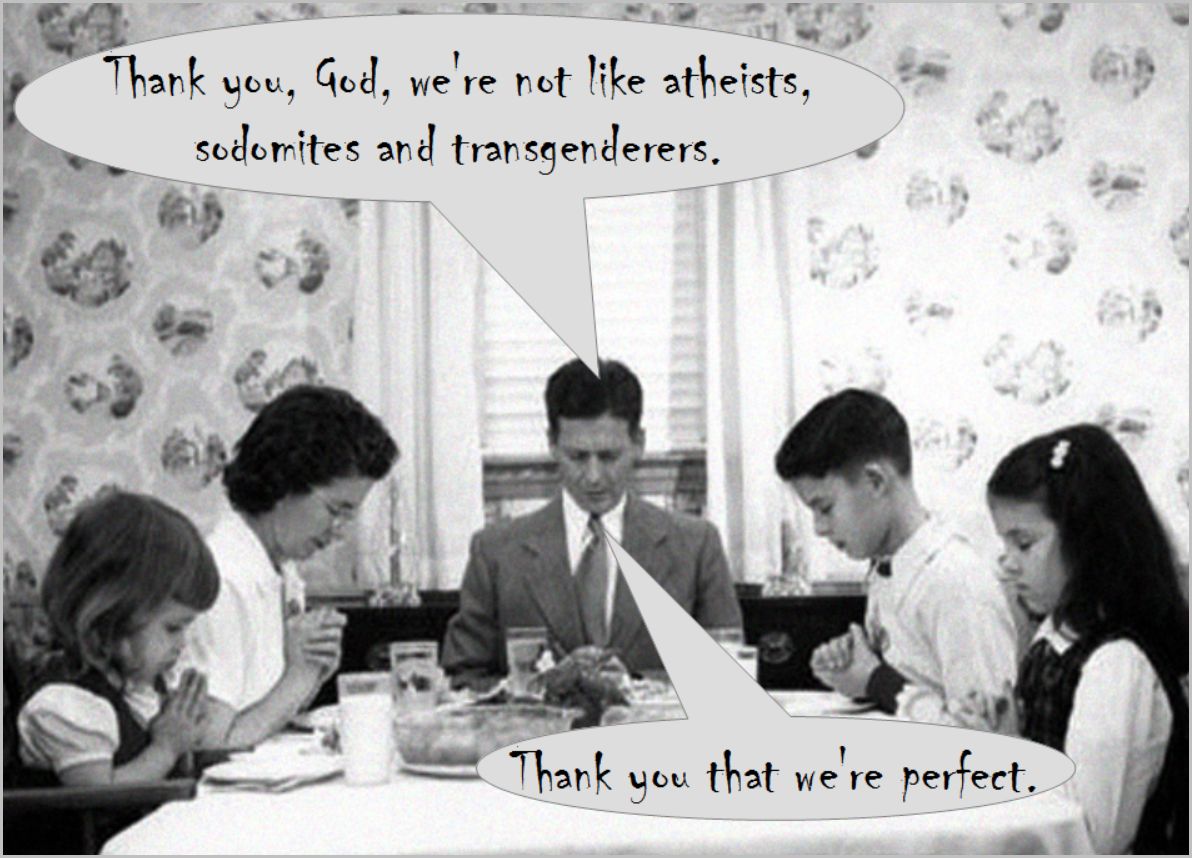
Sweet and sour, nasty and nice

or, whatever happened to Luke 18.11-14?

prayer2Why is it when people are emotionally blackmailed into becoming followers of Jesus, does their conversion make them sweet and sour, nasty and nice at the same time? The sweet and nice parts are what their new experience does for them. They get a new start of sorts, are introduced to like-minded friends in the church and become compelled to share their new joy with everyone else, whether they want to hear it or not, about how much they’ve changed because of Jesus. It’s nice for them. Deluded too, but if it makes them happy then why not?

This is why not. What they don’t tell you, not at first anyway, is how sour and nasty they have also become; how they must now defend God’s standards, because, as everyone knows, the omnipotent God of all creation is incapable of defending them himself. Being born again and morphing into ‘a new creation’ involves, without exception, becoming judgemental of others, condemnatory, inflammatory, bigoted and spiteful.

You think not? Then you haven’t heard what these same Christians think about abortion and women who have them. Homosexuality and those who are gay. Transgenderism and those born in the wrong body. Science and those who value evidence. Atheism and those of us who see through believers’ sad delusion.

Christians don’t, as some of them profess, hate the sin but love the sinner. They despise those who have philosophies different from them, those who live differently from them, those who are different from them.

A recent BBC poll asked if the world wouldn’t be more peaceful without religion. Here’s the results as of 14th July 2016:

Poll

I don’t know how many people this represents nor where they’re from – the site doesn’t say – but it would seem that most of us would think we would be better off without religion. It’s long past time we were able to be; religion has nothing to offer. It’s time we stopped giving it special treatment because some of it is sweet and nice. Its sour, nasty aspects are just as much a part of it, inseparable from whatever positives its adherents say it has. I’ll be looking soon at how we might push back against religion’s pervasive and poisonous influence in society.

The Stuff Christians Say… (part three)

DoorToDoorAtheists are aggressive/militant/unreasonable: The Christians might’ve got us on this one. After all, it is incredibly irritating when we atheists start preaching in the town centre or invade others’ events to tell them what to believe or dish out loony pamphlets or turn up at people’s doors when they’re just about to have their tea. And what about all those meeting places we have, on just about every corner of the city, with smart-arse posters about Adam and Steve on the board outside? And let’s not forget our readiness to blow up ourselves and others in the name of our great cause. Now that’s ‘militant’! Yes, we atheists really do have too much freedom to push our views on others. No wonder we’re so insufferable. (Note to self: check you’ve got this right.)

It takes more faith to be an atheist than a Christian: It takes no faith to recognise there are no supernatural beings. It takes no more faith not to believe in God – or to acknowledge that there is no God to believe in – than it does not to believe in Santa Claus, Poseidon or Ra. Christians themselves require no great abundance of faith to dismiss these characters. Is it so difficult to understand that atheists disregard the Christian pantheon of fantasy figures in exactly the same way? Or are believers practising their dishonesty-for-Jesus again? There is no faith involved in being an atheist. On the other hand, believing in an omnipotent but suspiciously inactive God, a super-hero Saviour, a magic Spirit, angels, cherubim, seraphim, demons, Satan, resurrected saints, Heaven, Hell and all manner of powers and principalities – this requires faith in delusional quantities. No atheist could possibly compete. Nor would they want to.

The Stuff Christians Say… (part two)

Balaam

Atheists don’t behave as evolution says they should: This ridiculous accusation is often slung at atheists by Christians who seem to see it as some sort of stinging rebuke. Answers In Genesis is very fond of it; the Hamster’s drones and other Christians seem to believe – without ever thinking it through (plus ca change) that because those who acknowledge the veracity of evolution don’t behave according to its principles they are somehow inconsistent in their ‘beliefs’ – hypocritical even. They seriously propose that because natural selection and the survival of the fittest (not one of Darwin’s phrases) are cruel, uncaring processes, then that is how, for the sake of consistency, atheists ought to behave too. We shouldn’t care, they say, when a child develops cancer or someone dies. We shouldn’t attempt to cure illness or work to prevent suffering because these are nature’s way and part of the mechanism of evolution.

While it’s true they are, it’s been a long time since our behaviour, our existence and continued success as a species has been solely determined by what nature does. Humans regularly override its mechanisms, natural selection included; every time we use birth control, show compassion for the weak, heal the sick, develop medicines, engineer genes and preserve life. And so we should.

Christians seem unable to comprehend that evolution is not a pattern to be followed. It is not a set of instructions for living, a prescription or a set of (a)moral guidelines. It is the best explanation, supported by considerable amounts of evidence, of how life developed on the Earth. As such it makes no ethical claims nor does it demand that its principles be blindly followed (that’d be religion). Are Christians truly unable to detect this difference?

Atheists have no reason to be moral: I’ve looked at this ignorant claim before. Of course we have reason to behave morally. We’re human, we live in human society. Morals help us do so while doing the least damage to ourselves and others. They may also enable us to bring some happiness or comfort to those around us. Atheists don’t look to an imaginary God to tell us how to be good; our morals come from our culture, upbringing and education. Christians’ morals do too, whatever else they may claim. They certainly don’t get them from that most immoral of books, the Bible.


to be continued…