Respect

Even before the events in Israel and Gaza, there were numerous recent examples of the term Islamophobia being used to suppress freedom of expression or shield wrongdoing.

A recent report by an all party group of UK MPs.

I’ve been told before that I should respect people’s religious beliefs. We all should apparently.

I can’t, I confess, summon respect for patent nonsense, nor for those who subscribe to it. I’m not even going to try.

There have, I admit, been a few believers I’ve met in life for whom I have had respect and even admiration, but this has been for the kind of person they were, not because of their religious beliefs per se. And no; their religion is not what made them admirable people. They were admirable irrespective of, or even despite, their irrational beliefs. I still hold to the theory of my own making, that religious conviction is like alcohol: both accentuate the existing characteristics of the individual, making them more of the person they already were, for better or for worse.

Equally, I’ve met many non-believers (I hate it that we have to describe ourselves as what we are not), LGBT people (for many religionists, the antithesis of admirable) and individuals whose views and outlook on life I haven’t necessarily agreed with, for whom I have also had respect and admiration.

It comes down to the old cliche, a truism nonetheless, that respect has to be earned. Just because someone believes in the supernatural or that Jesus died for our sins or that their deity or prophet trumps all others doesn’t mean I have to respect such views, or indeed those who hold them.

But this is where we’re headed, it seems. We’re expected to respect any old make-believe so long as it comes under the banner of religion and still more that doesn’t. It’s becoming ‘hateful’ to criticise religious belief and those who practise it. Because their views are sincerely held, the thinking goes, they merit protected status.

I commented some time ago on a Christian site (something I rarely do except when incensed) that was insisting ‘sodomites’ would burn in hell, because… the Bible. I countered that gay people were not going to hell because, in fact, no-one was. As well as the subsequent ‘loving’ comments from Christians, I was taken to task by a gay person telling me I was disrespecting the original poster’s Christian convictions.

Likewise when I suggest that we should be more wary of Muslim beliefs I’m told I’m being profoundly unfair, racist and Islamophobic, towards a minority – as a minority of one myself – and I should show more respect for an ancient and sacred tradition as well as those who subscribe to it.

I can’t do it. I can’t respect religious belief. It is no more worthy of respect than astrology, palm reading and spiritualism. It flies in the face of rationality. Not only is it insupportable, it is dangerous, a threat to hard-earned freedoms and rights.

Who Decides What A Culture’s Values Are?

Did you decide? Would you prefer to live in culture based on Christian, Islamic or Marxist values? According to some Internet Christians, these are the only choices available. Of course anyone with an ounce of sense and a modicum of honesty knows they’re not.

I choose to live in a society that is not dominated by cherry-picked Christian values, or indeed ‘values’ derived from any religion. I reject the claims of them all, including their demonstrably false notion that I and my fellow citizens cannot behave ourselves unless controlled by a morality imposed by an imaginary deity. Likewise, I don’t care to live in a culture determined by an extreme political ideology that serves only one part of society: usually the elites who devise the ideology in question.

Instead I choose, or rather was fortunate enough to be born into, a relatively liberal democracy, capable of determining its own values. These are largely secular and humanistic and include, amongst others, the rule of law, tolerance, and freedom of speech and movement. Of course the UK has never fully realised these aspirations but there has always been a sense, since the 1960s, that we were moving towards them. Perhaps I’m naive to think this, given the turbulence of the Thatcher years and President Blair’s mania for regulation, but overall it used to feel that we were moving gradually towards a fairer, more reasonable society.

It doesn’t now. The elites have embraced a wokeness that benefits a limited few and have redefined terms – ‘woman’, ‘crime’, ‘offence’, ‘hatred’ and ‘phobia’ among them – which has impacted negatively on personal rights and freedoms. They have reinterpreted the law so that it benefits vocal minorities while side-lining the majority. They have repeatedly reneged on promises and over-reacted to the crises of recent years – Covid in particular – by granting themselves greater powers to manage their own over-reaction; powers which, once each crisis has passed, they have declined to relinquish. The values of Britain today, as imposed by the governing classes, are overly woke and authoritarian. In my 68 years, I have never felt as micro-managed in my personal life as I do today.

So, I do understand why there are those who call for the return to what they perceive as Christian values or a cultural Christianity of church bells and hymn singing. I understand too the fear of some that the waning of Christian influence will see extreme Islamic values fill the vacuum. This seems to me to be a real possibility and one that would prove seriously detrimental and damaging to British society. However, attempting to resurrect nebulous ‘Christian values’ in order to prevent more intolerant ones from being imposed is no solution.

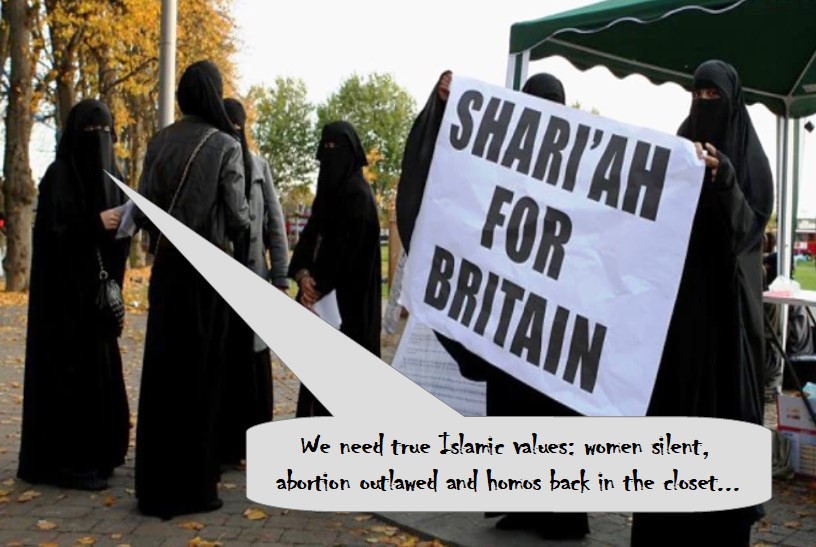
We need to be clear about our values and assert those we aspire to: tolerance, liberalism, democracy, freedom of speech, rights for all, equality under the law and, I would add, truthfulness, honesty, fairness, consideration and reasonableness. For a time, this may very well involve being intolerant of intolerance, whether derived from Christianity, Islam, wokeism or political ideology. In particular, we need to stop conceding ground to Islam and resisting the demands of Muslim activists when they conflict with the values and aspirations of the majority.

Perhaps none of this will matter to me, given I’m not going to be around for many more decades (if that). But I would like the Britain my grandchildren grow up in to be one that reflects humane, secular values. I fear for them that it might instead operate on the basis of oppressive, intolerant religious ones.


free speech

Why We Can’t Return To Christian Values

There has been a spate of articles recently advocating for a return to Christian values in the UK. Some, like that by Madeline Grant, don’t specify which values they have in mind. Nonetheless, Ms Grant worries about these unspecified values being replaced by the ‘terrible new gods’ of wokeism, while Douglas Murray – an agnostic commentator I admire and enjoy a great deal – argues for the revival of Christian forgiveness. Elsewhere, Richard Dawkins repeats his call for the preservation of ‘cultural Christianity’ in the face of less ‘decent’ religions like Islam.

I’m sure there are good arguments to be made for exercising more forgiveness both in our personal and national lives, though the idea is not without its difficulties. Dawkins too is right to express concerns that the vacuum that may be left as Christianity declines might be filled with more unsavoury and less charitable values.

But what are the Christian values that these writers see less of in modern life? For Dawkins it’s the chiming of church bells and rousing hymns, which, as pleasant as these are (I would not like them to disappear either) do not have any bearing on our morals and values.

According to Total People, our values in the UK are Democracy, the Rule of Law, Respect & Tolerance and Personal Liberty. Certainly the UK has long regarded itself as a tolerant country – though those on the receiving end of intolerance in the past (early immigrants, gay people for example) might disagree – and we have always aspired to show respect without necessarily achieving it. Our morals on the other hand, especially with regard to sex (and Christians invariably mean sex when they talk about moral decline) have changed over the last 30 or so years, becoming more tolerant of, for example, same-sex relationships and less accepting of adulterous or abusive ones.

The question is, however, do we owe our values and morals to Christianity? I’ve argued before that we don’t. I’ve also tried to demonstrate that there is no time in the past we could pinpoint and say, ‘here’s where the country demonstrably and consistently upheld Biblical principles, showing us just how far we’ve fallen since.’ I applied this criterion to the USA when Don Camp suggested there was a now lost Christian golden age, taking random points in US history and demonstrating there never was a time when Christian values prevailed. Any such golden age is a myth, in the States, the UK and anywhere else. It always has been so; read Paul’s first letter to the church in Corinth to see how far even early cultists fell short of his ideals. Christians themselves don’t and never have demonstrated the high standards the bible demands.

Why is this? Because Christian morals and values are impossible. Even those who think they live with the Holy Spirit in them fail, and frequently fail dramatically, to practise what they preach. They don’t love their enemies, a ridiculous expectation of Jesus’s that certainly can’t be extended to nations. Many of the righteous don’t demonstrate love for their neighbours (other than bombarding them with the gospel) and frequently showing an appalling lack of empathy for fellow-believers (take a look at the abuse that goes on in the church at large.) They don’t, in the main, sell all they have and give the proceeds to the poor; give to anyone and everyone who asks and give away their shirt as well as their jacket when it’s demanded of them. They do judge others but don’t – sorry, Douglas – forgive fellow-believers seventy times seven, let alone those of us they regard as the great unwashed. Perhaps it’s as well; what would a culture be like that repeatedly forgave its criminals, abusers and bullies?

The frequently ignored Golden Rule of ‘do onto others as you would have them do unto you’ predates Jesus by centuries, while the more realistic, secular version of it, tolerance and respect, likewise doesn’t derive from the Bible, Jesus or the church. This Holy Trinity of terrors demonstrate a marked absence of tolerance and respect for any positions other than their own and ‘personal liberty’ is not a concept known to them. Didn’t Jesus insist his followers become his slaves? His Father, meanwhile, is intolerant of everything human beings do and everything they are.

A Christian who commented on Grant’s article asked those who disputed her premise – that we need to return to Christian values – whether they would prefer to live in a country dominated by Christian, Islamic or Marxist values. I’ll leave his question with you – answers on a postcard please – and return to it next time.

.

Religiophobia?

Is criticising Christianity and the way some people practise their religion a form of Christophobia? Strictly speaking a phobia is an irrational fear of whatever precedes it, as in homo-phobia, trans-phobia, Islamo-phobia and the like. In the accusations of whatever-phobia we hear today – and they invariably are accusations – ‘phobia’ seems to have come to mean ‘hatred of’; a hatred of Christianity and therefore of Christians; of homosexuality and therefore of gay people; of trans-people; of Muslims and so on.

Reasonable criticism of belief systems is not hatred. I don’t and am sure I never have had a hatred of Christianity or of any other religion. I certainly have views about Christianity as a seriously flawed, cock-eyed superstition (I hope I’m not giving my position away too early.) Reasonable criticism of it, mockery even, is perfectly legitimate, for reasons I’ve outlined before, just as criticism and mockery of any belief in the fantastic is legitimate. Ideologies based on belief in imaginary beings do not automatically merit respect nor do they have a de facto immunity from criticism. The same applies to those who subscribe to such fantasies, particularly when they attempt to force them on others. Calling out believers on their inconsistencies and hypocrisy is perfectly reasonable.

Is it fair then to express critical views of homosexuality and by extension of gay people? Of course. We are not immune from reasoned criticism, though much of it doesn’t qualify as ‘reasoned’; we have suffered much from emotional reactions to our existence and still do. (See Bruce’s recent post in which Republican North Carolina’s lieutenant governor, Mark Robinson rants about godless homos. When comment deteriorates into vitriol it becomes an incitement to hatred and, sometimes, violence. When this happens, the modern sense of phobia is justified.)

Islam is as irrational as Christianity and other religious belief systems. It is as legitimate to criticise and, when appropriate, to condemn Islam, just as it is Christianity. It is reasonable to question Muslim’s treatment of women, to insist it is inappropriate, particularly in a Western context. It is appropriate to oppose Muslims’ opposition to Western values rather to accede to their opposition to, for example, freedom of speech or the teaching of evolution and sex education in schools. It seems increasingly to me that in Britain we are conceding too much to Islam and to Muslims because we fear both the accusation of Islamophobia and, not entirely irrationally, a disproportionately aggressive response. Reasonable criticism of a belief system and those who subscribe to it is not hateful. We have a duty in a largely secular society to say so. To resist irrational belief in the supernatural when that belief, be it Christianity, Islam, Judaism or any other of the 4,200 religions human beings have dreamt up seeks to impose itself on others is neither hateful nor irrational. It is essential.

I‘d write more about Islam if I knew more about it. I’m disinclined to learn more, however, having already wasted much of my life in thrall to that other ‘great’ religion, the one I spend so much time deconstructing here. Who needs to know more about another? Saviours, Prophets, Gods, angels, signs and wonders – they’re all equally meaningless. Instead of claiming they’re victims of Christo/Islamophobia, religionists would do well to develop thicker skins as we ‘abominations’ and ‘perverts’ have had to do. They should ask themselves whether criticism of their practices and worldview is justified. They might just find it is.

No God and the Domino Effect

This a response to Don Camp’s comment on my post The Evil of Christianity, in which he tries to isolate ‘the crux’ of our disagreement about the Faith.

You start, Don, from the assumption that there is a God. I, on the other hand, have considered the evidence and concluded that in all probability there isn’t one. Certainly not the Christian God. There may be a god out there somewhere that has no interest in human beings and their affairs, though I doubt it. As far as we humans are concerned such a deity is as good as non-existent, being entirely hypothetical. If it is out there, it certainly won’t be offended at my saying so.

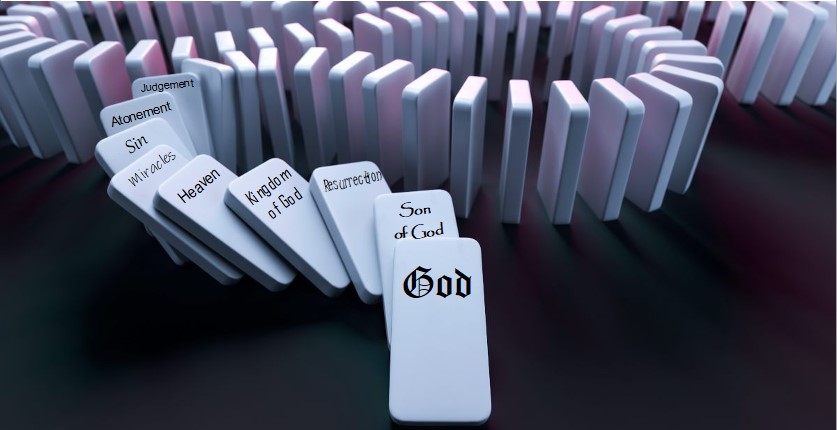
Once I realised some years ago that a personal God did not exist a number of other things followed (or rather, collapsed):

No God means no Son of God or God Incarnate, no Saviour or Christ.

No God means no resurrection (which Paul makes clear was a work of God).

No God means no Holy Spirit.

No Holy Spirit means no regeneration of individuals to become new creations in God (you only have to look at Christians today to see this is the case.)

No God means no grand Salvation plan.

No God means no Heaven, no Final Judgement, no Kingdom of Heaven of Earth, no Eternal Life.

No God means the universe can’t have been created by him.

No God means no manipulation of evolution, no intervention in human history and no prophecy of things to come.

No God means that the world would be just as we find it: messy, beautiful, dangerous, turbulent, indifferent.

No God means prophecy is man-made and comes to pass at no greater rate than chance allows (i.e. practically zero.)

No God means conversations with ‘him’, revelations from him and visions of him are all imagined, generated by and within the human brain, which works in mysterious ways.

No God means no God-given morality. Morality is, as you say, culturally determined and so may and does change over time. (You can see this in the Bible itself where morality supposedly handed down by God for all time evolves throughout the Old Testament and into the new.)

No God means there is neither Sin nor Righteousness. These are religious concepts. The whole spectrum of human behaviour, from destructive to altruistic, is demonstrated by believers and non-believers alike.

No God means assertions like ‘the issue turns on what I perceive as good for me versus what God declares is good for me’ are illusory. What is good for you is what you have worked out, even if you think God had a hand in it. A supernatural being who doesn’t exist cannot be responsible for your well-being, though your church and the bible undoubtedly contributed to your conditioning.

No God means individuals must work out their own meaning and purpose. Some do, some don’t, as you observe, Don. This is as true of believers as it is for non-believers. Many atheists have managed it, or not, without having it imposed by religion. And despite what you say, Christianity is a religion. It is the epitome of religion.

No God means none of the Abrahamic religions are true and therefore Christianity and its ‘holy’ book, being based on an invalid premise, must be false. Most of the posts on this here blog are about demonstrating this fact.

No God means all gods are man-made, not all gods except one.

The crux of the matter is you believe in God while I see how unlikely it is that there is one. I’d agree with you if I could, Don, but then we’d both be wrong.

The Circular Reasoning of Apologists

This is what what we’ve got so far:

Human behaviour is controlled by beings from an invisible, undetectable spiritual realm. We know this invisible, undetectable spiritual realm exists because of the effect it has on human behaviour (even if dumb old atheists can’t wrap their minds round the fact.)

Circular reasoning, not evidence.

The synoptic gospels rely on an earlier oral tradition. We know there was an earlier oral tradition because the synoptic gospels rely on it.

Circular reasoning, not evidence. (The same applies to Q.)

We know the stories about Jesus are indisputably true because they’re in the gospels that no-one at the time disputed. We know the gospels are indisputably true because they tell us stories about Jesus that at the time no-one disputed.

Circular reasoning, not evidence. There is no corroborative, independent evidence for any of the stories about Jesus. (I’ll get to the indisputable claim soon.)


The Guilt Legacy

A couple of nights ago I watched a programme called Jehovah’s Witnesses and Me fronted by Rebekah Vardy. I know nothing about Rebekah apart from the fact she’s a footballer’s wife who was recently involved in a social media scandal, but her reflections on being brought up in a Jehovah’s Witness household were honest and sincere. She said one of the legacies of her mother being ‘disfellowshipped’ when she, Rebekah, was 8 was that she felt, and still feels, guilty about much in life. The teaching of the organisation was, as it is in many evangelical churches, that the individual is a hopeless sinner who cannot please Jehovah, though must nevertheless endeavour to work out their own salvation. For JWs this involved (and still does, as you may know from personal encounters with them) going door to door and standing for hours on end in public spaces with a trolley-full of Watchtower publications.

I could relate to Rebekah’s feelings of guilt. While not a Jehovah’s Witness (I was never that gullible) my years as a Christian left me with a legacy of guilt. For many years it was the dominant emotion of my life. While a Christian I constantly felt I was letting God down: not as good a Christian as those around me, not witnessing enough, listening to pop music instead of worship songs – practically anything could trigger my not-good-enough feelings. I also felt responsible for anything that went wrong, even when I couldn’t possibly be, and guilt about my secret sexual feelings and, most especially that I wasn’t been a good enough father. To this day, I feel awful if I’m unable to help with my grown-up children’s problems. I am moving away from such fruitless thinking, and recognise that possibly I am naturally inclined to blame myself for events both within and outside my control. Christianity nonetheless exacerbated the problem, with its emphasis on the sinful worthlessness of the individual who is nothing without Jesus. I have, I’m pleased to say, got a lot better since abandoning its negative anti-human philosophy.

What scars has religion left those of you who are escapees from religion with? I’d be more then pleased to hear it’s none, but most of the ex-Christians I know have not come away unscathed. Feel free to share in the comments.

What Happens Before We Die (according to me)


Did you ever go to a party when you were a child and your parent told you it was time to leave before you were ready? That’s how I feel about death. I’m enjoying the party too much to want to leave. Although my ‘parent’ hasn’t told me it’s time to go just yet, I know they will before I want to. I can’t see me ever being ready really, though perhaps whatever cruelty nature visits upon my body and mind in years to come will change my mind about that. But as things stand, despite my fibromyalgia (a constant painful companion) and the levels of anxiety I allow myself to feel over trivial matters, I really have too much to live for. My partner Dennis and the adventures we have together; my family with my lovely grandchildren; my friends with whom I spend many good times; the many, many simple pleasures of life; everything I still want to do and try.

So, as the days, months and years roll by at an alarming rate – there’s definitely more of life behind me than there is front of me – it’s these things that matter in my life. 

All of this might suggest I’m afraid of dying. While I doubt the process of dying will be much fun, having so much to live for – enjoying the now – dispels, perversely, the fear of death itself. I’ll face it when I get to it, raging, I hope, against the dying of light, throwing a shameful tantrum because the party will go on without me. I’ll die, though, in the knowledge I actually got to it when so many didn’t. I’ll have enjoyed it too, for the most part, with a only a few bad times, fewer regrets and many more memories.

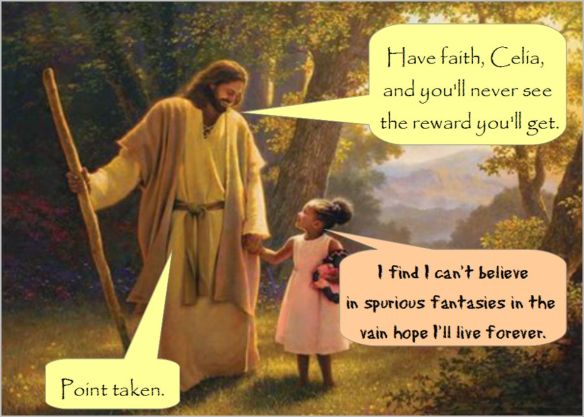
As Christians often tell those of us who are delusion-free, I am without hope. Of course I have hope – in continued days and achievable happiness – but none that there’s existence beyond death. I am confident there isn’t. Consciousness is completely dependent on the brain; when my brain dies, so do I. That will be that. The fantasy promoted by the New Testament, that there’ll be eternal life in a new body, is nothing but hopeless wishful thinking, that in spite of overwhelming evidence we go on. There is instead serenity and purpose in accepting the reality of death. It’s part of the deal, after all.

So let’s all eat, drink and be merry, as Ecclesiastes says. Enjoy life and help others, where we can, to enjoy theirs.

____________________________________________________

Dennis and I will be on one of our adventures when next I’m due to post. While I’ll set WordPress to publish it, I can guarantee it won’t. If I can do it manually (depends on whether I have a signal) I will. Otherwise I will see you on my return.

10 Reasons Why

I wonder what are the reasons those of you who were once Christians gave up on faith? Believers who know me far better than I know myself have attributed to me a whole range of motivations. Here’s a top ten of the reasons I rejected Jesus according to these spiritually astute know-it-alls:

In at 10 it’s…

You must have been hurt/had a bad experience of Christians. To which I answer, not particularly, though I did find the people I encountered in churches to be much like those I encountered in any other organisation I’ve been involved with. No different. Certainly no better, and in some ways worse when they squabbled or were petty and judgemental. Not sufficiently worse to make me abandon faith, but perhaps enough to make me ask whether Christianity really ‘worked’. Shouldn’t Christians who are new creatures, reformed in the image of Christ. be so much better than the rest of us?

At 9… You went to the wrong church. If so I must’ve attended several ‘wrong’ churches as I moved around the north of England with work. My wife and I always sought out churches with sound biblical teaching, so it wasn’t the lack of solid food that caused me to backslide (to use the Christian jargon.)

8. You wanted to wallow in your own sin. As I’ve said facetiously before, I like a good wallow as much as the next man and preferably with him. Back in the days of my struggling with faith, however, I didn’t find myself drawn to ‘sin’. I was trying to raise three children, do a demanding job and deal with the fallout from my boss’s affair with a colleague. My own sin was the last thing on my mind.

Related to this is the accusation that an apostate such as I wants, in some unfathomable way, to be God. Certainly I want to be fully human and to take charge of my own life, but aren’t these laudable intentions? It doesn’t mean I aspire to be God; I don’t want to be worshipped, don’t want to laud it over others, blame them for my deficiencies or send them to hell. That’s what God does, right? But it’s not me. 

7. You rejected Christ because you’re gay and didn’t like the constraints faith placed on your sexual behaviour. See above. I didn’t admit I was gay until several years after I ditched faith and it was several more after that before I came out, yet more until I did anything about it. But okay, if you want to reverse the order of events, I gave up on religion because I was latently gay. But not really, though certainly the abandonment of faith was a liberation; I could think for myself and was free, over a long period of time, to finally become myself.

6. You read the wrong books. I certainly did: C. S. Lewis (I still have my collection of his books), John Stott, John Piper, John Bunyan, Bonhoeffer, Joni Erickson, Corrie Ten Boom, Billy Graham, David Wilkerson… and the Bible. So yes, I wasted a lot of time reading this sort of thing, but I’m guessing that’s not what my Christian accusers mean. I read more widely as I moved away from faith which helped me break out of the Christian bubble, but this wasn’t the reason I left the faith. I was well on the way by this time.

5. You were never a true Christian. Your faith was intellectual or habit or emotional but not deeply personal. Of course I was a true Christian. Just ask Jesus. Oh… you can’t. I’ve written about this before as you’ll see here. I was as real a Christian as those who claim they’re the real deal now.

4. You were in thrall to non-Christian writers. Not in thrall, no, but these writers – Ehrman, the so-called New Atheists, science writers (Dawkins’ science books particularly), Pagels, Barker, Loftus, Alter and, yes, Carrier – make a lot more sense than those who write from the perspective of faith. These authors don’t seem to mind, indeed they relish that their readers think critically about the evidence they present. Mumbo-jumbo isn’t passed off as erudition.

3. You have no awareness of the spiritual; you think that only that which can be measured is real. This is true, but it is not why I gave up Christianity. It is a consequence of doing so. I have seen no evidence of a spiritual realm that exists outside the human imagination. If anyone is able to present evidence that it does have independent existence, I’m open to it. Until then I will continue to live with the understanding that angels, devils, demons, heaven, hell, celestial saviours and gods, like unicorns, dragons and Shangri-La, do not exist. It follows that as non-existent beings they cannot communicate with us nor await us as our final destination.

2. Your heart has been hardened by Satan. See above; there is no Satan. Hardening of the heart is a metaphor for those who don’t fall prey to Christianity’s fraudulent claims or at last see through them.

1. You gave up on faith because you realised none of it was true. Yes. Finally. This is why I rejected Christianity. It simply isn’t true, as I’ve attempted to demonstrate on this blog for the last 12+ years. Its third-rate fantasies, fake promises and failed prophecies are all evidence of its falsity.

But wait. None of the telepathic Christians who ‘know’ why I’m no longer a believer ever make this accusation. They would never concede that most (all) of what they believe simply isn’t true. But my life experience and my reading as I began to suspect Christianity was nothing more than a con have borne this out. Christianity is demonstrably untrue, theChristian God a fraud and supernatural-Jesus a fiction. This is why I abandoned Christianity.

How about you?

This time it’s personal

Desperately searching for another reason to dismiss recent critiques of Christianity, Don has suggested that my views and those of commenters here are somehow invalid because they’re ‘personal’. (I declined to publish Don’s latest comment in which he elaborated on this theme; not only was he already on enforced rest but he also decided to have a rant about ‘sexual depravity’. This would appear to have been directed  at my own happy same-sex relationship, as well as all other forms of consensual sex that God Don disapproves of.)

So what’s wrong with ‘personal’? My faith, when I had it was personal. I’d prayed the sinner’s prayer in which I confessed I was a sinner and I received Jesus into my heart (or so I thought) and began to live my life in accordance with what he required of me. This personal relationship with Jesus, as it was usually described in evangelical circles, was reinforced by the preaching I heard in church, by prayer meetings and Bible studies, by the devotional books I read, C. S. Lewis’s writing and the notes I used alongside my personal Bible reading.

I’ve written before how I abandoned all of this when, in a time of crisis, God wasn’t there, and I eventually came to realise, in what I can only describe as a moment of personal revelation, that this was because he didn’t exist.

I then set about discovering what it was I had believed for the previous 30 years; what were these beliefs that had shaped my life, determining what I did, who I married, my morality, my sense of guilt and failure… essentially all that I was. That quest, which began with my broadening my reading well beyond the bounds of devotional Christian books (how treacherous I felt when I first picked them up!) was personal. It was fuelled by the reaction of some Christian friends who attacked me personally when, still later, I came out not only as an atheist but as gay too. My dealings with one particular zealous and homophobic friend led to my first book and ultimately, over 12 years ago, to this blog.

RejectingJesus is a personal working out of my love-hate relationship with Christianity. It is, I hope, informed by my reading but it is first and foremost personal. The posts are my analysis of Christianity as it is practised and my own dissection of the Bible. I’m not a historian nor a theologian (thank god); my Masters is in English Literary Research and it is these skills, together with my knowledge of the Bible from my Christian days, that I apply in my sometimes irreverent analyses. Nothing is sacred, though I’m aware of the importance of providing evidence for my claims and, where relevant, in citing appropriate sources, which is why I provide links and reference relevant verses from the Bible. Perversely, Don also accuses me of being in thrall to the scholars I cite; the opposite of his complaint that posts are ‘personal’.

Do I then, as Don implies, try to discredit the Bible because I’m gay? Am I, as Don suggests, motivated by the ‘constraints’ the Bible places on my sexuality? I don’t believe so. Once I recognised that God didn’t exist, it followed that he could not have any opinion about homosexuality or indeed anything else. Like any other fictional character, his views were created by those who presumed to speak for him: ‘I am so mysterious and my ways unknowable. Oh, but by the way, I really don’t like those depraved gays. Feel at liberty to stone them.’ God’s self-appointed homophobes have to be challenged because of the damage they do.

Am I as an atheist predisposed to being critical of both faith and the Bible, as Christian readers sometimes say? Undoubtedly, but I’m no more predisposed than as a Christian I was predisposed to see God everywhere. As Nan put it in a recent comment:

Any individual who allows him/herself to put aside the centuries-long teachings of Christianity … and read the scriptures without bias and/or preconception … cannot fail to see the multitude of inconsistencies.

Nor can they fail to see the Bible’s flights of fancy, its reliance on dreams and visions, its make-believe and pretend fulfilment of prophecy, its forgeries and false promises, its disconnect from reality and magical thinking, its supernaturalism and sheer cultishness. Critically evaluating scriptures at face value, without making excuses for them or trying to guessing what the original writers might have ‘intended’ or deciding that unpalatable parts are ‘really’ symbolic/metaphorical is, however ‘personal’, by far the more honest approach.

To insinuate with a personal slur that having ‘personal’ reasons for criticising Christianity is a weak ad hominem. It does not address the arguments in question nor the issues at hand. Anyone who wants to demonstrate that what I say about the Bible, Christian belief and practice is wrong needs to provide evidence of their own. Insult, screeds of Bible quotation and ‘a legion of “work arounds”’ (Nan again) is not how to go about it.