
The Anunciation: A Ghost Story for Advent

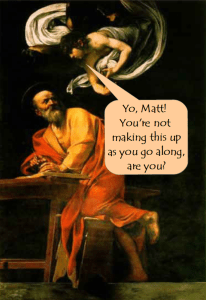
The Nativity in Matthew and Luke begins long before Jesus’ birth. Matthew introduces Mary and Joseph once the former has been impregnated with The Holy Sperm. He doesn’t go into any detail about how this happened, he just drops in, in Matt 1:18, that the deed is done. Mary has had sex with a ghost.

This isn’t good enough for Luke though, who after reading Matthew’s tall tale, decides it needs some expansion. A lot of expansion, in fact. He takes the story back to before Mary’s non-consensual encounter with the Holy Spirit and picks on Elizabeth and Zechariah, an elderly couple well past the age of having kids. All the same, they do enjoy a tumble in the sack every now and then, and the Lord – ever the voyeur – decides he’ll bless one such union with fruitfulness. (There is much wrong with the details of this unbelievable yarn, some of which I consider here; I won’t reiterate them now for fear of awakening any amateur theologians who might be lurking here in the wings.)

Suffice to say, Luke – for it is he, lest we forget, who is making this stuff up – decides that Elizabeth is a long lost cousin of Mary’s, like in one of those soaps where long lost relatives pop up all the time, usually to no good end. In this particular episode, however, all goes well and Mary visits Elizabeth, whose baby is, in a strange twist of fate, destined to be John the Baptist from the earlier two gospels. In this story his embryonic self jumps for joy inside his mother once he realises his uterine Saviour has come to visit.

But were getting ahead of ourselves. First Mary has to go through the rigmarole of getting pregnant. Obviously as a good Catholic girl she can’t have sex with her betrothed prior to their wedding and just when she’s considering when that might be, an angel appears unto her. It’s Gabriel who has quite a bit to do in the Nativity story as a whole. As angels do, he annunciates to Mary all about the pregnancy part of the plot and she acquiesces to the Lord getting her with child by magically transferring his seed into her womb. I’m guessing it was by magic. It’s possible some sort of actual rumpy-pumpy occurred but Luke delicately passes over the intimate parts. As apparently the Holy Spirit does too.

Mary is so overjoyed to be pregnant before her 13th birthday that she bursts into song on the spot and spontaneously produces a hymn based on the Psalms and the future teaching of the baby she has only just conceived. It’s hard to believe that no actual time travel was involved. It is instead, a miracle, as her impromptu ditty flourishes into the literary masterpiece now known as The Magnificat, which is not, it turns out, a feline super-hero. Fortunately, she can remember it all, word for word, decades later when Luke decides he needs to invent record it. Honestly, the whole thing puts Cole Porter to shame.

You’d think then Mary would dash off to tell her betrothed, Joseph, the wonderful news that she is pregnant without his or any other man’s assistance, but Luke makes no mention of it. Luckily, it’s covered by Matthew, where an angel drops in on Joseph, a person of great gullibility faith. On hearing what the angel has to say, he swallows the story hook, line and stinker.

Then it’s back to where we came in. Mary’s sets off down the road to see the cousin, the wonderful bearer of John. She pitches up there for three whole months, perhaps to avoid Joseph, who, it turns out, was not as gullible as she thought.

**********************************************

Honestly, this is really what happened. Would I lie to you? No, but someone would, and did. We’ll see what else he has in store in his over-worked imagination, next time.

**********************************************

PS. Don, I know you like indulging in a bit of biblical exegesis. If you’d like to borrow this totally respectful effort for your blog, get in touch and we’ll work something out.
The Meaning Of Matthew’s Mistakes

So Matthew likes quite a lot of what he finds in Mark. Likes it so much he decides to lift over 90% of it into his own Jesus story. Of course he’ll tweak it a bit because, disappointingly, Mark hasn’t emphasised Jesus’ Jewishness enough. That definitely needs bumping up; it’s what his readers will expect. And Mark has missed a trick or two: he starts his story with Jesus’ baptism, when, as everyone knows, every godman needs a magical origin. Just look at Tammuz, Horus, Romulus and, according to some, the Jewish high priest Melchizedek. So Matthew sets about scouring the scriptures for a prophecy or fable, anything really, that hints that the Messiah would have a miraculous birth. And he comes across this in Isaiah (7.14):

Therefore, the Lord, of His own, shall give you a sign; behold, a virgin is with child, and she shall bear a son, and she shall call his name Immanuel.

It’s not really a prophecy about the Messiah as the context makes clear, but that’s okay. There’s enough of a hint that it could be about a future Messiah that it’ll do. So Matthew sets about creating a birth narrative for his godman based on this verse, yanked from its context. His godman is going to have a virgin birth too.

What Matthew doesn’t realise, however, is that he’s made a mistake. He’s picked up the verse in the Septuagint, a Greek translation of the scriptures. If he’d checked, or even been able to read the original Hebrew, he would have soon seen that the verse actually reads:

Therefore, the Lord, of His own, shall give you a sign; behold, the young woman is with child, and she shall bear a son, and she shall call his name Immanuel.

The Hebrew word for ‘young woman’ is alma and that is the word used in Isaiah 7.14. The word for virgin is betulah. It does not appear. The use of it in the Septuagint is a mistake, a mistake that Matthew is not aware of. So he misappropriates the mistranslated verse to create a miraculous birth for Jesus and the myth of his virgin birth is born.

But Matthew hasn’t finished scouring the scriptures for prophecies that appear to be about Jesus. This time he alights on Zechariah 9:9:

Rejoice greatly, Daughter Zion! Shout Daughter Jerusalem! See your king comes to you, righteous and victorious, lowly and riding on a donkey, on a colt, the foal of a donkey.

Incredibly, this time Matthew has stumbled upon a prophecy about the Jewish Messiah! According to Zechariah, the Messiah-King’s victorious entry into Jerusalem will follow the defeat of his enemies and the establishment of universal peace. Matthew likes the sound of this. If he can shoehorn an episode into his story where Jesus rides into Jerusalem on a donkey, this will show his readers that Jesus really is the long-awaited Messiah-King. Never mind that the Jesus version bears little resemblance to the scenario predicted by Zechariah: Jesus is not an anointed king, he has not recently defeated his enemies nor has he just established universal peace. The only thing the original prophecy and Matthew’s version have in common is that the two principle figures, Zechariah’s Messiah-King and Jesus, ride into Jerusalem on a donkey.

Oh, no, wait. That’s wrong. According to Matthew Jesus approaches on two donkeys; a mother and her colt. He’s made another mistake. He doesn’t know that the use of ‘donkey’ and ‘colt’ in the prophecy refers to the same animal. He thinks there has to be two: a larger one and a smaller one. He is not familiar with the practice of parallelism, common in Jewish writing to emphasise a point by repeating it  but using alternative terminology. There aren’t two animals on which Jesus sits lop-sidedly, there’s one: a donkey, otherwise known as a colt which, to state the bleedin’ obvious, is also the foal of a donkey. Matthew misses all of this and places Jesus precariously on two mismatched animals.

What does this tell us? That Matthew is not describing an actual event. He has, rather, created a story based on a prophecy, designed to illustrate to his readers that Jesus is the Messiah-King prophesied by Zechariah. There is nothing historical about this story; it is an actualisation-in-fiction of a prophecy. A prophecy,  which, incidentally, still has not been fulfilled.

So Matthew is caught out at least twice. There are more examples in his gospel of his forcing an episode from the scriptures into his Jesus fable: other aspects of his birth narrative are clearly based on elements of Moses’ story; Judas’ thirty pieces of silver are based on a story from Zechariah 11, which has no relevance at all to the use he makes of it. There is also evidence that Matthew invented prophecy that he could then show Jesus ‘fulfilling’ (Matthew 2.23, for example.)

What all of this demonstrates is not that Jesus was foreshadowed in the Jewish scriptures, (foreshadowing being a technique beloved of some authors who use it to hint at future events in their fiction) but rather that many aspects of the Jesus story are literary re-imaginings of ‘prophecies’ and often unrelated episodes from the scriptures.

And if some, why not all?

Bible Blunders #568

Zechariah

Over Christmas I heard again the account in Luke, chapter 1, of Mary and Elizabeth’s miraculous pregnancies. The story includes one of the most laughable blunders in the bible.

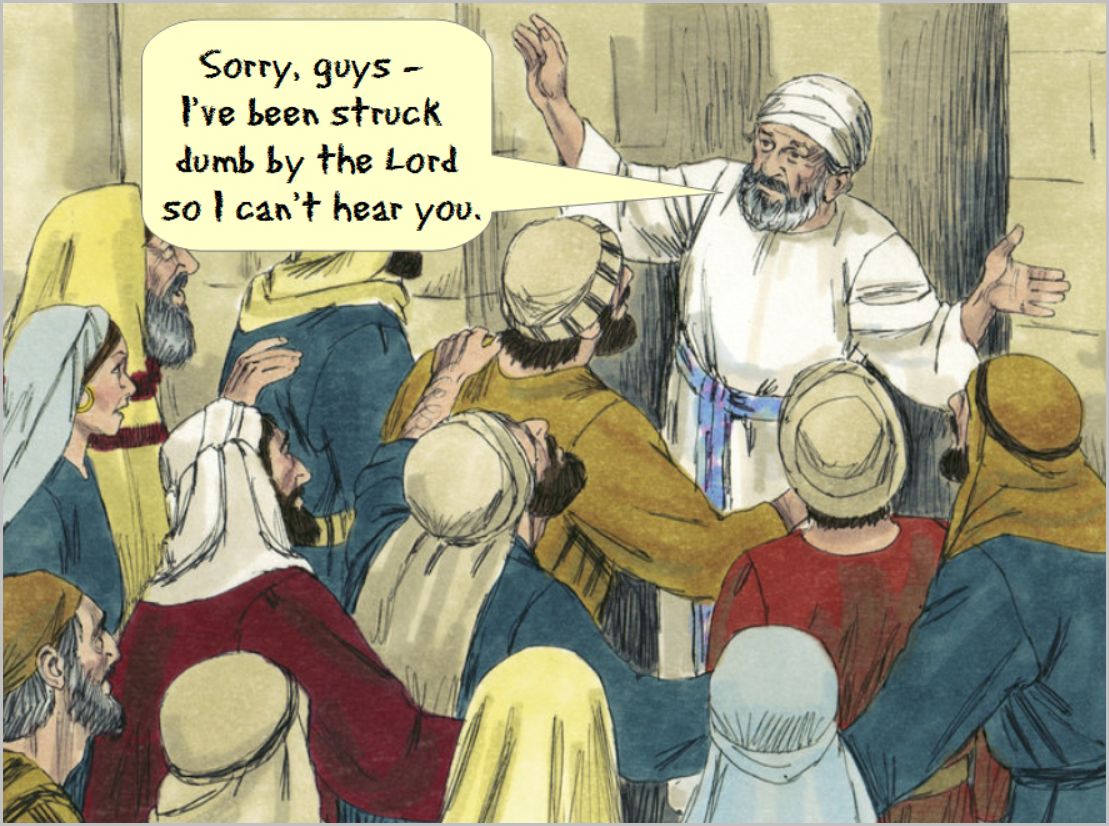
In what is clearly a re-write of the story in Genesis 17 about Abraham and Sarah, John the Baptist’s father-to-be, Zechariah, is told by an angel that his elderly wife will soon become pregnant. Zechariah, like Abraham, has his doubts and is immediately struck dumb because of his lack of his faith. When the child is born, Elizabeth announces he will be called ‘John’ as per the angel’s instructions. However, according to Luke 1.61-63 ‘the people’ (which people?) thought this a bad idea and said to Elizabeth:

“No one in your family has ever been named John.” So they motioned (‘made signs’ in the NIV) to Zechariah to find out what he wanted to name his son. Zechariah asked for a writing tablet.

Wait – they motioned to Zechariah? Why? He’s been struck dumb – he’s not deaf; he’s perfectly capable of hearing them. Then he asks for a writing tablet. He asks? He doesn’t ‘motion’ for it like the others have just done? It seems he can speak again suddenly – but in that case, why does he need the writing tablet?

Looks like Luke got a might confused here, forgot ol’ Zech had been rendered speechless and thought, for these two verses only, that he’d made him deaf.

And this, brethren, is the Inspired Word of God™.