
Conversion

I’d be interested to know, of those of you who are no longer Christians, what led you to become one in the first place.

It seems to me there are thousands of websites, books that argue philosophically for the validity of Christianity, present their evidence for the resurrection and generally take an intellectual approach to promoting the faith.

I’d be very surprised if this ‘evidence’, which is poor at best, and Christians’ philosophical arguments lead anyone to Jesus/God/faith.

My own experience is that conversion is an emotional experience. As a teen I listened to speaker after speaker at the YMCA I attended tell me how their sins had been forgiven and how getting to knew Jesus had given them a great sense of peace and purpose. I originally went along to the YM, as we called it, to meet friends, play table–tennis and drink coffee while listening to the juke-box. I had no idea I was a sinner nor that I needed forgiven but I liked the enthusiasm – they said it was ‘joy’ – that the speakers conveyed. I thought too I could maybe do with a sense of purpose though I was, as a fifteen year old, quite happy drifting along relatively aimlessly.

The persistent drip feed of what Jesus could do for me (and others) was persuasive. It sowed the seed, as the Christian cliché has it. It took a lively young American evangelist from Arthur Blessitt ministries to convict me. Jesus had turned his life around and he was on his way to heaven. Denying Jesus, he said, was to crucify him all over again. So I prayed the sinner’s prayer and gave my life to Jesus too.

Nowhere in any of this was there anything philosophical, no ’proof’ of the resurrection, no explanation of how the Bible was the Word of God. All the talks were appeals to emotion – how I could feel forgiven, how I could know love, joy and peace, how I could live forever after I died, up there with God in heaven.

All the rationalisation came later, like it always does. Psychologists tell us that the intuitive part of the brain makes decisions ahead of the rational part, which seeks to catch up afterwards, supply the reasons why the decision we’ve made is a good one. We’ve all done it when we’ve bought that item we don’t really need and have justified it all the way home. Religious conversion follows this pattern.

The thinking mind only becomes involved afterwards, hence ‘post hoc rationalisation’. We then become complicit in our own indoctrination: Bible study (both group and individual), listening to sermons, learning from more mature Christians, worship (all those song and hymn lyrics reinforcing the mumbo jumbo), reading Christian books, immersing ourselves in the complexities of the religion. This is how it’s always been. As Paul puts in 1 Corinthians 3:2, we move from milk to meat as we delve further into ‘the mysteries of Christ’. Or, more accurately, we become more deeply indoctrinated.

But all of this comes later. The emotional experience is first, as it was for Paul, C S. Lewis (who described it as being ‘surprised by joy’), George W. Bush and millions of other converts. In my Christian days, I personally ‘led people to the Lord’, by ‘sharing my testimony’ (I’ve still got the jargon!) and can assure you, those involved felt the Holy Spirit with a profound intensely. Only kidding. They became pretty emotional.

I know of no-one who became a Christian by assessing the evidence for the resurrection, reading Paul’s theobabble or analysing the central claims of Christianity. I suppose there might be some who, like Lee Strobel, insist they ‘came to faith’ this way. But faith and rational analysis are incompatible. When the writer of Hebrews (11:1) says: ‘faith is the substance of things hoped for, the evidence of things not seen,’ he is oblivious to the fact that there isn’t any ‘evidence’ of unseen spiritual ‘things’. There are only our own feelings and emotional confirmation bias.

So that’s how it was it for me. How was it for you?

Next time I’ll take a look at the deconversion process.
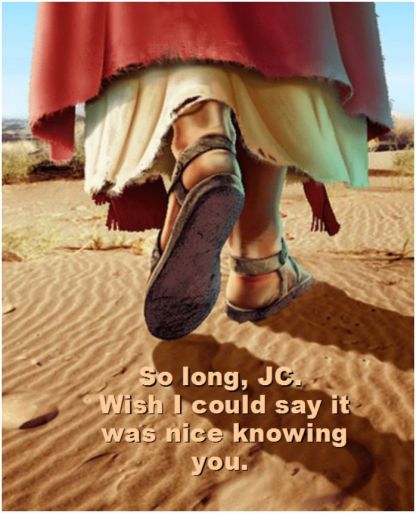
Pearl of Great Price

Blog358

Once Born Again™, I became involved with a local church, where my friend Simon took it upon himself to play Cupid, fixing me up with Jane. I was more than a little surprised a girl could be interested in me, but figured, in my flight from myself, that as she was interested, I should make the most of it. Sex wasn’t much of a problem: as good Christians we may’ve played about a little, but we stayed away from what the church liked to call ‘pre-marital intercourse’.

It wasn’t long, though, before Jane wanted to marry – she really wanted to get married. I wasn’t so sure and told her about my escapades with Sam, adding of course that I had since renounced such sin. She said that as long as it never happened again, she had no problem with my past transgressions. I felt pretty sure it wouldn’t happen again. After all, Jesus and his Holy Spirit were taking care of my old nature.

So Jane and I married and over time had three children. While I was very much involved with their upbringing, I would often feel I was ‘letting the Lord down’. When, as happened on holiday once, a group of younger men came round a corner minus their shirts, I found myself instinctually admiring them. What self-crucifying shame I would feel after occasions like these. I would even confess such ‘sins’ to a senior work colleague, a devout and very genuine older lady. I’d spare her the details of how exactly I’d ‘let the Lord down’, of course; I could never have brought myself to say I’d been turned on by naked male torsos. But somewhere deep within me I longed for intimacy and closeness with another man. I knew this was strictly forbidden so buried my desires deeper and deeper, suppressing and subjugating something vital about myself. I was on course, though I didn’t recognise it, to making myself ill. I was convinced that I was doing the right thing – for myself, for my marriage and for God.

My marriage, however, was in trouble. Jane seemed to have lost interest in our children, which hurt me greatly (and didn’t do them a lot of good either.) This and pressures at work, where my boss’ affair with a female colleague was creating some serious problems, made me question whether God really cared. When I needed him most, petitioning him for the wisdom to deal with these problems, the heavens, as the scripture almost says, were as brass. God, it seemed, just wasn’t interested. Perhaps, I started to wonder, he wasn’t even there. Added to this was the internal pressure I was still subjecting myself to; the tension and stress of sublimating my true nature. I was deeply unhappy. While the situation at work was eventually ‘resolved’ (by my finding a better job) I had become chronically depressed and remained so for several years.

Ultimately, once I had reached my fifties and the children were grown, Jane and I separated. I knew I couldn’t go on suffocating my feelings; the mind is not designed to be a pressure cooker – something has to give. I started to accept, though not yet embrace, my innermost nature. The relief was immediate and tremendous. I felt I had found myself and I didn’t care that society might not particularly like what I had I found. I had to be me, and not the uptight, miserable person I had become by denying my essential self. I squared up to the exciting yet daunting prospect of starting over, and acknowledged that if I were to have a new relationship it would be with another man. And so it was.

Over time I came to like myself – imagine that! All I’d felt for most of my life, since the time at the YMCA, was self-hatred. That was what Christianity, what Jesus, had done for me. Arguably, it had also ensured, by keeping me firmly in the closet, that I hadn’t died prematurely during the AIDs crisis of the 1980s. Perhaps though I’m giving it too much credit.

I’m ‘out’ now, in every sense: to my wonderfully supportive children, to you who read this blog (obviously) and to friends. Match-maker Simon, he who suggested going to the YMCA all those years ago, cut me off about a decade ago. As a born-again Christian, he regarded homosexuality as beyond the pale. His ‘principles’ meant more to him than our long-standing friendship. I still miss him, very much.

I don’t miss God. He has gone entirely and I’ve long recognise that he was never there to begin with. Instead, I have a sense of authenticity and my energy goes into living, not denial. I’ve become involved with the local LGBT Centre and I’m seeing a very nice man who I’m going to call Thomas, to spare his blushes. I’m very happy and feel, at long last, I really know what life’s about.

If you can stand it, I’ll tell you more next time.

Jesus, Simon and me

Blog357a

It took me long time to accept who I was. Most of my life, in fact. When I was in my late teens, I had a relationship with a young man the same age as myself. This was illegal at the time as the age of homosexual consent in the UK was 21, remaining so until the late 1990s when it became 18. (In 2004 it was finally made the same as heterosexual consent: 16.) We didn’t care. We had a lovely time and I for one was very happy. I think Sam was too. We lost touch eventually as life took us down different paths.

Not long after, I fell in among Christians. A friend – let’s call him Simon – thought it would be a good idea if we started going to the YMCA. This was long before the organisation became synonymous with the Village People and hangin’ out with all the boys. The YMCA I encountered was markedly evangelical. Once we’d visited a few times we were ‘invited’ to one of their young people’s meetings. I can’t remember what snappy title these meetings went by, but essentially they were a mixture of worship, bible reading and ‘teaching’. Sometimes there’d be a guest speaker who would tell us all about their relationship with Jesus, which, in case we had any doubts, was just marvellous. Before long I was giving my life to Jesus too, though in the long run it turned out to be only a temporary loan.

Occasionally, one of these guest speakers would talk about relationships, those with other human beings, and sex. From them I learnt that sex was almost always wrong: sex before marriage, sex outside marriage, sex with yourself – all of them were sinful. Even imagining sex and fancying someone (which qualified as lust) were wrong too. Who knew? But the most sinful, wicked and sordid sex of all was sex with someone of the same sex.

It didn’t seem it to me. The encounters I’d had with Sam were far from sordid and not at all evil. On the contrary, they were a lot of fun! But these people, these Christians, seemed to know what they were talking about. And hadn’t I given my life to Jesus? He detested homosexuality, or God did anyway, so Jesus must’ve felt the same way (actually this was all in the present tense, Jesus being alive and monitoring us from Heaven and all; Jesus detests homosexuality, they’d tell us.) Sometimes they’d read verses from the bible that proved it.

And so I started to suppress my feelings. They’d kinda got me in trouble anyway, when my body betrayed me in the showers after gym at school. Other boys would torment me about it. I wasn’t actually ‘out’, as we’d say today, and terms like ‘queer’ and ‘poof’ (the British equivalent of ‘fag’) were bandied around as general insults – they didn’t necessarily mean anyone actually thought you were gay. Nonetheless, they came a little too close to comfort. All things considered, a retreat to the back of the closet (not that I knew this terminology then either) seemed the best option. It was what Jesus wanted, or so I thought. I started to deny myself for him, as he insists his followers do, and began a life of self-deception.

Which would’ve been fine, except it’s impossible to live a lie in isolation. Others invariably become involved.

Enter Jane…