
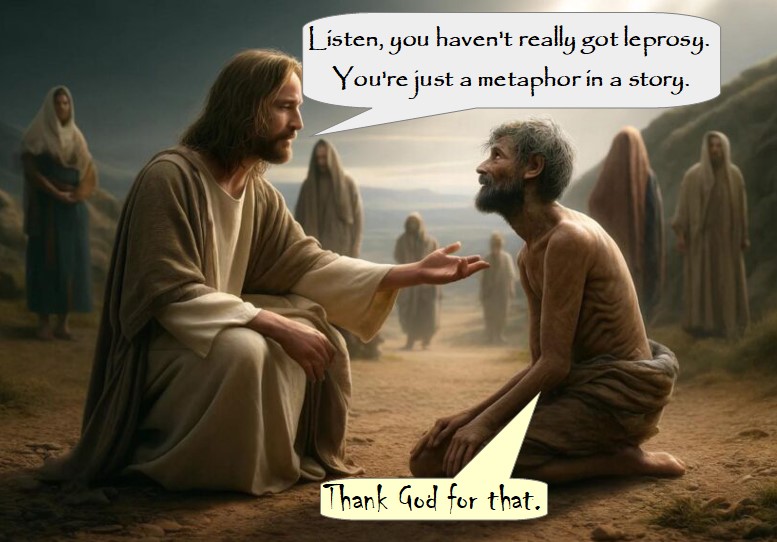
Jesus and the Leper

I thought we might share a couple of Bible studies these next couple of weeks. Some of you will remember these from your Christian days, when you’d gather with other eager believers so that a self-appointed expert could tell you what a particular story in the Bible really meant. I’m no expert, just someone who subjected myself to such indoctrination while all the time wondering if what I was being told was really what the passage was about. Doubts, however, were ‘of the devil’ so any such critical thinking needed to be suppressed. Since my eyes were opened to the allegorical nature of much of what is in the Bible and in the gospels in particular, I now see these same passages in a completely different light. I hope you’ll allow me to share my insights with you.

First off, it’s Mark 1:40-45, in which Jesus (seemingly) heals a leper:

 A man with leprosy came to him and begged him on his knees, “If you are willing, you can make me clean.” Jesus was indignant. He reached out his hand and touched the man. “I am willing,” he said. “Be clean!” 

Immediately the leprosy left him and he was cleansed. Jesus sent him away at once with a strong warning: “See that you don’t tell this to anyone. But go, show yourself to the priest and offer the sacrifices that Moses commanded for your cleansing, as a testimony to them.” 

Instead he went out and began to talk freely, spreading the news. As a result, Jesus could no longer enter a town openly but stayed outside in lonely places. Yet the people still came to him from everywhere.

The giveaway phrase here is ‘make me clean’. The man does not ask Jesus to heal him which, suffering from a debilitating disease as he was, would have been the most obvious, most pressing request to make. Instead, he asks to be ‘cleansed’ with all its ritual connotations, the word used here, καθαρίζω (katharizo), also meaning ‘purify’. According to Leviticus 4: 11-12, leprosy was a condition that was spiritually unclean. Only by making the prescribed offerings – the usual doves, lambs and ‘crimson stuff’ – could a leper who was already healed become ritually pure.

Who, according to the New Testament, replaces all the sacrificial offerings of the old covenant? Why, it’s Jesus himself of course (1 Corinthians 11:25, Ephesians 5:25-26 etc). Jesus cleanses and purifies the leper in the story, just as he is able to cleanse and purify sinners. This is what the early cult believed: ‘Ask Jesus, the heavenly Christ, to cleanse you of your sins and, just like he does for the leper in this parable, he’ll do it for you. As a penitent believer, you are the leper. Not only are you cleansed of your sin, you are purified.’

This also explains why Jesus is ‘indignant’ when the leper first approaches him. On the surface it makes little sense for him to be indignant with the man, which is why some translations change this verse to say Jesus ‘felt compassion for him.’ Jesus’ metaphorical annoyance is for those who have allowed the man’s spiritual condition to have deteriorated to a state comparable with leprosy. The Jewish priestly system, symbolised anachronistically in Mark as the Scribes and Pharisees, the later arch-enemies of the new cult.

Jesus commands the leper to visit the Jewish priest to demonstrate that he, Jesus, is the new cleanser of sins, replacing the priesthood itself. Instead, the leper goes against Jesus’ and the early cult’s wishes. My God, how could the cult remain secret and exclusive if newly cleansed converts behaved like this!

So there you have it. The leper is a metaphor for the sinner in need of the heavenly Jesus’ cleansing. His leprosy is a metaphor for the sin itself. The healing is a metaphor for the penitent’s spiritual purification. The man’s by-passing of the Jewish law is a metaphor for Jesus replacing the law. The cleansed leper’s shouting about it is a metaphor for the early cult’s desire to keep its rituals and teaching secret. Its parables like this one were designed to enlighten cult members while obfuscating and confusing the unbeliever (Mark 4:11-12).

As a literary creation, an allegory replete with metaphor, this event need never have happened in reality. Given its literary nature, it’s highly unlikely it did.

Redemption Songs

I was listening to some Bob Marley the other day and was struck by a line in his song ‘Get Up Stand Up’: ‘Almighty God is a living man’. He was not of course referring to Jesus but to Haile Selassie, the Emperor of Ethiopia who was still alive when ‘Get Up Stand Up’ was recorded in 1973. Rastafarians like Marley believed the Emperor would redeem African-descended Jamaicans and restore them to Africa from where their ancestors had been taken.

Rastafarians saw and still see themselves as modern day Israelites, like those in the Bible stories of Egyptian slavery and Babylonian captivity. Their perspective is reflected in songs like ‘Exodus’, by Marley, ‘The Israelites’ (Desmond Dekker) and ‘Rivers Of Babylon’ (The Melodians). Selassie himself denied being divine (‘why do you call me good, when only God is good?’) but that didn’t stop those who believed in him from making a saviour god of him. When, inevitably, he died (in 1975), some Rastas left the movement while others reinterpreted his role:

Some Rastas believed that Selassie did not really die and that claims to the contrary were Western misinformation… Another perspective within Rastafari acknowledged that Haile Selassie’s body had perished, but claimed that his inner essence survived as a spiritual force. A third response within the Rastafari community was that Selassie’s death was inconsequential as he had only been a “personification” of Jah rather than Jah himself.

It all sounds rather familiar doesn’t it? The saviour didn’t really die/his inner essence survived/his death was inconsequential. Where have we heard all that before?

This put me in mind of a cult that for a long time rivalled that of Christianity. Indeed, in the early days of Jesus belief, it boasted more members, all of them men. Unlike Christianity and Rastafari, this cult believed in a saviour whom adherents knew had never existed as a human on Earth. Mithras was a celestial being whose salvific work, which involved the symbolic slaughter of a bull, was carried out in the heavenly realm:

Mithras is the guide of souls which he leads from the earthly life into which they had fallen back up to the light from which they issued… It was not only from the religions and the wisdom of Orientals and Egyptians, even less from Christianity, that the notion that life on earth was merely a transition to a higher life was derived by the Romans. Their own anguish and the awareness of senescence made it plain enough that earthly existence was all hardship and bitterness. Mithras-worship became one, and perhaps the most significant, of the religions of redemption in declining paganism. (Jacob Burckhkart)

Eventually, in the fourth century, Christians suppressed Mithraism to the extent that its adherents, along with its ritualistic texts, were wiped from history. Only its deserted, underground temples remained.

What both examples tell us – and there are hundreds more – is that people have always been willing and eager to make gods of revered figures, both real and imagined. They are ready to believe them capable of impossible feats and to trust in them for whatever form of redemption they feel in need of. There can be no doubt Jesus belief sprang from this same sort of wishful thinking; Jesus being cast as a divine figure with the power to lead believers into the light and/or the promised land of eternal life. It hardly matters whether he existed or not. Like Mithras, an imaginary/imagined figure could just as easily fulfil the role as a real person, like Selassie, who had others’ unrealistic expectations thrust upon him.


Why God could not possibly have created the universe (pts 4 & 5)

Sacrifice2

The final two reasons why it is altogether unreasonable to credit the God of the bible with the creation of all that there is.

4. YHWH is inadequate

Christians want us to believe that the God of the bible is the ‘First Cause’ who purposefully created the cosmos. He is, they tell us, powerful beyond imagining, capable of bringing into existence a universe of infinite proportions, with its billions of suns, trillions of planets, nebulae, dark matter, black holes and the rest.

But this vast complexity stands is incompatible with YHWH, who demonstrates all the limitations we might expect of a god devised by primitive nomadic herdsmen. He is anthropomorphic, restricted in knowledge and defeated by technology his creators didn’t possess; like other deities of the period, he is obsessed with bizarre ritual, requiring genital mutilation and the sacrificial burning of animals. He lives, alternately, at the top of a mountain or in a box, from where he is capable of smelling roasting meat, and spends his time issuing laws about sex and slavery. He is primarily a god of war, his acts almost entirely destructive, rarely creative, which is what we might expect from a people continually in conflict with their neighbours.

Whatever else such a being might be, he is not one capable of creating the universe. He is nothing more than a small and petty tribal deity – one of many recognised by the Israelites during their history – created and sustained by men who knew no better. This is the god Jesus believed in, though he relocated him in the sky (‘the heavens’) and tried to turn him into something more amenable.

Despite this partial make-over, the New Testament version of God retains the attributes and limitations of his older self. He is, if Paul is to be believed, still pre-occupied with blood sacrifice, in dictating sexual behaviour and wreaking destruction on his supposed creation. He is no more capable of creating the cosmos than his predecessor. The God that modern Christians insist brought everything into being isn’t this limited, feeble, unsavoury figure. That God is another construct altogether, a far cry from the paltry god of the bible, and one they have devised themselves, that they make appear capable of creating the universe as we now know it to be.

5. The supernatural has no independent existence.

This is the bottom line: outside the human imagination, there is no evidence the supernatural exists. Even if we do take the human imagination into account, there is no evidence of an independent supernatural realm. No-one has ever seen a god, demon or angel, in exactly the same way they’ve never seen a fairy, goblin or unicorn. They may think they’ve experienced spiritual beings ‘within’ or felt them emotionally or hallucinated about them, but this does not mean they have independent existence. Despite millennia of religious belief no supernatural beings have ever manifested themselves, been witnessed, demonstrated or measured. Gods, like angels and spirits, do not exist. It follows, therefore, that the cosmos cannot have been created by them.

Thank you for bearing with me on my exploration of why god could not possibly have created the universe. I don’t know, of course – none of us do (yet) – how it came about, but the notion that it must have been god, the Christian god no less, simply isn’t feasible:

He would have had to create something from nothing, when the supernatural and immaterial are incapable of creating the natural and material.

The bible’s YHWH is too feeble to have been responsible and God-as-creator leads, in any case, only to an infinite regress.

The supernatural is a product of the human imagination; it has no independent existence.

However the universe came to be, we can be certain no gods, including the Christian one, were involved.


How It Works: God

Let’s see. If there’s a God – and how could there not be? – he’d have to be perfect. And powerful and really, really good. Not like all those pagan Gods who are just a bit too much like us. No, the most bestest God of all would have to be big and powerful, and good and perfect. I mean, why bother otherwise?

Oh, oh… first problem. If he’s good and perfect, how to explain us and the fact life can be pretty crap and not good or perfect at all? That can’t be his fault, can it? He’s perfect, so he couldn’t possibly make something that isn’t. Soooo… only logical conclusion – the crap must be our fault. Something we do, or maybe something we are. Yes, that’s what it must be (plus we get to bump up our part.)

And shit happens. Tsunamis, earthquakes, the crops fail, the rains don’t come. Life can be tough and seem pointless. It’s all depressing, then we die. It can feel like we’re being punished. Wait! Maybe we are being punished! For things we’ve done, or for what we are. That would fit wouldn’t it? A good and perfect God would surely want to punish us, with death and destruction and stuff. So that’s what these things must be!

Let’s get all this written down, that this is how things are. This good and perfect God finds us offensive and that’s why life is so shit. Except, except… surely God’s a reasonable bloke at heart and can be appeased? We could wheedle our way back into his good books and then life wouldn’t be quite so bad. Not sure how, though. Maybe sending him presents would do the trick, though how to get them to him when we can’t see him or anything…

I know! Let’s eviscerate some animals and then burn them and that way, he’ll be able to smell our efforts up where he lives, in the sky. That’s bound to work. And to be doubly sure, let’s mutilate our genitals and keep our women subjugated – because he can’t fail to like that.

Or maybe not. Maybe life will still be shit and we’ll still be shit. Maybe we need something more… imaginative. So let’s pretend that this God of ours puts together a rescue package. And what this means is he zaps us with some magic that obliterates the bits of us he can’t stand, which is pretty much all of it. And – here’s the good bit – we get to keep some of the eviscerating and sacrifice stuff.

Let’s get that written down too. And, and… maybe we can have it that this God is really going to rescue us and make everything not shit any more. He’s going to shake things up down here… no, no, wait – better than that, we’re going to go and live with him in the sky once we die, which gets rid of how shit death really is, and we’ll all live happily ever after, those of us he’s zapped anyway. Everyone else he can torture and burn forever! Yes that’s it! That’s how it’s got to be. God can still be good and perfect, even though he murders just about everyone, and some of us will get to be good and perfect too, and all the crap will just disappear, as if by magic.

That’s it. That’s how it really is. I can see it all now.

Oops. Gotta go. Time for my medication.

straitjacket