Do You See What I See?

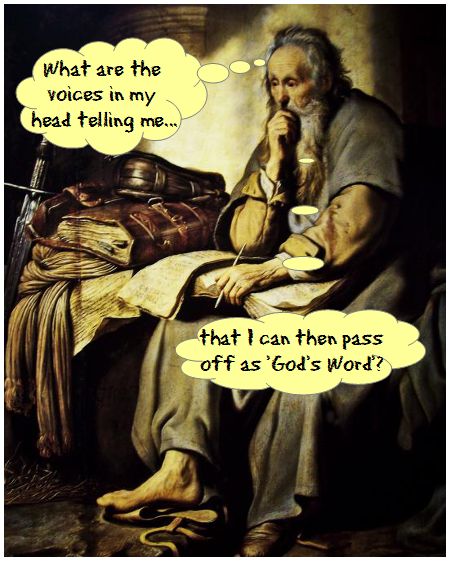
Christianity with its visions of God, angels and resurrected god-men, is not distinctive. It emerged from a culture in which such epiphanies were commonplace and highly esteemed. Appearances of deities, other supernatural beings and dead people were valued as genuine encounters with a reality on the other side of this mortal life. Paul was a Hellenised Jew and a Roman citizen (if Acts 17 can be believed); it was perfectly natural for him and his contemporaries to see and hear things that weren’t there.

Not only was the fledging Christ-cult influenced by the superstitious culture around it, but was born too of Judaism, itself awash with visions, apparitions and revelations. How could the new religion fail to be when its originators existed in such a milieu. One or other of these ‘visionaries’ believed they’d seen a resurrected Jesus. Of course they did. This is how gods manifested themselves then; everyone knew it. There were even those who hadn’t really had any inner-visions but wanted to be regarded as mystics themselves so would pretend they too had had direct contact with the deities.

The human mind has always been susceptible to illusions, to the potency of dreams and to misinterpreting what is going on around it. It’s also prone to a spot of fantasising now and then. This propensity didn’t cease once Christianity established itself. Muhammed claimed to have been visited by angels who revealed new truths about the nature of God – not least a change in name.

In the 19th century, a young farmer, Joseph Smith, living during a widespread and particularly intense religious revival, imagined (or pretended) he’d been visited by God and Jesus. Later, he said he’d been visited by a hitherto unknown angel with the unlikely name of Moroni. The result of course was multiple wives for Smith and the foundation of the Church of Jesus Christ of Latter Day Saints. Sufficient numbers of people believed Smith’s cockamamie stories about his alleged visions to commit to Mormonism. Smith wasn’t alone; others had visions of deities, including but not restricted to the Big Two, Jesus and his Father God. Hundreds recently saw the Virgin Mary hovering above New York City. They couldn’t all be wrong could they? Of course not, but they were all be deluded. Just like Joshua Mhlakela whom Jesus appeared to and told him the date of the Rapture was 22nd September, or possibly the 23rd, then with ‘billion percent’ certainty 7th October. Or maybe 8th…

This is how religions are made, changed and adopted: on a bed of illusory sand. If we need any further evidence that such experiences are illusory, created by the mind itself, then consider this: each time God, his angels or his Son appear in the religion-soaked brains of mystics and fraudsters, they reveal a message at odds with that revealed to previous visionaries. Each revelation has to be different of course. There would be no reason for such ‘visits’ otherwise.

Hence Abraham (or his script writer) imagining YHWH promising an eternal covenant and a new land.

Moses (or his script-writer) claiming YHWH had issued new laws while at the time commanding the slaughter of tribal enemies.

Cephas thinking he’d seen a risen Jesus who may or may not have told him of the imminent the End of the Age.

Jesus himself reportedly talking with his ‘Father’ about the necessity of his execution.

Paul flying to heaven so that Jesus could explain in great detail a new covenant, negating the original ‘eternal’ covenant with Abraham.

John of Patmos envisaging Jesus coming to Earth to slaughter the enemies he purportedly instructed his followers to love. (And Christians claim the Bible presents a unified message!)

All of these are manifestations of, and within, the minds of fantasists. Such manifestations are a naturally occurring malfunction of the brain.

And so it continues. Beware anyone who claims to have seen or heard from a deity of any sort. They, like their biblical counterparts, are deluded and almost certainly ill.

The Daft Things Christians Say (the Sequel)

The return of an old favourite (of mine if no-one else’s)!

Dennis and I were in the States a couple of weeks ago and had the dubious pleasure of watching American news channels. I noticed on more than one, the presenters signed off with ‘God Bless’. As well as undermining what little objectivity they have left, the phrase rang hollow and made those using it, for whatever reason, as vapid and insincere.

It’s a phrase that many ordinary Christians and the nominally religious use (a waitress serving us lobster also came out with it, as if the lobster would magically be granted extra flavour.) It seems to me it’s a remnant from the days of incantation and magic. ‘May God bless you’ as opposed to ‘Let the devil smite thee’ or some such. ‘Goodbye’ has survived from these times too, originally ‘God be with you’, and is equally meaningless. Meaningless because if a God existed he would presumably be with you if he felt like it, or not as the mood took him. Attempting to summon his presence with an incantation of well-wishing is hardly going to influence him. Similarly with ‘God Bless’. Doesn’t the Bible say that God blesses whom he will (Romans 9:18)? No imperative will change that. Might it make the declarer of God’s presence of blessing feel more smugly self- righteous while the intended recipient might feel better, he or she convincing themselves they are actually ‘blessed’? Maybe, but God would have nothing to do with either state of mind.

Likewise that magic phrase Christians like to add to the end of prayers: ‘we ask this in Jesus’ name’. Will God not listen to their supplications if they don’t add it? Will he grant their requests if they do? I think we all know the answer. Why should it make any difference to Almighty God whether they add magic words to their pleas? If it does, what sort of God is it who must have exact words used, like a Hogwarts spell? The addition of a ‘just’ before the word ‘ask’, meaning ‘this is really a modest little request, your worshipfulness, we don’t want to bother you,’ doesn’t make it any more meaningful. From within the faith, as without, the phrase couldn’t possibly make any difference, apart from possibly allowing the supplicant feel better, more self-satisfied, like the child who adds a pretty picture to the end of their writing. ‘We (just) ask this in Jesus’ name’ another empty and vacuous magic spell.

Mark and the Oral Tradition

Paul never refers to ‘the disciples’, the term used for Jesus’ inner circle in the later gospels. Instead, he refers to the founders of the cult as ‘apostles’ (literally ‘messengers’). Cephas is described as an apostle, as is Barnabas (Acts 14:14) and Paul himself. Paul defines the term more specifically as someone who has been commissioned directly by Jesus (1 Corinthians 9:1; Galatians 1:1-2). Evidently he himself was not: he encountered the risen Christ only in his head. He felt this was more than good enough. For Paul it was the only qualification anyone needed to be an apostle. He cites others who had encountered Jesus in the same way:

For what I received I passed on to you as of first importance: that Christ died for our sins according to the Scriptures, that he was buried, that he was raised on the third day according to the Scriptures, and that he appeared to Peter, and then to the Twelve. After that, he appeared to more than five hundred of the brothers at the same time, most of whom are still living, though some have fallen asleep. Then he appeared to James, then to all the apostles, and last of all he appeared to me also, as to one abnormally born. For I am the least of the apostles and do not even deserve to be called an apostle, because I persecuted the church of God. (1 Corinthians 15: 3-8)

What he goes on to say is crucial in understanding the nature of ‘the gospel’ that was in circulation in the years before Mark’s gospel:

But by the grace of God I am what I am, and his grace to me was not without effect. No, I worked harder than all of them – yet not I, but the grace of God that was with me. Whether, then, it was I or they, this is what we preach, and this is what you believed (1 Corinthians 15: 8-11; my emphasis.)

What they preached was their visions of a celestial Saviour. The witness of these visionaries of the risen Christ was the only gospel they knew and, Paul suggests here and elsewhere, the only one that was being transmitted orally when he was active. As we saw last time, he knew no other details of Jesus’ life, had none passed on to him and passed none on to others, except for these visions and the teaching he worked out from them – his ‘revelations’. Let me say that again: the visions of the risen Jesus were all he, Cephas and others knew. Paul says so categorically. There was no other ‘oral tradition’.

Paul builds his subsequent teaching on Jewish scripture, showing how his ‘revelations’ must be from the Christ because they comply with this scripture (even though he has to manipulate it to make it do so: in Romans 9, for example). Nowhere does he say he is referring to any history he has learnt, nor to anything passed on to him orally about Jesus’ teaching, ministry, life or miracles. Just the opposite in fact:

I want you to know… that the gospel I preached is not of human origin. I did not receive it from any man nor was I taught it; rather I received it (directly) by revelation from Jesus Christ’ (Galatians 1: 11-12).

About seven years after Paul’s death, a literate member of the one of the cult communities – known to us as Mark – decided to set down Paul’s teaching about the Christ in allegorical form. He tells us this is what he is doing several times in his gospel, including Mark 4:11-12:

To you has been given the secret of the kingdom of God, but for those outside everything is in parables, so that “‘they may indeed see but not perceive, and may indeed hear but not understand, lest they should turn and be forgiven’” (referencing and misquoting Isaiah 6:9)

Mark did not depend on any oral tradition for his information about Jesus’ life because apart from the ‘announcement’ built on Cephas’, Paul’s and others’ visions there was no oral tradition. Mark took Paul’s teaching and like him, used Jewish scripture as the basis for the story he developed from it. Thus, Paul’s ‘revelation’ of a bread and wine ritual (1 Corinthians 11:23-27) becomes the Last Supper (Mark 4:22-24); Paul’s teaching about forgiveness becomes Jesus’ teaching about forgiveness; Paul’s dispute with Cephas leads to a gospel Peter who is bungling and disloyal; Paul’s mention of The Twelve in 1 Corinthians becomes, with a miscalculation, the disciples; Paul’s instruction to obey the authorities (Roman’s 13:1) becomes Jesus’ (Mark 12:17); Paul’s, and Jewish scriptures’, promise of the spiritually blind (2 Corinthians 4:3-6) being helped to see becomes Jesus’ miracles of healing; Paul’s predictions about the end of the age (1 Thessalonians 4:15-17) become Jesus’ (Mark 13); Paul’s talk of the coming of the Christ in person (1 Thessalonians 4:13-5:11) becomes Jesus’ prophecies about the Son of Man appearing (Mark 14:61); Paul’s vision of the risen Christ becomes the resurrection. And on and on. There is nothing in Mark’s gospel that doesn’t derive from Paul’s teaching, and Jewish scripture in turn. it is, in short, made up.

All of this accounts for the absence of any resurrection appearances in Mark. His gospel ends with the discovery of the allegorical empty tomb and leaves off there because it is where his audience came in, as it were. They had been converted by hearing of the ‘appearances’ of the celestial Christ to Cephas and those Paul lists in 1 Corinthians. They already knew how the story ended or, more accurately, how it had begun: with those visions.

Later, Matthew, Luke and John would take Mark’s allegory and use it as the basis for their gospels, adding new, invented material of their own. The myth, in both the technical and popular sense, was born.

Evidence of God

As for evidence, you might be aware of Israel. That nation has been in the news much of late. So, without being flippant at all, I present Israel as evidence. Think about it. They are living the script written thousands of years ago. Not by chance.

Israel as evidence for the existence of God. I’m thinking about it as Don suggests.

Where did it all begin, this bizarre notion that one tribe in the Middle East was chosen by God to be his special people? According to the Genesis myth, it was when YHWH promised Abraham he’d be his best buddy forever and ever, so long as he mutilated his body and those of his sons in perpetuity. They would also have to keep every one of this bullying god’s 365 rules and regulations, including the petty and piffling ones. So far so good, apart from the fact it was all very one-sided, and the mutilation of course. You’d think this would’ve been a sign that things weren’t quite kosher, but no; Abraham and his descendants buy into it and almost straight away, YHWH begins to let them down.

God’s Chosen Ones soon find themselves slaves in Egypt. A second mythical character is needed – up pops Moses – to get them out of this scrape. Unfortunately, after Moses has finished chatting with YHWH, who identifies as a burning bush on the top of a mountain, the sulky deity feels slighted by something the Israelites are doing. As is his way, he has many of them slaughtered and the rest he forces to troop around the same small plot of land for 40 years. This is how best buddies treat each other!

Later, the Jews find themselves defeated by the Babylonians and are carted off into exile. This exile, which YHWH does nothing to prevent, lasts 70 years. Still, it leads to a pleasant song made famous by Boney M in 1978 so I suppose it was worth it.

For the next few hundred years, Israel falls under the rule of other nations more powerful than itself. Not to worry though, YHWH is still ‘looking after them’, particularly those who are slaughtered in the rebellions that ensue. As Robert Conner says in a recent comment on Debunking Christianity, ‘If Yahweh ever threatens to bless you and your children, just kill yourself and get it over with.’

Fast forward to the Roman occupation of Israel. YHWH, having undergone a makeover, reneges on his promise to take care of his Chosen Nation forever and ever and comes up with a different plan to save people from his own cussedness. Now, if they want to continue as his friend, they have to believe a supernatural being has returned from the dead.

Abandoned by God, as he now wants to be called, Jews who haven’t defected to the new faith see their sacred, eternal temple destroyed by the Romans in AD70. Thousands of them are massacred and the Jewish nation ceases to exist.

This sets the pattern for the next two millennia in which God’s new friends organise pogroms, massacres and vicious persecution of Jews. This culminates in the Final Solution of the Third Reich which seeks to eliminate the Jewish people entirely. While awaiting extermination in a concentration camp, Andrew Eames scrawls on the wall of his prison: ‘If there is a God, He will have to beg for my forgiveness.’ God allows six million of his Chosen People die at the hands at the Nazis.

Following the second world war, Israel takes possession of the area surrounding Jerusalem, then occupied by Palestinian Muslims who are themselves descended from earlier immigrants. Thousands on both sides are slaughtered in the conflict that follows. In 1948, after almost 2,000 years, Israel becomes a nation once again; not through any miracle of God but as a result of human endeavour and bloodshed.

Tension and further skirmishes followed, leading to the present day when Israel finds itself under attack by Hamas terrorists. Thousands of innocents – women, children and babies – have been slaughtered without mercy. Israel is, as I write, retaliating and intends to enact further vengeance. And where is God in all this? You guessed it: nowhere to be seen.

All of this, according to some – including the naive writer at the top of this post – serves as evidence of God’s existence. That Israel has persevered for so long, despite opposition, persecution and the holocaust is not, however, evidence of God, any more than the great cathedrals of the world are. It is instead testimony to the resilience, resolve and sheer bloody mindedness of the people themselves. Perhaps their belief in YHWH (they don’t of course recognise his Christian counterpart) has fuelled their persistence, as it has their territorial claims.

Jewish beliefs and history are not evidence that YHWH exists. If anything, his apparent abandonment* during their many trials and tribulations is evidence to the contrary.

*Of course a non-existent entity can’t actually abandon anything, any more than it can lend its support or favour one group of people over another.

Redeemed: From Slavery to… erm, Slavery

Thanks be to God, who delivers me through Jesus Christ our Lord! So then, I myself in my mind am a slave to God’s law, but in my sinful nature a slave to the law of sin. (Romans 7:25)

Do you not know that if you present yourselves to anyone as obedient slaves, you are slaves of the one whom you obey, either of sin, which leads to death, or of obedience, which leads to righteousness? (Romans 6:16)

(We are) justified freely by his grace through the redemption that is in Christ. (Romans 3:24)

When a slave had served sufficient time and had accumulated sufficient wealth or found a benefactor, he or she could buy their freedom. This seems particularly egregious when their servitude was already, in the case of debt, the means of paying back what was owed. In effect the enslaved individual was paying twice for their freedom. Be that as it may, the act of buying oneself out of slavery was known as redeeming oneself; redemption. Likewise, a third party buying your release was also known as redeeming. We still use the term in this sense today: a pawned item can be redeemed, bought back, for a greater amount of cash than the pawnbroker originally paid for it. The related term ‘ransom’, in Mark 10.45 has the same sense; paying money to secure the release of a captive.

The principle of buying oneself out of captivity and slavery underscores the Christian idea of redemption. It is the analogy Paul and other New Testament writers use, to explain Christ’s paying the price, through his sacrificial death, for the slave’s release. He redeems (or will do at some future point depending on which fantasist you’re reading) in exactly the same way a slave was redeemed, from a life of captive slavery to sin/the Law/Satan and his minions. 

There’s a catch. If a slave was redeemed by a third party, he was likely to find himself not free at all but the property of whoever had redeemed him. His debt having been paid off to his first owner, he might very well find himself in hock to a new one. So it is with Christian redemption. Christ may have paid off your perceived debt to your original owner (sin, Satan or whoever) but now you’re indebted to him. You’re his slave, as we saw in the previous post.

To downplay slavery as it was practised in the centuries before the cult adopted it as an analogy, is to undercut redemption as Paul and early cultists perceived it. Arguing that slavery was a relatively benign practice removes the basis of Christian redemption; if being a slave wasn’t really too bad then neither can being a slave of sin/the Law/Satan be too serious either. There’s really no great need to be redeemed and what Paul says in Romans and elsewhere counts for nothing.

But we knew that anyway.


Stories about Jesus

Our resident Christian implied recently that I disputed that stories about Jesus existed prior to the gospels being written. I don’t – this was another of Don’s straw man arguments – and told him that of course there were earlier stories about Jesus. But then I got to thinking: where exactly are those stories? How do we know they existed? How can we distinguish them from later embellishments?

Let’s take a look at the evidence*, starting with the earliest Christian writing that we have:

Paul

Paul doesn’t refer to a single event from Jesus’ life outside a barebone account of the crucifixion and resurrection. He doesn’t mention, for example, the nativity, the virgin birth, Jesus’ time in the wilderness, his chat with the devil, his baptism, John the Baptist, the miracles, the amazing things Jesus is reputed to have said, the parables, the Sermon on the Mount and Beatitudes, the I Am sayings, the healings, Lazarus, the arrival in Jerusalem, the cleansing of the Temple, the agony in the Garden of Gethsemane, the arrest, Judas, Pontius Pilate, Jesus’ trial, the mockery of the soldiers, Peter’s denial, the words Jesus spoke on the cross, Joseph of Arimathea, the rolled away stone, the empty tomb, Mary Magdalene, Doubting Thomas or the physical Ascension. Neither does he refer to any incidents or episodes from stories that didn’t eventually make it into the gospels. Not one of them. (He does create a narrative of his own that later finds its way there: the ritual of sharing bread and wine which Paul lifts from Pagan ceremonies. We’ll return to it in a later post.)

Apologists like to say that these serious omissions are no more than Paul’s assumption that his readers would already know the stories about Jesus.  He does not need to reiterate them. But no-one is suggesting he should or would have recounted them in full. What is odd and awkward is that Paul doesn’t even allude to them in his teaching. He could clinch many an argument by referring to a particular saying or miracle of Jesus’, but he never does.

When talking about obeying the (Roman) authorities, for example, in 1 Corinthians 15:12 &13, he could have said, ‘Recall that the Lord told us we should render unto Caesar that which is Caesar’s,’ but he doesn’t. He could have alluded to Thomas when explaining the importance of having faith without evidence; talked about the empty tomb when discussing Jesus’ resurrection; mentioned the raising of Lazarus as an example of the dead being resurrected; commented on Jesus turning water into wine when arguing that the Law had been superseded by a new covenant. He might even have quoted something Jesus said from a story in circulation that didn’t later end up in one of the gospels.

He doesn’t. Ever.

Paul claims he received none of his information about Jesus from any human being. He insists he received all he knew through revelation – the Lord speaking to him from heaven. Apparently, the Lord neglected to convey any of the details of his life on Earth. The apostles kept equally schtum. Paul was no more knowledgeable about the life of Jesus once he’d he met them than he had been before. Was he not inquisitive? Did he not ask the right questions? Did they dislike him so much they withheld every detail of Jesus’ activities on Earth? Did they not in fact have that kind of information? Whichever it was, Paul seems not have known any of the stories about Jesus that predated the gospels or even that later appeared in them. It’s possible, I would say likely, he did not know of them because they had yet to be created. Many of the stories about Jesus were ten or more years away.

But we mustn’t jump to conclusions. Next time we’ll take a look at other possible sources of these elusive stories.


*I read Bart Ehrman’s Jesus Before The Gospels a few years back. I hope I’m not merely reiterating what he says there. While there were some points I found less persuasive than others, Ehrman nevertheless does a good job of showing how stories about Jesus changed and evolved over the years.

The Evolution of Jesus II: from Life Giving Spirit to God the Son and beyond.

A couple of decades after the first visions of a risen Jesus, a Jewish zealot called Saul decided he’d seen him too. He came to imagine a vision he’d had in his head was this same Jesus, who then revealed to Saul – all entirely within his head as he admits – what his death and return from the dead really meant. Paul, as he renamed himself, announced that God had decided Jesus was a good man and returned him to life after his execution. In doing so, God made Jesus his Son (you can read all this poppycock in Romans 1:3-4). Jesus was now a life-giving spirit, the Saviour Christ: 1 Corinthians 15:45. (Maybe though Jesus always had been this; it’s kind of confusing, but in Philippians 2:6-8 Paul seems to think Jesus was some sort of quasi-divine being from the get-go. Take your pick. Whatever.)

Memetic selection ensured the survival and perpetuation of Paul’s bizarre idea, one that was, after all, not unfamiliar to the Hellenised people of the first century. The superstitious embraced and transmitted it without knowing a thing about any itinerant Jewish preacher. 

The next stage of Jesus’ evolution came twenty or so years later, when a believer we now know as Mark decided to write a back story for this Christ. He created his story using Jewish scripture, Paul’s ideas and the rules of the sect to which he belonged. Who knows if Mark believed Jesus had ever been a real person who trudged around Palestine preaching the good news about the end of everything, but in Mark’s story he had him do just that. He decided, crucially, that he wouldn’t have Jesus become God’s adopted son at the time of his spiritual resurrection. Instead, Mark had him become God’s son at his baptism (Mark 1.10-11).

This wasn’t quite good enough for the next two cultists who attempted a Jesus narrative. While they plagiarised much of Mark’s story, they changed details and made up more for Jesus to say and do. Importantly, where Mark had avoided suggesting Jesus’ resurrection appearances had occurred in the real world, Matthew and Luke showed no such reticence. Their Jesus(es) showed himself not in visions but in the flesh. It’s likely Matthew at least knew he was creating a symbolic, literary representation of others’ visions.

At the other end of the story, Matthew and Luke invented largely incompatible birth stories for their hero. For Matthew, Jesus was the Messiah from the time he was born, fulfilling all the prophecies Matthew borrowed to create his nativity story (he doesn’t: the Messiah, according to the very ‘prophecies’ Matthew manipulates is not divine but a human warrior).

Luke, on the other hand, is determined to push Jesus’ divinity even back further. For Luke, Jesus became divine when God magically made Mary pregnant; Luke’s Jesus is quite literally God’s son (Luke 1.35). Unfortunately, Mary forgot all about being impregnated by the Holy Semen Spirit later on in Luke’s ridiculous story. Nevertheless, Jesus’ status had evolved again; he’d become God’s son from the very moment of conception.

Even this was not good enough for the next version of the Jesus’ story. The writers of the fourth gospel decide to make him eternal and part of God himself. Plundering Greek philosophy and Paul’s ruminations from Philippians, they declare Jesus the ‘Logos’; the Word or aspect of God responsible for the creation of everything (John 1:1-5). And despite this being as far from an itinerant peasant preacher as it’s possible to be, even more gullible folk came to believe it.

Jesus’ evolution was still not complete, however. The council of Nicaea in 325 decided that Jesus was ‘begotten not made’ (whatever that means) – but couldn’t quite decide whether being the Logos and the Son of God actually made Jesus God Incarnate. It wasn’t until the Council of Constantinople in 381 that a collection of bishops decided Jesus was, after all, officially part of the Godhead. The apocalyptic preacher from the backwoods finally became God the Son, a mere 350 years after he lived (if indeed he did).

Jesus has continued to evolve ever since, becoming all things to all people; a God pliable enough to be whatever his followers want him to be: Roman Catholic, Greek Orthodox, Russian Orthodox, Evangelical, Mormon, fringe cult. He’s evolved into a schizophrenic deity capable of being both meek and mild and bellicose; best buddy and chief executioner; Christian Nationalist, socialist and capitalist, gay and anti-gay, pro-family and anti-family; anti-abortion and pro-gun; environmentalist and iconoclast; the one who promotes a prosperity gospel and the ‘One True God’ known (only) to a select few. Every contradictory manifestation is supported by the Bible, the Church or tradition. Every one is non-existent and ultimately pointless.

That’s some evolution.

The Evolution of Jesus I: from Itinerant Preacher to Death-Defying Vision

Image by Doppler, from YouTube video The Evolution of Jesus Christ.


Everything evolves. Not just Life, but the Mind, Personality, Morality and Culture. This is the thesis of Matt Ridley’s book, The Evolution of Everything: How Small Changes Transform Our World, in which he demonstrates that everything, from the Economy and Technology to Government and Education, were originally, and to some extent remain, bottom up phenomenon. Each emerged because of the developments that had preceded them; for this reason, they couldn’t arrive before they did, but their arrival, when it came, was inevitable. The time was right. Once each did arrive, it embarked on an inexorable process of change. It evolved.

‘Everything’, of course, includes Religion. As Ridley says (p259):

Further evidence for the man-made nature of gods comes from their evolutionary history. It is a little-known fact, but gods evolve. There is a steady and gradual transformation through human history not only from polytheism to monotheism, but from gods who are touchy, foolish, randy and greedy people, who just happen to be immortal, to disembodied and virtuous spirits living in an entirely different realm and concerned mainly with virtue. Contrast the vengeful and irritable Jehovah of the Old Testament with the loving Christian God of today.’

This is undoubtedly the case (Ridley presents his evidence); religion is an entirely human enterprise that developed from the bottom up. It too evolved. As Ridley shows, there is no other way.

While Ridley doesn’t discuss it, this evolutionary process applies to Jesus too. This seems to me apparent, rather than a little-known fact. He didn’t spring from nowhere; the time was right for him. By the start of what is now the first century, an apocalyptic brand of Judaism had emerged, inspired in part by the book of Daniel and other late Old Testament prophecy. It was whipped to fever pitch during the Roman occupation. People were anticipating that the Messiah would soon rescue them by force; the time was right for him to appear. And appear he did, in multiple forms, all of them eliminated by the Romans. Jesus was one of these.

He began either as an itinerant preacher with delusions of grandeur or he was an imaginary being whom a few people thought miraculously appeared to them. It doesn’t matter which; even if he existed, he very quickly evolved into a supernatural being. As an itinerant preacher he would have wandered around a small part of Palestine with a handful of followers, mouthing platitudes and predicting that God’s Kingdom would soon be arriving, and that he would be its king. Instead, he was executed for insurgency. Shortly afterwards, a couple of his followers swore they’d seen him alive again. With this claim Jesus made an evolutionary leap, from troublesome Jewish preacher to death-defying vision.

His evolution was underway.

To be continued…

Don’s Dynamic Lie-Detector

But you have an anointing from the Holy One, and all of you know the truth. I do not write to you because you do not know the truth, but because you do know it and because no lie comes from the truth.

1 John 2:20-21 as quoted by Don Camp.

Our resident, regularly banned God-botherer, Don Camp, claims that he has a special way of reading and interpreting spiritual writing. No, he hasn’t got a pair of magic rocks, but an inner ‘anointing’ with what Don calls his ‘lie-detector’. (You might have a similar device yourself, known more commonly as a bull-shit detector. Its alarm may well have been a-ring-a-ding-dinging when you read Don’s comment.)

Anointing, if you’re interested, is the ancient Jewish custom of initiating a king or priest by daubing oil on their head. Don has no evidence that he has been inwardly ‘anointed’ by an unseen spirit that helps him understand scripture better than anyone else. There is no evidence, outside of subjective feelings and one tautological bible verse, that any religious believer has had this done to them. (Read 1 John 2.20-21 again, Don, and you’ll see that a tautology is what it is: ‘the truth is the truth is the truth,’ is really all it says.)

On the contrary, we find that different Christians interpret given scriptures in a variety of different ways (I’ll get to examples in a minute). They differ too on which bits of the Bible are relevant to them and their church or sect. They disregard or explain away verses that don’t suit their purposes.

Don does this himself. His anointing Spirit doesn’t lead him to interpret verses like Matthew 16:27-28; 24:27, 30-31 & 34, Romans 13, 11 & 12, 1 Peter 4:7, 1 John 2:18, Revelation 22.20 etc at face value. He cannot countenance the fact that Jesus, Paul, John and all those other early fanatics were wrong about when the end of the age would happen – they are all very clear they thought it was imminent – so he reinterprets what they say to mean something they clearly and unequivocally do not. Don’s interpretation has them meaning, despite what they say, that the end of the age and all that goes with it would be thousands of years in their future. Should you challenge him on this, Don tells you that how you see it is wrong because you don’t have the special anointing he has. As he puts it in his comment, you’re lacking the right ‘dynamic’ (ring-a-ding-ding!) and as a result, you are incapable of interpreting scripture in the right way (i.e. his way).

In fact, Don does not have a way of understanding scripture that he can call his own. Rather, he interprets it with preconceptions he’s acquired elsewhere; that it is God’s Word, that it is Truth, that the spiritual world it describes is real, that it relates an historical resurrection, and so on. He comes to it with these presuppositions that he has learnt from preachers, teachers, commentaries, devotional books and other Christian propaganda he’s been exposed to. He is completely unable to take a step back to look at what he’s reading objectively. He knows what it says before he reads it – ‘truth’ as far as the Bible is concerned, ‘lies’ when it’s the Book of Mormon – and imposes that meaning onto it. This ‘dynamic’ enables him too to smooth over all of the Bible inconsistencies and allows him to see it as one seamless garment when it evidentially is not. He’s not alone in doing this, of course. Most evangelical (‘anointed’) Christians do it. I know I did.

Now for those examples, and a challenge for Don:

1. A few days ago, Holy Spirit anointed, preacher Dillon Awes used his dynamic lie-detector to interpret the Bible’s declarations about homosexuality like this:

What does God say is the answer, is the solution, for the homosexual in 2022, here in the New Testament, here in the Book of Romans (1:26-27)

That they are worthy of death! These people should be put to death!

Every single homosexual in our country should be charged with the crime, the abomination of homosexuality, that they have. They should be convicted in a lawful trial. They should be sentenced with death. They should be lined up against the wall and shot in the back of the head! That’s what God teaches. That’s what the Bible says.

2. Similarly, over the weekend, Ken Ham interpreted Genesis 1 to mean that dinosaurs and humans lived at the same time. After all, he ‘reasoned’, Genesis says God created ‘everything’ in those first six days, so that must include dinosaurs as well as Adam and Eve.

3. Pastor Douglas Wilson who featured recently on Bruce Gerencser’s blog, interpreted the assertion in Ephesians 5:22-24 that wives should be submit to their husbands, even if it entails rape:

…We have forgotten the biblical concepts of true authority and submission, or more accurately, have rebelled against them… However we try, the sexual act cannot be made into an egalitarian pleasuring party. A man penetrates, conquers, colonizes, plants. A woman receives, surrenders, accepts. This is of course offensive to all egalitarians, and so our culture has rebelled against the concept of authority and submission in marriage.

My question to you, Don, is: do you interpret Romans 1:26-27, Genesis 1 and Ephesians 5:22-24 the same way as these other Holy Spirit directed interpreters of scripture? If not, why not, when it’s the same Holy Spirit that equips you with your dynamic lie-detector, that also leads them into all truth?

These is not a rhetorical question; we all want to know. But be warned, Don, our bullshit detectors are primed and ready.


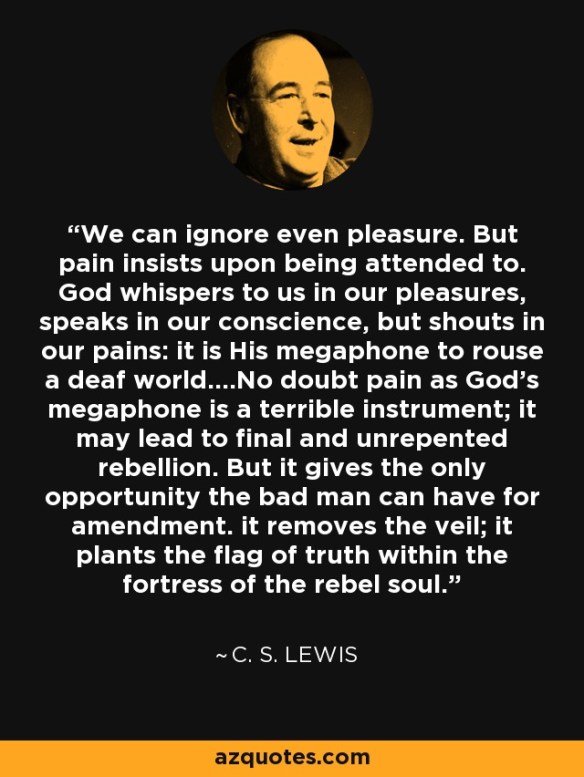
God’s Megaphone?

from his book, The Problem Of Pain

Does the Christian God use pain to draw people to himself? Assuming for a moment that such a God exists, does he use human suffering to make followers for himself?

There is no evidence in the Bible to suggest he does. To be sure, the Bible has a fair amount to say about pain. It claims that suffering is a means by which God either chastens Christians (Hebrews 12.7) or strengthens them (Romans 5.3-5), but this is exclusively for people who already believe. The Bible does not say non-believers are afflicted as a means of drawing them closer to God; the idea is unbiblical.

Let’s assume then that while this notion finds no support in the bible, Christians have learnt over the centuries, perhaps though extra-biblical revelation, that God does use pain in this way. What does this tell us about God? That he’s a being whose principal way of making human beings pay attention to him is by causing (or allowing) them to suffer frequently unbearable pain and anguish.

What sort of God is this? Not one who loves the world and cares for humans far more than he does mere sparrows (Matthew 6.26). He’s more an unpleasant, sadistic bully: the jock who backs you up against the wall, grips your balls and squeezes hard.

Maybe that’s how it is. The God who created the universe is just such a being; a moral monster, as commenter koseighty puts it. It’s easy to see how he might be: human beings suffer, yet there’s (supposedly) a God who loves them; therefore pain and suffering must at the very least be sanctioned by God, or, more likely, delivered by him. This, after all, is the story of the Old Testament. The God so arrived at though is a thoroughly human creation, a means of minimising cognitive dissonance by reconciling human suffering and a God who supposedly cares.

One more assumption is needed. Let’s assume this time that despite the odds, this character really exists. Does his strategy work? Does inflicting pain and anguish on people make them, as Lewis suggests, cry out to the One doing (or allowing) the inflicting and compel them to love him? It seems unlikely; I can’t find any evidence online of anyone claiming that pain or anguish brought them to God. From a personal perspective, I can honestly say that in times of distress or suffering I have never, post-deconversion, called out to God or any supernatural entity for help. I’ve never interpreted my suffering as his calling me closer and have never, since escaping Christianity, succumbed to his malicious charms. (What I did do occasionally, following my deconversion, was to convince myself that my suffering was a punishment from God – for leaving him behind, being gay or something I’d done. These feelings disappeared when I embraced fully the fact that the Christian God isn’t real.)

Where does this leave the Christian with, as Lewis puts it, ‘the problem of pain’? How do they reconcile a loving God who allows or even causes human beings to suffer? They can’t. Instead they spout empty platitudes that they think let their indifferent, imaginary God off the hook. Just look at the meaningless theo-babble religious leaders came up with in 2004 after a tsunami hit Indonesia, killing 227,898 people.

Leave God out of the equation, however, and there are far better explanations for why humans suffer. ‘Shit happens’ is far more convincing than anything the religious have to offer. Physical pain is the body’s reaction to damage. It is an imperfect system that frequently overreacts or fires up even after damage is repaired (I know this having fibromyalgia). That’s what it is to have, to be, a physical body. Anguish comes from random acts of nature, the violence and cruelty we inflict on each other and the death of loved ones, much of which is beyond human control. ‘Thoughts and prayers’ are useless in ameliorating this kind of suffering. Measures to restrict people’s access to weapons undoubtedly helps, as it has in countries with politicians with sufficient strength and intelligence to enact gun-control legislation. Without it, as in Ulvalde recently, more children will die, more parents will experience terrible anguish and another massacre is inevitable. God won’t stop it.

Suffering is not symbolic of something else; it is not ‘God’s megaphone’ or an opportunity for others to point those afflicted to Christ’s light (or any other bullshit that involves the supernatural.) Pain simply is. It is our lot as physical bodies to endure or alleviate it as best we can.