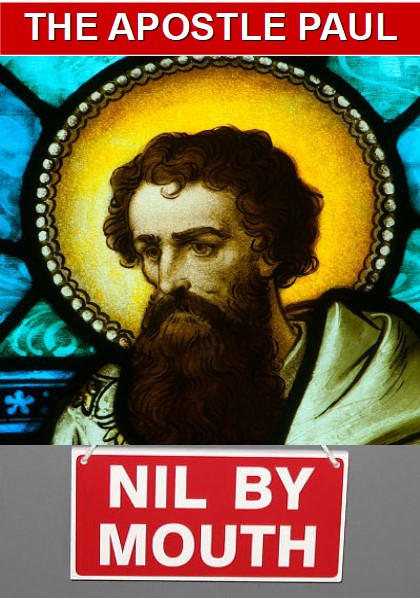
The New New Testament

With the New Testament books in their traditional sequence, it’s easy to conclude that there was first a remarkable individual who travelled around Galilee proclaiming the arrival of his Father God’s kingdom on Earth. He demonstrated great wisdom and compassion before being crucified by the Romans at the behest of the Jewish authorities. The first four books of the existing New Testament tell us so; that all of this happened first and all that follows occurred afterwards as a consequence of the events the gospels describe.

But, put the gospels where they belong in the chronological arrangement of the New Testament, and the events of the gospels do not happen first. Paul does:

I acknowledge that in putting the books in their correct order in my previous post, I cheated when I made the first the work of the very earliest cultists. No such book exists (no, it’s not Q and even if it were, we don’t have it). The earliest Christian beliefs are largely lost to us. All we know is that some individuals had visions of the Messiah. Paul tells us so in 1 Corinthians 15:5:

He (first) appeared to Cephas, and then to the Twelve.

These visions undoubtedly mark the beginnings of the cult. It later finds a convert in the Hellenized Jew Paul who he has his own vision(s). That these are visions and not an encounter with an actual person is clear from Paul’s declarations in Galatians 1:15-17 and 2 Corinthians 12. He stresses in Galatians that what he knows of the Messiah (‘Christ’ in Greek) comes not from any human source but from what this Christ has revealed to him in his own head: the revelations he’s fond of referring to. These, he says, showed him the importance of the Christ’s sacrifice, the crucifixion being the only Jesus event he’s interested in. Nowhere in his seven letters (1 Thessalonians to Philippians) does he mention anything a Galilean said, did or had done to him, apart from the crucifixion, which is mentioned without any historical detail. Paul’s interpretation of the crucifixion is devoid of Romans, the Sanhedrin, Gethsemane, Judas, Pilate, the scourging and cross carrying, Golgotha, the centurion, grieving disciples and empty tomb. Paul appears not to know anything specific about the event he obsesses over. Who can blame him when these details had yet to be invented?

Paul also has it revealed to him, or so he says, that this heavenly saviour will soon be coming down to the Earth to raise the dead, rescue the faithful who yet live and usher in God’s new golden age (1 Corinthians 15:52; 1 Thessalonians 4:16). It is an idea that permeates the rest of the New Testament writings.  

Paul’s faith, then, rests entirely on his visions/revelations. When proving that they really were of Jesus the Christ, he does so by repeatedly citing Jewish scriptures, never by referring to a particular saying, miracle or healing of an earthly Jesus. Paul’s Christ is a cosmic Superman who is raised from the dead as a ‘life giving spirit’ (1 Corinthians 15.46). (I’ve written about this on numerous occasions, including this post, so won’t reiterate all the details here.)

Written about a decade after Paul’s last letter, we come to the first gospel, which, lo and behold contains an abundance of sayings, miracles and healings of an earthly Jesus. Where did ‘Mark’ get these from? Not from a hitherto unknown document which won’t be posited for almost two millennia (Q); not from an ‘oral tradition’ when the only oral tradition we know of is Paul’s preaching, which doesn’t mention any details about an earthly Jesus.

  • To compound the problem, the first gospel is littered with angels, demons and other supernatural elements (voices from heaven anyone?)
  • It makes extensive use of stories from Jewish scripture, rewriting them and recasting their original protagonists with Jesus in their place.
  • It has him utter teaching that ‘astonishes’ those around him, when much of it is lifted directly from Jewish scriptures and would have been familiar to his listeners.
  • It makes him address the issues of the church as they existed around 70CE when the gospel was written and reflects the rules of the cult at that time.
  • It relies heavily on metaphor and allegory.
  • It has Jesus promise that the Son of Man will soon arrive on Earth to sort out its problems. This is Paul’s teaching about the imminent arrival of the Saviour through the clouds, dressed up in jargon from the book of Daniel. While apologists assume the Son of Man character is Jesus himself, promising his own future return, it evidently is not (it is rather, as I demonstrate here, a metaphor for the Jewish nation). What we have in Mark then, is a fictionalised Jesus predicting the appearance of the ‘real’ Christ from Heaven, just as Paul does.    

Mark’s gospel is most certainly not history nor an accurate record of the activities and teaching of a real human being. It is, as I’ve demonstrated before, fiction, from start to finish.

Following Mark in our chronological New Testament are two forged letters, purportedly by Paul (2 Thessalonians) and Peter (1 Peter) but actually by two different, anonymous authors. In them we’re back to hearing about a celestial Christ not an earthly Jesus. Earthly Jesus doesn’t get a mention despite the fact that one of the letters is supposedly by Peter, the fisherman who trailed around Galilee with Jesus for three years – allegedly – and witnessed his resurrection appearances. You think he’d have mentioned some of this in the letter. But no. Not a word.

And then two more gospels, both of which make extensive use of the first. ‘Matthew’ uses 80% of ‘Mark’ and adds some extra material of his own, including a birth narrative that is pure fantasy (including a magic dream and wandering star) and several new miracles. Where does this extra material (the so-called M source) come from? Some theologians speculate that again it’s from an oral tradition (the same hypothetical tradition used in Mark or a different one? Certainly not one known by Paul.) Even if so, we have no way of knowing whether it is reliable nor who originally reported it. It could just as easily have been invented by the anonymous creator of Matthew’s gospel. In fact, Matthew’s gospel is demonstrably a literary construct that plagiarises and embellishes Mark with more symbolic parallels – with Moses in particular – from Jewish scriptures. The stories of the resurrection are constructed in precisely this way.

Luke’s gospel is open to the same criticism. Where did his extra material (L) come from and why was it unknown to Paul and the creators of the two forgeries that preceded it? The obvious conclusion is that ‘Luke’ also made stuff up.

Here’s the problem with the synoptic gospels (those that carry the names of Mark, Matthew and Luke.) They appear in the midst of a sea of writing that knows nothing of an earthly Jesus and speaks only of a supernatural Superman. Yet we’re expected to believe that in the middle of this sea of myth and fantasy, the three gospels are an island of factual information about a real person. We’re required to accept that the synoptic gospels are reliable, factual, historical accounts of Jesus’ life on Earth. Apparently the gospel authors are the only ones who know the truth about his earthly existence while Paul and other writers evidently did not (or couldn’t care less about it) despite living and writing closer to Jesus’ supposed lifetime.

This is not the only problem. Even if the information about Jesus contained in the gospels was derived from an oral tradition, a hypothetical sayings gospel (‘Q’) or other lost sources (M & L) this would not make it any more reliable. It is just as likely to have been invented.

The next book of our chronological NT, the Acts of the Apostles was written by the same anonymous author as the third gospel. This story of the early days of the cult includes: a Jesus who beams up into the sky; visions; dreams; magic hankies and imaginary table cloths; angels; supernatural murders: miracle earthquakes and characters re-enacting events from Odyssey and the Jewish book of Jubilees. It gets Paul’s itinerary and theology wrong, smooths over his disputes with the pillars of the Jerusalem church and invents speeches for both him and various support characters. History it is not.

Immediately after Acts, we’re back to forgeries: Colossians and Ephesians, the latter being a composite of other Pauline letters and Colossians itself. We’re also back to the supernatural Jesus who makes salvation known through revelation. The two people who created these letters masquerading as Paul appear to have no knowledge of an Earthly Jesus. Had they not read any of the synoptic gospels? Did they not know any of the oral traditions or Q? Do they not care about all the supposedly factual information about Jesus that by this point was in wider circulation? Evidently not. They were interested only in promoting a celestial being, the Christ Jesus.

We’ll see more of this as we move on to the remaining books of the chronological New Testament, next time.

*It’s a trick question. Neither is any sense real.

The Lyin’, Cheatin’ Book

The Bible is a lyin’, cheatin’ book. And no, that isn’t the title of a long lost country song. The Bible was compiled by men who allowed themselves to be deceived and who were more than willing, perhaps unwittingly (to give them the benefit of the doubt), to dupe others. They included letters claiming to be by Paul and Peter that we know were not. They took the imaginary history of the early church, Acts, at face value, and the invented stories about Jesus – the gospels – as historical. They put them together in a way that made it look as if the gospels were written first, followed by Acts, Paul’s letters and the bulk of the forgeries. Paul’s letters they arranged, not in any sequential or thematic way, but from longest to shortest.

In fact, as far as Paul and the gospels are concerned, this is pretty much the reverse of the order in which they came into being. Of the documentation that made it into the New Testament, Paul’s genuine letters were first, starting with 1 Thessalonians in the late 50s and ending with Philippians in the early 60s. Only after Paul was dead did the first gospel appear (circa 70 CE), the anonymous account later attributed to ‘Mark’. After yet two more attempts to get the Jesus story right, came Acts, the notoriously inaccurate account of the early days of the cult and Paul’s adventures lifted from other sources. The fourth gospel followed much later, between 90 – 100 CE. Written by a sect of the late first century it offered a complete reimagining of the Jesus story. Along the way, numerous forgeries appeared as well as the lunacy that is Revelation, written circa 96 CE.

What would happen if we rearranged the books of the New Testament so they followed the order in which they were written? It would make them less duplicitous for a start and would also give us a more realistic picture of how Christianity arose. We would still be lacking a picture of what the earliest cultists believed prior to Paul but we can make a rough guess of what that might have been from what he says about those who preceded him.

We’ll do this next time and see what the newly ordered New Testament tells us about early Christian beliefs.

Paul and the Oral Tradition

Much is made of the oral tradition that it is said informs the material in the synoptic gospels, and possibly John too. The tradition of conveying the events of Jesus’ life and the things he said goes back to Jesus’ original followers – the disciples and the apostles (the terms are not necessarily interchangeable) – and continues with a high degree of accuracy, at least until AD70 when the first gospel was written. 

Which must be why we find so much detail about Jesus’ life in the letters of Paul, from his first letter, 1 Thessalonians, written circa AD55 to his last, Philippians (now an amalgam of several letters), written about 62. Paul was aware of the stories about Jesus – as all converts were – and affirms so many of the details of his life in his letters, passing on the vital stories and the traditions associated with him, in written form.

But not in our reality. Our Paul knows nothing of the details of Jesus’ life. Not once does he quote him or refer to the events of his life before the resurrection. There is nothing of the oral tradition. Nowhere in his letters does he draw from it; never does he say he knows for a fact that Jesus said or did a specific thing while on Earth.

Even after his meeting with Cephas and James, a full three years after his conversion, Paul relays not a single thing he learnt from them. After the encounter, he continues to promote only his own revelations and says nothing of what he learnt about Jesus from the man who supposedly spent three eventful years with him.

Fourteen years later, Paul meets again with Cephas and encounters other apostles for the first time. On this occasion, he and Cephas argue about justification and Paul comes away grumbling that ‘those leaders added nothing to me’ (Galatians 2:6) What? Not even stories about their time with the Master? Apparently these weren’t as important as disputes about soteriology.

Later still, Acts tells us that immediately after his conversion, Paul stayed with ‘disciple’ Ananias and other ‘disciples’ for several days. Did Ananias not know any of the oral tradition that he could pass on to Paul? Details about Jesus’ life, a saying or two or an account of a miracle? Apparently not. (This might be because the story is pure fabrication. Paul tells us himself, in Galatians 1: 16, that immediately after his conversion he ‘did not rush to consult with flesh and blood’).

Surely, though, he must have heard some of the Jesus story from those he persecuted prior to his dramatic conversion. If he did, he didn’t see fit to include any of it in his letters. Likewise, Paul had contact with cult communities he didn’t himself establish, such as that in Rome. Surely they conveyed some of the stories about Jesus that they had had passed on to them. He appears too to have known at least one other evangelist:  Apollos. If these other believers did pass on stories of Jesus from an ultra-reliable oral tradition, why didn’t Paul see fit to include any of them in his letters?

So what were Paul’s sources? Certainly not the oral tradition, nor Q, the hypothetical sayings gospel, which he likewise ignores. If the gospel was being spread orally from the time Jesus lived, by the apostles and other preachers, and was being passed around the fledgling cult communities, why did Paul know nothing of it? If in fact he did, why did he choose to ignore it in favour of his own inner-visions? Did he consider it of such little value?

These questions matter, as we’ll see next time when Mark decides he’ll set the Jesus story down on paper.

Is Jesus the Saviour, the Messiah and the Son of God?

Is Jesus the Saviour, the Messiah, and the Son of God?

No, no and no.

We know he’s not the Saviour because he hasn’t saved anyone. Every single person who has believed in him over the last 2,000 years has died and stayed dead. He hasn’t resurrected a single one of them and hasn’t ushered anyone into the heavenly mansion he (supposedly) said he was preparing for his Elect. Neither has he saved them from the trials of this life: illness, pain or suffering. His followers are no more saved from these than the rest of us.

Of course, Christians claim that what he saves people from is ‘sin’. But sin is an empty and peculiarly religious concept signifying the separation of ‘man’ from God. If there’s no God to be separated from there can be no sin. If, however, we’re talking about morals – ‘sinning’ – then it’s evident that believers are no more or less moral than anyone else. Jesus, it turns out, doesn’t save anyone from their own bad behaviour.

He’s not the Messiah (I’m resisting the temptation to add the Monty Python completion of that sentence) which is why most Jews do not believe in him. He doesn’t demonstrate any of the characteristics of the Messiah prophesied in Jewish scripture. He didn’t overturn the oppression his people endured under Roman rule and he hasn’t been there for the Jewish people in all their subsequent suffering. He certainly didn’t rescue them from the Holocaust. Only by redefining what is meant by ‘Messiah’, as early Christians did when they made the term synonymous with ‘saviour’, could Jesus even be considered a contender. In reality, he is an utter failure as a Messiah.

He’s not the Son of God. Even in the synoptic gospels he doesn’t claim to be; he’s cagey whenever the subject arises. It’s as if his early followers couldn’t make up their minds about how divine he actually was. Later Christians were more emphatic, claiming that the resurrection demonstrated Jesus’ divinity. Paul, however, doesn’t think so, saying only that Jesus’ return from the dead elevated him to a favoured position in God’s hierarchy (Philippians 2:9). Even this is going too far when the evidence of Jesus’ physical resurrection is so poor; the gospel stories do not  qualify him for Sonship. Nor do his failed promises and prophecies; if he were the Son of God, he’d have known the appearance of Son of Man (he himself?), the last judgement, the Kingdom of God on Earth, the inversion of the social order and the meek inheriting the Earth would not happen when he said they would. Or indeed at all. He was ignorant about so much! What sort of Son of God was he, to get so much so wrong?

In fact, we can be certain Jesus was no more the Son of God than Alexander the Great was Son of Ammon-Zeus or Augustus the ‘Son of the Most Divine’. How? Because like Ammon-Zeus and ‘the Most Divine’, the likelihood YHWH exists is ridiculously low; so low it’s reasonable to conclude he doesn’t. And no God = no Son of God.

To be continued.

The God Who Never Was

Blog404

I’m considering reasons why God is unlikely to exist. The sixth, though by no means final reason is (drumroll): Christians.

If God existed and if he did the things the Bible, and Jesus in particular, claimed for him, then Christians would be very different creatures. They wouldn’t be beligerent and self-righteous, desperately trying to draw others into their cult, callously condemning everyone outside it while claiming they themselves are the persecuted (a caricature, I concede, but not without truth).

Instead, and according to Jesus and Paul, they would be brand new creations (2 Corinthians 5.17), infused with supernatural power: the Spirit of God no less (John 14.26; Romans 8.7-9). They would, moreover, have abandoned their families (Luke 14.26) and sold all they own to give to the poor (Matthew 19.21), relying solely on God for their needs (Mark 11.24; Matthew 21.22). They’d spend all their time as his slaves (Matthew 25.21; Romans 6.22), helping the sick, the destitute and the imprisoned (Matthew 25.35-40) and in return God would have endowed them with the ability to heal all disease (Mark 16:15), raise the dead (Matthew 10.7-8) and do miracles even greater than Jesus’ own (Mark 16.17-18; John 14.12).

If Christians were like this, as Jesus and Paul promised, the world would be a much more remarkable and better place. What does it tell us that it isn’t? When Christians don’t constantly demonstrate compassion and miraculous powers but instead spend their time demeaning gay people, ranting about abortion and proselytising (the latter a redundant activity when, if they were the new creatures the Bible promises they’d be, we would all see God in and through their actions and superpowers.) That Christians are not like this tells us Jesus got it entirely wrong; that his God had no interest in him and has none in us; that faith in God, as Jesus and his early followers envisaged it, does not deliver.

Christians actually know this, which is why they ignore what the Bible says they should be like, or explain it away with convoluted exegesis. They’re focused on their own ‘spiritual growth’, ‘worship’ and on how they’ll be going to heaven when they die – an offer the Bible never makes. Whichever avoidance strategy they resort to, the Bible says what it says: that God will enable his followers to do great miracles, like healing the sick and raising the dead; ‘all things’, in fact, though Christ who strengthens them (Philippians 4.1). The evidence demonstrates conclusively, despite the disingenuous claims of some loopier evangelicals, that God does nothing of the sort. He fails, yet again, to come through. The only reasonable conclusion is that this is because he’s not real.

So those are six major reasons why it is highly unlikely God exists. There are others, some of which I’ve touched on in other posts: how, despite Jesus’ promises he will, God looks after his devotees no better than caged sparrows (Matthew 10.28-31); how there’s no evidence the supernatural exists; how the spiritual realm and the gods that go with it are products of the human imagination. Collectively – and even separately – these convince me there’s no God, and certainly not that sorry excuse for one, Yahweh.