There May Be Trouble Ahead…

Prophets, from left to right: Elijah, Julie Stephens,
Cindy Jacobs and er... Ed Miliband

Prophets don’t exist. A bunch of people intoxicated by religious fervour who think God has given them a special message that they must deliver to whoever will listen, are not prophets; they are a collection of extremists intoxicated with religious fervour.

We know this because no God exists. He can’t, as a result, drop messages, special or otherwise, into the heads of fanatics.

That’s it, really. No more to be said.

But so-called prophets exert quite an influence on our modern world. According to Abraham (I know, he’s a mythical figure but bear with me), God selected an ancient Jewish tribe to be his favourite buddies, so long as they did whatever he demanded of them, including hacking off their foreskins and that of their sons. What sort of prophet – what sort of God – comes up with this kind of lunatic fetishism?

Later the creators of a new prophet, whom they called Moses, came up with a story in which their hero encountered God in a bush (the symbolism is lost on us today.) This time he wanted his special buddies to invade their neighbour’s territory, slaughter them and take their land for themselves. This his favourite, de-foreskinned tribe did (modern genetic analysis of the peoples in the region suggests this isn’t what happened.)

After these fictional madmen came some potentially real fanatics who thought God had assigned them to lambast their fellow Jews for their shortcomings. These prophets promised the rubes rewards if they behaved as the prophets thought they should. These guys also came up with the idea that God would send a warrior Messiah to help his special little tribe take over the world. This is what happens when fanatics are allowed to get a hold of things.

A couple of centuries later, another self-proclaimed prophet turned up (or is invented) who seemed to think he’s the most special-est of all the prophets so far. This guy, called Yeshua (meaning ‘salvation’, so obviously not in any way symbolic) prophesied that the Messiah would be arriving real soon to sort the world out. He’d then hand it over to the Jewish people to manage. This guy’s script writers weren’t sure if Yeshua was talking about himself or some other supernatural character called the Son of Man. It doesn’t matter really. Nothing he prophesied happened when he confidently predicted it would: there was no Messiah who flies down from heaven, no final judgment, no great reset for the Earth. He was an absolute failure as a prophet; evidence, if more is needed, that those who claim to speak for God don’t know what they’re talking about. Don’t worry, though, this guy was recast as a resurrected Godman, just like the ones in pagan myths.

A few other prophets appeared around about the same time. In fact, the extremist who changed his name to Paul seemed to think that just about anyone could become one so long as they ‘edified’ the brethren. It was a few years though before the next really big so-called prophet came along.

In the 8th century, a guy called Muhammad said he was told by an angel who represented a different version of God that, amongst other things, Islam would spread worldwide and there would be an increase in senseless murders. These rather nebulous and self-fulfilling predictions are even now coming to pass. Muhammad’s future followers are indeed spreading Islam across the globe while senseless murders continue being committed, a good many of them by Muslims themselves.

While Muslims have made it clear that Muhammad is the final prophet, history has blessed us since with a few more. Joseph Smith in the 1880s was commanded by a different God (or maybe by the same one who’s changed his mind again) to start a new church and to obliterate anyone who stood in his way. He was successful in this enterprise, despite managing to get himself killed in the process.

You’d think, wouldn’t you, that given their abysmal success rate and the number of people who have suffered or perished as a result of their endeavours that we’d have had enough of prophets. While churches cannot agree on whether ‘genuine’ prophecy still exists, the prophets keep coming. Fanatics the world over, every bit as barmy as their predecessors, appoint themselves some deity’s spokesperson, and the ‘prophetic’ pronouncements begin: meaningless theobabble spattered across the Internet.

The New New Testament: part 2

We’re up to Hebrews in our new, chronological New Testament. The authors of Hebrews contend that their salvation was first ‘announced by the Lord’ and confirmed by those who ‘heard him’. This is not necessarily evidence of an earthly Jesus. Their declaration could equally refer to a cosmic Christ who, as he did with others, provided internal ‘revelations’, just as there are those today who claim Christ speaks to them in their heads. Hebrews’ authors say as much when they claim their faith has been confirmed by spiritual experiences such as ‘signs, wonders and various miracles, and by gifts of the Holy Spirit distributed according to his will’ (Hebrews 2: 3-4). They go on to announce that the New Covenant initiated by the new Moses – Jesus – is in every way superior to the Old Covenant and that he is the new, sinless high priest. Bizarre doesn’t doesn’t begin to describe it.

Hebrews contains the only example in the New Testament of a prediction of Jesus’ second coming: ‘so Christ, having been offered once to bear the sins of many, will appear a second time, not to deal with sin but to save those who are eagerly waiting for him’ (9:28). Hebrews, however, regards the Christ only as a supernatural high priest, operating in the heavenly realms. This second appearance then can only refer to this character, who is not conceived as having had any existence here on Earth.

Around the same time as Hebrews appeared, a senior cultist was writing to a group of Jewish Christians to remind them that faith alone isn’t enough for salvation. It must, James says, translate into improved behaviour. This runs contrary to Paul’s teaching which is that faith alone is sufficient. The letter mentions Jesus only twice (James 1:1 and 2:1) as ‘Lord Jesus, the Christ’. When reminding its readers to love their neighbour as themselves it doesn’t, as we might expect, tell them that this is because Jesus said so. Rather, it quotes from Jewish ‘scripture’; Leviticus 18:19 to be precise. An incongruous thing to do if, as some insist, the James in question was Jesus’ half-brother. In fact, the author makes no claim to have known Jesus and tells us nothing about him. He doesn’t make any reference to the teaching, miracles or activities attributed to Jesus in the first three gospels. Instead, he refers to him 11 times as ‘the Lord’ and tells his readers to be patient because ‘the coming of the Lord is at hand’ (James 5:8). Note what this is saying: the coming of the Lord is not a second coming or a return. And his arrival is ‘at hand’ (εγγύς, ‘engus’), meaning real soon, first century time.

Then, when you thought we’d never get to it, along comes a fourth gospel. Its authors revise the Jesus character and everything about him in this late entry. This Jesus speaks differently about different things. He’s fixated on himself, fully aware he’s a celestial being, completely in control of events, directing the entire story. The gospel introduces a new sidekick too, Jesus’ gay lover ‘the disciple whom Jesus loved’. This is possibly Lazarus, first introduced as a character in a parable in Luke 16:19-31 ‘John’, not Jesus, brings this symbolic character to life in the fourth gospel referring to him as the one the Lord loves (John 1:3). The previous three gospels know nothing of him as a real person.

John goes on to change the day of the crucifixion, to Thursday, because it fits his forced symbolism, and goes overboard in portraying the resurrection as a physical one, Jesus displaying his wounds and inviting the disciples to poke about in them. Preposterous grotesquery that, together with John’s unique resurrection accounts, the other gospel authors somehow missed. Were they not part of the much vaunted oral tradition when they wrote? Did they not know of it from Q? As commanding as John’s Jesus is, he is a very much a literary creation, of the ‘what if our celestial Christ had lived on Earth?’ type. But then again, aren’t they all?  

The Bible Is Fantasy

The Bible contains:

113 appearances of angels, usually interacting with human beings;

50+ visions, on which all of Christianity hangs: those of Daniel; Cephas and others who ‘saw’ the risen Christ; Paul and John the Elder in Revelation. 

21 supernatural dreams, including those experienced by Jacob, Technicolor Joseph, NT Joseph, the Magi, Pilate’s wife and Paul

Numerous apparitions and ghostly appearances, including that of the resurrected Jesus as well as Moses and Elijah and, in the Old Testament, the spirit of Samuel, conjured up from the grave by the witch of Endor.

Innumerable resurrections: not only that of Jesus but several Old Testament characters, and, in the New, Lazarus, Jairus’ daughter, the young man of Nain and the hordes who rose from their graves at the time of the crucifixion.

Multiple impossible astronomical events, ranging from the sun stopping in its orbit(!); a star wandering and hovering over a small house; a solar eclipse lasting several hours; stars that one day will fall from the sky; a God who lives just above the clouds and a ‘firmament’ between the Earth and the heavens that holds back water;

Several events in which nature is magically controlled: the parting of the Red Sea; Moses’ magician’s staff becoming a snake; the Nile turning to blood; Jonah being swallowed but not digested by a ‘great fish’ and Jesus calming a storm.

An abundance of fantastic beasts and fairy tale creatures: Giants (Genesis 6:1-4, Numbers 13:33); Leviathan the sea monster (Isaiah 27:1 etc); the Behemoth (Job 40:15-24); the Cherubim monsters (Ezekiel 1:4-21); the dragon and other beasts from Revelation

Many characters who are clearly legendary, from Adam & Eve, Noah, Lot and Abraham to Moses, Job, Daniel and gospel Jesus. Some of the Bible’s fictional characters lived to a literally incredible age: Adam 930 years, Seth 912, Methuselah 969, Noah 950, Abraham 175, Moses a pitiful 120. Jesus holds the record being now either 2,000 years old or eternal, depending on how you count it.

5 mythical places: Eden at the beginning of the book; New Jerusalem at the end; Heaven, the abode of God; Sheol the Old Testament place of the dead; Hades (Sheol mark II?) which Jesus visited while supposedly dead in his tomb (Acts 2:27, 31; Matt 16:18).

2 sentient ‘pillars’: one of cloud, one of fire (Exodus 13).

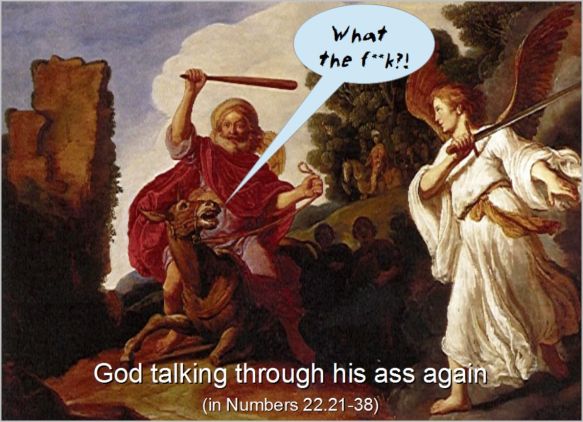
2 talking animals: the serpent in Eden and Balaam’s ass.

1 talking plant (Exodus 3:3).

0 science. No understanding whatsoever of what we now call astronomy, meteorology, germ theory, genetics, evolution, psychology… you name it.

So how do we read all of this? As the ancients themselves would, with an understanding of the world that regarded the supernatural, magic, miracles and monsters as real? We’re told often enough that this is how we should interpret scripture, not from a modern perspective. Perhaps we might credit the creators of the many books of the bible with greater skill, however, and interpret the inclusion of magic and miracle as allegorical or metaphorical; literary pieces, if you will. But then we have to decide which far-fetched stories are myth and which are historical accounts,. There really is no way to do this. A New Testament story awash with impossible events, implausible characters and symbolic tropes is every bit as allegorical or metaphorical as the same kind of story in the Old Testament (or, indeed, in Egyptian, Greek and Roman myth.) The reader who wants to see stories in the Old Testament as carefully crafted allegories has to concede that the Jesus narratives are of the same order.

It looks like we have to read the Bible as 21st century readers, because that is what we are. After all the Bible is supposedly a book for all time. We can, however, recognise the way in which its many creators saw the world – populated with fantasy creatures and subject to impossible events – and accept that they were wrong. Reality is not as they perceived it. What we cannot do is claim that the Jesus story is an oasis of truth in the midst of all this fantasy . 

Evidence of God

As for evidence, you might be aware of Israel. That nation has been in the news much of late. So, without being flippant at all, I present Israel as evidence. Think about it. They are living the script written thousands of years ago. Not by chance.

Israel as evidence for the existence of God. I’m thinking about it as Don suggests.

Where did it all begin, this bizarre notion that one tribe in the Middle East was chosen by God to be his special people? According to the Genesis myth, it was when YHWH promised Abraham he’d be his best buddy forever and ever, so long as he mutilated his body and those of his sons in perpetuity. They would also have to keep every one of this bullying god’s 365 rules and regulations, including the petty and piffling ones. So far so good, apart from the fact it was all very one-sided, and the mutilation of course. You’d think this would’ve been a sign that things weren’t quite kosher, but no; Abraham and his descendants buy into it and almost straight away, YHWH begins to let them down.

God’s Chosen Ones soon find themselves slaves in Egypt. A second mythical character is needed – up pops Moses – to get them out of this scrape. Unfortunately, after Moses has finished chatting with YHWH, who identifies as a burning bush on the top of a mountain, the sulky deity feels slighted by something the Israelites are doing. As is his way, he has many of them slaughtered and the rest he forces to troop around the same small plot of land for 40 years. This is how best buddies treat each other!

Later, the Jews find themselves defeated by the Babylonians and are carted off into exile. This exile, which YHWH does nothing to prevent, lasts 70 years. Still, it leads to a pleasant song made famous by Boney M in 1978 so I suppose it was worth it.

For the next few hundred years, Israel falls under the rule of other nations more powerful than itself. Not to worry though, YHWH is still ‘looking after them’, particularly those who are slaughtered in the rebellions that ensue. As Robert Conner says in a recent comment on Debunking Christianity, ‘If Yahweh ever threatens to bless you and your children, just kill yourself and get it over with.’

Fast forward to the Roman occupation of Israel. YHWH, having undergone a makeover, reneges on his promise to take care of his Chosen Nation forever and ever and comes up with a different plan to save people from his own cussedness. Now, if they want to continue as his friend, they have to believe a supernatural being has returned from the dead.

Abandoned by God, as he now wants to be called, Jews who haven’t defected to the new faith see their sacred, eternal temple destroyed by the Romans in AD70. Thousands of them are massacred and the Jewish nation ceases to exist.

This sets the pattern for the next two millennia in which God’s new friends organise pogroms, massacres and vicious persecution of Jews. This culminates in the Final Solution of the Third Reich which seeks to eliminate the Jewish people entirely. While awaiting extermination in a concentration camp, Andrew Eames scrawls on the wall of his prison: ‘If there is a God, He will have to beg for my forgiveness.’ God allows six million of his Chosen People die at the hands at the Nazis.

Following the second world war, Israel takes possession of the area surrounding Jerusalem, then occupied by Palestinian Muslims who are themselves descended from earlier immigrants. Thousands on both sides are slaughtered in the conflict that follows. In 1948, after almost 2,000 years, Israel becomes a nation once again; not through any miracle of God but as a result of human endeavour and bloodshed.

Tension and further skirmishes followed, leading to the present day when Israel finds itself under attack by Hamas terrorists. Thousands of innocents – women, children and babies – have been slaughtered without mercy. Israel is, as I write, retaliating and intends to enact further vengeance. And where is God in all this? You guessed it: nowhere to be seen.

All of this, according to some – including the naive writer at the top of this post – serves as evidence of God’s existence. That Israel has persevered for so long, despite opposition, persecution and the holocaust is not, however, evidence of God, any more than the great cathedrals of the world are. It is instead testimony to the resilience, resolve and sheer bloody mindedness of the people themselves. Perhaps their belief in YHWH (they don’t of course recognise his Christian counterpart) has fuelled their persistence, as it has their territorial claims.

Jewish beliefs and history are not evidence that YHWH exists. If anything, his apparent abandonment* during their many trials and tribulations is evidence to the contrary.

*Of course a non-existent entity can’t actually abandon anything, any more than it can lend its support or favour one group of people over another.

According to Scripture

A simple comparison of Mark’s and Matthew’s gospels is enough to demonstrate that the gospel writers invented their stories of Jesus. I’m going to take only a few examples over the next few posts, but the same analysis could be made of any of the episodes in the two gospels and yield the same results.

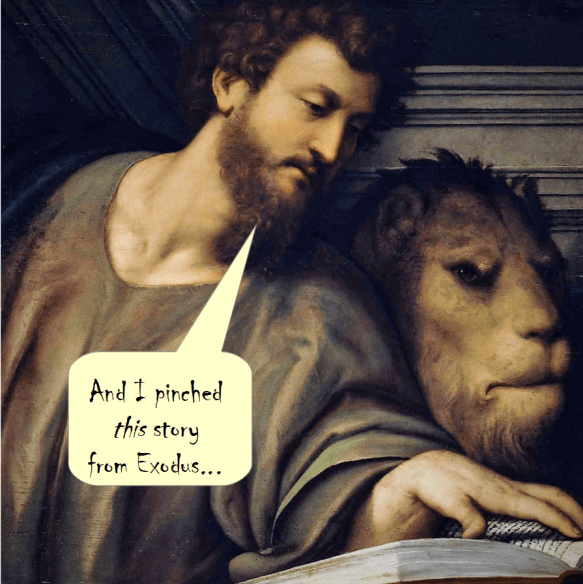
Mark starts his story with Jesus’ baptism and subsequent 40 days in the wilderness. The dominant motifs of both episodes are intended to alert the reader to the fact that Mark sees Jesus as the new Moses, preparing to lead his people out of bondage and into the Kingdom that God is preparing for them. The parting seas of Exodus 14 become the parting clouds through which God proclaims Jesus his Son, the 40 year trek through the wilderness (Exodus 16 etc) is replaced with Jesus’ 40 days in the wilderness. 

Mark gives the wilderness episode a mere two sentences (Mark 1.12-13) which isn’t enough for Matthew. He embellishes it in his gospel, making it a full-blown fantasy, complete with a lengthy conversation between Jesus and Satan. Matthew invented this story. We know he did because:

it cannot possibly have come from an eye-witness (because there wasn’t one);

It is patently fantasy material, with Satan, ministering angels and teleportation;

it cannot have derived from any oral tradition (as it is an embellishment of Mark’s tale, invented only a decade earlier, designed to echo the Moses story);

It is designed specifically to extend the analogy with the Moses. In Matthew, Jesus encounters the same temptations as the ancient Israelites in their wilderness trip, but, unlike his forebears, Jesus triumphantly resists them. He then recruits 12 disciples to go on ahead of him (Mark 3:13-15) just as Moses’ appointed 12 spies for the same purpose (Numbers 13). 

Matthew has even more up his sleeve. He is fully aware of the parallels Mark has made between Jesus and Moses and adds a third to the beginning of his Jesus narrative. In his contrived nativity story, he rewrites the story from Exodus 1 and 2, itself a complete fabrication, in which Pharaoh orders the elimination of all Israelite baby boys. He lifts it directly into the so-called Massacre of the Innocents episode in his gospel.

Again, we know Matthew made this up:

Herod did not order any such massacre. It is not an historical event.

Matthew was determined to find incidents in Jewish scripture he could claim were really about Jesus. Here he is at it.

He is determinedly extending Mark’s metaphor; this is not material from any other source or tradition.

He constructs the narrative using additional ‘prophecies’ he finds in the scriptures. For example, the trip to Bethlehem and the flight to Egypt, neither of which happened (no other gospel writers knows of them.) The Egypt episode is an imaginative (and dishonest) expansion of Hosea 11:1: ‘Out of Egypt I called my son’. In context, the verse refers to the Jewish nation not a future Messiah. And who led the Israelites out of Egypt? Moses.

The nativity story and the Moses/Israelite parallels in the Egypt/baptism/wilderness episodes in Matthew are not drawn from tales of Jesus that were doing the rounds. They are clever, contrived literary creations. They tell us too that Matthew did not regard Mark’s more basic stories as history or biography. He evidently did not view them as immutable. He changes and adds to them to make his own points, ‘correct’ Mark, extend his analogies and emphasise that which he thinks Mark hasn’t emphasised enough. Throughout his gospel he’s prepared to create new incidents, even when they conflict with points Mark makes. He knows that Mark’s work, like his own, constitutes carefully devised stories and he feels free – compelled – to improve them. You can’t treat history this way but you can rewrite fiction.

What are the Odds?

To look at it another way…

The stories of the Old Testament are largely fictional. They’re myth, legend and otherwise fabricated. There was no Eden, no world-wide flood, no slavery in Egypt, no Exodus. There’s no evidence that the characters around which events supposedly took place actually existed: no Noah, Abraham, Moses, Job, Jonah or Daniel. Their stories were created long after the time they purportedly lived; centuries later. The stories written about kings – which, if they existed, were no more than half-remembered tribal chiefs – and the so-called great prophets are constructed from folktales. In short, nothing we read in the Old Testament actually happened.

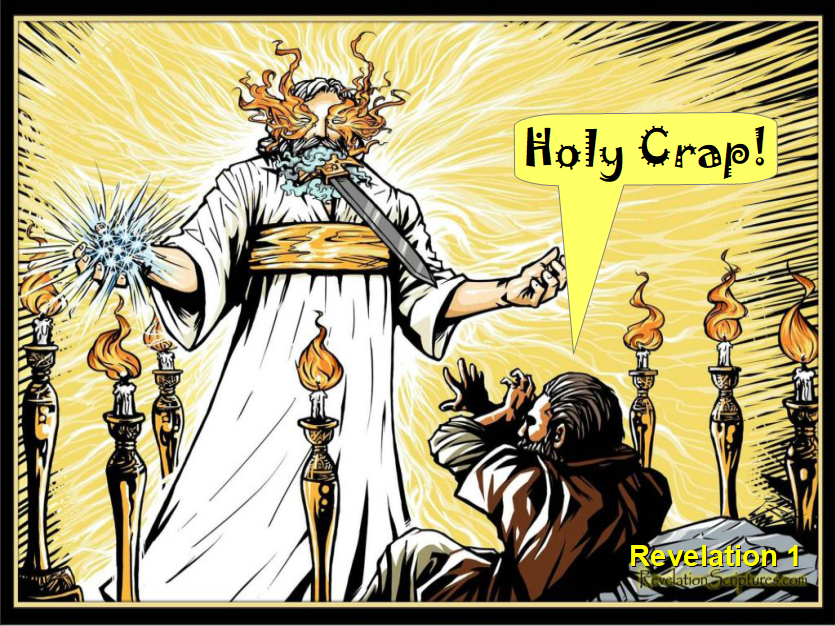
When we get to the New Testament, we find convoluted exposition of Paul’s ‘revelations’ about Jesus; visions and imagined sightings of a celestial being he had in his own head. It’s the same for the fruitcake writer of Revelation who envisaged an unreal comic book Jesus; invention every bit of it. The Acts of the Apostles offers a fanciful and wholly inaccurate ‘history’ of the early church, including angels, teleportation and fatal miracles. Of the 21 letters in the New Testament, at least 11 are forgeries, known to have been written by anonymous authors who were not who they claimed to be. The other 10, including Paul’s genuine letters and the likes of Hebrews, make up all sorts of mystical stuff about an angelic Godman-cum-high priest.

 And yet, in the midst of these myths and legends, made-up characters and stories, forgeries and fantasies and mystical musings stands the indisputable truth of the gospels. Or so Christians and theologians would have us believe. These particular stories, surrounded as they are by fiction on all sides are historical, factual and true.

What are the odds?

Jesus’ Final Solution

Blog332Composite

Jesus is beautiful. That’s what they were singing on TBN last night – thousands of Christians telling their false-idol Jesus just how lovely he is.

I’m fortunate in life to know some truly genuine and beautiful people and one of the things that qualifies them as beautiful is that they don’t advocate violence, cruelty or self-harm. I don’t know about you, but for me that’s something that marks out a good person. I can’t see folks who promote violence and cruelty as either good or lovely or beautiful. They’re just incompatible.

Unless of course you’re Jesus. Because, as ever, Jesus gets a free pass. He revels in violence and unpleasantness and his followers are always prepared to overlook it, because, well, he’s Jesus. Beginning with Paul he’s been remodelled from the rough itinerant preacher he clearly was to the epitome of all things bright and beautiful.

Here are some of his pronouncements, all hiding in plain sight in the gospels that tell us he was nothing of the sort –

Matthew 13.41-42 (and John 15.6):

The Son of Man will send out his angels, and they will weed out of his kingdom everything that causes sin and all who do evil. They will throw them into the blazing furnace, where there will be weeping and gnashing of teeth.

The fate of those who are not convinced by Jesus’ ‘good news’ is to be thrown into a blazing furnace. He’s not talking about after death here; he’s talking about when God’s Kingdom arrives on the Earth. He wants sinners and those he considers evil to be burnt alive. Jesus, who in Matthew’s gospel sees himself as the Son of Man, sounds more like Hitler than any ‘Prince of Peace.’ Burning people in giant ovens is Jesus’ final solution.

Then there’s Matthew 7.19-23:

Every tree that does not bear good fruit is cut down and thrown into the fire… Not everyone who says to me, ‘Lord, Lord,’ will enter the kingdom of heaven, but only the one who does the will of my Father who is in heaven. Many will say to me on that (judgement) day, ‘Lord, Lord, did we not prophesy in your name and in your name drive out demons and in your name perform many miracles?’  Then I will tell them plainly, ‘I never knew you. Away from me, you evildoers!’

Jesus makes clear here he’s talking about believers here – his own followers! If you don’t do all he says, Christians, you too are heading for the flames. What is it with this pyromaniac?

Luke 19.26-27:

I tell you that to everyone who has, more will be given, but as for the one who has nothing, even what they have will be taken away. But those enemies of mine who did not want me to be king over them—bring them here and kill them in front of me.

This is the conclusion of the so-called Parable of the Talents where Jesus emphasises the point of the story. With himself as the King of the World (Matthew 19.27-28) he wants those who don’t appreciate his megalomania to be executed in front of him. What’s not to like about this guy?

Matthew 5.29:

If your right eye causes you to sin, tear it out and throw it away; it is better for you to lose one of your members than for your whole body to be thrown into hell. 

Don Camp tells me (see the previous post) that this is meant metaphorically; metaphorically for what, Don? There is no reason to interpret this in any way other than literally. Look at the context: Jesus makes clear in the previous verse he’s talking about how to deal with lusting after women. He thinks the only way to stop yourself from doing this is to gouge out your eye (just the one?) According to Jesus, lust is such a terrible sin, it can only be properly dealt with by blinding yourself.

Matthew 5.30:

And if your right hand causes you to sin, cut it off and throw it away; it is better for you to lose one of your members than for your whole body to go into hell.

If you think you’re going to manage your lust any other way – by masturbating, for example – then you can forget that too; Jesus wants you to cut off the hand you do it with (or is he using ‘member’ in the modern euphemistic sense of ‘penis’?). The context of this verse is, like the previous one, sexual, and we know how much Christians like context. In case you’re tempted to dismiss this gruesome nonsense as an irrelevant part of Jesus’ message, he repeats it in Matthew 18.8-9.

Matthew 19.12:

For there are eunuchs who have been so from birth, and there are eunuchs who have been made eunuchs by men, and there are eunuchs who have made themselves eunuchs for the sake of the kingdom of heaven. Let the one who is able to receive this receive it.

Jesus advocates castration. Or, if you want to insist he’s speaking metaphorically, then he’s suggesting his most avid followers live a life without sex. And we know how well that worked out for the Catholic church. How do we know, though, when he’s being metaphorical and when literal? He hardly makes it clear. I suspect he’s only being metaphorical when Christians don’t like what he’s saying. If this is a metaphor here, it’s a particularly unpleasant one; Christian extremists have castrated themselves on the strength of these words and some have used them to justify castrating others. At the very least we might expect Jesus to have foreseen the consequences of such stupid remarks.

Luke 22.36:

He said to them, “But now if you have a purse, take it, and also a bag; and if you don’t have a sword, sell your cloak and buy one… The disciples said, “See, Lord, here are two swords.” “That is enough,” he replied.

Buy swords? What for? There’s only one purpose for swords – to run other people through. Now why would Jesus be suggesting his pals do that? To put up some resistance when he was arrested? What other purpose could they have in the context? Two swords, it turns out, are enough; though when Peter (according to John) uses his, Jesus castigates him. Talk about mixed messages!

Matthew 10.34-36:

Do not think that I have come to bring peace to the earth; I have not come to bring peace, but a sword. For I have come to set a man against his father, and a daughter against her mother, and a daughter-in-law against her mother-in-law; and one’s foes will be members of one’s own household.

Jesus predicts his own disruptiveness. Despite the prediction of the Christmas angels, his message was not one of peace but of division and bloodshed, as his later followers found out (and put these words in his mouth retrospectively.) Is it any wonder when he promised that those who weren’t a part of his cult (and some who were) would be thrown into the flames or put to the sword?

Mark 7.10-14:

Jesus said to the Pharisees: For Moses said, ‘Honour your father and mother,’ and ‘Anyone who curses their father or mother is to be put to death’… But you nullify the word of God by your tradition that you have handed down. And you do many things like that.’

Complicated this one, but essentially Jesus takes the Pharisees to task for not having troublesome youths executed as Moses commanded. In fact, he upholds all the barbaric practices of the Mosaic Law (Matthew 5.17).

Still think he’s a nice guy? Lovely and beautiful? Well of course, because the Jesus worshipped by Christians today – and even by Paul – was not this guy. The beautiful version is a construct that bears no resemblance to the bloodthirsty, furnace-building advocate of self-mutilation who haunts the pages of the gospels. Lovely he was not.


Hearing things

Blog332Pray

Don Camp has responded to my previous post, Voices In The Head, with a longish essay that he posted on Debunking Christianity. I want to use what he says to debunk the foolish notion that God speaks directly to people via their own  thoughts.

Those of us who do not believe in a God have, Don says, no ‘philosophical context’ for his speaking and are bound to ‘have trouble’ with the idea. I have to say, in fact, that I have no trouble at all with it. It’s easy: no God = no God speaking.

The rational thing to do, Don goes on, is for skeptics to fit those reports of God speaking into a context we do have, such as self-talk or schizophrenic delusions. This is another statement of the obvious; with no supernatural to account for such voices there can only be a rational explanation for this most irrational of phenomena.

Don then tries an analogy: ‘trying to explain God speaking to those who have no way to make sense of it is like explaining the color and beauty of a sunset to someone with no eyes.’ This is less than convincing. Those who are sceptical about God speaking (or doing anything) do have ‘eyes’: their rationality and critical faculties. A more accurate parallel for trying to persuade others the Almighty sends messages into his followers’ heads would be claiming that the events of a dream you had last night really happened in the world as we know it. ( I’ll have more to say about dreams later.)

‘I’ve said clearly,’ says Don, ‘what God speaking to people is not. It is not self-talk.’ Alas, Don does not tell us how he knows this.

‘Those who hear God speaking do not mistake it for self-talk,’ which is a pity because that’s what it is; Christians might choose to relabel it ‘God’ but that doesn’t mean it is. ‘It is also not schizophrenic delusions.’ It is a delusion though; I haven’t actually said that Don’s inner voice represents schizophrenia (he brought up the term) but I can’t see any difference between the voice he hears and those experienced, perhaps in more severe form, by schizophrenics.

‘Schizophrenic delusions, in which the sufferer either sees things that aren’t there or hears voices no one else hears, are characterized by self-isolation behavior, delusions, disorganized speech, bizarre behaviors, and flat affect. (see https://medical-dictionary…. )’ Whereas those hearing God’s voice gather together in self-contained enclaves separated, by choice, from ‘the World’. At other times they withdraw to talk to an imaginary super-being on their own and, according to Don, have him speak to them. If they’re really lucky, they’ll even get to see things that aren’t there. Obviously this kind of bizarre behaviour bears no resemblance to the true schizophrenic.

Don again: ‘Schizophrenic behaviors are very self-focused and their delusions are sometimes fearful or hateful and sometimes violent. It is the last that we see when people afflicted with schizophrenia pick up a gun and shoot up a school or a church or behead a girlfriend, as in the case you’ve noted in Mt. Vernon, Washington.’ Of course, schizophrenia is the same as most human behaviours; it exists on a spectrum. The Christian’s inner voice may not be as extreme or anti-social as that of the schizophrenic, but hearing it is on the same spectrum, perhaps at the safe end. Until it’s not, of course, as in the examples Don refers to.

‘But what about the person who hears God speak telling him that he should build a hospital in the Congo for AIDS patients or reach out to help the homeless? That is not the behavior of someone who suffers from mental illness. But that is the sort of thing that characterizes the lives of those ordinary Christians who report hearing God speak. So inner voices sometimes tell Christians to do good things. So what? This isn’t evidence they’re from God. What Don’s really arguing here, is that a ‘good’ message proves the Christian’s inner voice is God. And how do they know it’s God and not just self-talk? Because the message is ‘good’. This is circular and self-fulfilling, and doesn’t take into account all those instances when ‘God’ commands people to do bad things. According to the Old Testament it was the Lord himself who commanded Moses, Joshua and Samuel to massacre neighbouring tribes, the Lord who told Abraham to execute his own son in an especially cruel ‘test’. Doesn’t God do this any more? Has the unchanging God changed in this respect? Believers don’t just hear God telling them to do good things; the evidence is right there in the bible that (they imagine) he tells them to do wicked things too.

‘Does that kind of selfless compassion and determined service to mankind come from schizophrenic delusion or a disordered mind disconnected from reality? I do not think so. But that and many, many similar things are the result people having truly heard God speak.’ No, it’s the result of people interpreting an inner prompting as God. Interpreting it as such does not mean it is.

‘No physician would diagnose the many millions of ordinary Christians who report God speaking to them as schizophrenic.’ As I’ve already suggested, Don is creating a false dichotomy here: it isn’t necessary to be a diagnosed schizophrenic. It’s possible those hearing ‘helpful’ voices are much lower down on the delusional spectrum. They may never be schizophrenic in the medical sense, but this does not mean their voices are not self-generated.

‘But if God speaking is NOT self-talk or delusional, what is it?’ It is both of these things and Don hasn’t demonstrated otherwise. Still, let’s humour him and press on:

‘I think that J. Warner Wallace has as good an explanation as any. It is far more than voices in our heads. You can read his article here http://www.foxnews.com/opin…Fox News? Don really is in trouble.

‘What is significant for those who are convinced that there is no God out there to speak is that their conclusion contrasts with the experience (of) many billions of people over a very long time. It was the experience of those who wrote the Bible and many of those they wrote about. It has been the experience of billions since.’ Aah, now we’re playing the numbers game: ‘lots of people think this so it must be true.’ Well, okay, but many more billions dream while they’re asleep, and those dreams must come from somewhere; they can only be from God – there’s even biblical support for the idea that they are. So, if numbers of people demonstrate God’s involvement in our psyches then dreams are far more numerous than God merely speaking directly. However, God doesn’t create or speak through dreams, even though the bible suggests in places that he does. People may interpret them as God speaking but, as I’ve already said, interpretation is not evidence – and numbers prove nothing.

And now, having failed to present any sort of persuasive evidence that his inner voices are from God, Don leaps to this conclusion: ‘it is not really helpful for skeptics, who consider themselves in some way more grounded in reality than the rest of mankind, to Wave off this God speaking thing as delusional.’ Do we skeptics consider ourselves more grounded in reality – yes, I think perhaps we do. We look at evidence, not at what people believe they’re experiencing nor the numbers who believe, nor to the supernatural as an explanation for human phenomena. Voices in the head are generated by the brain; as Don concedes the mind commonly does this when we create a dialogue with ourselves. The nature of this dialogue is influenced and altered in those whose minds are saturated with religious ideas and mythology to the extent it is (mis)interpreted as the voice of God. This is the reality. I know, I’ve been there.

‘You need to consider,’ says Don in his coup de grace, ‘if there is not more to reality than you believe’? Do we? Do I? When a perfectly adequate explanation exists for voices in the head, why should any of us consider an alternative that relies on the supernatural? Actually though, I’ve done that too; for a long time I believed there must be ‘more to reality’ than we humans could conceive of or comprehend. So far, however, there is absolutely no evidence – zero, zilch – that what we don’t understand is Supernatural. Whether I ‘believe’ this or not is immaterial; it is a demonstrable fact. The Creator of everything-there-is cannot therefore be the source of voices in the head, dreams, visions or any other damn thing.

So, Don, a final point: if you stick, as I’m sure you will, with your belief that the voices you and other Christians hear are from God, then perhaps you could tell us why he says different things to different Christians – completely contradictory things (as I’ve written about here)? How do you account for God whispering one thing to you and the opposite to a fellow-believer? Do you dismiss as schizophrenic those who say God tells them not to commit massacres, but to shun gay people, control the weather, take possession of a new jet or prepare for the ‘great persecution‘ to come? Are these fellow Christians deluded? Maybe misinterpreting the voices in their head? If you dismiss them as deluded, muddle-headed or schizophrenic then you can perhaps see how we skeptics view you.

Making excuses for Jesus


Excuse 1. When he said ‘Kingdom of God’, what Jesus really meant was ‘transfiguration’.

Hokum

However it might seem, Jesus’ mission didn’t fail! Absolutely not. Because after he promised those standing in front of him would see God’s Kingdom come in power and glory, the gospels relate how some of the disciples saw Jesus having a friendly chat with Moses and Elijah (Mark 9.1-8 etc). So, say his apologists, this was what he was really referring to; his being visited by two of Judaism’s great figures, on day release from Heaven or having travelled through time or, more probably, having being planted in a story that is pure fabrication. Whichever, this ‘transfiguration’ is regularly hauled out as ‘evidence’ that those standing with Jesus did indeed see him in his Kingdom. (Here, here and here, for example.)

Pastor Bob Deffinbaugh, for example, puts it like this:

Jesus then promised His disciples that some of them would see the “kingdom of God” before they died: “I tell you the truth, some who are standing here will not taste death before they see the kingdom of God (Luke 9.27). While there are numerous explanations as to what Jesus’ words here mean, the simplest explanation, especially in the context, is that Jesus was foretelling the transfiguration which was to come within a week’s time.

But this cannot be ‘the simplest explanation’ because it doesn’t fit any of what Jesus said the Kingdom would be like. Here’s his description as it appears in Matthew 24.29-31 & 34 (emphasis added):

Immediately after the suffering of those days the sun will be darkened, and the moon will not give its light; the stars will fall from heaven, and the powers of heaven will be shaken. Then the sign of the Son of Man will appear in heaven, and then all the tribes of the earth will mourn, and they will see the Son of Man coming on the clouds of heaven with power and great glory. And he will send out his angels with a loud trumpet call, and they will gather his elect from the four winds, from one end of heaven to the other… Truly, I say to you, this generation will not pass away until all these things take place.

The transfiguration bears no relation to any of this, nor to his other predictions about what the Kingdom would be like – the meek inheriting the Earth, the last becoming first and so on – once it was established. The Kingdom of God as Jesus imagined it (and he did imagine it) was to be a far grander affair than a symbolic encounter ‘witnessed’ by a few disciples. It was to be seen by the entire world and would have far-reaching and long-lasting consequences. The transfiguration, no matter how much Jesus’ raiment is made to shine, simply doesn’t qualify. It can’t possibly be, then, what Jesus had in mind when he predicted the end of the age and God’s rule coming to the Earth. There is a fundamental dishonesty in claiming that it is.

Better luck next, Christians…