
Where are those stories?

Those opposed to the idea that Jesus was only ever a mythical figure are generally dismissive of those who point to the evidence of the New Testament that this is precisely how the earliest Christians saw him. These critics lambast as ‘amateurs’, ‘pseudo-historians’ and ‘fringe’ enthusiasts those who don’t see any evidence for an historical Jesus. But such ad hominems are not arguments and they’re certainly not evidence that a human Jesus existed. When the books of the New Testament are arranged in chronological order, the very earliest writing about Jesus – Paul in the 50s and the creed of 1 Corinthians 15 – appear to view him only as a scripture-fulfilling spiritual manifestation.

So, was Jesus actually an itinerant preacher who traipsed the Earth in the 30s before rapidly evolving into Paul’s mythical Christ or was he a mythical being to begin with, only later to be cast as an historical figure?

It has to be one or the other. 

Within twenty years of his supposed death, Paul and others had experienced dreams, visions and hallucinations (Acts 2:17) that convinced them Jesus was a supernatural being in heaven. This doesn’t of course rule out that a human Jesus had actually existed, but it makes it unnecessary for him to have done so. Paul and almost all the creators of the New Testament books treat his earthly existence as irrelevant. Even when ‘proving’ their celestial Superman is the promised Messiah, they refer not to his activities on Earth, but appeal exclusively to what they believed Jewish scripture revealed about the Messiah.

According to these men, this is how they knew the Jesus of their dreams was truly the Saviour: the ancient scriptures. Not a single one of them says, ‘I refer you to Jesus’ miraculous birth in Bethlehem; I remind you that he changed water into wine, controlled the elements and miraculously multiplied food.’ Not one of them references his many healings, exorcisms and raising of people from the dead. Not one mentions the historical details surrounding his crucifixion, the empty tomb or the women who first saw him alive again. Not one relates a single resurrection appearance (beyond their own visions) nor do they mention the ascension or a looked for ‘second’ coming. Why not? Surely these would be the definitive indicators that Jesus was the Messiah, instead of, or at least alongside, the so-called prophecies of ancient scriptures.

The ‘why not?’ is because these stories – the birth, the miracles, the healings, the empty tomb, the bodily resurrection, the ascension and the rest – had, at the time Paul was writing, not yet been created. Consequently, they couldn’t be passed on to Paul when he met Cephas and James. There was no much-vaunted ‘oral tradition’ for him to call upon to fill in the gaps in his knowledge about an Earthly Jesus. There was no oral tradition because there was no Earthly Jesus to relate stories about when Paul was active in the 50s. This version of Jesus, created from Jewish scripture, Paul’s teaching and cult rules, didn’t appear until the early 70s. Even after Mark’s gospel and its copycat sequels, most of the writers of later New Testament continued to believe in and refer only to a heavenly saviour verified by ancient Jewish scripture.

But, apologists say today, no-one at the time would be taken in by talk of a Messiah who existed only in the heavenly realm. And that’s true; despite the Bible’s claims to the contrary, very few people were persuaded. But some bought into it, just as others at the time bought into Mithras. Mithraism was, for a while, more successful than the fledgling Christian cult. Yet its adherents knew Mithras himself manifested only in the heavenly plane. This didn’t stop multitudes of military men from joining the cult to worship him. It was the same for the other deities of the day. They too didn’t exist even if stories about their adventures on the Earth were widely circulated and, in all probability, believed by the gullible.

If, however, Jesus’ life on Earth had happened in the early part of the first century, how was it that 20 years after his death he had already become an angelic being without a past? Why had Paul, the writer of Hebrews, the pseudo-Pauls, James and John of Patmos never heard any of the stories about him, or didn’t care about them or felt they weren’t really evidence of Jesus’ Messiahship? Where are those stories? Outside the later gospels they don’t exist. It’s as if, when Elvis Presley died, no one cared any more about all the hit records he’d made and were instead only interested in his post-mortem sightings in laundromats and shopping malls. The process just doesn’t happen this way round.

No, it is far more likely that Jesus went from being a celestial saviour to having stories written about him, stories that are based on prophecies in Jewish scripture and Paul’s ‘revelations’. They are allegorical and metaphorical, wholly made up as the writer of Mark 4:11-12 tells us with the equivalent of a Clark Kent wink:

The secret of the kingdom of God has been given to you. But to those on the outside everything is said in parables so that ‘they may be ever seeing but never perceiving, and ever hearing but never understanding; otherwise they might turn and be forgiven!’
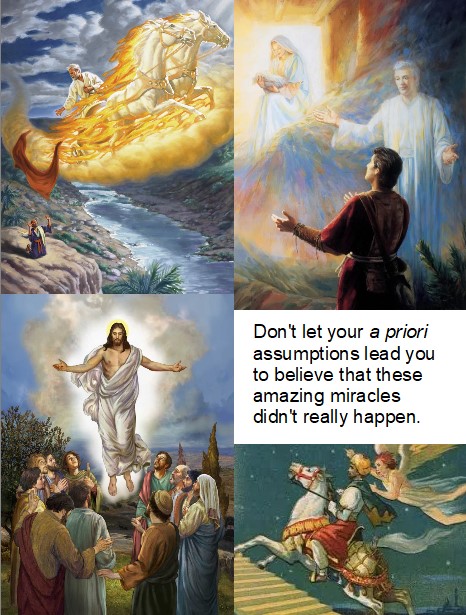
 

Either All True Or None True

About 2,500 years ago, a man called Elijah went up to heaven while still alive. He was taken through a whirlwind in a chariot of fire, pulled by horses of fire. This amazing event was witnessed by several other people who were profoundly affected by it. The story of this ascension was possibly relayed orally for many years until finally being written down in what is now 2 Kings 2.

Did any of this really happen?

Of course not. It’s a myth.

Some time in the 4th century BCE, the first king of Rome, Romulus, was taken, while still alive, to the dwelling place of the gods. From that time on he was worshipped as a god – some said he was eternal to begin with – with a temple being built in the very place from where he had ascended. Later he appeared to one of his followers, Julius Proculus who said the resurrected Romulus was larger and more beautiful than ever, armed with weapons shining like fire. Julius Proculus attested to this appearance of the resurrected Romulus, swore an oath to its veracity and relayed it faithfully to others.

Did any of this really happen?

Of course not. It’s a myth.

https://mythologymatters.wordpress.com/2019/04/18/easter-mythology-the-resurrection-as-modeled-on-greco-roman-myths/

It is not known when Mithras was born, if indeed he was. He emerged from a rock in the spiritual realm as a child or youth, ritually slaughtering a bull and sharing a banquet with the god Sol. He guided souls to the after-life, propelled as they were by the bull’s blood and flames. He was worshipped primarily by soldiers who saw him as their salvation from the bitterness of earthly life. There were rituals to be followed to become a true initiate and for Mithraic mysteries to be revealed. How Mithras made himself known to his acolytes is unknown, but in the first three centuries CE, his cult rivalled that of the Christians in popularity.

Did all of this really happen?

Of course not. It’s a fabrication, a myth.

In the 8th century CE, the prophet Muhammad flew from Mecca to Jerusalem on a winged equine. Once in Jerusalem he climbed a ladder to heaven. Once there he travelled through the various levels, having conversations with other lesser prophets, before entering Allah’s domain. His journey was later revealed to two early prophets who had known Muhammed when they were boys. They conveyed the details accurately until they were recorded, briefly at first in the Qur’an and later in more detail in its supplement, the hadith.

Did any of this really happen?

Of course not. It’s a fabrication, a myth.

In the early 19th century, Joseph Smith was visited by Jesus and his Father in a vision. They told him that he should not join any existing church because they were all in error. Later, a hitherto unknown angel named Moroni appeared to Smith and indicated to him where some gold plates were buried. He instructed Smith to dig up and translate the plates. Obediently, Smith did so, using a pair of seer stones for the translation. The resulting Book of Mormon was a revelation of Christ’s activities in North America following his resurrection. Smith wisely had a number of his associates witness, in writing, the existence of the gold plates as well as their supernatural provenance.

Did any of this really happen?

Of course not. It’s a fabrication.

In 1916 the Virgin Mary appeared numerous times to three poor Portuguese children, giving them instruction and prophesying to them. She also promised that she would perform a miracle at Fatima. Accordingly, between 30,000 and 100,000 people, including reporters and photographers, gathered at Fatima where many saw multi-coloured lights before the sun itself ‘danced’. It came closer to the Earth before zig-zagging back to its usual place in the sky. While not all of the attendees testified to the phenomenon of the dancing sun (some saw only the lights, others nothing at all) many did and testified to the effect the miracle had had upon them.

Did all of this really happen?

Of course not. It’s a fabrication based on hallucinations.

Around 30CE, a rabbi known as Jesus, who had been born of a virgin, gathered together 12 followers and went around Galilee preaching absolution from sin and the imminence of the Kingdom of God. He announced he was the Messiah who would rule the Earth when the kingdom arrived. The Jewish authorities took exception to his claims and petitioned the Romans to have him executed. This they did, only for Jesus to come back to life three days later, appearing in visions to his followers. He ascended to heaven, promising that those who believed in him would enjoy eternal life. Some of his disciples spread his message faithfully until it was eventually written down, first by a former Pharisee called Paul and then by four authors who accurately recorded what Jesus had said and done.

Did all of this really happen?

What do you think?

Redemption Songs

I was listening to some Bob Marley the other day and was struck by a line in his song ‘Get Up Stand Up’: ‘Almighty God is a living man’. He was not of course referring to Jesus but to Haile Selassie, the Emperor of Ethiopia who was still alive when ‘Get Up Stand Up’ was recorded in 1973. Rastafarians like Marley believed the Emperor would redeem African-descended Jamaicans and restore them to Africa from where their ancestors had been taken.

Rastafarians saw and still see themselves as modern day Israelites, like those in the Bible stories of Egyptian slavery and Babylonian captivity. Their perspective is reflected in songs like ‘Exodus’, by Marley, ‘The Israelites’ (Desmond Dekker) and ‘Rivers Of Babylon’ (The Melodians). Selassie himself denied being divine (‘why do you call me good, when only God is good?’) but that didn’t stop those who believed in him from making a saviour god of him. When, inevitably, he died (in 1975), some Rastas left the movement while others reinterpreted his role:

Some Rastas believed that Selassie did not really die and that claims to the contrary were Western misinformation… Another perspective within Rastafari acknowledged that Haile Selassie’s body had perished, but claimed that his inner essence survived as a spiritual force. A third response within the Rastafari community was that Selassie’s death was inconsequential as he had only been a “personification” of Jah rather than Jah himself.

It all sounds rather familiar doesn’t it? The saviour didn’t really die/his inner essence survived/his death was inconsequential. Where have we heard all that before?

This put me in mind of a cult that for a long time rivalled that of Christianity. Indeed, in the early days of Jesus belief, it boasted more members, all of them men. Unlike Christianity and Rastafari, this cult believed in a saviour whom adherents knew had never existed as a human on Earth. Mithras was a celestial being whose salvific work, which involved the symbolic slaughter of a bull, was carried out in the heavenly realm:

Mithras is the guide of souls which he leads from the earthly life into which they had fallen back up to the light from which they issued… It was not only from the religions and the wisdom of Orientals and Egyptians, even less from Christianity, that the notion that life on earth was merely a transition to a higher life was derived by the Romans. Their own anguish and the awareness of senescence made it plain enough that earthly existence was all hardship and bitterness. Mithras-worship became one, and perhaps the most significant, of the religions of redemption in declining paganism. (Jacob Burckhkart)

Eventually, in the fourth century, Christians suppressed Mithraism to the extent that its adherents, along with its ritualistic texts, were wiped from history. Only its deserted, underground temples remained.

What both examples tell us – and there are hundreds more – is that people have always been willing and eager to make gods of revered figures, both real and imagined. They are ready to believe them capable of impossible feats and to trust in them for whatever form of redemption they feel in need of. There can be no doubt Jesus belief sprang from this same sort of wishful thinking; Jesus being cast as a divine figure with the power to lead believers into the light and/or the promised land of eternal life. It hardly matters whether he existed or not. Like Mithras, an imaginary/imagined figure could just as easily fulfil the role as a real person, like Selassie, who had others’ unrealistic expectations thrust upon him.


Making it all up

While the Old Testament is made up of myth and legend and the New created from the visions and dreams of a few disturbed individuals, we are expected to believe that the gospel accounts nevertheless shine out as beacons of truth.

We know, however, that much of what is contained in the four canonical gospels is fiction. I’m not referring here merely to how contradictory they are (though there is that), I’m talking about the parts that are clearly made up, invented for theological and literary purposes. These include:

The nativity stories: These are myth, created so that the Godman has an origin similar to those of other Godmen: There is no historical evidence for a wand’rin’ star, a census that involved the mass movement of populations or the Massacre of the Innocents.

The virgin birth: relies on a misreading of ‘young woman’ in Isaiah 7.14

The flight to Egypt: a misapplication of Hosea 11.1.

Genealogies: invented. Matthew’s and Luke’s are completely different and don’t, in any case, include sufficient generations to reach back to ‘the first man’.

The Magnificat: Written as a Greek poem. It is not an outpouring of a young peasant woman.

The temptation in the wilderness: Jesus did not have a conversation with the devil. He was not attended to by squadrons of angels; we know such beings do not exist. In any case, which eye-witness was present to record these fanciful encounters?

Angels: 12 appearances across the gospels. Demons and other evil spirits: at least 20 mentions. Myth, pure and simple.

The miracles: all of them make a theological point. This is their purpose. They are literary.

Jesus’s teaching: designed to encourage members of the cult, a cult that could only exist after the events the gospels purport to relay. Everything he’s made to say comes from different sects, Paul’s teaching, Old Testament wisdom literature and even pagan sources.

The sermon on the mount: created and written in sophisticated Greek, not delivered by a semi-literate itinerant preacher.

John’s self-obsessed Jesus: nothing like the character in the synoptic gospels. Either he’s made up or they are. Or both.

The Transfiguration: Elijah and Moses do not return from the dead to have a chat with Jesus. This is completely made up.

The Eucharist: first appears in Paul’s teaching in I Corinthians 11.23-27. It is distinctly pagan but is accommodated in the gospels because Paul insisted he got it directly from his (imagined) Christ.

Judas’ betrayal: suggested by Zechariah 11.12-13 (which in context is not a prophecy).

The custom of freeing a prisoner (Barabbas): no such custom existed. The event is symbolic.

Resurrected corpses emerge from their graves: Matthew made this up. No-one else seems to know of it and Luke makes a point of cutting the episode out of his version of events.

The Crucifixion: based on Isaiah 53 and various Psalms.

The Resurrection: based on the visions of Cephas, Paul and others with added, invented detail, incompatible across the four accounts.

The Ascension: Jesus levitates into the stratosphere, in front of witnesses no less. Or perhaps not; Luke invented this impossibility.

There is much more in the gospels that is evidently and demonstrably made up. We can, as Christians do, believe it all really happened. We can insist that the stories are not based on other sources but that these sources are prophecies of real events that took place in history. From this perspective, Paul’s and others’ visions are then the result of these same events.

But which is more likely? –
The Old Testament is packed with prophecies about Jesus’ life and death, and that what Paul and others saw in their heads was because Jesus really existed and spoke to them once he’d returned to Heaven…

Or: The Jesus story is fictional, a patchwork of Old Testament snippets, mystical visions, invented symbolic events and pagan ideas of resurrecting Godmen.

And If the gospels are fiction – and they evidently are – then why not Jesus himself? If there was no real history to be written about him, just this mish-mash of other sources, that can only be because there was no Jesus who walked the Earth 2000 years ago.

Jesus is the same as his near contemporaries Osiris, Dionysus and Mithras. Like them, he is entirely mythological.