
Religion poisons the well. Again.

dye

The shooting in Orlando of people in a gay night club (50 dead, 53 wounded) is yet another example of religion as the antithesis of human flourishing. Not Christianity this time, of course, but that other ‘great’ religion, Islam, the religion of peace. But Christians cannot distance themselves from atrocities like this, carried out in the name of God, when the influence of even moderate religion is a pervasive, unhealthy presence in our society.

It’s true that Christians don’t, as rule, rampage in the streets or fly planes into buildings but they do contribute to the medium in which more extreme forms of religion grow:

Westboro Baptist Church, for example, with its own peculiar brand of Bible-based homophobia – ‘God hates fags’ and all the rest – is, like it or not, an expression of Christianity;

Right-wing evangelicals who interfere in the churches and governments of Africa and South America, actively encouraging them to take a homophobic stance and to pass anti-LGBT laws, are equally culpable; Scott Lively, Pat Robertson, Sharon Slater, you too are people filled with hate;

Likewise, those Catholic bishops who use their influence to denounce gay and transgendered folk as ‘mentally disordered’;

Christian bloggers who trot out the old, ‘Woe to those who call evil good and good evil’ (Isaiah 5.20) and misapply it to homosexuality, together with those who quote Leviticus 18.22 (‘abominations!’) and Romans 1.26-27 (‘unnatural and indecent!’)…

All of these contribute to the animus directed towards fellow human beings whose ‘sin’ is merely to be different. Religions, or more specifically their adherents, contribute significantly to the levels of misery in the world today, though Christians will cry ‘foul’ here (or ‘persecution’ even, because how they love claiming they’re being persecuted when asked to demonstrate some empathy and a little love.) After all, it wasn’t a Christian who gunned down the people in the Pulse nightclub this weekend. No it wasn’t. But every time religious bigots –

tell others what despicable sinners they are,

misrepresent and denigrate minorities,

promote ‘gay cures’,

attack same-sex marriage,

add quotation marks around the words gay and gay marriage, as if they’re somehow not real,

assert homosexuality and transgenderism are synonymous with ‘moral decay’,

claim natural disasters are God’s response to gay people’s very existence,

boycott businesses that support equality,

‘take a stand’ against transgendered people using the appropriate restroom and

refuse to serve gay couples –

every time, in short, they say LGBT people are evil, sick or worthless, the self-righteous prepare the ground for individuals like Omar Mateen to do what he did in Florida on Sunday. Religious leaders condemning such atrocities after the event is too little, too late, when they’ve failed to take charge of their acolytes and  do nothing to stem the tide of hatred flowing from their churches, mosques and temples. 

To those of us on the outside, religions are all of a kind; harmful superstitions. If a ‘faith’ entails belief in supernatural beings and puts allegiance to such imaginary figures above fellow human beings, it is without merit. It is the evil among us.
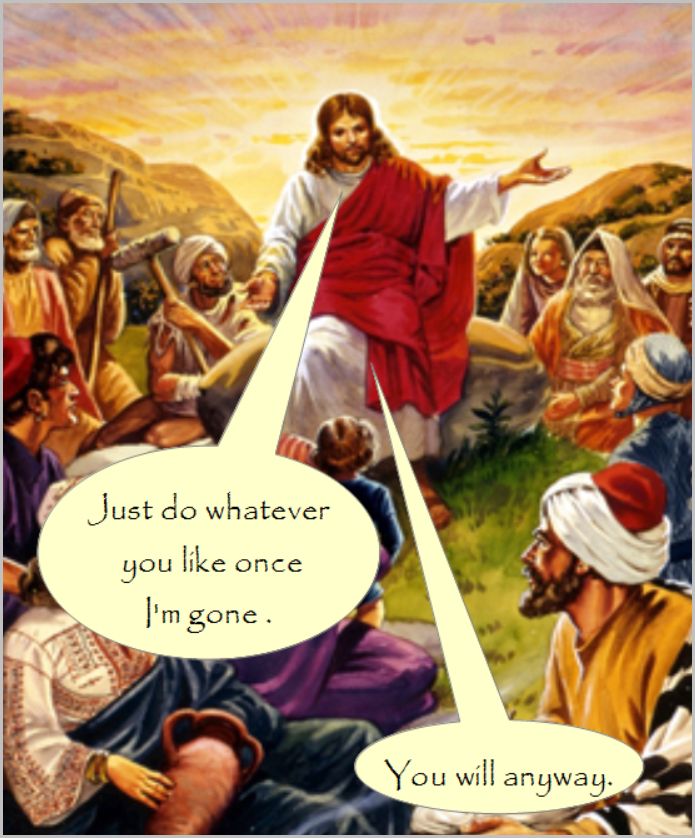
Do No Harm

sermon2

If religions took ‘do no harm’ to heart (as the Hippocratic Oath does) and their adherents were made to comply with it, what a better place this world would be. There’d be –

No more religiously-motivated suicide bombers and terrorist atrocities;

No more murder in the name of the Lord (whichever);

No more children molested by priests and pastors;

No churches attempting to cover up their crimes;

No more child deaths as a result of ‘faith-healing’;

No religiously-sanctioned denigration and abuse of women;

No more ritualistic mutilation of children’s and young women’s genitals;

No more religious scams and shams;

No more religiously-inspired vitriol directed at gay and transgender people;

No more barbaric executions of ‘minorities’, like gay men, women and those of other faiths.

Of course, even without these, the world would still not be perfect. Awful things would still happen. But the principle of doing no harm would eliminate much of the trauma inflicted on people by the proponents of irrational superstition.

On paper at least, the Abrahamic religions have expectations that are more demanding than simply doing no harm:

Love your neighbour as yourself (Leviticus 19:18; Judaism);

Love your enemies; treat others as you would like to be treated’ (Matthew 7.12 and 5.44; Christianity);

…compete with each other in doing good (Surat al-Ma’ida, 48; Islam).

However, these are just too damned hard for so many religionists. They disregard them and opt instead for the spiteful paranoia of the same holy books. Perhaps the simpler injunction of ‘do no harm’ would be easier for them. But until the preachers of judgement and hatred find it in themselves to promote such a principle, we will all continue to suffer the destructive effects of the ‘great’ faiths.

So, how long until the next terrorist attack? The next church child-abuse cover-up? The next rape scandal? The next persecution of gay people?

      Not long at all.

           Praise the Lord (whichever)!


Respect?

HebdoI could so easily take offence at this. (The caption reads ‘But who wants the English in Europe?’)

How far should we respect religious beliefs? I would suggest, not at all. The multitude of religions that exist in the world, not least the big five – Christianity, Islam, Buddhism, Hinduism and Judaism – are all built on mythologies that require belief in supernatural beings, highly improbable events and meaningless rituals. There is no evidence these beings exist or have ever existed, no evidence the improbable events ever occurred and none that the rituals lead to results of any sort.

Most religions have their revered teacher, prophet or saviour who died centuries or millennia ago, and about whom stories are told that cannot possibly be true. How can any thinking person respect the idea that one of these figures rose from the dead? Or that another flew to heaven on a winged horse? Or another grew a jewel tree from a toothpick? These stories deserve as much respect as other ancient tales – like the one about the man who killed a one-eyed giant or the dude who returned to life after being hacked to death and eaten. The preposterous stories told by today’s religions are of the same order.

For this reason, as well as many others – not least how religion causes some of its adherents to act and relate to others – religion is not above criticism. Indeed, there is a moral imperative to criticise world views based on far-fetched stories, especially when they cause some who subscribe to them to discriminate against others, advocate murder and  take it upon themselves to carry out executions like the ones we’ve seen in Paris this week. I’ve written before about how, while most religious believers are not themselves extremists, it is moderate believers who sustain the culture responsible for those who are. Fanatics, extremists and terrorists do not spontaneously create themselves; they emerge from mosques, churches, synagogues and temples. As Bill Maher said about Islam this week, ‘when there’s this many bad apples, there’s something wrong with the orchard.’

While some have argued that the magazine Charlie Hebdo provoked Muslim extremists to attack it with its satirical drawings of Muhammed (among many other religious ‘leaders’) it is absurd to suggest that publishing provocative pictures automatically leads to murder, as if the perpetrators have no choice in the matter. Of course they do. Caricatures of the pope have also appeared on the magazine’s cover and, as bizarre as the Catholic church is, it has not responded to these depictions with violence.

There is, in any case, a good argument to be made that offence can’t be given, only taken. While no doubt there are Muslims who don’t find rather poorly drawn, largely unfunny cartoons of Muhammed offensive, there are those who choose to. (Just like I could choose to take offence at the cover above.) But provocation, whatever the context, is no defence and no excuse for the slaughter, violence or incarceration of those with whom we’re offended.

The religious need to grow up and put away childish things; to stop taking offence so readily, insisting they’re being persecuted when they’re not and constantly assuming they and they alone have the right to mete out punishment. Is the god each religion claims for itself so weak and feeble he cannot look after himself, his standards and his reputation?

Well of course he can’t, because he doesn’t exist. Every god there has ever been, from Osiris to Christ, from Zeus to Allah has been a human invention. And if no god exists, then neither do his standards and reputation, nor his prophets and teachers, his Sons and emissaries; they’re all largely made up too. No-one should be punished for failing to respect the figments of primitive people’s imagination. It is beholden on all of us who have indeed put away such childish things, to disregard the sensibilities of those who subscribe to and peddle puerile nonsense and point out as often as we can that not only does the Emperor have no clothes but there’s not even an Emperor. Only then can the world work towards being free from the tyranny of religion.

Simplistic maybe, but the alternative is to continue tolerating the intolerable. And look where that’s getting us.