

It’s the End!

AI shows how it’s done. Arrange your elements carefully, and – hey, presto! – Jesus appears!

I’ve reached the end! The end of Jonathan Cahn’s The Dragon Prophecy that is. He has me convinced: the end of the age and the world itself, is just around the corner. He looks around the world, particularly the Middle East, sees the state it’s in and dives into the scriptures to uncover the prophecies that presage present day events. He then reveals how, collectively, these scriptures accurately describe the state of the world today following Hamas’s invasion of Israel on 7th October 2023.

Had he collected these passages prior to 7th October, would they have accurately foretold the events of that day? They should’ve done if that’s what they are really about. So where was this expose before 7th October? Where were the books, by Cahn or anyone else, revealing how the Bible predicted in detail, events that still lay in the future? Predicatbly (pun intended), they don’t exist. Cahn’s The Serpent’s Prophecy could only be written with hindsight, after the events, 7th October 2023 in particular, that he’s decided fulfil biblical prophecy. The prescience of these ancient scriptures is only apparent, to Cahn if no-one else, in retrospect.

He gathers disparate verses together to demonstrate how they do indeed predict current events. He omits many that don’t, even though they too appear to prophesy the future. He does this because they don’t fit the picture he’s trying to create: his interpretation of events in Israel and the significance he wants ascribed to them.

Cahn disingenuously forces unrelated verses to work together, like pieces from different jigsaw puzzles, to create a picture that loosely and disjointedly conforms with and thereby confirms his own conclusions. 

The culmination of The Dragon’s Prophecy is that the time is right and the stage set for Christ’s ‘return’. Cahn advises his readers to surrender to him before he comes though the clouds to do unspeakable things to them. While none of the ‘prophecies’ he’s pressed into service have ever been fulfilled and are certainly not being now, this one must surely be the greatest of the Bible’s failed prophecies.

Does all of this sound familiar? It should. Starting with Paul and the gospel writers, numerous hacks have pulled together biblical prophecies to show how events of their times fulfil the conditions for Christ’s return.

More than this, the gospels were created in exactly the same way that Cahn creates his end-of-the-world scenario. Mark, Matthew and Luke, ruthlessly plundered ancient Jewish scripture to show how their suffering Messiah (whether real or not) was predicted there. Significantly, no-one prior to the early days of the Christian cult believed that these particular scriptures foresaw a suffering Messiah who would die for the sins of his people before coming back to life. The scriptures could only be made to do so in retrospect. After some claimed to have seen the risen Jesus, early cultists began to scour the scriptures for passages – how many they had to ignore or misinterpret! – that could be made to create a loose, disjointed picture of their super-hero. It’s how Paul attempted to persuade others that Jesus was the Messiah (1 Corinthians 15:3,4 etc).

So Cahn is doing nothing new, finding a ready audience for his particular sleight of hand.
Desiderata

Blog361a

There’s really no secret to what life is about. It’s simple – simplistic even. All the same, it took me most of my life to discover it.

The best way to live your life is to be yourself.

That’s not as easy as it sounds, because you have to have pretty good sense of self to begin with and, for a multitude of reasons, such awareness can elude you.

It’s possible that this is because none of us truly has a self. Current thinking among psychologists and neuroscientists is that the self doesn’t exist. It’s an illusion, created by competing and often conflicting processes in the brain. I picture it like those optical illusions in which carefully arranged shapes make it appear, as in the figure below, that there’s a different shape in their midst, when in fact all that’s there is clear space. Maybe the neuroscientists are right about this, but even so, the self is a damn convincing illusion.

Kanizsa-triangle

Because the brain’s processes are ever active the illusory shape at the centre is subject to constant change – which we perceive as mood swings, changes to our personality, acting ‘out of character’ or being out of sorts with ourselves. Perhaps what I really mean by being yourself, then, is finding a point of equilibrium for the shape at the centre, where it isn’t constantly buffeted by the turbulence of the brain’s activities. However, this is merely to exchange one metaphor for another, so for now I’ll talk about the sense of ‘me-ness’ that we all experience subjectively and intuitively, and know as ‘the self’.

Perhaps you’ve never been in tune with who you are, living, as Plato called it, an unexamined life (he believed such a life wasn’t worth living). Perhaps like me, you drifted through the earlier part of life, allowing unplanned, random experiences to pull you along in their wake until you were left in a place you felt you don’t quite fit. Maybe though, you’ve heard a small inner voice calling you, telling you that this isn’t you. Perhaps, as I experienced for many years, the incongruity between who you are and where you’ve ended up is taking its toll on your mental health.

It’s also possible that you have heard your inner calling but have been told – by society, family or church that who you are is inconvenient, undesirable or unrealistic. ‘Just settle yourself down and conform to what we think is right for you,’ they’ve told you – and you have. They’ve convinced you that you won’t be accepted if you’re truly yourself, so you’ve suppressed or obscured who you know yourself to be.

Alternatively, you’ve assumed a role you know isn’t you. You’re doing a job that allows for no self-expression (because, after all, we all need to make a living), you’re in a relationship that suffocates the real you or you’ve been a church member, striving to conform to everyone’s unrealistic expectations of you. The result is you’re stressed, unhappy and uptight. You’re acting, as the term ‘role’ implies, without any authenticity. We all act from time to time, of course; there are occasions when it is unavoidable. But to live an entire life this way is to invite strife and depressive illness. To be healthy, happy and whole, you need to be authentic – true to yourself.

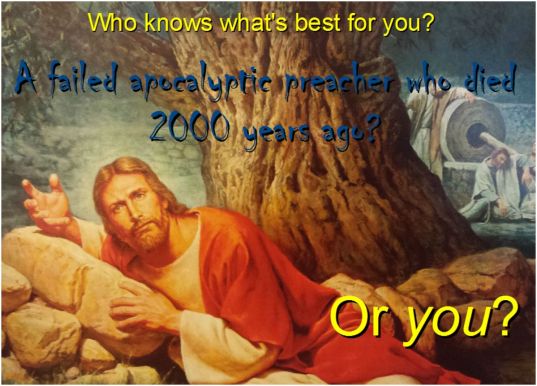
To adopt a religion is to assume a role. It is to deny your real self (Jesus demands you do: Matthew 16.24) and pretend you’re something you’re not. You can no doubt convince yourself God is doing a great work in you, sanctifying you and making you increasingly Christ-like, but the more you act out the part, the less like your genuine self you become. How can this be right for you, for your happiness and well-being? Adopting any ideology is to add a fake and unnecessary veneer to life that serves only to mask your true identity. Replacing who you are with a predetermined set of religious or political beliefs is mere play acting. Denial is not a solution; embracing your self is.

I hope that like me, you have reached a place where you know and embrace your real self. If not, and at the risk of sounding like a poor man’s Wayne Dyer, I’d ask you to take time to listen to your inner voice. Recognise it for what it is; it will not lead you astray. You know deep within who you are and who you should be, whether that’s an artist, teacher or baker; parent, celibate or gay; writer, performer or mystic; builder, musician or doctor, or a combination of these and other possibilities. You have to be what makes you happy. You owe it to your self.