Free Speech

The British government is considering making what it describes as Islamophobic remarks, on social media and elsewhere, a crime. It has so far been unable to define what Islamophobia is, but evidently it goes beyond the libel laws that already exist and which were used to jail the idiots who called for violence against immigrants (not exclusively Muslims) in the summer.

Critics say the government’s proposals are the means of introducing a blasphemy law through the back door. They fear it could lead to criminalising legitimate criticism of Islamic beliefs and practices. Should these be immune from criticism when some Muslim beliefs are as absurd as their Christian counterparts, others positively harmful and some antithetical to British democratic and social values? Should these aspects of Islam be immune from criticism or mockery? It would be a mistake if they were. Islam troubles me, and many others here in the UK, by virtue of the fact it is a religion. The imposition of a protected religion – any religion – is not something that would be beneficial for a largely secular society (or any other in my opinion).

And what of other religions? There has been mention that the new law would also protect Jews from anti-Semitism though there are, again, existing laws that do that. It’s difficult too to know what would be considered ‘anti-semitic’. Is criticism of the Israeli government’s actions? Hasidic Jews treatment of women? It’s hard to say, and it seems unlikely the British government will enlighten us any time soon.

You can be sure that if comment deemed Islamophobic or anti-Semitic becomes punishable by law, other religions will soon look to have their beliefs and practices granted the same ‘protections’. It would be perfectly reasonable for them to do so. After all, the criticism and mockery of Christianity and Christians themselves found here and elsewhere on the internet could be seen as being Christophobic, or whatever the Christian equivalent of Islamophobia is called. Of course Mormons and Jehovah’s Witnesses would be entitled to special protection too, as well as Buddhists, Hindus and all fringe religions. It might not be too long before criticism of politicians and politics is similarly curtailed.

Free speech would still exist for the practitioners of religions themselves of course. Our beloved local street preacher would still, presumably, be able shout about the evils of Pride and the sinfulness of homosexuality; his right to do so is, after all, enshrined in law. Muslim groups in Britain would still be able to deny women the same rights as men, while calling out the decadence and immorality of kafir Western cultures that have given them refuge. Terrorist acts carried out by Islamists would be protected from comment and censure. All religions would be able to assert the rightness of their ideologies over the mistaken beliefs of all the others.

Or will they? Will the proposed new law defining criticism of Islam as ‘Islamophobia’ escalate in the way I’m suggesting so that no-one can criticise or mock the beliefs of others? What of free speech then? How long before any such comment would be deemed hate speech, as negative remarks about transgenderism are now. How long before commenting on government policy is deemed to be ‘misinformation’? Questioning its ruinous pursuit of net zero, its immigration policy (or lack of one) and speaking out against whatever the current narrative happens to be might soon be anathema, in the same way questioning approaches to Covid were a few short years ago. How long before such ‘hate speech’ and ‘misinformation’ is punishable by law?

Of course I’m not saying calls to violence against any group of people whether religious, gay or transgender is something that should be tolerated. There are already laws to punish advocates of real hatred, as those who used social media to provoke riots in the UK discovered. Severely restricting free speech on the pretext of controlling hate speech and ‘misinformation’ still further will serve only to extinguish the legitimate criticism of religion, politics and other belief systems. It’s something totalitarian states do.
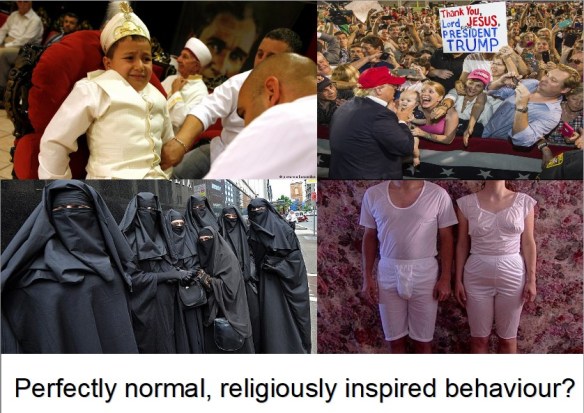
Religiophobia?

Is criticising Christianity and the way some people practise their religion a form of Christophobia? Strictly speaking a phobia is an irrational fear of whatever precedes it, as in homo-phobia, trans-phobia, Islamo-phobia and the like. In the accusations of whatever-phobia we hear today – and they invariably are accusations – ‘phobia’ seems to have come to mean ‘hatred of’; a hatred of Christianity and therefore of Christians; of homosexuality and therefore of gay people; of trans-people; of Muslims and so on.

Reasonable criticism of belief systems is not hatred. I don’t and am sure I never have had a hatred of Christianity or of any other religion. I certainly have views about Christianity as a seriously flawed, cock-eyed superstition (I hope I’m not giving my position away too early.) Reasonable criticism of it, mockery even, is perfectly legitimate, for reasons I’ve outlined before, just as criticism and mockery of any belief in the fantastic is legitimate. Ideologies based on belief in imaginary beings do not automatically merit respect nor do they have a de facto immunity from criticism. The same applies to those who subscribe to such fantasies, particularly when they attempt to force them on others. Calling out believers on their inconsistencies and hypocrisy is perfectly reasonable.

Is it fair then to express critical views of homosexuality and by extension of gay people? Of course. We are not immune from reasoned criticism, though much of it doesn’t qualify as ‘reasoned’; we have suffered much from emotional reactions to our existence and still do. (See Bruce’s recent post in which Republican North Carolina’s lieutenant governor, Mark Robinson rants about godless homos. When comment deteriorates into vitriol it becomes an incitement to hatred and, sometimes, violence. When this happens, the modern sense of phobia is justified.)

Islam is as irrational as Christianity and other religious belief systems. It is as legitimate to criticise and, when appropriate, to condemn Islam, just as it is Christianity. It is reasonable to question Muslim’s treatment of women, to insist it is inappropriate, particularly in a Western context. It is appropriate to oppose Muslims’ opposition to Western values rather to accede to their opposition to, for example, freedom of speech or the teaching of evolution and sex education in schools. It seems increasingly to me that in Britain we are conceding too much to Islam and to Muslims because we fear both the accusation of Islamophobia and, not entirely irrationally, a disproportionately aggressive response. Reasonable criticism of a belief system and those who subscribe to it is not hateful. We have a duty in a largely secular society to say so. To resist irrational belief in the supernatural when that belief, be it Christianity, Islam, Judaism or any other of the 4,200 religions human beings have dreamt up seeks to impose itself on others is neither hateful nor irrational. It is essential.

I‘d write more about Islam if I knew more about it. I’m disinclined to learn more, however, having already wasted much of my life in thrall to that other ‘great’ religion, the one I spend so much time deconstructing here. Who needs to know more about another? Saviours, Prophets, Gods, angels, signs and wonders – they’re all equally meaningless. Instead of claiming they’re victims of Christo/Islamophobia, religionists would do well to develop thicker skins as we ‘abominations’ and ‘perverts’ have had to do. They should ask themselves whether criticism of their practices and worldview is justified. They might just find it is.

Why it’s never a good idea to throw stones from inside your glass house

Blog369

I added the comment below to Bruce Gerencser’s blog yesterday. Bruce had been writing about one reason people don’t like Evangelical Christians, that being their attitude towards LGBT folk. It’s a good post and well worth your time (though not, of course, till you’ve finished here.) This is what I wrote:

It never ceases to amaze me that people who claim to possess the key to salvation, know the secret of eternal life, have a relationship with the creator of the universe and think their sins are all forgiven, have nothing better to do than spend their time slagging off LGBT folk.

A quick, admittedly non-scientific, survey of Christian blog and web-sites suggests that at least a third are attacks on those fortunate enough to be gay.

Maybe all that other stuff just isn’t as marvellous as they like to think it is.

Genuinely, I cannot understand how, when they think they’re tapped into the First Cause/the Power of the Universe/God, the Father Almighty, that the best evangelicals can do is to make repeated snipes at gay people. I had a look this morning at the Christian Research Network site to find three articles had recently been posted doing precisely that: one called ‘Which should be illegal: Christianity or Sodomy?’, about how religious rights are soon to be negated by gay rights (they won’t be, specially not in America); one criticising popular preacher Beth Moore for supporting a small number of gay-affirming pastors and another attacking clergy who might be gay but who remain celibate.  Obviously these matters are of great concern to the Lord of Hosts, the Judge of Mankind, who is, nonetheless, demonstrably impotent when it comes to doing anything about them. Or maybe, given his non-existence, they matter only to his small-minded sycophants here on Earth.

Bruce writes in another post that he doesn’t comment on Christian web-sites because ultimately it makes no difference; evangelicals don’t listen and don’t want to know what others think. They regard even the mildest criticism as the persecution the Bible promises they will face, particularly in these ‘last days’ (that we’ve been enjoying now for two millennia.) Bruce is right, of course. All the same, when I’ve time, I can’t help but comment on their anti-gay rhetoric, their judgement and condemnation of a relatively powerless minority. They can take it how they like; their casting of the first stone just can’t go unopposed.

I think it’s always pertinent to ask Christians why they’re not living according to Jesus’ commands – by not judging others, giving to all who ask, loving their enemies, and the rest, because as sure as eggs is eggs, the majority don’t. As if this matters to today’s evangelicals. Being a Christian is really about being part of a glee club that first and foremost benefits its members, no one else. Sometimes the party bubble needs a little puncturing. Of course, believers don’t like it; they tell you Jesus was only speaking ‘metaphorically’, which he always is when he says things they don’t like. They become aggressive and unpleasant because, presumably, that’s what he would want. Nonetheless, they sometimes need to see that when they condemn others, they can expect to be judged in return. That’s just how it works. Jesus says so.

Oh, and Dolly Parton too:

If you live in a glass house, don’t throw stones,
Don’t shatter my image till you look at your own,
Look at your reflection in your house of glass,
Don’t open my closet if your own’s full of trash,
Stay out of my closet if your own’s full of trash.

Amen to that, Dolly.


Billy Graham’s in Heaven

He said he would be, once he died. He said he couldn’t wait to get there (but still hung on until he was 99). He said there’d be a fanfare of trumpets when he arrived, as there would be for all the Saved, and that Jesus would lead him by the hand into the presence of God himself.

I’ve no doubt that Graham was sincere in his beliefs. He was a brilliant orator and during a long public life managed to avoid too much controversy, though he could be anti-semitic and regularly voiced his opposition to LGBT equality. 

Sincere he might have been, but Billy Graham was deluded. Some Christian sites have said so in recent days principally because his doctrine was not quite in accord with theirs; he directed new converts to the Catholic church, for example, if that’s where their interest lay; he seemed to think non-Christians would go to heaven if in life they’d looked to the light and lived honourable lives; he relied on altar calls when they are alien to the bible’s idea of conversion.

But this isn’t why he’s not in Heaven today, nor why he won’t be there at any point in the future. He was deluded because he believed in supernatural beings, in gods and angels, and because he thought human beings could be ‘saved’ by a magical incantation devised by a psychologically damaged zealot two thousand years ago. At the same time he was happy to ignore the claims of the man he believed to be the Son of God when he said he would return in the first century so that God could establish his Kingdom over all the Earth. Graham was equally happy to disregard this same prophet’s insistence that his followers denounce all wealth; he amassed a fortune over his lifetime – around $25,000,000 at the time of his death.

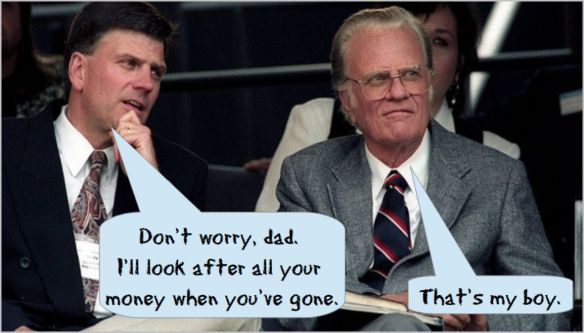
Grahams

Billy Graham repackaged evangelical Christianity, imbuing it with great emotional appeal and proffered it to the masses. He was good at it too; he made the impossible and the fanciful seem plausible and appealing. But he misled people that what he was offering was something they needed. We can only be grateful that what little evidence there is suggests that most of those who went forward as a result of his altar calls did not remain believers for very long. Estimates suggest about 6% stayed the course, though given the numbers Graham preached to, this still means about 12 million people.

He leaves behind a son who seems intent on destroying his father’s legacy and reputation; who is bigoted and virulently homophobic. His daughter too has not inherited his diplomacy nor even common sense. Billy Graham’s life’s work, if not undone by his offspring, will soon be forgotten, like all the other ‘great’ oratory preachers of the past. We should not revere him nor mourn his passing. His only achievement was to mislead people, seducing them into a life of intolerant superstition.