Mystic Revelations

What do the three ‘great’ Abrahamic religions have in common?

They all started with visions, hallucinations, dreams and mystic revelations. They’re not only based on these but owe their very existence to encounters with the supernatural that took place entirely within people’s heads. This of course is if they happened at all; many of these encounters with angels and God’s revelations take place in stories that have all the characteristics of myth or legend. Even so, they reveal much about the primitive state of mind (still around today) that believed God frequently revealed himself to, and in the minds of, chosen individuals.

First, the grand-daddy of the Abrahamic religions, Judaism: 

When Abram was 99 years old, YHWH appeared to him. He said to Abram, “I am El Shadday. Live in my presence with integrity. I will give you my promise, and I will give you very many descendants.” Immediately, Abram bowed with his face touching the ground, and again Elohim spoke to him, My promise is still with you. You will become the father of many nations. So your name will no longer be Abram [Exalted Father] but Abraham [Father of Many] because I have made you a father of many nations. I will give you many descendants. Many nations and kings will come from you. I will make my promise to you and your descendants for generations to come as an everlasting promise. I will be your Elohim and the God of your descendants. (Genesis 17)

Then Moses:

The Angel of YHWH appeared to (Moses) in a flame of fire from the midst of a bush. So he looked, and behold, the bush was burning with fire, but the bush was not consumed.

Then Moses said, “I will now turn aside and see this great sight, why the bush does not burn.”

So when YHWH saw that he turned aside to look, Elohim called to him from the midst of the bush and said, “Moses, Moses!” And he said, “Here I am.” (Exodus 3)

Notice how the inner voice goes from being that of ‘the angel of YHWH’ to YHWH himself (or one of his aliases). The entire scenario is preposterous of course, as is the Abraham episode before it. I’ve omitted the other occasions YHWH is said to appear to Abraham, including the infamous Genesis 22, where YHWH instructs Abraham to sacrifice his son. These stories are legends written, created from whole cloth, centuries after Abraham purportedly lived. He, like the later Moses, is almost certainly mythical, a character created to represent the beginnings of the Jewish faith. Even his names are symbolic. In truth, no one knows how Judaism began.

Onto Christianity:

The angel said to (Mary), “Don’t be afraid, Mary; God has shown you his grace. Listen! You will become pregnant and give birth to a son, and you will name him Jesus. He will be great and will be called the Son of the Most High. The Lord God will give him the throne of King David, his ancestor. He will rule over the people of Jacob forever, and his kingdom will never end.” (Luke 1)

Did this happen? If you believe angels exist then possibly, but we know they do not. We also know that this is myth. However, Luke wanted his readers to know that Jesus’ birth was miraculous so invented a story in which Mary encounters a heavenly being. The gospel writer anchors the divinity of Jesus to an implausible event which at best can only be a young woman’s vision (though it most certainly isn’t.)

The same is true of the resurrection appearances. Here’s Matthew 28:1-8:

Now after the Sabbath, as it began to dawn toward the first day of the week, Mary Magdalene and the other Mary came to look at the grave. And behold, a severe earthquake had occurred, for an angel of the Lord descended from heaven and came and rolled away the stone and sat upon it. And his appearance was like lightning, and his clothing as white as snow. The guards shook for fear of him and became like dead men. The angel said to the women, “Do not be afraid; for I know that you are looking for Jesus who has been crucified. He is not here, for He has risen, just as He said.”

More angels (they multiply in later gospels); again at best, though still highly improbable, the angel(s), if seen at all, can only be a vision or an hallucination (or mistaken identity.)

Onto the only first hand account of an encounter with the divine that the bible includes, Paul’s:

God was pleased to reveal His Son in me so that I might preach Him among the Gentiles… I want you to know, brothers and sisters, that the gospel I preached is not of human origin. I did not receive it from any man, nor was I taught it; rather, I received it by revelation from Jesus Christ. (Galatians 1)

I know a man in Christ who fourteen years ago—whether in the body I do not know, or out of the body I do not know, God knows—such a man was caught up to the third heaven. And I know how such a man—whether in the body or apart from the body I do not know, God knows— was caught up into Paradise and heard inexpressible words, which a man is not permitted to speak. (2 Corinthians)

This is all there is. This is the extent Paul talks about his heavenly encounters. In Galatians he admits that God revealing whatever it was he revealed was ‘in’ him, that is, in his own head. The bizarre tale he relates in 2 Corinthians reads like an hallucination (Paul says he doesn’t know whether it was in the body or out of it) which is all it could’ve been; there is no paradise or ‘third heaven’.

And finally, there’s Mohammed:

while I was sleeping last night, the keys of the treasures of the earth were brought to me till they were put in my hand.”… 

The angel came to him and asked him to read. The Prophet replied, “I do not know how to read. The Prophet added, “The angel caught me (forcefully) and pressed me so hard that I could not bear it any more. (Sahih Bukhari 6998)

Encounters with heavenly beings in dreams, ‘revelations’, visions, hallucinations and invented stories: these are central to Judaism, Christianity and Islam. The religions would not exist without them. Written as myth long after they supposedly occurred or referred to obliquely by those who claim to have experienced them, they are the products of fevered pre-scientific minds.

Post-script: I’ve searched in vain for Darwin’s admission that an angel revealed the process of evolution to him. I can only find his collection of evidence, his scientific observations and his careful analysis of his findings. Likewise Mendeleev who calculated the existence of elements that were at the time unknown. Likewise Crick, Watson and Franklin who discovered the structure of DNA. Strangely, none of these people relied on visions, dreams or divine revelations in uncovering truths about reality.

James, brother of the Lord

Let’s take a look at some of the problems that need to be addressed in recognising that Jesus the Christ was always a mythical being.

The first is, that despite the vast majority of what Paul writes talking about Jesus only as a divine super-being seen in visions and worked out through ‘revelations’, there are a couple of instances where he appears to be alluding to a real person.

The first is Galatians 1:19, where, in this literal translation, Paul refers to ‘James, the brother of the Lord’:

Then after three years I went up to Jerusalem to make acquaintance with Cephas and I remained with him days fifteen. Other, however, of the apostles none I saw if not James the brother of the Lord (‘adelphon’). In what now I write to you, behold before God, I lie not!

In context, Paul is asserting that his knowledge of ‘the Lord’ comes directly from the Lord himself in visions and revelations and ‘not from any man’ (Galatians 1:12) He did not, he asserts here, meet with Cephas and James until 3 years after his conversion. (His insistence he is not lying is curious, wouldn’t you say?)

His mention of James, ‘the brother of the Lord’ is potentially a problem for those who see Jesus as primarily a mythical figure. Richard Carrier accepts that the reference is an indicator in favour of historicity. However he goes on to say that Paul, Cephas, James and all fledgling Christians,

were brothers because they were at baptism the adopted sons of God. Literally. Paul explicitly says that. And this made them all brothers of the Lord Jesus. Again, Paul explicitly says that.

He explicitly says these things in Galatians 4:3-7 and Romans 8:15-17 respectively. Undoubtedly the term ‘brother of the Lord’ could refer to the fact that all Christians are brothers of the Lord through adoption. But then why is Cephas not also referred to as a brother of the Lord? Carrier demonstrates that Paul distinguishes between Apostles, who by definition have, like himself, had the risen Christ revealed to them (in other words have imagined they’ve seen him in their own heads) and those who haven’t. These less fortunate individuals, however well placed in the cult hierarchy, are, like all Christians, brothers of the Lord. Paul uses the term in this sense frequently, for example in 1 Corinthians 1:26 & 16:20; Romans 10:1 and 1 Thessalonians 1:4. He also calls his fellow Jews ‘brethren’ in Romans 9:3. His strange construction that he saw Cephas and ‘none other of the apostles, if not James’, does not imply he saw James as an apostle.

Nor does Paul say James is ‘the Lord’s brother’, which implies a familial connection. The Greek quite clearly employs the phrase ‘the brother of’, which suggests a looser, cultic connection; James is one of the adopted brotherhood.

Furthermore, Paul does not say James is the brother of ‘Jesus’ as Bart D. Ehrman falsely assumes. Paul says James is ‘the brother of the Lord’, ‘the Lord’ being the term he uses when referring to the heavenly saviour who was been ‘revealed’ to him. There’s no reason to suppose that Paul means anything other than this when he calls James the brother of the Lord. Again, what he is actually saying is, ‘I saw James, he of the brotherhood of our Heavenly Saviour.’ The term ‘brother’ for a fellow (male) Christian persists, in this very same way, in the present day.

I am not of the view, therefore, that Paul’s use of the term for James undercuts the likelihood that Jesus was then, as he is now, a mythical heavenly being.

The New New Testament

With the New Testament books in their traditional sequence, it’s easy to conclude that there was first a remarkable individual who travelled around Galilee proclaiming the arrival of his Father God’s kingdom on Earth. He demonstrated great wisdom and compassion before being crucified by the Romans at the behest of the Jewish authorities. The first four books of the existing New Testament tell us so; that all of this happened first and all that follows occurred afterwards as a consequence of the events the gospels describe.

But, put the gospels where they belong in the chronological arrangement of the New Testament, and the events of the gospels do not happen first. Paul does:

I acknowledge that in putting the books in their correct order in my previous post, I cheated when I made the first the work of the very earliest cultists. No such book exists (no, it’s not Q and even if it were, we don’t have it). The earliest Christian beliefs are largely lost to us. All we know is that some individuals had visions of the Messiah. Paul tells us so in 1 Corinthians 15:5:

He (first) appeared to Cephas, and then to the Twelve.

These visions undoubtedly mark the beginnings of the cult. It later finds a convert in the Hellenized Jew Paul who he has his own vision(s). That these are visions and not an encounter with an actual person is clear from Paul’s declarations in Galatians 1:15-17 and 2 Corinthians 12. He stresses in Galatians that what he knows of the Messiah (‘Christ’ in Greek) comes not from any human source but from what this Christ has revealed to him in his own head: the revelations he’s fond of referring to. These, he says, showed him the importance of the Christ’s sacrifice, the crucifixion being the only Jesus event he’s interested in. Nowhere in his seven letters (1 Thessalonians to Philippians) does he mention anything a Galilean said, did or had done to him, apart from the crucifixion, which is mentioned without any historical detail. Paul’s interpretation of the crucifixion is devoid of Romans, the Sanhedrin, Gethsemane, Judas, Pilate, the scourging and cross carrying, Golgotha, the centurion, grieving disciples and empty tomb. Paul appears not to know anything specific about the event he obsesses over. Who can blame him when these details had yet to be invented?

Paul also has it revealed to him, or so he says, that this heavenly saviour will soon be coming down to the Earth to raise the dead, rescue the faithful who yet live and usher in God’s new golden age (1 Corinthians 15:52; 1 Thessalonians 4:16). It is an idea that permeates the rest of the New Testament writings.  

Paul’s faith, then, rests entirely on his visions/revelations. When proving that they really were of Jesus the Christ, he does so by repeatedly citing Jewish scriptures, never by referring to a particular saying, miracle or healing of an earthly Jesus. Paul’s Christ is a cosmic Superman who is raised from the dead as a ‘life giving spirit’ (1 Corinthians 15.46). (I’ve written about this on numerous occasions, including this post, so won’t reiterate all the details here.)

Written about a decade after Paul’s last letter, we come to the first gospel, which, lo and behold contains an abundance of sayings, miracles and healings of an earthly Jesus. Where did ‘Mark’ get these from? Not from a hitherto unknown document which won’t be posited for almost two millennia (Q); not from an ‘oral tradition’ when the only oral tradition we know of is Paul’s preaching, which doesn’t mention any details about an earthly Jesus.

  • To compound the problem, the first gospel is littered with angels, demons and other supernatural elements (voices from heaven anyone?)
  • It makes extensive use of stories from Jewish scripture, rewriting them and recasting their original protagonists with Jesus in their place.
  • It has him utter teaching that ‘astonishes’ those around him, when much of it is lifted directly from Jewish scriptures and would have been familiar to his listeners.
  • It makes him address the issues of the church as they existed around 70CE when the gospel was written and reflects the rules of the cult at that time.
  • It relies heavily on metaphor and allegory.
  • It has Jesus promise that the Son of Man will soon arrive on Earth to sort out its problems. This is Paul’s teaching about the imminent arrival of the Saviour through the clouds, dressed up in jargon from the book of Daniel. While apologists assume the Son of Man character is Jesus himself, promising his own future return, it evidently is not (it is rather, as I demonstrate here, a metaphor for the Jewish nation). What we have in Mark then, is a fictionalised Jesus predicting the appearance of the ‘real’ Christ from Heaven, just as Paul does.    

Mark’s gospel is most certainly not history nor an accurate record of the activities and teaching of a real human being. It is, as I’ve demonstrated before, fiction, from start to finish.

Following Mark in our chronological New Testament are two forged letters, purportedly by Paul (2 Thessalonians) and Peter (1 Peter) but actually by two different, anonymous authors. In them we’re back to hearing about a celestial Christ not an earthly Jesus. Earthly Jesus doesn’t get a mention despite the fact that one of the letters is supposedly by Peter, the fisherman who trailed around Galilee with Jesus for three years – allegedly – and witnessed his resurrection appearances. You think he’d have mentioned some of this in the letter. But no. Not a word.

And then two more gospels, both of which make extensive use of the first. ‘Matthew’ uses 80% of ‘Mark’ and adds some extra material of his own, including a birth narrative that is pure fantasy (including a magic dream and wandering star) and several new miracles. Where does this extra material (the so-called M source) come from? Some theologians speculate that again it’s from an oral tradition (the same hypothetical tradition used in Mark or a different one? Certainly not one known by Paul.) Even if so, we have no way of knowing whether it is reliable nor who originally reported it. It could just as easily have been invented by the anonymous creator of Matthew’s gospel. In fact, Matthew’s gospel is demonstrably a literary construct that plagiarises and embellishes Mark with more symbolic parallels – with Moses in particular – from Jewish scriptures. The stories of the resurrection are constructed in precisely this way.

Luke’s gospel is open to the same criticism. Where did his extra material (L) come from and why was it unknown to Paul and the creators of the two forgeries that preceded it? The obvious conclusion is that ‘Luke’ also made stuff up.

Here’s the problem with the synoptic gospels (those that carry the names of Mark, Matthew and Luke.) They appear in the midst of a sea of writing that knows nothing of an earthly Jesus and speaks only of a supernatural Superman. Yet we’re expected to believe that in the middle of this sea of myth and fantasy, the three gospels are an island of factual information about a real person. We’re required to accept that the synoptic gospels are reliable, factual, historical accounts of Jesus’ life on Earth. Apparently the gospel authors are the only ones who know the truth about his earthly existence while Paul and other writers evidently did not (or couldn’t care less about it) despite living and writing closer to Jesus’ supposed lifetime.

This is not the only problem. Even if the information about Jesus contained in the gospels was derived from an oral tradition, a hypothetical sayings gospel (‘Q’) or other lost sources (M & L) this would not make it any more reliable. It is just as likely to have been invented.

The next book of our chronological NT, the Acts of the Apostles was written by the same anonymous author as the third gospel. This story of the early days of the cult includes: a Jesus who beams up into the sky; visions; dreams; magic hankies and imaginary table cloths; angels; supernatural murders: miracle earthquakes and characters re-enacting events from Odyssey and the Jewish book of Jubilees. It gets Paul’s itinerary and theology wrong, smooths over his disputes with the pillars of the Jerusalem church and invents speeches for both him and various support characters. History it is not.

Immediately after Acts, we’re back to forgeries: Colossians and Ephesians, the latter being a composite of other Pauline letters and Colossians itself. We’re also back to the supernatural Jesus who makes salvation known through revelation. The two people who created these letters masquerading as Paul appear to have no knowledge of an Earthly Jesus. Had they not read any of the synoptic gospels? Did they not know any of the oral traditions or Q? Do they not care about all the supposedly factual information about Jesus that by this point was in wider circulation? Evidently not. They were interested only in promoting a celestial being, the Christ Jesus.

We’ll see more of this as we move on to the remaining books of the chronological New Testament, next time.

*It’s a trick question. Neither is any sense real.

How the Bible tells us the Resurrection was nothing more than Visions

I’ve written about this before, but want to pull together some strands that demonstrate the risen Jesus was a vision or hallucination. He appeared only in the mind of others: the New Testament tells us as much.

Exhibit 1. Paul writes of the appearance of the risen Jesus, whom he sees as a ‘life-giving Spirit’, being ‘in’ him (Galatians 1.16). Paul has more than one such vision, including his trip to heaven recounted in 2 Corinthians 12.2, which he refers to as his ‘revelations’.

Exhibit 2. Paul implies in Corinthians 15.5-8 that others who have experienced the post-mortem Jesus ‘saw’ him in exactly the same way he did. For Paul, there was no difference between his inner-visions and those experienced by the so-called apostles.

Exhibit 3. The author of Acts creates a story out of Paul’s first vision, the famous account of his conversion on the road to Damascus. It’s a fabrication of course, told differently each time it’s referred to Even so, Luke retains the visionary nature of the experience: Jesus is a bright light and a disembodied voice.

Exhibit 4. The other sightings of the risen Jesus in Acts are visions. When, for example, Stephen is about to be stoned (Acts 7:54-56) he sees in his mind’s eye the heavens open and Jesus sitting at the right hand of god. Other New Testament encounters of the resurrected Jesus, such as John’s Revelation, are explicitly said to be visions.

Exhibit 5. Many of the sightings of the risen Jesus in Matthew and Luke are not of a real, physical human being. Those who experience him see him materialising in locked rooms, vanishing at will and floating up into the clouds. None of these events actually happened; they are the gospel writers’ literary realisations of visions experienced decades earlier, and they retain the hallucinatory qualities of those experiences.

Exhibit 6. Remaining with the gospels’ accounts of the risen Jesus, there is the strange phenomenon of those experiencing him failing to recognise him. Mary in the garden thinks he’s the gardener; the disciples on the road to Emmaus don’t know its him until he breaks bread; the disciples mistake him for someone else on the shore until he tells them how to fish properly. Most damning of all, some of the inner circle of disciples doubt it’s Jesus they’re seeing in their collective visions (Matt 28:17-18). Again, these stories preserve the tradition that the earlier visions weren’t always recognised as Jesus. And why wasn’t he? Because he was an hallucination

Exhibit 7. The risen Jesus has to prove who he is. According to Acts 1:1-3, he ‘presents himself’ his followers, some of whom have wandered around aimlessly with him for three years, and has to convince them he is who he appears to be. And, the text suggests, it takes him forty days to do it. This makes no sense. A far better explanation of this story (and it is a story) is that having experienced their visions of something-they-took-to-be-the-resurrected-Jesus (bright lights? Disembodied voices?), his followers set about convincing themselves that what they experienced really was their former Master. This they did by scouring the scriptures to find ‘proof’ that the Messiah would die and rise again. We know this is how their thinking worked. The same process was used to create the gospels and is evident throughout the New Testament.

Exhibit 8. Dead people stay dead. They do not resurrect.. This is not an a priori assumption. No corpse has ever revived after 36 hours or indeed any other period of time. We know this experientially, statistically and scientifically. Only in stories and religious myth do the dead return. This is what we are dealing with here: stories and myth that flesh out the visions and hallucinations of a few religious zealots.

Mark and the Oral Tradition

Paul never refers to ‘the disciples’, the term used for Jesus’ inner circle in the later gospels. Instead, he refers to the founders of the cult as ‘apostles’ (literally ‘messengers’). Cephas is described as an apostle, as is Barnabas (Acts 14:14) and Paul himself. Paul defines the term more specifically as someone who has been commissioned directly by Jesus (1 Corinthians 9:1; Galatians 1:1-2). Evidently he himself was not: he encountered the risen Christ only in his head. He felt this was more than good enough. For Paul it was the only qualification anyone needed to be an apostle. He cites others who had encountered Jesus in the same way:

For what I received I passed on to you as of first importance: that Christ died for our sins according to the Scriptures, that he was buried, that he was raised on the third day according to the Scriptures, and that he appeared to Peter, and then to the Twelve. After that, he appeared to more than five hundred of the brothers at the same time, most of whom are still living, though some have fallen asleep. Then he appeared to James, then to all the apostles, and last of all he appeared to me also, as to one abnormally born. For I am the least of the apostles and do not even deserve to be called an apostle, because I persecuted the church of God. (1 Corinthians 15: 3-8)

What he goes on to say is crucial in understanding the nature of ‘the gospel’ that was in circulation in the years before Mark’s gospel:

But by the grace of God I am what I am, and his grace to me was not without effect. No, I worked harder than all of them – yet not I, but the grace of God that was with me. Whether, then, it was I or they, this is what we preach, and this is what you believed (1 Corinthians 15: 8-11; my emphasis.)

What they preached was their visions of a celestial Saviour. The witness of these visionaries of the risen Christ was the only gospel they knew and, Paul suggests here and elsewhere, the only one that was being transmitted orally when he was active. As we saw last time, he knew no other details of Jesus’ life, had none passed on to him and passed none on to others, except for these visions and the teaching he worked out from them – his ‘revelations’. Let me say that again: the visions of the risen Jesus were all he, Cephas and others knew. Paul says so categorically. There was no other ‘oral tradition’.

Paul builds his subsequent teaching on Jewish scripture, showing how his ‘revelations’ must be from the Christ because they comply with this scripture (even though he has to manipulate it to make it do so: in Romans 9, for example). Nowhere does he say he is referring to any history he has learnt, nor to anything passed on to him orally about Jesus’ teaching, ministry, life or miracles. Just the opposite in fact:

I want you to know… that the gospel I preached is not of human origin. I did not receive it from any man nor was I taught it; rather I received it (directly) by revelation from Jesus Christ’ (Galatians 1: 11-12).

About seven years after Paul’s death, a literate member of the one of the cult communities – known to us as Mark – decided to set down Paul’s teaching about the Christ in allegorical form. He tells us this is what he is doing several times in his gospel, including Mark 4:11-12:

To you has been given the secret of the kingdom of God, but for those outside everything is in parables, so that “‘they may indeed see but not perceive, and may indeed hear but not understand, lest they should turn and be forgiven’” (referencing and misquoting Isaiah 6:9)

Mark did not depend on any oral tradition for his information about Jesus’ life because apart from the ‘announcement’ built on Cephas’, Paul’s and others’ visions there was no oral tradition. Mark took Paul’s teaching and like him, used Jewish scripture as the basis for the story he developed from it. Thus, Paul’s ‘revelation’ of a bread and wine ritual (1 Corinthians 11:23-27) becomes the Last Supper (Mark 4:22-24); Paul’s teaching about forgiveness becomes Jesus’ teaching about forgiveness; Paul’s dispute with Cephas leads to a gospel Peter who is bungling and disloyal; Paul’s mention of The Twelve in 1 Corinthians becomes, with a miscalculation, the disciples; Paul’s instruction to obey the authorities (Roman’s 13:1) becomes Jesus’ (Mark 12:17); Paul’s, and Jewish scriptures’, promise of the spiritually blind (2 Corinthians 4:3-6) being helped to see becomes Jesus’ miracles of healing; Paul’s predictions about the end of the age (1 Thessalonians 4:15-17) become Jesus’ (Mark 13); Paul’s talk of the coming of the Christ in person (1 Thessalonians 4:13-5:11) becomes Jesus’ prophecies about the Son of Man appearing (Mark 14:61); Paul’s vision of the risen Christ becomes the resurrection. And on and on. There is nothing in Mark’s gospel that doesn’t derive from Paul’s teaching, and Jewish scripture in turn. it is, in short, made up.

All of this accounts for the absence of any resurrection appearances in Mark. His gospel ends with the discovery of the allegorical empty tomb and leaves off there because it is where his audience came in, as it were. They had been converted by hearing of the ‘appearances’ of the celestial Christ to Cephas and those Paul lists in 1 Corinthians. They already knew how the story ended or, more accurately, how it had begun: with those visions.

Later, Matthew, Luke and John would take Mark’s allegory and use it as the basis for their gospels, adding new, invented material of their own. The myth, in both the technical and popular sense, was born.

Paul and the Oral Tradition

Much is made of the oral tradition that it is said informs the material in the synoptic gospels, and possibly John too. The tradition of conveying the events of Jesus’ life and the things he said goes back to Jesus’ original followers – the disciples and the apostles (the terms are not necessarily interchangeable) – and continues with a high degree of accuracy, at least until AD70 when the first gospel was written. 

Which must be why we find so much detail about Jesus’ life in the letters of Paul, from his first letter, 1 Thessalonians, written circa AD55 to his last, Philippians (now an amalgam of several letters), written about 62. Paul was aware of the stories about Jesus – as all converts were – and affirms so many of the details of his life in his letters, passing on the vital stories and the traditions associated with him, in written form.

But not in our reality. Our Paul knows nothing of the details of Jesus’ life. Not once does he quote him or refer to the events of his life before the resurrection. There is nothing of the oral tradition. Nowhere in his letters does he draw from it; never does he say he knows for a fact that Jesus said or did a specific thing while on Earth.

Even after his meeting with Cephas and James, a full three years after his conversion, Paul relays not a single thing he learnt from them. After the encounter, he continues to promote only his own revelations and says nothing of what he learnt about Jesus from the man who supposedly spent three eventful years with him.

Fourteen years later, Paul meets again with Cephas and encounters other apostles for the first time. On this occasion, he and Cephas argue about justification and Paul comes away grumbling that ‘those leaders added nothing to me’ (Galatians 2:6) What? Not even stories about their time with the Master? Apparently these weren’t as important as disputes about soteriology.

Later still, Acts tells us that immediately after his conversion, Paul stayed with ‘disciple’ Ananias and other ‘disciples’ for several days. Did Ananias not know any of the oral tradition that he could pass on to Paul? Details about Jesus’ life, a saying or two or an account of a miracle? Apparently not. (This might be because the story is pure fabrication. Paul tells us himself, in Galatians 1: 16, that immediately after his conversion he ‘did not rush to consult with flesh and blood’).

Surely, though, he must have heard some of the Jesus story from those he persecuted prior to his dramatic conversion. If he did, he didn’t see fit to include any of it in his letters. Likewise, Paul had contact with cult communities he didn’t himself establish, such as that in Rome. Surely they conveyed some of the stories about Jesus that they had had passed on to them. He appears too to have known at least one other evangelist:  Apollos. If these other believers did pass on stories of Jesus from an ultra-reliable oral tradition, why didn’t Paul see fit to include any of them in his letters?

So what were Paul’s sources? Certainly not the oral tradition, nor Q, the hypothetical sayings gospel, which he likewise ignores. If the gospel was being spread orally from the time Jesus lived, by the apostles and other preachers, and was being passed around the fledgling cult communities, why did Paul know nothing of it? If in fact he did, why did he choose to ignore it in favour of his own inner-visions? Did he consider it of such little value?

These questions matter, as we’ll see next time when Mark decides he’ll set the Jesus story down on paper.

The Resurrection: Real or Imagined?

Did Paul see a physically resurrected man or did he hallucinate some sort of spirit? What does the bible say?

Paul describes his encounter with the risen Jesus in his letter to cultists in Galatia:

For I did not receive it (the gospel) from man, nor was I taught it, but it came through a revelation of Jesus Christ… God was pleased to reveal his Son in me… (Galatians 1.12 & 15)

‘Revelation, revealed, in me’: there’s no physically resurrected body here.

In his letter to the little community in Corinth, Paul tells us explicitly that Jesus was raised as a ‘life giving spirit’ (1 Corinthians 15.45). Whatever this means, this is how Paul experienced the risen Christ. Nowhere in his letters does he claim to have seen a man who has physically risen from the dead. Even in the legend created around Paul’s mystical revelations decades later, there’s no physical Jesus: a bright light and disembodied voice is what Luke comes up with.

Why does this matter? Well, for a start, Paul’s is the only first hand account of an encounter with the risen Jesus we have. And it was of an entirely ‘spiritual’ nature. Second, Paul assumes that those who ‘saw’ the risen Jesus had exactly the same sort of experience he did. He says in 1 Corinthians 15.5-8,

…(the Risen Jesus) appeared to Cephas, and then to the Twelve. After that, he appeared to more than five hundred of the brothers and sisters at the same time, most of whom are still living, though some have fallen asleep. Then he appeared to James, then to all the apostles, and last of all he appeared to me also, as to one abnormally born.

Paul makes no distinction between the way he experienced the risen Jesus, as a life giving Spirit, and the way these others did. His persistent use of ‘appeared to’ also underlines the mystical nature of these encounters; he doesn’t say Jesus ‘visited’ James or ‘spent time with’ Cephas or ‘chatted with’ the apostles over a fish supper (those legends would come later). There’s absolutely no human interaction here between these people and a real human being. No: instead, Paul says Jesus ‘appeared to’ them, as in ‘he was an apparition’.

The translation of the same passage in the King James version makes this obvious:

…he was seen of Cephas, then of the twelve: After that, he was seen of above five hundred brethren at once; of whom the greater part remain unto this present, but some are fallen asleep. After that, he was seen of James; then of all the apostles.  And last of all he was seen of me also, as of one born out of due time.

As for Paul, then, so for all these other sightings (we only have Paul’s word they actually took place.) They were apparitions, hallucinations, innervisions, emotional, spiritual experiences – call them what you will – ‘seen of’ others. They were not of a real man physically raised from the dead.

Why do some Christians find this so hard to accept? After all, this is much their own experience today. They may not hallucinate that Jesus is standing in front of them (assuming that’s what the ‘life giving spirit’ looked like to Paul and others) but they have an emotional experience at conversion that they credit to the presence, the spirit, of this long dead individual. If that’s how it is for converts today, why not for the original Christians? Why does there have to be physical resurrection at all?

Spoiler: there doesn’t and there wasn’t.


In which Paul takes a trip to the third heaven

Blog408

In the New Testament, there are:

8 or more supernatural ‘visions’;

18 or so ‘appearances’ of angels;

about 6 significant dreams, through which God talks to people;

a dozen apparitions of dead people and

at least 3 significant ‘revelations’, in which individuals sense God in their heads (Paul, Jesus and John of Patmos).

The man who is largely responsible for Christianity as we know it, Paul, alludes only briefly to his magical conversion to the faith, describing it as ‘in’ his head in Galatians 1.16. It’s up to the writer of Acts to elaborate and embroider this non-event. Paul does, however, give rather more detail about another hallucination he has, in 2 Corinthians 12.1-4. To avoid boasting, he says boastfully, he refers to himself in the third person:

I must go on boasting. Although there is nothing to gain, I will go on to visions and revelations from the Lord. I know a man in Christ who fourteen years ago was caught up to the third heaven. Whether it was in the body or out of it I do not know, but God knows. And I know that this man—whether in the body or out of it I do not know, but God knows— was caught up to Paradise. The things he heard were too sacred for words, things that man is not permitted to tell.

This is evidently a psychotic episode; seeing things that are not there, experiencing events that are not happening. Paul himself admits he doesn’t know whether it was a real experience, nor does he know if he was in his body or not (definitely in it, just out of his mind.) He heard, he says, things he can’t possibly repeat, which makes you wonder why he bothers mentioning the whole bizarre episode in the first place: ‘I had this fantastic experience, unlike anything I’ve experienced before – but I can’t tell you a thing about it.’ It sounds like a dream he’s having trouble remembering or, like, man, a really freaky hallucinogenic trip.

From psychotic episodes like this – his conversion is another one – Paul spins his entire theology. Yes, the faith of Christians everywhere is founded on the hallucinations of a first century nutcase visionary.

I don’t know about you, but I’ve better things to do with my life than base it on the dreams and visions of a psychotic who lived 2000 years ago.


What A Dream I Had

Resurrection3

Last night.

I dreamt I was troubled and anxious about something or other, even though I’m not aware of being this way in reality.

In the dream, a couple of people drop by to console me. One of those people is my dad. He asks what’s wrong, listens and offers advice. He’s concerned and wise, positive and supportive. I have no doubt this is my father; he looks and sounds like him, but he’s an idealised version of him. I’m dimly aware in the dream that he’s behaving differently from the way he would in life – we rarely had heart-to-heart talks – but I’m so grateful for the help he’s offering, and it’s good to feel close to him.

In reality, my father died over ten years ago. I’m not sure I was aware of this in the dream or perhaps I just ignored it. I certainly ignored the way he was acting slightly out of character; I just was glad to see him again. I woke this morning feeling invigorated by the time spent with him (or the illusion of time spent with him) and with other friends who appeared in the dream to offer support.

I don’t for minute believe that the father I experienced in my dream was really my dad, returned from wherever he’s been these last ten years to offer words of comfort. My real dad has been nowhere for the past decade. He ceased to be in 2007. The version of him in my dream was a construct of my own mind, made from memories, wishful thinking and – okay, I admit it – a glass or two of wine. He was an image of how I’d like my dad to have been, perhaps – not that I give that much conscious thought. Nevertheless, this version of him is evidently buried somewhere in my head, waiting to be resurrected when the dream circumstances are right.

This is what it must surely have been like for those few individuals who, in visions and dreams, experienced Jesus after his death. In their grief and turmoil, the need to embrace the dream version of their friend must have been overwhelming. They would have persuaded themselves it really was him, communicating with them from beyond the grave. The fact one or two others had a similar experience can only have reinforced the compulsion to believe: ‘You saw him too? Then it must really have been him.’

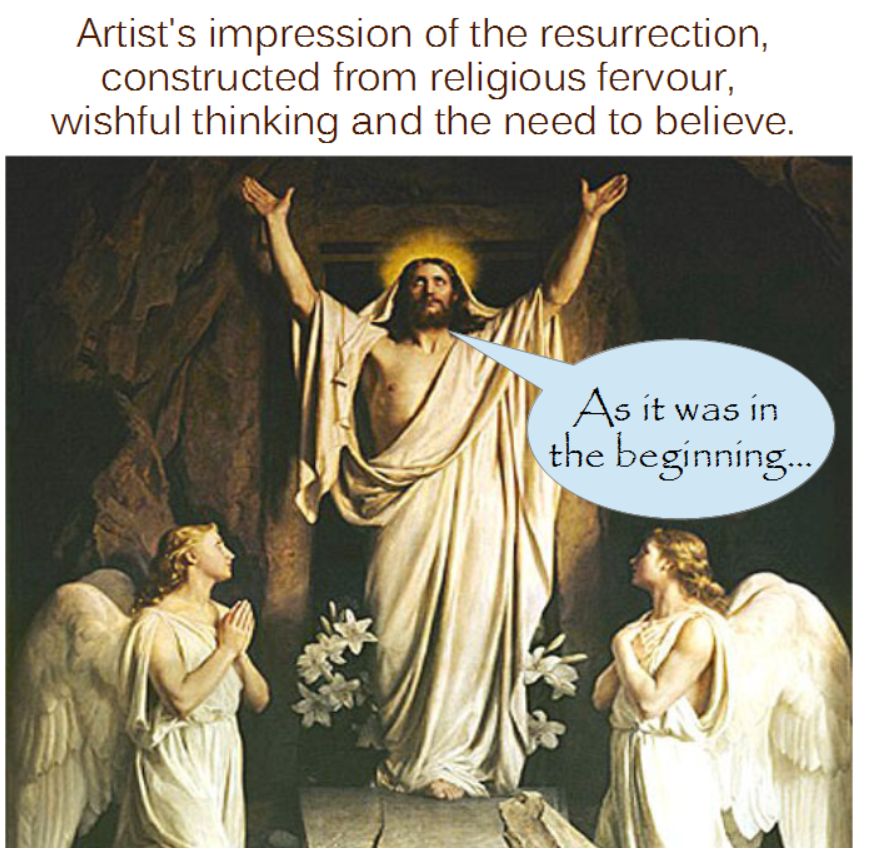
It wasn’t, of course. What those who witnessed the risen lord experienced was, as Paul suggests in Galatians 1.16, a creation of their own minds, constructed from religious fervour, wishful thinking and a powerful need to believe.

From this, all else followed.

To clanging cymbals everywhere

Massacre

If you’ve ever engaged one of God’s gentle people™ in discussion about one of their pet topics – the infallibility of scripture, evidence for the resurrection, the ‘abomination’ that is homosexuality or some other damn thing – you’ll know that, sooner or later, they turn nasty. They resort to name-calling and personal attacks; they tell you the reason you’re arguing against them is because you just want to wallow in your own sin – and, boy, are you going to suffer when it comes to judgement day.

Fellow-blogger, Bruce Gerencser has recently experienced this kind of thing from some twerp self-appointed ‘preacher of God’s word’ called T.C. Howitt, over on the Reasonable Doubt blog. I’ve been subjected to it innumerable times too. Eventually, you retreat; not because you’ve lost the argument or don’t have anything reasonable left to say but because there is only so much battering you can take. Then, as Bruce says, the bible thumper declares victory; the foe is vanquished – God’s word prevails! Even supposing this to be true, it is a Pyrrhic victory; the defence of doctrine is at the expense of others’ well-being and is achieved only by hurting them, usually intentionally so.

We shouldn’t be surprised by this of course; it has been the church’s way since the very beginning, from Paul’s tantrum about other evangelists he wished would accidentally castrate themselves (Galatians 5.12) to the massacre of native Americans by those passing on Jesus’ good news in the 16th century, right through to present day ‘hate’ preachers like Steven Anderson and Franklin Graham. Christianity is, and always has been, a nasty, bullying religion that cares only about its own preservation, never other people.

Those who proselytise on its behalf might care to read one of Paul’s better bits of self-promotion (1 Corinthians 13.1-2) which, if it is part of God’s infallible Word™, applies to those Christians today who have nothing better to do than hang around social media:

If I speak in the tongues of men or of angels, but do not have love, I am only a resounding gong or a clanging cymbal. If I have the gift of prophecy and can fathom all mysteries and all knowledge, and if I have a faith that can move mountains, but do not have love, I am nothing.

We might add that if the only way you can win your argument is by demolishing your opponent psychologically, you demonstrate that you are without love, making you in the eyes of ‘men’ and your own God, worth precisely nothing.