
The Anunciation: A Ghost Story for Advent

The Nativity in Matthew and Luke begins long before Jesus’ birth. Matthew introduces Mary and Joseph once the former has been impregnated with The Holy Sperm. He doesn’t go into any detail about how this happened, he just drops in, in Matt 1:18, that the deed is done. Mary has had sex with a ghost.

This isn’t good enough for Luke though, who after reading Matthew’s tall tale, decides it needs some expansion. A lot of expansion, in fact. He takes the story back to before Mary’s non-consensual encounter with the Holy Spirit and picks on Elizabeth and Zechariah, an elderly couple well past the age of having kids. All the same, they do enjoy a tumble in the sack every now and then, and the Lord – ever the voyeur – decides he’ll bless one such union with fruitfulness. (There is much wrong with the details of this unbelievable yarn, some of which I consider here; I won’t reiterate them now for fear of awakening any amateur theologians who might be lurking here in the wings.)

Suffice to say, Luke – for it is he, lest we forget, who is making this stuff up – decides that Elizabeth is a long lost cousin of Mary’s, like in one of those soaps where long lost relatives pop up all the time, usually to no good end. In this particular episode, however, all goes well and Mary visits Elizabeth, whose baby is, in a strange twist of fate, destined to be John the Baptist from the earlier two gospels. In this story his embryonic self jumps for joy inside his mother once he realises his uterine Saviour has come to visit.

But were getting ahead of ourselves. First Mary has to go through the rigmarole of getting pregnant. Obviously as a good Catholic girl she can’t have sex with her betrothed prior to their wedding and just when she’s considering when that might be, an angel appears unto her. It’s Gabriel who has quite a bit to do in the Nativity story as a whole. As angels do, he annunciates to Mary all about the pregnancy part of the plot and she acquiesces to the Lord getting her with child by magically transferring his seed into her womb. I’m guessing it was by magic. It’s possible some sort of actual rumpy-pumpy occurred but Luke delicately passes over the intimate parts. As apparently the Holy Spirit does too.

Mary is so overjoyed to be pregnant before her 13th birthday that she bursts into song on the spot and spontaneously produces a hymn based on the Psalms and the future teaching of the baby she has only just conceived. It’s hard to believe that no actual time travel was involved. It is instead, a miracle, as her impromptu ditty flourishes into the literary masterpiece now known as The Magnificat, which is not, it turns out, a feline super-hero. Fortunately, she can remember it all, word for word, decades later when Luke decides he needs to invent record it. Honestly, the whole thing puts Cole Porter to shame.

You’d think then Mary would dash off to tell her betrothed, Joseph, the wonderful news that she is pregnant without his or any other man’s assistance, but Luke makes no mention of it. Luckily, it’s covered by Matthew, where an angel drops in on Joseph, a person of great gullibility faith. On hearing what the angel has to say, he swallows the story hook, line and stinker.

Then it’s back to where we came in. Mary’s sets off down the road to see the cousin, the wonderful bearer of John. She pitches up there for three whole months, perhaps to avoid Joseph, who, it turns out, was not as gullible as she thought.

**********************************************

Honestly, this is really what happened. Would I lie to you? No, but someone would, and did. We’ll see what else he has in store in his over-worked imagination, next time.

**********************************************

PS. Don, I know you like indulging in a bit of biblical exegesis. If you’d like to borrow this totally respectful effort for your blog, get in touch and we’ll work something out.
Whatever Happened to Mary Magdalene?

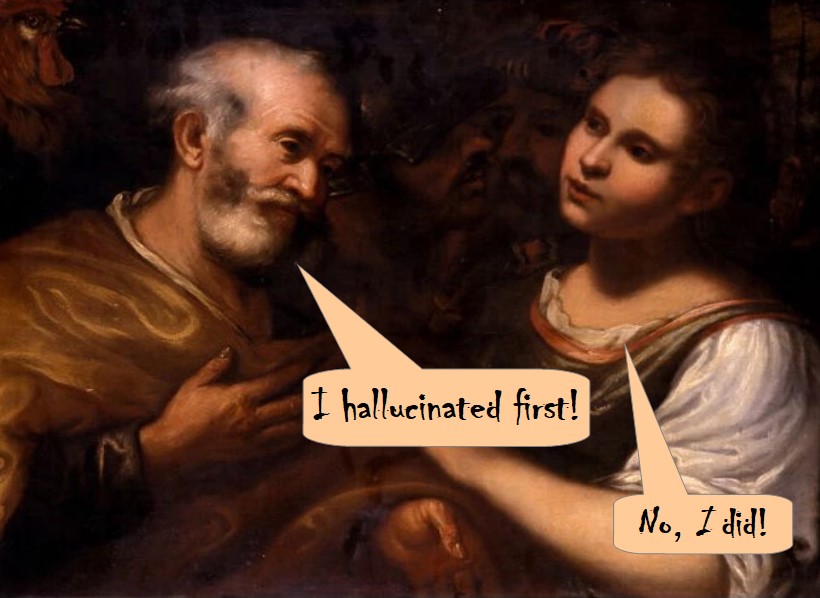
(The risen Jesus) appeared to Cephas, and then to the Twelve (1 Corinthians 15:12)

When Jesus rose early on the first day of the week, he appeared first to Mary Magdalene, out of whom he had driven seven demons. (Mark 16:9)

Mary Magdalene and the other Mary went to look at the tomb… Suddenly Jesus met them. “Greetings,” he said. They came to him, clasped his feet and worshipped him. (Matthew 28: 1 & 9)

Mary Magdalene went to the tomb and saw that the stone had been removed from the entrance… she turned around and saw Jesus standing there. (John 20: 1 & 14)

Whatever happened to Mary Magdalene? I mean, where did she go? She’s everywhere in the gospels: following Jesus and his entourage around the place, funding his layabout lifestyle (Luke 8:1-3) and being first to see him after he returned from the dead. After that, nothing. Luke doesn’t even bring her back for his sequel and no one else in the New Testament so much as mentions her. When, in 1 Corinthians 15, Paul lists those who, like him, have had a vision of the risen Christ, she’s conspicuously absent. Mary is the first person to see Jesus resurrected according to three of the four gospels, yet in the far earlier tradition mentioned by Paul, she doesn’t get a look in. Her place is taken by Cephas.

The neglect of Mary Magdalene in early tradition could of course be because she was a woman, and a woman’s testimony, back in those less than enlightened times, was worth far less than a man’s. However, it’s far more likely that whoever created the creed had never heard of her. Why not? Because the gospels didn’t exist when they came up with it. They had no idea that a woman was supposedly the first to see Jesus alive again. As far as they were aware, it was ‘Cephas’ who’d had the first vision of the risen Lord. Yet Peter – assuming he and Cephas are the same person – isn’t the first to see the risen Jesus in any of the gospels.

Mary Magdalene is side-lined like this because when the creed was created, and later still when Paul quotes it in 1 Corinthians 15, the stories about her hadn’t yet been invented. It’s safe to say, she hadn’t been invented.

In fact, Mary Magdalene and most of the rest of the support cast from the (future) gospels aren’t referred to anywhere else in the New Testament. This includes at least eight of the disciples from the slightly differing lists in the gospels, the Virgin Mary, Joseph, the angel Gabriel, the Magi, Nicodemus, Lazarus, Martha & Mary, Judas (apart from Luke’s side-splitting story about him in Acts), Barabbas, Joseph of Arimathea and Doubting Thomas. Likewise, fictionalised versions of historical figures with key roles in the gospel stories aren’t referred to either: Herod, Pilate, Caiaphas and John the Baptist(?) are all absent, even from epistles written and forged after the appearance of the gospels’ ‘cunningly devised fables’ (2 Peter 1:16).

Decades after the early creed of 1 Corinthians 15 and Paul’s letters, Mark invented Mary Magdalene, as well as many other characters who appear in his gospel. His allegory then became the basis for the other three canonical gospels, whose authors added their own imaginary characters.

And just as they invented the earthly Jesus’ companions and adversaries, they created too his miracles, teaching, cryptic parables, bodily resurrection and ascension. Mary Magdalene was but one small aspect of their ingenuity.


In which the Messiah loses his mind and his mother loses her memory

BlogXmas

So there it is; all the evidence you need that the nativity stories are pure invention, right there in the bible itself.

In Mark 3:20-21, Jesus’ family witness him spouting platitudes and setting himself up as a leader of his people. They think, not without reason, that he’s lost his mind.

When his family heard about this, they went to take charge of him, for they said, “He is out of his mind.”

As Bob Seidensticker says in a recent post, this could be because the writer of Mark’s gospel wanted to denigrate Jesus’ dumb old family in favour of Paul’s brand of Christianity. 

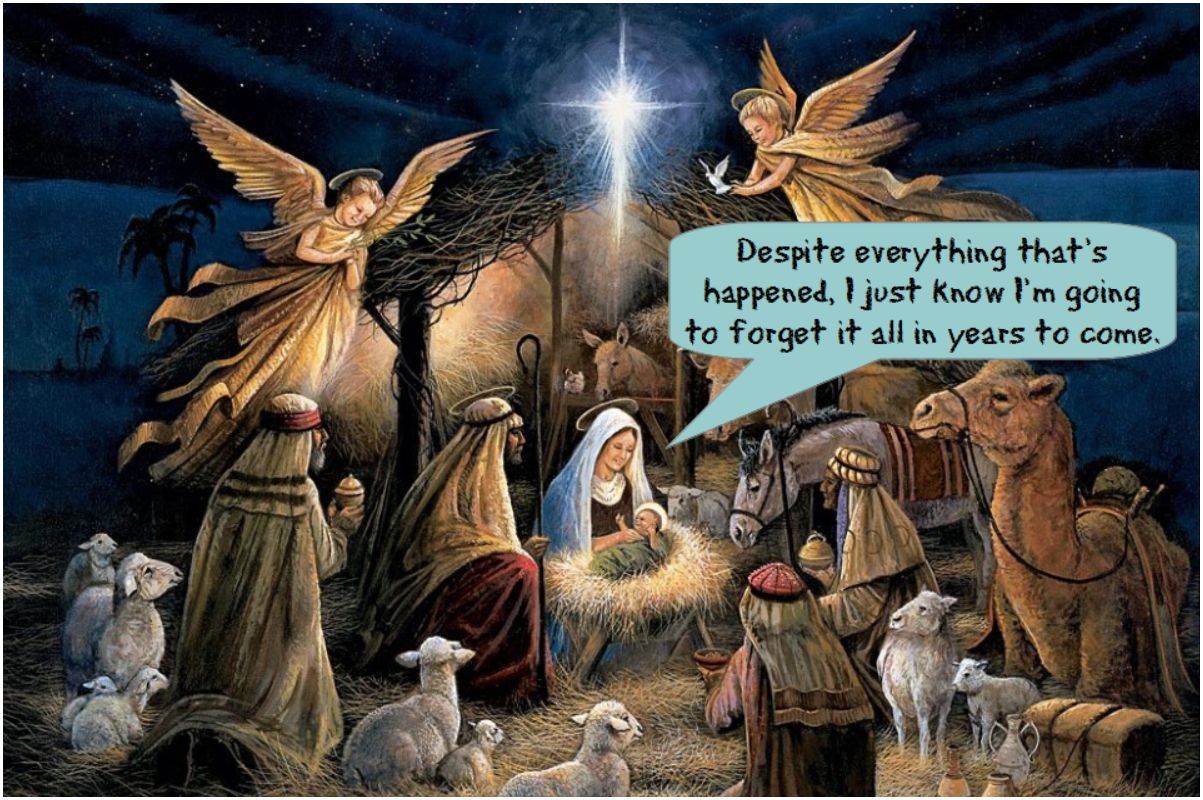
Luke 2:19, however, tells us that, back when she was still passing herself off as a virgin, Mary ‘treasured in her heart’ all the amazing things that happened at the time of her son’s birth.

Shouldn’t, then, Mark’s ‘out of his mind’ story be followed by something like this?:

And lo, when his brethren did decry Jesus, saying was out of his mind, Mary his mother did jump up and sayeth out loud, ”leave off, you bullies. I know from the way the Almighty impregnated me, from what Gabriel said and the miraculous things that on went on at his birth – wise men, armies of angels and magic stars – that my boy is the Messiah, the Son of God, maybe even God himself.”

And his brethren were amazed at this, because they’d never heard any of it, on account of those fanciful nativity stories not being invented for another fifty years.

I wonder why it isn’t?

A very happy Christmas to both my readers.


Why the Nativity reflects the fantasist mentality of those who created it.

Blog348Angels

The Nativity story tells us nothing about Jesus’ origins but plenty about the mindset of those who created it, decades after he lived.

They believed in angels. There are several visitations in the two versions of the story in Matthew and Luke: ‘Gabriel’ appears to Zechariah and strikes him dumb. Gabriel, again, manifests in front of Mary to tell her she hasn’t really been knocked up by a Roman soldier but that she’s going to be impregnated by the Holy Spirit. He then makes a lot of false promises too about how the boy will turn out. Later, a whole host of angels appear to some shepherds to tell them they’ll find a baby in a manger, news, that for some reason, they find amazing.

The creators of the gospels also believed that spirits were everywhere and that one of them was holy. Never mind that, according to John 14.16 & 16.7, the Holy Spirit doesn’t make its appearance until after Jesus’ ascension. In the nativity story, the Holy Spirit ‘speaks’ to Elizabeth, Simeon and Anna (how?) to tell them that Mary’s baby will be special.

The creators of the nativity myth also believed in dreams and visions. Joseph has a dream telling him to take his family to Egypt and the misnamed ‘wise men’ have a dream (just the one or did all of them have the same dream?) telling them not to go back to Herod. What a pity they didn’t ‘dream’ they shouldn’t call on him in the first place.

Angels, spirits and dreams are the context from which the gospel stories emerge: the gospel writers, and those who created their sources, believed implicitly that angels (and devils and demons) were real and that God communicated with them through dreams and visions. More than this, these same people accepted that the dead could return to life. According to the gospels, long-dead people could manifest themselves, and would appear and speak to the living (e.g: Matthew 17.1-3).

Incredibly, 1 in 3 people in the UK, a largely secular society, believes in angels. People with such a mentality were the ones who, 2000 years ago, claimed to have seen Jesus resurrected. Yet Christians insist they were stable, rational, reliable witnesses (never mind that the accounts of such appearances were written third, fourth, fifth hand, decades later.) Any such witnesses were neither stable nor reliable. They were the product of a pre-scientific culture that thought angels and devils populated the very air (Ephesians 6.12); that ancient celebrities could reappear in new bodies (Matthew 11.14; 14.1-2; 16.14); that without doubt that gods spoke to humans in dreams and that angels could and did appear bodily in front of favoured believers. People of such a culture, like Jesus himself, his early followers and the gospel writers, were fully primed, as a result, to have ‘supernatural’ encounters – or at least to interpret other experiences as such. They literally knew no better.

The stories that they wrote, with their supernatural beings and premonitionary dreams and visions – the Nativity, Jesus’ miracles and the Resurrection – are just that: stories, and the truth is not in them.

A happy Christmas to both my readers.