In which Howard visits Heaven and talks to Jesus

I recently finished reading My Descent Into Death and the Message of Love Which brought Me Back by Howard Storm, in which he recounts events surrounding his serious illness in the 1980s. This, he is convinced, caused his death after which some very dark beings, who at first he mistook for deranged medical staff, attempted to drag him off to a very sinister place. Fortuitously, Jesus and his angels were on hand to intervene and rescued hell-bound Howard.

Perhaps in my Evangelical days I would’ve lapped up stuff like this, but not now. A Christian friend – the same one who lent me the book I wrote about here – bought me. I promised I’d read it but what a struggle it was.

Once rescued by Jesus, Howard felt divested of his ego and overcome by love. He underwent a life review and was ever so gently ticked off for all the times he was less than kind. Instead of enjoying this state of bliss, however, Howard took the opportunity to bombard Jesus and the angels with banal questions, which given Howard’s comatose state they had time to answer at great length over many hours (which is how long it takes to read about them.)

When he came round and discovered he wasn’t actually as dead as he thought he was, Howard was a changed man. Once back on his feet, he joined a succession of churches so he could share his experience. When they didn’t fully appreciate how he’d really spent time with actual Jesus, he trained for the ministry himself. He has been a pastor now for several decades, regaling people with the tale of his encounter with fantasy heavenly beings.

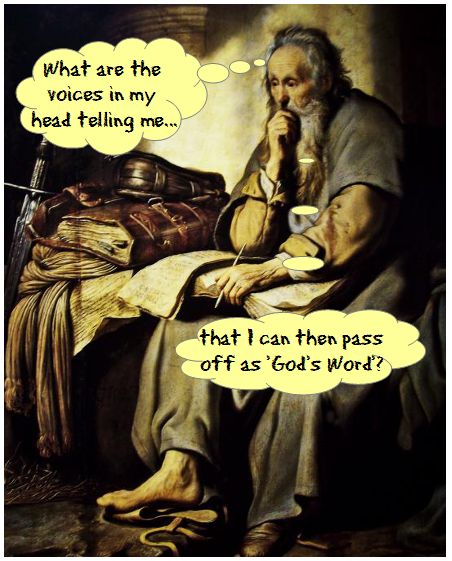
Undoubtedly, Storm’s experience was powerfully real to him, so much so it changed his life on his return to reality. As I read My Descent Into Death, however, I couldn’t help but feel I’d heard it all before: in Paul’s account of his imaginary visits to heaven and his encounters with a resurrected Jesus. These were probably not Near Death Experiences (NDEs) – though who’s to say – but, like Storm’s, brain-induced hallucinations.

As scientist Britt Hartley explains in the video sent by koseighty a while back, we now have a much greater understanding of NDEs; they are culturally determined hallucinations induced by the brain as it begins its shutdown. Hartley is clear that under stress the brain is more than capable of creating reassuring visions for itself.

But like Howard Storm’s, Paul’s ‘revelations’ are more than a mere sighting of Jesus. Paul too has a long discourse with the heavenly being conjured up by and in his own brain. He imagines Jesus explains to him how salvation works (in a mighty complicated way) in the same way Howard does. I’m sure this discourse, like Howard’s, did not take place during the visions but were worked out later, over time, as Paul, and Howard, interpreted what the inner-visions ‘must’ have meant.

Oddly though, given they both encountered the same character, it’s difficult to reconcile the messages each was given by him. Storm’s is of a mushy universal love, devoid of the demands and convoluted theology of Paul’s Jesus. Strange that the Jesus Christ who is, according to Hebrews 13:8, the same yesterday, today and forever, has modified and softened his message in the two thousand years between Paul’s and Howard’s revelations. It couldn’t be because Howard’s is the result of his conditioning by a modern American culture that sees Jesus as a shiny, white-robed figure surrounded by angels who dispenses nothing but all-embracing love and happy-clappiness, could it? It surely could.


The Great Eternal Life Scam

Heathens like me, and you dear reader, are gambling how we’ll spend eternity by rejecting Jesus. We’re turning down everlasting life to live in the mire of our own sin. Or so we’re told by evangelicals and other religious zealots.

So convinced am I that the claims of Christianity are wrong in every respect that I know I’m not gambling anything. Like everyone else who has ever lived, I will not survive my death. This is the nature of death – extinction, obliteration, oblivion. It is absurd to believe it is anything other when we know it is not.

I would not be averse to existence, particularly my own, continuing after death. I’d definitely go for it if that were available; I like being around, all sentient and self-aware and such. This is the sentiment to which Christianity appeals; most people do not want to think their existence is finite and that this often challenging life is really all there is. But life patently does not continue post mortem, except in works of fiction: fantasy, science fiction, the gospels.

Everlasting life is not the only promise Christianity makes, of course. There’s the whole ‘getting right with God’ shtick, forgiveness of sins and Life in all its fullness. Eternal life is the big one though, Christianity’s most miraculous, death-defying special offer.

Those doing the gambling are not atheists or sceptics. It’s Christians themselves doing that, succumbing to the false, utterly worthless promise of life after death. Those fully committed to Christianity spend their lives enslaved to its cultish demands, desperately trying to convince others they should surrender to its preposterous claims.

I value this life too much to squander any more of it on such nonsense. Yes, I did once, but I saw the light and stepped into it. Life is what you make it and needs to be lived before you die. There is zero chance you’ll be able to once it’s over.

Burst the bubble, those of you trapped within it. Your one and only life awaits you here on Earth. The clock is ticking.

The Great Resurrection Scam

Brothers and sisters, we do not want you to be uninformed about those who sleep in death, so that you do not grieve like the rest of mankind, who have no hope.  For we believe that Jesus died and rose again, and so we believe that God will bring with Jesus those who have fallen asleep in him. According to the Lord’s word, we tell you that we who are still alive, who are left until the coming of the Lord, will certainly not precede those who have fallen asleep. For the Lord himself will come down from heaven, with a loud command, with the voice of the archangel and with the trumpet call of God, and the dead in Christ will rise first. After that, we who are still alive and are left will be caught up together with them in the clouds to meet the Lord in the air. And so we will be with the Lord forever.

1 Thessalonians 4:13-17 (circa AD 49-51)

Paul said that because Jesus died and rose from the dead others would too. How does this follow?

He also claimed that all a person had to do to be sure of a spiritual resurrection was to believe that Jesus had already risen (1 Corinthians 15:20, AD 53-54), How did he know this? Almost certainly it came to him in one of his visions and his subsequent ‘revelations’ (‘the Lord’s word’ as he puts it in the letter to the Thessalonian sect).

Possibly, though less likely, he learnt it from the Christians he persecuted prior to his conversion. If so, where did they get the idea from? That the cult members in Thessalonica had to ask Paul what would happen to those who had passed away suggests this wasn’t a significant concern prior to this point. Paul and other early believers thought the Messiah/Son of Man was going to appear within their lifetimes (‘we who are still alive’ etc). It was only when cultists started dying off in noticeable numbers, and the Lord remained a no-show, that it started to become an issue. Paul had to make something up. And make it up he did.

Beyond The Grave

A few years ago, a friend of mine was working in his front garden when he spotted what he was sure were a couple of Jehovah’s Witnesses further down the street. He aimed to back inside before they reached his house, from where he could safely ignore them. But he timed it badly and before he knew it, the JWs were upon him.

My friend was under some stress at the time so when they asked him, ‘Wouldn’t you like to live forever?‘ he responded with, ‘Good God, no. This life’s bad enough. Why would I want it to go on forever?’ This took the wind out of their sail though didn’t divert them from their sales pitch for very long.

I’ve been in the same state of mind myself, and maybe you have, when life was so difficult I spent far too much time contemplating whether being dead might not be a better option. Thankfully, I couldn’t really contemplate doing anything about it, and was aware of the effect it would have on my loved ones if I did, but nonetheless I spent too much time considering – desiring even – my own non-existence.

I was pretty sure this was what awaited after death. I hadn’t, by this stage of my life, the conviction of the Jehovah’s Witnesses and mainstream Christians that a better life, one that would last forever, lay beyond this one. Instead, I made radical changes to my life in the here and now, to lift myself out of the slough of despond in which I found myself.

I love life now. It isn’t without its difficulties, not least the physical problems that come with older age, but I enjoy it to the full (apart from supermarket shopping). Having found my pearl of great price, I hope life will last for many years yet. I can’t guarantee it will, of course, so I make the most of every moment, surrounded by people I love and who love me.

Would I like my life to go on forever? Certainly, but I know it won’t. There is simply no evidence life continues after death. Assurances that it does in religious texts is no evidence at all. Even if it were, the type of eternal life suggested by the Bible, worshipping a needy, despotic God for evermore, is not the way I’d like to spend eternity.

Ask Christians how they know they will and the best that can come up with is that the Bible tells them so or that Jesus promises they will (which amounts to the same thing.) Ask them where this everlasting life will be lived and you’ll get one of two answers: in heaven or here on a restored Earth, once Jesus ‘returns’. The earliest writings in the New Testament support the here-on-Earth scenario. The later ones – perhaps because their authors had begun to realise Jesus wasn’t coming back any time soon – start, like John 14:2, to hint at a celestial existence.

No Christian – no non-believer either – has survived death to face eternal bliss or eternal damnation. Some will tell you that rising from the dead happens in an ethereal way immediately following death. The soul (or whatever) is resurrected either to be reunited with God outside of time and space or thrown to the demons in hell. The biblically savvy, like the JWs, will tell you the resurrection will not occur until Jesus’ return at some point in the future. Significantly, both expectations occur off-stage: the first in a undemonstrable plane of existence, the second in a future that never arrives. Both are wishful thinking, scenarios dreamt up by those frightened of their own non-existence.

The offer of everlasting life is one of the New Testament’s most pernicious lies. The idea is not to be found in the Jewish scriptures that make up the Christian Old Testament. It is a later development, dreamt up by extremists who convinced themselves, on the basis of a few visions, that God would ensure their continued survival, just as he had Jesus’s.

If this isn’t how the promise of living forever came about, then what is the evidence there is an existence beyond death? Empty assurances by first and second century cultists are not it.

  • Show me someone other than Jesus – whose ‘resurrection’ is metaphorical at best – who has risen from the dead.
  • Show me evidence that ordinary human Christians have already gone on to eternal life.
  • Show me, if you don’t subscribe to this view of immortality, the souls who rest with God awaiting a future resurrection (1 Thessalonians 4:13-18; Revelation 6:9-11).
  • Show me just one human, Christian or otherwise, who has gone on beyond death.
  • Prove that the promise of eternal life is real.

What Happens Before We Die (according to me)


Did you ever go to a party when you were a child and your parent told you it was time to leave before you were ready? That’s how I feel about death. I’m enjoying the party too much to want to leave. Although my ‘parent’ hasn’t told me it’s time to go just yet, I know they will before I want to. I can’t see me ever being ready really, though perhaps whatever cruelty nature visits upon my body and mind in years to come will change my mind about that. But as things stand, despite my fibromyalgia (a constant painful companion) and the levels of anxiety I allow myself to feel over trivial matters, I really have too much to live for. My partner Dennis and the adventures we have together; my family with my lovely grandchildren; my friends with whom I spend many good times; the many, many simple pleasures of life; everything I still want to do and try.

So, as the days, months and years roll by at an alarming rate – there’s definitely more of life behind me than there is front of me – it’s these things that matter in my life. 

All of this might suggest I’m afraid of dying. While I doubt the process of dying will be much fun, having so much to live for – enjoying the now – dispels, perversely, the fear of death itself. I’ll face it when I get to it, raging, I hope, against the dying of light, throwing a shameful tantrum because the party will go on without me. I’ll die, though, in the knowledge I actually got to it when so many didn’t. I’ll have enjoyed it too, for the most part, with a only a few bad times, fewer regrets and many more memories.

As Christians often tell those of us who are delusion-free, I am without hope. Of course I have hope – in continued days and achievable happiness – but none that there’s existence beyond death. I am confident there isn’t. Consciousness is completely dependent on the brain; when my brain dies, so do I. That will be that. The fantasy promoted by the New Testament, that there’ll be eternal life in a new body, is nothing but hopeless wishful thinking, that in spite of overwhelming evidence we go on. There is instead serenity and purpose in accepting the reality of death. It’s part of the deal, after all.

So let’s all eat, drink and be merry, as Ecclesiastes says. Enjoy life and help others, where we can, to enjoy theirs.

____________________________________________________

Dennis and I will be on one of our adventures when next I’m due to post. While I’ll set WordPress to publish it, I can guarantee it won’t. If I can do it manually (depends on whether I have a signal) I will. Otherwise I will see you on my return.

What Happens When We Die (According to the Bible)

Street preacher Dale McAlpine was busy regaling the shoppers of my home town yesterday with the good news that they’re all sinners destined for hell. The God who created them will, Dale assured them, face an eternity of torture unless they turn to Jesus.

Dale didn’t have many (any) takers for this wonderful good news. One brave person, a young woman, asked him why, if people are resurrected, the cemeteries remain resolutely full. Good point! Dale, armed with his megaphone and hectoring ignorance, responded that it is the soul that survives death and is taken up to Heaven to live eternally with God. For those without Jesus, their souls will be consigned to hell where they will burn for eternity.

How unbiblical is that? The Bible does not teach that believers will go to live forever with God in heaven. Eternity in Heaven is not on offer. The New Testament writers anticipated the arrival of Heaven – God’s new Kingdom – on Earth. When it did, they believed, the dead would be resurrected: the saints to everlasting life in new spiritual bodies on a regenerated Earth (Revelation 21:1-4), the rest to eternal damnation.

Paul has some vague ideas about what will happen to those who die before the general resurrection – he thinks their souls will be kept safe ‘in Christ’ (whatever that mean but doesn’t suggest they will be living it up in Heaven. Rather, he describes them in 1 Thessalonians 4:14-15 and 1 Corinthians 15:20 as being ‘asleep’. Many Christian ‘thinkers’ really take exception to this idea, though Paul says this intermediate state won’t last for long; the Kingdom on Earth was imminent. He believed it would arrive while most of those he was writing to were still alive (1 Thessalonians 4:17; 1 Corinthians 15: 51-52).

It’s all tosh, of course. Paul had absolutely no idea what happens to people after death. He invented everything he said about it, from the independent existence of sleeping souls to Jesus arriving on the clouds to resurrect the dead in new spiritual bodies. These bizarre ideas come from a fevered brain convinced it had seen a dead person alive again and thought it had once taken a trip to the third heaven (whatever that is).

How do we know Paul invented it all? Because of the aspects of his teaching that should by now be history: the arrival of God’s Kingdom on Earth, the resurrection of the dead and Christians being supplied with new spiritual bodies ( while the rest of us roast in hell.) None of these things happened when he said they would, or indeed at all. We know it too because we are aware both instinctively and empirically that there is no continuation after death. When the body ceases to function so too does the ‘self’, which can be generated only by a living brain. We have no ‘soul’ that goes on alone after death and which will one day be clothed in a new sparkly body.

Here’s my challenge then to those who believe and propagate such nonsense; the Dales, the evangelicals, the fundies and the oxymoronic intellectual Christians of this world: provide evidence of one individual who has survived death in the way Paul said they would. Show us one believer who has been resurrected or whose soul is currently sleeps in Christ or who now lives in Heaven. The only proviso is that this must be a real person who is 100% human; not a mythical demi-God, not a character in a story, not someone for whom the evidence of a resurrection is extremely poor. Not, in short, Jesus. Where is the evidence anyone else has experienced a resurrection or embarked on their eternal life in heaven? Billions of believers have died since Paul created his fantasy. Surely there must be someone

Suffer, Little Children

I recently wrote the post below for The Life and Times of Bruce Gerencser and thought that if you missed it, you might like to read it here. 

I was reading Gary Marston’s latest post on Escaping Christian Fundamentalism God Is So Good! He Allowed Ten Thousand Children to Starve to Death Today.

Gary has his very own Christian troll (All atheist/agnostic bloggers have them) called Swordmanjr, who leapt to God’s defence, the mighty Creator Of All Things needing fallible, flawed human beings to do this for him. Swordmanjr accused Gary of scapegoating God who, apparently, is not really responsible for suffering, nor indeed anything horrible.

I guess God could be being scapegoated if it wasn’t for the fact, his Son, God Incarnate according to some, tells us he cares for human beings much more than he cares for sparrows (which is, admittedly, not much at all), that he is concerned to the extent that he numbers each and every hair on individuals’ heads (Matthew 10:29-30). This must be before he allows so many of them to die of starvation and in natural disasters.

The evidence is that God does not care. He doesn’t care if you’re a child born into poverty who then dies a slow, miserable, painful death through malnutrition. He doesn’t care if you’re caught up in a natural disaster like the recent earthquake in Turkey (which, according to some Christian nutjob, was God’s response to Sam Smith’s performance at the Grammies) in which your entire community and you yourself are wiped out. He doesn’t care if you die of a nasty virus, which ultimately he’s responsible for, as millions including Christians did during the pandemic. He doesn’t care that you die, when, or how horribly. He – just – doesn’t – care, period.

Jesus, as he was about so much, was plain wrong about his Father’s caring. The real world does not and will not match up with this early Christian fantasy.

Believers who leap to God’s defence invariably do it by launching vitriolic ad hominem attacks on non-theists who dare to criticise his shoddy performance. In doing so, they demonstrate yet another of Christianity’s disconnects; it’s promise that it makes new creatures of people, filled with love and compassion (2 Corinthians 5:17).

By their fruits shall ye know them,’ proclaims Jesus in Matthew 7:15-20. If the Christians who lurk around atheist blogs are anything to go by, those fruits are often pretty rotten: vitriol, spite, hatred… ‘evil’ Jesus calls it. These Christians frequently end their comments with a threat: one day the atheist will stand before God’s judgement throne and then they’ll be sorry: hell awaits!

God is not there in this kind of behaviour. He’s not there when humans suffer and die, frequently horribly. He’s not there in the Bible verses that promise he is there in such circumstances. God is not there.


Death’s Sting

supermancry-e1457347480705

Image copyright DC Comics

A long time friend of mine died suddenly a couple of days ago. Tom was in his comic shop, putting together orders, and, it appears, suffered a heart attack. He died there alone.

Death still has its sting – for both those who die (which is all of us) and those who are left behind. Paul’s rhetorical question, ‘Oh death, where is thy sting?’ (1 Corinthians 15:55) has always seemed to me to be particularly fatuous, not to mention deceitful. He said it, of course, in the belief that faith in his Christ meant life would resume on the other side of the grave. Even if this were so, dying would not be without its pain, and grieving not without deep sorrow.

And what about that word ‘sting’? The Greek Paul uses, ‘κέντρον’, means ‘a sharp point’ as if death is nothing more than a pin prick, a short sharp shock no more troublesome than an injection. In my experience, spending time with people who are dying, it is far from that. The body’s shutdown is often slow, relentless and unbearable. Morphine helps, not Jesus.

Mourning too is persistent; an emptiness and a profound sense of loss, as we often acknowledge when offering condolences. It takes time to subside, but never truly disappears. Every death, especially of loved ones, depletes us. As John Donne puts it:

Any man’s death diminishes me, because I am involved in mankind; and therefore never send to know for whom the bell tolls; it tolls for thee.

God Nature, whose product we are, is insensible and indifferent to our suffering. It neither knows nor cares that we are self-aware, emotional beings who grieve and suffer. Death, which troubles us so much, is one of the engines of evolution. Once we have passed the stage at which we might viably reproduce we are programmed to decline and  die. We must make way for new creations, which is not, despite what Christians claim, in a brand new body on a new earth or in heaven. The new creations are those who follow us. Paul, as he was in so many respects, is wrong to say that because of the futile hope of resurrection, death has lost its sting and the grave its victory. Death will never lose its sting, its pain and finality.

Tom will be remembered by those to whom he mattered in life. This is the best we can do; this and living our lives to the full while we’re still here, loving others and being kind.

Farewell Tom, my friend.

Jesus’ Final Solution

Blog332Composite

Jesus is beautiful. That’s what they were singing on TBN last night – thousands of Christians telling their false-idol Jesus just how lovely he is.

I’m fortunate in life to know some truly genuine and beautiful people and one of the things that qualifies them as beautiful is that they don’t advocate violence, cruelty or self-harm. I don’t know about you, but for me that’s something that marks out a good person. I can’t see folks who promote violence and cruelty as either good or lovely or beautiful. They’re just incompatible.

Unless of course you’re Jesus. Because, as ever, Jesus gets a free pass. He revels in violence and unpleasantness and his followers are always prepared to overlook it, because, well, he’s Jesus. Beginning with Paul he’s been remodelled from the rough itinerant preacher he clearly was to the epitome of all things bright and beautiful.

Here are some of his pronouncements, all hiding in plain sight in the gospels that tell us he was nothing of the sort –

Matthew 13.41-42 (and John 15.6):

The Son of Man will send out his angels, and they will weed out of his kingdom everything that causes sin and all who do evil. They will throw them into the blazing furnace, where there will be weeping and gnashing of teeth.

The fate of those who are not convinced by Jesus’ ‘good news’ is to be thrown into a blazing furnace. He’s not talking about after death here; he’s talking about when God’s Kingdom arrives on the Earth. He wants sinners and those he considers evil to be burnt alive. Jesus, who in Matthew’s gospel sees himself as the Son of Man, sounds more like Hitler than any ‘Prince of Peace.’ Burning people in giant ovens is Jesus’ final solution.

Then there’s Matthew 7.19-23:

Every tree that does not bear good fruit is cut down and thrown into the fire… Not everyone who says to me, ‘Lord, Lord,’ will enter the kingdom of heaven, but only the one who does the will of my Father who is in heaven. Many will say to me on that (judgement) day, ‘Lord, Lord, did we not prophesy in your name and in your name drive out demons and in your name perform many miracles?’  Then I will tell them plainly, ‘I never knew you. Away from me, you evildoers!’

Jesus makes clear here he’s talking about believers here – his own followers! If you don’t do all he says, Christians, you too are heading for the flames. What is it with this pyromaniac?

Luke 19.26-27:

I tell you that to everyone who has, more will be given, but as for the one who has nothing, even what they have will be taken away. But those enemies of mine who did not want me to be king over them—bring them here and kill them in front of me.

This is the conclusion of the so-called Parable of the Talents where Jesus emphasises the point of the story. With himself as the King of the World (Matthew 19.27-28) he wants those who don’t appreciate his megalomania to be executed in front of him. What’s not to like about this guy?

Matthew 5.29:

If your right eye causes you to sin, tear it out and throw it away; it is better for you to lose one of your members than for your whole body to be thrown into hell. 

Don Camp tells me (see the previous post) that this is meant metaphorically; metaphorically for what, Don? There is no reason to interpret this in any way other than literally. Look at the context: Jesus makes clear in the previous verse he’s talking about how to deal with lusting after women. He thinks the only way to stop yourself from doing this is to gouge out your eye (just the one?) According to Jesus, lust is such a terrible sin, it can only be properly dealt with by blinding yourself.

Matthew 5.30:

And if your right hand causes you to sin, cut it off and throw it away; it is better for you to lose one of your members than for your whole body to go into hell.

If you think you’re going to manage your lust any other way – by masturbating, for example – then you can forget that too; Jesus wants you to cut off the hand you do it with (or is he using ‘member’ in the modern euphemistic sense of ‘penis’?). The context of this verse is, like the previous one, sexual, and we know how much Christians like context. In case you’re tempted to dismiss this gruesome nonsense as an irrelevant part of Jesus’ message, he repeats it in Matthew 18.8-9.

Matthew 19.12:

For there are eunuchs who have been so from birth, and there are eunuchs who have been made eunuchs by men, and there are eunuchs who have made themselves eunuchs for the sake of the kingdom of heaven. Let the one who is able to receive this receive it.

Jesus advocates castration. Or, if you want to insist he’s speaking metaphorically, then he’s suggesting his most avid followers live a life without sex. And we know how well that worked out for the Catholic church. How do we know, though, when he’s being metaphorical and when literal? He hardly makes it clear. I suspect he’s only being metaphorical when Christians don’t like what he’s saying. If this is a metaphor here, it’s a particularly unpleasant one; Christian extremists have castrated themselves on the strength of these words and some have used them to justify castrating others. At the very least we might expect Jesus to have foreseen the consequences of such stupid remarks.

Luke 22.36:

He said to them, “But now if you have a purse, take it, and also a bag; and if you don’t have a sword, sell your cloak and buy one… The disciples said, “See, Lord, here are two swords.” “That is enough,” he replied.

Buy swords? What for? There’s only one purpose for swords – to run other people through. Now why would Jesus be suggesting his pals do that? To put up some resistance when he was arrested? What other purpose could they have in the context? Two swords, it turns out, are enough; though when Peter (according to John) uses his, Jesus castigates him. Talk about mixed messages!

Matthew 10.34-36:

Do not think that I have come to bring peace to the earth; I have not come to bring peace, but a sword. For I have come to set a man against his father, and a daughter against her mother, and a daughter-in-law against her mother-in-law; and one’s foes will be members of one’s own household.

Jesus predicts his own disruptiveness. Despite the prediction of the Christmas angels, his message was not one of peace but of division and bloodshed, as his later followers found out (and put these words in his mouth retrospectively.) Is it any wonder when he promised that those who weren’t a part of his cult (and some who were) would be thrown into the flames or put to the sword?

Mark 7.10-14:

Jesus said to the Pharisees: For Moses said, ‘Honour your father and mother,’ and ‘Anyone who curses their father or mother is to be put to death’… But you nullify the word of God by your tradition that you have handed down. And you do many things like that.’

Complicated this one, but essentially Jesus takes the Pharisees to task for not having troublesome youths executed as Moses commanded. In fact, he upholds all the barbaric practices of the Mosaic Law (Matthew 5.17).

Still think he’s a nice guy? Lovely and beautiful? Well of course, because the Jesus worshipped by Christians today – and even by Paul – was not this guy. The beautiful version is a construct that bears no resemblance to the bloodthirsty, furnace-building advocate of self-mutilation who haunts the pages of the gospels. Lovely he was not.

 

More fairly random, half-formed thoughts on Evolution

Flintstones42

(Note to self: check the captions to this and last time’s pictures are the right way round.)


3. On God in Nature

God is revealed in nature! The bible says so (Romans 1.20) and you don’t even have to be a Creationist to see it – the evidence is there in plain sight.

But to suggest that, because aspects of nature are beautiful (or stunning or endearing) from a human perspective, the natural world can only have come from the hand of a loving Creator is merely to argue from a position of incredulity: “I can’t conceive how such beauty came to be; it must have been God.”

I live close to the countryside and although there is much that is impressively beautiful, the mercilessly cruel working of nature is also apparent: ruthless competition, even between plants and certainly among animal wildlife; waste on a vast scale; predation – young blue-tit (chickadee) chicks in my garden eaten a few weeks ago by magpies – death and sex.

The incredulous believer who refuses to see these aspects of nature and sees only beauty – and much of it is undeniably beautiful – is being disingenuous in their selection of evidence (confirmation bias in action). If God reveals himself in nature, then just as it is, he has to be callous, cruel and indifferent to suffering too.

“Ah, yes,” says the Christian, “but that’s because we live in a fallen world,” which is having it both ways: God is apparent in nature, except when he isn’t… because then it’s a fallen world.

Speaking of which –


4. On This Being a Fallen World

Creationists, such as those at Answers In Genesis, like to argue that genetic mutations in humans and animals fail to ‘increase the information’ and, further, that such errors would only lead to malfunction and the death of the organism. They’re right about the latter; significant mutation is almost always detrimental. However, according to Nature, ‘others have little or no detrimental effect. And sometimes, although very rarely, the change in DNA sequence may even turn out to be beneficial to the organism.’ A mutation that increases the chances an animal will survive and reproduce ensures that the particular mutation is passed on to its offspring.

The constant shuffling and recombining of genes in sexual reproduction also changes and ‘increases the information’ within the genome with the consequent effect on the phenotype (the genome’s physical expression). This is analogous with the twenty-six letters of the English alphabet producing new, unique sentences, paragraphs and texts every time they are recombined.

Creationists are wrong therefore to insist that mechanisms do not exist to change or add to genetic ‘information’. They are wrong too that variations caused by mutation cannot contribute to the evolution of an organism; while most born with such variance are likely to die before they can reproduce (natural selection in action) a minority are able to pass on the changes. Mutation and sexual recombination of genes are integral to evolution and the development of the organism.

I mention this because the bible presents quite a different scenario. In Genesis, the world and everything in it is created in a state of perfection. Then, because of human disobedience and sin, God feels compelled to curse his entire creation and the sudden or gradual – Christians are none to clear about which it is – transition to degradation, entropy and death begins.

It’s here that creationists’ objection to the role of mutation in evolution proves a stumbling block for their own scenario: a system designed to function in a particular way cannot continue to operate effectively after undergoing such a radical, brutal overhaul. We know of no other system that, having undergone such demolition, can continue to work in the way it was intended to, and certainly not as effectively as the ecosystem has for millennia. Look, for example, at how human activity has contributed recently to radical changes in climate.

Nature relies on those things that Christians say arose because of God’s curse on it: death, disease, waste, competition, cruelty. A system with such inherent ‘faults’, so far removed from how it was ‘designed’ to operate, would have failed long ago.

From this we can conclude that:

Nature/ecosystems/life were not ‘designed’ at all.

     They were never part of a ‘perfect’ creation.

         They were not cursed and are not now faulty components of a fallen,     malfunctioning world – nor could they be.

                       They could not operate any differently from the way they do.

                             They will not, despite what the bible says (Romans 8.20-21), be restored one day to a state of perfection they didn’t have in the first place.