
Flourishing

The solution to all our problems is to return to God.

How many times have we been told this recently? It seems here in the UK that hardly a week goes by without a new book, report or high-profile article appearing advocating a return to ‘Christian values’ or acknowledging Something Greater Than Ourselves (invariably the Christian God). This, it invariably assures us, is the only way to bring us back to our senses and solve all our problems. Even previously atheist/agnostic writers – Richard Dawkins, Douglas Murray, Tom Holland, Jordan Peterson, Aaran Hirsi Ali and Russell Brand (how’d he get in here?) – suggest that Christianity must be revived to prevent the vacuum created by its decline from being filled by the less humane Islam.

I’ve written about this fallacy before – here and here – so won’t go over the same ground again. Instead, I want to highlight a recent report, The Global Flourishing Study, carried out by Harvard University and funded primarily by the Templeton Foundation. Alarm bells! The Templeton Foundation is a religious organisation, so already the study’s conclusions are thrown into question. What were participants asked? What was their background? What bias did the questions convey?

Not surprisingly then, the study concluded that many people in the world are not flourishing and that those who are, are flourishing – surprise, surprise – largely as a result of religion:

Religious service attendance was one of the factors most consistently associated with present or subsequent wellbeing, across countries and across outcomes.

Religious groups have leapt on the conclusions as evidence that humans need God to live fulfilling lives. The key word here, however, is ‘attendance’. The study itself acknowledges that human community – being with other, like-minded people with a common interest or cause – is a significant aspect of the resulting flourishing. But we knew this already so maybe the $43.4 million spent on the study might have been better spent: feeding the hungry, perhaps? An earlier 2017 study also by Harvard was headlined:

Harvard study, almost 80 years old, has proved that embracing community helps us live longer, and be happier.

Numerous other recent studies have reached this same conclusion (see here, here, and here for more).

The god factor injected into Harvard’s more recent study to satisfy the Templeton Foundation and its affiliates is further complicated by the fact that there isn’t only one god involved in making us all feel jollier. There are currently thousands in use throughout the world (the internet is unable to provide an actual figure, however approximate). Thus, those who congregate in the mosque to praise Allah enjoy the same ‘flourishing’ as those who meet at the synagogue to worship Yahweh. Likewise, those who come together to worship Brahman experience the same benefits as those who gather to praise Jesus. Not because any one of the gods in question is the real one – they can’t all be – but because the participants are worshipping and serving together, collectively as a community. That is where the ‘blessing’ comes from. The innumerable gods involved are incidental. Indeed, each is dismissed, if not held in contempt, by the adherents of the others.

In the end then, what enables us to flourish and live longer healthier lives is company – human company. This doesn’t require a church, mosque, synagogue or temple. There are other, superstition-free ways: time spent with family; volunteering with others; joining a drama/bridge/walking/sports/writing/LGBT (worked for me) /whatever-you’re-interested-in group. The song from Funny Girl gets it right: ‘people who need people are the luckiest people in the world’. Of course other people can be frustrating (present company excepted) but unlike the gods they’re real and provide the companionship, fellowship and company we need to thrive. As ever, no God required.
A New Kind Of Christian


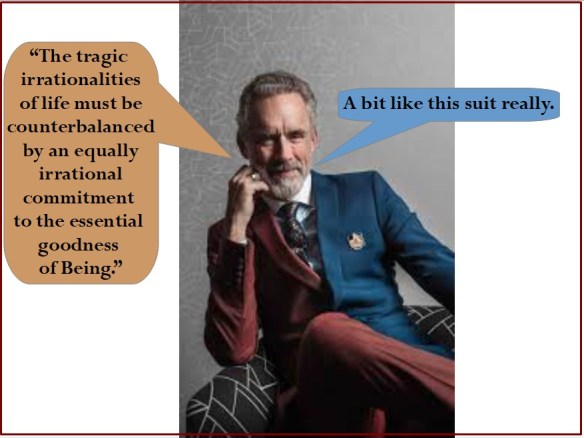
You’ll be overjoyed to hear that Jordan B. Peterson has a new book out. He’s been busy promoting the not at all pretentiously titled We Who Wrestle With God. He was interviewed about it recently in British magazine The Spectator. The interview has to be read to be believed. The introduction can be read here but the rest, alas, is behind a paywall. Don’t worry though, I’ll supply you with the highlights. The article is a goldmine of stupefying statements about God and how Jordan is the only one who really understands the Bible’s stories. They need ‘arranging’, you see, and their underlying ‘hypotheses’ understood:

The Bible presents a series of hypotheses. One is that there’s an underlying unity that brings together all structures of value. The second claim is that there’s a relationship between the human psyche and that unity and each of the main biblical stories casts that unity in a different light, accompanied by the insistence that, despite those differences, what is being pointed to is one animating principle. As far as I can tell, that’s correct.

You got that? As ol’ Jordan humbly admits, this ‘revolutionary realisation’ is his and his alone. Of course, none of this sort of thing is original; the idea that characters, events and stories in the Old Testament prefigure realities in the New is as old as the hills. Typology can be imposed on any set of myths. The gospel writers and Paul did it, seeing Jesus prefigured in Jewish scripture and inventing stories about him so that he complied with these earlier types. There’s nothing ‘revolutionary’ about spotting this, but like so many before him, Peterson gets it back to front and falls, quite literally, for the oldest trick in the Book. Continue reading

10 Reasons Why

I wonder what are the reasons those of you who were once Christians gave up on faith? Believers who know me far better than I know myself have attributed to me a whole range of motivations. Here’s a top ten of the reasons I rejected Jesus according to these spiritually astute know-it-alls:

In at 10 it’s…

You must have been hurt/had a bad experience of Christians. To which I answer, not particularly, though I did find the people I encountered in churches to be much like those I encountered in any other organisation I’ve been involved with. No different. Certainly no better, and in some ways worse when they squabbled or were petty and judgemental. Not sufficiently worse to make me abandon faith, but perhaps enough to make me ask whether Christianity really ‘worked’. Shouldn’t Christians who are new creatures, reformed in the image of Christ. be so much better than the rest of us?

At 9… You went to the wrong church. If so I must’ve attended several ‘wrong’ churches as I moved around the north of England with work. My wife and I always sought out churches with sound biblical teaching, so it wasn’t the lack of solid food that caused me to backslide (to use the Christian jargon.)

8. You wanted to wallow in your own sin. As I’ve said facetiously before, I like a good wallow as much as the next man and preferably with him. Back in the days of my struggling with faith, however, I didn’t find myself drawn to ‘sin’. I was trying to raise three children, do a demanding job and deal with the fallout from my boss’s affair with a colleague. My own sin was the last thing on my mind.

Related to this is the accusation that an apostate such as I wants, in some unfathomable way, to be God. Certainly I want to be fully human and to take charge of my own life, but aren’t these laudable intentions? It doesn’t mean I aspire to be God; I don’t want to be worshipped, don’t want to laud it over others, blame them for my deficiencies or send them to hell. That’s what God does, right? But it’s not me. 

7. You rejected Christ because you’re gay and didn’t like the constraints faith placed on your sexual behaviour. See above. I didn’t admit I was gay until several years after I ditched faith and it was several more after that before I came out, yet more until I did anything about it. But okay, if you want to reverse the order of events, I gave up on religion because I was latently gay. But not really, though certainly the abandonment of faith was a liberation; I could think for myself and was free, over a long period of time, to finally become myself.

6. You read the wrong books. I certainly did: C. S. Lewis (I still have my collection of his books), John Stott, John Piper, John Bunyan, Bonhoeffer, Joni Erickson, Corrie Ten Boom, Billy Graham, David Wilkerson… and the Bible. So yes, I wasted a lot of time reading this sort of thing, but I’m guessing that’s not what my Christian accusers mean. I read more widely as I moved away from faith which helped me break out of the Christian bubble, but this wasn’t the reason I left the faith. I was well on the way by this time.

5. You were never a true Christian. Your faith was intellectual or habit or emotional but not deeply personal. Of course I was a true Christian. Just ask Jesus. Oh… you can’t. I’ve written about this before as you’ll see here. I was as real a Christian as those who claim they’re the real deal now.

4. You were in thrall to non-Christian writers. Not in thrall, no, but these writers – Ehrman, the so-called New Atheists, science writers (Dawkins’ science books particularly), Pagels, Barker, Loftus, Alter and, yes, Carrier – make a lot more sense than those who write from the perspective of faith. These authors don’t seem to mind, indeed they relish that their readers think critically about the evidence they present. Mumbo-jumbo isn’t passed off as erudition.

3. You have no awareness of the spiritual; you think that only that which can be measured is real. This is true, but it is not why I gave up Christianity. It is a consequence of doing so. I have seen no evidence of a spiritual realm that exists outside the human imagination. If anyone is able to present evidence that it does have independent existence, I’m open to it. Until then I will continue to live with the understanding that angels, devils, demons, heaven, hell, celestial saviours and gods, like unicorns, dragons and Shangri-La, do not exist. It follows that as non-existent beings they cannot communicate with us nor await us as our final destination.

2. Your heart has been hardened by Satan. See above; there is no Satan. Hardening of the heart is a metaphor for those who don’t fall prey to Christianity’s fraudulent claims or at last see through them.

1. You gave up on faith because you realised none of it was true. Yes. Finally. This is why I rejected Christianity. It simply isn’t true, as I’ve attempted to demonstrate on this blog for the last 12+ years. Its third-rate fantasies, fake promises and failed prophecies are all evidence of its falsity.

But wait. None of the telepathic Christians who ‘know’ why I’m no longer a believer ever make this accusation. They would never concede that most (all) of what they believe simply isn’t true. But my life experience and my reading as I began to suspect Christianity was nothing more than a con have borne this out. Christianity is demonstrably untrue, theChristian God a fraud and supernatural-Jesus a fiction. This is why I abandoned Christianity.

How about you?