
Conclusions

So what do we see when we arrange the books of the New Testament in chronological order?

  1. In all probability, Jesus was first experienced in visions experienced by a few Jewish zealots looking for the arrival of the Messiah. His name – Yeshua – is symbolic and means ‘The Lord is Salvation’.

  2. These visions led to ‘revelations’ that convinced these zealots that the Messiah would soon arrive on the Earth to set God’s plans in motion.

  3. A small number of Jews were convinced of the veracity of these claims and sought to spread the message that the Messiah/Jesus was soon to arrive on Earth.

  4. A few years later, a Hellenized Jew who called himself Paul, argued that the Messiah – ‘Christ’ in Greek – had died in the heavenly realm and been raised from the dead by God. His sacrifice, Paul insisted, was a propitiation for human sin, both Jew and Gentile.

  5. Also according to Paul, the Christ’s arrival would trigger the resurrection of the dead, prophesied in Daniel 12:1-3 and Isaiah 26:19-20, the final judgement (Daniel 7:22) and the establishment of God’s kingdom on Earth, governed by God’s Chosen (Daniel 7:27). Regrettably, he drew most of these conclusion from a book, Daniel, now known to be fake.

  6. Paul ‘proved’ that the Messiah-figure he’d seen in his visions really was the Messiah prophesied in Jewish scripture by quoting from them extensively.

  7. Soon after Paul died, the original group of visionaries, who had had their differences with Paul, were all but wiped out when the Romans destroyed Jerusalem.

  8. Around the same time, an unknown cultist took it upon himself to write an allegorical history of the Christ’s activities. He based this allegory on Paul’s teaching about the Christ as well as events from Jewish scripture. He set his story in Galilee some forty years earlier and has his fictional Christ, Jesus, prophesy the arrival on Earth of the real Messiah whom he calls the Son of Man, after Daniel 7:13-14.

  9. Two other cultists set about altering and improving this original history. One re-establishes the Christ’s Jewish credentials, and extending references to and allegorising aspects of Jewish scripture.

  10. A completely imaginary history of the early cult was created by one of these writers, smoothing over the differences between the beliefs of the earliest visionaries and Paul.

  11. Other writers, including some pretending to be the late Paul, continue to write of Jesus the Christ as a celestial saviour.

  12. A fourth history of the Christ was created, this time providing Jesus with a bodily resurrection (contrary to Paul) and discarding some of the cult’s earlier beliefs, the imminence of God’s kingdom on Earth included. The authors of this account imply that dead believers will awaken to new life in heaven (John 14:2)

  13. The idea that the Messiah will arrive imminently was, however, kept alive by other writers. One anticipated the Christ would soon purge the world of evil-doers and bring a holy, bejewelled Jerusalem down to Earth.

  14. Others soon abandoned the idea that any of this would happen soon. The arrival of the Christ was postponed indefinitely.

  15. The notion the Son of Man/Messiah/Jesus had yet to appear was also dropped as the church adopted the allegorical gospels as real history. It began to expel those who disputed the gospels’ veracity and denied that Jesus was the Christ incarnate.

  16. While the term is not used in the New Testament the Christ’s delayed arrival was, from the early second century, thought of as a second coming.

  17. The church, once well established went on to embellish doctrine, adding the Triune God; eternal life in Heaven; the elevation of Mary and the saints; the New Testament as the Word of God and the infallibility of the Bible as a whole. Some of these were, and are, in direct contradiction of the beliefs of the earliest Christians.

  18. Believers today, if they read the New Testament at all, take its traditional order at face value, which distorts the evolution of its ideas. They allow their preachers to smooth over what now appear to be random contradictions (hermeneutics).

  19. Today’s Christians believe primarily in the heavenly Christ, who forgives their sins and guides their lives from Heaven. They also hold on to the belief that he was manifested as a human, and vociferously oppose the idea he was and is only an imagined supernatural being.

  20. At the same time they prioritise Paul’s teaching about him over anything he is made to say in the gospels .

That how I see it anyway. The more time I spend looking at the New Testament books in their correct order, as well as what this reveals about the beliefs of early Christians, the more I’m driven to these conclusions. They’re the only ones that make sense of all that we find in their writings. I realise this is contentious. Mythicism is not widely accepted but it is the only position that explains the recorded facts as we have them. The original Jesus was seen (in the mind of the first visionaries and by many later) as a heavenly Messiah. While the gospels were generally accepted as historical many decades after they were written, they are anomalies in the expression of the early faith. They can only be seen as allegories of the living, dying and rising of a cosmic saviour, a sequence not uncommon in the mythologies of the ancient world.

I recognise too that there may well be other problems with this position, which I’ll get to soon.
The Bible Is Fantasy

The Bible contains:

113 appearances of angels, usually interacting with human beings;

50+ visions, on which all of Christianity hangs: those of Daniel; Cephas and others who ‘saw’ the risen Christ; Paul and John the Elder in Revelation. 

21 supernatural dreams, including those experienced by Jacob, Technicolor Joseph, NT Joseph, the Magi, Pilate’s wife and Paul

Numerous apparitions and ghostly appearances, including that of the resurrected Jesus as well as Moses and Elijah and, in the Old Testament, the spirit of Samuel, conjured up from the grave by the witch of Endor.

Innumerable resurrections: not only that of Jesus but several Old Testament characters, and, in the New, Lazarus, Jairus’ daughter, the young man of Nain and the hordes who rose from their graves at the time of the crucifixion.

Multiple impossible astronomical events, ranging from the sun stopping in its orbit(!); a star wandering and hovering over a small house; a solar eclipse lasting several hours; stars that one day will fall from the sky; a God who lives just above the clouds and a ‘firmament’ between the Earth and the heavens that holds back water;

Several events in which nature is magically controlled: the parting of the Red Sea; Moses’ magician’s staff becoming a snake; the Nile turning to blood; Jonah being swallowed but not digested by a ‘great fish’ and Jesus calming a storm.

An abundance of fantastic beasts and fairy tale creatures: Giants (Genesis 6:1-4, Numbers 13:33); Leviathan the sea monster (Isaiah 27:1 etc); the Behemoth (Job 40:15-24); the Cherubim monsters (Ezekiel 1:4-21); the dragon and other beasts from Revelation

Many characters who are clearly legendary, from Adam & Eve, Noah, Lot and Abraham to Moses, Job, Daniel and gospel Jesus. Some of the Bible’s fictional characters lived to a literally incredible age: Adam 930 years, Seth 912, Methuselah 969, Noah 950, Abraham 175, Moses a pitiful 120. Jesus holds the record being now either 2,000 years old or eternal, depending on how you count it.

5 mythical places: Eden at the beginning of the book; New Jerusalem at the end; Heaven, the abode of God; Sheol the Old Testament place of the dead; Hades (Sheol mark II?) which Jesus visited while supposedly dead in his tomb (Acts 2:27, 31; Matt 16:18).

2 sentient ‘pillars’: one of cloud, one of fire (Exodus 13).

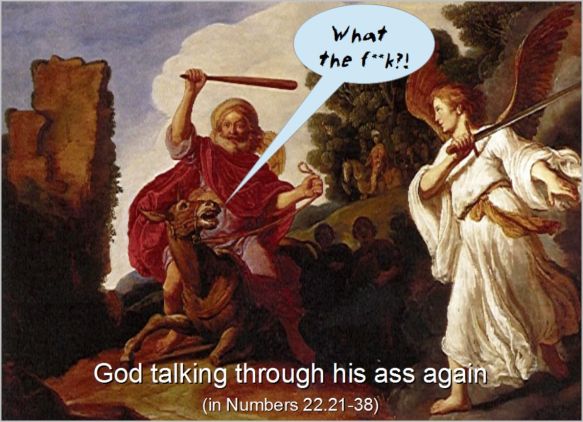
2 talking animals: the serpent in Eden and Balaam’s ass.

1 talking plant (Exodus 3:3).

0 science. No understanding whatsoever of what we now call astronomy, meteorology, germ theory, genetics, evolution, psychology… you name it.

So how do we read all of this? As the ancients themselves would, with an understanding of the world that regarded the supernatural, magic, miracles and monsters as real? We’re told often enough that this is how we should interpret scripture, not from a modern perspective. Perhaps we might credit the creators of the many books of the bible with greater skill, however, and interpret the inclusion of magic and miracle as allegorical or metaphorical; literary pieces, if you will. But then we have to decide which far-fetched stories are myth and which are historical accounts,. There really is no way to do this. A New Testament story awash with impossible events, implausible characters and symbolic tropes is every bit as allegorical or metaphorical as the same kind of story in the Old Testament (or, indeed, in Egyptian, Greek and Roman myth.) The reader who wants to see stories in the Old Testament as carefully crafted allegories has to concede that the Jesus narratives are of the same order.

It looks like we have to read the Bible as 21st century readers, because that is what we are. After all the Bible is supposedly a book for all time. We can, however, recognise the way in which its many creators saw the world – populated with fantasy creatures and subject to impossible events – and accept that they were wrong. Reality is not as they perceived it. What we cannot do is claim that the Jesus story is an oasis of truth in the midst of all this fantasy . 

The Son of Man

I started wondering why, if his creators believed him to be the Messiah, they have gospel Jesus habitually refer to saviour-figures in the third person? He does it Matthew 23 which we looked at couple of weeks ago, when he talks about there being ‘one instructor: the Messiah’, and he does it repeatedly in all four gospels when he refers to ‘the Son of Man’. The term comes from Daniel 7:13 where it is rendered as ‘one like a son of Man’.

In my vision at night I looked, and there before me was one like a son of Man, coming with the clouds of heaven. He approached the Ancient of Days and was led into his presence.

The interpretation of which, supplied in Daniel 7:27, is that:

The sovereignty, power and greatness of all the kingdoms under heaven will be handed over to the holy people of the Most High. His kingdom will be an everlasting kingdom, and all rulers will worship and obey him (my emphasis).

The phrase used for ‘son of Man’, bar enash, means simply ‘human being’ and is used to contrast with the ‘beasts’ of nations that the ‘prophecy’ says will rule prior to this. However, as Daniel explains, the human being in question is the nation of Israel – the holy people of the Most High – who will finally triumph over the four beastly nations that will dominate the Earth first. The nation of Israel will metaphorically emerge from the clouds and join the Ancient of Days to rule from Heaven. There is no mention anywhere in the Daniel dream-prophecy of a Messiah or individual human being who will accomplish any of this.

As Neil Godfrey puts it:

The coming of this “Son of Man” is within the realm where one expects deities to travel. The coming is, moreover, to another station within the clouds, namely the throne of the Ancient of Days. The context again explains that this “coming” is effecting a change of rule on earth. A kingdom is falling, and freedom is given to “the saints of the Most High”.

Nevertheless, it is this title – the now fully capitalised ‘Son of Man’ – that Mark has Jesus assume. The other three gospel writers copy it from him. Paul, writing decades before them, seems not to know that Jesus used it. Evidently the celestial Christ he encountered in visions and revelations didn’t feel the need to mention it. (Hardly surprising when Mark is freely inventing years later.)

So what does this tell us about Jesus, or, more specifically, about how the Jewish Christians of Mark’s community viewed him?

A number of scholars (e.g. Ehrman, Carrier, Goodacre, Westar Institute) have argued (as have I in my own amateurish way) that gospel Jesus is constructed from ‘prophecies’ lifted from Hebrew scriptures. Other commentators have demonstrated how he is, in the first two gospels at least, the personification of the nation of Israel*. This isn’t just because he identifies with the son of Man figure in Daniel. He also equates himself with the Suffering Servant of Isaiah 53 and elsewhere. Strictly speaking, he is made to identify with the Suffering Servant by Mark and the other gospel authors, particularly Matthew, who all copy Mark’s original idea. As Isaiah 53 makes clear, God’s Suffering Servant is not a person: it is Israel.

Not only is Jesus identified with Daniel’s son of Man and Isaiah’s Suffering Servant – the personification of the Jewish nation – but Isaiah 53 is used as a template for his trial, mockery, crucifixion and resurrection. It is the nation that is God’s servant which, as Mark was writing, was going through trials, tribulation, suffering and apparent death: the destruction of Jerusalem and its temple, with thousands of Jewish people being crucified by the Romans.

So it will be Israel, Mark hints in his extended parable, that will emerge resurrected and who will ascend metaphorically through the clouds to sit at the right hand of God to rule the nations. He leaves out the details of this resurrection and ascension from the end of his gospel because at the time of his writing they had yet to happen. But, he tells his readers and listeners, they will. They have to because Daniel and Isaiah say so: after suffering comes God-assured victory. Mark’s Jesus story, then, is an allegory of the history of the Jewish nation and its projected future. The allusions to Abraham, Moses, the Exodus, Elijah, Isaiah’s Suffering Servant, Daniel’s son of Man and the accompanying ‘prophecies’ make this more than apparent.

Gospel Jesus is a metaphor (or indeed a simile, one who is like a son of Man/the Jewish nation), his life made to conform in every respect with the history of that same nation. He is an allegory as Mark makes clear throughout his gospel. 

The clues are there for all to discern and as Mark advises, ‘he who has ears, let him hear’.

*See Watts: Isaiah’s New Exodus and Mark and numerous Christian apologists who make the same point: Google ‘Jesus and Israel’.

More on Prophecy

Commenter Koseighty wrote this response to Don Camp following Don’s assertion that we’re living in the End Times. Koseighty explains perfectly how Biblical prophecy is constructed and how inevitably it can only fail.

Don said:
I base my conclusion (never absolute) on the fact that all the markers of the end of the age are converging in these days.

Koseighty: This is what every generation of Christian has said since, and including, Jesus himself. But, besides being nauseatingly clichéd, it shows you don’t understand Jewish apocalyptic literature.

Here’s how Jewish apocalyptic literature works. It’s written in two parts. In the first part the author elaborates all the woes afflicting the people, most often in highly symbolic language. In the second part, the author tells how God is going to set things right, again most often in highly symbolic language.

The first part, the woes part, is not in any way prophetic. The woes and abominations it describes is how the author see his world at the time of writing. The second part, while prophetic, is imminent. It is not something that will happen thousands of years later. The author’s prophecies are going to happen any minute now. “Behold, I come quickly!”

Inevitably what we see in these writings is the first part accurately describes the time of the author, and the second part fails to occur. Believers then either twist the words of the second part to “show” they really did happen, or they place the fulfillment at some future date, collectively called by Christians “The End Times™.”

We see this in Daniel. Scholars can give the year Daniel was written – 167 BCE, if I recall correctly – because the first accurate part describes events prior to that date, and the second prophecy part never happened.

The same can be seen in Mark. The author describes the, current to him, destruction of Jerusalem and the temple, but the imminent coming of Christ in clouds of glory doesn’t happen.

The same with Paul. He describes his times and the imminent resurrection at Christ’s coming (which will include Paul and his followers), but neither the coming nor the resurrection ever happen.

As with the author of the Revelation. He describes his current view of the world and the Roman empire and the imminent destruction to precede the imminent coming of Christ (“Behold, I come quickly!“) which never happens.

Sorry, Don. You’re making the same mistake all those Christians have made before you. Taking Revelation as a prophecy of a distant (to the author) future time instead of happening right then in the time the author was describing.

Perhaps the church should have listened to all those heretics rather than burning them. Perhaps they should have read those heretical texts rather than burning them. Perhaps then Christianity could have come to an accurate consensus on these things rather than the ridiculous one they came up with.

How the Bible gets almost everything wrong: volume 1

Jesus7

Scripture is under attack! Yes, really. Answers in Genesis says so, so it must be true. The Enemy with a capital letter is out to undermine its authority. That Satan and his school-boy pranks! What will he think of next?

It doesn’t, though, need an all-powerful personification of evil to undermine the bible. It does it all by itself. In any aspect we might care to mention; scientific, medical, historical, moral, psychological – even how the universe operates- the bible is mistaken, confused and just plain wrong. The truth is not in it.

Let’s take look at some examples:

The bible’s scientific blunders

According to the bible:

the Earth was created before the sun (Genesis 1:9-16)

Stars are points of light in the canopy – ‘the firmament’ – that surrounds the Earth (Genesis 1:16-17)

Beyond this canopy is water (water comes for the sky doesn’t it? I guess the canopy leaks. God opens its ‘windows’ during Noah’s flood) (Genesis 1:6-7)

The sun moves, though it can be made to stop in its tracks with the right magic (Joshua 10:12-13)

Genetic characteristics can be changed by whatever animals look at while they’re copulating (Genesis 30:37-39)

Hares and coneys chew the cud (Leviticus 11:5-6) and flying insects sometimes have four legs (Leviticus 11:20-23)

The value of Pi is 3 (1 Kings 7:23-26)

More here if you can bear it: http://skepticsannotatedbible.com/science/long.html

The bible’s historical inaccuracies

The ‘history’ of the Old Testament is largely fabricated. Much of it is myth and legend, created centuries after the events it purports to describe. There is no evidence, for example, that the Israelites were slaves in Egypt, wandered the wilderness for forty years and then invaded the land of Canaan. Historians are now fairly sure that the people who would later fashion themselves as the Israelites were rabble-rousers within Canaan and that they set about eliminating, by one means or another, other populations that lived there. The ‘great kings’ of Judaism – David, Solomon – were no more than tribal leaders; think ‘Taliban commanders’ and you’ll have a pretty accurate picture of what they were really like.

There’s no evidence either for Noah’s ark and a global flood, the events of the tower of Babel, Joshua’s destruction of the walls of Jericho, Daniel’s adventures in the palace of Nebuchadnezzar… you name it. Each and everyone of these stories was created to make theological points, to aggrandise the people who created them.

There are similar problems when it comes to the historicity of Jesus’ life.

The bible’s medical ignorance

According to Jesus – God Incarnate, no less – many disabilities and diseases are caused by demons:

A man in the crowd answered, “Teacher, I brought you my son, who is possessed by a spirit that has robbed him of speech… Jesus rebuked the unclean spirit, saying to it, “You deaf and dumb spirit, I command you, come out of him and do not enter him again.” (Mark 9:17 & 25)

The way to cure illness therefore is to ‘drive out the unclean spirits’ that cause it. Jesus does so many times (Matthew 12.22 etc) and sends his chums out to have a go as well (Matt 10.1). Now, is this because God knows that sickness and disease really are caused by supernatural baddies, or is it because Jesus’ understanding of illness was as limited as that of any other first-century peasant? You got it – Jesus (and his later script-writers) merely reflect first-century ignorance about the causes of illness. However, if, as today’s Christians believe, Jesus was somehow God himself, then why don’t they opt for exorcism every time they’re ill? There are some nut-jobs who do, of course, but why don’t all of them trust their lord and saviour on the matter?

There’s equally ludicrous medical advice elsewhere in the New Testament: James 5.14-15 tells us that the cure for any ailment is prayer:

Is anyone among you sick? Let him call for the elders of the church, and let them pray over him, anointing him with oil in the name of the Lord. And the prayer of faith will save the one who is sick, and the Lord will raise him up.

Sure enough, some believers have taken this ridiculous advice seriously. Instead of medical treatment, they’ve done as the bible commands and prayed for their sick children, frequently with fatal consequences.

More next time…