
If not Metaphor, then what?

I’ve been arguing that everything in Mark’s gospel is metaphor (because he says so) but there are some pronouncements credited to Jesus in the synoptic that do seem to read as if they’re not. These look as if they are meant to be taken at face value: 

Mark 9:1 And he said to them, “Truly, I say to you, there are some standing here who will not taste death until they see the kingdom of God after it has come with power.”

Mark 10:21. Go, sell everything you have and give to the poor, and you will have treasure in heaven. Then come, follow me.

Matthew 5:39. But I tell you, do not resist an evil person. If anyone slaps you on the right cheek, turn to them the other cheek also.

Matthew 5:40. And if anyone wants to sue you and take your shirt, hand over your coat as well.

Matthew 5: 43-44. You have heard that it was said, ‘Love your neighbour and hate your enemy.’ But I tell you, love your enemies and pray for those who persecute you,

Matthew 6:24. No one can serve two masters. Either you will hate the one and love the other, or you will be devoted to the one and despise the other. You cannot serve both God and money.

Matthew 6.25. Therefore I tell you, do not worry about your life, what you will eat or drink; or about your body, what you will wear. Is not life more than food, and the body more than clothes?

Matthew 7:6. Do not judge, or you too will be judged. For in the same way you judge others, you will be judged, and with the measure you use, it will be measured to you.

Luke 6:30. Give to everyone who asks you, and if anyone takes what belongs to you, do not demand it back.

Luke 14:26 If anyone comes to me and does not hate father and mother, wife and children, brothers and sisters – yes, even their own life – such a person cannot be my disciple.

Perversely, these are the very commands that most Christians insist are intended metaphorically. This includes those who oppose the idea that, Jesus’ parables excepted, the gospels are in any way symbolic. I know from experience that they have any number of unconvincing arguments of why Jesus doesn’t really mean what he is made to say. For example: ‘these pronouncements are too severe and impractical to be taken literally’; ‘the verses are being taken out of context’, and ‘they have a deeper spiritual meaning’ (oops – that’d be metaphor, wouldn’t it?). Ask these same folk if the statements are therefore metaphorical and you can expect to be met with barrage of abuse.

If they’re not metaphorical, why do we not find Christians striving to live according to them: renouncing wealth, giving to all who ask, selling all they have, resisting no-one, judging no-one, hating family, becoming a slave and having no care for their own welfare for the sake of the kingdom that Jesus promised was imminent.

Because they don’t believe him. Easier to disregard his words about the kingdom arriving within his disciples’ lifetime and the instructions for living in the short time until then. The hard stuff is treated as metaphorical when it makes demands on Christians themselves.

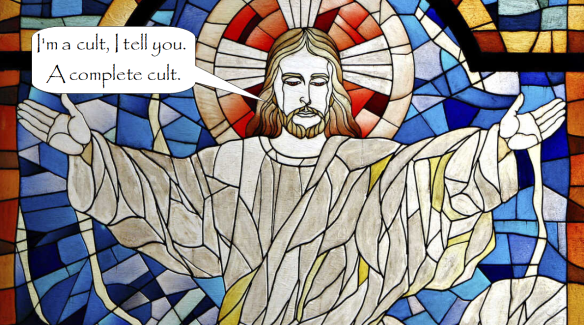
Possibly they’re right. I’d suggest that the pronouncements like those above were not Jesus’s at all. They’re cult-speak; the extreme demands of cult leaders seeking to control their acolytes. In case this sounds like an about face on my part, let me assure you it isn’t; I’ve long argued that among the metaphor and the reworking of Jewish scripture, the gospels include copious amounts of early cult rules.

Whether they’re metaphor or extreme demands once imposed on cult members, no-one today takes much notice of Jesus’ commands. What does this tell us about their worth? What does it tell us about Christians from the earliest days until now? What does it say about their willingness to crucify themselves (definitely a metaphor) in order to follow him?

Cruci-fiction

Given the birth, baptism and wilderness narratives are fiction, why not then the other parts of Mark and Matthew? We’ve already seen how the trial and crucifixion in Mark are literary creations, which Matthew lifts and embellishes. The resurrection stories are also invented, which is why the different accounts are confused and contradictory. The likelihood that everything between the beginning and the end – Jesus’ ‘ministry’, miracles and preaching – is invented too, either by the authors of the gospels themselves or by those who preceded them. My money would be on the former; the stories are so carefully arranged, forming an integral part of a clever literary construct.

I have a growing, sneaking admiration for what Mark and Matthew, and later Luke and John, achieved. They consciously set about creating myth. When Paul and others preached that their Christ had died and risen again ‘according to the scriptures’ that’s literally what they meant; the Christ was discernible in Jewish scripture, his story laid out there for those with eyes to see it. Mark tells us as much in Mark 4:9: ‘He who has ears to hear, let him hear.’

What he and, to an even greater extent, Matthew did, was construct a Saviour story from these elements. They saw him, or thought they did, all over the place. Whether or not there was an actual Jesus is beside the point. as is the extent to which the gospel writers may have used existing stories about him. Gospel Jesus is their imaginative creation from start to finish. His life, deeds and many of his sayings are put together by cutting and pasting scripture.

Cite any episode in Mark and Matthew’s gospels and it will have a precedent in scripture, either a prophecy (that invariably isn’t a prophecy) or episode (that was never about a future suffering Messiah) or character (usually legendary in their own right.) You can believe, as many True Believers do, that these ‘Old Testament’ episodes foreshadow the events of Jesus’ life. That he miraculously fulfilled prophecy through everything he did and said while here on Earth. Or you can take the view that doesn’t rely on faith in the miraculous, and recognise that he’s merely written that way. He’s the literary embodiment of scattered scraps of scripture.

On this much more realistic view, everything Jesus is made to do, particularly his miracles and crucifixion, is symbolic; a fictional enactment of scripture. Other aspects are drawn from Paul (the Last Supper/Eucharist, for example), claims of inner-visions (the resurrection) and early cult rules (behavioural expectations.) The events of Jesus’ earthly existence, as created by the gospel writers, have no historical basis; they didn’t really happen. I maintain that all of the gospel writers were fully cognisant of this as they created their respective symbolic lives for him.

If It Walks Like A Duck…

Psychology Today has this to say about cults:

Destructive individuals and cults use deception and undue influence to make people dependent and obedient. A group should not be considered a cult merely because of its unorthodox beliefs. It is typically authoritarian, headed by a person or group of people with near complete control of followers. Cult influence is designed to disrupt a person’s authentic identity and replace it with a new identity.

Let’s break this down a little:

Destructive individuals: But those enemies of mine who did not want me to be king over them – bring them here and kill them in front of me (Luke 19.27).

Do not suppose that I have come to bring peace to the earth. I did not come to bring peace, but a sword (Matthew 10:34).

He said to them, ‘But now, the one who has a purse must take it, and likewise a bag. And the one who has no sword must sell his cloak and buy one. For I tell you, this scripture must be fulfilled in me, “And he was counted among the lawless”; and indeed what is written about me is being fulfilled.’ They said, ‘Lord, look, here are two swords.’ He replied, ‘It is enough’ (Luke 22: 36-38). [This is evidently a fictitious episode created around a supposed prophecy (Isaiah 53:12).]

Use deception: The time has come. The kingdom of God has come near. Repent and believe the good news! (Mark 1:14-15). Therefore I tell you, whatever you ask in prayer, believe that you have received it, and it will be yours (Mark 11.24).

Undue influence: Any one of you who does not renounce all that he has cannot be my disciple (Luke 14.33). No one who puts his hand to the plough and looks back is fit for the kingdom of God. (Luke 9.62).

To make people dependent: If anyone comes to me and does not hate his own father and mother and wife and children and brothers and sisters, yes, and even his own life, he cannot be my disciple (Luke 14.26).

…and obedient: If you love me, keep my commands (John 14:15). Whoever serves me must follow me; and where I am, my servant also will be. My Father will honour the one who serves me (John 12.26).

Typically authoritarian… with near complete control: You are my friends if you do what I command you (John 15.14).

Not everyone who says to me, ‘Lord, Lord,’ will enter the kingdom of heaven, but the one who does the will of my Father who is in heaven. On that day many will say to me, ‘Lord, Lord, did we not prophesy in your name, and cast out demons in your name, and do many mighty works in your name?’ And then will I declare to them, ‘I never knew you; depart from me, you workers of lawlessness’ (Matthew 7.21)

Disrupts a person’s true identity: If anyone wants to come after me, let him deny himself, and take up his cross, and follow me. For whoever wants to save his life will lose it. But whoever loses his life for my sake will find it. (Luke 9.23). 

And replaces it with a new identity: Truly I tell you, unless you change and become like little children, you will never enter the kingdom of heaven (Matthew 18.13).

(John said,)He must become greater; I must become less’ (John 3.30).

It is not the healthy who need a doctor, but the sick. I have not come to call the righteous, but sinners to repentance (Luke 5: 31-32).

Whether Jesus said these things or they were put into his mouth by his early followers, it is still the case that if it looks like a cult, talks like a cult and behaves like a cult… it’s a cult.

As it was in the beginning, now and ever shall be.