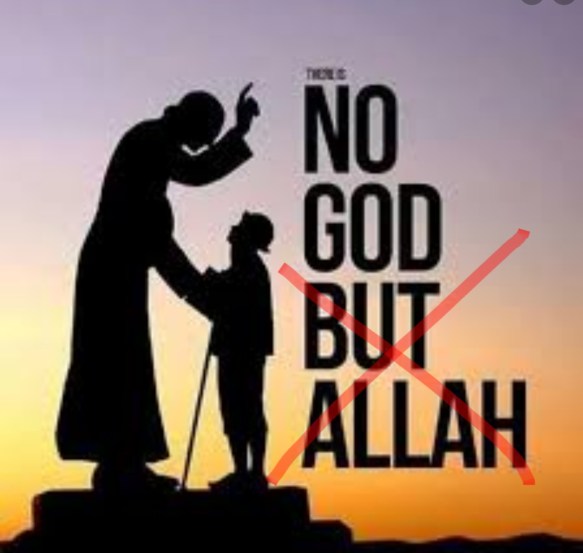
Mystic Revelations

What do the three ‘great’ Abrahamic religions have in common?

They all started with visions, hallucinations, dreams and mystic revelations. They’re not only based on these but owe their very existence to encounters with the supernatural that took place entirely within people’s heads. This of course is if they happened at all; many of these encounters with angels and God’s revelations take place in stories that have all the characteristics of myth or legend. Even so, they reveal much about the primitive state of mind (still around today) that believed God frequently revealed himself to, and in the minds of, chosen individuals.

First, the grand-daddy of the Abrahamic religions, Judaism: 

When Abram was 99 years old, YHWH appeared to him. He said to Abram, “I am El Shadday. Live in my presence with integrity. I will give you my promise, and I will give you very many descendants.” Immediately, Abram bowed with his face touching the ground, and again Elohim spoke to him, My promise is still with you. You will become the father of many nations. So your name will no longer be Abram [Exalted Father] but Abraham [Father of Many] because I have made you a father of many nations. I will give you many descendants. Many nations and kings will come from you. I will make my promise to you and your descendants for generations to come as an everlasting promise. I will be your Elohim and the God of your descendants. (Genesis 17)

Then Moses:

The Angel of YHWH appeared to (Moses) in a flame of fire from the midst of a bush. So he looked, and behold, the bush was burning with fire, but the bush was not consumed.

Then Moses said, “I will now turn aside and see this great sight, why the bush does not burn.”

So when YHWH saw that he turned aside to look, Elohim called to him from the midst of the bush and said, “Moses, Moses!” And he said, “Here I am.” (Exodus 3)

Notice how the inner voice goes from being that of ‘the angel of YHWH’ to YHWH himself (or one of his aliases). The entire scenario is preposterous of course, as is the Abraham episode before it. I’ve omitted the other occasions YHWH is said to appear to Abraham, including the infamous Genesis 22, where YHWH instructs Abraham to sacrifice his son. These stories are legends written, created from whole cloth, centuries after Abraham purportedly lived. He, like the later Moses, is almost certainly mythical, a character created to represent the beginnings of the Jewish faith. Even his names are symbolic. In truth, no one knows how Judaism began.

Onto Christianity:

The angel said to (Mary), “Don’t be afraid, Mary; God has shown you his grace. Listen! You will become pregnant and give birth to a son, and you will name him Jesus. He will be great and will be called the Son of the Most High. The Lord God will give him the throne of King David, his ancestor. He will rule over the people of Jacob forever, and his kingdom will never end.” (Luke 1)

Did this happen? If you believe angels exist then possibly, but we know they do not. We also know that this is myth. However, Luke wanted his readers to know that Jesus’ birth was miraculous so invented a story in which Mary encounters a heavenly being. The gospel writer anchors the divinity of Jesus to an implausible event which at best can only be a young woman’s vision (though it most certainly isn’t.)

The same is true of the resurrection appearances. Here’s Matthew 28:1-8:

Now after the Sabbath, as it began to dawn toward the first day of the week, Mary Magdalene and the other Mary came to look at the grave. And behold, a severe earthquake had occurred, for an angel of the Lord descended from heaven and came and rolled away the stone and sat upon it. And his appearance was like lightning, and his clothing as white as snow. The guards shook for fear of him and became like dead men. The angel said to the women, “Do not be afraid; for I know that you are looking for Jesus who has been crucified. He is not here, for He has risen, just as He said.”

More angels (they multiply in later gospels); again at best, though still highly improbable, the angel(s), if seen at all, can only be a vision or an hallucination (or mistaken identity.)

Onto the only first hand account of an encounter with the divine that the bible includes, Paul’s:

God was pleased to reveal His Son in me so that I might preach Him among the Gentiles… I want you to know, brothers and sisters, that the gospel I preached is not of human origin. I did not receive it from any man, nor was I taught it; rather, I received it by revelation from Jesus Christ. (Galatians 1)

I know a man in Christ who fourteen years ago—whether in the body I do not know, or out of the body I do not know, God knows—such a man was caught up to the third heaven. And I know how such a man—whether in the body or apart from the body I do not know, God knows— was caught up into Paradise and heard inexpressible words, which a man is not permitted to speak. (2 Corinthians)

This is all there is. This is the extent Paul talks about his heavenly encounters. In Galatians he admits that God revealing whatever it was he revealed was ‘in’ him, that is, in his own head. The bizarre tale he relates in 2 Corinthians reads like an hallucination (Paul says he doesn’t know whether it was in the body or out of it) which is all it could’ve been; there is no paradise or ‘third heaven’.

And finally, there’s Mohammed:

while I was sleeping last night, the keys of the treasures of the earth were brought to me till they were put in my hand.”… 

The angel came to him and asked him to read. The Prophet replied, “I do not know how to read. The Prophet added, “The angel caught me (forcefully) and pressed me so hard that I could not bear it any more. (Sahih Bukhari 6998)

Encounters with heavenly beings in dreams, ‘revelations’, visions, hallucinations and invented stories: these are central to Judaism, Christianity and Islam. The religions would not exist without them. Written as myth long after they supposedly occurred or referred to obliquely by those who claim to have experienced them, they are the products of fevered pre-scientific minds.

Post-script: I’ve searched in vain for Darwin’s admission that an angel revealed the process of evolution to him. I can only find his collection of evidence, his scientific observations and his careful analysis of his findings. Likewise Mendeleev who calculated the existence of elements that were at the time unknown. Likewise Crick, Watson and Franklin who discovered the structure of DNA. Strangely, none of these people relied on visions, dreams or divine revelations in uncovering truths about reality.

Flourishing

The solution to all our problems is to return to God.

How many times have we been told this recently? It seems here in the UK that hardly a week goes by without a new book, report or high-profile article appearing advocating a return to ‘Christian values’ or acknowledging Something Greater Than Ourselves (invariably the Christian God). This, it invariably assures us, is the only way to bring us back to our senses and solve all our problems. Even previously atheist/agnostic writers – Richard Dawkins, Douglas Murray, Tom Holland, Jordan Peterson, Aaran Hirsi Ali and Russell Brand (how’d he get in here?) – suggest that Christianity must be revived to prevent the vacuum created by its decline from being filled by the less humane Islam.

I’ve written about this fallacy before – here and here – so won’t go over the same ground again. Instead, I want to highlight a recent report, The Global Flourishing Study, carried out by Harvard University and funded primarily by the Templeton Foundation. Alarm bells! The Templeton Foundation is a religious organisation, so already the study’s conclusions are thrown into question. What were participants asked? What was their background? What bias did the questions convey?

Not surprisingly then, the study concluded that many people in the world are not flourishing and that those who are, are flourishing – surprise, surprise – largely as a result of religion:

Religious service attendance was one of the factors most consistently associated with present or subsequent wellbeing, across countries and across outcomes.

Religious groups have leapt on the conclusions as evidence that humans need God to live fulfilling lives. The key word here, however, is ‘attendance’. The study itself acknowledges that human community – being with other, like-minded people with a common interest or cause – is a significant aspect of the resulting flourishing. But we knew this already so maybe the $43.4 million spent on the study might have been better spent: feeding the hungry, perhaps? An earlier 2017 study also by Harvard was headlined:

Harvard study, almost 80 years old, has proved that embracing community helps us live longer, and be happier.

Numerous other recent studies have reached this same conclusion (see here, here, and here for more).

The god factor injected into Harvard’s more recent study to satisfy the Templeton Foundation and its affiliates is further complicated by the fact that there isn’t only one god involved in making us all feel jollier. There are currently thousands in use throughout the world (the internet is unable to provide an actual figure, however approximate). Thus, those who congregate in the mosque to praise Allah enjoy the same ‘flourishing’ as those who meet at the synagogue to worship Yahweh. Likewise, those who come together to worship Brahman experience the same benefits as those who gather to praise Jesus. Not because any one of the gods in question is the real one – they can’t all be – but because the participants are worshipping and serving together, collectively as a community. That is where the ‘blessing’ comes from. The innumerable gods involved are incidental. Indeed, each is dismissed, if not held in contempt, by the adherents of the others.

In the end then, what enables us to flourish and live longer healthier lives is company – human company. This doesn’t require a church, mosque, synagogue or temple. There are other, superstition-free ways: time spent with family; volunteering with others; joining a drama/bridge/walking/sports/writing/LGBT (worked for me) /whatever-you’re-interested-in group. The song from Funny Girl gets it right: ‘people who need people are the luckiest people in the world’. Of course other people can be frustrating (present company excepted) but unlike the gods they’re real and provide the companionship, fellowship and company we need to thrive. As ever, no God required.

Featuring the Battle of the Century! Doomsday v. Panacea!

Human beings love doomsday scenarios. We have perpetually convinced ourselves that the circumstances in which we live are the most dreadful ever and, to quote The Beatles, can’t get no worse, The earliest Christians thought it: things were so bad that the end was surely to come. YHWH would tolerate the awful state of affairs no longer. But to the surprise of no-one he did.

Those alive in 17th century Europe couldn’t conceive of a worse time, what with the plague and all, and persuaded themselves that the world was ending. During the Covid lockdown we were told that the human race faced being annihilated by the virus and that whatever we’d previously regarded as normal would never return. Today we’re assured that the planet faces extinction if we don’t stop using fossil fuels. At the same time others claim that democracy/the West/civilisation are in such decline that the world will soon disintegrate into anarchy. Who knows, perhaps one day one of these modern doomsday scenarios will come to pass. Even a stopped clock is right twice a day.

Equally though, we are adept at devising panaceas, universal remedies to our problems. We have an unshakeable belief that by making a few simple changes – a new government/president/policy/ invention/initiative/innovation – we will avert disaster and resolve the challenges we face.

How have the panaceas of the past fared? The Jesus’ cult’s promises of new life and heaven of earth collapsed in the first century when God failed to rescue those who identified as his Chosen Ones from the wickedness that surrounded them. Nevertheless, Christianity bullied its way on to the present day, still offering the same tired solutions to age-old problems. Religion, in all its forms, only makes matters worse.

Revolution is no solution either, as the socially aware songs of the 1970s advised us. The French, American, Russian and Chinese revolutions changed situations but they didn’t usher in an age of peace and prosperity or remedy everything their instigators said they would. History demonstrates again and again that violence fails to improve anything. The freedom and independence that the Baltic states now enjoy came not from revolution but from the foresight of Mikhail Gorbachev who knew Russia could no longer afford to sustain its satellite states. Putin however knows better and seeks to reabsorb them back into his own soviet union.

Other panaceas of the past have similarly failed to deliver. The so-called industrial revolution created our modern world, led to the end of slavery and gave us the standard of living those of us in the West enjoy. Now we must deal with what many perceive as its legacy: world pollution, climate change, dwindling resources. Eliminating these is the new panacea. Once these challenges have been met, or so we’re told, the world will find itself on a much better footing, on course to recover from the damage we’ve caused it. Hence Just Stop Oil and Extinction Rebellion. It’s as simple as that. Except we know that surely it isn’t when the biggest polluters – China, Russia, India and potentially the US (Trump says he will pull out of climate change agreements if returned to the White House) – are not wholly on board.

We are a very long way from eliminating the use of oil: for a long time to come it will be needed to lubricate machinery, engines and windfarms, and for the production of plastics (a panacea in their own right not that long ago), computers, mobile phones and building materials. That’s not to mention the need for oil in the nation’s defence: the navy’s ships, the air force’s planes and the army’s tanks. We do not yet have the means of replacing the oil which fuels and lubricates modern life. We can be sure too that when we do, this new panacea will also have its own drawbacks, which will only become apparent once we have committed to them. We know this already with nuclear power which, once fossil fuels are eliminated, will be the principal means of producing electricity in the enormous quantities required to supply to industry, for heating, lighting and transport, including electric cars, which, if politicians have their way, will be the only kind available. We are already using environmentally-damaging methods’ to extract the rare minerals used for the manufacture of batteries, a process which also, ironically, creates more CO2 than the manufacture of a petrol car (itself a panacea not too long ago): According to MIT’s Climate Lab, one ton of mined lithium emits almost 15 tons of CO2’.

While there are those who claim that EVs cause less environmental damage than petrol (gas) vehicles, damage is still damage. It is not net zero. The dream of worldwide net zero is impossible. The only way it is even approachable is for the car and other forms of transport to disappear altogether – and we all know that isn’t going to happen. Even  hypocritical eco-warriors use the car and other forms of transport dependent on fossil fuels to get themselves to whichever work of art or ancient monument they plan to deface. 

China, which produces two thirds of the world’s electric car batteries, accounted ‘for 95% of the world’s new coal power construction activity in 2023.’ Then there’s the disposal of spent batteries: do we have policies for doing that in an environmentally friendly way? Is there an environmentally friendly way?

As you can probably tell, I’m not a believer in panaceas, whether religious or politically devised. They don’t work and never have. In years to come, the West will be wringing its hands at its plundering of the Congo for cobalt and South America for lithium for electric car batteries. ‘How could we get it so wrong?’ we will cry. ‘There must be a better way, a better panacea. Meanwhile, we must do penance and make reparations.’ I don’t have the answers, but extremist approaches like the half-baked schemes of Ed Miliband, the UK’s Secretary of State for Energy Security and Net Zero (yes, really), and pursuing impossible dreams do not seem to me to be the solution.

Respect

Even before the events in Israel and Gaza, there were numerous recent examples of the term Islamophobia being used to suppress freedom of expression or shield wrongdoing.

A recent report by an all party group of UK MPs.

I’ve been told before that I should respect people’s religious beliefs. We all should apparently.

I can’t, I confess, summon respect for patent nonsense, nor for those who subscribe to it. I’m not even going to try.

There have, I admit, been a few believers I’ve met in life for whom I have had respect and even admiration, but this has been for the kind of person they were, not because of their religious beliefs per se. And no; their religion is not what made them admirable people. They were admirable irrespective of, or even despite, their irrational beliefs. I still hold to the theory of my own making, that religious conviction is like alcohol: both accentuate the existing characteristics of the individual, making them more of the person they already were, for better or for worse.

Equally, I’ve met many non-believers (I hate it that we have to describe ourselves as what we are not), LGBT people (for many religionists, the antithesis of admirable) and individuals whose views and outlook on life I haven’t necessarily agreed with, for whom I have also had respect and admiration.

It comes down to the old cliche, a truism nonetheless, that respect has to be earned. Just because someone believes in the supernatural or that Jesus died for our sins or that their deity or prophet trumps all others doesn’t mean I have to respect such views, or indeed those who hold them.

But this is where we’re headed, it seems. We’re expected to respect any old make-believe so long as it comes under the banner of religion and still more that doesn’t. It’s becoming ‘hateful’ to criticise religious belief and those who practise it. Because their views are sincerely held, the thinking goes, they merit protected status.

I commented some time ago on a Christian site (something I rarely do except when incensed) that was insisting ‘sodomites’ would burn in hell, because… the Bible. I countered that gay people were not going to hell because, in fact, no-one was. As well as the subsequent ‘loving’ comments from Christians, I was taken to task by a gay person telling me I was disrespecting the original poster’s Christian convictions.

Likewise when I suggest that we should be more wary of Muslim beliefs I’m told I’m being profoundly unfair, racist and Islamophobic, towards a minority – as a minority of one myself – and I should show more respect for an ancient and sacred tradition as well as those who subscribe to it.

I can’t do it. I can’t respect religious belief. It is no more worthy of respect than astrology, palm reading and spiritualism. It flies in the face of rationality. Not only is it insupportable, it is dangerous, a threat to hard-earned freedoms and rights.

Religiophobia?

Is criticising Christianity and the way some people practise their religion a form of Christophobia? Strictly speaking a phobia is an irrational fear of whatever precedes it, as in homo-phobia, trans-phobia, Islamo-phobia and the like. In the accusations of whatever-phobia we hear today – and they invariably are accusations – ‘phobia’ seems to have come to mean ‘hatred of’; a hatred of Christianity and therefore of Christians; of homosexuality and therefore of gay people; of trans-people; of Muslims and so on.

Reasonable criticism of belief systems is not hatred. I don’t and am sure I never have had a hatred of Christianity or of any other religion. I certainly have views about Christianity as a seriously flawed, cock-eyed superstition (I hope I’m not giving my position away too early.) Reasonable criticism of it, mockery even, is perfectly legitimate, for reasons I’ve outlined before, just as criticism and mockery of any belief in the fantastic is legitimate. Ideologies based on belief in imaginary beings do not automatically merit respect nor do they have a de facto immunity from criticism. The same applies to those who subscribe to such fantasies, particularly when they attempt to force them on others. Calling out believers on their inconsistencies and hypocrisy is perfectly reasonable.

Is it fair then to express critical views of homosexuality and by extension of gay people? Of course. We are not immune from reasoned criticism, though much of it doesn’t qualify as ‘reasoned’; we have suffered much from emotional reactions to our existence and still do. (See Bruce’s recent post in which Republican North Carolina’s lieutenant governor, Mark Robinson rants about godless homos. When comment deteriorates into vitriol it becomes an incitement to hatred and, sometimes, violence. When this happens, the modern sense of phobia is justified.)

Islam is as irrational as Christianity and other religious belief systems. It is as legitimate to criticise and, when appropriate, to condemn Islam, just as it is Christianity. It is reasonable to question Muslim’s treatment of women, to insist it is inappropriate, particularly in a Western context. It is appropriate to oppose Muslims’ opposition to Western values rather to accede to their opposition to, for example, freedom of speech or the teaching of evolution and sex education in schools. It seems increasingly to me that in Britain we are conceding too much to Islam and to Muslims because we fear both the accusation of Islamophobia and, not entirely irrationally, a disproportionately aggressive response. Reasonable criticism of a belief system and those who subscribe to it is not hateful. We have a duty in a largely secular society to say so. To resist irrational belief in the supernatural when that belief, be it Christianity, Islam, Judaism or any other of the 4,200 religions human beings have dreamt up seeks to impose itself on others is neither hateful nor irrational. It is essential.

I‘d write more about Islam if I knew more about it. I’m disinclined to learn more, however, having already wasted much of my life in thrall to that other ‘great’ religion, the one I spend so much time deconstructing here. Who needs to know more about another? Saviours, Prophets, Gods, angels, signs and wonders – they’re all equally meaningless. Instead of claiming they’re victims of Christo/Islamophobia, religionists would do well to develop thicker skins as we ‘abominations’ and ‘perverts’ have had to do. They should ask themselves whether criticism of their practices and worldview is justified. They might just find it is.

This time it’s personal

Desperately searching for another reason to dismiss recent critiques of Christianity, Don has suggested that my views and those of commenters here are somehow invalid because they’re ‘personal’. (I declined to publish Don’s latest comment in which he elaborated on this theme; not only was he already on enforced rest but he also decided to have a rant about ‘sexual depravity’. This would appear to have been directed  at my own happy same-sex relationship, as well as all other forms of consensual sex that God Don disapproves of.)

So what’s wrong with ‘personal’? My faith, when I had it was personal. I’d prayed the sinner’s prayer in which I confessed I was a sinner and I received Jesus into my heart (or so I thought) and began to live my life in accordance with what he required of me. This personal relationship with Jesus, as it was usually described in evangelical circles, was reinforced by the preaching I heard in church, by prayer meetings and Bible studies, by the devotional books I read, C. S. Lewis’s writing and the notes I used alongside my personal Bible reading.

I’ve written before how I abandoned all of this when, in a time of crisis, God wasn’t there, and I eventually came to realise, in what I can only describe as a moment of personal revelation, that this was because he didn’t exist.

I then set about discovering what it was I had believed for the previous 30 years; what were these beliefs that had shaped my life, determining what I did, who I married, my morality, my sense of guilt and failure… essentially all that I was. That quest, which began with my broadening my reading well beyond the bounds of devotional Christian books (how treacherous I felt when I first picked them up!) was personal. It was fuelled by the reaction of some Christian friends who attacked me personally when, still later, I came out not only as an atheist but as gay too. My dealings with one particular zealous and homophobic friend led to my first book and ultimately, over 12 years ago, to this blog.

RejectingJesus is a personal working out of my love-hate relationship with Christianity. It is, I hope, informed by my reading but it is first and foremost personal. The posts are my analysis of Christianity as it is practised and my own dissection of the Bible. I’m not a historian nor a theologian (thank god); my Masters is in English Literary Research and it is these skills, together with my knowledge of the Bible from my Christian days, that I apply in my sometimes irreverent analyses. Nothing is sacred, though I’m aware of the importance of providing evidence for my claims and, where relevant, in citing appropriate sources, which is why I provide links and reference relevant verses from the Bible. Perversely, Don also accuses me of being in thrall to the scholars I cite; the opposite of his complaint that posts are ‘personal’.

Do I then, as Don implies, try to discredit the Bible because I’m gay? Am I, as Don suggests, motivated by the ‘constraints’ the Bible places on my sexuality? I don’t believe so. Once I recognised that God didn’t exist, it followed that he could not have any opinion about homosexuality or indeed anything else. Like any other fictional character, his views were created by those who presumed to speak for him: ‘I am so mysterious and my ways unknowable. Oh, but by the way, I really don’t like those depraved gays. Feel at liberty to stone them.’ God’s self-appointed homophobes have to be challenged because of the damage they do.

Am I as an atheist predisposed to being critical of both faith and the Bible, as Christian readers sometimes say? Undoubtedly, but I’m no more predisposed than as a Christian I was predisposed to see God everywhere. As Nan put it in a recent comment:

Any individual who allows him/herself to put aside the centuries-long teachings of Christianity … and read the scriptures without bias and/or preconception … cannot fail to see the multitude of inconsistencies.

Nor can they fail to see the Bible’s flights of fancy, its reliance on dreams and visions, its make-believe and pretend fulfilment of prophecy, its forgeries and false promises, its disconnect from reality and magical thinking, its supernaturalism and sheer cultishness. Critically evaluating scriptures at face value, without making excuses for them or trying to guessing what the original writers might have ‘intended’ or deciding that unpalatable parts are ‘really’ symbolic/metaphorical is, however ‘personal’, by far the more honest approach.

To insinuate with a personal slur that having ‘personal’ reasons for criticising Christianity is a weak ad hominem. It does not address the arguments in question nor the issues at hand. Anyone who wants to demonstrate that what I say about the Bible, Christian belief and practice is wrong needs to provide evidence of their own. Insult, screeds of Bible quotation and ‘a legion of “work arounds”’ (Nan again) is not how to go about it.


God: Probably Not

20200430_133042

As God-botherers everywhere are fond of telling us, we can’t prove that God doesn’t exist. Of course, no negative can ever be proven. My own conviction that there isn’t a God does not rely on ‘proof’, but on the probability that he doesn’t. Perhaps this is the same as Christians’ own dismissal of Zeus and Krishna as real beings; if they think about such things, that is. So what is the probability that God does not exist? My next couple of posts will look at my reasons for concluding that the likelihood of the Christian God existing is ridiculously low. Some of these reasons have developed from my reading of the last thirty odd years, others from my own thinking about the subject. Both are now so intertwined I don’t know exactly which is which. You’ll have encountered some of what I’ve got to say in other posts on this blog but it seems worthwhile put all my arguments in one place.

So, reason one: God explains nothing. He isn’t required to explain the Big Bang, evolution, human psychology, germ theory, viral pandemics or anything else that science explains with far greater proficiency and conviction. At best, the god concept has atrophied into a god-of-the-gaps desperation. Science doesn’t know how life began, goes the ‘reasoning’, therefore it can only have been God. This explains nothing, merely adding an unnecessary element into the equation; Occam’s Razor demands we remove any such elements from our arguments and attributing life to an unknown supernatural agent is just such a redundancy. I’m confident that science will one day answer the question of how life started, but even if it that were never to happen, the answer would not be, as if by magical default, God.

Two: the more characteristics we attribute to God, the less likely it is that he exists. Let’s say, by way of analogy, that I’ve put myself on a dating app to look for a new partner. To start with I specify that all this partner needs is a good sense of humour. Then I wonder if this is enough. Wouldn’t they also have to be within my preferred age group? Of course. I’ve already narrowed my chances of finding my ideal person. So I think I may as well go for it: I want someone who’s good looking too, with a place of their own, within travelling distance of where I live and with interests similar to my own, including a passion for the ukulele. The likelihood of my finding this person is pretty remote. The probability they actually exist, with all the attributes I want, is equally unlikely.

So it is with God. If he were only the creator of the universe he would be unlikely enough (because of reason 1 above) but that’s not all that is required of him. He has to be also a God that is interested in his creation, and not only interested but intimately involved with certain aspects of it, humans particularly. He is now beginning to recede from the possible into the margins of the improbable. But then it’s claimed that in addition to being the creator of everything and a micromanager to boot, he’s also ephemeral and unknowable. He’s simultaneously loving and a severe judge. He’s both omniscient and omnipotent (this last doesn’t follow from his being the creator; it’s a separate attribute). He’s a god of reason and yet only satisfied by blood sacrifice. And on and on, well beyond the bounds of probability and into the realms of the impossible, like my hypothetical ideal mate. God as envisaged by Christians (and others) is an impossibility.

To be continued.

Theoidiocy

Blog401a

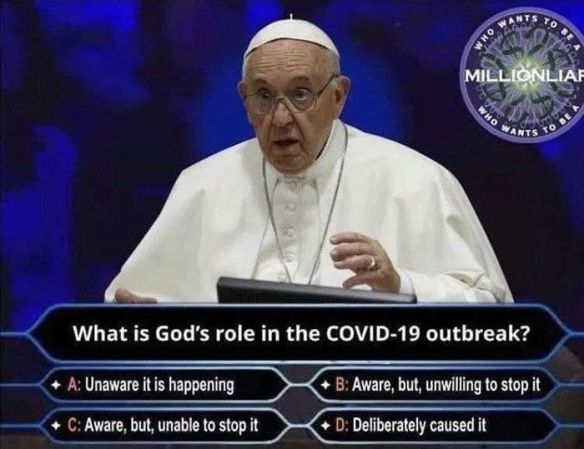
Theodicy – how to square suffering with an all powerful, loving God. A meme doing the rounds neatly summarises the four possibilities as applied to the Covid-19 pandemic.

Here it is and here they are:

Blog401

Assuming God exists and given his apparent indifference/inaction during the current crisis (not to mention numerous previous ones) these are really the only four options. However, if

  • he is unaware Covid-19 is happening then he’s not omniscient
  • he is aware of it but is unwilling to stop it then he’s not all loving
  • he is aware of it but is unable to stop it then he’s not all powerful
  • he deliberately caused (or allowed it) it then he’s nothing but a complete and utter bastard

Oh wait – turns out there’s a fifth option! (Pause while we phone a friend.)

So that’s it – God doesn’t exist, which is why we see him doing f**k all in this and every other calamity we’ve ever faced.

As for me, I’ll put my trust in science. Already those damn scientists with their ‘man’s ideas’ (©Ken Ham) have started solving the problem. No need then to rely on an imaginary, non-existent friend. Thank God for that.

God or Superman?

Blog397

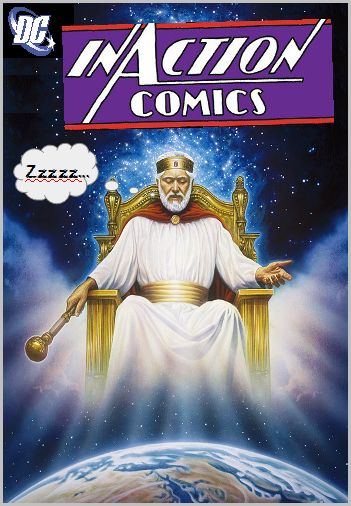
An early problem faced by the creators of Superman, only a few years after his first appearance in Action Comics #1 in 1938, was his impotence in the real world. Here was a character with incredible super-human powers – not quite as phenomenal as they would later become – who could defeat gangsters, wife-beaters, bullies and evil dictators with a flick of his little finger, but who, when a real life bully emerged on the world stage, couldn’t do anything. Stories could have been written about how he single-handedly defeated the Nazis and restored world peace but none of this would have been reflected in the real world. It’s true that today with its alternate realities and constant rebooting that Superman could be made to defeat modern-day fascism; but that would be on some other fictional Earth, not the real one. In the real world, Superman would remain impotent, having little effect beyond raising awareness and morale, which is what he did – or, more accurately, what his creators had him do – during World War II. There wasn’t anything else he or they could do.

By now, coronavirus should really have disappeared from the face of the Earth. Last Sunday was National Day of Prayer in the US. Independent of Donald Trump’s ‘initiative’ in calling for a day of grovelling in front of the Almighty, many other Christians have also been begging God to protect their church community from covid-19 (the godless can fend for themselves). Still others have commanded the virus, in the name of Jesus, to leave them and the USA alone (the rest of the world be damned.)

The effect of all this pleading and commanding has been that the coronavirus has continued to spread, heedless of borders and indifferent to the religious beliefs of its victims. Either God doesn’t give, as we say in this neck of the woods, a rat’s arse about who contracts covid-19, nor who dies from it, not even his born-again Chosen Ones. Everybody’s gotta die sometime, right? The important thing is that they’re right with the Lord before they do.

Or – God’s just like Superman. We can imagine him doing all sorts of incredible things, like healing disease, curing illness and saving the world, but in reality, none of them ever happen. He’s not going to protect people from coronavirus in precisely the same way he failed to protect them from 9/11, AIDs, the Holocaust, Spanish Flu, The Great Plague, Black Death and Leprosy. It’s not that he doesn’t care, it’s that he’s not there. He’s no more real than Superman and is every bit as impotent as the Man of Steel.

I’m a big fan of Superman – I’ve been reading the comics he appears in for 57 years now – and I’m fully aware he’s not real; he was created by Jerry Siegel and Joe Shuster 82 years ago and has been embellished by every writer and artist who’s worked on him ever since – much like God. If only those who plead with the Almighty, and worse, tell the rest of us what he thinks of us, would recognise that he is fictional too. He exists only in a fantasy realm, outside of which he has no super-powers, no influence, no ability to save us from coronavirus or anything else.

Remember the sequence in the Simpsons episode where Homer is, as usual, in lots of trouble; he looks to the sky and pleads, ‘I’m not normally a praying man, but if you’re up there, please save me… Superman.’ That’s exactly what Christians are doing right now, and the result will be the same as it was for Homer and for everyone else who’s ever called on Superman God to save them.

Desiderata

Blog361a

There’s really no secret to what life is about. It’s simple – simplistic even. All the same, it took me most of my life to discover it.

The best way to live your life is to be yourself.

That’s not as easy as it sounds, because you have to have pretty good sense of self to begin with and, for a multitude of reasons, such awareness can elude you.

It’s possible that this is because none of us truly has a self. Current thinking among psychologists and neuroscientists is that the self doesn’t exist. It’s an illusion, created by competing and often conflicting processes in the brain. I picture it like those optical illusions in which carefully arranged shapes make it appear, as in the figure below, that there’s a different shape in their midst, when in fact all that’s there is clear space. Maybe the neuroscientists are right about this, but even so, the self is a damn convincing illusion.

Kanizsa-triangle

Because the brain’s processes are ever active the illusory shape at the centre is subject to constant change – which we perceive as mood swings, changes to our personality, acting ‘out of character’ or being out of sorts with ourselves. Perhaps what I really mean by being yourself, then, is finding a point of equilibrium for the shape at the centre, where it isn’t constantly buffeted by the turbulence of the brain’s activities. However, this is merely to exchange one metaphor for another, so for now I’ll talk about the sense of ‘me-ness’ that we all experience subjectively and intuitively, and know as ‘the self’.

Perhaps you’ve never been in tune with who you are, living, as Plato called it, an unexamined life (he believed such a life wasn’t worth living). Perhaps like me, you drifted through the earlier part of life, allowing unplanned, random experiences to pull you along in their wake until you were left in a place you felt you don’t quite fit. Maybe though, you’ve heard a small inner voice calling you, telling you that this isn’t you. Perhaps, as I experienced for many years, the incongruity between who you are and where you’ve ended up is taking its toll on your mental health.

It’s also possible that you have heard your inner calling but have been told – by society, family or church that who you are is inconvenient, undesirable or unrealistic. ‘Just settle yourself down and conform to what we think is right for you,’ they’ve told you – and you have. They’ve convinced you that you won’t be accepted if you’re truly yourself, so you’ve suppressed or obscured who you know yourself to be.

Alternatively, you’ve assumed a role you know isn’t you. You’re doing a job that allows for no self-expression (because, after all, we all need to make a living), you’re in a relationship that suffocates the real you or you’ve been a church member, striving to conform to everyone’s unrealistic expectations of you. The result is you’re stressed, unhappy and uptight. You’re acting, as the term ‘role’ implies, without any authenticity. We all act from time to time, of course; there are occasions when it is unavoidable. But to live an entire life this way is to invite strife and depressive illness. To be healthy, happy and whole, you need to be authentic – true to yourself.

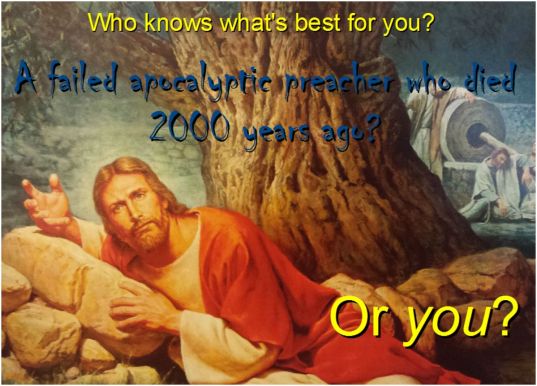
To adopt a religion is to assume a role. It is to deny your real self (Jesus demands you do: Matthew 16.24) and pretend you’re something you’re not. You can no doubt convince yourself God is doing a great work in you, sanctifying you and making you increasingly Christ-like, but the more you act out the part, the less like your genuine self you become. How can this be right for you, for your happiness and well-being? Adopting any ideology is to add a fake and unnecessary veneer to life that serves only to mask your true identity. Replacing who you are with a predetermined set of religious or political beliefs is mere play acting. Denial is not a solution; embracing your self is.

I hope that like me, you have reached a place where you know and embrace your real self. If not, and at the risk of sounding like a poor man’s Wayne Dyer, I’d ask you to take time to listen to your inner voice. Recognise it for what it is; it will not lead you astray. You know deep within who you are and who you should be, whether that’s an artist, teacher or baker; parent, celibate or gay; writer, performer or mystic; builder, musician or doctor, or a combination of these and other possibilities. You have to be what makes you happy. You owe it to your self.