Where are those stories?

Those opposed to the idea that Jesus was only ever a mythical figure are generally dismissive of those who point to the evidence of the New Testament that this is precisely how the earliest Christians saw him. These critics lambast as ‘amateurs’, ‘pseudo-historians’ and ‘fringe’ enthusiasts those who don’t see any evidence for an historical Jesus. But such ad hominems are not arguments and they’re certainly not evidence that a human Jesus existed. When the books of the New Testament are arranged in chronological order, the very earliest writing about Jesus – Paul in the 50s and the creed of 1 Corinthians 15 – appear to view him only as a scripture-fulfilling spiritual manifestation.

So, was Jesus actually an itinerant preacher who traipsed the Earth in the 30s before rapidly evolving into Paul’s mythical Christ or was he a mythical being to begin with, only later to be cast as an historical figure?

It has to be one or the other. 

Within twenty years of his supposed death, Paul and others had experienced dreams, visions and hallucinations (Acts 2:17) that convinced them Jesus was a supernatural being in heaven. This doesn’t of course rule out that a human Jesus had actually existed, but it makes it unnecessary for him to have done so. Paul and almost all the creators of the New Testament books treat his earthly existence as irrelevant. Even when ‘proving’ their celestial Superman is the promised Messiah, they refer not to his activities on Earth, but appeal exclusively to what they believed Jewish scripture revealed about the Messiah.

According to these men, this is how they knew the Jesus of their dreams was truly the Saviour: the ancient scriptures. Not a single one of them says, ‘I refer you to Jesus’ miraculous birth in Bethlehem; I remind you that he changed water into wine, controlled the elements and miraculously multiplied food.’ Not one of them references his many healings, exorcisms and raising of people from the dead. Not one mentions the historical details surrounding his crucifixion, the empty tomb or the women who first saw him alive again. Not one relates a single resurrection appearance (beyond their own visions) nor do they mention the ascension or a looked for ‘second’ coming. Why not? Surely these would be the definitive indicators that Jesus was the Messiah, instead of, or at least alongside, the so-called prophecies of ancient scriptures.

The ‘why not?’ is because these stories – the birth, the miracles, the healings, the empty tomb, the bodily resurrection, the ascension and the rest – had, at the time Paul was writing, not yet been created. Consequently, they couldn’t be passed on to Paul when he met Cephas and James. There was no much-vaunted ‘oral tradition’ for him to call upon to fill in the gaps in his knowledge about an Earthly Jesus. There was no oral tradition because there was no Earthly Jesus to relate stories about when Paul was active in the 50s. This version of Jesus, created from Jewish scripture, Paul’s teaching and cult rules, didn’t appear until the early 70s. Even after Mark’s gospel and its copycat sequels, most of the writers of later New Testament continued to believe in and refer only to a heavenly saviour verified by ancient Jewish scripture.

But, apologists say today, no-one at the time would be taken in by talk of a Messiah who existed only in the heavenly realm. And that’s true; despite the Bible’s claims to the contrary, very few people were persuaded. But some bought into it, just as others at the time bought into Mithras. Mithraism was, for a while, more successful than the fledgling Christian cult. Yet its adherents knew Mithras himself manifested only in the heavenly plane. This didn’t stop multitudes of military men from joining the cult to worship him. It was the same for the other deities of the day. They too didn’t exist even if stories about their adventures on the Earth were widely circulated and, in all probability, believed by the gullible.

If, however, Jesus’ life on Earth had happened in the early part of the first century, how was it that 20 years after his death he had already become an angelic being without a past? Why had Paul, the writer of Hebrews, the pseudo-Pauls, James and John of Patmos never heard any of the stories about him, or didn’t care about them or felt they weren’t really evidence of Jesus’ Messiahship? Where are those stories? Outside the later gospels they don’t exist. It’s as if, when Elvis Presley died, no one cared any more about all the hit records he’d made and were instead only interested in his post-mortem sightings in laundromats and shopping malls. The process just doesn’t happen this way round.

No, it is far more likely that Jesus went from being a celestial saviour to having stories written about him, stories that are based on prophecies in Jewish scripture and Paul’s ‘revelations’. They are allegorical and metaphorical, wholly made up as the writer of Mark 4:11-12 tells us with the equivalent of a Clark Kent wink:

The secret of the kingdom of God has been given to you. But to those on the outside everything is said in parables so that ‘they may be ever seeing but never perceiving, and ever hearing but never understanding; otherwise they might turn and be forgiven!’


 

James, brother of the Lord

Let’s take a look at some of the problems that need to be addressed in recognising that Jesus the Christ was always a mythical being.

The first is, that despite the vast majority of what Paul writes talking about Jesus only as a divine super-being seen in visions and worked out through ‘revelations’, there are a couple of instances where he appears to be alluding to a real person.

The first is Galatians 1:19, where, in this literal translation, Paul refers to ‘James, the brother of the Lord’:

Then after three years I went up to Jerusalem to make acquaintance with Cephas and I remained with him days fifteen. Other, however, of the apostles none I saw if not James the brother of the Lord (‘adelphon’). In what now I write to you, behold before God, I lie not!

In context, Paul is asserting that his knowledge of ‘the Lord’ comes directly from the Lord himself in visions and revelations and ‘not from any man’ (Galatians 1:12) He did not, he asserts here, meet with Cephas and James until 3 years after his conversion. (His insistence he is not lying is curious, wouldn’t you say?)

His mention of James, ‘the brother of the Lord’ is potentially a problem for those who see Jesus as primarily a mythical figure. Richard Carrier accepts that the reference is an indicator in favour of historicity. However he goes on to say that Paul, Cephas, James and all fledgling Christians,

were brothers because they were at baptism the adopted sons of God. Literally. Paul explicitly says that. And this made them all brothers of the Lord Jesus. Again, Paul explicitly says that.

He explicitly says these things in Galatians 4:3-7 and Romans 8:15-17 respectively. Undoubtedly the term ‘brother of the Lord’ could refer to the fact that all Christians are brothers of the Lord through adoption. But then why is Cephas not also referred to as a brother of the Lord? Carrier demonstrates that Paul distinguishes between Apostles, who by definition have, like himself, had the risen Christ revealed to them (in other words have imagined they’ve seen him in their own heads) and those who haven’t. These less fortunate individuals, however well placed in the cult hierarchy, are, like all Christians, brothers of the Lord. Paul uses the term in this sense frequently, for example in 1 Corinthians 1:26 & 16:20; Romans 10:1 and 1 Thessalonians 1:4. He also calls his fellow Jews ‘brethren’ in Romans 9:3. His strange construction that he saw Cephas and ‘none other of the apostles, if not James’, does not imply he saw James as an apostle.

Nor does Paul say James is ‘the Lord’s brother’, which implies a familial connection. The Greek quite clearly employs the phrase ‘the brother of’, which suggests a looser, cultic connection; James is one of the adopted brotherhood.

Furthermore, Paul does not say James is the brother of ‘Jesus’ as Bart D. Ehrman falsely assumes. Paul says James is ‘the brother of the Lord’, ‘the Lord’ being the term he uses when referring to the heavenly saviour who was been ‘revealed’ to him. There’s no reason to suppose that Paul means anything other than this when he calls James the brother of the Lord. Again, what he is actually saying is, ‘I saw James, he of the brotherhood of our Heavenly Saviour.’ The term ‘brother’ for a fellow (male) Christian persists, in this very same way, in the present day.

I am not of the view, therefore, that Paul’s use of the term for James undercuts the likelihood that Jesus was then, as he is now, a mythical heavenly being.

Experiencing Jesus

Back in my students days, sometime in the Middle Ages, I was involved in the conversion of a couple of friends. I’d only just met them, after starting college a week or so earlier. I was training to be a teacher and the college thought it would be a good idea if their new recruits spent a couple of weeks travelling to a school miles away to observe how education was delivered there (pretty chaotically it turned out.)

Jan, Karen and I travelled to the school in Rob’s Triumph Herald car. Rob was a new friend too. He and I met the first day of college and hit it off straight away, both being evangelicals (his guitar was covered in Arthur Blessit ‘One Way’ stickers) and bonding over our mutual love of Larry Norman.

Rob had one such sticker on the dashboard of his car and one day, on our way back from the school, Jan and Karen asked about it and what it was like to be a Christian. We had somewhere taken an unintended detour and the journey back to the college was taking longer than usual so we had plenty of time to share our faith with them. It was a dream come true – what committed Christian didn’t look for opportunities to witness to non-believers, which we did with great enthusiasm.

Before going off to college I’d had a strange vision: a vivid scenario playing out in my head. In it, some people I hadn’t yet met came to my dorm room and asked me to lead them to Christ. While I hadn’t seen my room at this point it turned out to look exactly as I’d seen it in the vision. Lo and behold, after our chat in the car, Rob appeared at my door that evening and said Jan and Karen had arrived at his room saying they wanted to become Christians. We took them to the little prayer room in the back of the college chapel and there the Holy Spirit took over. We prayed with ‘the girls’ and introduced them to Jesus. The entire room was filled then with another powerful presence like a wind or tongues of fire as we sensed Jesus there with us.

It was a powerful experience and for the girls an overwhelming one. They left praising the Lord on an all-time spiritual high. Soon after, Jan had to go into hospital (I forget why) and used the time to read the Bible we gave her in its entirety. She was on fire for the Lord there in that hospital ward. Later she surrendered her yoga materials to us once we’d shown her how the practice was Satanic and, doing the Lord’s bidding, we destroyed it for her. Jan and Karen joined the Christian Union, coming to the twice weekly meetings and began to attend the local evangelical church every Sunday.

To this day, Jan remains a Christian. I haven’t seen her for many years but we share Christmas cards and very occasionally comment on Facebook posts. Karen abandoned her faith a few years after her conversion.

How to explain this amazing experience? Conditioning meets emotion. That it was life-changing for both Jan and Karen (for a while) and also for Rob and me, was the result of our own intense feelings. Neither Jesus nor his Spirit was present in that little prayer room. We thought he was and that was enough. We didn’t need to see him, it was enough to sense his powerful presence (in reality our own heightened emotions.)

Wasn’t this how it was for the earliest Christians? Those Paul told about Jesus never actually ‘saw’ him; they felt him among them. This is how the gospels say it works, not the sighting of a physical body but the sensing of a presence. Matthew makes his version of Jesus predict that this is exactly what will happen (in reality Matthew is reflecting what early cultists had been experiencing for decades when he came to write his gospel):

For where two or three are gathered together in my name, I am there among them (Matt 18:20).

In other words, a small group intent in their worship would experience the presence of their heavenly saviour. They would manifest a sense of his being there through their collective emotions, just as Jan, Karen, Rob and I did in that prayer room. As did those, like Cephas, who experienced him way back at the start of the Jesus movement, and as Paul did in his imagined encounters with the risen Christ.

No reanimated corpse required.

Whatever Happened to Judas Iscariot?

Even more significant in the gospels than Mary Magdalene is Judas. Like her, he is strangely absent from the rest of the New Testament. Apart from Luke’s ridiculous story of his death in Acts 1:18 – a story that contradicts the one in Matthew 27:5 – he isn’t mentioned anywhere else. You might think that’s to be expected, given he’s the disciple who betrays Jesus in the gospels. His name must have been anathema to early Christians.

We might expect, however, that when Paul is describing the Lord’s Supper for the very first time in 1 Corinthians 11:23-26, he might, when he gets to the part where he says ‘on the night he was betrayed’, have mentioned the name of the betrayer. It would seem the natural thing to do. Unfortunately, the word ‘betrayed’ (prodidomi) doesn’t appear in 1 Corinthians 11:23-26 or anywhere else in the epistles. The word Paul uses is paradidomi, meaning ‘handed over’, a handing over by spiritual agents (God himself?) not a traitorous human. Judas is in fact absent from Paul’s description of the Lord’s Supper, a revelation he claims to have received directly from the heavenly Jesus, who neglects to include Judas and all the other disciples too. Nor does Paul call the event ‘The Last Supper’; that name would come later. Read 1 Corinthians 11:23-26 for yourself and see. Bart Ehrman also addresses the problem here.

Bizarrely though Judas does turn up, sort of, in 1 Corinthians 15:3-8, when Paul is quoting a creed thought to originate in the earliest days of the new faith. Because it is considered so early, this creed is greatly valued and frequently cited by apologists. Never mind that it contradicts the later gospel sightings of the Risen Jesus (see the previous post). Here’s what Paul says in 1 Corinthians 15:5: ‘(Jesus) appeared to Cephas, and then to the Twelve.’ Then to the Twelve? What Twelve? As Simon Peter, wasn’t Cephas one of the Twelve to begin with? Maybe they weren’t the same person after all.

More significantly, the Twelve, at least according to the later gospels, originally included Judas. He was one of Jesus’ inner circle. And according to Matthew 27 and Acts 1 he killed himself almost immediately after betraying Jesus. He wasn’t around to see the Resurrected Christ. Yet according to Paul and the early creed all of the Twelve saw Jesus alive again. Either Judas wasn’t one of the Twelve and the gospels are wrong, or he was and he didn’t betray his Master after all, remaining alive for his reappearance. (Just to be clear, the Twelve at the time of the resurrection appearances did not include Judas’s replacement, Matthias (Acts 1:23-26). Matthias doesn’t become one of the Twelve till after Jesus has returned to Heaven (Acts 1: 9).

So, Judas isn’t mentioned as a Jesus’ betrayer by anyone other than the gospel writers, decades after the supposed resurrection. He isn’t mentioned by name at all. The only possible reference to him is in 1 Corinthians 15:5 where he’s still one of the Twelve and sees the resurrected Jesus. It couldn’t be could it, that Mark, reading Paul’s description of the Lord’s supper mistook, or deliberately misinterpreted, the phrase ‘was handed over’ to mean ‘was betrayed’ and constructed his story about the duplicitous Judas accordingly? Why, yes it could.

Conveniently, ‘Judas’ is the Greek form of ‘Judah’, the kingdom of the Jews who, so far as early Christians were concerned, rejected Jesus as the Messiah. Judas is a symbolic character in a literary work, representing those foolish Jews who turned their backs on salvation and so ‘betrayed’ the true Messiah.

Whatever Happened to Mary Magdalene?

(The risen Jesus) appeared to Cephas, and then to the Twelve (1 Corinthians 15:12)

When Jesus rose early on the first day of the week, he appeared first to Mary Magdalene, out of whom he had driven seven demons. (Mark 16:9)

Mary Magdalene and the other Mary went to look at the tomb… Suddenly Jesus met them. “Greetings,” he said. They came to him, clasped his feet and worshipped him. (Matthew 28: 1 & 9)

Mary Magdalene went to the tomb and saw that the stone had been removed from the entrance… she turned around and saw Jesus standing there. (John 20: 1 & 14)

Whatever happened to Mary Magdalene? I mean, where did she go? She’s everywhere in the gospels: following Jesus and his entourage around the place, funding his layabout lifestyle (Luke 8:1-3) and being first to see him after he returned from the dead. After that, nothing. Luke doesn’t even bring her back for his sequel and no one else in the New Testament so much as mentions her. When, in 1 Corinthians 15, Paul lists those who, like him, have had a vision of the risen Christ, she’s conspicuously absent. Mary is the first person to see Jesus resurrected according to three of the four gospels, yet in the far earlier tradition mentioned by Paul, she doesn’t get a look in. Her place is taken by Cephas.

The neglect of Mary Magdalene in early tradition could of course be because she was a woman, and a woman’s testimony, back in those less than enlightened times, was worth far less than a man’s. However, it’s far more likely that whoever created the creed had never heard of her. Why not? Because the gospels didn’t exist when they came up with it. They had no idea that a woman was supposedly the first to see Jesus alive again. As far as they were aware, it was ‘Cephas’ who’d had the first vision of the risen Lord. Yet Peter – assuming he and Cephas are the same person – isn’t the first to see the risen Jesus in any of the gospels.

Mary Magdalene is side-lined like this because when the creed was created, and later still when Paul quotes it in 1 Corinthians 15, the stories about her hadn’t yet been invented. It’s safe to say, she hadn’t been invented.

In fact, Mary Magdalene and most of the rest of the support cast from the (future) gospels aren’t referred to anywhere else in the New Testament. This includes at least eight of the disciples from the slightly differing lists in the gospels, the Virgin Mary, Joseph, the angel Gabriel, the Magi, Nicodemus, Lazarus, Martha & Mary, Judas (apart from Luke’s side-splitting story about him in Acts), Barabbas, Joseph of Arimathea and Doubting Thomas. Likewise, fictionalised versions of historical figures with key roles in the gospel stories aren’t referred to either: Herod, Pilate, Caiaphas and John the Baptist(?) are all absent, even from epistles written and forged after the appearance of the gospels’ ‘cunningly devised fables’ (2 Peter 1:16).

Decades after the early creed of 1 Corinthians 15 and Paul’s letters, Mark invented Mary Magdalene, as well as many other characters who appear in his gospel. His allegory then became the basis for the other three canonical gospels, whose authors added their own imaginary characters.

And just as they invented the earthly Jesus’ companions and adversaries, they created too his miracles, teaching, cryptic parables, bodily resurrection and ascension. Mary Magdalene was but one small aspect of their ingenuity.


An Anonymous Author Writes…

A little while ago I came across a group of enthusiasts who met locally to celebrate the chap who’d founded their group a few decades back. I paid them a few visits to see what they were about and when they learnt I was capable of stringing a few sentences together, asked if I would write a short biography of their Founder. Being an obliging sort, I said I would, not realising the challenges that lay ahead.

For a start, none of them had actually known the guy. He’d died soon after the group had started and none of the current membership had ever met him. Worse, they weren’t even sure what his real name was. Some said ‘Josh’, some ‘Jess’ and others ‘Manny’. They thought a guy who had known him was still alive, but couldn’t remember his name either. ‘Rocky’, they said, or maybe ‘Tiny’.

All the same, I’d said I’d have a go at the biography and didn’t want to disappoint them so I set about searching the Web. I soon discovered that both ‘Rocky’ and ‘Tiny’ had passed away, about the same time six or so years earlier. There was nothing online about any Rocky but there was quite a bit about Tiny. Or rather by him. He’d left a whole series of posts, mostly about he’d been contacted by the founder from beyond the grave. He said over and over that he could prove it really was the Founder he was channelling because, apparently, it said so in some old stories. He quoted these all over the place.

All weird stuff, but all I had to go on.

So I set to. I tried to make as much sense as I could of Tiny’s writing. I made stories out of his rambling, imagining what the Founder must’ve been like from the things Tiny claimed he’d told him. Like Tiny, I used old stories to fill out the narrative and included loads of metaphor. People love finding hidden meanings in things. I stopped short though at having the Founder come back from the dead at the end, not even metaphorically. Tiny insisted he had done but no-one in their right minds would believe it.

In the end, I thought I’d made a good job of it. The guys in the group thought so too. They were so pleased they suggested I publish it on Amazon, which I did. To my surprise, it started selling really well and got some very good reviews (and only a couple of poor ones.) To my annoyance, though, it wasn’t not long before a bunch of opportunists took to writing novellas about the Founder themselves, and (the nerve of it) lifting whole chunks of my story and ‘correcting the errors’! Errors? How could there be errors in something I’d made up? They even used my technique, lifted from Tiny, of borrowing bits from older books and making them fit their version. Their ‘Founder’ turned out to be different from mine, though not, I’m convinced, anywhere near as good.

I’ve decided I was going to retire from this writing lark. It’s too competitive and there are too many plagiarists around. Let them get on with their inferior sequels. Everybody will remember I was the first, and the best. Won’t they?

Mark and the Oral Tradition

Paul never refers to ‘the disciples’, the term used for Jesus’ inner circle in the later gospels. Instead, he refers to the founders of the cult as ‘apostles’ (literally ‘messengers’). Cephas is described as an apostle, as is Barnabas (Acts 14:14) and Paul himself. Paul defines the term more specifically as someone who has been commissioned directly by Jesus (1 Corinthians 9:1; Galatians 1:1-2). Evidently he himself was not: he encountered the risen Christ only in his head. He felt this was more than good enough. For Paul it was the only qualification anyone needed to be an apostle. He cites others who had encountered Jesus in the same way:

For what I received I passed on to you as of first importance: that Christ died for our sins according to the Scriptures, that he was buried, that he was raised on the third day according to the Scriptures, and that he appeared to Peter, and then to the Twelve. After that, he appeared to more than five hundred of the brothers at the same time, most of whom are still living, though some have fallen asleep. Then he appeared to James, then to all the apostles, and last of all he appeared to me also, as to one abnormally born. For I am the least of the apostles and do not even deserve to be called an apostle, because I persecuted the church of God. (1 Corinthians 15: 3-8)

What he goes on to say is crucial in understanding the nature of ‘the gospel’ that was in circulation in the years before Mark’s gospel:

But by the grace of God I am what I am, and his grace to me was not without effect. No, I worked harder than all of them – yet not I, but the grace of God that was with me. Whether, then, it was I or they, this is what we preach, and this is what you believed (1 Corinthians 15: 8-11; my emphasis.)

What they preached was their visions of a celestial Saviour. The witness of these visionaries of the risen Christ was the only gospel they knew and, Paul suggests here and elsewhere, the only one that was being transmitted orally when he was active. As we saw last time, he knew no other details of Jesus’ life, had none passed on to him and passed none on to others, except for these visions and the teaching he worked out from them – his ‘revelations’. Let me say that again: the visions of the risen Jesus were all he, Cephas and others knew. Paul says so categorically. There was no other ‘oral tradition’.

Paul builds his subsequent teaching on Jewish scripture, showing how his ‘revelations’ must be from the Christ because they comply with this scripture (even though he has to manipulate it to make it do so: in Romans 9, for example). Nowhere does he say he is referring to any history he has learnt, nor to anything passed on to him orally about Jesus’ teaching, ministry, life or miracles. Just the opposite in fact:

I want you to know… that the gospel I preached is not of human origin. I did not receive it from any man nor was I taught it; rather I received it (directly) by revelation from Jesus Christ’ (Galatians 1: 11-12).

About seven years after Paul’s death, a literate member of the one of the cult communities – known to us as Mark – decided to set down Paul’s teaching about the Christ in allegorical form. He tells us this is what he is doing several times in his gospel, including Mark 4:11-12:

To you has been given the secret of the kingdom of God, but for those outside everything is in parables, so that “‘they may indeed see but not perceive, and may indeed hear but not understand, lest they should turn and be forgiven’” (referencing and misquoting Isaiah 6:9)

Mark did not depend on any oral tradition for his information about Jesus’ life because apart from the ‘announcement’ built on Cephas’, Paul’s and others’ visions there was no oral tradition. Mark took Paul’s teaching and like him, used Jewish scripture as the basis for the story he developed from it. Thus, Paul’s ‘revelation’ of a bread and wine ritual (1 Corinthians 11:23-27) becomes the Last Supper (Mark 4:22-24); Paul’s teaching about forgiveness becomes Jesus’ teaching about forgiveness; Paul’s dispute with Cephas leads to a gospel Peter who is bungling and disloyal; Paul’s mention of The Twelve in 1 Corinthians becomes, with a miscalculation, the disciples; Paul’s instruction to obey the authorities (Roman’s 13:1) becomes Jesus’ (Mark 12:17); Paul’s, and Jewish scriptures’, promise of the spiritually blind (2 Corinthians 4:3-6) being helped to see becomes Jesus’ miracles of healing; Paul’s predictions about the end of the age (1 Thessalonians 4:15-17) become Jesus’ (Mark 13); Paul’s talk of the coming of the Christ in person (1 Thessalonians 4:13-5:11) becomes Jesus’ prophecies about the Son of Man appearing (Mark 14:61); Paul’s vision of the risen Christ becomes the resurrection. And on and on. There is nothing in Mark’s gospel that doesn’t derive from Paul’s teaching, and Jewish scripture in turn. it is, in short, made up.

All of this accounts for the absence of any resurrection appearances in Mark. His gospel ends with the discovery of the allegorical empty tomb and leaves off there because it is where his audience came in, as it were. They had been converted by hearing of the ‘appearances’ of the celestial Christ to Cephas and those Paul lists in 1 Corinthians. They already knew how the story ended or, more accurately, how it had begun: with those visions.

Later, Matthew, Luke and John would take Mark’s allegory and use it as the basis for their gospels, adding new, invented material of their own. The myth, in both the technical and popular sense, was born.

Paul and the Oral Tradition

Much is made of the oral tradition that it is said informs the material in the synoptic gospels, and possibly John too. The tradition of conveying the events of Jesus’ life and the things he said goes back to Jesus’ original followers – the disciples and the apostles (the terms are not necessarily interchangeable) – and continues with a high degree of accuracy, at least until AD70 when the first gospel was written. 

Which must be why we find so much detail about Jesus’ life in the letters of Paul, from his first letter, 1 Thessalonians, written circa AD55 to his last, Philippians (now an amalgam of several letters), written about 62. Paul was aware of the stories about Jesus – as all converts were – and affirms so many of the details of his life in his letters, passing on the vital stories and the traditions associated with him, in written form.

But not in our reality. Our Paul knows nothing of the details of Jesus’ life. Not once does he quote him or refer to the events of his life before the resurrection. There is nothing of the oral tradition. Nowhere in his letters does he draw from it; never does he say he knows for a fact that Jesus said or did a specific thing while on Earth.

Even after his meeting with Cephas and James, a full three years after his conversion, Paul relays not a single thing he learnt from them. After the encounter, he continues to promote only his own revelations and says nothing of what he learnt about Jesus from the man who supposedly spent three eventful years with him.

Fourteen years later, Paul meets again with Cephas and encounters other apostles for the first time. On this occasion, he and Cephas argue about justification and Paul comes away grumbling that ‘those leaders added nothing to me’ (Galatians 2:6) What? Not even stories about their time with the Master? Apparently these weren’t as important as disputes about soteriology.

Later still, Acts tells us that immediately after his conversion, Paul stayed with ‘disciple’ Ananias and other ‘disciples’ for several days. Did Ananias not know any of the oral tradition that he could pass on to Paul? Details about Jesus’ life, a saying or two or an account of a miracle? Apparently not. (This might be because the story is pure fabrication. Paul tells us himself, in Galatians 1: 16, that immediately after his conversion he ‘did not rush to consult with flesh and blood’).

Surely, though, he must have heard some of the Jesus story from those he persecuted prior to his dramatic conversion. If he did, he didn’t see fit to include any of it in his letters. Likewise, Paul had contact with cult communities he didn’t himself establish, such as that in Rome. Surely they conveyed some of the stories about Jesus that they had had passed on to them. He appears too to have known at least one other evangelist:  Apollos. If these other believers did pass on stories of Jesus from an ultra-reliable oral tradition, why didn’t Paul see fit to include any of them in his letters?

So what were Paul’s sources? Certainly not the oral tradition, nor Q, the hypothetical sayings gospel, which he likewise ignores. If the gospel was being spread orally from the time Jesus lived, by the apostles and other preachers, and was being passed around the fledgling cult communities, why did Paul know nothing of it? If in fact he did, why did he choose to ignore it in favour of his own inner-visions? Did he consider it of such little value?

These questions matter, as we’ll see next time when Mark decides he’ll set the Jesus story down on paper.

If the Gospels were History…

If the gospels were written by eye-witnesses, we should see the use of the first person singular or plural: ‘I saw this happen’, ‘we heard him say that’ and so on. This would not necessarily mean that the author was present, just as he isn’t in the ‘we’ passages in Acts, but it is what we should reasonably expect if the authors were involved in at least some of the events. There are no such instances in any of the gospels.

We would see gospel authors identifying themselves, at the start of their accounts, for example. We don’t.

We would not see an eye-witness lifting significant amounts of material from someone who wasn’t an eye-witness. Yet Matthew plagiarises Mark, ‘improves’ it and passes it off as his own. This isn’t eye-witness behaviour and it is not how eye-witness testimony works.

We would see the gospel writers cite their sources: Mark would tell us he’s recording Peter’s recollections and that he witnessed Jesus’ trial personally (there’s no evidence he did either, speculation from centuries later notwithstanding.) Luke would tell us which accounts he’s referring to in Luke 1:1-2. While we now know he too plagiarises Mark and quite probably Matthew, he doesn’t admit it. We would know the source of events that took place behind closed doors such as Jesus’ interview with Pilate.

We could expect contemporaneous accounts independent of the gospels, recording the miraculous events they claim occurred; the wandering star, the earthquakes, the hours long eclipse, the healings and controlling of nature, the resurrected zombies, the ripping of the 35 foot temple curtain, the resurrection of an executed criminal. Instead there’s nothing, not even in later works such as those of Josephus (because all of these events are metaphorical).

We should expect Cephas (known as Simon Peter in the later gospels) to have recorded his experiences with Jesus. Yet, when he gets his chance, in the letters he supposedly wrote (1 and 2 Peter), he makes no mention of them at all.

We should expect the Christians prior to Paul to have recorded some of these episodes. Some argue that they did, in a document now called Q, but this precious document was, unbelievably, soon lost or abandoned. Alternatively, they may not have seen the need to write anything down because they believed the world was about to end very soon. Either way – no accounts from them about ‘the history of Jesus’.

We should expect Paul to mention aspects of the Jesus story in his letters. After all, he claims to have persecuted Christians for some time before his conversion and to have met and conversed with Cephas for 15 days. Yet he conveys no details at all. Instead, he claims all he knows of Jesus derives from visions and ‘revelations’ in his head. His account of the bread and wine ritual informs Mark’s story of the Last Supper, not the other way round; it is – Paul says clearly – another ‘revelation’ in his head.

We should expect there to be details about Jesus’ earthly life in other books of the NT. Instead we find only a celestial high priest in Hebrews and a warrior Christ in the supposed visions of Revelation. Nothing historical here.

We should, if the gospels are history, expect them to read like history. History, including that written at a similar time does not include angels, devils and apparitions, magic stars, virgin births, miracles and supernatural healings. Where it does, as in Constantine’s vision of the cross, such elements are seen for what they are: myth, not history.

We would not expect the central figure of the gospels to be constructed almost entirely from parts of older religious writing. This is not a technique used in genuine historical records.

We would not expect to find the level of metaphor and mythic tropes – magic, supernatural characters, returns from the dead – in what is ostensibly an informational text. History does not rely heavily on metaphor and symbolic tropes the way the gospels do. There is no ‘logic of history’ in the Jesus story.

We would expect to see geographical and political details relayed reasonably accurately. Instead, Jesus’ trial arrangements are highly improbable; they do not conform with what is known about Roman trials – and we know a lot, because of the records they kept. Jesus would not have had a personal interview with an indecisive Pilate, who would not have consulted the mob, would not have sent Jesus to the Jewish authorities or Herod and would not have offered to exchange Jesus for Barabbas (there was no ‘tradition’ of exchanging one criminal for another) and so on. From what we know of him, Pilate would have authorised the execution without a qualm, as he did for many other would-be messiahs. The rest – the gospel details – are drama, Jewish scripture brought to life with added metaphor. Fiction, in other words.

The Bible Is Fantasy

The Bible contains:

113 appearances of angels, usually interacting with human beings;

50+ visions, on which all of Christianity hangs: those of Daniel; Cephas and others who ‘saw’ the risen Christ; Paul and John the Elder in Revelation. 

21 supernatural dreams, including those experienced by Jacob, Technicolor Joseph, NT Joseph, the Magi, Pilate’s wife and Paul

Numerous apparitions and ghostly appearances, including that of the resurrected Jesus as well as Moses and Elijah and, in the Old Testament, the spirit of Samuel, conjured up from the grave by the witch of Endor.

Innumerable resurrections: not only that of Jesus but several Old Testament characters, and, in the New, Lazarus, Jairus’ daughter, the young man of Nain and the hordes who rose from their graves at the time of the crucifixion.

Multiple impossible astronomical events, ranging from the sun stopping in its orbit(!); a star wandering and hovering over a small house; a solar eclipse lasting several hours; stars that one day will fall from the sky; a God who lives just above the clouds and a ‘firmament’ between the Earth and the heavens that holds back water;

Several events in which nature is magically controlled: the parting of the Red Sea; Moses’ magician’s staff becoming a snake; the Nile turning to blood; Jonah being swallowed but not digested by a ‘great fish’ and Jesus calming a storm.

An abundance of fantastic beasts and fairy tale creatures: Giants (Genesis 6:1-4, Numbers 13:33); Leviathan the sea monster (Isaiah 27:1 etc); the Behemoth (Job 40:15-24); the Cherubim monsters (Ezekiel 1:4-21); the dragon and other beasts from Revelation

Many characters who are clearly legendary, from Adam & Eve, Noah, Lot and Abraham to Moses, Job, Daniel and gospel Jesus. Some of the Bible’s fictional characters lived to a literally incredible age: Adam 930 years, Seth 912, Methuselah 969, Noah 950, Abraham 175, Moses a pitiful 120. Jesus holds the record being now either 2,000 years old or eternal, depending on how you count it.

5 mythical places: Eden at the beginning of the book; New Jerusalem at the end; Heaven, the abode of God; Sheol the Old Testament place of the dead; Hades (Sheol mark II?) which Jesus visited while supposedly dead in his tomb (Acts 2:27, 31; Matt 16:18).

2 sentient ‘pillars’: one of cloud, one of fire (Exodus 13).

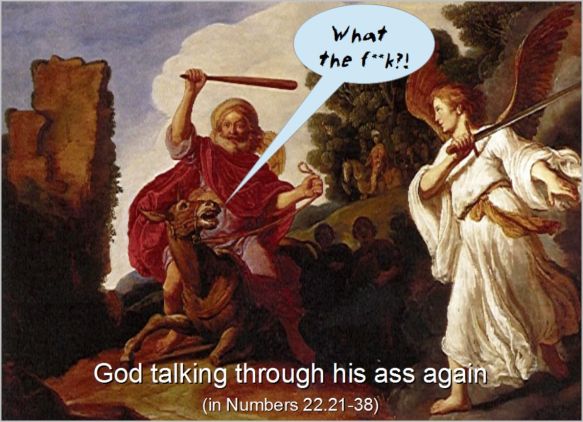
2 talking animals: the serpent in Eden and Balaam’s ass.

1 talking plant (Exodus 3:3).

0 science. No understanding whatsoever of what we now call astronomy, meteorology, germ theory, genetics, evolution, psychology… you name it.

So how do we read all of this? As the ancients themselves would, with an understanding of the world that regarded the supernatural, magic, miracles and monsters as real? We’re told often enough that this is how we should interpret scripture, not from a modern perspective. Perhaps we might credit the creators of the many books of the bible with greater skill, however, and interpret the inclusion of magic and miracle as allegorical or metaphorical; literary pieces, if you will. But then we have to decide which far-fetched stories are myth and which are historical accounts,. There really is no way to do this. A New Testament story awash with impossible events, implausible characters and symbolic tropes is every bit as allegorical or metaphorical as the same kind of story in the Old Testament (or, indeed, in Egyptian, Greek and Roman myth.) The reader who wants to see stories in the Old Testament as carefully crafted allegories has to concede that the Jesus narratives are of the same order.

It looks like we have to read the Bible as 21st century readers, because that is what we are. After all the Bible is supposedly a book for all time. We can, however, recognise the way in which its many creators saw the world – populated with fantasy creatures and subject to impossible events – and accept that they were wrong. Reality is not as they perceived it. What we cannot do is claim that the Jesus story is an oasis of truth in the midst of all this fantasy .