There May Be Trouble Ahead…

Prophets, from left to right: Elijah, Julie Stephens,
Cindy Jacobs and er... Ed Miliband

Prophets don’t exist. A bunch of people intoxicated by religious fervour who think God has given them a special message that they must deliver to whoever will listen, are not prophets; they are a collection of extremists intoxicated with religious fervour.

We know this because no God exists. He can’t, as a result, drop messages, special or otherwise, into the heads of fanatics.

That’s it, really. No more to be said.

But so-called prophets exert quite an influence on our modern world. According to Abraham (I know, he’s a mythical figure but bear with me), God selected an ancient Jewish tribe to be his favourite buddies, so long as they did whatever he demanded of them, including hacking off their foreskins and that of their sons. What sort of prophet – what sort of God – comes up with this kind of lunatic fetishism?

Later the creators of a new prophet, whom they called Moses, came up with a story in which their hero encountered God in a bush (the symbolism is lost on us today.) This time he wanted his special buddies to invade their neighbour’s territory, slaughter them and take their land for themselves. This his favourite, de-foreskinned tribe did (modern genetic analysis of the peoples in the region suggests this isn’t what happened.)

After these fictional madmen came some potentially real fanatics who thought God had assigned them to lambast their fellow Jews for their shortcomings. These prophets promised the rubes rewards if they behaved as the prophets thought they should. These guys also came up with the idea that God would send a warrior Messiah to help his special little tribe take over the world. This is what happens when fanatics are allowed to get a hold of things.

A couple of centuries later, another self-proclaimed prophet turned up (or is invented) who seemed to think he’s the most special-est of all the prophets so far. This guy, called Yeshua (meaning ‘salvation’, so obviously not in any way symbolic) prophesied that the Messiah would be arriving real soon to sort the world out. He’d then hand it over to the Jewish people to manage. This guy’s script writers weren’t sure if Yeshua was talking about himself or some other supernatural character called the Son of Man. It doesn’t matter really. Nothing he prophesied happened when he confidently predicted it would: there was no Messiah who flies down from heaven, no final judgment, no great reset for the Earth. He was an absolute failure as a prophet; evidence, if more is needed, that those who claim to speak for God don’t know what they’re talking about. Don’t worry, though, this guy was recast as a resurrected Godman, just like the ones in pagan myths.

A few other prophets appeared around about the same time. In fact, the extremist who changed his name to Paul seemed to think that just about anyone could become one so long as they ‘edified’ the brethren. It was a few years though before the next really big so-called prophet came along.

In the 8th century, a guy called Muhammad said he was told by an angel who represented a different version of God that, amongst other things, Islam would spread worldwide and there would be an increase in senseless murders. These rather nebulous and self-fulfilling predictions are even now coming to pass. Muhammad’s future followers are indeed spreading Islam across the globe while senseless murders continue being committed, a good many of them by Muslims themselves.

While Muslims have made it clear that Muhammad is the final prophet, history has blessed us since with a few more. Joseph Smith in the 1880s was commanded by a different God (or maybe by the same one who’s changed his mind again) to start a new church and to obliterate anyone who stood in his way. He was successful in this enterprise, despite managing to get himself killed in the process.

You’d think, wouldn’t you, that given their abysmal success rate and the number of people who have suffered or perished as a result of their endeavours that we’d have had enough of prophets. While churches cannot agree on whether ‘genuine’ prophecy still exists, the prophets keep coming. Fanatics the world over, every bit as barmy as their predecessors, appoint themselves some deity’s spokesperson, and the ‘prophetic’ pronouncements begin: meaningless theobabble spattered across the Internet.

Mystic Revelations

What do the three ‘great’ Abrahamic religions have in common?

They all started with visions, hallucinations, dreams and mystic revelations. They’re not only based on these but owe their very existence to encounters with the supernatural that took place entirely within people’s heads. This of course is if they happened at all; many of these encounters with angels and God’s revelations take place in stories that have all the characteristics of myth or legend. Even so, they reveal much about the primitive state of mind (still around today) that believed God frequently revealed himself to, and in the minds of, chosen individuals.

First, the grand-daddy of the Abrahamic religions, Judaism: 

When Abram was 99 years old, YHWH appeared to him. He said to Abram, “I am El Shadday. Live in my presence with integrity. I will give you my promise, and I will give you very many descendants.” Immediately, Abram bowed with his face touching the ground, and again Elohim spoke to him, My promise is still with you. You will become the father of many nations. So your name will no longer be Abram [Exalted Father] but Abraham [Father of Many] because I have made you a father of many nations. I will give you many descendants. Many nations and kings will come from you. I will make my promise to you and your descendants for generations to come as an everlasting promise. I will be your Elohim and the God of your descendants. (Genesis 17)

Then Moses:

The Angel of YHWH appeared to (Moses) in a flame of fire from the midst of a bush. So he looked, and behold, the bush was burning with fire, but the bush was not consumed.

Then Moses said, “I will now turn aside and see this great sight, why the bush does not burn.”

So when YHWH saw that he turned aside to look, Elohim called to him from the midst of the bush and said, “Moses, Moses!” And he said, “Here I am.” (Exodus 3)

Notice how the inner voice goes from being that of ‘the angel of YHWH’ to YHWH himself (or one of his aliases). The entire scenario is preposterous of course, as is the Abraham episode before it. I’ve omitted the other occasions YHWH is said to appear to Abraham, including the infamous Genesis 22, where YHWH instructs Abraham to sacrifice his son. These stories are legends written, created from whole cloth, centuries after Abraham purportedly lived. He, like the later Moses, is almost certainly mythical, a character created to represent the beginnings of the Jewish faith. Even his names are symbolic. In truth, no one knows how Judaism began.

Onto Christianity:

The angel said to (Mary), “Don’t be afraid, Mary; God has shown you his grace. Listen! You will become pregnant and give birth to a son, and you will name him Jesus. He will be great and will be called the Son of the Most High. The Lord God will give him the throne of King David, his ancestor. He will rule over the people of Jacob forever, and his kingdom will never end.” (Luke 1)

Did this happen? If you believe angels exist then possibly, but we know they do not. We also know that this is myth. However, Luke wanted his readers to know that Jesus’ birth was miraculous so invented a story in which Mary encounters a heavenly being. The gospel writer anchors the divinity of Jesus to an implausible event which at best can only be a young woman’s vision (though it most certainly isn’t.)

The same is true of the resurrection appearances. Here’s Matthew 28:1-8:

Now after the Sabbath, as it began to dawn toward the first day of the week, Mary Magdalene and the other Mary came to look at the grave. And behold, a severe earthquake had occurred, for an angel of the Lord descended from heaven and came and rolled away the stone and sat upon it. And his appearance was like lightning, and his clothing as white as snow. The guards shook for fear of him and became like dead men. The angel said to the women, “Do not be afraid; for I know that you are looking for Jesus who has been crucified. He is not here, for He has risen, just as He said.”

More angels (they multiply in later gospels); again at best, though still highly improbable, the angel(s), if seen at all, can only be a vision or an hallucination (or mistaken identity.)

Onto the only first hand account of an encounter with the divine that the bible includes, Paul’s:

God was pleased to reveal His Son in me so that I might preach Him among the Gentiles… I want you to know, brothers and sisters, that the gospel I preached is not of human origin. I did not receive it from any man, nor was I taught it; rather, I received it by revelation from Jesus Christ. (Galatians 1)

I know a man in Christ who fourteen years ago—whether in the body I do not know, or out of the body I do not know, God knows—such a man was caught up to the third heaven. And I know how such a man—whether in the body or apart from the body I do not know, God knows— was caught up into Paradise and heard inexpressible words, which a man is not permitted to speak. (2 Corinthians)

This is all there is. This is the extent Paul talks about his heavenly encounters. In Galatians he admits that God revealing whatever it was he revealed was ‘in’ him, that is, in his own head. The bizarre tale he relates in 2 Corinthians reads like an hallucination (Paul says he doesn’t know whether it was in the body or out of it) which is all it could’ve been; there is no paradise or ‘third heaven’.

And finally, there’s Mohammed:

while I was sleeping last night, the keys of the treasures of the earth were brought to me till they were put in my hand.”… 

The angel came to him and asked him to read. The Prophet replied, “I do not know how to read. The Prophet added, “The angel caught me (forcefully) and pressed me so hard that I could not bear it any more. (Sahih Bukhari 6998)

Encounters with heavenly beings in dreams, ‘revelations’, visions, hallucinations and invented stories: these are central to Judaism, Christianity and Islam. The religions would not exist without them. Written as myth long after they supposedly occurred or referred to obliquely by those who claim to have experienced them, they are the products of fevered pre-scientific minds.

Post-script: I’ve searched in vain for Darwin’s admission that an angel revealed the process of evolution to him. I can only find his collection of evidence, his scientific observations and his careful analysis of his findings. Likewise Mendeleev who calculated the existence of elements that were at the time unknown. Likewise Crick, Watson and Franklin who discovered the structure of DNA. Strangely, none of these people relied on visions, dreams or divine revelations in uncovering truths about reality.

The Bible Is Fantasy

The Bible contains:

113 appearances of angels, usually interacting with human beings;

50+ visions, on which all of Christianity hangs: those of Daniel; Cephas and others who ‘saw’ the risen Christ; Paul and John the Elder in Revelation. 

21 supernatural dreams, including those experienced by Jacob, Technicolor Joseph, NT Joseph, the Magi, Pilate’s wife and Paul

Numerous apparitions and ghostly appearances, including that of the resurrected Jesus as well as Moses and Elijah and, in the Old Testament, the spirit of Samuel, conjured up from the grave by the witch of Endor.

Innumerable resurrections: not only that of Jesus but several Old Testament characters, and, in the New, Lazarus, Jairus’ daughter, the young man of Nain and the hordes who rose from their graves at the time of the crucifixion.

Multiple impossible astronomical events, ranging from the sun stopping in its orbit(!); a star wandering and hovering over a small house; a solar eclipse lasting several hours; stars that one day will fall from the sky; a God who lives just above the clouds and a ‘firmament’ between the Earth and the heavens that holds back water;

Several events in which nature is magically controlled: the parting of the Red Sea; Moses’ magician’s staff becoming a snake; the Nile turning to blood; Jonah being swallowed but not digested by a ‘great fish’ and Jesus calming a storm.

An abundance of fantastic beasts and fairy tale creatures: Giants (Genesis 6:1-4, Numbers 13:33); Leviathan the sea monster (Isaiah 27:1 etc); the Behemoth (Job 40:15-24); the Cherubim monsters (Ezekiel 1:4-21); the dragon and other beasts from Revelation

Many characters who are clearly legendary, from Adam & Eve, Noah, Lot and Abraham to Moses, Job, Daniel and gospel Jesus. Some of the Bible’s fictional characters lived to a literally incredible age: Adam 930 years, Seth 912, Methuselah 969, Noah 950, Abraham 175, Moses a pitiful 120. Jesus holds the record being now either 2,000 years old or eternal, depending on how you count it.

5 mythical places: Eden at the beginning of the book; New Jerusalem at the end; Heaven, the abode of God; Sheol the Old Testament place of the dead; Hades (Sheol mark II?) which Jesus visited while supposedly dead in his tomb (Acts 2:27, 31; Matt 16:18).

2 sentient ‘pillars’: one of cloud, one of fire (Exodus 13).

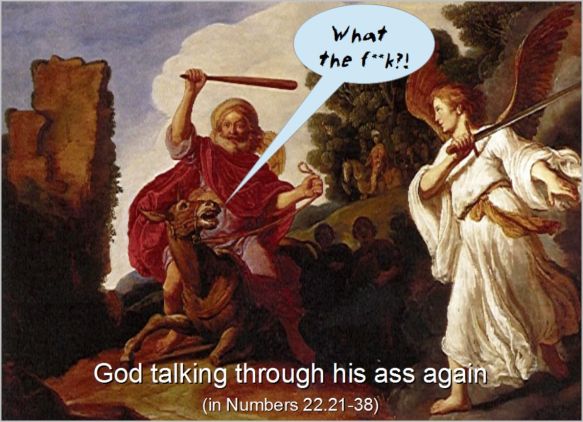
2 talking animals: the serpent in Eden and Balaam’s ass.

1 talking plant (Exodus 3:3).

0 science. No understanding whatsoever of what we now call astronomy, meteorology, germ theory, genetics, evolution, psychology… you name it.

So how do we read all of this? As the ancients themselves would, with an understanding of the world that regarded the supernatural, magic, miracles and monsters as real? We’re told often enough that this is how we should interpret scripture, not from a modern perspective. Perhaps we might credit the creators of the many books of the bible with greater skill, however, and interpret the inclusion of magic and miracle as allegorical or metaphorical; literary pieces, if you will. But then we have to decide which far-fetched stories are myth and which are historical accounts,. There really is no way to do this. A New Testament story awash with impossible events, implausible characters and symbolic tropes is every bit as allegorical or metaphorical as the same kind of story in the Old Testament (or, indeed, in Egyptian, Greek and Roman myth.) The reader who wants to see stories in the Old Testament as carefully crafted allegories has to concede that the Jesus narratives are of the same order.

It looks like we have to read the Bible as 21st century readers, because that is what we are. After all the Bible is supposedly a book for all time. We can, however, recognise the way in which its many creators saw the world – populated with fantasy creatures and subject to impossible events – and accept that they were wrong. Reality is not as they perceived it. What we cannot do is claim that the Jesus story is an oasis of truth in the midst of all this fantasy . 

Evidence of God

As for evidence, you might be aware of Israel. That nation has been in the news much of late. So, without being flippant at all, I present Israel as evidence. Think about it. They are living the script written thousands of years ago. Not by chance.

Israel as evidence for the existence of God. I’m thinking about it as Don suggests.

Where did it all begin, this bizarre notion that one tribe in the Middle East was chosen by God to be his special people? According to the Genesis myth, it was when YHWH promised Abraham he’d be his best buddy forever and ever, so long as he mutilated his body and those of his sons in perpetuity. They would also have to keep every one of this bullying god’s 365 rules and regulations, including the petty and piffling ones. So far so good, apart from the fact it was all very one-sided, and the mutilation of course. You’d think this would’ve been a sign that things weren’t quite kosher, but no; Abraham and his descendants buy into it and almost straight away, YHWH begins to let them down.

God’s Chosen Ones soon find themselves slaves in Egypt. A second mythical character is needed – up pops Moses – to get them out of this scrape. Unfortunately, after Moses has finished chatting with YHWH, who identifies as a burning bush on the top of a mountain, the sulky deity feels slighted by something the Israelites are doing. As is his way, he has many of them slaughtered and the rest he forces to troop around the same small plot of land for 40 years. This is how best buddies treat each other!

Later, the Jews find themselves defeated by the Babylonians and are carted off into exile. This exile, which YHWH does nothing to prevent, lasts 70 years. Still, it leads to a pleasant song made famous by Boney M in 1978 so I suppose it was worth it.

For the next few hundred years, Israel falls under the rule of other nations more powerful than itself. Not to worry though, YHWH is still ‘looking after them’, particularly those who are slaughtered in the rebellions that ensue. As Robert Conner says in a recent comment on Debunking Christianity, ‘If Yahweh ever threatens to bless you and your children, just kill yourself and get it over with.’

Fast forward to the Roman occupation of Israel. YHWH, having undergone a makeover, reneges on his promise to take care of his Chosen Nation forever and ever and comes up with a different plan to save people from his own cussedness. Now, if they want to continue as his friend, they have to believe a supernatural being has returned from the dead.

Abandoned by God, as he now wants to be called, Jews who haven’t defected to the new faith see their sacred, eternal temple destroyed by the Romans in AD70. Thousands of them are massacred and the Jewish nation ceases to exist.

This sets the pattern for the next two millennia in which God’s new friends organise pogroms, massacres and vicious persecution of Jews. This culminates in the Final Solution of the Third Reich which seeks to eliminate the Jewish people entirely. While awaiting extermination in a concentration camp, Andrew Eames scrawls on the wall of his prison: ‘If there is a God, He will have to beg for my forgiveness.’ God allows six million of his Chosen People die at the hands at the Nazis.

Following the second world war, Israel takes possession of the area surrounding Jerusalem, then occupied by Palestinian Muslims who are themselves descended from earlier immigrants. Thousands on both sides are slaughtered in the conflict that follows. In 1948, after almost 2,000 years, Israel becomes a nation once again; not through any miracle of God but as a result of human endeavour and bloodshed.

Tension and further skirmishes followed, leading to the present day when Israel finds itself under attack by Hamas terrorists. Thousands of innocents – women, children and babies – have been slaughtered without mercy. Israel is, as I write, retaliating and intends to enact further vengeance. And where is God in all this? You guessed it: nowhere to be seen.

All of this, according to some – including the naive writer at the top of this post – serves as evidence of God’s existence. That Israel has persevered for so long, despite opposition, persecution and the holocaust is not, however, evidence of God, any more than the great cathedrals of the world are. It is instead testimony to the resilience, resolve and sheer bloody mindedness of the people themselves. Perhaps their belief in YHWH (they don’t of course recognise his Christian counterpart) has fuelled their persistence, as it has their territorial claims.

Jewish beliefs and history are not evidence that YHWH exists. If anything, his apparent abandonment* during their many trials and tribulations is evidence to the contrary.

*Of course a non-existent entity can’t actually abandon anything, any more than it can lend its support or favour one group of people over another.

God’s Obsession

The first of a series of posts by guest contributor YHWH who posts on AllMadeUpandImaginary.com.

______________________________________________

Hi guys! And gals too though I have to confess I’m not really as interested in gals. I like cocks. I’m obsessed by them. I like them cut, and the sooner the better. I’m a bit of a perfectionist, you see. I made the first cock for the original human male, a beefcake called Adam. His name was a little joke on my part. You see, I knew the Hebrews would become my best buddies in few millennia’s time and that they’d use the word ‘Adam’ to mean ‘man’. Good pun, don’t you think?

Admittedly, it only works in the long term.

Anyway, Adam had the first. Cock that is. I’d made it so he was hung like a horse, and I thought he’d get some fun out of it with the female I’d thoughtfully supplied him with, though not for reproductive purposes. I hadn’t predicted at that stage how much trouble Adam and the woman were going to be, so when they were, I had to rethink my plan and invent procreation. I didn’t want to start again from scratch so I just repurposed the penis, shrunk it down a little and got the Adam prototype to cover it up. I didn’t want to get rid of it entirely because of course I was so pleased with it. Also it had some other function at the time, though I can’t recall now what that was.

After watching humans copulate for what seemed like an eternity (in what they imagined was privacy, which still makes me laugh), I felt that I hadn’t got the design of the dick quite right. It looked, well, comical with all that superfluous skin at the end that folded away anyway when the damn thing raised itself up in praise. I thought I could do better, but you know, by then I’d already restarted the whole damn project for a second time and to be honest, I couldn’t be bothered going back to the drawing board a third time.

So first chance I got, I came up with a contingency plan. I would find some way of getting them to cut it off. Not the whole cock, don’t get me wrong, ’cause as I say, I like that. No. The extra skin on the end. I figured they just didn’t need it and the whole thing would look more streamlined without it. Sure, they might lose some sensitivity when fucking, but so what. 

So I wait for the right dickhead (see what I did there?) to come along. Someone who’d be daft enough to sacrifice his offspring to me if I told him to. Sure enough, one soon comes along and I actually have to stop him from murdering his own son because, despite my reputation, I’m not really into that kind of thing. Well, not much. No, the cock’s the thing. So I tell him he can be my extra special buddy if only he’ll cut the skin off the end of his penis. I tell him that this’ll show me and the world that we have a special pact. In return, I promise that I’ll look after him and his descendants forever and ever. Not that he was gonna get to show his cock to the world, you understand, but you get my drift. And whaddya know, the idiot agrees to it and there and then takes an old rock to his old man, and his kids’, his slaves’ and anyone else he could lay his hands on, and hacks off the ends. I tell you, there’s one born every minute.

It wasn’t a pretty sight, I admit, what with all the blood and ragged skin, but it had more or less healed after a few months, infections notwithstanding, into something presentable. I took a look, ’cause I like looking at cocks and anything humans do with them, and I decided I approved. It looked more like I should’ve made the thing in the first place.

So for the next few hundreds years I’m happy with all the mutilated penises. I give their owners instructions about what they can and can’t do with them:

Slice off the top: That’s a must.

Rape female captives and slaves: Of course.

Fuck as many women as you can afford to keep: Naturally.

Have sex with your daughters: Well, okay but only if you’re pissed and they make the first move.

Don’t play around with other men’s cocks: Oh now, come on! Only I’m supposed to have an interest in other males’ members. So that’s a no. There are limits!

Then along comes some twerp who starts saying that anyone wants to be my buddy doesn’t have to crop their foreskin. I mean, who the hell does he think he is? I nudge a couple of my old mates and get them to tell this killjoy that I’m dead against the idea. But he ignores them and pretty soon there’s a whole bunch of fanatics who won’t get their dicks out for me. I ask you.

Thank God Me, there are still those who will though, including that other lot of God-botherers I’ve been keeping my eye on. They’re more than happy to slice and dice their young son’s willies. That’s what I like to see: commitment. And a nice bit of genital mutilation.

______________________________________________

Thanks YHWH for a really enlightening blog. Next time, His Almightiness will be talking about what he calls ‘The Spare Rib Problem: the Dickless Chicks.

What are the Odds?

To look at it another way…

The stories of the Old Testament are largely fictional. They’re myth, legend and otherwise fabricated. There was no Eden, no world-wide flood, no slavery in Egypt, no Exodus. There’s no evidence that the characters around which events supposedly took place actually existed: no Noah, Abraham, Moses, Job, Jonah or Daniel. Their stories were created long after the time they purportedly lived; centuries later. The stories written about kings – which, if they existed, were no more than half-remembered tribal chiefs – and the so-called great prophets are constructed from folktales. In short, nothing we read in the Old Testament actually happened.

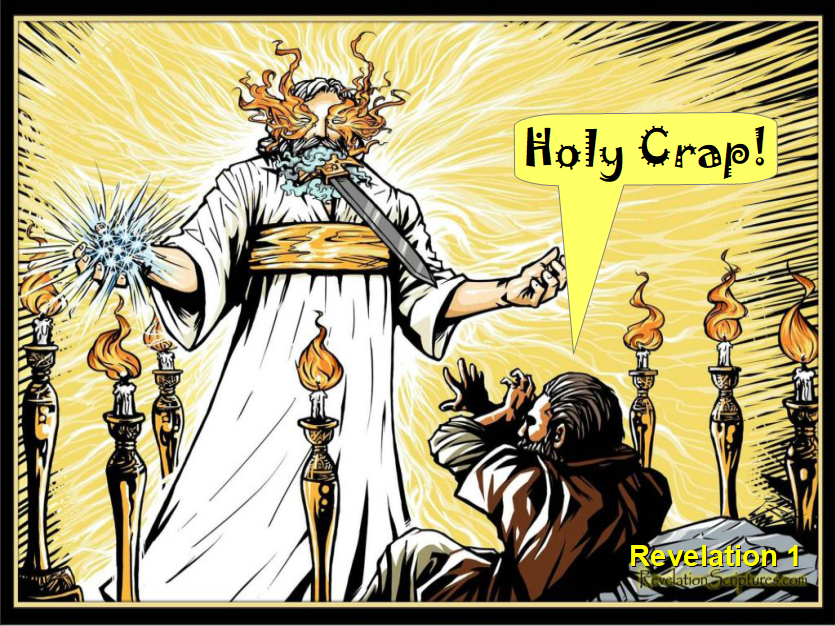
When we get to the New Testament, we find convoluted exposition of Paul’s ‘revelations’ about Jesus; visions and imagined sightings of a celestial being he had in his own head. It’s the same for the fruitcake writer of Revelation who envisaged an unreal comic book Jesus; invention every bit of it. The Acts of the Apostles offers a fanciful and wholly inaccurate ‘history’ of the early church, including angels, teleportation and fatal miracles. Of the 21 letters in the New Testament, at least 11 are forgeries, known to have been written by anonymous authors who were not who they claimed to be. The other 10, including Paul’s genuine letters and the likes of Hebrews, make up all sorts of mystical stuff about an angelic Godman-cum-high priest.

 And yet, in the midst of these myths and legends, made-up characters and stories, forgeries and fantasies and mystical musings stands the indisputable truth of the gospels. Or so Christians and theologians would have us believe. These particular stories, surrounded as they are by fiction on all sides are historical, factual and true.

What are the odds?

Hearing things

Blog332Pray

Don Camp has responded to my previous post, Voices In The Head, with a longish essay that he posted on Debunking Christianity. I want to use what he says to debunk the foolish notion that God speaks directly to people via their own  thoughts.

Those of us who do not believe in a God have, Don says, no ‘philosophical context’ for his speaking and are bound to ‘have trouble’ with the idea. I have to say, in fact, that I have no trouble at all with it. It’s easy: no God = no God speaking.

The rational thing to do, Don goes on, is for skeptics to fit those reports of God speaking into a context we do have, such as self-talk or schizophrenic delusions. This is another statement of the obvious; with no supernatural to account for such voices there can only be a rational explanation for this most irrational of phenomena.

Don then tries an analogy: ‘trying to explain God speaking to those who have no way to make sense of it is like explaining the color and beauty of a sunset to someone with no eyes.’ This is less than convincing. Those who are sceptical about God speaking (or doing anything) do have ‘eyes’: their rationality and critical faculties. A more accurate parallel for trying to persuade others the Almighty sends messages into his followers’ heads would be claiming that the events of a dream you had last night really happened in the world as we know it. ( I’ll have more to say about dreams later.)

‘I’ve said clearly,’ says Don, ‘what God speaking to people is not. It is not self-talk.’ Alas, Don does not tell us how he knows this.

‘Those who hear God speaking do not mistake it for self-talk,’ which is a pity because that’s what it is; Christians might choose to relabel it ‘God’ but that doesn’t mean it is. ‘It is also not schizophrenic delusions.’ It is a delusion though; I haven’t actually said that Don’s inner voice represents schizophrenia (he brought up the term) but I can’t see any difference between the voice he hears and those experienced, perhaps in more severe form, by schizophrenics.

‘Schizophrenic delusions, in which the sufferer either sees things that aren’t there or hears voices no one else hears, are characterized by self-isolation behavior, delusions, disorganized speech, bizarre behaviors, and flat affect. (see https://medical-dictionary…. )’ Whereas those hearing God’s voice gather together in self-contained enclaves separated, by choice, from ‘the World’. At other times they withdraw to talk to an imaginary super-being on their own and, according to Don, have him speak to them. If they’re really lucky, they’ll even get to see things that aren’t there. Obviously this kind of bizarre behaviour bears no resemblance to the true schizophrenic.

Don again: ‘Schizophrenic behaviors are very self-focused and their delusions are sometimes fearful or hateful and sometimes violent. It is the last that we see when people afflicted with schizophrenia pick up a gun and shoot up a school or a church or behead a girlfriend, as in the case you’ve noted in Mt. Vernon, Washington.’ Of course, schizophrenia is the same as most human behaviours; it exists on a spectrum. The Christian’s inner voice may not be as extreme or anti-social as that of the schizophrenic, but hearing it is on the same spectrum, perhaps at the safe end. Until it’s not, of course, as in the examples Don refers to.

‘But what about the person who hears God speak telling him that he should build a hospital in the Congo for AIDS patients or reach out to help the homeless? That is not the behavior of someone who suffers from mental illness. But that is the sort of thing that characterizes the lives of those ordinary Christians who report hearing God speak. So inner voices sometimes tell Christians to do good things. So what? This isn’t evidence they’re from God. What Don’s really arguing here, is that a ‘good’ message proves the Christian’s inner voice is God. And how do they know it’s God and not just self-talk? Because the message is ‘good’. This is circular and self-fulfilling, and doesn’t take into account all those instances when ‘God’ commands people to do bad things. According to the Old Testament it was the Lord himself who commanded Moses, Joshua and Samuel to massacre neighbouring tribes, the Lord who told Abraham to execute his own son in an especially cruel ‘test’. Doesn’t God do this any more? Has the unchanging God changed in this respect? Believers don’t just hear God telling them to do good things; the evidence is right there in the bible that (they imagine) he tells them to do wicked things too.

‘Does that kind of selfless compassion and determined service to mankind come from schizophrenic delusion or a disordered mind disconnected from reality? I do not think so. But that and many, many similar things are the result people having truly heard God speak.’ No, it’s the result of people interpreting an inner prompting as God. Interpreting it as such does not mean it is.

‘No physician would diagnose the many millions of ordinary Christians who report God speaking to them as schizophrenic.’ As I’ve already suggested, Don is creating a false dichotomy here: it isn’t necessary to be a diagnosed schizophrenic. It’s possible those hearing ‘helpful’ voices are much lower down on the delusional spectrum. They may never be schizophrenic in the medical sense, but this does not mean their voices are not self-generated.

‘But if God speaking is NOT self-talk or delusional, what is it?’ It is both of these things and Don hasn’t demonstrated otherwise. Still, let’s humour him and press on:

‘I think that J. Warner Wallace has as good an explanation as any. It is far more than voices in our heads. You can read his article here http://www.foxnews.com/opin…Fox News? Don really is in trouble.

‘What is significant for those who are convinced that there is no God out there to speak is that their conclusion contrasts with the experience (of) many billions of people over a very long time. It was the experience of those who wrote the Bible and many of those they wrote about. It has been the experience of billions since.’ Aah, now we’re playing the numbers game: ‘lots of people think this so it must be true.’ Well, okay, but many more billions dream while they’re asleep, and those dreams must come from somewhere; they can only be from God – there’s even biblical support for the idea that they are. So, if numbers of people demonstrate God’s involvement in our psyches then dreams are far more numerous than God merely speaking directly. However, God doesn’t create or speak through dreams, even though the bible suggests in places that he does. People may interpret them as God speaking but, as I’ve already said, interpretation is not evidence – and numbers prove nothing.

And now, having failed to present any sort of persuasive evidence that his inner voices are from God, Don leaps to this conclusion: ‘it is not really helpful for skeptics, who consider themselves in some way more grounded in reality than the rest of mankind, to Wave off this God speaking thing as delusional.’ Do we skeptics consider ourselves more grounded in reality – yes, I think perhaps we do. We look at evidence, not at what people believe they’re experiencing nor the numbers who believe, nor to the supernatural as an explanation for human phenomena. Voices in the head are generated by the brain; as Don concedes the mind commonly does this when we create a dialogue with ourselves. The nature of this dialogue is influenced and altered in those whose minds are saturated with religious ideas and mythology to the extent it is (mis)interpreted as the voice of God. This is the reality. I know, I’ve been there.

‘You need to consider,’ says Don in his coup de grace, ‘if there is not more to reality than you believe’? Do we? Do I? When a perfectly adequate explanation exists for voices in the head, why should any of us consider an alternative that relies on the supernatural? Actually though, I’ve done that too; for a long time I believed there must be ‘more to reality’ than we humans could conceive of or comprehend. So far, however, there is absolutely no evidence – zero, zilch – that what we don’t understand is Supernatural. Whether I ‘believe’ this or not is immaterial; it is a demonstrable fact. The Creator of everything-there-is cannot therefore be the source of voices in the head, dreams, visions or any other damn thing.

So, Don, a final point: if you stick, as I’m sure you will, with your belief that the voices you and other Christians hear are from God, then perhaps you could tell us why he says different things to different Christians – completely contradictory things (as I’ve written about here)? How do you account for God whispering one thing to you and the opposite to a fellow-believer? Do you dismiss as schizophrenic those who say God tells them not to commit massacres, but to shun gay people, control the weather, take possession of a new jet or prepare for the ‘great persecution‘ to come? Are these fellow Christians deluded? Maybe misinterpreting the voices in their head? If you dismiss them as deluded, muddle-headed or schizophrenic then you can perhaps see how we skeptics view you.

Always and Forever

nurseGod is trustworthy and true. He always keeps his promises. We know this because Christians, either in person or on web-sites, like to tell us so.

Let’s take a look at some of the promises God made back when he only liked Jewish people. How well do they hold up?

As part of his promise (covenant) with Jewish patriarch, Abraham, that he would look after his descendants in perpetuity, Yahweh came up with a particularly gross way for them to sign up:

I will always keep the promise I have made to you and your descendants, because I am your God and their God… Abraham, you and all future members of your family must promise to obey me. As the sign that you are keeping this promise, you must circumcise every man and boy in your family. This will be a sign that my promise to you will last forever. Any man who isn’t circumcised hasn’t kept his promise to me and can’t be one of my people… The promise I am making to you and your family will be for (your son) and his descendants forever (Genesis 17.7, 9-13, 21; my emphases).

‘Always’ and ‘forever’ obviously meant only until God changed his mind – which he did when he came up with the new ‘covenant’. You know the one: ‘believe in Jesus to be saved, no primitive surgery required.’ Of course, Jews still feel the original promise is in force and so keep up the old slicing’n’dicing membership requirement. So who’s right? Jewish people who feel that a promise is a promise? Or Christians who insist God eventually lost interest in mutilating penises? It’s hard to tell, but if it’s the Christians, then God, being omniscient and all, must have known he would change his mind eventually. So why tell ol’ Abe the agreement with him was ‘always’ and ‘forever’?

Then there’s the one where God promises there’ll be a descendant of King David’s on the throne forever:

I will establish your royal throne over Israel forever, as I promised David your father when I said, ‘You shall never fail to have a successor on the throne of Israel’ (1 Kings 9.5).

Oops. David’s line ceased ruling over Israel when the Assyrians defeated it in 586BCE. Since then there has been no king of the Davidic line ruling over Israel. Why didn’t God see this coming? And if he did, why’d he make a promise, with ‘forever’ and ‘never fail’, that he knew he wasn’t going to keep? Yes, I know Christians like to claim that Jesus took over the kingship when he came along, but he didn’t, not really. His descent from David is highly questionable and there’s still that awfully long gap between 586BCE and Jesus’ time that blows a hole in ‘never fail’ and ‘forever’. In any case, Jews, by definition, have never seen Jesus as their king and they’ve got a point: it’s difficult to see how someone dead and/or totally invisible can be king of anything.

Never mind, let’s try another. This time God’s promise that everything’s going to work out okay:

(The Lord) will judge between the nations and will settle disputes for many peoples. They will beat their swords into ploughshares and their spears into pruning hooks. Nation will not take up sword against nation, nor will they train for war anymore (Isaiah 2.4).

Safe to say this didn’t happen either. Not while people were still using swords and spears anyway.

Finally, what about the promise that’s trotted out every Christmas? –

For to us a child is born, to us a son is given, and the government will be on his shoulders. And he will be called Wonderful Counsellor, Mighty God, Everlasting Father, Prince of Peace. Of the increase of his government and peace there will be no end. He will reign on David’s throne and over his kingdom, establishing and upholding it with justice and righteousness from that time on and forever (Isaiah 9:6-7).

Whatever Christians might claim for these verses, they’re not about Jesus. At the risk of repeating myself, I’ll repeat myself: Jesus did not and does not reign on David’s throne. He said he would, it’s true, believing himself to be the fulfilment of ‘prophecies’ like this, but he was wrong, as events went on to demonstrate. He didn’t, in any case, fit the description of whoever it is who’s being spoken of here; an earthly ruler who – yes, you guessed it – has still to show up. We’d have spotted him if he had. Some Jewish scholars think they might have done, pointing to King Hezekiah who ruled Israel in the 8th and 7th centuries BCE, for almost 30 years. That’s hardly ‘forever’ though, is it. Yet more evidence that ‘prophecy’ doesn’t ever work, principally because it’s impossible to know the future.

God’s promises are like those of politicians: you just can’t trust them. There has to come a time when those who believe in them must face up to the fact they’re not promises at all, just ancient wishful thinking.