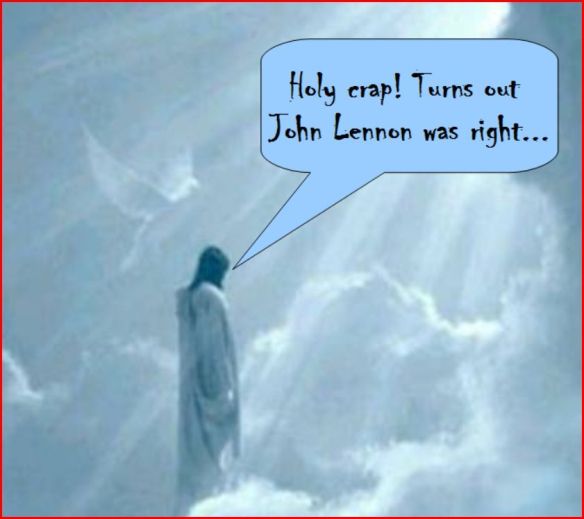
Not The Answer

Unlike most Brits, I knew of Charlie Kirk before his assassination last Wednesday. He cropped up on American blogs I read, most frequently on Joe.My.God. I profoundly disagreed with practically everything Charlie Kirk had to say, though a little of it made me re-examine my position on some issues. His views on gun control seemed to me to be extremely foolish and I objected to what he had to say about gay people, our relationships and status in society. I reacted against his Christian views, entangled as they were with his extreme political views. I objected too to his promotion of his faith; it seemed trite and smug (but then I think this of anyone who preaches Jesus.)

Following Kirk’s death, it’s been reported that he was prepared to debate with those who disagreed with him. He said, ‘When people stop talking, that’s when you get violence… When people stop talking, that’s when civil war happens, because you start to think the other side is so evil, they lose their humanity.’ Seemingly then he valued free speech and recognised the importance of dialogue and discussion, though perhaps his intent was to influence the views of others rather than reconsider his own.

He was opposed to transgenderism and this, at the time of writing, looks to have prompted his murder. Many on the Utah University campus last Wednesday would have been incensed by Kirk’s position that trans people were an ‘abomination’, showing a ‘throbbing middle finger to God.’ Some engaged him civilly on the issue, asking pertinent questions. Tyler Robinson, however, decided he would oppose Kirk’s more extreme views and advance the Trans cause by shooting him dead.

There is no justification for what Robinson did. Executing people one disagrees with is a feature of Putin’s Russia or Kim Jong Un in North Korea. It ought not to happen in the democratic west where we debate our opponents or, if they happen to be politicians, vote them out of office. Murder is never the solution, and in this case did not advance the cause the shooter felt so strongly about. Quite the opposite.

Those who argue that his shooting was justifiable – and yes, they’re out there – on the basis that Kirk’s views were extreme and reactionary must also accept that the assassination of any public figure is justifiable on the basis that some people find their views objectionable. Do we really want to go down this road, of rationalising assassinations on the basis the target espouses an ideology we find objectionable?

Those who rejoice at Charlie Kirk’s demise demonstrate a lack of humanity and support the desecration of Western values, free speech in particular.


More Daft Things Christians Say

Image from a video by Intimacy With God, available here. I don’t recommend it.

In this season: a new favourite of evangelicals.

Though it is biblical (2 Timothy 4:2), what the hell does it mean in the mouths of today’s Christians? Here it is used to excess in the FreshPerspective blog: 

God is shifting his faithful sons and daughters into new seasons. But before I divulge into the signs, understand that everyone is called to different seasons. Some are being released into a season of exposure (platforms, opportunities etc), some into a season of preparation (preparing for a new season), and some into a wilderness season (a time of God pruning you, deliverance from past sins and behaviors before you enter a new season). So don’t be discouraged when it seems like you’re not where everyone else is. Seek God, pray and receive his wisdom and knowledge for what season you’re in.

It’s meant to sound profound, but there’s nothing profound about it. It’s pretentious, meaningless twaddle. Bob Dylan said it far better when he sang, ‘the times they are a-changing’. Things change; they continually evolve. Likewise our personal circumstances. God isn’t blessing, releasing, pruning or preparing you. Nor has he any great plans for you or the church. (Why? Because he’s not real.)  

Thoughts and Prayers/I’ll pray for you

Thoughts and prayers are always proffered when disaster strikes. The ‘thoughts’ I understand; when a long-distance friend lost her daughter to suicide a couple of years ago, I wanted her to know I was thinking of her and was ready to listen if she wanted to talk. She told me later that it was comforting to know that friends were thinking of her and were around if she needed them. I don’t think she said this just to make us, the friends, feel better. Such painful circumstances pare away insincerity.

There’s often not much more we can do beyond thinking about others when they are suffering like this. There are circumstances of course when we can offer more practical help, but adding ‘prayers’ to any expression of concern is lazy and glib. Prayers are of no use to anyone in distress or despair because prayers are, in any context, of no use, period. There’s no God out there, up there or inside us listening to our inner pleading. Even if there were, he is, according to his personality profile in the bible, so capricious and unheeding that he would do nothing to alleviate suffering. Neither would he step in supernaturally to remedy the terrible situations humans find themselves in. If he was even remotely concerned, he wouldn’t allow these to happen in the first place. Little point then in asking him to help with any mess he’s helped created, either intentionally or through disinterest.

But as I say, there’s no God so we need not trouble ourselves trying to work out what he’s playing at. Nor do we ever need the sanctimonious promise of prayers that will probably never be said. It doesn’t matter whether they are or not, so please, True Believers, can we dispense with  the cant?

The Daft Things Christians Say (the Sequel)

The return of an old favourite (of mine if no-one else’s)!

Dennis and I were in the States a couple of weeks ago and had the dubious pleasure of watching American news channels. I noticed on more than one, the presenters signed off with ‘God Bless’. As well as undermining what little objectivity they have left, the phrase rang hollow and made those using it, for whatever reason, as vapid and insincere.

It’s a phrase that many ordinary Christians and the nominally religious use (a waitress serving us lobster also came out with it, as if the lobster would magically be granted extra flavour.) It seems to me it’s a remnant from the days of incantation and magic. ‘May God bless you’ as opposed to ‘Let the devil smite thee’ or some such. ‘Goodbye’ has survived from these times too, originally ‘God be with you’, and is equally meaningless. Meaningless because if a God existed he would presumably be with you if he felt like it, or not as the mood took him. Attempting to summon his presence with an incantation of well-wishing is hardly going to influence him. Similarly with ‘God Bless’. Doesn’t the Bible say that God blesses whom he will (Romans 9:18)? No imperative will change that. Might it make the declarer of God’s presence of blessing feel more smugly self- righteous while the intended recipient might feel better, he or she convincing themselves they are actually ‘blessed’? Maybe, but God would have nothing to do with either state of mind.

Likewise that magic phrase Christians like to add to the end of prayers: ‘we ask this in Jesus’ name’. Will God not listen to their supplications if they don’t add it? Will he grant their requests if they do? I think we all know the answer. Why should it make any difference to Almighty God whether they add magic words to their pleas? If it does, what sort of God is it who must have exact words used, like a Hogwarts spell? The addition of a ‘just’ before the word ‘ask’, meaning ‘this is really a modest little request, your worshipfulness, we don’t want to bother you,’ doesn’t make it any more meaningful. From within the faith, as without, the phrase couldn’t possibly make any difference, apart from possibly allowing the supplicant feel better, more self-satisfied, like the child who adds a pretty picture to the end of their writing. ‘We (just) ask this in Jesus’ name’ another empty and vacuous magic spell.

Omens and Portents

Hey guys, can you help me out a little? The last few weeks I’ve experienced an omen. Or maybe it’s an auspice. A sign. Could even be a miracle.

That’s the trouble, you see. I don’t know which. And even if, with your help, I manage to work it out, I still don’t know what it all means.

You see, there I was in my favourite coffee shop waiting for my cappuccino to cool a little. I happened to look over at it and saw two dead flies floating on the surface. So naturally, I called over the server and said – you know what’s coming – ‘waiter, there’s a fly or two in my drink’. Now whether the flies had been getting it on with each other and decided the froth on my coffee was a good place to do it, I don’t know, but it led to their demise: death by conjugal drowning.

I got a fresh coffee.

Skip forward a few days and I’m about to have a nice glass of Merlot in my favourite Italian restaurant. There on the top, just after it’s been poured, is a solitary swimmer, another of God’s blessed little creatures backstroking its way around my glass in ever erratic circles. After I paraphrase the old joke again, the waiter removes the glass, fishes out the drunken fly and returns my wine. Or maybe he poured a fresh glass. Who knows.

And then – yes, you know what’s coming – a few days after that I’m having another cappuccino in a third establishment when another of the little blighters tops itself in my drink. That’s three times in only a few days. I mean twice would be a coincidence but three times! As Ian Fleming almost said, ‘once is an accident, twice is a coincidence, three times is a pattern’. There was a pattern to my flysome encounters, and we know what a pattern means: it means a pattern maker! An intelligence behind this series of unfortunate events. But which? And what did they all mean? A pattern has to have meaning! What was the message I was being sent from the supernatural plane?

Was it an omen? A portent? A sign from above? Was God telling me something? If so what? Maybe you guys can help.

I just realised though that there’s a Lord of the Flies, Beelzebub, who might be trying to communicate with me. (Is there a Lord of the Slugs and a Lord of the Flatfish too? Logic dictates there should be… but I digress). In the Word of God (Mark 3:24 etc), Beelzebub is none other than the devil in disguise, an alter-ego of old pal Satan.

What’s Satan/Beelzebub trying to say to me by directing flies to land in my beverages? I really need to know. If only these all-powerful supernatural types could be a little clearer.

But Some Doubted

We know that all the accounts of the resurrection appearances are inconsistent, incompatible with each other and read like visions or hallucinations. If that’s not enough there are two aspects of the stories that are delivered almost as asides that give the game away.

Matthew 28:17 records that

…the eleven disciples went to Galilee, to the mountain where Jesus had told them to go. When they saw him, they worshipped him; but some doubted.

Meanwhile, in a completely different set of resurrection appearances, Acts 1:3 claims that

After his suffering, (Jesus) presented himself to (his chosen apostles) and gave many convincing proofs that he was alive. He appeared to them over a period of forty days and spoke about the kingdom of God.

These verses from Matthew and Acts are almost always overlooked by true believers. In the Matthew passage we have a number of the eleven remaining disciples doubting that what they were experiencing was the resurrected Jesus. That’s the same disciples whom the gospel tells us trailed round the countryside with him listening to him as he regularly predicted his death and resurrection. Yet when the resurrection happened (spoiler: it didn’t really) they doubted that what they were seeing was Jesus.

How can this be? Did he not look himself, as in the other tall-tales of his reappearance? Was he so changed he was unrecognisable? If so, how did anybody recognise him? That’s the trouble with visions and apparitions: they’re just not clear or convincing.

Luke, meanwhile, extends the time that Jesus spends with his followers from a day or so in his gospel to 40 days in Acts. This is when Jesus offers the ’many convincing proofs’ that he is the Messiah and has survived death. This really makes no sense at all. As I asked in a previous post (slightly edited here) –

By ‘many convincing proofs’: what does this mean? That he had to prove he’d come back to life? Couldn’t his old chums see that for themselves? Couldn’t they recognise the man with whom they’d spent the last three years (allegedly)? Or if they could, weren’t they convinced he’d returned from the dead so that he felt the need to prove it? And how did he prove it? With a death certificate? By letting them poke his holes? And this took forty days?

Isn’t it more likely they were subject to group hysteria and some sort of hallucination (they’d had hallucinations before – see Matthew 17:1-9) and they then had to convince each other that what they’d experienced was really Jesus?

This is what was really going on: it took those who’d hallucinated seeing the heavenly Messiah a significant amount of time (what ‘40 days’ actually means) to concoct what they thought proved their visions were real. Like Paul (perhaps copying him), they found this ‘proof’ in the ‘prophecies’ of Jewish scripture.

This is the ‘many convincing proofs’ Luke refers to. No resurrected god-man spent 40 days offering evidence from scripture that he was really back from the dead. The visionaries themselves came up with it. Unfortunately for them, relying on shaky exegesis and misapplied passages from ancient texts is no proof at all.

Try telling that to Paul and the gospel writers though. All of Christianity rests on the visions of a few and the ‘many convincing proofs’ from scripture that persuaded them that what they’d experienced was really the Messiah, manifested in all his glory.

We’re talking a faith built on sand indeed. No wonder those sensible early disciples doubted every part of it.

Spiritual Forces of Evil in the Heavenly Realms

Original AI image from Night Cafe 

For our struggle is not against flesh and blood, but against the rulers, against the authorities, against the powers of this dark world and against the spiritual forces of evil in the heavenly realms. (Ephesians 6:12)

…you followed the ways of this world and of the ruler of the kingdom of the air, the spirit who is now at work in those who are disobedient. (Ephesians 2:2)

the prince of this world now stands condemned. (John 16:11)

The first-century worldview of early Christian cultists was that somewhere above the Earth a battle raged between God and Satan. The powers of darkness – the devil and his demons – had in ages past launched an attack on the Lord and his angels. This war in the spiritual realm continued unabated up to the time when a cultist wrote Ephesians, pretending to be Paul. Paul himself had already alluded to Satan as the god of this age (2 Corinthians 4:4), while the authors of the fourth gospel would later refer to him as the archon – ruler and prince – of this world (John 12:31; 14:30).

Which just goes to show how the Almighty God they believed in was nothing of the sort. He had tussled with his arch-enemy for eons without quashing his rebellion and putting an end to his persistent attacks. The stand-off had gone on for millennia, and, according to today’s Christians, is still happening. A puny god it is who cannot get the better of one of his far less powerful creations.

And what are God and Satan fighting over? Us, apparently. The devil wants control of human beings.

Why? Who knows. In fact, according to Paul, Satan already has control over us. He enslaves us to sin, which in turn leads to death (Romans 5:12, 6:23). 

Not to worry though, Paul, fake Paul and the fourth gospel writers assure us that their enfeebled God has a cunning plan! He’ll allow a being who is precious to him – like a son, in fact – to be sacrificed so that anyone who believes in him will no longer be enslaved to Satan and sin and will be granted eternal life. How’s that for special magic!

Who shouted out from the back that that sounds like a cop-out? It’s a fantasy bordering on the insane. Like it or not, we are somehow embroiled in heavenly warfare, specially if we’re of the number who’ve bought into this malarkey.

While we’re at it, have you noticed how so many of the wars and skirmishes currently afflicting the world have religion at their heart? YHWH is scrapping with Allah, Allah is up against the Great Satan while Jesus – no stranger to war-mongering himself – presides over it all, leading the world to Armageddon and his own ultimate ‘return’.

Here’s my suggestion. All the gods and demons need to get their act together. They should agree to an ultimate slug-fest, a final battle in the spiritual realm to decide who’s really the Supreme God – the last deity standing – and leave us humans out of it entirely. Surely, being gods, they’re up for finding out who can piss furthest up the wall.

A preposterous idea? Of course it is. None of these fantasy beings exist. There’s no YHWH, Allah, Heavenly Father, Jesus, Krishna, angels, archons, Satan or ‘spiritual forces of evil’ to duke it out. There’s no ‘heavenly plane’ where they can get to it. Everyone of these despotic characters is a human creation, as are the wars, disputes and skirmishes they underpin. It follows that none of them can be the supreme god and certainly none of them are worth fighting over. It’s time we grew up and put away all of our childish imaginary tyrants.

The End Is Nigh

The End is Nigh. Yes, really. Climate change activists waste energy on a daily basis letting us know. Unless we listen to them, our self-appointed Saviours, and immediately give up fossil fuels, the world is headed for calamity and will end soon. Never mind the pollution caused by Russia’s war-mongering and that of the 21 wars and 108 other armed conflicts (what’s the difference?) in the world today. It’s the way you heat your home that is going to bring about the end.

Not with the same focus as today’s climate fanatics but with the same religious fervour, the Jews of two and a half millennia ago waited expectantly for their very human Mashiach (anointed one) to appear. He was to deliver them from their oppressors and make them oppressors instead. He failed to arrive.

Years later, in the first century CE, a small enclave of Jews became convinced their Messiah was on his way. He had by this time transmogrified into a heavenly being but would soon be arriving to set the world aright and deliver his little band of followers from evil and, they decided, from death too. He didn’t make it, but such irrational wishful thinking is how all religions get going and Christianity was no exception.

Muslims, meanwhile, believe that the Day of Judgement is not far off. Everyone will then be judged according to their service to Allah, the faithful rewarded with eternal life, the rest sent to Jahannam (hell).

So here’s a question for you: what do these years have in common? 66-70CE, 365, 370-400, 500, 793, 800, 847, 1000, 1033, 1200, 1284, 1504, 1585, 1600, 1705, 1792, 1833, 1836, 1874, 1901, 1918, 1936, 1967, 1977, 1982, 1994, 1997, 2000, 2007, 2011 and 2021.

They are, of course, a few of the innumerable predictions that the end isn’t far off, after which there will be a great reset. As I suspect you already know, none of these predictions came to pass.

Neither will any of the numerous predictions of future apocalypses– lots of them here – either. It’s not that we’re incapable of wiping ourselves out; it’s possible we will one day, but there won’t be a Mashiach, Christ or God who will step in at the last minute to rescue a favoured few so that everything can start again. There’s no simplistic fix of the sort climate zealots, Islamist terrorists and bumptious politicians insist. Like their apocalyptic predecessors they’re only deluding themselves and lying to the rest of us.

We are, it seems, obsessed with End Times scenarios, and always have been. Our only saviours, however, will be ourselves, if we’ve the will to be. I’m not sure we have, but a first step might be recognising that there’s no Starman (Starmer?) waiting in the sky, or anywhere else, eager to save us. There’s no magic panacea that will rescue us and reset the world.

Hysteria/Mission Creep/Overreach

When I was head (principal) of a primary (elementary) school in the 1990s, I had a staff member who regarded every small problem as ‘a Major Disaster’ (her words). Everything from a mislaid document to wet weather on sports day was an earth-shattering calamity. She was not the only one to overstate manageable events. Those who wield authority over us, their media lackeys and those with a cause of their own to promote are expert in whipping the populace up into a frenzy disproportionate to the given situation. After a short period in the spotlight, the hysteria and the movements that cause it usually fade, as the media finds something newer and shinier about which to induce panic. Occasionally, the newly out-of-favour movements fight back with renewed vigour, a mission creep extending their influence into new areas.

Looking back over the last 25 years, I and my fellow citizens here in the UK have been expected to be alarmed to an alarming degree about:

The Millennium Bug, when every computer in the world, so the experts said, would crash the instant the year 2000 started. This would, in turn, crash every automated system everywhere, causing chaos and mass fatalities. You all know what actually happened.

Foot & Mouth Disease, when millions of cattle and sheep were slaughtered and burnt. Millions of healthy animals were destroyed in case they contracted the disease.

Weapons of Mass Destruction supposedly amassed by Iraq who, we were told, could unleash them on the West within 45 minutes. That there was no evidence of any WMDs and the fact Iraq did not deploy them (because you can’t deploy something that doesn’t exist) did not deter George W. Bush and Tony Blair from launching their oxymoronic (with the emphasis on the moronic) ‘war on terror’. In so doing, they destabilised the world, creating many of the problems we face today.

Child Abuse Scandals: After either missing or covering up the serial abuse of children and vulnerable people by a BBC celebrity, British authorities went to town on ‘suspected paedophiles’, many of whom were nothing of the sort. (A friend of mine was caught up in this hysteria and spent time in prison for a youthful indiscretion many years earlier.) Unfortunately, this national crisis and the perceived need not to offend Muslims came into conflict when, over 20 years, rape gangs comprised mainly of Pakistani men were able operate in up to 50 UK cities with impunity. Hundreds of thousands of vulnerable, white working-class girls were systematically groomed and raped while the police and authorities turned a blind eye, the consequence of a woke priority taking precedence over the rights and safety of others.     

The Covid Pandemic and Lockdown, when governments the world over (apart from Sweden) panicked about a flu-like virus, closed down entire countries, failed to protect the vulnerable and crashed the very economies needed to fund healthcare and treatment for the infected. Britain was closed down for almost 2 years and still hasn’t recovered from the consequences. Citizens are now paying heavily for actions taken by a government that extended its powers to achieve very little.

        Cartoon by Mark Woods, Spectator magazine, 7th June '25

Mental Health issues and the medicalised labelling of ordinary human behaviours. We all have mental health issues; this is what it is to be human. Some, it is true, have more than others. Determining an individual has ‘mental health issues’ forces him or her to become his or her issues. Instead of being prone to depression (as I was) or anxiety, the individual who experiences these is now ‘neuro-diverse’. Instead of suffering from a condition the individual could do something about they become that condition. Some people, usually males, used to be diagnosed as autistic. Now that autism is seen as a spectrum, everyone is deemed to be on it somewhere; everyone as a result is autistic. People become trapped in their condition with no way out, lifelong treatment the only recourse.

Black Lives Matter. As Lionel Shriver asks here, do black lives matter any more now than they did before all that righteous indignation and virtual signalling from white people?

Identity Politics in which individuals were told as a matter of urgency to self-identify solely on the basis of their ethnicity, religion, gender or sexuality. Gender dysphoria became a thing from which the trans-movement emerged. While I’ve every sympathy for those who feel they were born in the wrong body, society was unprepared for and incapable of dealing with the consequences. Women became ‘cis-women’, sex became ‘gender’ (a grammatical term), ‘non-binary’ became an option and the abuse of pronouns was politicised. An individual could identify as a plural ‘they’, while others lost their jobs if they declined to play along. Worst of all, children, who were too young to be allowed a tattoo, were given puberty blocking drugs, and in some cases surgery, because they felt they were the wrong sex. Children.

The High Court in the UK recently ruled that a man cannot become a woman, entrenching the views of campaigners and prompting other supporters to claim they knew this all along.

Wokeism; while it’s right and proper to treat each other with kindness, courtesy and consideration, politicising something we were, by and large, already doing was not. Wokeism pushed the boundaries over what could be done or said, or rather could not. Anything that might cause someone else offence was forbidden; commenting or criticising others’ religious beliefs or defending women’s rights became ‘hateful’; having a view on unsustainable immigration numbers made you a fascist. This was the era of cancelling those who did not conform to woke ideals. Toppling statues was popular too on the basis that a long-forgotten figure from 250 years ago may have had a slight connection with the slave trade. Western guilt for actions over which people living today had no part in and demands for reparations to those equally uninvolved ensued.

The ‘necessary’ control of free speech, a panic we’re still mired in. Stupid and inflammatory comments on social media can now earn you a prison sentence longer than that of a paedophile offender, often preceded by a visit from half a dozen policemen who will root through your house looking for evidence that you might have once had a ‘Brexity’ thought. Subjects off limits are; arguing that Covid19 began in a Wuhan laboratory (it might upset the Chinese); Islam, Islamic extremism and the Pro-Palestinian movement (however it’s still okay to criticise and condemn Jewish people for the actions of their government); expressing views different from the UK government’s and whatever the prevailing narrative happens to be. A government agency, ‘Prevent‘, last year redefined terrorism (see below) as ‘vocal support of ideologies that advocate discrimination’ and any expression of what it calls ‘cultural nationalism’. What this means is that those who call out religiously-motivated discrimination, lawlessness and terrorism are to be considered terrorists themselves. Actual terrorism and violence is therefore protected against those who would speak out about it, those who do so being the real terrorists. To put it another way, which I read recently (though can’t remember where): those who say hurty things are far more culpable than those who commit actual hurty things. This Orwellian doublespeak must now be taught in universities and other higher education institutions.  

The Climate Crisis and Net-Zero. You must be alarmed by the climate crisis (see here for how much of it Al Gore got wrong). You must too pay heavily for net-zero, thanks to additional taxes; energy prices in the UK are the highest in the world. You must buy into the government’s attempts to enforce a net-zero energy policy by 2050, despite net-zero being unachievable.

What if, might, could, maybe: the media’s favourite phrases to ramp up hysteria. ‘There might be terrible consequences’; ‘we could be headed for another Major Disaster’; ‘if X happens (though it hasn’t) then Y could possibly follow.’ When did the media stop reporting what has actually happened and take up fortune telling instead?  

* * * * * *

There is some comfort in the fact that the so-called crises and hysteria of the past eventually receded and faded away. So too will many of these current causes. All things, as George Harrison once wisely reminded us, must pass. They will, however, be replaced by others equally irrational and preposterous. Those who create them, be they governments, special interest groups or overwrought Swedish teenagers will expect us to conform to their Chicken-Little levels of hysteria. When they do, don’t be alarmed and be sure to seek out the evidence for yourself.

The More Things Change

What a year it was! The weather went mad! It can only have been climate change. There was heavy snow and hail all over the UK in the first week of January. Shoppers in London collapsed from the cold while a blizzard blanketed the north of England with several inches of snow. Five foot drifts marooned a train in Scotland while in Australia bush fires raged. By the middle of the month ‘killer smog’ had enveloped London and whole communities in Scotland were buried by more blizzards.

Early in February the Hudson River froze from shore to shore for the first time in 37 years. Fresh snow covered Britain again on 20th .

Floods killed 200 people in Australia on March 3rd. A further 44,000 were left homeless and 300,000 animals also drowned.

April saw more unseasonal weather, yet by July temperatures in Scotland reached 80°F (27°C) while Buenos Aires saw its first snow for decades. On July 14th lightning killed a woman and injured 46 racegoers at Royal Ascot. July was the hottest and driest for 86 years in the UK. An earthquake in Turkey killed 4 and left 25 injured. 600 houses were destroyed and 1,000 damaged.

Large parts of the US suffered the worst drought for 46 years and there were water shortages in Britain during August. Towards the end of the month, torrential rain caused serious problems in the south of the country.

By October, 71mph winds caused problems in the north, closing Liverpool’s Speke airport. India’s Punjab meanwhile suffered 12,000 square miles of flooding. 7,000 villages were inundated. Torrential rain and gales hit the south and east coasts of England later in the month. In November the south and west were blanketed in fog and as a result central London was dark by mid-afternoon.

By mid-December dense fog, gales, floods and snow affected all of Britain. In County Durham visibility was reduced to nil while the Orkneys experienced 94mph winds. The area was still suffering from the drought that first affected it in July. Churches took it upon themselves to pray for rain throughout December. Prayers that went unanswered.

The weather was certainly messed up in 1955!

* * * * * *

The weather conditions described are taken from the book, The Year I Was Born: 1955 (I was!) containing newspaper reports from that year. I haven’t included all the variations the book refers to. The world population in 1955 was 2.5 billion (8 billion today), the UK population was 49.5 million (68.4 today) and the USA 166 million (340 today).

Were the extremes of weather in 1955 the result of global warming? No-one has ever said so, not even Greta Thunberg. In fact, no-one mentions how volatile the weather was in the recent past when they’re busy telling us how much more calamitous it is today.

Is it though, really?

On Climate Change

The climate is not having a crisis. I’ve consulted it and it assures me it feels perfectly fine about everything. It explained that every now and then it goes through a few fluctuations, much as we all do in life, and that this isn’t anything new.

I ask the climate whether it is concerned that the changing weather conditions it is imposing on us now are something it has any concern about. It laughs icily and says it couldn’t care less what anyone thinks about what the weather is doing.

It is, it reminds me, only we who are anxious about its recent activities. Frankly, it intones brightly, it doesn’t give a damn. When I put to it that we humans may have contributed to its recent, erratic behaviour it guffaws intemperately and says we’ve merely contributed to the inevitable. It scoffs at our hubris in thinking we can somehow change or even ‘reverse’ the course it has set for itself. It points out that even if the entire world were to stop using oil and fossil fuels right now – which China, Russia, India and the USA aren’t ever going to do – it would make no difference. The weather would continue to do just what it wanted to do.

Maybe I shouldn’t have confused climate and weather as essentially the same thing. After all, scientists tell us they’re not, even as they show us ‘freak’ weather conditions to prove that the climate is indeed having a crisis. Oddly, they don’t seem to accept as evidence environments where the weather is much the same as its always been, only where it’s grown ‘worse’ by human reckoning. They blame events like flash floods and forest fires on climate change when a little research suggests that while these are the consequence of human activity – building on flood planes,  straightening rivers while neglecting to dredge them, failing to clear brush from forest floors to create fire breaks (not to mention the idiots who start fires either deliberately or carelessly) – they are the result of more general stupidity. 

The weather/climate merely chuckles warmly at such folly. It reminds me, it says briskly, of the three hundred years in the Middle Ages when the climate was the same as or even warmer than today’s, and the time in the 14th century when severe storms destroyed large swathes of East Anglia, England. And, it asks coldly, what about the Little Ice Age that affected Europe for 600 years between the 13th and 19th centuries? Remember, it says, when the River Thames froze over on a regular basis so that Frost Fairs could be held on it? All conveniently forgotten now because they occurred before ‘reliable’ records began. The weather reminds me that, despite this, it now kills 95% fewer people with its extremes than it did 100 years ago. And what thanks do I get for it? it demands airily.

The weather storms off, leaving an assortment of climates in its wake. I get the impression it will continue on its own sweet way regardless of anything we can do. It will fluctuate, as it put it, delivering ‘extremes’ of heat and cold, storms, clement and inclement weather (as we might see it) because that is what it has always done, indifferent to those living under its tyranny.