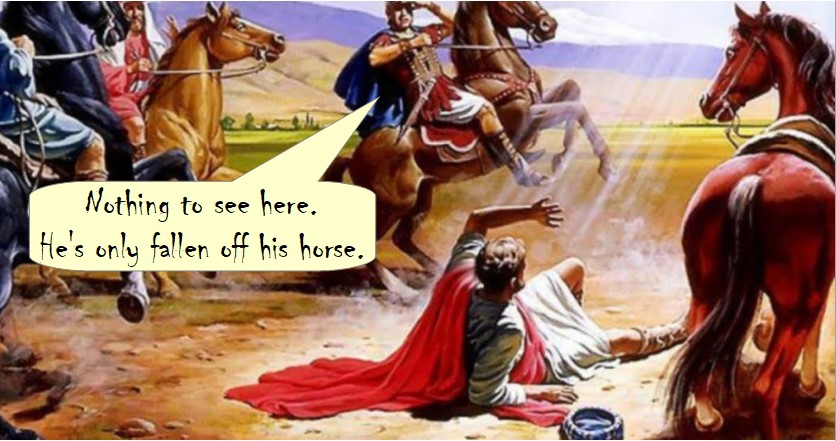
Looney Tunes


In the air are Satan and his evil host. On earth are his servants – the masses of demons – and his innumerable worldwide human slaves. Throughout the once Christian West and America Satan’s slaves are all of the ungodly souls who have rejected our Lord Jesus Christ in favor of darkness, rebellion, autonomy, power, materialism, and a life of sin.

Linda Kimball, Renew America

This is reality for some modern day fanatics. They lift this sort of baloney from Ephesians (2:1-2, 6:12) which they attribute, erroneouslyto Paul.

It has to be true because it’s in the Bible. We must all respect it too because whackadoodle Linda believes it sincerely. Who needs evidence, sanity even, when you can diss every other human being like this? You can forget loving your neighbour as yourself when your neighbour is nothing more than a demon-possessed slave of Satan!

Anti Podeans

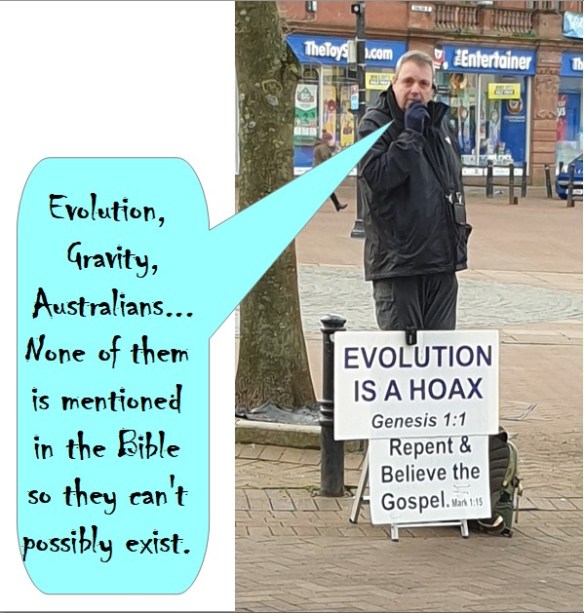
In Heresy (p243-248), Catherine Nixey relates how Greek philosopher Plato (b. circa 247BC), aware that the Earth was spherical, speculated there were lands on the other side of it. He ‘posited the idea that if one walked around the world far enough, one would end up in a position where one’s feet (podes, in Greek) would be opposite (anti-) the position you had been in when you first started walking… the notion of Antipodes had been born.’ By the first century AD, ‘Pliny the Elder… was therefore able to observe that all educated men agreed the world was spherical and that there were Antipodes.’ He wrote of the inhabitants of the Antipodes whom, he said, were as unlikely to fall of the world as those who lived in the northern hemisphere.

A thousand years after Plato and we find Christian writers rubbishing the ideas of these clever men. One, Lactantius (b. 240), declared that the idea the Earth was spherical was ridiculous and lampooned the ‘senseless’ notion that there were people on the other side of it ‘whose footsteps are higher than their heads.’ The ‘pagans’ who suggested such things, he argued, needed ‘divine instruction; for that only is wisdom.’ Augustine (b. 354) too argued that there were no Antipodeans in the Bible and as ‘there is no falsehood in scripture’, then Antipodeans could not possibly exist; the very idea was ‘absurd’. And so it continued: ‘Saint’ Jerome (b. circa 342) declared that the notion of Antipodeans was ‘witless’, while Cosmas Indicopleustes (6th century) wrote that ‘pagans’ ‘vomit out fictions and fables’ about the earth and solar system. He set about disproving these fictions from the Bible and did so, to his own satisfaction at least.

Scripture and the teaching to which it gave rise, set human knowledge and learning back a millennium: the so-called Dark Ages, in which, thanks to the church, ignorance and superstition prevailed. It wasn’t until the thirteenth century that Greek ideas began to be rediscovered and revived.

Despite this, there are plenty of people around today who think that the world was created in six literal days, a virgin gave birth, they themselves will live forever and the world will end soon when Jesus comes through the clouds. All because the Bible says so.

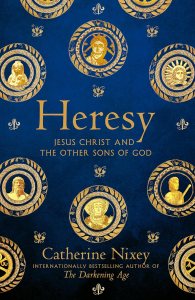
Heresy: Jesus Christ And The Other Sons Of God

I’m reading Catherine Nixey’s new book Heresy: Jesus Christ And The Other Sons Of God (I reviewed her previous one, The Darkening Age, here). Among other things, she demonstrates in Heresy how Christianity is a product of its age,  an age when dime-a-dozen saviours, miracle cures and resurrections were seen as real. Nixey also shows how, from the start, there were many ‘Christianities’, not just one. The set of beliefs that eventually became, by fair means and foul, the orthodoxy, jostled alongside hundreds of others for well over a century. Despite their proliferation, however, early Christianities remained an insignificant cult for almost two centuries.

Those who recognised these early forms of Christian beliefs for what they were, were vociferous in their criticism of them. Much of what they had to say no longer exists, unfortunately, thanks to later Christians who frequently destroyed it. We know of it, however because of what survives in the works of Christian writers who in their refutations quoted from it.

The arguments offered by these early critics still sound remarkably relevant today; the objections of modern sceptics are not really new. The likes of Celsus (b. circa AD140) and Porphyry (b. circa 234) came up with them first. Their early criticism bears repeating:

Celsus:

If these people proclaim Jesus, and others proclaim someone else, and if they all have the common glib slogan, “Believe if you want to be saved, or else away with you – well then, what will those do who really want to be saved? Are they to throw dice in order to divine where they may turn, and whom they are to follow?’ (Heresy, p26)

Those who claimed to have witnessed the resurrection were either ‘deluded by… sorcery, (or through) wishful thinking had an hallucination due to some mistaken notion. (An experience which) has happened to thousands’. (p47)

while he (Jesus) was in the body, and no one believed upon him, he preached to all without intermission; but when he might have produced a powerful belief in himself after rising from the dead, he showed himself secretly only to one woman, and to his own boon companions.(sourced here)

According to Porphyry,

Christian parables were ‘fictitious’… no more than imaginative little stories… replete with stupidity, written in a ‘comical and unconvincing style. (Heresy, p24)

Responding to Christians’ belief in bodily resurrection, Porphyry points out that many ‘have perished in the sea and their bodies eaten by fishes and many have been eaten by wild birds and animals. How then is it possible that these bodies should return?’ (pp47-48)

How indeed.

Critics like these were soon silenced, their work burnt – Celsus’ survives mainly in Origen’s rebuttal – and, as the church assumed greater power, so too were later authors.

As Nixey demonstrates, the word heresy originally meant ‘choice’. For Christians it soon came to mean making the wrong choice, the adoption of beliefs that did not conform to those who, in the ascendancy, came to control ‘Christian Truth’. Whoever chose otherwise, including those of alternate Christianities, were condemned as heretics in the new meaning of the word.

(Edited for sentence drop-out)

Gullibility

On the left, oily evangelical preacher the reverend canon Mike Pilavachi (yes, really. No irony at all in those self-aggrandizing titles.) Pilavachi used his spiritual authority to abuse young men, compelling them to take part in homoerotic wrestling matches and providing them, for his own kinky gratification, with full body massages. Because, you know, it’s what Jesus would’ve wanted. He also bullied and manipulated others in his church and ‘across the world’ in his ‘ministry.’ So far so much par for the course.

What I find incredible is the reaction of one of Pilavachi’s victims, Matt Redman (right), musical partner in Pilavachi’s Soul Survivor church festivals.

Redman had this to say recently:

I think Jesus is an expert at bringing things into the light, and I think that’s what’s happening in this whole process. I think Jesus is doing this. I think Jesus is cleaning up his church and bringing something into the light that needed to be in the light.

What lunacy! Jesus will bring the sordid goings ‘into the light’, which raises more questions than it answers :

Was it Jesus who brought these doings into the open or was it victims who found the courage to speak out? If it really was Jesus, why didn’t he reveal matters much sooner to prevent more young men from falling foul of the deplorable Pilavachi’s abuse? Why, indeed, did Jesus not prevent the abuse in the first place, saving everyone the pain and psychological damage Pilavachi’s actions caused? Why did Jesus not make Pilavachi into a brand new creation, as promised in 2 Corinthians 5:17, when first he imbued him with his Spirit, a creation that lacked the desire to manipulate and abuse others?

I think we know the answer to all these questions.

Believing in Jesus is to believe in a fiction that has no more concern for your well-being than Casper the Friendly Ghost (to whom he is closely related). As much as I empathise with the vulnerable Matt Redman, he needs to be less forgiving of Pilavachi, reassess his reliance on a shadow and face reality. If anything, his belief in Jesus led him into the clutches of a psychopath who used him for his own gratification.

Mike Pilavachi has yet to be questioned by police. I guess Jesus really does look after his friends.

Respect

Even before the events in Israel and Gaza, there were numerous recent examples of the term Islamophobia being used to suppress freedom of expression or shield wrongdoing.

A recent report by an all party group of UK MPs.

I’ve been told before that I should respect people’s religious beliefs. We all should apparently.

I can’t, I confess, summon respect for patent nonsense, nor for those who subscribe to it. I’m not even going to try.

There have, I admit, been a few believers I’ve met in life for whom I have had respect and even admiration, but this has been for the kind of person they were, not because of their religious beliefs per se. And no; their religion is not what made them admirable people. They were admirable irrespective of, or even despite, their irrational beliefs. I still hold to the theory of my own making, that religious conviction is like alcohol: both accentuate the existing characteristics of the individual, making them more of the person they already were, for better or for worse.

Equally, I’ve met many non-believers (I hate it that we have to describe ourselves as what we are not), LGBT people (for many religionists, the antithesis of admirable) and individuals whose views and outlook on life I haven’t necessarily agreed with, for whom I have also had respect and admiration.

It comes down to the old cliche, a truism nonetheless, that respect has to be earned. Just because someone believes in the supernatural or that Jesus died for our sins or that their deity or prophet trumps all others doesn’t mean I have to respect such views, or indeed those who hold them.

But this is where we’re headed, it seems. We’re expected to respect any old make-believe so long as it comes under the banner of religion and still more that doesn’t. It’s becoming ‘hateful’ to criticise religious belief and those who practise it. Because their views are sincerely held, the thinking goes, they merit protected status.

I commented some time ago on a Christian site (something I rarely do except when incensed) that was insisting ‘sodomites’ would burn in hell, because… the Bible. I countered that gay people were not going to hell because, in fact, no-one was. As well as the subsequent ‘loving’ comments from Christians, I was taken to task by a gay person telling me I was disrespecting the original poster’s Christian convictions.

Likewise when I suggest that we should be more wary of Muslim beliefs I’m told I’m being profoundly unfair, racist and Islamophobic, towards a minority – as a minority of one myself – and I should show more respect for an ancient and sacred tradition as well as those who subscribe to it.

I can’t do it. I can’t respect religious belief. It is no more worthy of respect than astrology, palm reading and spiritualism. It flies in the face of rationality. Not only is it insupportable, it is dangerous, a threat to hard-earned freedoms and rights.

Presenting a well-thought through Christian Response*

If there’s one thing I love about writing this blog it’s the considered, articulate comments I get from loving Christians.

A brave anonymous commenter left one the other day on the 2015 post ‘Gentle Jesus – meek and mild?‘. Short on time and rhetorical skills, Brave Anon opted instead for a different range of tactics. Here’s what he(?) had to say:

I’m a little short on time, and i wish I wasn’t, because I could pick apart your post piece by piece for hours. I WILL say though, that I’d expect someone who has dedicated a whole site to this matter to have actually read the book he’s so dedicated to disproving. It’s pretty clear that you haven’t and only used quick Google searches to try to prove your point. The big thing that i’d really like to point out is that most of the scripture you quoted to try to prove your point is from the Old Testament. That means it was law BEFORE Jesus was born. Yes, some of them are pretty harsh. That is why Jesus whittled the 613 commandments in the OT down to 10 in the NT. The most important being, ”Love the Lord your God with all your heart, and with all your soul, and with all your mind.” The most important one, right behind that, is to, “Love your neighbor as yourself.” That is why I just prayed for you. I wish that people like you would get away from trying to disprove the Word and find something else (literally ANYTHING else) to spend your time doing. What do you have to gain by making this site? Do you have such little self worth that, as a grown adult (I assume, but maybe I’m wrong), you really need someone to pat you on the back and say, “WOW! You did a really good job! You get a gold star. That means, you get to pick out what toy you want to play with at recess first today!” Will, if that’s what you need, I ain’t the one to say it. Your arguments are weak, and you are clearly uninformed on the subject you’ve chosen to focus on. Why don’t you, at least, read the Bible (I mean cover to cover) before you speak on it. If you need a little motivation, why don’t you remember that Satan knows the Bible better than ANYONE here on Earth. I mean, even better than the POPE!!! Familiarize yourself so you can, at least, make an educated, organized, well informed, argument. You do that, and I’ll consider giving you a shred of respect. Otherwise, good luck on your day of reckoning. I hear it’s hot down there, so make sure you pack shorts!!

Let’s ‘pick apart’ the tactics in use here:

  1. Mind reading: Brave Anon knows that I have never read the Bible. Impressive. Wrong, but impressive. He uses his telepathy too to work out my motivation for writing: so I’ll be rewarded with praise. Thanks, Brave Anon; in the 12 years I’ve been blogging I’ve never realised this.

  2. Jumping to conclusions: Brave Anon decides all my information comes from Google. While it’s true I do use Google to verify sources and provide links to articles, when it comes to the Bible, I quote it directly. All those references in brackets are the clue that this is what’s going on. They look like this: (Matthew 7:1-3), (1 Corinthians 5:12). Brave Anon might want to look these two up on Google.

  3. Confused irrelevancy: Brave Anon is unhappy I ‘quoted… from the Old Testament’ in the post in question. Wait – didn’t he just say I’ve never read the Bible? Isn’t the Old Testament part of the Bible any more? The point made by the post is that Matthew’s very Jewish Jesus says that the Law – that’s the one in the Old Testament – will never pass away, not one jot or tittle of it. Wasn’t the Old Testament, under a different name of course, the only scripture Jesus knew? Maybe that’s why I quote it alongside the later stuff Matthew makes up for him to say.

  4. Intuition: Brave Anon intuits I’m a full grown adult. Brilliant. He could of course have read ‘The Author…’ above, which would have told him that, and would also have informed him of why I post what I do. Guessing is so much more effective though, don’t you think?

  5. Condescension: Brave Anon prayed for me. Nice. Nevertheless, he felt moved to send a derisory comment.

  6. Withholding his respect: Jeez, if I’d known this was going to happen I’d never have written the post. I’m positively bereft.

  7. More confused irrelevancy: Satan, the capitalised POPE… what the…?

  8. Desperation: ‘Just wait until the day of reckoning then you’ll regret criticising my buddy Jesus ‘cause you’ll be burning in hell!’ This threat is always a part of Christians’ comments. I’m thrilled Brave Anon remembered to include it.

Thanks for dropping by, Brave Anon, and for reminding me to pack my shorts.

*Not really.

Who Decides What A Culture’s Values Are?

Did you decide? Would you prefer to live in culture based on Christian, Islamic or Marxist values? According to some Internet Christians, these are the only choices available. Of course anyone with an ounce of sense and a modicum of honesty knows they’re not.

I choose to live in a society that is not dominated by cherry-picked Christian values, or indeed ‘values’ derived from any religion. I reject the claims of them all, including their demonstrably false notion that I and my fellow citizens cannot behave ourselves unless controlled by a morality imposed by an imaginary deity. Likewise, I don’t care to live in a culture determined by an extreme political ideology that serves only one part of society: usually the elites who devise the ideology in question.

Instead I choose, or rather was fortunate enough to be born into, a relatively liberal democracy, capable of determining its own values. These are largely secular and humanistic and include, amongst others, the rule of law, tolerance, and freedom of speech and movement. Of course the UK has never fully realised these aspirations but there has always been a sense, since the 1960s, that we were moving towards them. Perhaps I’m naive to think this, given the turbulence of the Thatcher years and President Blair’s mania for regulation, but overall it used to feel that we were moving gradually towards a fairer, more reasonable society.

It doesn’t now. The elites have embraced a wokeness that benefits a limited few and have redefined terms – ‘woman’, ‘crime’, ‘offence’, ‘hatred’ and ‘phobia’ among them – which has impacted negatively on personal rights and freedoms. They have reinterpreted the law so that it benefits vocal minorities while side-lining the majority. They have repeatedly reneged on promises and over-reacted to the crises of recent years – Covid in particular – by granting themselves greater powers to manage their own over-reaction; powers which, once each crisis has passed, they have declined to relinquish. The values of Britain today, as imposed by the governing classes, are overly woke and authoritarian. In my 68 years, I have never felt as micro-managed in my personal life as I do today.

So, I do understand why there are those who call for the return to what they perceive as Christian values or a cultural Christianity of church bells and hymn singing. I understand too the fear of some that the waning of Christian influence will see extreme Islamic values fill the vacuum. This seems to me to be a real possibility and one that would prove seriously detrimental and damaging to British society. However, attempting to resurrect nebulous ‘Christian values’ in order to prevent more intolerant ones from being imposed is no solution.

We need to be clear about our values and assert those we aspire to: tolerance, liberalism, democracy, freedom of speech, rights for all, equality under the law and, I would add, truthfulness, honesty, fairness, consideration and reasonableness. For a time, this may very well involve being intolerant of intolerance, whether derived from Christianity, Islam, wokeism or political ideology. In particular, we need to stop conceding ground to Islam and resisting the demands of Muslim activists when they conflict with the values and aspirations of the majority.

Perhaps none of this will matter to me, given I’m not going to be around for many more decades (if that). But I would like the Britain my grandchildren grow up in to be one that reflects humane, secular values. I fear for them that it might instead operate on the basis of oppressive, intolerant religious ones.


free speech

Why We Can’t Return To Christian Values

There has been a spate of articles recently advocating for a return to Christian values in the UK. Some, like that by Madeline Grant, don’t specify which values they have in mind. Nonetheless, Ms Grant worries about these unspecified values being replaced by the ‘terrible new gods’ of wokeism, while Douglas Murray – an agnostic commentator I admire and enjoy a great deal – argues for the revival of Christian forgiveness. Elsewhere, Richard Dawkins repeats his call for the preservation of ‘cultural Christianity’ in the face of less ‘decent’ religions like Islam.

I’m sure there are good arguments to be made for exercising more forgiveness both in our personal and national lives, though the idea is not without its difficulties. Dawkins too is right to express concerns that the vacuum that may be left as Christianity declines might be filled with more unsavoury and less charitable values.

But what are the Christian values that these writers see less of in modern life? For Dawkins it’s the chiming of church bells and rousing hymns, which, as pleasant as these are (I would not like them to disappear either) do not have any bearing on our morals and values.

According to Total People, our values in the UK are Democracy, the Rule of Law, Respect & Tolerance and Personal Liberty. Certainly the UK has long regarded itself as a tolerant country – though those on the receiving end of intolerance in the past (early immigrants, gay people for example) might disagree – and we have always aspired to show respect without necessarily achieving it. Our morals on the other hand, especially with regard to sex (and Christians invariably mean sex when they talk about moral decline) have changed over the last 30 or so years, becoming more tolerant of, for example, same-sex relationships and less accepting of adulterous or abusive ones.

The question is, however, do we owe our values and morals to Christianity? I’ve argued before that we don’t. I’ve also tried to demonstrate that there is no time in the past we could pinpoint and say, ‘here’s where the country demonstrably and consistently upheld Biblical principles, showing us just how far we’ve fallen since.’ I applied this criterion to the USA when Don Camp suggested there was a now lost Christian golden age, taking random points in US history and demonstrating there never was a time when Christian values prevailed. Any such golden age is a myth, in the States, the UK and anywhere else. It always has been so; read Paul’s first letter to the church in Corinth to see how far even early cultists fell short of his ideals. Christians themselves don’t and never have demonstrated the high standards the bible demands.

Why is this? Because Christian morals and values are impossible. Even those who think they live with the Holy Spirit in them fail, and frequently fail dramatically, to practise what they preach. They don’t love their enemies, a ridiculous expectation of Jesus’s that certainly can’t be extended to nations. Many of the righteous don’t demonstrate love for their neighbours (other than bombarding them with the gospel) and frequently showing an appalling lack of empathy for fellow-believers (take a look at the abuse that goes on in the church at large.) They don’t, in the main, sell all they have and give the proceeds to the poor; give to anyone and everyone who asks and give away their shirt as well as their jacket when it’s demanded of them. They do judge others but don’t – sorry, Douglas – forgive fellow-believers seventy times seven, let alone those of us they regard as the great unwashed. Perhaps it’s as well; what would a culture be like that repeatedly forgave its criminals, abusers and bullies?

The frequently ignored Golden Rule of ‘do onto others as you would have them do unto you’ predates Jesus by centuries, while the more realistic, secular version of it, tolerance and respect, likewise doesn’t derive from the Bible, Jesus or the church. This Holy Trinity of terrors demonstrate a marked absence of tolerance and respect for any positions other than their own and ‘personal liberty’ is not a concept known to them. Didn’t Jesus insist his followers become his slaves? His Father, meanwhile, is intolerant of everything human beings do and everything they are.

A Christian who commented on Grant’s article asked those who disputed her premise – that we need to return to Christian values – whether they would prefer to live in a country dominated by Christian, Islamic or Marxist values. I’ll leave his question with you – answers on a postcard please – and return to it next time.

.

Death and Taxes. But mainly taxes

Can I have a rant? I’m sick and tired of tax I have to pay in the UK to pay for others’ ill-conceived schemes and failures. I know a society depends on taxation for its services; taxation, in theory, ensures its successful operation. Here in the UK taxation pays for health care, policing, the justice system, defence, amenities, schools, welfare support, local services and the salaries of local and national government officials. However, British tax payers are currently paying the highest tax in 70 years – since World War 2 in fact.

Currently in the UK, average incomes are taxed at 20%. Purchases on everything except essential food items and children’s clothing are taxed at 20%, petrol at a staggering 54%, average house purchases at 5% while so-called green taxes are set at around 15%. Then there are local taxes, based on property size, road tax for those who drive and inheritance taxes that limit how much an individual can pass on to his or her offspring of money that has been already taxed. Plus the tax on alcohol (variable but around 25%), sugar tax (an average of 21p per litre of fizzy drink), house purchase tax (‘stamp duty’), inheritance tax and tobacco tax. It is estimated the average working person in the UK pays in the region of 40% of their income in tax.

What does the government do with all the money it collects? Too much of it pays for government bungling:

  • The mess made of the Covid pandemic when almost 10 billion pounds of public money was wasted – thrown away – on unusable PPE equipment. More tax payers money is now being spent on destroying that same equipment, while the Covid Enquiry, set up to discover just how badly the government bungled lockdown, is currently costing tax payers a further 156 million pounds.
  • Approximately 10.3 billion pounds was lost on the government’s Covid support scheme in 2012-22 due to ‘fraud and error’. In the same period, a further 40 billion pounds was wasted on other government schemes, none of which it was capable of operating with any degree of competence. 
  • The government’s inability to control immigration, both legal and illegal, despite numerous promises it would do so. I have a great deal of sympathy for those fleeing danger (though many who claim asylum in Britain are actually coming from France) but the UK’s services – those mentioned above – simply cannot cope with the increased numbers. Asylum seekers are initially accommodated at a cost of 8 million pounds a day, 1.3 billion pounds per year, in hotels and houses bought or rented by the government’s appointed agencies. It takes about 18 months for the Home Office to assess whether applicants can stay.

  • The 537 million pounds of tax payers’ money the government gave to China between 2009 and 2021. This apparently funds private enterprise in a country known for its disregard of human rights, one which the government itself has recently said poses a major threat to world security. It is currently donating a ‘reduced’ amount of 10 million a year. Why? Is this little more than protection money?

    Last year, the UK also gave £33.4 million to India, a country with its own space program. The amount is set to increase to £57 million next year. The UK government claims that much of this is for ‘business investment’. But again, why?

  • The 480 million pounds being handed over to French authorities in return for them preventing smugglers leaving French shores with illegal immigrants in unsafe rubber dinghies. The French authorities fail to do this but the British government continues to pay them.

  • The subsidies government hands over to private business, like the train companies that now receive more tax payers’ money than they did when the system was in public ownership.
  • The bailing out of failing banks in loans, only a small fraction of which is ever repaid despite the extortionate amounts the banks continue to pay their executives in bonuses.
  • Redundancy payments made to those in failing private businesses: the Body Shop is the latest to benefit from tax payers’ largesse.
  • Paying not just the salaries but the pensions of civil servants, bureaucrats, politicians and police. (Disclosure: as a former teacher, I paid, together with my employers’ contributions, for my own pension.)
  • The generous pay increases MPs award themselves. The latest only a few weeks ago was 5.5%. Local councillors meanwhile awarded themselves 20%, again payable by tax payers. The bars and restaurants in the Houses of Parliament are all subsidised in the same way, as is the heating of MPs’ second homes.

  • The endless expansion of the civil service, some of whom are currently considering striking because they have been told they must turn up at the office two days a week. This, they say, is an imposition too far, contravening the basic human right to work at home in their pyjamas (or something.)
  • Failing to get people back into work and paying those who will not work, often over entire lifetimes.
  • Unnecessary green policies. Britain has little need, despite the ranting of a few excitable extremists, to rush headlong into unsustainable green policies. Green taxes are, in theory at least, passed to multi-billion pound industries, that are more than capable of doing so for themselves, to develop more sustainable energy sources.
  • For the government’s failure to reform the NHS, which, it is estimated, employs as many administrators and bureaucrats as it does clinicians and medics, the people who actually deliver health care.

Tax payers’ money is not the panacea for all the problems politicians have failed to resolve. Liberally throwing tax payers’ hard-earned cash at whatever problem arises should not, on every occasion, be the first resort. It ought to be the last. It is easy to spend other people’s money, without accountability, and easy to waste it. When it runs out, it is equally as easy to increase taxes to extract still more from the masses. This is precisely what happened last year when taxes were, yet again, raised ‘temporarily’.

There is nothing I and ordinary hardworking people can do about this unjust, exploitative arrangement. We can vote against the current governing party and perhaps, as seems likely, have it replaced with another who will tax us just as much, or, as seems likely, more. They will then waste our money on other self-serving, hair-brained and ultimately fruitless causes.

End of rant.


Crime the Newspeak way

Reports coming in of a burglary in progress, Sarge.

Burglary, you say? Not our responsibility, son. The householder will be insured, don’t worry.

But, Sarge…

Stop stressing, son. We’ve got more important things to deal with.

Like what, Sarge? Stopping those Save The Planet extremists from bringing the motorway to a standstill?

Don’t be daft, lad. That’s not our concern either. They’re entitled to disrupt whatever they like. It’s a human right so long as they’re supporting some cause or other.

But what about when they damage public property, Sarge? Shouldn’t we intervene then?

Not likely! We don’t want to be seen as the unenlightened tools of an authoritarian state.

Like we were in Lockdown, you mean?

That was different.

But what about the vandalism? You know, when they throw soup at old paintings and cut them up with knives?

Self-expression, son. They’re entitled.

So vandalism’s not a crime anymore?

Only when it’s motivated by hate. Then it’s a hate crime – obviously.

What about shop-lifting then? There’s been a lot of that lately.

Dear, dear. That’s totally different, lad. Shops are insured and can always pass the cost of a bit of light pilfering onto paying customers. It’s not a problem that need concern us.

None of this is as simple as I thought it was going to be.

You’ve got to get your priorities straight. That’s the key.

What do you mean, Sarge?

What you need to be concerned about is whether what somebody’s written on social media is a hate crime. And let me tell you, it usually is.

Right.

You’ve been on your 10 day Hate Speech Detection training, haven’t you? You should know all this.

I found it confusing, Sarge. I wasn’t sure that criticising God-botherers or misgendering someone was really, well… hate. And I couldn’t tell either whether somebody just expressing their views was what you’d call hate speech.

Listen, son. As a rule of thumb, it’s all hate speech. Or, as we’re going to be calling it from hereon in, ‘a non-crime hate incident’.

But if it’s not a crime, Sarge, why are we bothering about it? I mean, aren’t we supposed to be dealing with, you know, real crime?

What, you mean petty things like burglaries and thieving, anti-social behaviour and vandalism? Don’t be daft, son. That’s not what we’re about any more.

But I thought…

You see, that’s your problem right there, son. You’re not being paid to think.

But…

I’m putting you down for 10 days Non-Crime Hate Incident training. We’ll soon have you licked into shape, don’t you worry.

But, Sarge…

_______________________________________

The Scottish Government’s foolhardy Hate Crime Act comes into force today, April 1st.

Canada introduced such a law earlier this year.

Who’s next?