Conclusions

So what do we see when we arrange the books of the New Testament in chronological order?

  1. In all probability, Jesus was first experienced in visions experienced by a few Jewish zealots looking for the arrival of the Messiah. His name – Yeshua – is symbolic and means ‘The Lord is Salvation’.

  2. These visions led to ‘revelations’ that convinced these zealots that the Messiah would soon arrive on the Earth to set God’s plans in motion.

  3. A small number of Jews were convinced of the veracity of these claims and sought to spread the message that the Messiah/Jesus was soon to arrive on Earth.

  4. A few years later, a Hellenized Jew who called himself Paul, argued that the Messiah – ‘Christ’ in Greek – had died in the heavenly realm and been raised from the dead by God. His sacrifice, Paul insisted, was a propitiation for human sin, both Jew and Gentile.

  5. Also according to Paul, the Christ’s arrival would trigger the resurrection of the dead, prophesied in Daniel 12:1-3 and Isaiah 26:19-20, the final judgement (Daniel 7:22) and the establishment of God’s kingdom on Earth, governed by God’s Chosen (Daniel 7:27). Regrettably, he drew most of these conclusion from a book, Daniel, now known to be fake.

  6. Paul ‘proved’ that the Messiah-figure he’d seen in his visions really was the Messiah prophesied in Jewish scripture by quoting from them extensively.

  7. Soon after Paul died, the original group of visionaries, who had had their differences with Paul, were all but wiped out when the Romans destroyed Jerusalem.

  8. Around the same time, an unknown cultist took it upon himself to write an allegorical history of the Christ’s activities. He based this allegory on Paul’s teaching about the Christ as well as events from Jewish scripture. He set his story in Galilee some forty years earlier and has his fictional Christ, Jesus, prophesy the arrival on Earth of the real Messiah whom he calls the Son of Man, after Daniel 7:13-14.

  9. Two other cultists set about altering and improving this original history. One re-establishes the Christ’s Jewish credentials, and extending references to and allegorising aspects of Jewish scripture.

  10. A completely imaginary history of the early cult was created by one of these writers, smoothing over the differences between the beliefs of the earliest visionaries and Paul.

  11. Other writers, including some pretending to be the late Paul, continue to write of Jesus the Christ as a celestial saviour.

  12. A fourth history of the Christ was created, this time providing Jesus with a bodily resurrection (contrary to Paul) and discarding some of the cult’s earlier beliefs, the imminence of God’s kingdom on Earth included. The authors of this account imply that dead believers will awaken to new life in heaven (John 14:2)

  13. The idea that the Messiah will arrive imminently was, however, kept alive by other writers. One anticipated the Christ would soon purge the world of evil-doers and bring a holy, bejewelled Jerusalem down to Earth.

  14. Others soon abandoned the idea that any of this would happen soon. The arrival of the Christ was postponed indefinitely.

  15. The notion the Son of Man/Messiah/Jesus had yet to appear was also dropped as the church adopted the allegorical gospels as real history. It began to expel those who disputed the gospels’ veracity and denied that Jesus was the Christ incarnate.

  16. While the term is not used in the New Testament the Christ’s delayed arrival was, from the early second century, thought of as a second coming.

  17. The church, once well established went on to embellish doctrine, adding the Triune God; eternal life in Heaven; the elevation of Mary and the saints; the New Testament as the Word of God and the infallibility of the Bible as a whole. Some of these were, and are, in direct contradiction of the beliefs of the earliest Christians.

  18. Believers today, if they read the New Testament at all, take its traditional order at face value, which distorts the evolution of its ideas. They allow their preachers to smooth over what now appear to be random contradictions (hermeneutics).

  19. Today’s Christians believe primarily in the heavenly Christ, who forgives their sins and guides their lives from Heaven. They also hold on to the belief that he was manifested as a human, and vociferously oppose the idea he was and is only an imagined supernatural being.

  20. At the same time they prioritise Paul’s teaching about him over anything he is made to say in the gospels .

That how I see it anyway. The more time I spend looking at the New Testament books in their correct order, as well as what this reveals about the beliefs of early Christians, the more I’m driven to these conclusions. They’re the only ones that make sense of all that we find in their writings. I realise this is contentious. Mythicism is not widely accepted but it is the only position that explains the recorded facts as we have them. The original Jesus was seen (in the mind of the first visionaries and by many later) as a heavenly Messiah. While the gospels were generally accepted as historical many decades after they were written, they are anomalies in the expression of the early faith. They can only be seen as allegories of the living, dying and rising of a cosmic saviour, a sequence not uncommon in the mythologies of the ancient world.

I recognise too that there may well be other problems with this position, which I’ll get to soon.

The New New Testament: part 3

Following the fourth gospel is the epistle of Jude, written at the end of the first century. It is certainly not by a brother of Jesus, despite this traditional attribution. Rather, it addresses false teaching in the Christian community of its day. It makes its points with reference to characters in Jewish scriptures and even mentions the apostles (those who had visions of Jesus) but knows nothing about an earthly Jesus. Parts of Jude are lifted wholesale into the later forgery of 2 Peter.

And then… another made up Jesus! This time the avenging angel of Revelation. I’ve written about Revelation recently so won’t repeat it all here. Suffice to say, this revealing is completely within a disturbed cultist’s head. He wants to see those who oppose the cult to suffer at the hands of his the Messiah who sweeps down from heaven determined to wipe out unbelievers and set the chosen few up as rulers of a reformed Earth. This Jesus seems to have forgotten he once told people to love their neighbours, pray for those who persecuted them, humble themselves, give all they had to the poor etc etc. Revelation Jesus has no time for this sorta shit! Of course, he’s no more real than any of the gospel Jesuses. He’s simply another made-up version, ‘revealed’, or so his creator would have us think, from Heaven. Revelation is chockful of symbolism – The Whore of Babylon, the Number of the Beast, the Marriage Supper of the Lamb etc – all of it applicable to the time when it was written. It has no bearing on anything after that time and doesn’t, despite sloppy interpretations, feature ‘the Anti-Christ’.

The letters of John were all probably written by the same person. This is not the John credited with creating the fourth gospel nor Revelation’s nut-job. This John, or whatever he was really called, is concerned with divisions within his community, chiefly those caused by a group who denied that Jesus was the Christ (1 John 2:22). They were literally anti-Christ. This is where the term occurs in the New Testament and it doesn’t refer to a future madman who will crush Christians in his attempt to rule the world. It seems likely that John’s anti-Christs believed Jesus did not visit Earth as a flesh and blood human being. They were perhaps the last remnants of those Christians who, like Paul and most of the preceding New Testament letter writers, held that Jesus was a divine being, active only in Heaven. With these epistles then, written around CE 100, we turn a corner. Belief in the symbolic Jesus depicted in the gospels as a real man, has become the orthodoxy. It took some time to get here.

And chronologically, that’s about it. There are four forged books left, making the properly ordered New Testament end, not with a bang but a whimper. While 1 & 2 Timothy and 2 Peter claim to be written by Paul and Peter respectively their late date rules this out. 1 Timothy provides the infamous line that women should remain silent in church and obey their husbands at all times. 2 Peter has all the nonsense about a day being the same as a thousand years in God’s eyes. Its duplicitous author argues that God is delaying bringing punishment to the world so that more people might be saved. Evidently he lacks any mathematical understanding. You would think at this point the cultists would have realised that the cultists of the previous century, so certain of the Lord’s imminent arrival had got it disastrously wrong. But no. They reinterpreted their ‘revelations’ and prophecies so that instead of his arrival being ‘at hand’ it was now set to happen at any time in the future, even thousands of years ahead.

Christianity was all but dead at this point. It simply refused to admit it.

The New New Testament: part 2

We’re up to Hebrews in our new, chronological New Testament. The authors of Hebrews contend that their salvation was first ‘announced by the Lord’ and confirmed by those who ‘heard him’. This is not necessarily evidence of an earthly Jesus. Their declaration could equally refer to a cosmic Christ who, as he did with others, provided internal ‘revelations’, just as there are those today who claim Christ speaks to them in their heads. Hebrews’ authors say as much when they claim their faith has been confirmed by spiritual experiences such as ‘signs, wonders and various miracles, and by gifts of the Holy Spirit distributed according to his will’ (Hebrews 2: 3-4). They go on to announce that the New Covenant initiated by the new Moses – Jesus – is in every way superior to the Old Covenant and that he is the new, sinless high priest. Bizarre doesn’t doesn’t begin to describe it.

Hebrews contains the only example in the New Testament of a prediction of Jesus’ second coming: ‘so Christ, having been offered once to bear the sins of many, will appear a second time, not to deal with sin but to save those who are eagerly waiting for him’ (9:28). Hebrews, however, regards the Christ only as a supernatural high priest, operating in the heavenly realms. This second appearance then can only refer to this character, who is not conceived as having had any existence here on Earth.

Around the same time as Hebrews appeared, a senior cultist was writing to a group of Jewish Christians to remind them that faith alone isn’t enough for salvation. It must, James says, translate into improved behaviour. This runs contrary to Paul’s teaching which is that faith alone is sufficient. The letter mentions Jesus only twice (James 1:1 and 2:1) as ‘Lord Jesus, the Christ’. When reminding its readers to love their neighbour as themselves it doesn’t, as we might expect, tell them that this is because Jesus said so. Rather, it quotes from Jewish ‘scripture’; Leviticus 18:19 to be precise. An incongruous thing to do if, as some insist, the James in question was Jesus’ half-brother. In fact, the author makes no claim to have known Jesus and tells us nothing about him. He doesn’t make any reference to the teaching, miracles or activities attributed to Jesus in the first three gospels. Instead, he refers to him 11 times as ‘the Lord’ and tells his readers to be patient because ‘the coming of the Lord is at hand’ (James 5:8). Note what this is saying: the coming of the Lord is not a second coming or a return. And his arrival is ‘at hand’ (εγγύς, ‘engus’), meaning real soon, first century time.

Then, when you thought we’d never get to it, along comes a fourth gospel. Its authors revise the Jesus character and everything about him in this late entry. This Jesus speaks differently about different things. He’s fixated on himself, fully aware he’s a celestial being, completely in control of events, directing the entire story. The gospel introduces a new sidekick too, Jesus’ gay lover ‘the disciple whom Jesus loved’. This is possibly Lazarus, first introduced as a character in a parable in Luke 16:19-31 ‘John’, not Jesus, brings this symbolic character to life in the fourth gospel referring to him as the one the Lord loves (John 1:3). The previous three gospels know nothing of him as a real person.

John goes on to change the day of the crucifixion, to Thursday, because it fits his forced symbolism, and goes overboard in portraying the resurrection as a physical one, Jesus displaying his wounds and inviting the disciples to poke about in them. Preposterous grotesquery that, together with John’s unique resurrection accounts, the other gospel authors somehow missed. Were they not part of the much vaunted oral tradition when they wrote? Did they not know of it from Q? As commanding as John’s Jesus is, he is a very much a literary creation, of the ‘what if our celestial Christ had lived on Earth?’ type. But then again, aren’t they all?  

The New New Testament

With the New Testament books in their traditional sequence, it’s easy to conclude that there was first a remarkable individual who travelled around Galilee proclaiming the arrival of his Father God’s kingdom on Earth. He demonstrated great wisdom and compassion before being crucified by the Romans at the behest of the Jewish authorities. The first four books of the existing New Testament tell us so; that all of this happened first and all that follows occurred afterwards as a consequence of the events the gospels describe.

But, put the gospels where they belong in the chronological arrangement of the New Testament, and the events of the gospels do not happen first. Paul does:

I acknowledge that in putting the books in their correct order in my previous post, I cheated when I made the first the work of the very earliest cultists. No such book exists (no, it’s not Q and even if it were, we don’t have it). The earliest Christian beliefs are largely lost to us. All we know is that some individuals had visions of the Messiah. Paul tells us so in 1 Corinthians 15:5:

He (first) appeared to Cephas, and then to the Twelve.

These visions undoubtedly mark the beginnings of the cult. It later finds a convert in the Hellenized Jew Paul who he has his own vision(s). That these are visions and not an encounter with an actual person is clear from Paul’s declarations in Galatians 1:15-17 and 2 Corinthians 12. He stresses in Galatians that what he knows of the Messiah (‘Christ’ in Greek) comes not from any human source but from what this Christ has revealed to him in his own head: the revelations he’s fond of referring to. These, he says, showed him the importance of the Christ’s sacrifice, the crucifixion being the only Jesus event he’s interested in. Nowhere in his seven letters (1 Thessalonians to Philippians) does he mention anything a Galilean said, did or had done to him, apart from the crucifixion, which is mentioned without any historical detail. Paul’s interpretation of the crucifixion is devoid of Romans, the Sanhedrin, Gethsemane, Judas, Pilate, the scourging and cross carrying, Golgotha, the centurion, grieving disciples and empty tomb. Paul appears not to know anything specific about the event he obsesses over. Who can blame him when these details had yet to be invented?

Paul also has it revealed to him, or so he says, that this heavenly saviour will soon be coming down to the Earth to raise the dead, rescue the faithful who yet live and usher in God’s new golden age (1 Corinthians 15:52; 1 Thessalonians 4:16). It is an idea that permeates the rest of the New Testament writings.  

Paul’s faith, then, rests entirely on his visions/revelations. When proving that they really were of Jesus the Christ, he does so by repeatedly citing Jewish scriptures, never by referring to a particular saying, miracle or healing of an earthly Jesus. Paul’s Christ is a cosmic Superman who is raised from the dead as a ‘life giving spirit’ (1 Corinthians 15.46). (I’ve written about this on numerous occasions, including this post, so won’t reiterate all the details here.)

Written about a decade after Paul’s last letter, we come to the first gospel, which, lo and behold contains an abundance of sayings, miracles and healings of an earthly Jesus. Where did ‘Mark’ get these from? Not from a hitherto unknown document which won’t be posited for almost two millennia (Q); not from an ‘oral tradition’ when the only oral tradition we know of is Paul’s preaching, which doesn’t mention any details about an earthly Jesus.

  • To compound the problem, the first gospel is littered with angels, demons and other supernatural elements (voices from heaven anyone?)
  • It makes extensive use of stories from Jewish scripture, rewriting them and recasting their original protagonists with Jesus in their place.
  • It has him utter teaching that ‘astonishes’ those around him, when much of it is lifted directly from Jewish scriptures and would have been familiar to his listeners.
  • It makes him address the issues of the church as they existed around 70CE when the gospel was written and reflects the rules of the cult at that time.
  • It relies heavily on metaphor and allegory.
  • It has Jesus promise that the Son of Man will soon arrive on Earth to sort out its problems. This is Paul’s teaching about the imminent arrival of the Saviour through the clouds, dressed up in jargon from the book of Daniel. While apologists assume the Son of Man character is Jesus himself, promising his own future return, it evidently is not (it is rather, as I demonstrate here, a metaphor for the Jewish nation). What we have in Mark then, is a fictionalised Jesus predicting the appearance of the ‘real’ Christ from Heaven, just as Paul does.    

Mark’s gospel is most certainly not history nor an accurate record of the activities and teaching of a real human being. It is, as I’ve demonstrated before, fiction, from start to finish.

Following Mark in our chronological New Testament are two forged letters, purportedly by Paul (2 Thessalonians) and Peter (1 Peter) but actually by two different, anonymous authors. In them we’re back to hearing about a celestial Christ not an earthly Jesus. Earthly Jesus doesn’t get a mention despite the fact that one of the letters is supposedly by Peter, the fisherman who trailed around Galilee with Jesus for three years – allegedly – and witnessed his resurrection appearances. You think he’d have mentioned some of this in the letter. But no. Not a word.

And then two more gospels, both of which make extensive use of the first. ‘Matthew’ uses 80% of ‘Mark’ and adds some extra material of his own, including a birth narrative that is pure fantasy (including a magic dream and wandering star) and several new miracles. Where does this extra material (the so-called M source) come from? Some theologians speculate that again it’s from an oral tradition (the same hypothetical tradition used in Mark or a different one? Certainly not one known by Paul.) Even if so, we have no way of knowing whether it is reliable nor who originally reported it. It could just as easily have been invented by the anonymous creator of Matthew’s gospel. In fact, Matthew’s gospel is demonstrably a literary construct that plagiarises and embellishes Mark with more symbolic parallels – with Moses in particular – from Jewish scriptures. The stories of the resurrection are constructed in precisely this way.

Luke’s gospel is open to the same criticism. Where did his extra material (L) come from and why was it unknown to Paul and the creators of the two forgeries that preceded it? The obvious conclusion is that ‘Luke’ also made stuff up.

Here’s the problem with the synoptic gospels (those that carry the names of Mark, Matthew and Luke.) They appear in the midst of a sea of writing that knows nothing of an earthly Jesus and speaks only of a supernatural Superman. Yet we’re expected to believe that in the middle of this sea of myth and fantasy, the three gospels are an island of factual information about a real person. We’re required to accept that the synoptic gospels are reliable, factual, historical accounts of Jesus’ life on Earth. Apparently the gospel authors are the only ones who know the truth about his earthly existence while Paul and other writers evidently did not (or couldn’t care less about it) despite living and writing closer to Jesus’ supposed lifetime.

This is not the only problem. Even if the information about Jesus contained in the gospels was derived from an oral tradition, a hypothetical sayings gospel (‘Q’) or other lost sources (M & L) this would not make it any more reliable. It is just as likely to have been invented.

The next book of our chronological NT, the Acts of the Apostles was written by the same anonymous author as the third gospel. This story of the early days of the cult includes: a Jesus who beams up into the sky; visions; dreams; magic hankies and imaginary table cloths; angels; supernatural murders: miracle earthquakes and characters re-enacting events from Odyssey and the Jewish book of Jubilees. It gets Paul’s itinerary and theology wrong, smooths over his disputes with the pillars of the Jerusalem church and invents speeches for both him and various support characters. History it is not.

Immediately after Acts, we’re back to forgeries: Colossians and Ephesians, the latter being a composite of other Pauline letters and Colossians itself. We’re also back to the supernatural Jesus who makes salvation known through revelation. The two people who created these letters masquerading as Paul appear to have no knowledge of an Earthly Jesus. Had they not read any of the synoptic gospels? Did they not know any of the oral traditions or Q? Do they not care about all the supposedly factual information about Jesus that by this point was in wider circulation? Evidently not. They were interested only in promoting a celestial being, the Christ Jesus.

We’ll see more of this as we move on to the remaining books of the chronological New Testament, next time.

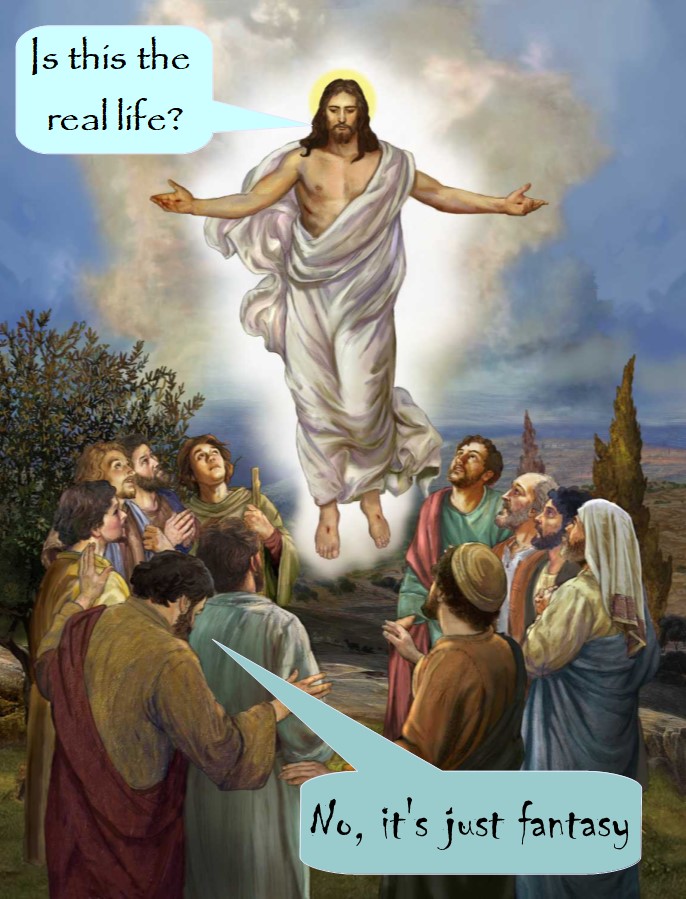
*It’s a trick question. Neither is any sense real.

The Lyin’, Cheatin’ Book

The Bible is a lyin’, cheatin’ book. And no, that isn’t the title of a long lost country song. The Bible was compiled by men who allowed themselves to be deceived and who were more than willing, perhaps unwittingly (to give them the benefit of the doubt), to dupe others. They included letters claiming to be by Paul and Peter that we know were not. They took the imaginary history of the early church, Acts, at face value, and the invented stories about Jesus – the gospels – as historical. They put them together in a way that made it look as if the gospels were written first, followed by Acts, Paul’s letters and the bulk of the forgeries. Paul’s letters they arranged, not in any sequential or thematic way, but from longest to shortest.

In fact, as far as Paul and the gospels are concerned, this is pretty much the reverse of the order in which they came into being. Of the documentation that made it into the New Testament, Paul’s genuine letters were first, starting with 1 Thessalonians in the late 50s and ending with Philippians in the early 60s. Only after Paul was dead did the first gospel appear (circa 70 CE), the anonymous account later attributed to ‘Mark’. After yet two more attempts to get the Jesus story right, came Acts, the notoriously inaccurate account of the early days of the cult and Paul’s adventures lifted from other sources. The fourth gospel followed much later, between 90 – 100 CE. Written by a sect of the late first century it offered a complete reimagining of the Jesus story. Along the way, numerous forgeries appeared as well as the lunacy that is Revelation, written circa 96 CE.

What would happen if we rearranged the books of the New Testament so they followed the order in which they were written? It would make them less duplicitous for a start and would also give us a more realistic picture of how Christianity arose. We would still be lacking a picture of what the earliest cultists believed prior to Paul but we can make a rough guess of what that might have been from what he says about those who preceded him.

We’ll do this next time and see what the newly ordered New Testament tells us about early Christian beliefs.

A New Kind Of Christian


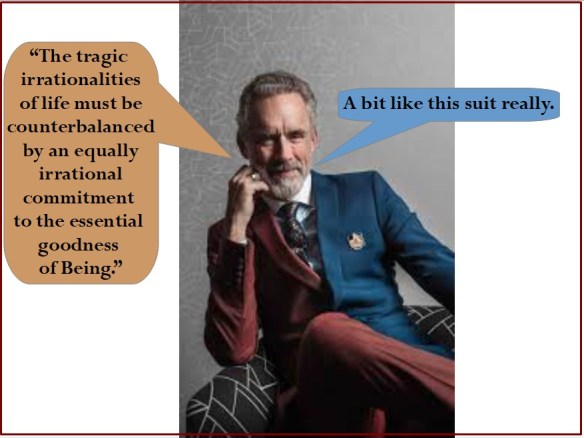
You’ll be overjoyed to hear that Jordan B. Peterson has a new book out. He’s been busy promoting the not at all pretentiously titled We Who Wrestle With God. He was interviewed about it recently in British magazine The Spectator. The interview has to be read to be believed. The introduction can be read here but the rest, alas, is behind a paywall. Don’t worry though, I’ll supply you with the highlights. The article is a goldmine of stupefying statements about God and how Jordan is the only one who really understands the Bible’s stories. They need ‘arranging’, you see, and their underlying ‘hypotheses’ understood:

The Bible presents a series of hypotheses. One is that there’s an underlying unity that brings together all structures of value. The second claim is that there’s a relationship between the human psyche and that unity and each of the main biblical stories casts that unity in a different light, accompanied by the insistence that, despite those differences, what is being pointed to is one animating principle. As far as I can tell, that’s correct.

You got that? As ol’ Jordan humbly admits, this ‘revolutionary realisation’ is his and his alone. Of course, none of this sort of thing is original; the idea that characters, events and stories in the Old Testament prefigure realities in the New is as old as the hills. Typology can be imposed on any set of myths. The gospel writers and Paul did it, seeing Jesus prefigured in Jewish scripture and inventing stories about him so that he complied with these earlier types. There’s nothing ‘revolutionary’ about spotting this, but like so many before him, Peterson gets it back to front and falls, quite literally, for the oldest trick in the Book. Continue reading

The Origins of Evil

Where does evil come from? The Billy Graham Organisation knows:

…the Bible does reveal two important truths about where evil comes from. First… evil comes from the Evil One — that is, from Satan… Satan is a powerful spiritual being who is absolutely opposed to God, and is far stronger than most of us realize. He isn’t equal with God, but is totally evil, and repeatedly works against God. Jesus called him “a murderer from the beginning…. a liar and the father of lies”.

No, not really. Evil is not a supernatural being cavorting around an unseen, undetectable spiritual realm while inflicting havoc on our reality (see here). Satan is not the embodiment of all evil for the simple expedient he and his minions do not exist.

What else does the Bible have to say about the origin of evil? Fake Paul in 1 Timothy 6: 9-10 claims that ‘…the love of money is the root of all evil’. He goes on to say, ’while some coveted after (money), they have erred from the faith, and pierced themselves through with many sorrows,’ which sounds suspiciously like a snipe at early Christians who refused to hand over their worldly goods to the cult.

Now, while greed and avarice can undoubtedly lead to wickedness, the love of money is not the root of all evil. Vindictiveness, spite, fear, ignorance, stupidity, hatred, lust for power, sexual lust, jealousy, coveting another’s property or territory, religious beliefs and deceit (take note, fake Paul): all can, and do, lead to evil.

Let’s give the Bible one last chance.

The author of Mark’s gospel has Jesus say:

What comes out of a man, that defiles a man. For from within, out of the heart of men, proceed evil thoughts, adulteries, fornications, murders, thefts, covetousness, wickedness, deceit, lewdness, an evil eye, blasphemy, pride, foolishness. All these evil things come from within and defile a man (Mark 7:20-23 NKJV).

While ‘Mark’ is talking about ritual purity in this bizarre mix of low-level immorality, religious offences and actual wickedness, he nails it as far as the source of evil is concerned. It emanates from human beings, most often, from men. While women are also capable of committing evil acts, and children too sometimes, most are perpetrated by men. 

It’s not easy finding evidence for this online, where misogynistic, religionist have taken over, claiming women are more evil than men on account of Eve eating the forbidden fruit. They also argue that women are more evil because they ‘hold a grudge longer’. However, a little digging dispels this ridiculous notion. Consider:

Are most dictators men or women? (Men, almost exclusively);

Are most genocidal acts initiated and carried out by men or women? (Men, almost exclusively)

Are most murderers men or women? (Men: 98% of murder convictions are of men);

Are most rapists men or women? (Men; 99% of convictions are of men);

Are rape gang members men or women? (Men, almost exclusively);

Are most child abusers men or women? (Men make up 88% of perpetrators);

Are most school shootings carried out by males or females? (Males, on a ratio of 145:4);

Are most terrorists men or women? (Men, on a ratio of 5:1);

Are most crime lords, drug barons and death-cult leaders men or women? (You already know the answer…)

Are most victims of sexual abuse male or female? (Female: 1 in 5 compared with 1 in 7 males)

Almost all malicious and unnecessary infliction of harm on others, nearly every evil act ever committed has been and is committed primarily by men. Only a small number are carried out by women. However, just because most evil is committed by men, not all men are evil. More than this, most human beings don’t commit ‘evil’. Neither do most Christians, though there does seem to be an inordinate number who are prepared to sexually abuse others. Nonetheless, many are happy to blame Satan for what evil there is, including their own. Attributing human evil to a malevolent fantasy figure is a duplicitous attempt to evade both responsibility and culpability.

In any case, according to true believers Satan’s main occupation is sowing the seeds of doubt in the minds of Christians, in an attempt to lead them away from Jesus (2 Corinthians 11:30). Satan is, when all is said and done, a pretty hopeless prop, not ‘a powerful spiritual being’ but an enfeebled metaphor for the evil that some humans engender.

Afterthought:

Where does goodness come from? That too is human. All compassion, kindness, consideration, empathy, helpfulness, love, joy and peace come from us.

Or not, as the case may be.

It’s the End!

AI shows how it’s done. Arrange your elements carefully, and – hey, presto! – Jesus appears!

I’ve reached the end! The end of Jonathan Cahn’s The Dragon Prophecy that is. He has me convinced: the end of the age and the world itself, is just around the corner. He looks around the world, particularly the Middle East, sees the state it’s in and dives into the scriptures to uncover the prophecies that presage present day events. He then reveals how, collectively, these scriptures accurately describe the state of the world today following Hamas’s invasion of Israel on 7th October 2023.

Had he collected these passages prior to 7th October, would they have accurately foretold the events of that day? They should’ve done if that’s what they are really about. So where was this expose before 7th October? Where were the books, by Cahn or anyone else, revealing how the Bible predicted in detail, events that still lay in the future? Predicatbly (pun intended), they don’t exist. Cahn’s The Serpent’s Prophecy could only be written with hindsight, after the events, 7th October 2023 in particular, that he’s decided fulfil biblical prophecy. The prescience of these ancient scriptures is only apparent, to Cahn if no-one else, in retrospect.

He gathers disparate verses together to demonstrate how they do indeed predict current events. He omits many that don’t, even though they too appear to prophesy the future. He does this because they don’t fit the picture he’s trying to create: his interpretation of events in Israel and the significance he wants ascribed to them.

Cahn disingenuously forces unrelated verses to work together, like pieces from different jigsaw puzzles, to create a picture that loosely and disjointedly conforms with and thereby confirms his own conclusions. 

The culmination of The Dragon’s Prophecy is that the time is right and the stage set for Christ’s ‘return’. Cahn advises his readers to surrender to him before he comes though the clouds to do unspeakable things to them. While none of the ‘prophecies’ he’s pressed into service have ever been fulfilled and are certainly not being now, this one must surely be the greatest of the Bible’s failed prophecies.

Does all of this sound familiar? It should. Starting with Paul and the gospel writers, numerous hacks have pulled together biblical prophecies to show how events of their times fulfil the conditions for Christ’s return.

More than this, the gospels were created in exactly the same way that Cahn creates his end-of-the-world scenario. Mark, Matthew and Luke, ruthlessly plundered ancient Jewish scripture to show how their suffering Messiah (whether real or not) was predicted there. Significantly, no-one prior to the early days of the Christian cult believed that these particular scriptures foresaw a suffering Messiah who would die for the sins of his people before coming back to life. The scriptures could only be made to do so in retrospect. After some claimed to have seen the risen Jesus, early cultists began to scour the scriptures for passages – how many they had to ignore or misinterpret! – that could be made to create a loose, disjointed picture of their super-hero. It’s how Paul attempted to persuade others that Jesus was the Messiah (1 Corinthians 15:3,4 etc).

So Cahn is doing nothing new, finding a ready audience for his particular sleight of hand.

When A Child Is Born… Supernaturally

To what extent are the conflicting nativity stories in Matthew and Luke historical? That depends on whether or not you believe in the supernatural.

There is no evidence of a supernatural realm nor the beings who are said to inhabit it: God, heavenly Jesus, the Holy Spirit, angels and those they are constantly at war with: Satan and his demonic hordes. It is not as Jonathan Cahn describes it in The Serpent’s Prophecy:

Behind the perceivable realm lies another, beyond our ability to measure or quantify. Behind the history of this world lies another, unrecorded, unrecited, unknown. And behind that which moves and transforms the world lie unseen forces, causes, agents, undying and primeval (p3).

Cahn cannot possibly know any of this, any more than fake-Paul could when he wrote Ephesians 2,000 years ago (6:12). A reality that exists above and beyond nature – the meaning of supernatural – that is ‘unseen’, undetectable and ‘unknown’ is one that doesn’t exist, except in the imagination of a few fantasists.

Yet the supernatural is the basis of Christianity. Without it, its agents, as Cahn calls them, could not have interacted with the only reality there is. The Holy Spirit could not have impregnated Mary; angels could not have materialised to announce Jesus’s birth to a group of credulous shepherds; a divine being could not have communicated through dreams with Joseph and the Magi; a magic star could not have been manoeuvred into place over Jesus’ house. Most significantly, a non-existent God could not have sent his ‘son’ into this world.

It is futile to argue whether Matthew or Luke’s nativity narrative is the more historically accurate. Nor is there any point in trying to harmonise the two accounts. Neither is historical: the involvement of the supernatural rules out their being factual.

The inclusion of the supernatural in everything that follows is also fatal to claims made for the gospels’ historicity. The clues are there in the text: God’s pronouncements from the sky; the inexplicable miracles and healings; the presence of angels, demons and Satan; the dead rising; visions, prayers and prophecies. These tell us that what we’re dealing with is fantasy material. The creators of the gospels and other books of the New Testament had no more evidence than Cahn does that secretive super-beings existed, even if they did take them for granted. God and his interventions no more exist than Santa Claus and his magical Christmas deliveries.

Paul tells us that God raised Jesus from the dead (Romans 8:11). But there is no God, so he didn’t. There was no supernatural resurrection and without a resurrection there were no encounters, like those in the gospels, with a reanimated body.

Remove the supernatural from the Jesus story and there’s nothing left. Some wise advice lifted from Jewish scripture perhaps, plus a few cult rules, but that’s all. Paul’s experience of the risen Christ, like that of Cephas before him (described nowhere in the New Testament but allegorised in the gospels) and John of Patmos after him, were as Paul himself says, a ‘revealing’ in their own heads.

I hope none of this spoils Christmas for you. The Nativity isn’t a bad story, indeed it’s quite beautiful in places. But it is not historical. Like much in gospel Jesus’ life, and the resurrection itself, it is a fantasy generated by irrational and superstitious minds.

A very happy Christmas to both my readers.

Experiencing Jesus

Back in my students days, sometime in the Middle Ages, I was involved in the conversion of a couple of friends. I’d only just met them, after starting college a week or so earlier. I was training to be a teacher and the college thought it would be a good idea if their new recruits spent a couple of weeks travelling to a school miles away to observe how education was delivered there (pretty chaotically it turned out.)

Jan, Karen and I travelled to the school in Rob’s Triumph Herald car. Rob was a new friend too. He and I met the first day of college and hit it off straight away, both being evangelicals (his guitar was covered in Arthur Blessit ‘One Way’ stickers) and bonding over our mutual love of Larry Norman.

Rob had one such sticker on the dashboard of his car and one day, on our way back from the school, Jan and Karen asked about it and what it was like to be a Christian. We had somewhere taken an unintended detour and the journey back to the college was taking longer than usual so we had plenty of time to share our faith with them. It was a dream come true – what committed Christian didn’t look for opportunities to witness to non-believers, which we did with great enthusiasm.

Before going off to college I’d had a strange vision: a vivid scenario playing out in my head. In it, some people I hadn’t yet met came to my dorm room and asked me to lead them to Christ. While I hadn’t seen my room at this point it turned out to look exactly as I’d seen it in the vision. Lo and behold, after our chat in the car, Rob appeared at my door that evening and said Jan and Karen had arrived at his room saying they wanted to become Christians. We took them to the little prayer room in the back of the college chapel and there the Holy Spirit took over. We prayed with ‘the girls’ and introduced them to Jesus. The entire room was filled then with another powerful presence like a wind or tongues of fire as we sensed Jesus there with us.

It was a powerful experience and for the girls an overwhelming one. They left praising the Lord on an all-time spiritual high. Soon after, Jan had to go into hospital (I forget why) and used the time to read the Bible we gave her in its entirety. She was on fire for the Lord there in that hospital ward. Later she surrendered her yoga materials to us once we’d shown her how the practice was Satanic and, doing the Lord’s bidding, we destroyed it for her. Jan and Karen joined the Christian Union, coming to the twice weekly meetings and began to attend the local evangelical church every Sunday.

To this day, Jan remains a Christian. I haven’t seen her for many years but we share Christmas cards and very occasionally comment on Facebook posts. Karen abandoned her faith a few years after her conversion.

How to explain this amazing experience? Conditioning meets emotion. That it was life-changing for both Jan and Karen (for a while) and also for Rob and me, was the result of our own intense feelings. Neither Jesus nor his Spirit was present in that little prayer room. We thought he was and that was enough. We didn’t need to see him, it was enough to sense his powerful presence (in reality our own heightened emotions.)

Wasn’t this how it was for the earliest Christians? Those Paul told about Jesus never actually ‘saw’ him; they felt him among them. This is how the gospels say it works, not the sighting of a physical body but the sensing of a presence. Matthew makes his version of Jesus predict that this is exactly what will happen (in reality Matthew is reflecting what early cultists had been experiencing for decades when he came to write his gospel):

For where two or three are gathered together in my name, I am there among them (Matt 18:20).

In other words, a small group intent in their worship would experience the presence of their heavenly saviour. They would manifest a sense of his being there through their collective emotions, just as Jan, Karen, Rob and I did in that prayer room. As did those, like Cephas, who experienced him way back at the start of the Jesus movement, and as Paul did in his imagined encounters with the risen Christ.

No reanimated corpse required.