
Jesus v. Paul Round 2: And the winner is…

Make-overI’m re-reading Barrie Wilson’s excellent How Jesus Became Christian. Wilson makes the case that Paul’s Christianity was, and is, an entirely different religion from that of the historical Jesus. He shows how Paul’s ‘Christification’ changed the original mission of Jesus – to alert his fellow Jews to the imminence of God’s kingdom on Earth – ‘from one focused on the teachings of Jesus to one about the Christ’ (p242).

How right he is. This very the dichotomy troubled me in my own church-going days when evangelical Christianity, as it still does, consistently excluded the demanding, extreme and human Jesus of the synoptic gospels to focus instead on this illusory supernatural being. They preach sermons about him, sing hymns to him and intone creeds that skip glibly over everything Jesus said and did when he was alive. The Christ was, I came to see over time, an invention of Paul’s, the product of his strange hallucination sketchily recounted in Galatians 1.11-12 and 1 Corinthians 9.1 & 15.45. The Jesus he talks about is a sort of cosmic super-hero, a god-man of the type found in pagan religions in the first century. He has little or nothing to do with Jesus the Jew preacher and would-be Messiah, preserved – just about – in the three synoptic gospels.

So, the differences between Jesus and the Christ are profound. Here are a few of them, that I’ve drawn up, demonstrating that Christianity as we know it – essentially Paul’s ‘Christified’ version with inconvenient bits removed – bears little relation to the ‘good news’ of Jesus:

Jesus’ good news: God’s Kingdom on Earth imminent (Mark 9.1 etc)
Paul’s good news: Salvation through a dying/rising god-man (Romans 3.19-26; 4.24; 5.1-2; 5.10 etc)

Jesus presents as: Jewish Messiah claimant: ‘Son of Man’; Self-appointed judge and king in near future (Matthew 16.28; 13.41; Luke 22.30 etc)
Paul presents: Mystical saviour: The Christ, who saves those who ‘share’ in his death and resurrection; Christ as judge and ruler of mankind in near future (Romans 3.25; 6.1-11; 13.11-12; 1 Corinthians 15.20-28; Philippians 3.20)

Jesus’ qualifications: Teacher, preacher and healer; ideas rooted in Jewish prophecy; full of his own importance (Matthew 5.17; 7.12; 9.35; 25.40)
Paul’s qualifications: Builds entire religion on single hallucination; borrows heavily from pagan cults; full of his own importance (1 Corinthians 15.8; Galatians 1.15-16)

Jesus’ position: Adherent of Jewish Law; emphasises its importance (Mark 6.2; Matthew 5.19)
Paul’s position: Disregards Jewish Law; implies it is ‘dung’ (Romans 3.28; Galatians 5.6; Philippians 3.7-9)

Jesus insists on: Obedience to Jewish Law (Matthew 5.17-20)
Paul insists on: Faith in Christ and his resurrection (Romans 1.16-17; 3.22)

Jesus’ salvation requirement: Be righteous/perfect (Matthew 5.48; 13.43)
Paul’s salvation requirement: Faith (Romans 5.1; Galatians 2:15-16)

Jesus expects: Right behaviours and attitudes (Matthew 5.38-48)
Paul expects: Right belief (Romans 10.10-13)

Jesus’ teaching: Measure for measure morality (Matthew 6.38; 7.2; Luke 6.37); Forgive in order to be forgiven (Matthew 6.14); Show mercy in order to be shown it (Matthew 5.7); Give in order to receive (Matthew 6.38); Treat others as you wish to be treated (Matthew 7.12)
Paul’s teaching: Profess right belief (Romans 10.9)

Jesus’ commands: Love God (Matthew 22.37); Love your neighbour (Matthew 22.39); Love your enemy (Matthew 5.44)
Paul’s commands: Embrace Christ (Romans 8.35-38; Galatians 3.27); Be filled with the Holy Spirit (Romans 5.5; Galatians 5.16-18); Avoid those with different teaching (Romans 16.17; Galatians 6.6-9)

Jesus’ extremism: Give up everything you have (Mark 10.21; Luke 14.33); Give to all who ask (Matthew 5.42); Turn the other cheek (Matthew 5.39); cut off own hands, remove eyes (Mark 9.43-47); Consider castration (Matthew 19.12)
Paul’s extremism: No interest in anything Jesus taught when was alive; intolerance of Jesus’ original followers (Galatians 2.11-21)

Jesus’ guarantees: Resurrection/eternal life through demonstration of one’s personal righteousness once the Kingdom comes (Matthew 25.31-36)
Paul’s guarantees: Resurrection/eternal life for those with right belief and faith when Christ returns soon to judge mankind (1 Corinthians 15.20-28; 51-52)

Jesus’ outcomes: No Kingdom on Earth; no appearance of the Son of Man or a returned Jesus; disappearance of the movement that subscribed to Jesus’ ‘good news’
Paul’s outcomes: No appearance of the Christ; no rapture; no resurrection; no cosmic judgement

Jesus’ result: Failure
Paul’s result: Becomes mainstream Christianity; Paul wins!

As Wilson makes clear, the two are, despite some small overlap, very different belief systems. The Christ Christians worship is not the same as the Jesus they ignore. Nonetheless, they continue to pretend they are one and the same, unable to see that the join is, and always has been, a gaping hole.

 
Notes:
i) Biblical references are by no means exhaustive; there are many others that support each point and difference.

ii) Details of Wilson’s book are:
Wilson, B. (2008) How Jesus Became Christian: The Early Christians and the Transformation of a Jewish Teacher into the Son of God. Weidenfeld & Nicolson, London.
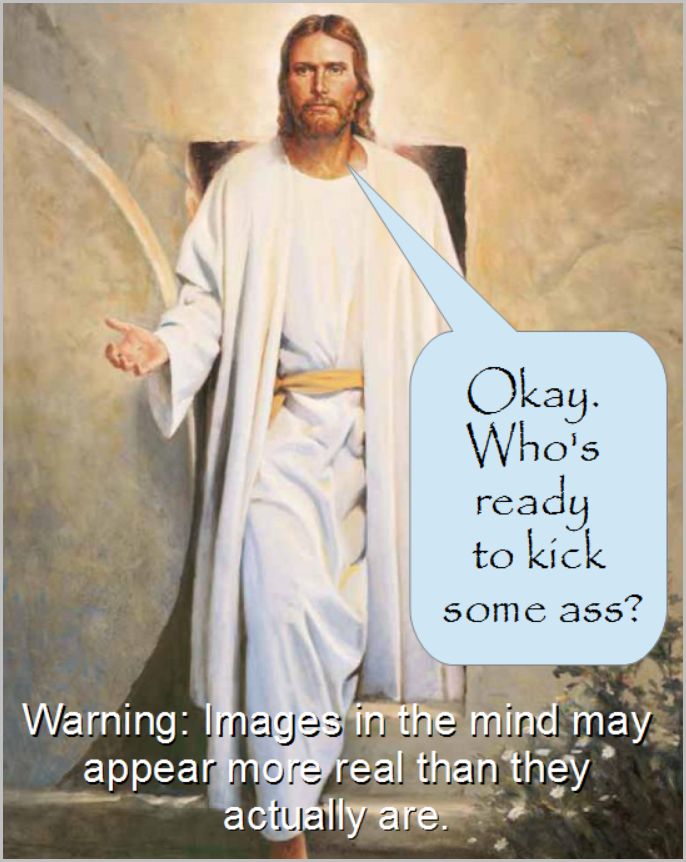
Christians’ Favourite Delusions 32: Jesus Is God

Res2Test your Bible knowledge and see if you can work out when it was Jesus became God:

Was it:

a) After he died?
Paul thought this was when God decided to adopt Jesus. The Almighty noticed what a good man Jesus was and decided to resurrect him. In so doing, he made him his Son:

his Son… was descended from David according to the flesh and was declared to be Son of God with power according to the spirit of holiness by resurrection from the dead. (Romans 1. 3-4, my emphasis)

Paul doesn’t say Jesus was God. In fact, he strongly suggests he wasn’t, both in the phrase ‘descended from David’ and in his assertion that he became God’s Son – not God – only at the resurrection. So, Jesus wasn’t God when Paul wrote Romans, round about 57CE. If, as Bart Ehrman suggests in How Jesus Became God (p224), Paul is quoting an earlier creed, it’s not what the first Christians believed either.* Paul does edge closer to a divine Jesus in other letters – Philippians 2, for example – but that’s not what ‘God revealed’ to him originally.

b) When he was baptised?
In the earliest gospel, Mark says it was when he was baptised that Jesus became God’s son:

(Jesus) saw the heavens torn apart and the Spirit descending like a dove on him. And a voice came from heaven, ‘You are my Son, the Beloved; with you I am well pleased.’ (Mark 1.10-11)

So in Mark, God adopts Jesus earlier in his career than in Paul’s Romans scenario. All the same, while he gets to be God’s beloved son, this doesn’t make him divine; God has many sons in the Bible and a Son of God, with or without capitals, is not the same as ‘God the Son’. Jesus himself makes this clear in Mark 10.18, where he actually denies he’s God.

c) When he was born?
Well, this is more like it. According to Matthew, Jesus is the Messiah from the time he was born. We’ve got even further back now – from Paul’s post-mortem elevation of Jesus, to his baptism, to his birth. Of course all of these can’t right. If Jesus was divine from birth – or even before – there’d be no need for him to be promoted after his death. But Matthew doesn’t actually say he’s divine; he suggests that Jesus fulfils all the prophecies of the Messiah (of course he doesn’t, but that’s what Matthew wants us to believe.) However, the Messiah, according to the very ‘prophecies’ Matthew quotes, is not divine; he’s a human warrior king. Oops.

d) When he was conceived?
Luke is determined to push it back further still. For Luke, it’s when God magically makes Mary pregnant that Jesus becomes truly and literally God’s son (Luke 1.35). Except, of course, Mary appears to have no recollection of this event later in the gospel narratives when she can’t work out why her son behaves in bizarre ways. Could Luke have made up the entire conception story? You bet.

e) Back at the beginning of time?
John’s gospel appears to say so:

In the beginning was the Word, and the Word was with God, and the Word was God. He was in the beginning with God. All things came into being through him, and without him not one thing came into being. What has come into being in him was life, and the life was the light of all people. The light shines in the darkness, and the darkness did not overcome it. (John 1.1-5)

Or does it? John says the Word (Logos) has always existed and is part of God – but does this mean Jesus? This question vexed the church for the best part of it first four hundred years. Was the Logos the same as God and was Jesus the Logos? The council of Nicaea in 325 attempted to clear the matter up but not all bishops agreed with its conclusion – that the Son was ‘begotten not made’ (whatever that means) – and the controversy raged for another few decades.

f) When the church decided he was?
Yup, this is it. A different group of bishops decided, finally, that Jesus was God at the Council of Constantinople in 381. They re-jigged the statement made at Nicaea fifty-six years earlier, which then became the ‘Nicene creed’ that’s still said in some churches today.

So, Jesus didn’t become wholly and officially divine until 381, a mere 350 years after he lived and 300 after Paul and the gospel writers. How scriptural is that?

Jesus wasn’t divine, wasn’t God incarnate, wasn’t the Son of God with capital letters, wasn’t the Messiah, wasn’t and isn’t the saviour of the world. He was a first-century preacher and prophet whose prophecies were a disaster, whose mission to bring the Kingdom of God to Earth failed and who died and was buried. He was resurrected only in the ideas of other men, who tried and eventually succeeded in making him into something he wasn’t.


* I’ve not referred extensively to Ehrman’s writing in this post but undoubtedly his many books, especially How Jesus Became God, have influenced me, as has Barrie Wilson’s How Jesus Became Christian. Jonathan Hill’s Christianity: The First 400 Years, published by Christian company, Lion, was also useful.


Idiotic Stuff Jesus Said 6: The ‘I Am’ sayings

CampLet’s be clear from the outset here; Jesus never actually made any of the seven ‘I am’ claims put into his mouth in John’s gospel. You know the ones: ‘I am the Way, the Truth and the Life’, ‘I am the True Vine’, ‘the Good Shepherd’, ‘the Light of the World’ and so on. So it is a little unfair to lump them with all the idiotic things it’s more likely Jesus did say (see previous posts.)

How do we know he didn’t say them? Lots of reasons. Firstly, they’re not in the other three gospels all of which were written earlier than John’s, and are therefore closer to the time Jesus lived (though the earliest, Mark’s gospel, was probably put together thirty to forty years after Jesus lived.) If Jesus had really made all those grand ‘I am’ claims, wouldn’t the other gospel writers have recorded them too? Yet none of them mentions even one.

Secondly, in the synoptic gospels – Matthew, Mark and Luke – Jesus has a different message from the one given to him in John’s gospel. The earlier gospels have Jesus talk about himself only very rarely. Instead, he goes on at length about the coming of the Kingdom of God (or Heaven) and how y’all better get ready for it ’cause it’s a-coming soon. Was he wrong about that one! On the odd occasion he does refer to himself in the synoptic gospels, he often does it in a sort of coded way, calling himself ‘the son of man’. He hardly ever uses ‘I’, let alone makes grandiose claims about himself.

Thirdly, all three of the synoptic gospels rely on earlier sources, now lost to us, and none of those has Jesus make ‘I am’ statements either. How do we know? Because, again, they’re not there in any of the three accounts – Matthew, Mark or Luke – that are built up from them. Significantly, one of these sources is an early record of Jesus’ sayings; that’s a ‘sayings gospel’ that doesn’t relate any ‘I am’ sayings.

Fourthly, John’s gospel is late – at least sixty years after JC’s death and also after Paul’s supernatural Christianity had gained a foothold among the gullible. The Jesus of John’s gospel is a reworked version, more in-line with the ‘Christ’ that Paul preached and much less like the Jewish peasant who had lived and preached the Kingdom of God. Despite what Christians claim, John’s gospel is not another eye-witness report (none of the gospels is) that differs only in minor details from the other three accounts. It is total reworking of the story, with its central figure transformed into a sort of divine Superman, and the idea of the coming Kingdom relegated to a single mention. This change of agenda renders the fourth gospel utterly unreliable as an historical record of anything the earthly Jesus might have said.

Fifthly, Christians claim John’s gospel differs from the others because in it Jesus reveals special, secret truths about himself to ‘the disciple whom he loved’, traditionally the John whom the gospel is named after. But again, the problem with this explanation is that the synoptic gospels don’t mention Jesus favouring one particular disciple over the others (unless it’s Simon Peter). In these, John, a loud, brash fisherman, plays only a minor role. Why don’t the synoptics refer to the special, more intimate relationship that John’s gospel refers to? Largely because there wasn’t one – not until the fourth gospel came to be written and ‘John’, who led the community that produced it, wanted to bump up his part.

So, idiotic as it would have been for an itinerant Jewish preacher and ‘prophet’, whose mission ended in failure, to make these claims about himself, Jesus never did. He didn’t say he was ‘the Way, the Truth and the Life’. Or ‘the Vine’. Or ‘the Good Shepherd’. These are claims made for him long after he lived, by people who were persuaded by a snake-oil salesman that a God-man had mystically ‘saved’ them. They ‘re-imagined’ Jesus, sayings and all, to fit their idea of what he must have been like – and John’s gospel was born.

Its Jesus, if he was being honest, should really have said, ‘I Am… nothing but Pure Invention.’

The fool says in his heart…

Celia2If you get into a discussion with Christians about their faith and you tell them, often reluctantly because you just know where it’s going to lead, that you don’t share their belief in a deity on account of there being no evidence for one outside of the human imagination, it isn’t long – if they haven’t done so already – before they start quoting ‘scripture’ at you.

Among their favourite verses, along with ‘For God so loved the world…’ (John 3.16) and ‘for a man to lie with a man… is an abomination’ (Leviticus 20.13) is Psalm 14.1: ‘The fool hath said in his heart there is no God’. And having cited it, they stand back in smug triumph, having put you firmly in your place and clinched the argument.

But the Bible would say this, wouldn’t it? It’s in its interest, and in the interest of those who wrote it and believe in it, to rubbish those who don’t buy into its fallacies. Christians who quote this verse, and others, are wilfully refusing to accept that you don’t recognise the ‘authority’ of their magic book. What they are really saying is, ‘You don’t believe in my God or the Bible, but I’m going to use it anyway to ‘prove’ my point.’

Why do they do this? Can they not see the futility of it? It’s like my quoting from ‘Twas The Night Before Christmas to demonstrate that, whether they like it or not, Santa Claus is watching over them to see if they’re naughty or nice. But referencing one make-believe source does not prove the existence of another. You have to believe in Santa Claus to begin with, as children often do, to believe the poem is an accurate account of his activities. So it is with the Bible. It only has significance if you already believe that God exists. It won’t of itself convince you that he does.

The Koran has its own ‘the fool hath said in his heart’ verses. Loads of them. Christians might like to consider whether a Muslim telling them ‘the vilest of animals in Allah’s sight are those who disbelieve’ (Q8:55) would persuade them that Allah is the one true God, and that they’re idiots for thinking otherwise. It wouldn’t, of course, so perhaps they’d kindly stop wasting their own time, and ours, doing the same to atheists.

The best response to a believer who tells you ‘the fool hath said in his heart there is no God’?

‘If even a fool can see it, why can’t you?’