Who Decides What A Culture’s Values Are?

Did you decide? Would you prefer to live in culture based on Christian, Islamic or Marxist values? According to some Internet Christians, these are the only choices available. Of course anyone with an ounce of sense and a modicum of honesty knows they’re not.

I choose to live in a society that is not dominated by cherry-picked Christian values, or indeed ‘values’ derived from any religion. I reject the claims of them all, including their demonstrably false notion that I and my fellow citizens cannot behave ourselves unless controlled by a morality imposed by an imaginary deity. Likewise, I don’t care to live in a culture determined by an extreme political ideology that serves only one part of society: usually the elites who devise the ideology in question.

Instead I choose, or rather was fortunate enough to be born into, a relatively liberal democracy, capable of determining its own values. These are largely secular and humanistic and include, amongst others, the rule of law, tolerance, and freedom of speech and movement. Of course the UK has never fully realised these aspirations but there has always been a sense, since the 1960s, that we were moving towards them. Perhaps I’m naive to think this, given the turbulence of the Thatcher years and President Blair’s mania for regulation, but overall it used to feel that we were moving gradually towards a fairer, more reasonable society.

It doesn’t now. The elites have embraced a wokeness that benefits a limited few and have redefined terms – ‘woman’, ‘crime’, ‘offence’, ‘hatred’ and ‘phobia’ among them – which has impacted negatively on personal rights and freedoms. They have reinterpreted the law so that it benefits vocal minorities while side-lining the majority. They have repeatedly reneged on promises and over-reacted to the crises of recent years – Covid in particular – by granting themselves greater powers to manage their own over-reaction; powers which, once each crisis has passed, they have declined to relinquish. The values of Britain today, as imposed by the governing classes, are overly woke and authoritarian. In my 68 years, I have never felt as micro-managed in my personal life as I do today.

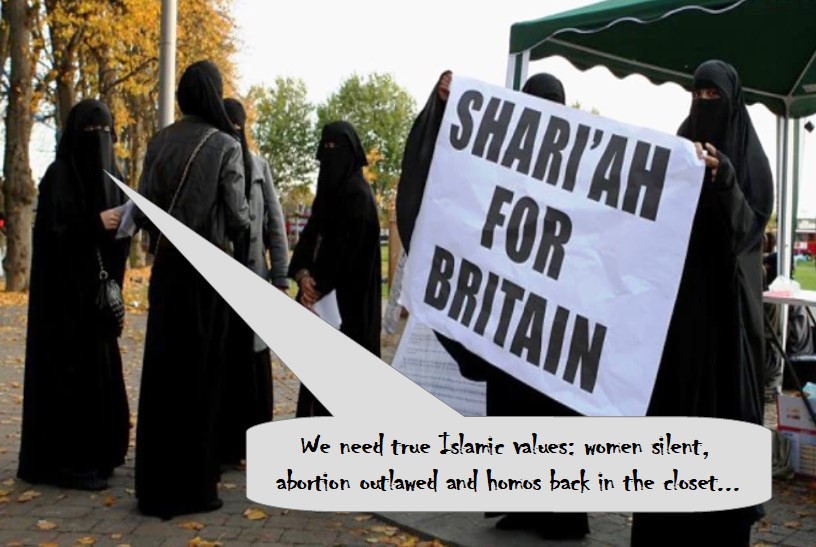
So, I do understand why there are those who call for the return to what they perceive as Christian values or a cultural Christianity of church bells and hymn singing. I understand too the fear of some that the waning of Christian influence will see extreme Islamic values fill the vacuum. This seems to me to be a real possibility and one that would prove seriously detrimental and damaging to British society. However, attempting to resurrect nebulous ‘Christian values’ in order to prevent more intolerant ones from being imposed is no solution.

We need to be clear about our values and assert those we aspire to: tolerance, liberalism, democracy, freedom of speech, rights for all, equality under the law and, I would add, truthfulness, honesty, fairness, consideration and reasonableness. For a time, this may very well involve being intolerant of intolerance, whether derived from Christianity, Islam, wokeism or political ideology. In particular, we need to stop conceding ground to Islam and resisting the demands of Muslim activists when they conflict with the values and aspirations of the majority.

Perhaps none of this will matter to me, given I’m not going to be around for many more decades (if that). But I would like the Britain my grandchildren grow up in to be one that reflects humane, secular values. I fear for them that it might instead operate on the basis of oppressive, intolerant religious ones.


free speech

Why We Can’t Return To Christian Values

There has been a spate of articles recently advocating for a return to Christian values in the UK. Some, like that by Madeline Grant, don’t specify which values they have in mind. Nonetheless, Ms Grant worries about these unspecified values being replaced by the ‘terrible new gods’ of wokeism, while Douglas Murray – an agnostic commentator I admire and enjoy a great deal – argues for the revival of Christian forgiveness. Elsewhere, Richard Dawkins repeats his call for the preservation of ‘cultural Christianity’ in the face of less ‘decent’ religions like Islam.

I’m sure there are good arguments to be made for exercising more forgiveness both in our personal and national lives, though the idea is not without its difficulties. Dawkins too is right to express concerns that the vacuum that may be left as Christianity declines might be filled with more unsavoury and less charitable values.

But what are the Christian values that these writers see less of in modern life? For Dawkins it’s the chiming of church bells and rousing hymns, which, as pleasant as these are (I would not like them to disappear either) do not have any bearing on our morals and values.

According to Total People, our values in the UK are Democracy, the Rule of Law, Respect & Tolerance and Personal Liberty. Certainly the UK has long regarded itself as a tolerant country – though those on the receiving end of intolerance in the past (early immigrants, gay people for example) might disagree – and we have always aspired to show respect without necessarily achieving it. Our morals on the other hand, especially with regard to sex (and Christians invariably mean sex when they talk about moral decline) have changed over the last 30 or so years, becoming more tolerant of, for example, same-sex relationships and less accepting of adulterous or abusive ones.

The question is, however, do we owe our values and morals to Christianity? I’ve argued before that we don’t. I’ve also tried to demonstrate that there is no time in the past we could pinpoint and say, ‘here’s where the country demonstrably and consistently upheld Biblical principles, showing us just how far we’ve fallen since.’ I applied this criterion to the USA when Don Camp suggested there was a now lost Christian golden age, taking random points in US history and demonstrating there never was a time when Christian values prevailed. Any such golden age is a myth, in the States, the UK and anywhere else. It always has been so; read Paul’s first letter to the church in Corinth to see how far even early cultists fell short of his ideals. Christians themselves don’t and never have demonstrated the high standards the bible demands.

Why is this? Because Christian morals and values are impossible. Even those who think they live with the Holy Spirit in them fail, and frequently fail dramatically, to practise what they preach. They don’t love their enemies, a ridiculous expectation of Jesus’s that certainly can’t be extended to nations. Many of the righteous don’t demonstrate love for their neighbours (other than bombarding them with the gospel) and frequently showing an appalling lack of empathy for fellow-believers (take a look at the abuse that goes on in the church at large.) They don’t, in the main, sell all they have and give the proceeds to the poor; give to anyone and everyone who asks and give away their shirt as well as their jacket when it’s demanded of them. They do judge others but don’t – sorry, Douglas – forgive fellow-believers seventy times seven, let alone those of us they regard as the great unwashed. Perhaps it’s as well; what would a culture be like that repeatedly forgave its criminals, abusers and bullies?

The frequently ignored Golden Rule of ‘do onto others as you would have them do unto you’ predates Jesus by centuries, while the more realistic, secular version of it, tolerance and respect, likewise doesn’t derive from the Bible, Jesus or the church. This Holy Trinity of terrors demonstrate a marked absence of tolerance and respect for any positions other than their own and ‘personal liberty’ is not a concept known to them. Didn’t Jesus insist his followers become his slaves? His Father, meanwhile, is intolerant of everything human beings do and everything they are.

A Christian who commented on Grant’s article asked those who disputed her premise – that we need to return to Christian values – whether they would prefer to live in a country dominated by Christian, Islamic or Marxist values. I’ll leave his question with you – answers on a postcard please – and return to it next time.

.

Religiophobia?

Is criticising Christianity and the way some people practise their religion a form of Christophobia? Strictly speaking a phobia is an irrational fear of whatever precedes it, as in homo-phobia, trans-phobia, Islamo-phobia and the like. In the accusations of whatever-phobia we hear today – and they invariably are accusations – ‘phobia’ seems to have come to mean ‘hatred of’; a hatred of Christianity and therefore of Christians; of homosexuality and therefore of gay people; of trans-people; of Muslims and so on.

Reasonable criticism of belief systems is not hatred. I don’t and am sure I never have had a hatred of Christianity or of any other religion. I certainly have views about Christianity as a seriously flawed, cock-eyed superstition (I hope I’m not giving my position away too early.) Reasonable criticism of it, mockery even, is perfectly legitimate, for reasons I’ve outlined before, just as criticism and mockery of any belief in the fantastic is legitimate. Ideologies based on belief in imaginary beings do not automatically merit respect nor do they have a de facto immunity from criticism. The same applies to those who subscribe to such fantasies, particularly when they attempt to force them on others. Calling out believers on their inconsistencies and hypocrisy is perfectly reasonable.

Is it fair then to express critical views of homosexuality and by extension of gay people? Of course. We are not immune from reasoned criticism, though much of it doesn’t qualify as ‘reasoned’; we have suffered much from emotional reactions to our existence and still do. (See Bruce’s recent post in which Republican North Carolina’s lieutenant governor, Mark Robinson rants about godless homos. When comment deteriorates into vitriol it becomes an incitement to hatred and, sometimes, violence. When this happens, the modern sense of phobia is justified.)

Islam is as irrational as Christianity and other religious belief systems. It is as legitimate to criticise and, when appropriate, to condemn Islam, just as it is Christianity. It is reasonable to question Muslim’s treatment of women, to insist it is inappropriate, particularly in a Western context. It is appropriate to oppose Muslims’ opposition to Western values rather to accede to their opposition to, for example, freedom of speech or the teaching of evolution and sex education in schools. It seems increasingly to me that in Britain we are conceding too much to Islam and to Muslims because we fear both the accusation of Islamophobia and, not entirely irrationally, a disproportionately aggressive response. Reasonable criticism of a belief system and those who subscribe to it is not hateful. We have a duty in a largely secular society to say so. To resist irrational belief in the supernatural when that belief, be it Christianity, Islam, Judaism or any other of the 4,200 religions human beings have dreamt up seeks to impose itself on others is neither hateful nor irrational. It is essential.

I‘d write more about Islam if I knew more about it. I’m disinclined to learn more, however, having already wasted much of my life in thrall to that other ‘great’ religion, the one I spend so much time deconstructing here. Who needs to know more about another? Saviours, Prophets, Gods, angels, signs and wonders – they’re all equally meaningless. Instead of claiming they’re victims of Christo/Islamophobia, religionists would do well to develop thicker skins as we ‘abominations’ and ‘perverts’ have had to do. They should ask themselves whether criticism of their practices and worldview is justified. They might just find it is.

Christian Values

I keep coming across the idea that the West is abandoning its ‘Christian values’ (here for example). Some say we’re doing so without having anything with which to replace them, while others bemoan the influence of ‘wokeism’, Islam and social media.

This seems to me to be lazy journalism. What Christian values are we talking about?

  • Self-sacrifice, humility, selling all to help the poor, putting others before oneself? These are Christian values according to gospel Jesus but they have never been the prevalent values of Western culture.

  • Prohibitions against lying, stealing and murdering, together with admonitions to be civil and respectful predate the Bible by some considerable time. Then, as now, they were not values adhered to by everyone but were, nonetheless, ones that ancient cultures aspired to.

  • Sexual mores, then. This is, after all, what most Christians mean when they refer to Christian values. These are forever in a state of flux in any culture; however much authorities attempt to legislate sexual practices, consenting adults will always do what they want to do. The sixth commandment and the Bible’s homophobic stance would not exist if adultery and homosexuality were not practised in the barbaric past. Meanwhile, polygamy, paedophilia and non-consensual sex (with slaves) get a free pass in the Old Testament. The West’s sexual mores, which in any case vary from culture to culture, are not based on the Bible.

  • Anti-Semitism, superstition, slavery, the subjugation of women and the denigration of those of different religions, race and sexuality, are Christian values, all derived from the Bible, that the West has upheld in the past, and occasionally returns to still. If these are the Christian values we are abandoning then good, and good riddance too. We’re all better off without them.

The West’s values are capitalism, ‘civil rights, equality before the law, procedural justice’, education, empiricism and democracy, none of which derive from Christianity. Arguably they emerged in the West as a reaction against the church and the establishment, with their oppressive values, during the Enlightenment. These are humanistic values that, it seems to me, are not under threat today (though some of them could benefit from reform).

This being said, other values, particularly the right to free speech, empiricism, privacy and the right to live peaceably according to one’s own principles do appear to be under threat. There are aspects of wokeism and its troublesome twin, cancel culture, that pose a threat to these values, which have been, until recently, highly prized in the West. wokeism gnaws troublesomely at the West’s self-esteem and self-respect, rewriting its history and insisting it apologise and make reparation for the actions of people who lived hundreds of years ago. Even so, the values wokeism threatens were not derived from Christianity; you will not find individuals’ rights, empiricism and free speech promoted in the Bible, nor by later church tradition. These values were hard won by enlightened men and women and subsequently evolved, as all values and principles do, over the last couple of centuries.

Despite the loud lament that the West is losing its Christian values, it isn’t. Apart from a few unpalatable prejudices that can be traced back to the Bible, the West does not operate on Christian values and has not done so, if it ever did, for a very long time.

Policing Social Media?

I wrote this post in the middle of March, just before Don pitched Camp here, as a follow up to this post. Since then, the issues I address in it have moved on at an alarming rate. I’ve revised it to reflect these developments.

Who watches the watchmen? Should those who take it upon themselves to define what we are allowed to say or view be the same as those who police what we say and view? 

I’m not arguing for the protection of those who post abusive, hateful or libellous comments online. There is no place for racism, misogyny or homophobia in life and there are already laws for dealing with them. There is no reason they should not get a free pass on social media either. The question remains, however, who should be responsible for monitoring hate speech and either preventing or removing it. The same question needs to be asked of those comments that are considered, by whoever is going to decide these things, ‘harmful’ or constituting ‘misinformation’. Should the same official bodies that determine what is abusive, harmful or ‘misinformative’ be responsible for the actual censoring? This it seems to me, would be disastrous; the kind of thing that goes on in Russia, China and North Korea, not the ‘free’ west.

Nevertheless, let’s take look at the likely candidates for the role:

Governments. Should a government department regulate social media? As far as I’m aware, no such department exists in the UK or US at present. Governments themselves have, arguably, better things to do than monitor social media. Neither do they have the skills nor objectivity to exercise new, radical powers of censorship. It would be far too easy for them to decide that anything critical of their policies or actions is hate speech (or harmful or misinformation). In any case, as we’ve seen during the pandemic, governments already have far too much control of our lives.

The Police. The police have neither the resources nor manpower to monitor all that is said online. In the UK they don’t have sufficient manpower to intercept the many paedophiles operating online, let alone to monitor the comments of billions of ordinary folk. and haven’t they enough serious crime to be dealing with? 

Social media companies. Their algorithms have, so far, largely failed to eliminate abuse, while responding with unseemly zeal to blocking and barring perfectly innocent comments because of the presence of the odd trigger word. There simply aren’t enough humans to regulate comment, nor are social media companies in the business of deciding what is harmful or misinformative (though Patheos recently ousted bloggers who wrote anything critical about religion.) Governments may occasionally express their displeasure that companies are not doing more, but it’s difficult to see how they can. The slippery Sir Nick Clegg (behind Mark Zuckerberg in the picture), former UK MP and now second-in-command at Facebook, is not, as an establishment millionaire, the man for the job.

Users themselves. It isn’t realistic to think all users could be self-censoring. Many are not, nor are they ever going to be. Those with more extremist views, who have been blocked or banned by the popular social media companies, gravitate towards other sites, or create their own, that allow and even encourage such views (say ‘hi’ to QAnon, Breibart etc.) There is no moderation, in every sense of the word, on such sites (unless of course you happen to disagree with them, in which case you’re swiftly booted off.)

What to conclude? That governments have lost control of social media? Yes.  Though I would argue that control was never theirs to take. They’ve come late to the party and find, despite their gate-crashing attempts with new ‘misinformation’ laws, that they’re not being allowed in. Ultimately, however, these new laws are meaningless; a law that cannot be enforced is no law at all.

However…

Since I wrote this post, the UK’s Culture Secretary, the befuddled Nadine Dorries, has decided she wants to regulate streaming services, including Netflix, Amazon Prime Video and Disney+, lest they make available to paying adults content that might be regarded as ‘harmful’. If she is successful in having her bill pass into law, the government’s own media watchdog, Ofcom, will be able to force streamers to filter (out) what they provide in the UK, just as they have to do in China. It’s as if the late Mary Whitehouse finally won*. This is not what democratic governments are for.

* Mary, for my readers in the U.S., was a self-appointed guardian of public morals, not unlike your very own Monica Coles.