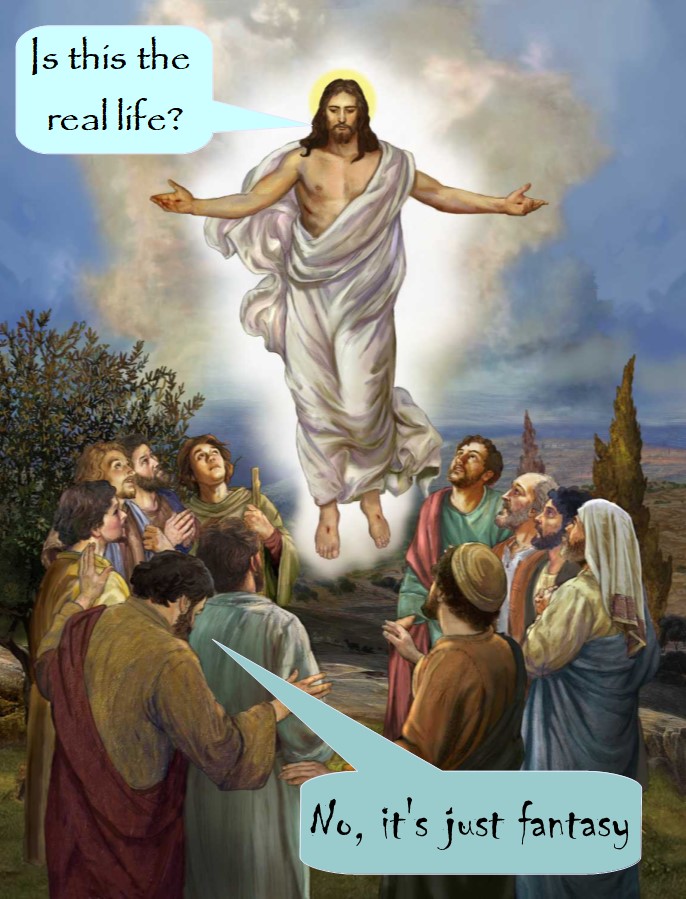
In which Howard visits Heaven and talks to Jesus

I recently finished reading My Descent Into Death and the Message of Love Which brought Me Back by Howard Storm, in which he recounts events surrounding his serious illness in the 1980s. This, he is convinced, caused his death after which some very dark beings, who at first he mistook for deranged medical staff, attempted to drag him off to a very sinister place. Fortuitously, Jesus and his angels were on hand to intervene and rescued hell-bound Howard.

Perhaps in my Evangelical days I would’ve lapped up stuff like this, but not now. A Christian friend – the same one who lent me the book I wrote about here – bought me. I promised I’d read it but what a struggle it was.

Once rescued by Jesus, Howard felt divested of his ego and overcome by love. He underwent a life review and was ever so gently ticked off for all the times he was less than kind. Instead of enjoying this state of bliss, however, Howard took the opportunity to bombard Jesus and the angels with banal questions, which given Howard’s comatose state they had time to answer at great length over many hours (which is how long it takes to read about them.)

When he came round and discovered he wasn’t actually as dead as he thought he was, Howard was a changed man. Once back on his feet, he joined a succession of churches so he could share his experience. When they didn’t fully appreciate how he’d really spent time with actual Jesus, he trained for the ministry himself. He has been a pastor now for several decades, regaling people with the tale of his encounter with fantasy heavenly beings.

Undoubtedly, Storm’s experience was powerfully real to him, so much so it changed his life on his return to reality. As I read My Descent Into Death, however, I couldn’t help but feel I’d heard it all before: in Paul’s account of his imaginary visits to heaven and his encounters with a resurrected Jesus. These were probably not Near Death Experiences (NDEs) – though who’s to say – but, like Storm’s, brain-induced hallucinations.

As scientist Britt Hartley explains in the video sent by koseighty a while back, we now have a much greater understanding of NDEs; they are culturally determined hallucinations induced by the brain as it begins its shutdown. Hartley is clear that under stress the brain is more than capable of creating reassuring visions for itself.

But like Howard Storm’s, Paul’s ‘revelations’ are more than a mere sighting of Jesus. Paul too has a long discourse with the heavenly being conjured up by and in his own brain. He imagines Jesus explains to him how salvation works (in a mighty complicated way) in the same way Howard does. I’m sure this discourse, like Howard’s, did not take place during the visions but were worked out later, over time, as Paul, and Howard, interpreted what the inner-visions ‘must’ have meant.

Oddly though, given they both encountered the same character, it’s difficult to reconcile the messages each was given by him. Storm’s is of a mushy universal love, devoid of the demands and convoluted theology of Paul’s Jesus. Strange that the Jesus Christ who is, according to Hebrews 13:8, the same yesterday, today and forever, has modified and softened his message in the two thousand years between Paul’s and Howard’s revelations. It couldn’t be because Howard’s is the result of his conditioning by a modern American culture that sees Jesus as a shiny, white-robed figure surrounded by angels who dispenses nothing but all-embracing love and happy-clappiness, could it? It surely could.


Seek and Ye Shall Find

Thanks to all the Christians who responded to my questions last week. Here’s the answers (in red) they helped me reach.

I asked –

1. What happens to you, as a Christian, when you die:

a) You go immediately to heaven (The Bible says this precisely nowhere)

b) You go into suspended animation until Christ’s coming and the final judgement (Paul implies this is the case in 1 Thessalonians 4:13-18. You have to ask yourself how he knew this)

c) You cease to exist (Yup, this is it. So, as Dolly says, better get to livin’)

2. According to the first three gospels, how long was Jesus in the grave?

a) About 36 hours (Friday tea-time till just before sunrise on Sunday. You do the Math)

b) 3 whole days (see above. Despite saying in Matthew 12:40 that this is how long he’d be dead, he fell way short. The fourth gospel, on the other hand, alters the timeline to make things fit)

c) He wasn’t: he went down to hell (according to 1 Peter 4:6 and the so-called Apostles’ Creed this is exactly what he did. Some people are daft enough to believe it)

3. Which of the following does Paul refer to in his letters?

a) Jesus’ miraculous birth (he mentions this zero times)

b) Jesus’ parables, teaching and miracles (likewise; not a single mention)

c) The Empty Tomb (nor this. Don’t you think that’s strange?)

4. How often did Paul refer to Jesus’ second coming?

a) In all of his letters (Nope)

b) 2 or 3 times (Nope)

c) Never (That’s it: not once. Paul looks forward to Jesus coming soon, as if it’ll be his first visit: 1 Thessalonians 4:13-18 again. Don’t you think that’s significant?)

5. How often did Jesus refer to his second coming?

a) Once or twice (No)

b) Frequently (Again, no)

c) Never (Yes, never. The fictional Jesus of the gospels says someone called ‘the Son of Man’ would be arriving real soon: Mark 14:62. Occasionally Jesus’ creators suggest he and the Son of Man are one and the same, which they are in that both are fictional)

6. When did Paul say the Messiah would be coming to the Earth?

a) Thousands of years in the future (To hear modern Christians talk you’d think this was it, but no: Paul never said this.)

b) While he himself was still alive (He says clearly that he expected he’d still be alive when Jesus came down from heaven: 1 Thessalonians 4:13-18. How many more times?)

c) He didn’t say (course he did: see above)

8. According to the gospels, when did Jesus say the Son of Man would be coming to the Earth?

a) He didn’t (he did)

b) Thousands of years in the future (Nope)

c) While those he was talking to were still alive (Yes: in Mark 9:1; 13:26 and 14:62)

8. What, according to the Bible, is the Word of God?

a) The Bible itself (‘Fraid not)

b) The Church (No)

c) Jesus (Yes, but not as often as you might think: only in John 1:1-3)

9. Which was written first?

a) Mark’s gospel (made up about 70CE)

b) Paul’s letters (the earliest, in the 50s)

c) Acts of Apostles (invented circa 80-90CE)

10. When the New Testament mentions ‘the Scriptures’, what is it referring to?

a) Ancient Jewish writings (exclusively so)

b) The whole of the Bible as we now know it (the Bible as such probably didn’t exist until the 4th century)

c) The New Testament (there was no New Testament when the writers who would later be included in it were writing. So, no)

11. How did the New Testament writers ‘prove’ Jesus was the Messiah?

a) By claiming the scriptures predicted he would be (Exclusively so)

b) By pointing to his miracles (Never)

c) By quoting things he said (Never)

Now isn’t that odd.

12. According to the Bible, how did Jesus want his followers to spend their time?

a) By witnessing to atheists on the internet (You think?)

b) By worshipping him (Never)

c) By feeding the hungry, healing the sick and helping the weak (This. See Matthew 25:31-46. So why you spending your days and nights harassing non-believers on the Net?)

Actually, no Christian helped out with this. The answers are those that scholars (and I, in my own humble little way) have arrived by actually reading the friggin’ Bible. 

Where are those stories?

Those opposed to the idea that Jesus was only ever a mythical figure are generally dismissive of those who point to the evidence of the New Testament that this is precisely how the earliest Christians saw him. These critics lambast as ‘amateurs’, ‘pseudo-historians’ and ‘fringe’ enthusiasts those who don’t see any evidence for an historical Jesus. But such ad hominems are not arguments and they’re certainly not evidence that a human Jesus existed. When the books of the New Testament are arranged in chronological order, the very earliest writing about Jesus – Paul in the 50s and the creed of 1 Corinthians 15 – appear to view him only as a scripture-fulfilling spiritual manifestation.

So, was Jesus actually an itinerant preacher who traipsed the Earth in the 30s before rapidly evolving into Paul’s mythical Christ or was he a mythical being to begin with, only later to be cast as an historical figure?

It has to be one or the other. 

Within twenty years of his supposed death, Paul and others had experienced dreams, visions and hallucinations (Acts 2:17) that convinced them Jesus was a supernatural being in heaven. This doesn’t of course rule out that a human Jesus had actually existed, but it makes it unnecessary for him to have done so. Paul and almost all the creators of the New Testament books treat his earthly existence as irrelevant. Even when ‘proving’ their celestial Superman is the promised Messiah, they refer not to his activities on Earth, but appeal exclusively to what they believed Jewish scripture revealed about the Messiah.

According to these men, this is how they knew the Jesus of their dreams was truly the Saviour: the ancient scriptures. Not a single one of them says, ‘I refer you to Jesus’ miraculous birth in Bethlehem; I remind you that he changed water into wine, controlled the elements and miraculously multiplied food.’ Not one of them references his many healings, exorcisms and raising of people from the dead. Not one mentions the historical details surrounding his crucifixion, the empty tomb or the women who first saw him alive again. Not one relates a single resurrection appearance (beyond their own visions) nor do they mention the ascension or a looked for ‘second’ coming. Why not? Surely these would be the definitive indicators that Jesus was the Messiah, instead of, or at least alongside, the so-called prophecies of ancient scriptures.

The ‘why not?’ is because these stories – the birth, the miracles, the healings, the empty tomb, the bodily resurrection, the ascension and the rest – had, at the time Paul was writing, not yet been created. Consequently, they couldn’t be passed on to Paul when he met Cephas and James. There was no much-vaunted ‘oral tradition’ for him to call upon to fill in the gaps in his knowledge about an Earthly Jesus. There was no oral tradition because there was no Earthly Jesus to relate stories about when Paul was active in the 50s. This version of Jesus, created from Jewish scripture, Paul’s teaching and cult rules, didn’t appear until the early 70s. Even after Mark’s gospel and its copycat sequels, most of the writers of later New Testament continued to believe in and refer only to a heavenly saviour verified by ancient Jewish scripture.

But, apologists say today, no-one at the time would be taken in by talk of a Messiah who existed only in the heavenly realm. And that’s true; despite the Bible’s claims to the contrary, very few people were persuaded. But some bought into it, just as others at the time bought into Mithras. Mithraism was, for a while, more successful than the fledgling Christian cult. Yet its adherents knew Mithras himself manifested only in the heavenly plane. This didn’t stop multitudes of military men from joining the cult to worship him. It was the same for the other deities of the day. They too didn’t exist even if stories about their adventures on the Earth were widely circulated and, in all probability, believed by the gullible.

If, however, Jesus’ life on Earth had happened in the early part of the first century, how was it that 20 years after his death he had already become an angelic being without a past? Why had Paul, the writer of Hebrews, the pseudo-Pauls, James and John of Patmos never heard any of the stories about him, or didn’t care about them or felt they weren’t really evidence of Jesus’ Messiahship? Where are those stories? Outside the later gospels they don’t exist. It’s as if, when Elvis Presley died, no one cared any more about all the hit records he’d made and were instead only interested in his post-mortem sightings in laundromats and shopping malls. The process just doesn’t happen this way round.

No, it is far more likely that Jesus went from being a celestial saviour to having stories written about him, stories that are based on prophecies in Jewish scripture and Paul’s ‘revelations’. They are allegorical and metaphorical, wholly made up as the writer of Mark 4:11-12 tells us with the equivalent of a Clark Kent wink:

The secret of the kingdom of God has been given to you. But to those on the outside everything is said in parables so that ‘they may be ever seeing but never perceiving, and ever hearing but never understanding; otherwise they might turn and be forgiven!’


Later ‘evidence’

The Didache is an early Christian manual discussing ethical behaviour and outlining liturgical practice. Scholars disagree about when it was created, most opting for a date around 100CE. Despite referring to itself as ‘The Teaching of the Lord Through the Twelve Apostles to the Gentiles’ in the only extant complete copy, the Didache doesn’t mention Jesus by name nor refer to any of the historical details of the kind provided in the gospels. Instead, it refers to ‘the Lord’ or ‘the Messiah’, the same terms Paul uses for his angelic Christ, and makes use of ‘teaching’ similar to that in the (invented) gospels, from which it almost certainly draws.

We’re now heading into a period when the gospels were in wider circulation and any reference to Jesus cannot be regarded as independent from them. We need, consequently, to be suspicious of any ‘evidence’ that appears to affirm his historical existence. Documents that appear after the gospels is unlikely to be from independent sources (not that they always reference their sources) but are merely relying on gospel data as filtered through contemporary Christian believers. Hence the Roman historian Tacitus, who wrote in his Annals circa 115CE:

Nero fastened the guilt (for the fire in Rome in 64CE) and inflicted the most exquisite tortures on a class hated for their abominations, called Chrestians by the populace. Chrestus, from whom the name had its origin, suffered the extreme penalty during the reign of Tiberius at the hands of one of our procurators, Pontius Pilatus, and a most mischievous superstition, thus checked for the moment, again broke out not only in Judæa, the first source of the evil, but even in Rome, where all things hideous and shameful from every part of the world find their centre and become popular.

Chrestians? Chrestus?

Pilate as procurator instead of prefect? Christianity as a ‘mischievous superstition’?

Actually, this last I can see. The other peculiarities are a problem for those who claim this is evidence for an historical Jesus. Written some 85 years after Jesus was supposedly active, this first extra-biblical reference to something approaching an historical figure is simply too late. Likewise everything after it.

We’ve exhausted the paltry references to ‘the Christ’ or ‘the Lord’ that exist prior to and just after the gospels. An historical Jesus there is not, in any of them. What does this all mean? 

Jesus outside the New Testament

So what about other 1st century writing? Doesn’t this provide extra-biblical evidence for an historical Jesus?

The Jewish historian Josephus wrote his Jewish Antiquities around 93/94CE. In the section known as the ‘Testimonium Flavianum’, he appears to talk about Jesus in glowing terms:

Now there was about this time Jesus, a wise man, if it be lawful to call him a man, for he was a doer of wonderful works, a teacher of such men as receive the truth with pleasure. He drew over to him both many of the Jews, and many of the Gentiles. He was the Christ; and when Pilate, at the suggestion of the principal men amongst us, had condemned him to the cross, those that loved him at the first did not forsake him, for he appeared to them alive again the third day, as the divine prophets had foretold these and ten thousand other wonderful things concerning him; and the tribe of Christians, so named from him, are not extinct to this day.

I’m not here going into great detail about why many scholars believe this to be an interpolation; suffice to say they do. A later Christian added the entire passage in the middle of an account Josephus is relating about Pontius Pilate that has nothing to do with Jesus. It employs language and a style alien to anything else Josephus wrote and appears to be a rewrite of the appearances of the resurrected Jesus on the road to Emmaus in Luke 24:13-35. None of it is testimony to any Earthly Jesus.

Josephus’ apparent second reference to Jesus is in a later section of Jewish Antiquities. There he relates a story about the execution of a certain James who happens to have a brother called Jesus. Unfortunately, despite the two names corresponding to gospel characters, the two are, as the context makes clear, two entirely different people. This James is a Jewish High Priest who, Josephus mentions incidentally, had a sibling called Jesus. They lived at a later time. Unfortunately, at some point, a scribe or someone else added the phrase, ‘called Christ’ after the second mention of this Jesus. This may have been accidental when a marginal note (who wrote it and why?) was transferred to the main text. This Jesus is not remotely ‘the Christ’.

Josephus, therefore, tells us nothing about Jesus, neither as a celestial super-being nor as a real person. 

Around the same time as Josephus’s Antiquities, the document now known now as 1 Clement appeared. Thought to have been written circa 95CE (though Carrier thinks it might be as early as 65), 1 Clement appears to quote gospel Jesus:

(Be) especially mindful of the words of the Lord Jesus which He spoke teaching us meekness and long-suffering. For thus He spoke: ‘Be merciful, that you may obtain mercy; forgive, that it may be forgiven to you; as you do, so shall it be done unto you; as you judge, so shall you be judged; as you are kind, so shall kindness be shown to you; with what measure you measure, with the same it shall be measured to you.’

Certainly this sounds like the things Jesus is reported as saying in the gospels, Matthew in particular. Nevertheless, it is not identical to anything Jesus does say there. These words sound suspiciously like an exposition of the behaviour the early cult expected of its members (though didn’t always experience, 1 Clement addressing this very issue). Similar words had already been put into the mouth of Jesus in Matthew’s gospel allegory. Of course if Carrier is right with his dating, Matthew might easily have appropriated them from 1 Clement itself. Whichever it is, they could as easily have been ‘spoken’ by an imaginary saviour in heaven than from a man who had lived on Earth several decades earlier.

Outside of these ‘words of the Lord Jesus’, every other reference in 1 Clement is to the Jewish scriptures. Its author makes all of his points using the scriptures, even when a reference to Jesus’ teaching, miracles or parables would be far more apposite. Like almost all of the New Testament writers, Clement appears not to know any of these details. When he addresses suffering, he uses Peter and Paul’s deaths as his examples, not Jesus’ crucifixion, which gets no mention at all.

Clement’s ‘Lord Jesus’ is, like that of Paul and other New Testament writers, a supernatural superman, whose existence is exclusively proven by ‘prophecies’ in ancient scripture.

And that’s it. No first century writer outside the Bible tells us anything about an Earthly Jesus. Those who appear to mention him, do so only briefly and offer no information about his life. The majority of first-century writing about Jesus then, both inside and outside the Bible, speak only of a mythical Christ who had cultic followers.

We’ll take look at some early 2nd century documentation next time.

You can already guess what this offers though, can’t you.

The New New Testament

With the New Testament books in their traditional sequence, it’s easy to conclude that there was first a remarkable individual who travelled around Galilee proclaiming the arrival of his Father God’s kingdom on Earth. He demonstrated great wisdom and compassion before being crucified by the Romans at the behest of the Jewish authorities. The first four books of the existing New Testament tell us so; that all of this happened first and all that follows occurred afterwards as a consequence of the events the gospels describe.

But, put the gospels where they belong in the chronological arrangement of the New Testament, and the events of the gospels do not happen first. Paul does:

I acknowledge that in putting the books in their correct order in my previous post, I cheated when I made the first the work of the very earliest cultists. No such book exists (no, it’s not Q and even if it were, we don’t have it). The earliest Christian beliefs are largely lost to us. All we know is that some individuals had visions of the Messiah. Paul tells us so in 1 Corinthians 15:5:

He (first) appeared to Cephas, and then to the Twelve.

These visions undoubtedly mark the beginnings of the cult. It later finds a convert in the Hellenized Jew Paul who he has his own vision(s). That these are visions and not an encounter with an actual person is clear from Paul’s declarations in Galatians 1:15-17 and 2 Corinthians 12. He stresses in Galatians that what he knows of the Messiah (‘Christ’ in Greek) comes not from any human source but from what this Christ has revealed to him in his own head: the revelations he’s fond of referring to. These, he says, showed him the importance of the Christ’s sacrifice, the crucifixion being the only Jesus event he’s interested in. Nowhere in his seven letters (1 Thessalonians to Philippians) does he mention anything a Galilean said, did or had done to him, apart from the crucifixion, which is mentioned without any historical detail. Paul’s interpretation of the crucifixion is devoid of Romans, the Sanhedrin, Gethsemane, Judas, Pilate, the scourging and cross carrying, Golgotha, the centurion, grieving disciples and empty tomb. Paul appears not to know anything specific about the event he obsesses over. Who can blame him when these details had yet to be invented?

Paul also has it revealed to him, or so he says, that this heavenly saviour will soon be coming down to the Earth to raise the dead, rescue the faithful who yet live and usher in God’s new golden age (1 Corinthians 15:52; 1 Thessalonians 4:16). It is an idea that permeates the rest of the New Testament writings.  

Paul’s faith, then, rests entirely on his visions/revelations. When proving that they really were of Jesus the Christ, he does so by repeatedly citing Jewish scriptures, never by referring to a particular saying, miracle or healing of an earthly Jesus. Paul’s Christ is a cosmic Superman who is raised from the dead as a ‘life giving spirit’ (1 Corinthians 15.46). (I’ve written about this on numerous occasions, including this post, so won’t reiterate all the details here.)

Written about a decade after Paul’s last letter, we come to the first gospel, which, lo and behold contains an abundance of sayings, miracles and healings of an earthly Jesus. Where did ‘Mark’ get these from? Not from a hitherto unknown document which won’t be posited for almost two millennia (Q); not from an ‘oral tradition’ when the only oral tradition we know of is Paul’s preaching, which doesn’t mention any details about an earthly Jesus.

  • To compound the problem, the first gospel is littered with angels, demons and other supernatural elements (voices from heaven anyone?)
  • It makes extensive use of stories from Jewish scripture, rewriting them and recasting their original protagonists with Jesus in their place.
  • It has him utter teaching that ‘astonishes’ those around him, when much of it is lifted directly from Jewish scriptures and would have been familiar to his listeners.
  • It makes him address the issues of the church as they existed around 70CE when the gospel was written and reflects the rules of the cult at that time.
  • It relies heavily on metaphor and allegory.
  • It has Jesus promise that the Son of Man will soon arrive on Earth to sort out its problems. This is Paul’s teaching about the imminent arrival of the Saviour through the clouds, dressed up in jargon from the book of Daniel. While apologists assume the Son of Man character is Jesus himself, promising his own future return, it evidently is not (it is rather, as I demonstrate here, a metaphor for the Jewish nation). What we have in Mark then, is a fictionalised Jesus predicting the appearance of the ‘real’ Christ from Heaven, just as Paul does.    

Mark’s gospel is most certainly not history nor an accurate record of the activities and teaching of a real human being. It is, as I’ve demonstrated before, fiction, from start to finish.

Following Mark in our chronological New Testament are two forged letters, purportedly by Paul (2 Thessalonians) and Peter (1 Peter) but actually by two different, anonymous authors. In them we’re back to hearing about a celestial Christ not an earthly Jesus. Earthly Jesus doesn’t get a mention despite the fact that one of the letters is supposedly by Peter, the fisherman who trailed around Galilee with Jesus for three years – allegedly – and witnessed his resurrection appearances. You think he’d have mentioned some of this in the letter. But no. Not a word.

And then two more gospels, both of which make extensive use of the first. ‘Matthew’ uses 80% of ‘Mark’ and adds some extra material of his own, including a birth narrative that is pure fantasy (including a magic dream and wandering star) and several new miracles. Where does this extra material (the so-called M source) come from? Some theologians speculate that again it’s from an oral tradition (the same hypothetical tradition used in Mark or a different one? Certainly not one known by Paul.) Even if so, we have no way of knowing whether it is reliable nor who originally reported it. It could just as easily have been invented by the anonymous creator of Matthew’s gospel. In fact, Matthew’s gospel is demonstrably a literary construct that plagiarises and embellishes Mark with more symbolic parallels – with Moses in particular – from Jewish scriptures. The stories of the resurrection are constructed in precisely this way.

Luke’s gospel is open to the same criticism. Where did his extra material (L) come from and why was it unknown to Paul and the creators of the two forgeries that preceded it? The obvious conclusion is that ‘Luke’ also made stuff up.

Here’s the problem with the synoptic gospels (those that carry the names of Mark, Matthew and Luke.) They appear in the midst of a sea of writing that knows nothing of an earthly Jesus and speaks only of a supernatural Superman. Yet we’re expected to believe that in the middle of this sea of myth and fantasy, the three gospels are an island of factual information about a real person. We’re required to accept that the synoptic gospels are reliable, factual, historical accounts of Jesus’ life on Earth. Apparently the gospel authors are the only ones who know the truth about his earthly existence while Paul and other writers evidently did not (or couldn’t care less about it) despite living and writing closer to Jesus’ supposed lifetime.

This is not the only problem. Even if the information about Jesus contained in the gospels was derived from an oral tradition, a hypothetical sayings gospel (‘Q’) or other lost sources (M & L) this would not make it any more reliable. It is just as likely to have been invented.

The next book of our chronological NT, the Acts of the Apostles was written by the same anonymous author as the third gospel. This story of the early days of the cult includes: a Jesus who beams up into the sky; visions; dreams; magic hankies and imaginary table cloths; angels; supernatural murders: miracle earthquakes and characters re-enacting events from Odyssey and the Jewish book of Jubilees. It gets Paul’s itinerary and theology wrong, smooths over his disputes with the pillars of the Jerusalem church and invents speeches for both him and various support characters. History it is not.

Immediately after Acts, we’re back to forgeries: Colossians and Ephesians, the latter being a composite of other Pauline letters and Colossians itself. We’re also back to the supernatural Jesus who makes salvation known through revelation. The two people who created these letters masquerading as Paul appear to have no knowledge of an Earthly Jesus. Had they not read any of the synoptic gospels? Did they not know any of the oral traditions or Q? Do they not care about all the supposedly factual information about Jesus that by this point was in wider circulation? Evidently not. They were interested only in promoting a celestial being, the Christ Jesus.

We’ll see more of this as we move on to the remaining books of the chronological New Testament, next time.

*It’s a trick question. Neither is any sense real.

The Case of Plagiarised Essays and the Missing Source

This is a true story. I was involved. It took place when I was a university tutor and had dozens of student essays to mark at any time. The work of about 120 students were distributed randomly between myself and two colleagues.

On this particular occasion, I had about 40 to assess and about half way through them I came upon an essay from a student whom I’ll call Matty. It wasn’t a particular good essay; it was poorly argued, and was littered with errors, the most glaring of which was the referring to the well known psychologist E. (for Elizabeth) Loftus as a man. I gave it a grade only a little over the pass mark and moved on.

Three or four essays later I reached one by ‘Lucas’. As I started on this submission, I realised I’d read it before. I searched back in the marked pile and pulled out Matty’s work. Sure enough, both essays were pretty much identical. The occasional word had been changed, paragraph breaks altered here and there and some sentences rearranged, but the two pieces of work were essentially the same. Crucially, the second essay used the very same quotations from E. Loftus and again used male pronouns for her when discussing her work.

The university, quite rightly, took plagiarism seriously. I summoned Lucas and Matty to my office and confronted them with their third-rate essays. Both insisted they had not copied. They had, they insisted, worked independently. They hadn’t even seen the other’s work.

So,’ I asked, ‘how is it your essays are so similar, identical in many places, and most tellingly, how have you both ‘independently’ managed to attribute the wrong sex to Elizabeth Loftus?’

We must have used the same books,’ Lucas offered.

Right,’ I said, ‘and which book was it that thought Loftus was a man?’

Not sure, ‘ Matty offered, ‘but we could maybe find it for you. Because it definitely did.’

Just point it out to me from one of your identical and very thin bibliographies,’ I suggested.

The two scanned down the list of three or four books. ‘Erm, not sure,’ Lucas said.

No, it’s not there,’ Matty concluded. ‘I’m not sure which it was.’

Okay,’ I said, ‘when you find it, maybe you can bring the book in to show me.’

They nodded eagerly, believing they’d averted the problem.

In the meantime,’ I said, ‘I’m going to fail both of your essays. I’m afraid too I have no choice but to report you to the Academic Standards Board for your plagiarism.’

The boys looked stunned. ‘But we didn’t copy and that book definitely said Mr Loftus was a man.’

There’s no book that says she’s a man,’ I said, ‘and you know it. You’re not going to be able to produce the book because it doesn’t exist. One of you made the mistake of thinking she was male and the other simply copied the error. I don’t know which way round it was, but that’s the only reasonable explanation.’

They left dejected. I did report them to the Academic Standards Board. Unbeknown to me, a tutor from a different department had also reported them for plagiarism in the essays they had submitted to him. Both students were eventually expelled for repeated offences.

I recalled the episode while reading Gary Marston’s Escaping Christian Fundamentalism blog about the hypothetical ‘Q’ that some scholars argue existed before Matthew and Luke’s gospels were written. These scholars postulate that both gospel authors lifted the material they have in common, other than that copied from Mark, from ‘Q’. Like my two likely lads, none of them has ever been able to provide evidence for the existence of this mythical document.

The most obvious explanation for the similarities between Matthew and Luke’s non-Markian material is that one of them, probably Luke, cribbed from the other. Like my two plagiarists, Matthew and Luke are without credibility. Whoever came first – probably Matthew – plagiarised from Mark and made up stories that Luke then copied, mistakes and all, and altered to suit his own purposes. If they’d been dishonest students they’d have been expelled long ago.

This Must Be Heaven

In the last week or so my Facebook feed has been bombarded with posts and memes of a religious nature. Every other one is of this sort. Most are Evangelical though some are evidently Roman Catholic, what with Jesus and his mom with their hearts pinned to their blouses. All of them inform me in the schmaltziest of terms how wonderful Jesus/God/Heaven is. Just about every one is followed by comments consisting single word: Amen! Some have a ‘Praise Jesus’ and occasionally there’s profound philosophical insight (kidding).

Last time my FB was invaded, about six months ago, I had to go into each post separately to blocked them. For a while FB complied. Now that my period of grace (pun intended) is over, they’re back with a righteous vengeance. Before I block them all over again, I’d like to share one with you. Its picture is at the top of this post. Some bright-spark has given it the title First Moments in Heaven, which is patently not what it’s called; not even the nuttiest fantasist would include gravestones in heaven. None of the undiscerning commenters seemed to have spotted their inclusion. Having had this pile of old cobblers dumped on my FB page, I felt obliged to point out the problem. As if a single drooling commenter cared. Here’s a sample of what they went on to say:

I despair that this saccharine banality is the best many Christians have to offer. It really can’t be argued with; people who enthuse over such slush are immune to reflection, reason and critical thinking. A staggering 13,000 of them reposted the damn thing.

The picture evidently depicts the general resurrection here on Earth and, as I thought when I first saw it, is a Jehovah’s Witness creation, originating in a Watchtower magazine. Not a single one of the thousands of born-again geniuses who orgasmed over the picture noticed it was the product of a sect they detest. Again, I felt compelled to alert them to the fact.

Now to block the lot of them. Amen! Praise Jesus!


What to make of the Supernatural

When I was young, about 8 or 9, I was frightened of creatures that invaded my bedroom in the dark: monsters under the bed, devils in human form lurking in the shadows, that kind of thing. One night when I couldn’t sleep through fear, it came to me that if these creatures were real then so too were the super-heroes I loved: Superman, Batman and the Legion of Super-Heroes! Now, I knew these DC characters didn’t really exist and so I reasoned (I think pretty well for a 9 year old!) that that neither did their evil counterparts, the monsters and devils I was scared of. With this realisation, the horrors were vanquished. Shadows were just shadows. There was nothing scary under the bed.

Somewhere in a recent comment, either here or elsewhere (I can’t remember which nor can I find it), someone informed me that I make the a priori assumption that the supernatural isn’t real.

The term a priori is used with abandon by people who don’t necessarily know what it means so here’s how The Oxford English dictionary defines it:

relating to or denoting reasoning or knowledge which proceeds from theoretical deduction rather than from observation or experience.

I’ll take that. The only way one can assess the supernatural is through reasoning and deduction. There’s no independent evidence for it that can be considered; no external phenomenon to observe and analyse; no science, history or philosophy books that take it seriously or even consider it. I have no personal experience of the beings that supposedly inhabit the supernatural realm; no gods, angels, spirits, demons, ghosts or goblins have manifested themselves in front of me. I’ve never experienced magic, spells or exorcisms, at least not ones that can’t be explained far more convincingly in other ways. So what does that leave in terms of evidence?

Fantasy stories and religious texts. These are the only sources of information about the supernatural, and at least one of them is entirely fictional. Fantasy stories are by definition fiction. They are made up. Similarly, religious works are the products of minds from before the advent of science; explanations of the world and human experience that their creators could construct only in terms of their localised, pre-scientific superstitions. No-one outside of those who’ve chosen to believe in them takes them seriously, which is why their claims are never considered in serious science or history books (Ken Ham’s ‘scientific’ publications are nothing of the sort; they’re religious texts masquerading as science.)

That the supernatural has to be argued for, from an assumption that it does exist, is clear indication it does not; such powerful beings would surely be apparent in the real world, just as they are in Stranger Things (a fiction in case you’re not sure.) No-one has so far demonstrated that the supernatural is real. It is possible to argue it is but only through reliance on the same religious texts, the authority and reliability of which is in dispute on such matters

So, do I make an a priori assumption the supernatural doesn’t exist? Yes, in the sense I take it a priori that it doesn’t. Is this an assumption? No, it is a conclusion arrived at through an assessment of the evidence – there isn’t any: consideration of accounts of the supernatural reveals they’re fictional or prescientific, while personal experience of the apparently supernatural is better explained by rational means. I don’t therefore assume the supernatural doesn’t exist, I deduce it does not.

Actually, I did this when I was 8 or 9.

Back by unpopular demand – it’s the New Year Pop Quiz!

All set? Here we go!

1. Which one of these fantasy figures actually exists?

2. For which one of these ideas is there refutable/verifiable, corroborative scientific evidence?

3. Which one of these events is demonstrably historical?

4. Which one of these phenomena is verified and corroborated by psychology?

5. Applying logic and reasoning, which of the following scenarios is most likely to be true:

6. Which of these statements is verifiably true?

Answers:

Question 1. The answer is none of them, though C, Donald Trump, comes closest. 10 points if you put C, none if you plumped for any of the others: despite the volumes written about them there isn’t an iota of  evidence that they exist.

Question 2. Award yourself 10 points for B, though if you’re a True Believer this is the only one you think isn’t true. There is an abundance of refutable/verifiable, corroborative scientific evidence that it is. You can only wish there were for the other three.

Question 3. A is correct – 10 points. There is a considerable amount of evidence that the moon landing occurred on 20th July 1969. There is absolutely none at all that the other three are historical. For the sake of argument, let’s say they’re mythical. Nul points if you think otherwise.

Question 4. The answer is all of them. Oh no, wait… that’s my cognitive dissonance speaking. D is the only one of those listed recognised by psychologists. My bad and 10 points to you.

Question 5. The answer is of course E. Award yourself another 10 points if you thought outside the box on this one. (You can also have 10 points if you said they’re all equally likely, as in ‘not at all’.)

Question 6. 10 points for D

Scores: 

If you scored 50 or more, congratulations! If you scored nothing at all, you are confirmation that question 6’s answer – D. Human beings are capable of believing just about anything – is true. Well done.

A happy new year to you all.