Christians’ Favourite Delusions 32: Jesus Is God

Res2Test your Bible knowledge and see if you can work out when it was Jesus became God:

Was it:

a) After he died?
Paul thought this was when God decided to adopt Jesus. The Almighty noticed what a good man Jesus was and decided to resurrect him. In so doing, he made him his Son:

his Son… was descended from David according to the flesh and was declared to be Son of God with power according to the spirit of holiness by resurrection from the dead. (Romans 1. 3-4, my emphasis)

Paul doesn’t say Jesus was God. In fact, he strongly suggests he wasn’t, both in the phrase ‘descended from David’ and in his assertion that he became God’s Son – not God – only at the resurrection. So, Jesus wasn’t God when Paul wrote Romans, round about 57CE. If, as Bart Ehrman suggests in How Jesus Became God (p224), Paul is quoting an earlier creed, it’s not what the first Christians believed either.* Paul does edge closer to a divine Jesus in other letters – Philippians 2, for example – but that’s not what ‘God revealed’ to him originally.

b) When he was baptised?
In the earliest gospel, Mark says it was when he was baptised that Jesus became God’s son:

(Jesus) saw the heavens torn apart and the Spirit descending like a dove on him. And a voice came from heaven, ‘You are my Son, the Beloved; with you I am well pleased.’ (Mark 1.10-11)

So in Mark, God adopts Jesus earlier in his career than in Paul’s Romans scenario. All the same, while he gets to be God’s beloved son, this doesn’t make him divine; God has many sons in the Bible and a Son of God, with or without capitals, is not the same as ‘God the Son’. Jesus himself makes this clear in Mark 10.18, where he actually denies he’s God.

c) When he was born?
Well, this is more like it. According to Matthew, Jesus is the Messiah from the time he was born. We’ve got even further back now – from Paul’s post-mortem elevation of Jesus, to his baptism, to his birth. Of course all of these can’t right. If Jesus was divine from birth – or even before – there’d be no need for him to be promoted after his death. But Matthew doesn’t actually say he’s divine; he suggests that Jesus fulfils all the prophecies of the Messiah (of course he doesn’t, but that’s what Matthew wants us to believe.) However, the Messiah, according to the very ‘prophecies’ Matthew quotes, is not divine; he’s a human warrior king. Oops.

d) When he was conceived?
Luke is determined to push it back further still. For Luke, it’s when God magically makes Mary pregnant that Jesus becomes truly and literally God’s son (Luke 1.35). Except, of course, Mary appears to have no recollection of this event later in the gospel narratives when she can’t work out why her son behaves in bizarre ways. Could Luke have made up the entire conception story? You bet.

e) Back at the beginning of time?
John’s gospel appears to say so:

In the beginning was the Word, and the Word was with God, and the Word was God. He was in the beginning with God. All things came into being through him, and without him not one thing came into being. What has come into being in him was life, and the life was the light of all people. The light shines in the darkness, and the darkness did not overcome it. (John 1.1-5)

Or does it? John says the Word (Logos) has always existed and is part of God – but does this mean Jesus? This question vexed the church for the best part of it first four hundred years. Was the Logos the same as God and was Jesus the Logos? The council of Nicaea in 325 attempted to clear the matter up but not all bishops agreed with its conclusion – that the Son was ‘begotten not made’ (whatever that means) – and the controversy raged for another few decades.

f) When the church decided he was?
Yup, this is it. A different group of bishops decided, finally, that Jesus was God at the Council of Constantinople in 381. They re-jigged the statement made at Nicaea fifty-six years earlier, which then became the ‘Nicene creed’ that’s still said in some churches today.

So, Jesus didn’t become wholly and officially divine until 381, a mere 350 years after he lived and 300 after Paul and the gospel writers. How scriptural is that?

Jesus wasn’t divine, wasn’t God incarnate, wasn’t the Son of God with capital letters, wasn’t the Messiah, wasn’t and isn’t the saviour of the world. He was a first-century preacher and prophet whose prophecies were a disaster, whose mission to bring the Kingdom of God to Earth failed and who died and was buried. He was resurrected only in the ideas of other men, who tried and eventually succeeded in making him into something he wasn’t.


* I’ve not referred extensively to Ehrman’s writing in this post but undoubtedly his many books, especially How Jesus Became God, have influenced me, as has Barrie Wilson’s How Jesus Became Christian. Jonathan Hill’s Christianity: The First 400 Years, published by Christian company, Lion, was also useful.


Christians’ Favourite Delusions 31: The first Christians wouldn’t have been prepared to die for a lie.

VisionOkay, so if Jesus didn’t rise from the dead, what caused Christianity to spread the way it did? Or, as Christians like to put it, why would early Christians be prepared to die for something that didn’t happen? For the same reason they were ready to die for things that did happen; they were religious fanatics and people have died for a lot less. In any case, we have little evidence the earliest Christians did die prematurely for their faith, but they had plenty of reasons, other than a resurrection that didn’t happen, to give their lives to the cause:

1. Many of them seemed to think that, after his death, they’d had a vision of their leader. This was persuasive enough for the Pharisee Paul to become a follower ‘unto death’ – so why not for others? Still today, believers claim they’ve seen Jesus – it’s often how new cults get started – and those who lived in the first century were even more fanatical and superstitious. According to the gospels they –

  • believed in reincarnation (Jesus and John the Baptist are taken to be reincarnated versions of long dead prophets in Mark 6.14-15 and Matthew 16.14);
  • thought that the dead could return to life (Mark 6.16; Matthew 27.52) and
  • accepted that angels walked the Earth performing miracles (John 5.4).

It’s not much of step for them to have believed that the visions they were having or hearing about were of a resurrected Jesus. It doesn’t matter they weren’t; it was enough that early converts believed they were.

2. Jesus promised his original disciples and hangers-on that the Kingdom of God on earth was not far off. It would happen, he promised, in their lifetime; the ‘Son of Man’ would come down from heaven through the clouds with a battalion of angels and would take charge of the Earth on God’s behalf (Matthew 16:27-28; Matthew 24:27, 30-31, 34; Luke 21:27-28, 33-34). It’s not clear whether Jesus regarded himself as this mythical figure from the book of Daniel but nonetheless Jesus’ first followers were convinced the end was nigh – God was soon to intervene in history to transform the Earth, remodelling it in their favour (Matthew 5.5-12). They were privileged to have this information direct from Jesus himself – this was his Good News, his gospel – and they set about making it known. Even Paul, who changed the Jesus he’d never met into a cosmic super-hero, believed this (1 Corinthians 15:23-26). A brave new world was a cause worth living for and, if necessary, dying for.

3. The very first Jesus-followers, the disciples, believed that when all of this happened – when God’s Kingdom was on the Earth as it was in Heaven – they would rule it with him. Hadn’t Jesus himself told them that they would? He surely had – it’s recorded in Luke 22:28-30. So not only was God going to renew the Earth and its political systems, he was going to put them in charge! Who wouldn’t want to hang on to a promise like that? It was, surely, one worth living and dying for. We know, because Paul tells us in Galatians 2 and elsewhere that the disciples holed themselves up in Jerusalem to await God’s intervention; for them this meant the return of their Master who would carve up the transformed world and put them in charge of it.

So there we are, three good reasons why Christianity caught on:

  • Visions of Jesus, which meant that, even if his body had died, he had miraculously gone beyond death and would be returning soon;
  • The promise of God’s Kingdom on Earth, when the underdogs would become top dogs;
  • The susceptibility and gullibility of those at whom the message was aimed.

This is why the new movement spread rapidly, particularly among the susceptible, gullible under-class. No resurrection was necessary. Over time those visions, like Jesus’ message, would morph into something quite different, giving us the myth of a physical resurrection, a church he never intended founding and, eventually, the ‘promise’ of heaven. These were never part of the original ‘Good News’.

Happy Easter, y’all.

Is This It?

AlphaI was disappointed that my local church, when advertising the Alpha Course this year, didn’t use its usual poster. You know the one – and if you don’t it’s like the one above – that asks ‘Is this it?’, meaning both, ‘Is this all there is to life?’ and ‘Is this life all there is?’ Every year, I so much want to answer the question by scrawling ‘Yes’ on the bottom of the poster. I don’t, of course, because I’m too law-abiding to deface someone else’s property. But ‘yes’ really is the answer to the question ‘Is this it?’ and to the other two questions it suggests. This life is all there is. What you make of it is also ‘all there is’ (so better make the most of it).

Of course, the Alpha Course and Christians in general want to persuade you that this life isn’t all there is, that a better life awaits you after death. They want to tell you too that there’s a life that’s better than the one you’re currently living, however interesting, challenging, fulfilling or unhappy that might be. All you have to do to have this better life – and have it last forever – is to give yourself to Jesus. Oh, yes, and sign up for the Alpha Course too, of course.

Will your life really get better if you decide to believe in a mythical figure who magically sacrificed himself to himself to save you from yourself? It might, but not because you’ll have bought into this particular delusion. If it happens at all, life will be better because you’ll have become a member of a community (a church) and will enjoy the support of others who share the delusion. It might seem better too because your church will tell you what to think about particular issues – morality, abortion, homosexuality, evolution, for example – and you will be freed, should you want to be, from the burden of thinking for yourself.

But your life will not assume any cosmic significance, because nothing human beings do, say or believe ever has cosmic significance. Humans, whatever your church or the Alpha Course tells you, simply do not have cosmic significance. So, your decision to follow Christ won’t mean you’ll live forever (because, however much they might wish it, human beings don’t live forever.) It will not transform you into a ‘spiritual creature’; won’t make you beloved of the Creator of the universe; won’t transform you into the likeness of the mythical Christ. You will not have a hot-line to either the Creator nor to this Christ and so you won’t find them answering your prayers. You will not be part of any cosmic battle between God and the devil. You will not have God’s Son or the Son’s Spirit (which is it, Christians?) coming to make their home in you. You will no more be living in the End Times than you were before your conversion and the world will, though you will fail to recognise it, make even less sense than it does now.

What Christianity offers is pure fantasy, the same sort of fantasy that Mormons, Muslims, Moonies and all manner of other religious believers claim as their Truth. The only difference between your fantasy and theirs will be in the detail. Of course, as a Christian you’ll be told that your set of superstitions is the real and only Truth and that all of the others are false (or the lies of the devil, or whatever.) But in reality, yours will be just as absurd, just as impossible, just as disconnected from reality as theirs. And, what’s more, you’ll go on facing the same problems, the same joys, the same pain, the same short lifespan and the same opportunities that your culture offers you, that you’ve always had.

So give the Alpha Course a miss. Give Christianity a miss. Give all religion a miss. Give anything that tells you this life isn’t all there is a miss too, because this IS all there is. And thank God for that.

God’s Blunt Instruments

CultI get so tired of how Christians think they should show ‘love’ to others. They’ve got clear instructions in their holy book about how to do this but as with so many of their beliefs, they by-pass the commands of their saviour, to come up with their own, less costly ways of ‘loving’ their neighbour.

The righteous will (say), ‘Lord, when did we see you hungry and feed you, or thirsty and give you something to drink? When did we see you a stranger and invite you in, or needing clothes and clothe you? When did we see you sick or in prison and go to visit you?’

“The King will reply, ‘Truly I tell you, whatever you did for one of the least of these brothers and sisters of mine, you did for me.’ (Matthew 25.38-40)

Christians, however, have decided that the best way to show love is not to do what Jesus says but instead to call out others’ ‘sin’, to rant about how lost they are and how they’d be so much better if they adopted the same beliefs as Christians themselves.

I’ve experience of this in my own life. ‘While you’re a sinner of the worst kind,’ I’ve been told, ‘I love you enough to tell you about Jesus’ –

As if I’ve never heard about Jesus before;

As if there’s any credence to the entirely religious concept of ‘sin’;

As if this kind of emotional blackmail equates in any way with love.

In case you’ve been lucky enough to avoid it yourself, there’s plenty of this kind of stuff online too: try here or here or here or here for starters. As Matt Barber, who modestly describes himself as ‘an instrument of God’s truth’, puts it, ‘all we, all you, as faithful Christians can do is to speak truth in love and pray that those truths plant a seed that bears fruit in the hardened hearts of lost souls.’

Oh yes, it’s all done in the name of ‘love’ – and the cherry-picked bits of ‘God’s truth’ that appeal to the self-righteous.

Of course, gay people get more than their fair share of this brand of Christian love™. There’s no sign of the unconditional love of which Jesus speaks for the ‘sodomites’ regularly trashed by Christian Voice (Stephen Green’s choice of phrase, not mine) and those ‘mired’ in ‘the homosexual lifestyle’ (no, I don’t know what it is either) invented by the likes of Matt Barber and others who mistake their prejudices for truth and their bigotry for love.

Christians just don’t seem to get it that their ‘witness’ doesn’t consist of judging and condemning the rest of us for our ‘sin’, accosting us with ‘God’s truth’ and telling us how they love us really, even though they don’t show it.

It is – or should be – about action; doing and showing love unconditionally and sacrificially. How do we know this? Because their saviour says so. And until we see this, Christians, you’ll forgive us, won’t you, for not taking very seriously your claims to be instruments of God’s truth nor your empty rhetoric about ‘love’.


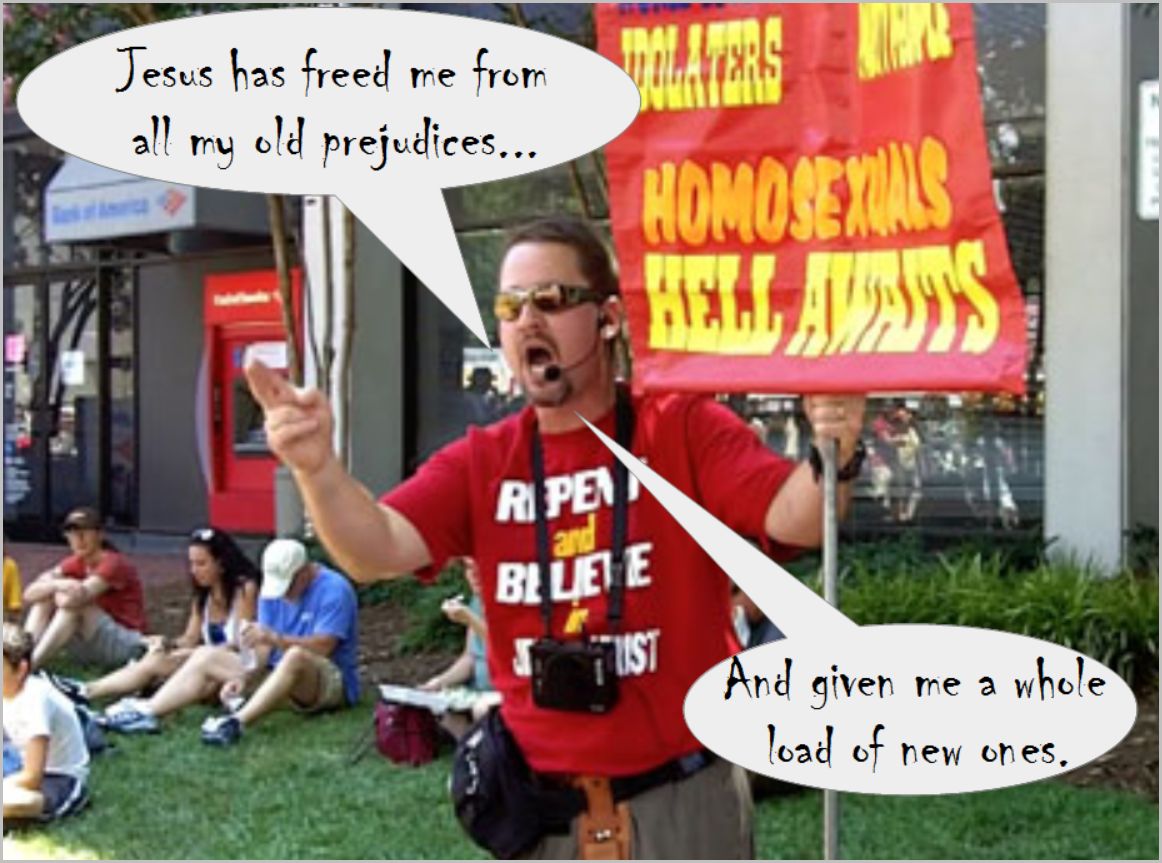
The words in the speech bubble above are Bill Muehlenberg’s, another of God’s self-appointed tools. Even Jesus, who was not averse to unpleasantness, didn’t spout the vitriol that some of today’s Men of God™ delight in. In any case, doesn’t Muehlenberg’s claim describe Christianity so much more accurately than it does ‘homosexualism’, whatever that is? Just try replacing the term with ‘Christianity’ and you’ll see. Bill doesn’t know a cult when he’s in one. (Well, he wouldn’t, would he.) And don’t you just love his mismatched pronouns?

Christian Love in Action

CrossI’ve been banned from a ‘Christian’ web-site. From Barbwire, in fact, the extreme mouthpiece of extreme mouthpiece Matt Barber and his chums; Scott Lively, self-confessed ‘father’ of Uganda’s anti-gay movement; Bryan Fischer, bigoted evangelical shock-jock; Laurie Higgins, gay-sex obsessed ‘marriage defender’ and Bradlee Dean, third-rate rockstar-cum-provocatuer, amongst others.

My ban is not because I was abusive. Actually, I’m not sure what prompted it though I’m not alone in having my comments deleted and my name blocked. Others who’ve challenged the bigotry and distortions regularly paraded on Barbwire have been too. Dissent will not be countenanced by ‘Christian’ bullies whose faith is weak and arguments even weaker.

I hope my comments were reasoned and reasonable, even if sometimes flippant; above all, I hope they were challenging. I tried to challenge both those ‘names’ who write for the blog as well as those who comment there, to react and respond as their Saviour commands them to; to treat others as they would want to be treated; to attend to the log in their own eyes before the speck in their neighbours’; not to judge lest they be judged and to show compassion for those with different views.

Have I as a non-believer any right to expect Christians to behave like this? I think so – I think we all have. After all, they’re the ones who’ve bought into Jesus’ demands; the ones who proclaim him as messiah and potential saviour of the world; the ones who feel compelled to tell us about him at every turn. They’re the ones who believe they’re born again as new creatures, filled with the Holy Spirit, who now live transformed lives as Christ-like beings. It’s not unreasonable to expect to see them reflect all of this in how they deal with other people; loving their neighbour, not casting the first stone… and all the rest of it.

So how do they deal with dissenters on Barbwire? They call them ‘morons’, and ‘fools’ and ‘pervs’ and ‘sodomites’ and ‘idiots’. Now, it could well be that I’m all of these things and the good Lord has chosen to reveal it to his gentle people on the site, if not to me. But when you call out these supposed Christians on this less than loving behaviour – pointing out that Jesus says in Matthew 5.22 not to call others fool, let alone all those other things – what happens? You get more abuse, and lots of edging around Jesus’ words (he only meant not to call other Christians fools) and claiming his commands don’t apply to them because he was really only speaking metaphorically – as he always is when they don’t want to do what he says.

And then you, the one on the receiving end of their Christian Love™, are blocked, banned and deleted, while those with the slurs and insults remain, because it’s what Jesus would want, leaving them free to move on to new targets.

ScreenDoes it matter? Not really; as long as for a brief period there are others opposing the bigotry and hatred that spills, in Jesus’ name, from Barbwire and sites like it. Christians such as Matt Barber and, here in the UK, Stephen Green, are relatively powerless individuals, after all. They’re loud bullies who justify their extremism by claiming it is the standard demanded by a mythical being. But all the same, they and their cronies are influential. Witness the sycophantic commenters who commend every scurrilous word these bullies say about non-believers, fellow Christians, gay people, politicians, immigrants and those they imagine ‘persecute’ Christians here and in the States. The articles on Barbwire encourage and reinforce the prejudices, bigotry and small-mindedness of ‘Christians’ like these, helping shape the way they treat people in the real world.

I’d encourage you to take look at Barbwire and to become a commenter yourself, opposing the hatred and bigotry, not to mention the irrationality and stone-throwing, that you’ll find there. If you do, you won’t have to do it for long because, sooner rather than later, you’ll be banned, as the voices of reason and compassion invariably are there.

Then again, there are worse reasons for being thrown out of a sewage plant.


The fool says in his heart…

Celia2If you get into a discussion with Christians about their faith and you tell them, often reluctantly because you just know where it’s going to lead, that you don’t share their belief in a deity on account of there being no evidence for one outside of the human imagination, it isn’t long – if they haven’t done so already – before they start quoting ‘scripture’ at you.

Among their favourite verses, along with ‘For God so loved the world…’ (John 3.16) and ‘for a man to lie with a man… is an abomination’ (Leviticus 20.13) is Psalm 14.1: ‘The fool hath said in his heart there is no God’. And having cited it, they stand back in smug triumph, having put you firmly in your place and clinched the argument.

But the Bible would say this, wouldn’t it? It’s in its interest, and in the interest of those who wrote it and believe in it, to rubbish those who don’t buy into its fallacies. Christians who quote this verse, and others, are wilfully refusing to accept that you don’t recognise the ‘authority’ of their magic book. What they are really saying is, ‘You don’t believe in my God or the Bible, but I’m going to use it anyway to ‘prove’ my point.’

Why do they do this? Can they not see the futility of it? It’s like my quoting from ‘Twas The Night Before Christmas to demonstrate that, whether they like it or not, Santa Claus is watching over them to see if they’re naughty or nice. But referencing one make-believe source does not prove the existence of another. You have to believe in Santa Claus to begin with, as children often do, to believe the poem is an accurate account of his activities. So it is with the Bible. It only has significance if you already believe that God exists. It won’t of itself convince you that he does.

The Koran has its own ‘the fool hath said in his heart’ verses. Loads of them. Christians might like to consider whether a Muslim telling them ‘the vilest of animals in Allah’s sight are those who disbelieve’ (Q8:55) would persuade them that Allah is the one true God, and that they’re idiots for thinking otherwise. It wouldn’t, of course, so perhaps they’d kindly stop wasting their own time, and ours, doing the same to atheists.

The best response to a believer who tells you ‘the fool hath said in his heart there is no God’?

‘If even a fool can see it, why can’t you?’